
 info@apippress.com
 +86 18163351462 (WhatsApp)
 +86 182 8014 0209
Article Content
Introduction
A rapidly growing body of international research and literature exists within the intersection of design and construction on the topics of circular construction [1,2,3,4] and stakeholders across the design and building sector; from domains like urban planning, urban design, landscape architecture, building architecture, and engineering, increasingly come together with the ambition to change the construction industry to promote a green transition and sustainable development.
The key motivation behind the rapidly growing attention to circular construction is the increasing awareness that planet Earth is approaching a crucial tipping point in a pluri-ecological crisis. Human exploitation of natural resources, pollution, waste management issues, and high CO2 emissions are causing significant negative impacts on the global environment, climate, biodiversity, and both human and non-human wellbeing [5,6,7,8,9,10]. The higher aim of this green transition and sustainable development is thus, among others, to develop a new circular building paradigm across multiple design scales. This paradigm aims to minimize energy consumption and material waste while simultaneously fostering resilient communities and socially just worlds equipped to adapt to future urbanization and climate changes [6, 7, 11].
The ongoing efforts often emphasize the importance of a circular design approachFootnote1 seeking to incorporate design strategies for how to reduce, reuse, recycle, and even regenerate materials, as well as rethink material practices in future building designs and urban site developments. The international consensus around the green transition and sustainability agenda was initiated by the Brundtland report [12], ‘Our Common Future’ in 1987, and further promoted by the Sustainable Development Goals (SDG’s) [13] in 2016. Both initiatives highlight understanding sustainability as an interrelated concept mutually comprised of environmental, economic, and social concerns.
When it comes to the ongoing efforts of the building industry, the overall focus on sustainability widely affects what is being built and experimented with [14]. Insights from Danish municipalities reveal that they are collectively responsible for more than 30 million square meters, building on average about 300,000 square meters per year making them one of the biggest building owners in the country and an important stakeholder in promoting circular design processes [15]. Their present activities and ambitions seem however to focus extensively on design strategies for material reuse, material preservation, waste management, and Life Cycle Assessment [15]. Hence, a strong attention to planetary impact manifested primarily in material concerns. Despite a high regard for multiple matters of concern factoring into sustainable building processes, many of the wider social concerns often take a backseat and remain underexamined in the ‘form-follows-capital’ mantra dominating the building sector [7, 9, 16]. A wide range of academics and practitioners agree that a new combined socio-economic and planetary paradigm is needed to create a future ‘healthy ecosystem’ which cares for both planet and people [3, 4, 7, 16, 17]. Yet, the ways and means for how to reach such a sustainable and green transition are at present not clear, and there are no simple answers for how to approach it.
Social concerns have, however, been re-addressed and foregrounded by Peters [18] arguing that social sustainability is an ‘interdisciplinary topic’ with the concept of wellbeing at the core supported by Nilsson et. al [19], who additionally points to the categories of equity, participation, and influence as well as social capital as central topics. Attempts at operationalization, such as the doughnut economy model developed by Raworth [20] and the certification system such as DGNB framework, that targets both the building and neighborhood scale, provides tools and vocabularies for working with social sustainability [21]. The doughnut model specifically suggests that the planetary boundaries and ecological ceiling are closely linked to a social foundation and the concept of social vulnerability. Relatedly, Raworth [20, 22] calls for urban designers, architects and engineers to not just understand their role and responsibility in design projects and construction actions, but more importantly acknowledge that urban designers, architects, and engineers are part of a delicate symbiosis and ecosystem—on a planetary level—and therefore must understand what consequences and impacts their intentions and actions will have on future generations from a social point of view; on local as well as wider global scales. Continuing this symbiotic line of thought, Fitz & Krasny [7] highlight how the present economic system governing architecture and urbanism (an economy which they refer to as developer-driven and capital-centric) is “…at war with many forms of life on earth, including human life.” [7, 12]. They call the present condition in architecture and urbanism ‘a crisis of care’ that urgently needs a new situated understanding [23, 24].
This situated understanding emphasizes a broader, holistic view of complex social situations. It involves a relational and ecological perspective on social life [23:xxv], focusing on dynamic interdependencies and connections between human and non-human entities. This approach aims to capture the multifaceted nature of real-world situations, highlighting the diverse and overlapping entanglements between social and material concerns through the lens of ‘care’. It considers the interrelatedness of care practices (activities—what), agents of care (stakeholders—who), and the purpose of care (positionality—why) [25]. Notably, the last part of this lens focuses on an ‘ethics of care’, drawing attention to which priorities and values are needed to support both increasing urbanization as well as planetary wellbeing.
The care perspective thus corresponds with the social sustainability agenda by emphasizing the importance of nurturing and supporting the most vulnerable species with compassion to ensure their wellbeing and future flourishing [9, 26,27,28,29]. At its core it focuses on creating inclusive, resilient, and just societies where everyone can thrive, as coined with the concept of social sustainability across various disciplines since 1987 [30,31,32,33].
The research presented in this article is part of a long-term interest in topics related to social sustainability and care for human wellbeing across the two domains of urban design and architecture, as well as an educational background in design engineering. Our research perspective builds on the underlying assumption that the aspects of social sustainability represent an important part of the green transition, as material explorations and circular practices are not a standalone endeavor. Their ability to create change and difference will always be interdependent [16, 34]. Thus, our research is fueled by an interest in the ‘design situation’ and attention to what building practices does in the encounter between human bodies, objects and techniques as argued for by Ingold [35] and Mol [36, 37], as well as combined with an interest in feminist, critical post-human approach favoring a more-than-human and relational understanding as argued for by Guattari [38], Escobar [39], Haraway [10], and Clark [23, 24]. Based on this ‘plural’ ecological thinking and ‘situated’ relational understanding, the article explores the interactions and interrelatedness between material and social concerns in a contemporary circular design project. It places special interest in how social sustainability manifests itself in the ‘design situation’ and the design-related phases.
We speculate if the care perspective, that includes a deep dedication to the plural, situated, and multiscale conditions can help connect the social concerns to the strong attention to material concerns in contemporary circular design projects. To address this curiosity and speculation, the authors put forward the following two research questions oriented towards unpacking concerns and intentions governing professional design practice:
RQ1) How do the material and social concerns manifest themselves in contemporary circular design practice? And by extension, RQ2) what intentions seem to affect how social concerns are included in contemporary circular design practice?
On methodology
To achieve these kinds of practice-based insights, we methodologically engage in a single case study of the newly constructed kindergarten, ‘The Swan’, located in Gladsaxe near Copenhagen, Denmark. This kindergarten has been awarded for its unique circular design approach [40, 41]. ‘The Swan’ exemplifies a significant intersection of design and construction, showcasing experiments with material reuse, which are rapidly advancing in contemporary Danish building practice [42].
Engaging in a case study is a qualitative research method collecting empirical information through close examination of best-practice in a real-life context [43,44,45]. It is an exploratory approach [45] used elaborately within architectural scholarship [7, 46, 47]. A case study of ‘The Swan’ offers a chance to gain empirical insights from state-of-the-art professional practice and start documenting the complexities of a real-life design situation and its’ procedures – insights which are needed to better understand how the social concerns in contemporary circular design manifests itself through the different design-related phases (like the ‘design proposal’ and ‘main project’ with demolition and construction) [36, 37, 45]. However, we are aware that the specificness of the single case study represents a site specific and highly situational narrative. As such we do not aim for generalizability to establish statistical patterns across urban design, architectural and engineering sciences on an international and global level, but rather ‘analytic generalizability’ with respect to an activation of the theoretical ‘propositions’ outlined in the introduction [25, 45:15].
To be able to discuss the insights of the case study we establish a theoretical framework introducing the caring perspective suggested by scholars like Tronto [25, 48] and Fitz & Krasny [7] as a critical analytical lens to unpack and examine how the material and social concerns manifest themselves in design practice as well as understand what intentions affect how social concerns are included in design practice[49].Footnote2 We unpack these caring perspectives through the concept of ‘situated knowledge’ [23, 24]. Inspired by the situational analysis approachFootnote3 and a series of mappings outlining respectively:
- ‘The Situation’: situates the case study and outlines the dense ‘landscape’ of empirical information collected on the design proposal and main project phases (see Figs. 2, 3).
- ‘Material Practice’: outlines the ‘caring practices’ and initiates the analysis of relations among the different social and material concerns, zooming in on the actions and activities happening within the design proposal and main project phases (see Figs. 4, 5, 6).
- ‘Affective Involvement’: identify and outline the major emotional involvement taken by the local community on key design-related issues within the design proposal and main project phases (Figs. 7).
The mappings are developed in multiple versions during the research process. Initially, these maps are ‘messy’ but become more ‘ordered’ and detailed as information is collected [23, 24]. Our maps are created by writing keywords and using images to collectively inform an analysis of the design situation of ‘The Swan’. It is important to note that this approach, in addition to traditional qualitative methods like interviews and ethnographic observations, encourages the use of multiple types of materials and thus deliberately allows for various types of data such as online documents, websites, videos, imagery, social media and more [20, 23, 24:9].
With these considerations in mind, our case study and analytical mappings were done through a combination of empirical information collected from:
Online material documenting the project. This was carried out as desktop research, examining the online material available like webpages, archival material, public media, and YouTube videos produced, among others, by Lendager Architects to present the detailed project mindset and design process [42, 45, 50, 51]. This comprehensive online material provided insights into publicly available narratives about the kindergarten. It highlighted statements from key stakeholders involved in the ‘design proposal’ and ‘main project’ phases, shared through anecdotes, and revealed various design activities along with the underlying intentions and visions of the design architect. Furthermore, it offered glimpses into the opinions, relationships, and collaboration between design architect, project architect, demolisher/contractor, engineer, and municipality. Finally, an inspection report made from 2024 was publicly available, outlining onsite observations and professional reflections from the kindergarten staff regarding the built environment and how it supports the development of play and wellbeing in the pedagogical work [52].
Interviews with a series of key design stakeholders like the project architect, demolisher company, and contractor. The interviews were done online, using TEAMS performed in a semi-structured manner focused on inquiring about different project roles, project phases, collaborations and their approach to material and social concerns [43]. Online interviews were transcribed during the interview session using the AI auto-transcription function and checked manually afterwards as part of a theoretical-selective and thematic coding. In addition to the online material, these interviews helped to zoom in on some of the marginal and unvoiced perspectives present during the actual ‘design proposal’ and ‘main project’ phases of the case study. The interviews provided detailed descriptions of how the project architect, demolition company, and contractor experienced the ongoing everyday engagement with material and social concerns.
Using social media to study the affective perspectives and place attachments of local community members via a public Facebook group (formed around Gladsaxe School) and posts from 2017 to 2023 made by former school pupils (now adults) [53]. The social media posts provide a source of visual insight and is, as argued by Burgis-Thorsen & Munk [54:2], “a situated citizen perspective…that grasps aspects of lived experience that may not be understood by words alone”. The subjective and value-based nature of these posts is particularly interesting to us, as we are curious about the affective awareness former community members have regarding the site and its transformation during the ‘main project’ phases with the demolition and construction activities happening on-site.
We successfully covered the perspectives of the design and project architects, the demolition/construction company, and the neighbors through various sources of empirical material. However, we have not yet been able to interview and collect detailed stories from other key stakeholders. Most notably, the end-user perspectives representing the project after the design-related phases are missing; for instance, staff, children, and parents, who could have provided key insights into the relationship between material and social concerns based on occupation and everyday operation user experiences. Furthermore, the municipal landowner/client perspective is also not fully represented, which could have informed a more critical discussion about the ambitions of the project before the design-related phases, and the relation between vision and reality. Despite reaching out to—and being in contact with—these stakeholders several times to help cover more stories from all phases of the project, they were unable to participate in the research due to overwhelming public and scholarly attention. This circumstance raises important reflections related to the methodology, the researcher role, and the reliability of the insights presented in the discussion and conclusion. More attention to these stakeholders and their positions must be considered as the next step in an ongoing discussion of the case in question.
Our aim with the theoretical framework and case study at this current stage of the research (zooming in on the stories of key design stakeholders during the design-related phases), is to provide preliminary insights and raise awareness among other researchers about how social concerns manifest themselves in contemporary circular design practice during the ‘design proposal’ and ‘main project’. In doing so, we hope to contribute to the important and continued debate about the green transition and circular design thinking—fields that are still emerging in many ways.
Theoretical framework
Architectural- and Urban Design is an explorative practice, where buildings and building sites often hold high economic value as powerful ‘playgrounds’ influenced by both political and social capital forces [6, 7]. Additionally, these sites and the built environment are continuously undergoing alteration and development. During this alteration, urban designers, architects, and engineers enter a dialogue with the ‘what was’, ‘what is’, and ‘what if’ – taking into consideration the past histories rooted in collective memories of the local community, existing materials, but also the site conditions and surrounding landscape [54,55,56]. As Gissen [57] argues, cities are a kind of landscape, with environmental and material conditions including a particular flora and fauna as well. Through demolition and construction processes such’subnatures’ and existing material conditions may be seen as’disturbing material settings’ that are eliminated, perhaps permanently, or maybe even replaced [57].
This highlights the relevance of re-discussing the concept of ‘social sustainability’ as a critical concern of sustainable, green transitions. Because, regardless of consensus on the mutuality between economic-, environmental- and social sustainability, the multiplicity of social concerns remains vague in its delimitation and application [19,20,21,22, 25, 46, 47]. As mentioned, social sustainability focuses on the one side on the improvement of social equity, social justice, inclusivity, human diversity, quality of life as well as health and wellbeingFootnote4 of all. [18, 30,31,32,33, 58, 59] On the other side, it is an important factor in energy consumption and reduction of waste when we look at the everyday practices of users and the operational aspects related for instance to the maintenance of buildings and urban spaces [31]. Thus, these multiple contributing aspects encompasses both the tangible and the intangible elements of the built environment and their transformation processes [58]. As a result, the industry is left with the task of bridging a gap across that which is monitorable and measurable; and that which is debatable and requires situational sensitivity.Footnote5 Something which is also the theme of recent research on ‘social commissioning’ and the potential ‘social value creation’ that arises in between understanding the built as ‘a project’ or as ‘a lived space’ [61].
In correspondence with these points of attention on the social values associated with the built environment, recent shifts in modern architectural theory highlight the need to think beyond the separation of material concerns and social concerns but also think beyond the narrow human-centered perspectives. Instead, it points towards critical thinking focusing on architecture and urban design ‘as an act of care’ considering both people and planet, as well as material concerns and social concerns in tandem [9, 10, 62]. The caring approach is broadly speaking an ethics recognizing and addressing the needs of human and non-human entities necessary for securing planetary wellbeing [8, 26]. The following section explores this rethinking with the aim of carving out relevant themes that can guide the following case analysis.
Towards architecture as an act of care?
The urgent call for a revised understanding of building design and site development is as mentioned evident with the writings of Tronto [25] and Krasny [8, 62], who argue that the mutual interdependence, dynamic equilibrium, and interconnectedness of daily human life and the wider state of the planet can be approached with an ‘extended compassion’ and basic sense of care – as an alternative to the ongoing material concerns prevailing within the building sector.
Krasny [62] argues that the ‘caring perspective’ is urgently needed as an ethical counteract to the building sector’s dominating ‘form-follows-capital’ mantra, and on-going neoliberal and capitalist, hyper-competitive trends currently dominating the Global building sector and related disciplines. Elaborating on this perspective, they highlight how architecture has been separated from the perspectives of care in at least two ways. First, the establishment of the ‘Architect’ as an independent (male) figure, which since the writings of Vitruvius and Alberti has been elevated to an intellectual and creative genius; an agent of cultural change and an authority [62], with neither the craftsman nor the end-users considered as equals to the architect. Second, the fundamental idea in Modern Architecture since the mid-twentieth century has predominantly been that ‘(hu)man is above nature’. It denotes a subject-object divide where plants, animals, and other earthlings or organisms are less-than-human. In addition, it denotes a capitalist-colonial regime exploiting land and nature as commodity of resources to be consumed, mostly based on an ideology of progress and techno-scientific approach, with the higher aim to literally build a better future [7, 8].
Modernism’s fundamental understanding of architecture as the relation of form to structure, of construction to design led to highlighting aesthetic qualities of the building (as an object) as the end means. A design perspective clearly illustrating the intersection of design and construction, historically often referred to as ‘Tectonics’ by architectural scholars [63, 64]. However, as Krasny [62:36] argues, this notion of aesthetics is “firmly linked with autonomy and independence as opposed to necessity and dependence, qualities that are conventionally associated with the labors of care.”—considerations which possibly still influence knowledge power regimes and the distribution of work, as well as contributing to a separation of craftsmanship and architectural profession.
Consequently, Krasny [62, 65] suggests distinguishing between ‘Architecture’ with a capital letter A, often referring to a specific series of buildings or urban spaces designed by the creative genius (white, male) architect. Whereas ‘architecture’ refers to all kinds of buildings, not necessarily involving an architect. It might be the vernacular buildings or the informal, mundane, everyday buildings like the supermarket, storage space, or gas station. Furthermore Trubiano, Beim & Meister [66] and Krasny [62] argue for a new definition of architecture that brings the ethical and political concerns into view, for instance including resource politics connected to building materials [65]. As a result, buildings are strongly interdependent on political and economic processes. The core argument is that architects’ and engineers’ carelessness have been part of draining many of the Earth’s material reserves and exploiting natural resources [67].
If we zoom in on the discourse of the care perspective, it grows out of feminist thought, originally used to describe the female/feminized everyday practices happening in private homes [25], and as outlined by Baracco, Wright & Tegg [68:65], the word ‘care’ is both a noun and a verb:
“As a noun it means to maintain and protect. But also, to give serious attention or consideration to something; as a verb it means to feel concern or interest, but also to look after something. To care for first requires a caring about.”
Krasny [62] links this to architecture and explains that architecture in all its different phases and stages can act as a form of care. She mentions among others the work collaborations, interactions with clients and contractors, labor conditions and material flows. As well as processes of maintaining and repairing existing buildings. Even education of architects and writing about architecture [62]. In addition, Davis [26] includes people’s affective attachment to urban places and building sites; and their sense of continued connectedness with them across time.
Consequently, these perspectives suggest a more ‘holistic’, ‘situated’, and ‘plural’ mindset, as well as increasing attention to the intersection of design and construction. Central is the relational concept of care and carefully understanding that the design and construction of buildings and urban spaces must start from the given means available and with careful consideration for local and global conditions [65].
The point is to restore an ecological balance and realign societies within planetary limits. It demands ethics of the more-than-human worlds as argued by Donna Haraway [10] and Bruno Latour [69]. It further highlights the entanglements and assemblages of the earth as an ecosystem inhabited by the co-existence of ‘earthlings’ like humans, animals, plants, bacteria and fungi – among others [56]. This entails also, a call for more situated ways of caring about what kind of communities ‘we’ create [23, 24]. As argued by Fitz & Krasny [7:14]:
“…paying more attention to the local production, reuse of existing buildings or building materials, community engagement, volunteering, participatory workshops, skill building or public environmental pedagogy.”
One the one hand, the care perspective highlights the ecological disruptions and the social injustice or inequalities across nation borders, thereby raising awareness to questions of belonging and community, but also the sense of interconnectedness and attachment revealed through the distribution of earthly resources [70]. On the other hand, the care perspective ultimately questions the dominating attention to material availability, structural principles and construction details – over the less attention to the social sustainable layers and the complexity of working with human diversity and social entanglements, when designing these environmentally sustainable buildings.
In sum, the caring perspective provides an interrogative oscillation between three lenses of care: 1) the actual work and care practices: here referred to as care as material practice – actions and what is done, 2) the actual engagements and affective involvement: here referred to as care as affective involvement – related to who is involved in taking action and the target of those caring actions, and 3) the moral intention and caring about something: here referred to as care as ethical intentions – related to why it matters (see Fig. 1).
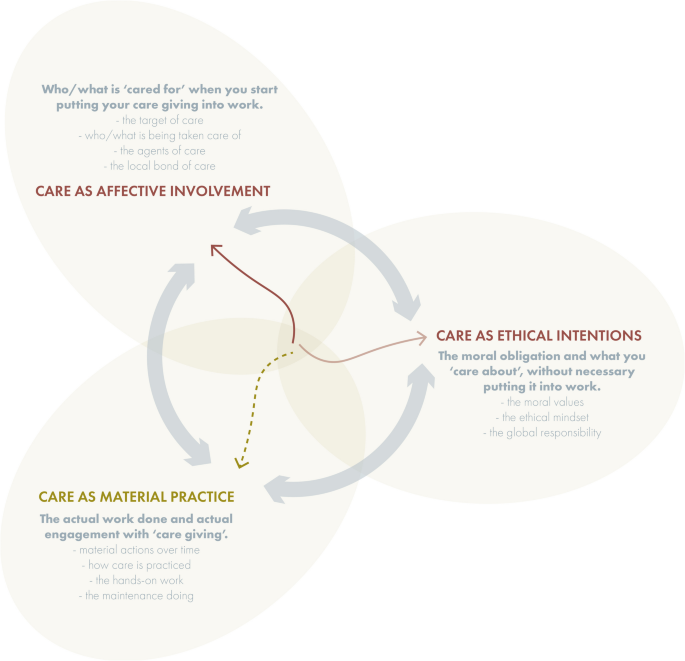
The Care Perspective. A theoretical-analytical framework exploring three interrelated lenses of care: 1) Care as material practice (what is done), 2) Care as affective involvement (who it involves), and 3) Care as ethical intentions (why it matters) (credits: Authors)
Based on the three care lenses highlighted by Tronto [25], the caring framework developed by Fitz & Krasny [7], and Clarke’s [23] situated analysis approach, we have established a theoretical-analytical lens to help unpack and discuss the case study presented later:
1) Care as material practice refers to the actual actions and material practices that enable care giving. For instance, constructing a building requires assembling structural elements, plumbing and electricity and construction activities – or so-called material practices – which are woven together in a complex life-sustaining web [25]. As highlighted by Trubiano, Beim & Meister [66:586], this lens describes labor practices and pays attention to the actual work, and how the actual work favor health, safety and prosperity for communities. For instance, how stakeholders across urbanism, architecture, engineering and construction evaluate and negotiate “what must be kept, removed, adapted, and added” to ensure longevity. It is about maximizing the reuse of building materials, through intelligent material strategies and appropriate use of materials, and whether the project accelerates the adoption of craft-based, local, low-energy, and regenerative materials. But it can also relate to the processes of involving end-users, community members and various stakeholders.
2) Care as affective involvement refers to the (temporary) alliances and diverse range of agents created around the care giving activities and material practices. What is interesting here is to understand who the ‘care givers’ and the ‘care receivers’ are. Or if there is a ‘caring with’ present. Thus, the lens reflects key stakeholders and relations of power, with the aim of recognizing how for instance people, animals and plants are entangled in the material practices described in first lens of care. In a more traditional building lens, this could involve land- or building owners, architects, engineers, urban planners, public administrators, demolishers, developers, construction companies, craftsmen, and end-users. But, as highlighted by Fitz & Krasny [7], it also involves the new alliances created around a project, such as a wide range of people with different situated knowledges for instance urban researchers, gardeners, community organizers, educators, technicians, lawyers, teachers, neighbors in the local community, and several more. This category highlights the shared responsibility for everybody engaged with- and in contact with ‘the situation’; the building, the site, and the design/construction process [25], considering also if the craftsmen and demolition/construction workers of the building site are protected and cared for. Thereby establishing a trusting and co-dependent bond of care. In that way, the second lens of care is also about attachment and the affective.
3) Care as ethical intentions refers to the positionality or moral values motivating the care practices and agents of care outlined with the first and second lenses of care. For instance, it includes which sustainability aspects a design project focuses on and why. This lens of care emphasizes the acceptance and allocation of responsibility and the intentions to act, representing a situated and relational perspective where the design process is a practice of care, and the architect acts as a caregiver [8, 25]. As emphasized by Tronto [25], in a building process it means taking responsibility for the consequences and impacts of the entire building process throughout all lifecycle phases, both on a local and global scale. Trubiano, Beim & Meister [66] further unfolds on a macro scale, how the production of building materials using fossil fuels leads to an extensive exploitation of land resources worldwide. They highlight the need to consider communities at large and argue that a socially sustainable approach must limit the harm caused to people, places, and cultures when ‘harvesting’ building materials. These perspectives point to the importance of understanding stakeholder positions and the broader consequences of building construction. This includes thinking beyond the site, considering the human activities and behaviors that construction demands, as well as understanding the material resources consumed during construction, occupation/operation, and maintenance.
What is important from our point of view is that this caring perspective offers an exploration of the oscillation between material and social concerns embedded in the design-related phases, by unpacking the interconnection and interdependency of the material practices, social agencies, and moral intentions performed throughout a project [49].
CASE STUDY – framing the design situation of ‘The Swan’
‘The Swan’ is the world’s first circular kindergarten [42, 71]. It is a pilot-project developed by the municipality of Gladsaxe (landowner/client), near Copenhagen in Denmark for children aged 8 months to 6 years. As part of integrating the UN’s Sustainable Development Goals into Gladsaxe Municipality’s own development plans, it was politically decided that all newly constructed kindergartens must be ‘Swan-labeled’. The ‘Swan-label’ is a Danish certification system that emphasizes low energy consumption, a healthy indoor environment (including humidity, ventilation, acoustics, and daylight), the environmental and health properties of chemicals used in building materials and chemical construction products, the reuse of materials, and biodiversity [72]. Unlike the other daycare facilities, the Swan kindergarten was also certified with a high proportion of recycled materials [42]. The project entails the transformation of a former three-story yellow brick elementary school, Gl. Gladsaxe (1922/1937Footnote6). The new building spans 1,428 m2 and was constructed using recycled building materials from the old school buildings.
The transformation of the former school into a kindergarten can be outlined in several phases. Initially, the building served as an elementary school for almost 90 years. It was closed in 2010, followed by a 10-year transition period where the building was temporarily activated with various purposes. Next came the planning phase, which began in 2020 and included a design proposal and main project involving demolition and construction. The process concluded in 2022 with a certification phase and the commissioning of the kindergarten, marking the beginning of its new occupation and operation phase (see Fig. 2).
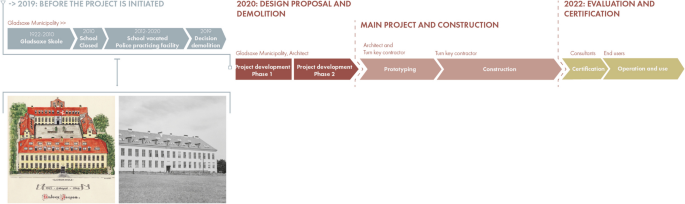
The Historic Situation. Overall timeline outlining design-related phases combined with historic illustrations of the elementary school. Images: former elementary school, respectively from 1946 and 1940 (Credits: https://billeder.gladsaxe.dk, with no restrictions)
The design proposal was done by Lendager Architects, with Sweco Architects handling the main project. Niras served as the engineer for the design proposal, while Aksel V. Jensen A/S was consultant engineer for the main project. The demolition contractor was Tscherning with Niras as demolition engineers. The turnkey contractor was Ason A/S.
During the phase of planning for the new kindergarten project, the project leader from Gladsaxe Municipality, in collaboration with the architectural firm Lendager and the engineering company Niras, initially assessed the old school for usable materials according to their certification standards, which became the starting point for designing the new kindergarten [42]. After the initial phases of salvaging, registering, and screening the materials to determine which could be reused or recycled, the municipality described the project through a tender document. This document contained the necessary design guidelinesFootnote7 and key design concepts for developing the new kindergarten. It became Denmark’s first ‘circular tender’ highlighting the reuse of building materials and the requirement of obtaining the Swan-label, thereby placing significant responsibility on the demolition contractor to carefully dismantle the building and ‘clean and store’ building materials for reuse in the new construction [42, 71]. (Fig. 3).
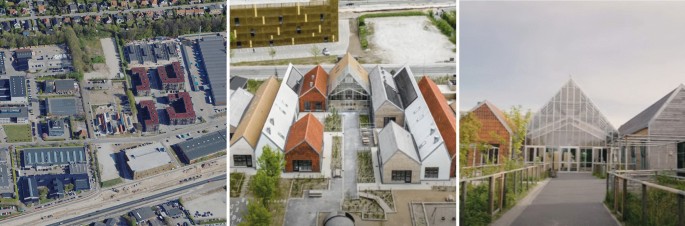
The Situation. Aerial photographs and front exterior of ‘The Swan’. Notice the industrial character of the surrounding neighborhood (Credits: Lendager, with permission)
According to the project leader, the municipality aimed to promote sustainability in construction on multiple levels, drawing inspiration from the concept of ‘Circular Building Practice’ [42, 71]. Their goals included minimizing waste from demolition and utilizing materials with low CO2 emissions. Additionally, reducing the use of chemicals and environmentally harmful substances in building materials was fundamental to the project’s development [42, 71]. There was also a strong desire to ensure the building provided high-quality spaces both inside and outside for its users and the broader local community [50, 51, 73,74,75]. Finally, alongside its significant emphasis on circular construction, material reuse, and the chemistry of building materials, the daycare provides services for children with cognitive or physical disabilities, including autism spectrum disorder, down syndrome, cerebral palsy, genetic defects, and consequences of premature birth [52]. According to available online material, these special needs are addressed through adapted structures, specialized training facilities, and a focus on accessibility [76].
In the following three sections, we use the theoretical-analytical framework (Fig. 1) and mapping process as a critical lens to zoom in on the design-related phases (design proposal and main project) of the case study.
Care as material practices
“Normally when we start a project, we either do a competition or we have a client that specifically calls us and are interested in doing a project together with us. …In this project, we were pitching ourselves to the municipality. Because we really, really wanted to show a project where a municipality try to do a circular project.” (Lendager [50], 2:25–2:50).
This quote illustrates an untraditional material practice in how the land/building owners and architects started working with the building transformation and the design proposal. For long prevailing building practices have included demolishing and removing all existing buildings and outdoor elements, leaving the site empty and cleared from previous activities. However, in this case the building project and design solutions began long before any drawings were made. The architects explain how “…this is where it becomes different…” (Lendager [50], 9:11–9:13), unfolding that “..the demolished materials become building material… and that is what the demolisher had not done before. So, they went from being demolisher to material supplier…” (Lendager [50], 13:32–14:02).
This points to how the municipality had two types of assignments within the building project: a) a design-architectural project (giving form), and b) a building-demolition project (taking care of the existing building stock) (see Fig. 4). However, the two tasks were closely related, as the demolishing company was also the building material supplier, and thereby an essential partner in securing the material storage on site. Likewise, the actual demolition- and disassembly process, became an important part of the early design process. Accordingly, the first thing the design architects did was to visit the chosen site and do a ‘material registration’: “The registration is a very complex thing…where you are going through all the materials; quantities and testing them for all kinds of chemistry…their origins and trying to find out what you can do with it… finding out how to up-cycle them or directly reuse the materials… finding out how we could disassemble it—and describe how to disassemble it…” (Lendager [50], 8:36–9:07).
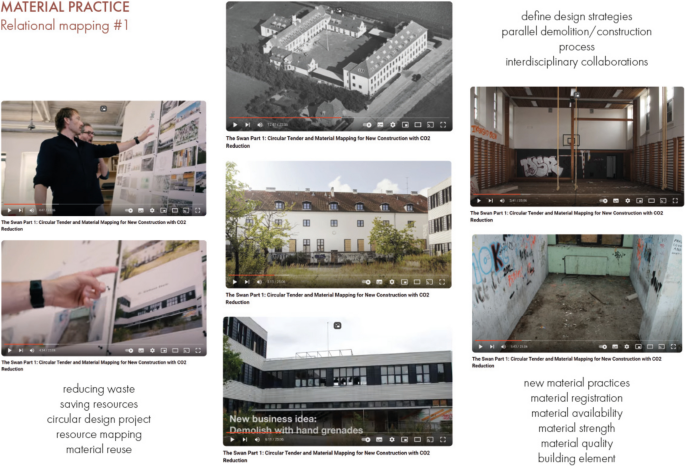
Design Proposal. This relational map examines the material practices of the site and building during the early design phases of the project, highlighting the material concerns (credits: Lendager, with permission)
The material registration in this case was (as mentioned above) further incentivized by the demand to procure a ‘Swan-label’, as well as defining strategies for how to disassemble the different building elements and building materials. This ‘Swan-label’ guided important decisions related to operational energy, choice of materials, and indoor climate, making it particularly favorable for circular building projects. These requirements were all documented in an idea catalogue/report supported by a conceptual design proposal for the building project. In that sense, the material registration comprised a ‘resource mapping’ through analysis of the different building parts: their sections, membranes, facades, structural systems, and material performance. Even down to outlining the number of nails and brackets [42]. Consequently, the main project architects were informed precisely how much, and what type of material was available, so they could design based on availability: “This is where we say ‘form follows availability’…” (Lendager [50], 12:14–12:17).
Noteworthy, the case shows an emphasis on retaining as many materials as possible on-site throughout the entire demolition and construction process. The design architect repeatedly highlights how various materials—from large quantities of brick, roof tiles, timber frames, steel façade panels, and concrete to smaller items like lamps, bike racks, and characteristic artifacts from the school—were meticulously salvaged, preserved, and reused in the new construction (see Fig. 5).
“The reason why it looks like that – which is quite crazy—… a lot of families and people in Gladsaxe Municipality were ‘pissed-off’, because this school – which is quite beautiful … from 1937—… it was historical for these people. And then because it had been emptied for so long, and they did not know what to do with it, they had leased it out to the police technical-tactics squat that had thrown hand-grenades inside the building. So, when we came in to evaluate if we could use the building there was traces of explosions everywhere … so it was really damaged.” (Lendager [50], 4:56–5:45).
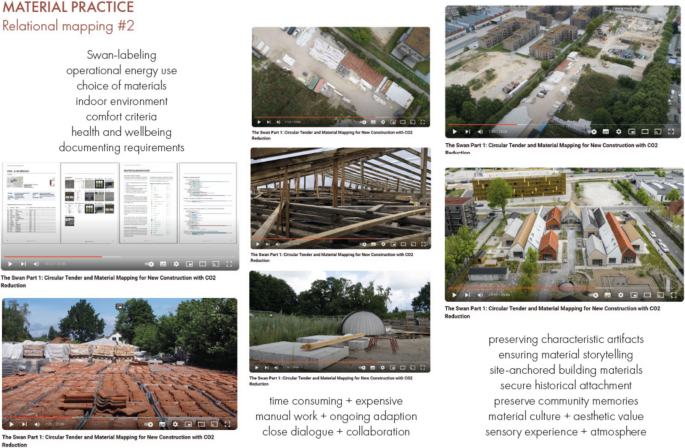
Main Project—Demolition. This relational map examines the material practices of the demolition and early construction phases of the project, highlighting both material and social concerns (credits: Lendager, with permission)
With this quote, the design architect unfolds how the first phase of sketching investigated ideas to keep most of the old buildings with the intention of reusing the materials. Additionally, as emphasized by Lendager [50], the municipality of Gladsaxe paid significant attention to the Sustainability Development Goals (SDG’s) early in the process and harbored ambitions for the material storytelling which could support user recognition and thus a strong identity brand. But as they started sketching bearing in mind that the user group was diverse, they realized that the existing buildings—with their various levels—were too complex to integrate into a new project due to accessibility. Furthermore, the buildings were too big compared to the need for functions in the kindergarten. Instead, they decided to establish a ‘material bank’ or temporary ‘material storage’ on the old school sports field nearby (see Fig. 5). Notably, according to both design and project architects, the important point here is that instead of the municipality having to buy all the new building materials, they already had many of the materials available on site [50].
Instead of mixing and matching the many different materials ‘harvested’ from the original buildings, the design architect deliberately curated a new material and programmatic narrative through clustering the materials into separate groups—each material representing one building, in total resembling a small village of different houses. In this way, the kindergarten consists of several small houses, each with its own identity expressed through the exterior material or color (see Fig. 6). Likewise, the interior is designed with different zones, facilitating various activities and atmospheres, thereby offering great flexibility in the exterior and interior, allowing the children to explore, gather, and interact in both small and large groups – in line with the pedagogical demands for children with special needs [50, 51, 73,74,75].
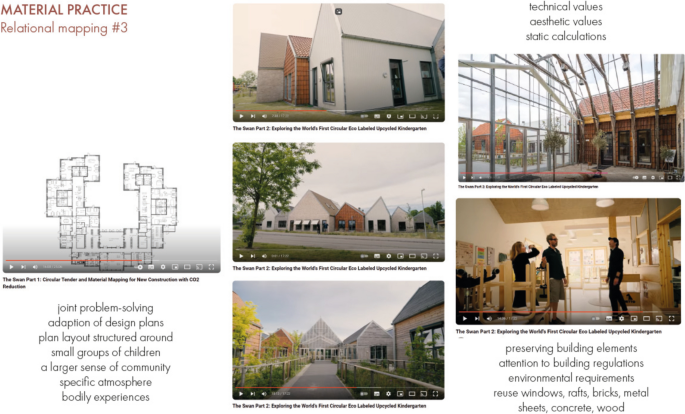
Main Project—Construction. This relational map examines the material practices of the construction phase of the project, highlighting both material and social concerns (credits: Lendager, with permission)
This careful selection and reuse of materials aimed to ensure a material storytelling [42, 50] as addressed here by the project leader from the Municipality [52]: “…parents who attended Gladsaxe School themselves will recognize the clock from the schoolyard in the orangery, and the dome from the school’s observatory will become a playhouse on the playground…”. In that sense, the site anchors the building materials to its surroundings, and the term ‘local building materials’ literally entails preserving and reusing what is already available through existing building stock. It highlights a return to the ‘material culture’ and ‘material practices’ as key-drivers in the early design phases.
The disassembly phase was run by the demolition contractor and engineers responsible for the planning and demolition of the existing building. The potential of reuse is confirmed here by the project leader from the demolition company describing how this process was unique and innovative because it was guided by careful preservation of the building elements and building materials:
“I would add that it has provided some experience in relation to new projects. It has given an insight into what- and how much you can use. Because some materials you don’t even consider for reuse. For example, they used a lot of steel plates and such. I would probably have told them that those old, dented steel sheets were waste. But they could be used and look fine. … It has a value. Ten years ago, it was not something we had an eye on.” (Interview A, 16:48–17:08 + 17:32–17:35).
Naturally, this results in a more time-consuming and expensive demolition process because the demolition workers had to work manually by hand and with smaller tools to preserve the different building materials, rather than using big machines to tear down and crush large building elements without any care for the materials. This careful disassembly of the building parts, cleaning the elements and storing the materials—a kind of opposite building practice—challenged the prevailing ‘industrialized thinking’ but still enabled a maturation of careful material practices from the contractor role.
Despite the elaborate analysis of available materials in the preliminary phases (see Figs. 4, 5), the project encountered several challenges in meeting building regulations and environmental requirements, as the realities of disassembling the building materials often differed from the original plans and lists. This situation both required close dialogue and continued collaboration between demolition contractor, architect, and building owner, as well as flexibility and adaptation of the design plans during the demolition and construction process, particularly regarding the reuse of windows, rafters, and bricks:
“Now we were so lucky, on this project, that you simply had—in addition to making the list of what had to be preserved—you had also made an outcome requirement. In other words, what must a brick look like. It should be nice on one side, at least. We then had to give in to that, because now no one had seen these stones because the house had been plastered. So, it was only when we started peeling them out that we could establish that it was already recycled stone. … there were simply dents in it that cannot have occurred during the lifetime of the house.” (Interview A, 7:18–7:48).
In addition, the project architect unfolds how the past life of a material may represent certain aesthetic and historic value, yet also pose certain challenges concerning its structural agency:
“Today the reuse of bricks goes relatively smoothly, because it has been tried before. It’s almost a standard now… but the challenge we’ve had is that sometimes when you reuse a brick, it has been weakened in the dismantling and cleaning process, and it has a few years behind it. This means that the engineers have problems with static calculations on it. … therefore, we had to make a concrete backwall (load carrying structural element, red.) in the buildings here where there are bricks. And that was a weakness because we would not have used concrete. It is not so good compared to our design concept and idea. However, there is obviously a problem with calculating the statics when using old bricks. We must become better at that.” (Interview B, 9:13–10:03).
According to several of the interviewed stakeholders involved in the design process, besides environmental sustainability and material availability, social sustainability was considered an important factor in the design and construction of the new kindergarten. Based on the online material available it is described how the required Swan-labeling foreground healthy work environment, children wellbeing, and accessibility [40, 75]. However, the project architect notes that a term like social sustainability is ‘fluffy’ but exemplifies the social concerns by highlighting how the overall building design and plan layout is structured around a particular focus on small groups of children and a larger sense of community [50, 51, 73,74,75] (see Fig. 6). Furthermore, he highlights how the various zones and the unheated orangery each offer a specific atmosphere, inviting the children to engage in different bodily experiences and opportunities for play. The design architect describes the design as a ‘village’ seen from a child’s perspective [50, 51, 73,74,75]. On the one hand these stories reveal a deliberate choice made by the design architect to show that building materials have more than one purpose. It can work both as roof, flooring, exterior, and interior. On the other hand, each building has its’ own ‘materiality’, and that variation translates into a specific ‘aesthetic’ identity [50, 51]. However, the project architect highlights that there has been no direct user involvement in his part of the project. But he clarifies that the municipality has had an internal dialogue with key experts about the requirements and needs of the future end-users related to the building’s function and design in the early project phases.
On ‘care as material practices’
As mentioned in the theoretical framework, the lens ‘care as material practice’ refers to the actual actions and labor practices that enable caregiving. This lens, together with the above mappings, highlights the relationships between various social and material concerns. As seen from the interview quotes and Figs. 4, 5, 6, material concerns are evidently practiced through tangible design, on site demolition, and construction activities. Along with related strategies such as the appropriate reuse of bricks, upcycling concrete, and adopting craft-based skills to develop innovative building details. These material practices are informed by municipal aspiration to reach a certain certification but also ambitions to establish site specific material storytelling and identity building are used as part of the reasoning. Additionally, the case exemplifies how stakeholders across disciplines like architecture, engineering, and construction are increasingly involved in mutual activities on site in multiple project phases, where they must collaborate, communicate, and negotiate the reuse of materials, adaptation strategies, design values, and design mindsets. Especially the demolition and design activities mold and fold together here and establish interrelation dependency. The stakeholders involved also confirm that the process has maturated their construction practices. Notably, however the mappings (Figs. 4, 5, 6) indicate the unvoiced involvement of end-users and a weak sense of community activation and thus attachment during the ‘design situation’ of the kindergarten. As such ‘care as material practice’ seems especially evident in professionals directly reading, handling and facilitating materials on site, transferring them from one functional situation (performing as a school) to another situation performing as a kindergarten. Disassembling and reassembling over time to evoke different agencies.
Care as affective involvement
In continuation of the material practices and concerns unfolded above, the project architect emphasizes the importance of dialogue and collaboration with the craftsmen. This collaborative approach emerged from the need to develop solutions and modify working methods directly on the demolition/construction site to address safety challenges and ensure a safe work environment during the manual demolition process [42]. It highlights a caring for the craftsmen. Also, he elaborates how he had to adapt the design process to work with recycled materials, which often involved hand drawing and sketching directly on the construction site to find solutions. A caring for the materials:
“All the details and everything. I have drawn it by hand like in the good old days… It has been a complicated design process… because it was a process where we reuse old materials and only have some conceptual ideas to start from… and it has been a very complicated construction… because many of the solutions are made directly on site… I have stood together with the craftsmen and asked’Can we do this? Can we cut this one, here? Can we join this like that?’So, in that way it’s special. It is rare that I have had a building project where you have sketched your way through the process in this way. It’s been immensely satisfying and incredibly fun to do.” (Interview B, 2:26–3:19).
He further explains using an example with reused tiles around the windows in the facades, how hand sketching played a central role in the main project and construction phases, as it enabled him to work quickly on site, and with great flexibility in combining recycled materials with durable construction techniques. (Interview B, 41:16–41:57) This required ongoing collaboration and negotiation between the architect and craftsmen around construction details, using among other mock-ups and hand-sketching on site to test possible solutions. These examples suggest a practice of joint problem solving, where the project architect worked closely with the craftsmen to find practical solutions to the challenges of reusing materials:
“… I could see both young and old carpenters and masons … they clearly took pleasure in the fact that it was—what shall we call it, handwork?—they got to try out their profession… They also had to come up with some things and they were involved in that process. I could feel that it gave them job satisfaction… many of them said, when have we ever made a house like that?… they got to use their creative abilities as well and their skills” (Interview B, 31:31–32:46 + 33:00).
The project architect further unfolds that the architectural visibility of these material choices enables a certain kind of storytelling: “… it’s nice to use and reuse materials, hidden in constructions and so on. But what is a nice story here is that we can see where we have reused the materials. Because it is used aesthetically. You have no doubt when you enter a room that it is recycled bricks. You have no doubt that it is recycled wood and old rafters reused. When you go outside, you have no doubt that it is old materials that have been used on the facade.” (Interview B, 17.20–17.44).
As another example of this, several project stakeholders point to the orangery and the reuse of the old wood rafters which were implemented there. The project architect highlights that – like the metal sheets – the wood was full of cracks and holes, and they were not sure if it would make sense to use them as façade materials if it had to be changed in 5 years anyway (Interview A, 8:48–9:06). But the biggest issue in these design decisions was that the sawmills hired to cut the wood, all rejected the task because they were afraid of damaging their saw blades on screws and nails in the rafters. Instead, they made a large unheated orangery, where they could use the old rafters for the entire construction. “We could only do that because we thought through the fire strategy …otherwise there would be problems with fire… But the fact that the constructions are visible, and you can see the materials. Of course, it helps to shape your experiences of the room. And it makes a difference to your experience of the room, whether you see a lot of old rafters that have been reused, or some new ones from the rafter factory” (Interview B, 13.25–14:59 + 20:42–21:11).
Interestingly, this statement – points both to a caring for how different materials are reused and meet each other from a technical point of view but also touch on the value of ‘material culture’ and preserving a ‘material identity’, as an important alternative to demolishing all past traces of the site. Hence, a potentially social concern as well – since embracing the imperfections and natural patina of these materials can become a strong architectural gesture (caring for end-users and local community), leaving no doubt when entering a room that these materials have been salvaged and reused. The old wood rafters, in this case, become long-lasting building elements that change function over time and adapt to the shifting demands while sustaining a ‘historical identity’ of the old school and preserving an urban memory for future place identification and site attachment. As noted by Trubiano, Beim & Meister [66] a continuous way of building through reusing building elements, or transforming existing building stock, highlights both the joining of new and old as an aesthetic/beauty, but it further helps preserve the memories, stories and identities a site holds in a community. Thereby revealing the social concerns through the entanglements between the affective involvement of the local community and the actions of the construction workers.
Yet, as emphasized by the project architect, it probably depends on your personal perspective on material culture. He argues: “Some people just think it’s old nonsense. And someone can see the beauty in it. So, it kind of depends on what kind of approach you have to it.” (Interview B, 21:31–21:38).
However, in broadening the perspective of caring beyond the ‘caring for’ materials and end-users of the kindergarten, to include the neighboring community, interviewee A comments that they did not experience any interest or curiosity from the local community during the demolition and disassembly phase. In his opinion this is probably due to the ‘industrialized character’ of the area which in general holds very few private neighbors passing by. From the project architects’ point of view however, interviewee B experienced quite the opposite: “I haven’t been able to keep track of whether it’s neighbors or who it was. But there has been a lot of interest. People thought it was exciting, and I know that the municipality’s people have come to visit there a lot. Just to keep up with the process… And I’ve also had a lot of colleagues out there and show me around because they think it’s exciting.” (Interview B, 22:00–22:26).
These reflections point to the important social worlds, alliances, and power relations established between stakeholders in the design situation utilizing materials from a local valuable building with a community function, and the surrounding neighbors carrying with them past narratives and memories. These relations can further be explored by paying attention to the voices and opinions expressed by the local community members and former users of the school and site. They use social media (Facebook) as a public platform to share their school experiences, private stories and memories, but also to keep in touch and discuss up-dates on the developments in their old community [53, 77]. The posts on the platform vocalize and provide small glimpses of their affective involvement and shared sense of place attachment not just towards the school and its function, but the building site and the demolition and construction activities (see Fig. 7).
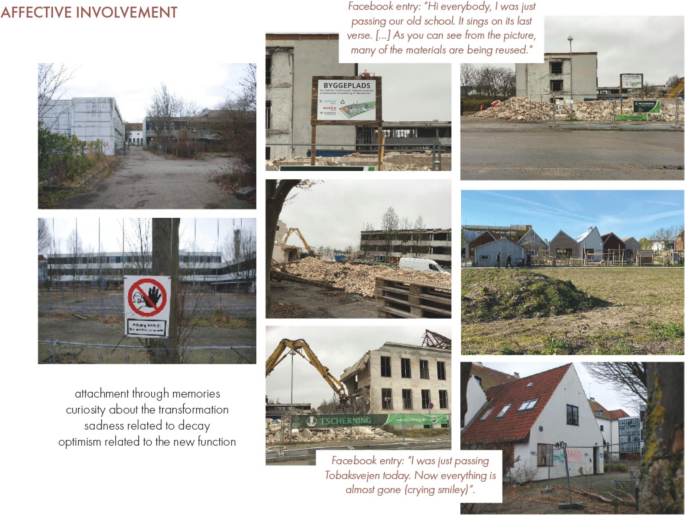
Affective Involvement. This mapping examines the emotional engagement of the Facebook group representing former local community members, highlighting their childhood memories (credits: Per Skipper, with permission)
As an example, one person on several occasions throughout 2017–2023 share site specific situations from the design-related phases, through a series of photos and short videos. These ‘micro-documentaries’ is encouraged and celebrated by the online community, commenting for example: “Oh what a pleasant read! Brings back good memories!”[77]. But it also activates several people to express an emotional sadness with the site condition and disapproval of the building project, either in written language or through emojis. Selected examples from 2017–2023 read:”A little sad, but thanks for taking the time”, “Strange to see the school demolished”, “My old school road “ (emoji with heart), “Oh yeah…not much to pick up there”, “It’s sad to see your old school decaying like that” (3 crying emojis) [77]. Interestingly, few of the 33 comments (and 43 emojis) posted around May 2023 linked to four photos of the newly constructed kindergarten comment directly on the actual building activities and construction. Yet, a series of mixed affections are clearly revealed. Selected examples read: “Strange to see, can’t recognize the place at all”, “The school wasn’t too pretty, but this construction is worse”, “If it must happen, it is a nice building. I also miss our old school”,”A bit sad that the old school is gone” (crying emoji),”Sad that it turned out this way” (crying emoji),”Is it a test building, it should be torn down “, “But that it is reused as a kindergarten is good – at least better than lying as a ruin” [77].
On ‘care as affective involvement’
This lens zooms in on the notions of attachment and affect, reflecting key stakeholders and power relations established within different social worlds. The aim is to recognize the alliances and major collective actors involved in the design situation. As seen in the interview quotes, the caregivers in this case include the municipality project leader, design/project architects, engineers, and contractors. They establish a trusting and co-dependent bond of care for planetary and environmental aspects through their direct material concerns. The analysis also reveals a collective awareness, affective attachment, and social concern, manifested in the Swan-label, which encompasses caring for the wellbeing and thriving of children with special needs, as well as the health and safety of the craftsmen working on the building site. The care receivers are thus both the craftsmen during the demolition/construction phases and future end-users—the children and the kindergarten staff—during everyday occupation and operation of the built environment of the kindergarten. Additionally, the parents, former school children, and local community are ‘cared for’ through the deliberate preservation and reuse of specific architectural elements, such as the schoolyard clock and dome from the old Gladsaxe School.
Interestingly, in this case, there is no immediate ‘caring with’, from an end-user perspective, as they are not directly involved in the design proposal and main project phases. However, a ‘caring with’ is established among the architects, engineers, constructors, and craftsmen, who must collaborate across multiple project phases and co-create many building details directly onsite in what they describe as a ‘flexible and adaptable collaboration’ (see Figs. 4, 5, 6, 7). Notably, these less clear relationships indicate that greater attention could be given to the unvoiced stories of the craftsmen involved in the demolition and construction phases, to better understand their affective involvement.
Care as ethical intentions
Following this, we move on to the third and final lens of care: ‘care as ethical intentions’, which examine the positionality, design values and intentions in a more global perspective.
As seen with the examples above, the case exemplifies a situation where the architect is no longer independent but highly dependent on material availability and various stakeholders, including demolition workers, construction engineers, and craftsmen, throughout the entire transformation process. The creative capacities are in this case not limited to architects working at a computer but evolve and mature through social bonds and close on-site collaboration across disciplines. This case study thus showcases both a shift in knowledge organization and distribution of work tasks during the design-related phases. Moreover, these material practices foster greater human awareness and social interaction.
Consequently, with the case of the Swan kindergarten, the ‘architectural intention’ and ‘design values’ with a set of instructions is slightly adjusted and continuously modified throughout the demolition and construction process. The authority of the architect as the ‘genius’ conceiving the ‘masterplan’ is dissolved and replaced by an ongoing negotiation between architect, engineer, craftsmen, and client. But seemingly there is no negotiation with end-users nor local community, to accommodate more social concerns. The example of the kindergarten accordingly shows the interconnectedness and dependence of the different ‘agents of care’ and the collective creative process and co-production highlight a mutual negotiation of possible solutions. The decision-making and value-setting is not restricted to the architect, but developed through the new, temporary alliances.
Admittedly, the case also illustrates that the autonomy and intention of the architect is still preserved, to some extent. As it is in most online materials and videos published, the design architect, who explains and clarifies about the ‘design situation’ [50, 51]. Less attention is provided to the positions, design intentions and values of other ‘agents of care’ participating in the ‘design situation’ [42].
The section above illustrates also how different meanings and values are created across stakeholders and the so-called ‘agents of care’. Their attachment and positionality are both material and socio-cultural. Nonetheless, for the demolition workers it is a relatively short time spent on the site working with the careful disassembly of the old school and preserving the components as best as possible. The design architect, project architect, and demolition company are mostly concerned about the careful demolition process and disassembly of building parts. As well as repairing and rescuing material components in tents on site; preserving and taking care of materials throughout the construction process. This careful process obviously created a strong awareness of the environmental changes and resource conditions during the different activities.
The Facebook community and former pupils vocalize an attachment to the old school motivated by the experiences and memories attached to the site and its buildings. Overall, their caring is attached more to the people affiliated with that place during their schooltime and seem less emotionally connected with the old building volumes, the building materials, the structural components and perhaps even the past material condition and ‘subnatures’ of the site. In that sense, the building, building site, and building materials carry a mix of tangible-visible and intangible-emotional stories.
On ‘care as ethical intentions’
In addition to the previous two lenses, this lens emphasizes the allocation of responsibility and the ethical intentions in the design situation, including purpose of care (positionality) and implications of care. Hence, the design proposal and main project are seen as ‘practices of care’, and the key design stakeholders—the municipality project leader, design/project architects, engineers, demolisher/contractor—acts as ‘caregivers’, who’s mindsets, visons, intentions, decision-making, and specific actions have consequences and impacts throughout the entire design situation and all lifecycle phases of the building/building site on both local and global scales.
Accordingly, the major positions taken are: a) planetary and environmental health, manifested in the significant material concerns and detailed stories told about efforts to reduce waste, save resources, reduce carbon footprints, and limit climate impacts; b) work environment, safety and craftsmen health, manifested in the contractors social concerns about demolition and construction procedures, but interestingly also how educational background and their overall knowledge, skills and competencies relate to this; and c) children and staff health, manifested most notably in the phase of building occupation and direct material concerns such as material chemical quality, indoor environment, and accessibility. A less voiced position as part of this building occupation is: d) end-user involvement and social concerns relating to their affective involvement, ownership and agency, and e) positions on creating aesthetic experiences with historic references to the local community and former school children. Finally, positions seemingly not taken by the key design stakeholders are: f) social concerns on global, broader community scale, and g) non-human and material concerns in foreign places. In none of the empirical material examined did any of the information reveal social concerns on, for instance, how the broader consequences of building construction and exploitation of land resources in foreign locations worldwide can harm distant people and places.
The stories told by the municipality, architect and demolition contractors about the careful preservation of material culture, and their collaborative material practices are seemingly not shared with the online community of former school pupils. On the contrary, this ‘local community’ tell stories of destruction and despair. Stories that reveal some continued emotional attachment to the specific place and the memories of the past material practices and affective involvements. So, while the caring perspective presented in the theoretical framework addresses ethical concerns, material practices, and process-awareness regarding the entanglement and relationships of doing and making together in a cross-continental and dialogical context—debating radical interdependence, connectedness, world-citizenship, and ethical awareness before financial restraints [39, 70]—the actual case study reveals how everyday practical implications and difficulties faced by architects and engineers overshadows other concerns. These design professionals struggle to shift their attachments and sensibilities towards both material and social concerns in tandem. They appear less aware of their wider social connections and shared responsibilities regarding the site, material resources and wider communities. The comprehensive care perspective which spans moral values and ethical intentions across local and global communities is not clearly revealed with this specific case.
Discussion and conclusion
As argued in the introduction, a rapidly growing body of international research and literature exists on the topics of circular design and construction motivated by the awareness of a pluri-ecological crisis. Despite its high importance for a successful green transition, the social sustainability aspects are often underexamined and overshadowed by material availability and environmental concerns.
This article thus began with curiosity and speculation about the aspects of social sustainability in comparison to the perceived strong attention to material availability in contemporary circular design practice. This further motivated the authors to adopt a case study approach, examining the design situation of a Danish kindergarten, ‘The Swan’, to provide a site-specific discussion of two research questions: RQ1) how material and social concerns manifest themselves in contemporary circular design practice; and RQ2) what intentions seem to affect how social concerns are included in contemporary circular design practice.
The case study offers empirical insights from professional practice (examining state-of-the-art) and document the complexities of real-life design procedures. We zoomed in on understanding the ‘design situation’ and the material and social concerns manifested in the design-related phases via the design proposal and main project. To analyze and unpack the complex entanglements of the material and social concerns within the case study, we established a theoretical-analytical framework introducing a ‘caring perspective’ and three lenses of care: 1) care as material practice (what is done), 2) care as affective involvement (who is involved), and 3) care as ethical intentions (why it matters). Additionally, inspired by how the caring perspective already draws on the concept of ‘situated knowledge’ and ‘situational analysis’ we enhanced the theoretical-analytical framework with various situational mappings.
These mappings collectively helped inform, order, and analyze the design situation of ‘The Swan’ kindergarten. For instance, on the first question of how material and social concerns manifest themselves in contemporary design practice, the case study demonstrated that despite the elaborate material registration and detailed technical descriptions, most of the material conditions were unknown and difficult to estimate pre-hand the demolition phase, but also during the construction phases. Additionally, what happened in the actual demolition phase strongly influenced the materials available in the following construction phases and informed the design strategies. This directly highlights a strong material concern but more indirectly reveals a series of social concerns aimed at the craftsmen physically present on the building site. Furthermore, the case study interestingly highlighted the ‘return’ to craft technologies and challenges prevailing construction logic. It suggests both a strong material and social concern with the interesting change appearing in collaboration flows across labor divisions and the interactions of craftsmen, engineers, and project architects. Often the industrialized production and standardized construction methods set aside craftmanship and local building techniques [66]. Accordingly, the collaboration processes underline the need for breaking down disciplinary boundaries with special interdisciplinary mindsets, knowledge, and skills. Competencies, neither the project architect nor contractor find is implemented in existing education and training programs for employees [66], but which they highly enjoy (see page 17). In our opinion, this possibly underscores a future direction for more close collaboration across disciplines during education to foster handling on-site collaborations and material practices in parallel with social concerns.
On the second question, examining what intentions seem to affect how social concerns are included in contemporary circular design practice, our study reveals that Fjalland’s [78] emphasis on the ‘material practices’ of reusing old building materials to raise awareness of our interconnected responsibilities is not evident. Instead, it seems the authority of the design architect to some extent still prevails in the design-related phases, sometimes at the expense of caring for social justice. By extension, the theoretical framework highlighted a strong demand for understanding how to embrace and empower local communities throughout the demolition and construction process. Yet, this seems less important in the insights we gained from the key design stakeholders involved in the kindergarten project. Instead, it seems like these social sustainability concerns are hard to unpack and verbalize in comparison to the material concerns and environmental-ethical intentions.
In summary, these findings reveal that, despite circular intentions and ethical motivations, building practices were still mainly guided by material concerns and design aesthetics. There was less evident care about how these practices affect the ongoing maintenance and wellbeing of all involved, end-users and neighbors alike. Moreover, concerns about global justice and wider social responsibility were less evident in the case study. In that sense, the caring perspective exemplified by the three ‘lenses of care’ highlighted a predominance of material concerns, showcasing the complexity and difficulty of securing a robust social sustainability mindset.
Still, the design situation might be more extensive than initially thought. For future directions, we regard the case study included here as a first steppingstone for further scrutiny. Firstly, through studies of the case in question with a specific focus on the end-users, the bodily experiences of the architecture as well as interviews with staff and leadership. Secondly, further case studies of other projects with outspoken ambitions for social sustainability would enable multiple case analysis, where comparisons across the lenses of care could be conducted. In addition, we would like to comment also on the future didactic task of maturing sustainable and robust practices within the industry. We suggest that educational programs related to the building industry consider collaborating more across those domains to train a ‘caring perspective’ and foster competencies in dependent collaboration across scales. As part hereof, reconsidering how material skills, craft knowledge, and social concerns can be (re)introduced into design educations with the caring perspective as a critical lens.
By raising awareness of these issues, we hope to contribute to and advance the necessary debate about future circular design and the potential of maturing practices where material and social concerns overlap and merge into more situated practices of care.
