
 info@apippress.com
 +86 18163351462 (WhatsApp)
 +86 182 8014 0209
Article Content
On the characteristics and potential of natural stone
Natural stone has been a widely used and valued building material in Switzerland for centuries, particularly due to its durability, great load-bearing capacity and regional availability. Gneiss, granite, marble, sandstone and limestone are quarried in the Swiss Alps, the Central Plateau and the Jura Mountains (Francis [2]). The stones’ geological formation shapes their specific material qualities not only physically but also in terms of their expression, colour and haptic. Natural stone is a building material whose origins are permanently inscribed in it. Architecturally meaningful buildings create a profound cultural and scenic connection between the construction site and the landscape from which the stone was quarried, weaving a tangible bond between structure and place.
Over the last one hundred years, natural stone has been superseded by industrially manufactured products such as reinforced concrete, steel and brick. Knowledge of using load-bearing solid natural stone in construction is no longer applied widely today. Against the backdrop of climate change, resource scarcity and difficult global markets, the widespread occurrence and specific characteristics of natural stone represent an untapped and underestimated potential that is well worth exploring.
Physically, natural stone is characterised by its high compressive strength, which ranges from 20 to over 220 MPa,Footnote1 depending on the type of stone.Footnote2 Accordingly, granite, gneiss, sandstone, or limestone are all capable of bearing high vertical loads. These hard natural stones also characteristically evince technical properties, such as extreme hardness, density, low porosity and water resistance. Hard stone’s resistance to weathering and environmental influences like sun, water, ice and wind exposure makes it a particularly durable material. Moreover, owing to its inertia, natural stone is a good thermal accumulator that can be used to store energy in buildings. It is also a pollutant-free and chemically stable raw material. Numerous studies have pointed out its low CO2 footprint in comparison to that of many other building materials.Footnote3 High costs and CO2 emissions are caused in the main by its extraction, processing, transport and installation. Thus, the CO2 footprint of natural stone can be significantly reduced through careful extraction, minimal processing, and regional transport distances,Footnote4 alongside efficient construction methods [3]. Additionally, limiting surface treatments further decreases CO2 emissions and labour costs.
The use of natural stone in construction as a load-bearing material presents a series of challenges. Its low tensile strength limits its application; large spans are possible only in conjunction with auxiliary means. As a natural product, it is more difficult to use than standardised industrial products. Given the hardness, bulkiness and great weight of certain natural stones, processing this raw material of hard stones like gneiss is very cost-intensive in terms both of labour and transport. Additionally, softer stones like sandstone and limestone are prone to weathering from exposure to salts and acids, requiring material-compatible applications and specialised protective measures to ensure their durability over time. For oriented, sedimentary rocks it is important to take the direction of layers for installation into account, to reduce damaging weathering.
Observations in Swiss quarries
‘Natural stone helped forge Switzerland’s identity in its early years, in the absence of other mineral resources.’ [1].
Quarrying and residual material
Blasting serves to extract large blocks from the rockface in one go. It is a first step extraction method for hard stones (granite, gneiss). A great proportion of residual material ensues as a by-product. A more precise and therefore material-saving method is the use of a diamond wire saw or a circular saw, both of which cut the rock by revolving continuously under running water. In the drilling and splitting technique, holes are drilled in the rock then wedges are driven into them. Manual, hydraulic or pneumatic pressure with cushions is used to split the stone blocks along natural fault-lines. Sandstones and limestones are extracted by saws and splitting technique parallel to their sedimentary layers. Depending on the specific quarry, the proportion of residual material is lower than in hard stone quarries.
Further processing of the raw blocks of hard stones and sandstones gives rise to large quantities of low-grade material that is not presently turned into dimension stone products. The quality and quantity of this material varies greatly, depending on its degree of hardness, its location in the mountains, and the extraction and processing methods used. Evaluations in two Swiss quarries show 22% in a sandstone quarry and 67% in a gneiss quarry of the quarried volume consists of residual pieces that thus far outweigh the volume of the end products.Footnote5 These residual pieces (also known as rubble stone) are considered as waste. They include smaller formats that can no longer, or not yet, be sold in the framework of the current product range and market situation as well as stones that, owing to mineral inclusions, fail to meet the static or aesthetic requirements. They usually remain in the quarry. In consequence, companies end up storing residual material in their own quarries or landfill sites, thus blocking their further operations. Yet nearly everything extracted from quarries holds potential for use and reuse.
Current applications
The Swiss varieties of natural stone are extracted from the seventy-seven quarries now in operation.Footnote6 The annual volume extracted amounts to ca. 0.75 million tonnes, which equates to 300′000 m3, 90% of which is used on the domestic market (Naturstein-Verband [9]). A distinction is thereby made between crushed hard stoneFootnote7 and natural masonry stones; the latter are used on the one hand as constructive stones – in the form of ashlar or solid blocks – or on the other as decorative stones – in the form of panels or slabs for cladding facades and other surfaces, or of blocks for sculpture and statuary. Nowadays, masonry stones are only occasionally used in architecture as load-bearing elements.Footnote8 Whereas Historically, the use of load-bearing masonry stone was significantly more prevalent [11]. The available data for extracted stones from Swiss quarries does not distinguish between ornamental and structural products.
Challenges: a decline in the number of quarries; new concessions and competition
‘Switzerland has at its disposal a great variety of natural masonry stone and can in theory meet its own needs.’ [13]
The number of active quarries in Switzerland (Fig. 1) has decreased over the last century. Until the eighteenth century, most natural stone was extracted locally, and with a great deal of effort, from a small quarry close to the place it was to be used. Only a few special types of stone were transported over larger distances or exported, such as Arzo marble from Ticino [11]. Owing to industrialisation and the ensuing economic boom, along with major improvements to rail transport in the latter half of the nineteenth century, the number of significant quarrying companies increased to around 700 by the year 1900 [11]. Yet the year 1900 marked the onset of decline in the Ticino granite industry and Swiss stone industry generally [11]. The spread of affordable, industrially manufactured building materials, such as brick, tiles, concrete and steel, superseded the use of natural stone. Meanwhile, in recent decades, the surviving Swiss quarry companies have come under pressure from international trade, the simpler import of foreign stones and lower wages abroad [10, 11]. Today, half of the natural stone used in Swiss construction is imported from Italy, China, India and Brazil [6, 13]. Foreign competition is particularly acute when it comes to hard stones for road and rail construction. Processing residual pieces as gravel and track ballast accordingly holds little economic appeal for Swiss quarries [10]. This research proposes using Swiss stone as sustainable, constructive material, to thus increase the added value and competitiveness of Swiss quarries.
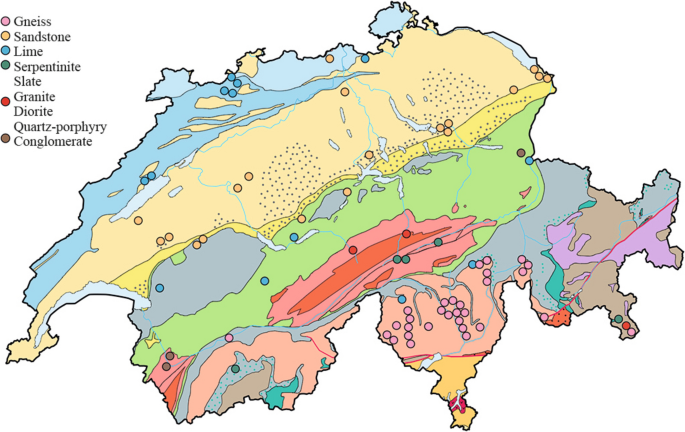
Map of Swiss stone quarries (Naturstein-Verband [8])
Natural stone as a resource is a common good. The local canton or district is free to dispose of it and to award permits and concessions for its commercial extraction [13]. It thereby also lays down long-term extraction prospects and volumes as well as renaturation concepts for the period after closure of a quarry. To cover the annual extraction requirement of 0.75 million tonnes, it is vital to continually renew the concessions [13]. The extraction processes cause emissions and may disfigure the landscape. Currently, extraction results in a growing number of usage conflicts between landscape protection zones and settlement areas [13]. Strict labour protection laws, environmental provisos and extraction regulations guarantee the working conditions in Swiss natural stone quarries as well as their environmental sustainability, yet they simultaneously increase the economic pressure on the sector and propel imports of cheaper products from abroad. Market trends influence the demand for natural stone products and in recent decades global demand for ever more decorative stones, such as marble slabs for high-end real estate projects, has shot up. Neither a more sustainable use of natural stone nor ecological considerations, such as reduced processing and short transport routes, are considered when it comes to the choice and use of natural stone.
Strategies for construction with solid stones
Based on these observations and challenges in Swiss quarries, developing new approaches to utilising natural stone clearly becomes a necessity. To this end, we identified two strategies taking into account the various aspects: extraction, processing, transportation, installation and disassembly. We assume that transportation distances, costs, and ecological side-effects are similarly low across all four case studies. The distances between quarry and construction site in Switzerland are comparably short, e.g., 50 km [3]. For installation, the case studies explored strategies that allow for disassembly and reuse of material. The following case studies described were designed and developed during two semesters at the Department of Architecture, ETH Zurich.Footnote9
The first strategy is to use the stone in the largest possible and least processed formats. The goal is to maintain a low CO2 balance by keeping the post-extraction processing stages to the minimum, for example, by opting to leave surfaces in their raw, unrefined state, thus eliminating the need for additional sawing and polishing. The second strategy consists in using auxiliary means to combine the residual by-products of extraction and processing, so as to fabricate new larger stones blocks. This approach aims to maximise the efficient use of all quarried stone, thereby significantly reducing waste.
Strategy 1: large stones
In the following we present two case studies that build on the ‘Large Stones’ strategy to propose new constructive links and spatial qualities.
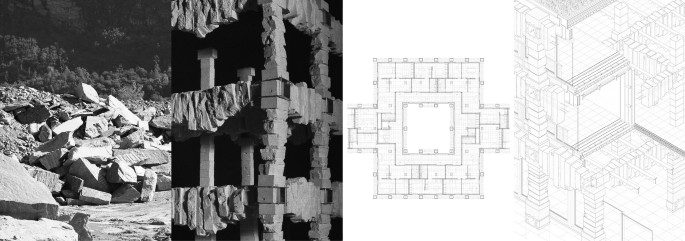
The ‘Stone Depot House’Footnote10 case study (Fig. 2) demonstrates how stacked unfinished blocks of natural stone with a low ecological footprint can constitute the load-bearing and spatial structure of a building. In this case study, only extraction techniques using a diamond saw or a circular saw are applied; further processing is omitted to reduce both CO2 emissions and costs for the stone material. The building itself serves as an intermediate storage for the material, eliminating the need for extensive storage facilities and additional transport between quarry and site. Installation and disassembly are possible. This solution can be applied to any soft stone that has been precisely excavated using diamond or circular saws, such as sandstones and limestones.
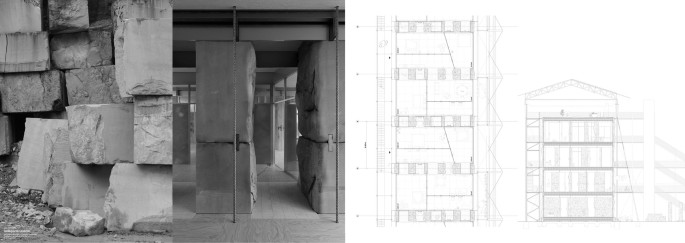
Bollinger sandstone, interior image and drawings of case study ‘Stone Depot House’
Sandstone quarried near Bollingen above Lake Zurich is cut from the rockface and broken up by means of circular saws and water pressure cushions in underground quarrying. The blocks measure 3 m × 1.5 m × 2 m. They are cut in half or in three at the quarry, before being transported to the construction site. There, the raw blocks are vertically stacked to create a stone depot house. The large volume of material used in this structure is justified by the natural stone’s very low CO2 footprint and its properties both as a thermal accumulator and as a load-bearing element that supports the horizontal bracing of the structure. In addition, the solid building structure allows the structural stone to be easily reused after dismantling.
The simple construction method, namely the stacking and alignment of several unfinished blocks, creates a wall structure over several storeys. The horizontal divisions within the stone framework are achieved with CLT panels, while lightweight, delicate partitions further subdivide the interior spaces. The stone blocks are fixed in place both by their own weight and end-matched flat steel. Steel beams resting on them comprise the support for the inserted CLT panels. The voids between the stone walls provide adaptable spaces suited to a variety of functions, including bathrooms, storage alcoves, or multipurpose niches. The construction is climatically sealed by a post-and-beam curtain facade and the interior face of the outer-lying stone blocks is clad in insulation. A steel scaffolding structure is set in front of the ‘stone depot’ on all sides to support the structure for an overhead crane that provides vertical and horizontal access to the rooms from the outside. The overhead crane facilitates step-by-step construction as well as modulation of the floor plates and interior partition walls and alternative restacking of the natural stone blocks. The structure offers great potential for future polyvalent usage and transformation: the spaces between the stone wall structure are multifunctional and adaptable while the stone blocks themselves could be differently arranged and, given their great size, also be further processed on site.
The ‘Digital Efficiency’Footnote11 case study (Fig. 3) uses innovative digital technologies. Through 3D scanning, the processing of raw stone blocks is significantly minimised, resulting in a substantially improved CO2 footprint. The dry staking installation onsite needs high precision, using robotic cranes and GPS methods. Disassembly, reuse and further processing of the large stone blocks is possible. This concept can be applied to any stone that has been precisely excavated using diamond or circular saws and that is naturally fractured in sediment layers, such as sandstone and limestone.
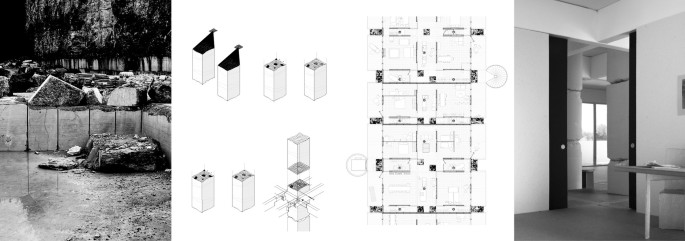
Laufener limestone, 3D scans and processing of blocks, floor plan and interior of case study ‘Digital Efficiency’
Limestones are sedimentary rocks, blocks of which can be cut from a quarry face by means of circular or diamond wire saws. The stone can be easily split, horizontally, owing to its stratification and natural layers. These layers determine the height of the quarried blocks. The project proposes a simple means of securing stacked blocks. Owing to their profile, these solid stone columns measuring 1 m × 2 m or 1 m × 1 m absorb both vertical and horizontal forces. The vertical surfaces of the blocks are not polished. Traces of the circular saw remain visible. Usually, smooth surfaces are required in order to form a precise bed joint for the transfer of vertical forces. Instead, in this project, the split horizontal surfaces of each stone block are digitally scanned and analysed, then very few contact points – necessary for the transfer of forces – are individually processed. There is then no further need to cut and polish the entire surface. The comprehensive and intensive processing phase otherwise required for the transfer of forces in stacked stones is reduced here by digital technologies.
The large limestone columns comprise the structural skeleton of the building. The horizontal bed joints look like open fissures and reference the quarrying process, the natural layers in the stone, and the brittleness of the material. The grid of columns, like walls in two directions, is determined by the columns’ ability to absorb horizontal forces: the gaps between them stand in relation to the section of the columns. The spaces between the massive columns of limestone blocks measuring from 80 to 200 cm are spanned by CLT beams. Each load-bearing pair is fastened to the stacks by thread screws. The ceilings are made of CLT elements. The ground plan of the superstructure consists of five zones. The slabs overhang it on both sides and the inner zones between the facades can be further subdivided. The facades and vertical elements for the spatial division are aligned with the slab supports and the columns, to which they are affixed. The presence of the materials stone and timber shapes the structure and the spatial qualities of the open floor plan. The rigorous grid determines the position of the columns and the dimensions of the spaces. The vertical access stairwells on the outer walls and the cantilevered balcony layer function independently of the building’s superstructure and hence support the concept of an adaptive floor plan. The minimal CO2 footprint of the permanent stone and timber structure has ecological and architectural advantages in comparison to similar post-and-beam systems in reinforced concrete. The robust stone columns rhythmically connect, define and structure the sequence of rooms, creating a strong presence in space.
Strategy 2: from rubble stone to new masonry stone
The following two case studies demonstrate that quarried stone of a lesser quality can be transformed into load-bearing elements by means of auxiliary materials such as lime mortar or steel.
The ‘New Artificial Stone’Footnote12 case study (Fig. 4) demonstrates the versatile use of Guntliweider sandstone in three aggregate states: in the form of gravel in gabions; as rubble cast in lime mortar to form new artificial stones blocks; and as newly quarried masonry stone. This application is related to the actual real occurrence of stone at the Guntliweider quarry, which has large quantities of small-format stones (50% are gravel, residual stone) and only limited quantities of high-quality, massive stone (5% large stones and 45% medium to small stones). Processing is carried out specifically according to size: while the large, valuable pieces are shaped into keystones, the smaller ones are cast into new masonry stones. The wall installation follows conventional masonry techniques. With using lime mortar, disassembly and reuse is still possible. The three methods were specifically developed for this quarry. However, the casting can also be applied to other sandstone gravel material.
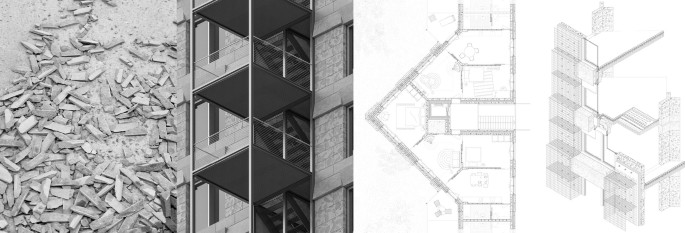
Guntliweider sandstone, facade image and construction drawings of case study ‘New Artificial Stones’
The gravel used in gabions serves as soundproofing in the facade exposed to noise emissions. The stone rubble is mixed with lime mortar and cast as new artificial stones blocks that form load-bearing walls in the interior and in the facades. The few large-format masonry stones are positioned as mighty and striking keystones above doors and windows. The various surfaces of the masonry stones, rubble stone and gravel remain visible in both the facade and the interior spaces, as an aesthetic composition. These architectonic qualities are complemented by the physical and structural advantages of a building comprised of solid elements.
The ‘Circular Stone Chain’Footnote13 case study (Fig. 5) investigates how the common occurrence of residual pieces in the Maggia gneiss quarry in Ticino can be translated into a striking stone storage depot or curtain of stone. Processing includes the creation of two parallel surfaces for each stone and drilling to thread the stones onto a steel cable or rod. On-site installation involves the structural integration of vertical and horizontal elements into the steel nodes through post-tensioning, ensuring load transfer and stability. Particularly in the extraction process of homogenous soft stones and hard stones, e.g., sandstones, gneiss or granite, medium-sized residual stone is a sub-product, which is suitable for this solution.
Maggia gneiss, facade image and construction drawings of case study ‘Circular Stone Chain’
Extracting and cutting raw blocks of gneiss stone to size results in a number of diverse, small-format residual pieces. Here, these are threaded onto steel cables and are post-tensioned once the elements are in place, in order to activate the compressive strength of gneiss and the tensile strength of steel. Such hybrid construction elements can be installed as either columns or beams. They are delivered to the building site prefabricated, and with the aid of steel knots, are screwed together at the ends. This exoskeleton is used to erect a multi-storey building. The floors consist of interlocking timber elements that rest on the secondary structure of steel beams. Stud walls made of wood-based panels are used to partition the open floor plan. Thanks to its modular structure, the building can accommodate diverse needs and functions. It follows ‘design to disassembly’ principles and can accordingly be taken apart or re-adapted.
The post-tensioned Maggia gneiss columns and beams offer a sustainable approach to repurposing residual stone pieces. The case study presents itself as a stone curtain or a grand stone repository. The stone and steel components are firmly connected, but designed to be easily disassembled, creating a circular, reusable building system.
An old resource for new constructions
Our analysis shows that the prevailing use of natural stone as an ornamental or cladding material and in road construction and landscaping has contributed to its banalisation. In addition, the great expense of producing highly processed stone has made it harder for Swiss stone to remain competitive, leading to marginalisation of the stone sector. Moreover, the intensive degree of processing barely takes into account the high CO2 emissions that thereby ensue. In summary, it becomes clear that contemporary uses of natural stone often fail to fully leverage its unique properties and may even disregard them, to the industry’s detriment.
In response to these contradictions, the two strategies presented provide potential solutions to counteract this unfavourable trend for Swiss natural stones. By focusing on lightly processed construction stones and new masonry stones made from residual material, Swiss gneiss, sandstone and limestone quarries can offer new, competitive product categories for the Swiss building market. The findings demonstrate the potential of natural stone in the construction industry, beyond decorative purposes. Further interdisciplinary research will be required to provide more specific sustainability, cost-effective data on processing, transportation, installation and disassembly.
To fully harness the unique qualities of natural stone and promote its role as an ecological building material, it should be reclaimed as a local resource and utilised as a circular, structural, load-bearing element. Ideally, an architectonic design is the result of critical inquiry into the specific occurrence of the chosen stone, the means by which it is quarried and processed, and its role in construction.
The new aesthetic of stone finds its expression in the raw traces left by mechanical extraction – the fissures that endure when stones are joined or stacked, the rugged surfaces formed along natural inclusions. These imperfections capture the stone’s journey from earth to form, embodying an authenticity that celebrates its primal texture.
The value of the material is no longer defined by the refinement of cultivated craftsmanship; instead, its aesthetic power resides in the raw, unaltered essence of the resource itself.
