
 info@apippress.com
 +86 18163351462 (WhatsApp)
 +86 182 8014 0209
Article Content
Abstract
Transition metal sulfides are a prevailing supercapacitive electrode material because of their redox activity, potentially addressing global energy demands while minimizing environmental pollution. Here, binder-free manganese copper sulfide (MnS-CuS) electrode material was synthesized via a low-cost homemade chemical vapor deposition (H-M-CVD) technique, which significantly decreased the synthesis time by providing high purity, uniform growth, reduced agglomeration, and superior electrochemical performance. X-ray diffraction verified the polycrystalline nature of the electrode material, along with the presence of microstrains and lattice defects that promote rapid charge diffusion. The MnS-CuS electrode material with high surface area (97.48 m2/g), mesoporous structure, and greater active sites enables efficient ion transport to enhance electrochemical performance. The MnS-CuS electrode material exhibited high values of specific capacitance (2011 F/g), energy density (34.5 Wh/kg), and power density (1296 W/kg). It retained 93% of its capacitance after 10,000 cycles with a coulombic efficiency of 97%. An asymmetric supercapacitor assembled with this electrode material achieved a specific capacitance of 929 F/g (at 1 A/g), energy density of 44 Wh/kg, and power density of 3189 W/kg, demonstrating that the synthesized MnS-CuS electrode material can be potentially used for sustainable energy storage systems.
Graphical abstract
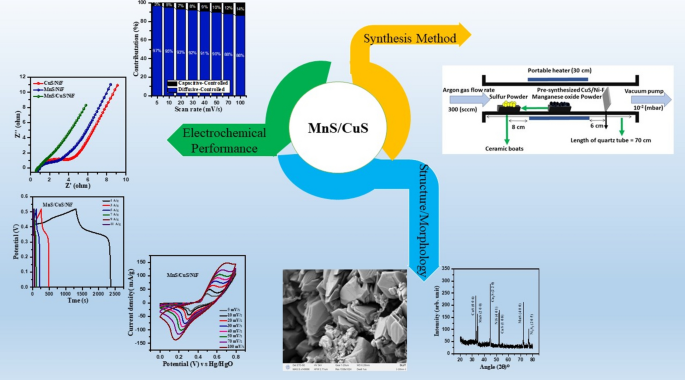
Explore related subjects
Discover the latest articles and news from researchers in related subjects, suggested using machine learning.
- Carbon Materials
- Hydrogen storage materials
- Porous Materials
- Supercapacitors
- Transition Metal Dichalcogenides
- Materials for Devices
Data Availability
Relevant data will be made accessible upon judicious petition from the corresponding researchers after acceptance.
References
-
P. Xu, C. Miao, K. Cheng, K. Ye, J. Yin, D. Cao, Z. Pan, and X. Zhang, High electrochemical energy storage performance of controllable synthesis of nanorod Cu1. 92S accompanying nanoribbon CuS directly grown on copper foam. Electrochim. Acta 214, 276 (2016).
-
P. Himasree, I.K. Durga, T.N.V. Krishna, S.S. Rao, C.V.M. Gopi, S. Revathi, and H.J. Kim, One-step hydrothermal synthesis of CuS@ MnS on Ni foam for high performance supercapacitor electrode material. Electrochim. Acta 305, 467 (2019).
-
L. Yu, B. Yang, Q. Liu, J. Liu, X. Wang, D. Song, and X. Jing, Interconnected NiS nanosheets supported by nickel foam: soaking fabrication and supercapacitors application. J. Electroanal. Chem. 739, 156 (2015).
-
K. Krishnamoorthy, G.K. Veerasubramani, S. Radhakrishnan, and S.J. Kim, One pot hydrothermal growth of hierarchical nanostructured Ni3S2 on Ni foam for supercapacitor application. Chem. Eng. J. 251, 116 (2014).
-
X. Wu, J. Ma, J. Wang, X. Zhang, G. Zhou, and Z. Liang, Progress, key issues, and future prospects for li-ion battery recycling. Glob. Chall. 6(12), 2200067 (2022).
-
M. Yousaf, A. Rasheed, A. Farid, I.A. Khan, M.A. Ghanem, and F. Marken, Electrochemical properties of binder-free micro-blocks/sheets-based cadmium-nickel-sulfide electrode materials for portable energy storage applications. J. Energy Storage 99, 113416 (2024).
-
M.A. Ali, A. Farid, A. Rasheed, M. Yousaf, A.M. Alfares, N. Ayub, and F. Marken, Synthesis and electrochemical properties of microcanals Mg-S-Cu-S as an electrode material for energy storage applications. J. Electroanal. Chem. 971, 118588 (2024).
-
A. Raza, A. Farid, A. Rasheed, M. Yousaf, I.A. Khan, K.M. Mohammed, and M.A. Ghanem, Home-made chemical vapor deposition-based synthesis of binder-free nanostructured magnesium-molybdenum-sulfide electrode materials for supercapacitor application. J. Phys. Chem. Solids 192, 112093 (2024).
-
R. Kötz, and M.J.E.A. Carlen, Principles and applications of electrochemical capacitors. Electrochim. Acta 45(1516), 2483–2498 (2000).
-
I.A. Khan, R. Medwal, S. Fareed, A. Farid, J.V. Vas, M.V. Reddy, and R.S. Rawat, Nanostructured polycrystalline Ni3S2 as electrode material for lithium ion batteries. Mater. Res. Express 7(1), 015517 (2020).
-
T. Abbas, M.W. Iqbal, S. Gouadria, H.H. Hegazy, H.U. Hassan, A.M. Afzal, and A. Alzahrani, Hydrothermally synthesized highly efficient binary silver strontium sulfide (AgSrS) for high-performance supercapattery applications. J. Solid State Electrochem. 27(4), 873–883 (2023).
-
K.Y. Yasoda, S. Kumar, M.S. Kumar, K. Ghosh, and S.K. Batabyal, Fabrication of MnS/GO/PANI nanocomposites on a highly conducting graphite electrode for supercapacitor application. Mater. Today Chem. 19, 100394 (2021).
-
R. Li, J. Tian, W. Wu, Q. Wang, C. Zhang, C. Zhou, and L. Yang, CuS/polyaniline nanoarray electrodes for application in high-performance flexible supercapacitors. J. Energy Storage 55, 105385 (2022).
-
K. Samdhyan, P. Chand, and H. Anand, Effect of different precursors on the electrochemical behavior of CuS nanostructures as electrode material for supercapacitor applications. Mater. Today Proc. 76, 56–62 (2023).
-
K. Samdhyan, P. Chand, and H. Anand, High-performance asymmetric supercapacitor based on hierarchical hydrothermally grown CuS nanostructures. J. Electroanal. Chem. 968, 118504 (2024).
-
H. Heydari, S.E. Moosavifard, S. Elyasi, and M. Shahraki, Nanoporous CuS nano-hollow spheres as advanced material for high-performance supercapacitors. Appl. Surf. Sci. 394, 425–430 (2017).
-
H. Heydari, S.E. Moosavifard, M. Shahraki, and S. Elyasi, Facile synthesis of nanoporous CuS nanospheres for high-performance supercapacitor electrodes. J. Energy Chem. 26(4), 762–767 (2017).
-
C.J. Raj, B.C. Kim, W.J. Cho, W.G. Lee, Y. Seo, and K.H. Yu, Electrochemical capacitor behavior of copper sulfide (CuS) nanoplatelets. J. Alloys Compd. 586, 191–196 (2014).
-
S. Shaikh, and M.K. Rabinal, Rapid ambient growth of copper sulfide microstructures: binder free electrodes for supercapacitor. J. Energy Storage 28, 101288 (2020).
-
A. Salimi, and S. Sanjabi, Binder-free copper manganese sulfide nanoflake arrays electrodeposited on reduced graphene oxide-wrapped nickel foam as an efficient battery-type electrode for asymmetric supercapacitors. J. Power. Sources 620, 235253 (2024).
-
F. Wang, X. Li, and Y. Qiao, NiS/Cu7S4 composites as high-performance supercapacitor electrodes. J. Solid State Electrochem. 27(1), 25–36 (2023).
-
I. Khan, D. Arif, A. U. Shah, K. Safeen, B. Ali, G. Eid, … & A. Safeen, Superior electrochemical performance of CuS/FeSe2 for advanced asymmetric supercapacitor applications. Electrochem. Commun. 107915 (2025).
-
K.V.G. Raghavendra, K.M. Rao, and N.U. Kumar, Hydrothermal synthesis of CuS/CoS nano composite as an efficient electrode for the supercapattery applications. J. Energy Storage 40, 102749 (2021).
-
R. Ramachandran, M. Saranya, A.N. Grace, and F. Wang, MnS nanocomposites based on doped graphene: simple synthesis by a wet chemical route and improved electrochemical properties as an electrode material for supercapacitors. RSC Adv. 7(4), 2249–2257 (2017).
-
H. Liu, Z. Guo, X. Wang, J. Hao, and J. Lian, CuS/MnS composite hexagonal nanosheet clusters: synthesis and enhanced pseudocapacitive properties. Electrochim. Acta 271, 425–432 (2018).
-
I.A. Poimenidis, M. Lykaki, P.A. Loukakos, and M. Konsolakis, Ultra-high supercapacitor performance of NiSRu@ NiO nanocomposites on nickel foam electrodes. J. Energy Storage 83, 110679 (2024).
-
H. He, X. Yang, L. Wang, X. Zhang, X. Li, and W. Lü, Neuron-like hierarchical manganese sulfide@ Cu 2 S core/shell arrays on Ni foam as an advanced electrode for an asymmetric supercapacitor. CrystEngComm 22(36), 6047–6056 (2020).
-
R. Guo, Y. Sun, J. Jiang, L. Zhang, Z. Ji, and Y. Jiang, Hydrothermal synthesis of Zn-doped CuS as a binder-free positive electrode material for supercapacitor applications. New J. Chem. 49(12), 4793–4800 (2025).
-
H. Abdullah, M. Sundararaj, V. Selvanathan, N.M. Naim, M. Akhtaruzzaman, M.H.D. Othman, and B. Yuliarto, The effect of deposition time on the morphology of CuS electrodes fabricated by chemical bath deposition for supercapacitor applications. Appl. Phys. A Mater. Sci. Process. 130(11), 834 (2024).
-
H.K. Kaplan, and S.K. Akay, Transparent and conducting p-type (CuS) x:(ZnS) 1–x thin films produced by thermal evaporation: An efficient broadband Si heterojunction photodiode. Appl. Surf. Sci. 652, 159330 (2024).
-
A. Raza, M. Ali, N. Ayub, S. Atta, and M. Jawad, Chemical vapor deposition-based synthesis of binder-free nanostructure α-MoO3 electrode material for PES devices. Phys. Scr. 99(5), 055910 (2024).
-
I.A. Khan, A. Rasheed, A. Farid, M. Yousaf, and A. Raza, Structural and optical properties of broccoli-based nanostructured ZnS films synthesized by powder vapor transport technique. Opt. Quantum Electron. 55(2), 133 (2023).
-
M. Yousaf, A. Rasheed, M. Ahmad, A. Farid, and I.A. Khan, Role of annealing temperature on structural and optical properties of zinc oxy-nitride films synthesized by powder vapor transport technique. Ceram. Int. 48(11), 15371 (2022).
-
J. Song, M. Liu, X. Ma, Q. Tian, J. Feng, X. Zhong, and F. Duan, Thermal decomposition behavior and computational analysis of alpha and beta manganese dioxide nanorods. J. Alloys Compd. 962, 171208 (2023).
-
I.A. Khan, A. Rasheed, A. Farid, M. Yousaf, and A. Raza, Synthesis of flower like microstructured CdZnS films for optoelectronic applications by powder vapor transport technique. Phys. Scr. 98(10), 105925 (2023).
-
I.A. Khan, M. Noor, A. Rehman, A. Farid, M.A.K. Shahid, and M. Shafiq, Role of evaporation time on the structural and optical properties of ZnO films deposited by thermal evaporator. EPJ Appl. Phys. 72(3), 30302 (2015).
-
I.A. Khan, M. Kashif, A. Farid, R.S. Rawat, and R. Ahmad, Effect of annealing temperature on the structural, morphological, and mechanical properties of polycrystalline zirconium oxynitride composite films deposited by plasma focus device. Jpn. J. Appl. Phys. 56(12), 125501 (2017).
-
S. Khan, M. Usman, K. Jabbour, M. Abdullah, P. John, F. Asghar, and M.N. Ashiq, Facile fabrication of SrAl2O4/rGO nanohybrid via hydrothermal route for electrochemical energy storage devices. J. Energy Storage 83, 110721 (2024).
-
M. Yousaf, A. Farid, A. Rasheed, A. Raza, M.A. Ali, and I.A. Khan, Growth of binder-free highly efficient supercapacitors electrode materials based on nickel sulfide nanostructures anchored on hierarchical nickel foam. J. Saudi Chem. Soc. 28(2), 101822 (2024).
-
S. Ali, F. Badshah, M.S. Mehdi, M. Imran, M. Awais, M. Sajid, and R. Khan, Fabrication of binder free CVD based molybdenum disulfide ASC device: Supercapacitive performance. J. Energy Storage 111, 115383 (2025).
-
A. Raza, A. Rasheed, A. Farid, M. Yousaf, N. Ayub, and I.A. Khan, Synthesis of binder-free nanofibers ZnS/MoS2/NiF electrode material for asymmetric supercapacitor applications. J. Energy Storage 84, 110811 (2024).
-
P. Skarvelis, G. D. Papadimitriou, & M. Perraki, Self-lubricating composite coatings containing TiC–MnS or WC-MnS compounds prepared by the plasma transferred arc (PTA) technique (2010).
-
N.S. Arul, J.I. Han, and D. Mangalaraj, Fabrication of highly flexible conducting electrode based on MnS nanoparticles/graphite/scotch tape for supercapacitor applications. J. Mater. Sci. Mater. Electron. 29, 1636 (2018).
-
Z. Zhan, C. Liu, L. Zheng, G. Sun, B. Li, and Q. Zhang, Photoresponse of multi-walled carbon nanotube–copper sulfide (MWNT–CuS) hybrid nanostructures. Phys. Chem. Chem. Phys. 13(45), 20471 (2011).
-
M. Kashif, S. Khan, H. Wajahat, F.F. Alharbi, A.G. Al-Sehemi, S. Eman, and H. Alqurashi, Physicochemical and electrochemical investigation of lead sulphide-graphene oxide hybrid nanostructure for energy storage applications. J. Electroanal. Chem. 974, 118680 (2024).
-
D. Ji, H. Zhou, Y. Tong, J. Wang, M. Zhu, T. Chen, and A. Yuan, Facile fabrication of MOF-derived octahedral CuO wrapped 3D graphene network as binder-free anode for high performance lithium-ion batteries. Chem. Eng. J. 313, 1623–1632 (2017).
-
Y. He, X. Zeng, Z. Lu, S. Mo, Q. An, Q. Liu, and Y. Zou, Aqueous Electrocatalytic Hydrogenation Depolymerization of Lignin β-O-4 Linkage via Selective Caryl–O (C) Bond Cleavage: The Regulation of Adsorption. J. Am. Chem. Soc. 146(46), 32022–32031 (2024).
-
U.T.D. Thuy, N.Q. Liem, C.M. Parlett, G.M. Lalev, and K. Wilson, Synthesis of CuS and CuS/ZnS core/shell nanocrystals for photocatalytic degradation of dyes under visible light. Catal. Commun. 44, 62–67 (2014).
-
B.A. Taleatu, E.A. Arbab, and G.T. Mola, Stable α-MnS thin film deposited by two-electrode cell: synthesis, structural characterization and photoemission spectroscopic studies. Appl. Phys. A 120, 959–965 (2015).
-
J. Gopalakrishnan, T. Murugesan, M.S. Hegde, and C.N.R. Rao, Study of transition-metal monosulphides by photoelectron spectroscopy. J. Phys. C Solid State Phys. 12(23), 5255 (1979).
-
Z. Yang, N. Ghorai, S. Wu, S. He, and T. Lian, Direct and indirect interfacial electron transfer at a plasmonic p-Cu7S4/CdS heterojunction. ACS Nano (2025).
-
L. Li, R. Li, S. Gai, S. Ding, F. He, M. Zhang, and P. Yang, MnO2 nanosheets grown on nitrogen-doped hollow carbon shells as a high-performance electrode for asymmetric supercapacitors. Chem. Eur. J. 21(19), 7119 (2015).
-
P. Kar, S. Farsinezhad, X. Zhang, and K. Shankar, Anodic Cu 2 S and CuS nanorod and nanowall arrays: preparation, properties and application in CO 2 photoreduction. Nanoscale 6(23), 14305 (2014).
-
M. Zhai, Y. Cheng, Y. Jin, and J. Hu, Solvothermal synthesis of flower-like structure Cu-Mn bimetallic sulfide on Ni-foam for high-performance symmetric supercapacitors. Int. J. Hydrogen Energy 44(26), 13456 (2019).
-
D.R. Rodiansyah, M.A. Irham, F.H.T. Baskoro, N. Nurfauziah, B.W. Nuryadin, S.A. Wella, and F. Iskandar, Microflower CuS: Ni as a negative electrode with battery-type behavior for all transition-metal-sufides-based high-performance asymmetric supercapacitors. Electrochim. Acta 513, 145511 (2025).
-
S. Khan, M. Usman, M. Abdullah, M.S. Waheed, M.F. Ashiq, M.I. Ahmad, and M.N. Ashiq, Facile synthesis of CuAl2O4/rGO nanocomposite via the hydrothermal method for supercapacitor applications. Fuel 357, 129688 (2024).
-
A. Raza, A. Rasheed, A. Farid, M. Yousaf, N. Ayub, and I.A. Khan, Synthesis of binder-free, low-resistant randomly orientated nanorod/sheet ZnS–MoS2 as electrode materials for portable energy storage applications. ACS Omega 9(26), 27919 (2024).
-
M. Dong, Z. Chai, J. Li, and Z. Wang, One-step potentiostatic electrodeposition of cross-linked bimetallic sulfide nanosheet thin film for supercapacitors. Ionics 26, 4095 (2020).
-
B. Pattanayak, P.A. Le, D. Panda, F.M. Simanjuntak, K.H. Wei, T. Winie, and T.Y. Tseng, Ion accumulation-induced capacitance elevation in a microporous graphene-based supercapacitor. RSC Adv. 12(42), 27082 (2022).
-
Y. Deng, Y. Shen, Y. Du, T. Goto, and J. Zhang, A novel electrode hybrid of N-Ti3C2Tx/C/CuS fabricated using ZIF-67 as an intermediate derivation for superhigh electrochemical properties of supercapacitors. J. Mater. Res. Technol. 19, 3507 (2022).
-
M.Z.U. Shah, M. Sajjad, H. Hou, S. UrRahman, and A. Shah, Copper sulfide nanoparticles on titanium dioxide (TiO2) nanoflakes: a new hybrid asymmetrical Faradaic supercapacitors with high energy density and superior lifespan. J. Energy Storage 55, 105651 (2022).
-
S. Dhanalakshmi, I.M. Babu, S. Karuthapandian, and N. Prithivikumaran, Facile synthesis of mesoporous Gd2O3/CuS nanorods for high performance supercapacitors. Mater. Chem. Phys. 309, 128355 (2023).
-
H. Sabeeh, M. Aadil, S. Zulfiqar, A. Rasheed, N.F. Al-Khalli, P.O. Agboola, and I. Shakir, Hydrothermal synthesis of CuS nanochips and their nanohybrids with CNTs for electrochemical energy storage applications. Ceram. Int. 47(10), 13613 (2021).
-
C. Wang, S. Wei, Q. Zhu, X.B. Yang, B. Zhou, Z.Q. Duan, and Y.M. Hu, Petaloid CuS nanocrystalline combined with nitrogen self-doped porous carbon as hybrid electrodes for supercapacitors. J. Energy Storage 91, 112021 (2024).
-
H. Guo, J. Zhang, F. Yang, M. Wang, T. Zhang, Y. Hao, and W. Yang, Sandwich-like porous MXene/Ni3S4/CuS derived from MOFs as superior supercapacitor electrode. J. Alloys Compd. 906, 163863 (2022).
-
Y. Li, J. Liu, T. Gong, C. Liang, L. Li, X. Lin, and H. Liu, One-step hydrothermal preparation of a novel 2D MXene-based composite electrode material synergistically modified by CuS and carbon dots for supercapacitors. J. Alloys Compd. 947, 169400 (2023).
-
H. Niu, Y. Liu, B. Mao, N. Xin, H. Jia, and W. Shi, In-situ embedding MOFs-derived copper sulfide polyhedrons in carbon nanotube networks for hybrid supercapacitor with superior energy density. Electrochim. Acta 329, 135130 (2020).
-
S. Wang, J. Wang, X. Ji, J. Meng, Y. Sui, F. Wei, and D. Zhuang, Formation of hollow-cubic Ni (OH) 2/CuS 2 nanocomposite via sacrificial template method for high performance supercapacitors. J. Mater. Sci. Mater. Electron. 31, 10489–10498 (2020).
-
G. Nabi, A. Siddiqa, M. Tanveer, A. Nadeem, and K.S. Ahmad, Manganese substitution effects on structural and electrochemical performance of CoFe2O4 for promising supercapacitor electrode materials. Inorg. Chem. Commun. 168, 112850 (2024).
-
A. Laheäär, P. Przygocki, Q. Abbas, and F.J.E.C. Béguin, Appropriate methods for evaluating the efficiency and capacitive behavior of different types of supercapacitors. Electrochem. Commun. 60, 21 (2015).
-
V.K. Mariappan, K. Krishnamoorthy, P. Pazhamalai, S. Sahoo, D. Kesavan, and S.J. Kim, Two dimensional famatinite sheets decorated on reduced graphene oxide: A novel electrode for high performance supercapacitors. J. Power. Sources 433, 126648 (2019).
-
R. BoopathiRaja, M. Parthibavarman, S. Prabhu, and R. Ramesh, A facile one step hydrothermal induced hexagonal shaped CuS/rGO nanocomposites for asymmetric supercapacitors. Mater. Today Proc. 26, 3507 (2020).
-
T.D. Raju, A. Gopalakrishnan, and S. Badhulika, Facile synthesis of 3D/2D Cu2Se cauliflower/CuS nanosheets composite as a binder-free electrode for high-performance asymmetric solid-state supercapacitors. J. Alloys Compd. 845, 156241 (2020).
-
R. Balu, A. Panneerselvam, J.R. Rajabathar, G. Devendrapandi, S. Subburaj, S. Anand, U.S. Veerasamy, and S. Palani, Synergistic effect of Echinops flower-like Copper sulfide@ Cadmium sulfide heterostructure for high-performance all-solid-state asymmetric supercapacitor. J. Energy Storage 72, 108447 (2023).
Acknowledgments
The manuscript entitled “H-M-CVD based fabrication of binder-free heterostructured manganese-copper-sulfide asymmetric device: supercapacitive performance” is done at the Plasma Processing of Electrode Materials Lab, Department of Physics, Government College University Faisalabad, Pakistan.
Ethics declarations
Conflict of interest
The researchers have officially lodged the research paper under the title “H-M-CVD based fabrication of binder-free heterostructured manganese-copper-sulfide asymmetric device: supercapacitive performance”. All of them acknowledged having no contradiction of interest, no monetary assistance, and no link within the last 10 years associated with the subject.
Additional information
Publisher’s Note
Springer Nature remains neutral with regard to jurisdictional claims in published maps and institutional affiliations.
Rights and permissions
Springer Nature or its licensor (e.g. a society or other partner) holds exclusive rights to this article under a publishing agreement with the author(s) or other rightsholder(s); author self-archiving of the accepted manuscript version of this article is solely governed by the terms of such publishing agreement and applicable law.
Reprints and permissions
About this article
Cite this article
Ayub, N., Khan, I.A. & Farid, A. H-M-CVD-Based Fabrication of Binder-Free Heterostructured Manganese–Copper–Sulfide Asymmetric Device: Supercapacitive Performance. J. Electron. Mater. (2025). https://doi.org/10.1007/s11664-025-12163-4
- Received
- Accepted
- Published
- DOI https://doi.org/10.1007/s11664-025-12163-4
Keywords
- MnS-CuS
- polycrystalline
- nanoplates
- energy density
- power density
