
 info@apippress.com
 +86 18163351462 (WhatsApp)
 +86 182 8014 0209
Article Content
1 Introduction
1.1 Relevant studies on thermal discomfort
Nowadays, energy saving and emission reduction are getting increasing attention of researchers and engineers. Reducing energy consumption in heating, ventilation and air conditioning (HVAC) is an essential step to achieve energy savings in building, while it affects thermal comfort of indoor occupants (Su et al., 2023). Solar radiation significantly affects the thermal comfort of indoor occupants, which can influence people’s productivity (Lam et al., 2017; Elnaklah et al., 2020), health (He et al., 2024), and also building energy consumption (Yongga et al., 2020; Yongga et al., 2022).
To quantify the intensity of solar radiation on indoor occupants, several models have been developed in the current academia. Arens et al. (Arens et al., 2015) introduced the SolarCal model to forecast the thermal comfort of individuals indoors based on solar radiation. The SolarCal Model (SC Model) is a simplified mathematical model that relies on the effective radiation field (ERF) and utilizes equations to convert direct, diffuse and reflected radiation into the increase in the mean radiant temperature (Delta MRT). Based on the SC Model, Andrea Zani et al. (Zani et al., 2018) proposed the daylight coefficient method (DC method), which uses Rhino and Grasshopper to build building and human body models for calculation. He et al. (He et al., 2021) proposed the HNU Solar Model to predict the Delta MRT due to solar radiation on indoor people. The model only needs simple input parameters to quickly calculate Delta MRT.
Some other researchers have proposed evaluation indexes to analyze the effect of solar radiation on thermal comfort of indoor occupants. Somsak Chaiyapinunt and Nopparat Khamporn used the predicted percentage of dissatisfied (PPD) and plane radiant temperature asymmetry (RTA) as evaluation indexes (Chaiyapinunt & Khamporn, 2020). They investigated the relationship between solar radiation and thermal comfort of a person sitting near a glass window. The results indicate that diffuse radiation is the factor that most affects thermal comfort. Huan Zhang et al. proposed CPMV* to predict the thermal comfort of the human body under solar radiation by considering both direct and diffuse radiation. The results indicate that CPMV* is the most sensitive to diffuse radiation; but the diffuse radiation is set at 30% of the total solar radiation which may be proper for sunny days rather than cloudy days (Zhang et al., 2020). He et al. evaluated the effect of solar radiation on human thermal comfort via local and mean skin temperatures and evaporative heat loss from skin by Gagge’s model and thermal sensation vote (TSV) (He et al., 2024). It was found that the mean skin temperatures increased by about 4 °C when exposed to strong solar radiation.
1.2 Research gaps
The current academia still has some unfilled gaps as follows:
- 1.Few models can quickly and accurately analyze the impact of windows on indoor human exposure to solar radiation at different locations throughout the year, without the aid of software such as Radiance.
- 2.In terms of quantifying the impact of windows on indoor solar radiation and evaluating indoor thermal comfort evaluation indexes, there are very few indexes that consider the discomfort caused by solar radiation in different seasons.
- 3.The existing studies seldom fully consider the effects of the window direction, transmittance, and window-to-wall ratio on indoor solar radiation which finally affect occupants’ thermal comfort.
To accurately calculate the solar heat gain, this study adopts a mathematical model called the improved HNU Solar Model proposed by the authors. Then, a new evaluation index called the annual thermal discomfort time ratio by solar radiation (ratiotd, solar) is proposed to evaluate the thermal discomfort of indoor occupants near windows. The influences of different window parameters (window direction, window transmittance, window-to-wall ratio) on human thermal comfort were also analyzed, which provide references for evaluating and optimizing the window design to create thermally comfortable environments for indoor occupants.
2 Methods
2.1 Workflow
This study used the improved HNU Solar Model to calculate the solar radiation intensity on indoor occupants. This model calculates direct, diffuse and reflected solar radiation into Delta MRT, and has been published in the paper (Xiang et al., 2024), so this study briefly introduces the model in Sect. 2.2.
As shown in Fig. 1, based on the improved HNU Solar Model, a new evaluation index called ratiotd, solar is proposed to evaluate thermal comfort of indoor occupants. To evaluate thermal comfort in different seasons more accurately, the Delta MRT thresholds for different seasons are added to the calculation of ratiotd, solar in this study (see Sect. 2.3).
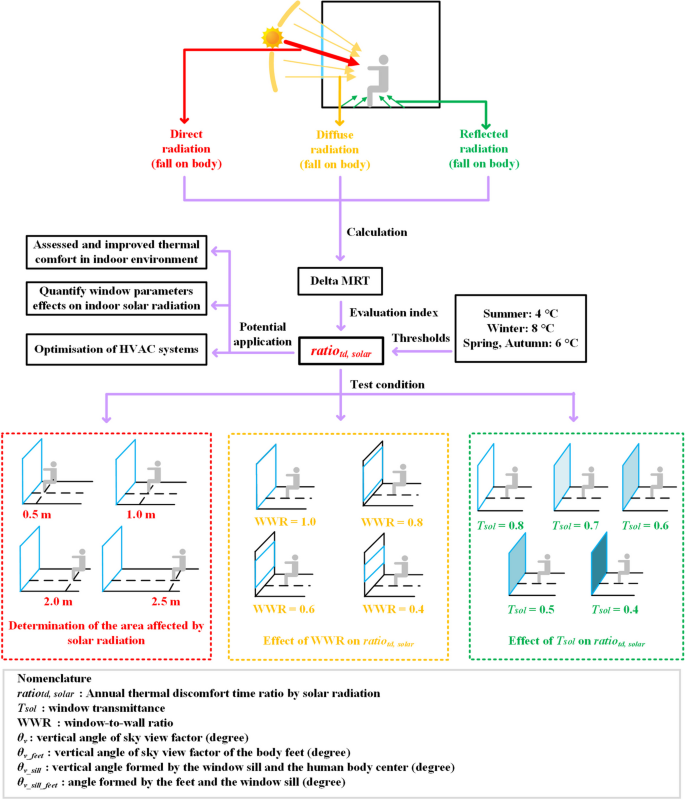
The workflow of this study
Three test conditions are used in this study to determine the area which is easy to be affected by solar radiation and to analyze the effects of different window parameters (window direction, window transmittance (Tsol), and window-to-wall ratio (WWR)) on ratiotd, solar (see Sect. 2.4 and Sect. 3).
2.2 Model
This study uses the improved HNU Solar Model (Xiang et al., 2024) to calculate the increase in the indoor MRT from solar fluxes absorbed by the occupant. The improved HNU Solar Model is a pure mathematical model, which uses strategies such as sky-annulus fraction, virtual body shadow, and equivalent window for calculation (He et al., 2021).
In the above-stated model, the human body points, the window points and the clearness index Kt are used to improve the accuracy of Delta MRT. Five points of the simplified human body and nine points of the window were selected for the calculation of Delta MRT. Firstly, the improved HNU Solar Model calculates an effective radiant field by solar radiation (ERFsolar). The ERFsolar is calculated by the sum of diffuse, direct, and reflected solar radiation, as seen in Eq. (1) (Arens et al., 2015).
where ERFsolar is the effective radiant field by solar radiation, unit in W/m2; Edir and Ediff are the direct and diffuse solar radiant fluxes respectively, unit in W/m2; Erefl_diff is the reflected diffuse solar radiant flux, unit in W/m2; Erefl_dir is the reflected direct solar radiant flux, calculated by the equivalent window method (He et al., 2021), W/m2; αSW is the shortwave absorptivity (= 0.67); αLW is the long-wave absorptivity (= 0.95).
Then the improved HNU Solar Model calculates direct, diffuse, reflected direct, and reflected diffuse solar radiation with the following equations (Arens et al., 2015):
where fp is the body projection area factor (ASHRAE Standard 55–2017 (ANSI/ASHRAE., 2017) provides a computer program to calculate it); fbes is the proportion of the body exposed to direct sunlight (equal to the ratio of the distances between the projections of the head and the toes exposed to direct sun), which is calculated by the virtual body shadow method calculation (He et al., 2021); Tsol is the window transmittance (= 0.8); Idir is the outdoor direct radiation intensity, unit in W/m2; fsvv is the sky view angle coefficient (the proportion of the sky that a person sees through the window), calculated by sky-annulus fraction method (He et al., 2021); Idiff_actual is actual outdoor diffuse radiation for indoor body, unit in W/m2; Rfloor is the floor reflectance (= 0.2); fsvv_eq is the equivalent sky view coefficient; Idiff_eq is the equivalent diffuse radiation intensity, unit in W/m2; fsvv_feet is the sky view coefficient at the foot of the human body; Idiff_feet is actual outdoor diffuse radiation for indoor feet, unit in W/m2. fsvv_eq and Idiff_eq are computed by using the equivalent window method.
The fsvv and Idiff_actual are important in the calculation of diffuse radiation and reflected diffuse radiation. Their accuracy is elevated in the improved HNU Solar Model by using the human body points, the window points and the clearness index Kt.
The relevant equations of fsvv are as follows (Xiang et al., 2024):
where θv is the angle between the human body’s point and the highest and lowest edges of the window facing it, unit in degree; θv_sill is the perpendicular angle formed by the window sill and the human body’s point, unit in degree; θh is the angle between the human body’s point and the left-most and right-most ends of the window, unit in degree; H is the window height, unit in m; hi is the distance from the ith point of the person to the ground, unit in m; dfront is the distance between the window-toward body side and the window, unit in m.
The relevant equations of Idiff_actual are as follows (Xiang et al., 2024):
where Idiff_actual_i is the Idiff_actual of the ith point of the human body, unit in W/m2; Idiff_actual_ij is the Idiff_actual of the ith point of the human body and the jth point of the window, unit in W/m2; Kt is clearness index, which ranges from 0 to 1, with a larger value representing a clearer sky; θv_ij is the θv of the human’s ith point to the jth point of the window, unit in degree; alt is the sun’s altitude angle, unit in degree; θv_sill_ij is the θv_sill of the human’s ith point to the jth point of the window, unit in degree; β is the angle between the human body and the center of the window, unit in degree; γ is the angle between the window’s center line (facing the interior) and the sun’s azimuth (azi), unit in degree.
Finally, the Delta MRT is determined by ERFsolar, seen in Eq. (14) (Arens et al., 2015).
where ΔMRT is Delta MRT by solar radiation, unit in °C; feff is the proportion of the human body’s surface that is exposed to solar radiation (= 0.696 when seated, = 0.725 when standing (Arens et al., 2015)); hr is the radiation heat transfer coefficient (= 6.012 W/m2⋅K (ANSI/ASHRAE., 2017)), unit in m.
2.3 Evaluation index
In this paper, the annual thermal discomfort time ratio by solar radiation (ratiotd, solar) is proposed, which is used to evaluate the annual thermal discomfort caused by high intensity of solar radiation on indoor human body at different locations of room under various conditions.
Operative temperature (Top) refers to the uniform temperature of a hypothetical black enclosure and the enclosed air within it, enabling an occupant to exchange an equivalent amount of heat through both radiation and convection as compared to the actual non-uniform environmental conditions (ANSI/ASHRAE., 2017). Top is calculated as follows (ANSI/ASHRAE., 2017):
which Top is operative temperature, °C; ta is average air temperature, °C; is mean radiant temperature, °C; A is 0.5 when the average air speed is < 0.2 m/s.
Since the air velocity inside the room is usually < 0.2 m/s, the relevant equations of Top are as seen in Eq. (16).
At the same time, when a person is exposed to solar radiation, the human body may feel thermal discomfort. The relevant equations of Top are as follows as seen in Eq. (17).
So is obtained by subtracting Eqs. (16 and 17) as follows:
According to the paper (Hu et al., 2022), the optimum temperature is 20.3 °C for males and 20.4 °C for females in winter. According to ASHRAE Standard 55–2017 (ANSI/ASHRAE., 2017), the comfortable temperature range is about 20–24 °C in winter. Thus, in this study, it is assumed that when the Delta MRT is higher than 8 °C (which may increase the Top from 20 to 24 °C or higher), the human body receives strong solar radiation and feels thermal discomfort. In summer, according to the paper (Liu et al., 2024), when the Delta MRT is higher than 4 °C, the indoor occupants feel thermal discomfort. Considering the thresholds of Delta MRT values in winter and summer, in transitional seasons (spring and autumn), it is assumed that when the Delta MRT is higher than 6 °C, the human body receives strong solar radiation and feels thermal discomfort.
With all the thresholds defined above, a new index, the annual thermal discomfort time ratio by solar radiation (ratiotd, solar) is proposed to evaluate the indoor thermal comfort affected by solar radiation. In this study, only the thermal discomfort hours during the working hours of a day (from 08:00 to 18:00) is counted, and ratiotd, solar is calculated as follows:
where ratiotd, solar is the annual thermal discomfort time ratio by solar radiation, unit in %; ttd_summer is the hours when indoor Delta MRT is greater than 4 °C during working hours in summer, unit in h; ttd_winter is the hours when indoor Delta MRT is greater than 8 °C during working hours in winter, unit in h; ttd_spring is the hours when indoor Delta MRT is greater than 6 °C during working hours in spring, unit in h; ttd_autumn is the hours when indoor Delta MRT is greater than 6 °C during working hours in autumn, unit in h; 4015 is the hours during the working hours of a year (from 08:00 to 18:00).
First, the Delta MRT values are calculated for the summer, winter, and transition seasons by the improved HNU Solar Model, respectively. Then, the Delta MRT values that exceed the comfort threshold of different seasons are counted, after which the number of exceeded thresholds are used to calculate the ratiotd, solar through Eq. (15).
In the current academia, there are several indexes for evaluating thermal comfort affected by indoor solar radiation, such as PMV (Du et al., 2022), CPMV (Xu et al., 2022), CPMV* (Zhang et al., 2020), etc. These indicators usually rely on onsite indoor measurement before calculation, which is time-consuming and hard to use for fast annual evaluation. The new index ratiotd, solar, compared to other indicators, has some advantages as follows:
- (1)The ratiotd, solar adopts different threshold values of Delta MRT for different seasons, which considers the different preferences of indoor occupants for solar radiation in different seasons;
- (2)This study analyzes the effects of different directions, transmittances, and window-to-wall ratios on the thermal comfort of indoor occupants through ratiotd, solar, and provides guidance for improving indoor thermal comfort at the design stage;
- (3)The ratiotd, solar is calculated by the improved HNU Solar Model, and thus it has the advantages of fast computation, high accuracy, and does not require software like the above-stated model (He et al., 2021).
2.4 Test conditions
It is assumed that the reflected solar radiation reaching the human body from outside is mainly from the floor. And the reflectance of the floor in the room model is set at 0.2. This paper analyzes the solar radiation on seated human body (corresponding to the seated activities indoors), assuming that the height of the seated human body is 1.32 m. The meteorological data are those of Changsha (Weather Data by Country).
The size of the window is 3.0 m × 3.0 m. The distance of the person from the window is set at 0 m, 0.5 m, 1 m, 1.5 m, 2 m, and 2.5 m. The horizontal distance of the person from the center of the window is set to -1 m, -0.5 m, 0 m, 0.5 m, 1 m, where a negative number means that the person is to the right of the window center line.
There are three test conditions in Table 1. From Table 1, the window transmittance (Tsol) and window-to-wall ratio (WWR) are set at different values to determine their effects on ratiotd, solar. It should be noted that when WWR was changed, the height of the window was changed accordingly, but the window width was not changed and the location of the window center point remained in the middle of the wall. The basis for the setting of reflectance is ASHRAE standard 55–2017 (ANSI/ASHRAE., 2017) and paper (Arens et al., 2015). The floor of the room in this study has a reflectivity of only short-wave radiation (= 0.2). The reason for setting the lower limit of Tsol at 0.4 is that when Tsol is below 0.4, solar radiation will not cause much discomfort, but such a low Tsol Value is not proper for utilizing daylight and creating good window view for indoor occupants. A good evidence for the above-stated point is that when Tsol is 0.4, most of the area close to the window has low discomfort percentages (Fig. 10). The effects of lower transmittance (like for fully eliminating the effects of solar radiation) can be studied in the future.
3 Results and discussion
3.1 Determination of the area easily affected by solar radiation
Firstly, this study determines the indoor area that is easy to be affected by solar radiation, of which the average value of ratiotd, solar was then calculated. In this section, Tsol is set at 0.8 and WWR is set at 1.0 for calculation.
Figure 2 is the space-mapping of the ratiotd, solar values with the four window directions (Tsol = 0.8 and WWR = 1). The blue rectangular blocks in Fig. 2 are the windows. It can be seen that the ratiotd, solar values for the indoor area near the window increased significantly when the human body stays closer to the window. When occupants are less than 2.0 m away from the window, ratiotd, solar value is usually higher than 10% whatever the window direction is. Considering that indoor occupants somehow have distances from the window rather than directly touching it, the area 0.5–2.0 m away from the window is regarded as the area that is easily affected by solar radiation; and the average ratiotd, solar value of the above-mentioned area is calculated hereinafter.
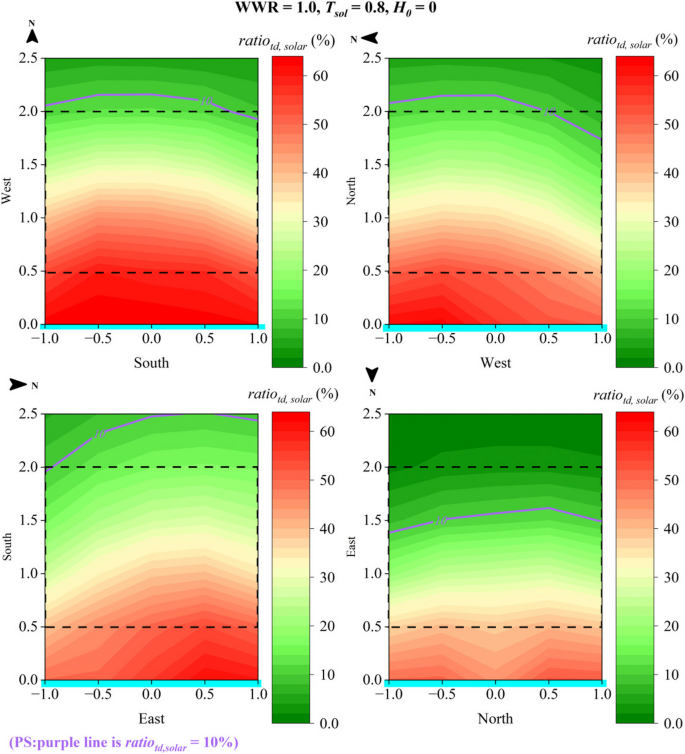
The space-mapping of the ratiotd, solar values by indoor human body with the four window directions when Tsol = 0.8 and WWR = 1
From the Fig. 2, it can be seen that the average ratiotd, solar values of the area 0.5–2.0 m away from the windows are 33.71%, 28.85%, 30.73%, and 21.02% for the south, west, east, and north windows, respectively. In addition, it should be noted that ratiotd, solar values can be up to 53% if the indoor occupants stay very close to the north window, which indicates that the north window may also cause some solar discomfort for indoor occupants.
3.2 Effect of window-to-wall ratio on annual thermal discomfort time ratio by solar radiation
The figures for all WWR values (from Figs. 3, 4, 5 and 6) show that as the decrease in WWR leads to a decrease in ratiotd, solar. The ratiotd, solar values for the south window are generally larger than those for the west and east windows, while the ratiotd, solar values for the north window are usually lower than the other three window directions. For every 0.1 reduction in WWR, the average values of the four directions are reduced by 3% to 4%.
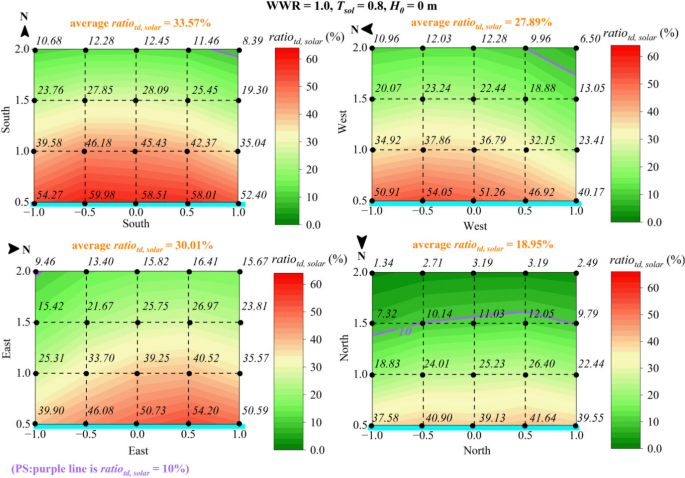
The space-mapping of the ratiotd, solar values by indoor human body with the four window directions when Tsol = 0.8 and WWR = 1.0 in the area easily affected by solar radiation
Figure 3 shows that the space-mapping of the ratiotd, solar values by indoor human body with the four window directions (Tsol = 0.8 and WWR = 1.0). As can be seen from the Fig. 3, the average ratiotd, solar values of the area 0.5–2.0 m away from the windows are 33.57%, 27.89%, 30.01%, and 18.95% for the south, west, east, and north windows, respectively.
Figure 4 shows that the space-mapping of the ratiotd, solar values by indoor human body with the four window directions (Tsol = 0.8 and WWR = 0.8). As can be seen from the Fig. 4, the average ratiotd, solar values of the area 0.5–2.0 m away from the windows are 25.63%, 21.87%, 24.84%, and 13.29% for the south, west, east, and north windows, respectively.
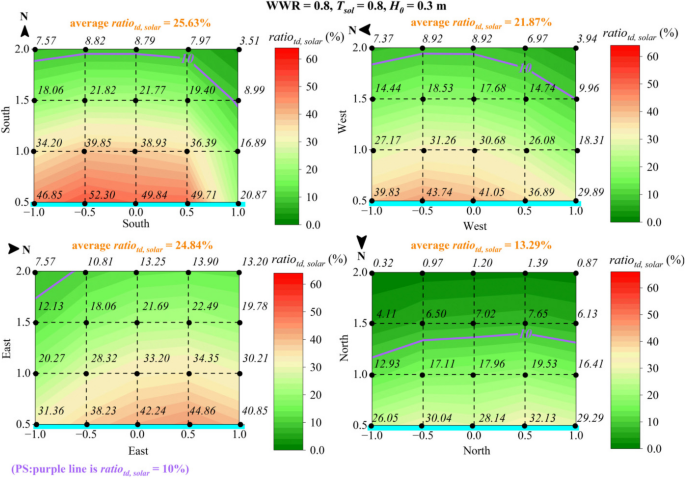
The space-mapping of the ratiotd, solar values by indoor human body with the four window directions when Tsol = 0.8 and WWR = 0.8 in the area easily affected by solar radiation
Figure 5 shows that the space-mapping of the ratiotd, solar values by indoor human body with the four window directions (Tsol = 0.8 and WWR = 0.6). As can be seen from the Fig. 5, the average ratiotd, solar values of the area 0.5–2.0 m away from the windows are 20.23%, 14.82%, 18.53%, and 7.08% for the south, west, east, and north windows, respectively.
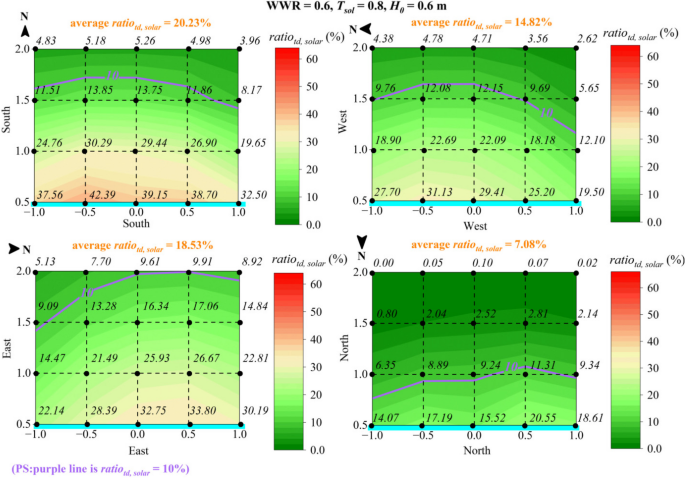
The space-mapping of the ratiotd, solar values by indoor human body with the four window directions when Tsol = 0.8 and WWR = 0.6 in the area easily affected by solar radiation
Figure 6 shows that the space-mapping of the ratiotd, solar values by indoor human body with the four window directions (Tsol = 0.8 and WWR = 0.4). As can be seen from the Fig. 6, the average ratiotd, solar values of the area 0.5–2.0 m away from the windows are 11.21%, 7.91%, 11.91%, and 2.04% for the south, west, east, and north windows, respectively.
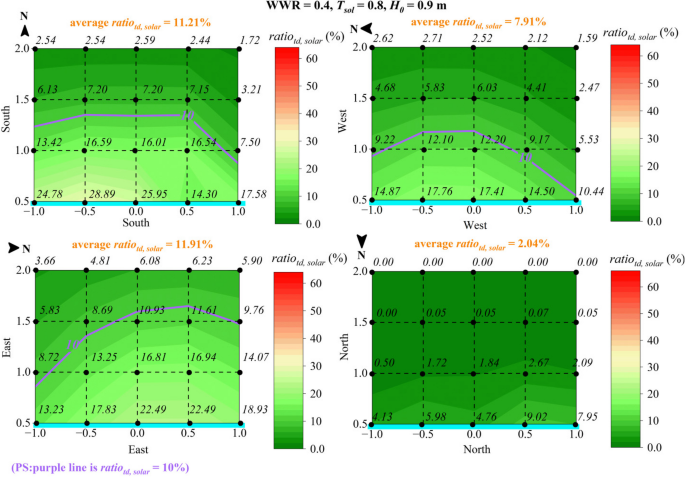
The space-mapping of the ratiotd, solar values by indoor human body with the four window directions when Tsol = 0.8 and WWR = 0.4 in the area easily affected by solar radiation
3.3 Effect of window transmittance on annual thermal discomfort time ratio by solar radiation
The figures for all Tsol values (from Figs. 7, 8, 9 and 10) show that as the Tsol value decreases, the ratiotd, solar also decreases. For every 0.1 reduction in Tsol, the average values for all four directions are reduced by 4% to 6%.
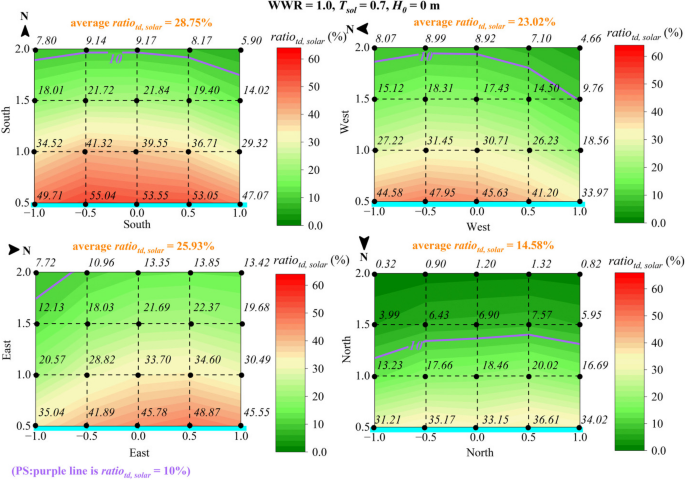
The space-mapping of the ratiotd, solar values by indoor human body with the four window directions when Tsol = 0.7 and WWR = 1.0 in the area easily affected by solar radiation
Figure 7 shows that the space-mapping of the ratiotd, solar values by indoor human body with the four window directions (Tsol = 0.7 and WWR = 1.0). As can be seen from the Fig. 7, the average ratiotd, solar values of the area 0.5–2.0 m away from the windows are 28.75%, 23.02%, 25.93%, and 14.58% for the south, west, east, and north windows, respectively.
Figure 8 shows that the space-mapping of the ratiotd, solar values by indoor human body with the four window directions (Tsol = 0.6 and WWR = 1.0). As can be seen from the Fig. 8, the average ratiotd, solar values of the area 0.5–2.0 m away from the windows are 23.60%, 18.12%, 21.72%, and 10.29% for the south, west, east, and north windows, respectively.
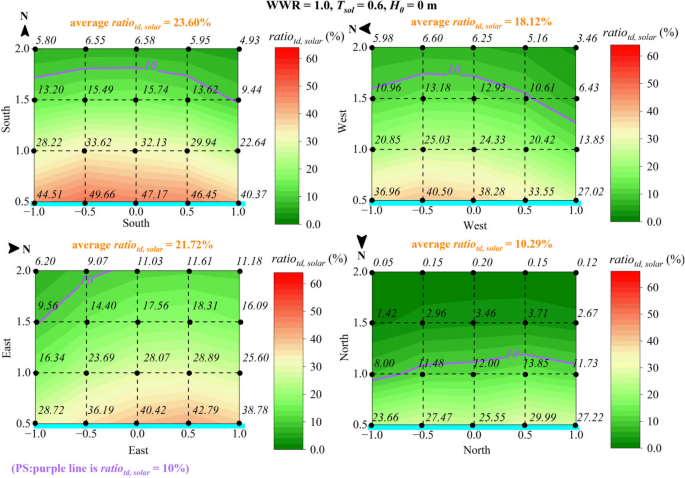
The space-mapping of the ratiotd, solar values by indoor human body with the four window directions when Tsol = 0.6 and WWR = 1.0 in the area easily affected by solar radiation
Figure 9 shows that the space-mapping of the ratiotd, solar values by indoor human body with the four window directions (Tsol = 0.5 and WWR = 1.0). As can be seen from the Fig. 9, the average ratiotd, solar values of the area 0.5–2.0 m away from the windows are 18.50%, 13.32%, 17.38%, and 6.34% for the south, west, east, and north windows, respectively.
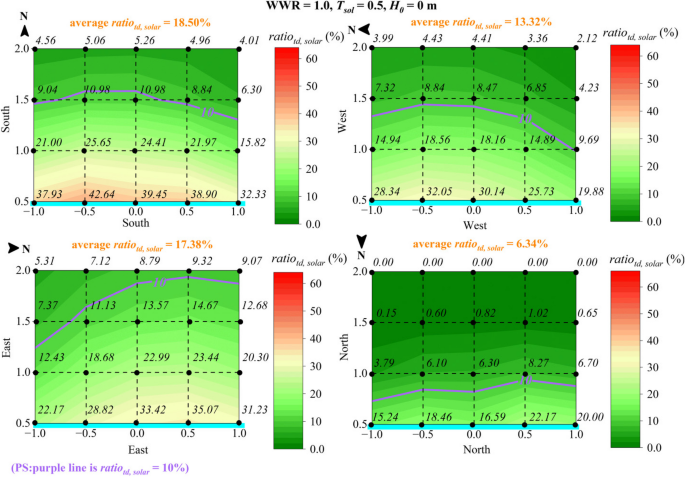
The space-mapping of the ratiotd, solar values by indoor human body with the four window directions when Tsol = 0.5 and WWR = 1.0 in the area easily affected by solar radiation
Figure 10 shows that the space-mapping of the ratiotd, solar values by indoor human body with the four window directions (Tsol = 0.4 and WWR = 1.0). As can be seen from the Fig. 10, the average ratiotd, solar values of the area 0.5–2.0 m away from the windows are 13.25%, 8.76%, 13.02%, and 3.13% for the south, west, east, and north windows, respectively.
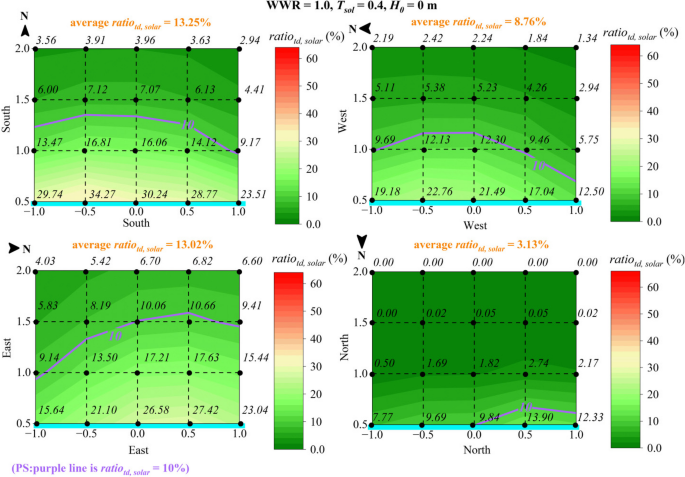
The space-mapping of the ratiotd, solar values by indoor human body with the four window directions when Tsol = 0.4 and WWR = 1.0 in the area easily affected by solar radiation
4 Discussion
4.1 Contribution of this study
This study proposes a new index to evaluate the discomfort of indoor occupants caused by solar radiation under different window parameters: different directions, window transmittance, and window-to-wall ratio. The improved HNU Solar Model has been published in the paper (Xiang et al., 2024). This model has been verified to be highly accurate by comparing it with the DC model, so it can illustrate the accuracy of the evaluation metrics proposed by this model. The following contributions can be achieved:
- (1)During building design stage, one can estimate the thermal comfort of occupants near windows via using the proposed index ratiotd, solar or the results of Sect. 3. The changes in ratiotd, solar with different window directions, window transmittance, and window-to-wall ratios also provide references for designers to select proper ways to reduce solar discomfort.
- (2)The index ratiotd, solar can guide the development of advanced window technologies, such as thermochromic and electrochromic technologies (He et al., 2023). For example, the index ratiotd, solar can be used as one of optimization goals of thermochromic windows to minimize the solar discomfort.
- (3)The calculation of solar radiation intensity on indoor occupants can also help optimize the design and operation of HVAC systems. With the accurate estimation of heating effects of solar radiation, the needed set-point temperatures of the HVAC systems in different indoor building areas can be determined, which helps accurately improve indoor comfort and avoid energy wasting.
4.2 Limitations
- (1)The thresholds of Delta MRT for different seasons are estimated from the results of some existing field studies (Hu et al., 2022; Liu et al., 2024) where the environmental parameters were not well controlled, rather than from human subject experiments conducted in environmental chambers.
- (2)The thermal sensations of different human body parts may be different when exposed to the same intensity of solar radiation. Nonetheless, this issue is not incorporated in the proposed index in this study.
- (3)Despite thermal effects, solar radiation brings daylight to indoor environments. The combined effects of solar heat and light on indoor occupants can be further investigated in future work.
5 Conclusion
In this paper, the improved HNU Solar Model is used to calculate the solar heat imposed on indoor occupants, and then a new index, the annual thermal discomfort time ratio by solar radiation (ratiotd, solar), is proposed to evaluate indoor thermal comfort affected by solar radiation. Afterward, the ratiotd, solar values with different window directions, transmittance, and window-wall ratios were analyzed, with the climate data of Changsha, a city in the central-south area of China. The conclusions of this study are represented as follows:
- (1)According to the calculated results via the improved HNU Solar Model, indoor occupants are easy to have thermal discomfort caused by solar radiation when their distances from the window are less than 2.0 m.
- (2)For windows with different directions, when the area is 0.5–2.0 m away from the windows, the maximum values of ratiotd, solar are 64.48%, 62.84%, 61.79% and 50.71% for the south, west, east, and north windows, respectively.
- (3)For every 0.1 reduction in WWR, the average ratiotd, solar is reduced by 3% to 4%.
- (4)For every 0.1 reduction in Tsol, the average ratiotd, solar is reduced by 4% to 6%.
