
 info@apippress.com
 +86 18163351462 (WhatsApp)
 +86 182 8014 0209
Article Content
1 Introduction
In the last decade, supply chains face uncertainty and unforeseen events such as the Covid 19 crisis, the war in Ukraine, the Houthi blockade of the Red Sea, natural disasters or cyber-attacks (Atilgan et al. 2011) that can affect them negatively productivity and sustainability (Dolgui et al. 2022). Moreover, according to previous studies, the companies negated the problems faced by the supply chains (Buer and et al. 2018) and used just-in-time and lean manufacturing methods to reduce the negative effects of these events and vulnerabilities. Consequently, the problems faced by supply chains have amplified over time, adding new risks generated by global events and phenomena (Bode et al., 2015). On the same time, enterprises are beginning to use advanced computing systems like artificial intelligence, blockchain, machine learning, big data analytics or robots’ technologies (Kuo et al. 2018; Ko et al. 2010) on a larger scale in their supply chains to increase their capacity for transparency and the ability to adopt competent decisions (Giannakis et al. 2011).
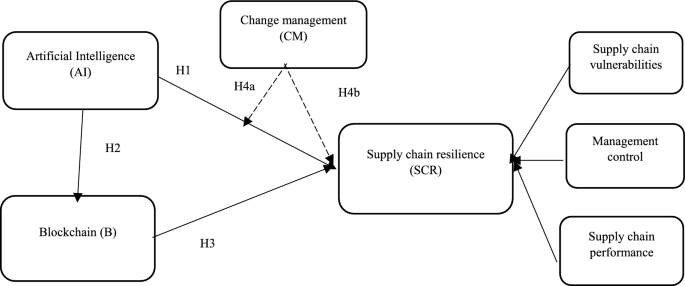
Our research contributes to the development of literature by examining the driving effect of change management (CM) on the interaction between artificial intelligence (AI) and blockchain (B) on supply chains resilience (SCR).
The paper is structured as follows: Sect. 2 presents the literature review and hypothesis formulation. Section 3 presents data analysis and hypothesis testing. Section 4 highlights findings, limitations and future research avenues, and finally Sect. 5 discusses the conclusions of the paper.
2 Literature review and hypothesis formulation
Supply chain resilience (SCR) denotes the SC’s capability to adapt and recover after a disruption and to resist future shocks (Ali et al. 2017). The recovery aspect concerns the SC’s ability to quickly retain the optimal operational performance after experiencing the disruption (Davoudi et al. 2021; Ham et al. 2020). The resistance aspect concerns the SC’s ability to minimize the impact of disruptions pro-actively, either through constantly monitoring the environment to avoid the potential disruptions entirely (Choi et al. 2001) or optimally reconfiguring itself to promptly recover from the negative impacts of eminent disruptions (Bak et al. 2020; Sawyerr et al. 2020). As a result, understanding the mechanism through which SCs can enhance their resilience has recently gained significant attention within the operations and supply chain management disciplines.
In our paper, we consider resilience according to Fiksel’s definition of resilience: “the capacity for an enterprise to survive, adapt, and grow in the face of turbulent change” (Fiksel 2006). We can consider that resilience is also a major output of change, because it measures the success of changes implementation within the supply chain while retaining the structural and functional controls in place (Ates et al. 2011).
Change management (CM) provides a coherent approach to combat the negative effects of different types of shocks and disruptions in the supply chain, offering a structured and systemic approach based on methodologies and critical knowledge about processes, tools and techniques to effectively manage supply chain transitions (Ceptureanu et al. 2024). Thus, change management complements resilience behavior within supply chains to recover from the adverse effects of changes in the internal and external environment of organizations that are part of the supply chain. Furthermore, change management is essential in developing survival and continuity mechanisms. In addition, process-oriented change management techniques are fundamental to improving resilience capabilities within supply chains (Ates et al., 2011).
Regarding artificial intelligence (AI), it has been presented as a thinking machine having the potential to learn, adapt, mimic human intelligence and support decision-making in business processes (Jarrahi 2018). Artificial intelligence generates a dramatic positive effect on the supply chain resilience and outputs because it has the ability to collect data, detect business patterns, teach business development mechanisms and explore data intelligently (Wiedmer et al. 2021). On the other hand, among limitations of artificial intelligence we can mention security risks of large systems and lack of scalability, due to the absence of authorized transactions (Dutta et al. 2020; Dinh et al. 2013). The necessity for authorized transactions is critical because there are many stakeholders involved and there are possibilities for data loss or theft.
Blockchain (B) has the ability to store digital information in an encrypted and distributed manner (Ivanov et al. 2021; Dinh et al. 2018). Blockchain can analyse artificial intelligence actions better than experts due to its ability to analyse enormous data (Wiedmer et al. 2021; Ambrozie et al. 2022). Therefore, blockchain is considered a key factor in combination with artificial intelligence to achieve organizational resilience of the supply chain (Öztürk et al. 2020). The efficiency of the blockchain can be improved by using artificial intelligence, due to the fact that the latter can analyze and process huge amounts of information (Kim et al., 2018). Therefore, we hypothesize the following.
H1. Artificial intelligence has a positive influence on the development of the supply chain resilience.
Both AI and blockchain perform functions that contribute to a company’s organizational resilience in distinct ways (Khosla et al. 2019). Artificial intelligence uses a coherent mechanism of machines and intelligent devices that execute tasks more accurately and efficiently compared to human intelligence, while blockchain facilitates the recording, storage and distribution of data through a secured digital ledger system (Ivanov et al. 2021). Artificial intelligence facilitates the design of supply chain processes and activities by guiding different stakeholders (Baryannis et al. 2019). Firms perceive the added value of artificial intelligence in high-quality data streams that can further support the decision-making process (Davenport et al. 2018). Artificial intelligence can create models on unstructured records, where blockchain can store and disseminate information to stakeholders in a secure way (Dinh et al., 2018). It also facilitates blockchain in various applications, from ownership and rights, tracking member access or contract status (Lu et al., 2017). Therefore, we hypothesize the following.
H2. Artificial intelligence has a positive influence on the development of blockchain for supply chain.
In addition to storage capacity and security, blockchain helps reduce transaction costs by reducing the role of third parties in authenticating transactions (Lu et al., 2017). Blockchain helps develop resilience in supply chains by ensuring visibility and transparency of a company’s transactions and operations (Dolgui et al., 2022). Blockchain therefore helps to integrate organizational resilience into the supply chain (Ivanov et al. 2021), where stakeholders can see the flow of information along the value chain (Dolgui et al. 2022). With existing electronic data exchange infrastructure, programming interfaces and mark-up language, blockchain can facilitate auditable transactions and share data between supply chain members (Wiedmer et al. 2021). This continuous flow of information about business transactions helps firms to be prepared for unexpected events, to appropriately allocate resources and develop resilience of supply chain, thus improving organizational competitiveness (Eskandari-Khanghahi et al. 2018; Ceptureanu et al. 2021). Therefore, we hypothesize the following.
H3. Blockchain has a positive influence on the development of resilience of supply chain.
The organizational resilience of the supply chain becomes critical in the current business environment, characterized by high volatility (Hussain et al., 2022). A consistent part of supply chain costs concerns information that can influence the degree of organizational resilience (Eskandari-Khanghahi et al. 2018). AI can be used to efficiently allocate the resources and processes of supply chain organizations (Min 2010). Therefore, we hypothesize the following.
H4a. Change management positively influence the relationship between artificial intelligence and supply chain resilience.
Blockchain enables supply chains to engage consumers by providing adequate and verifiable data, thus ensuring greater transparency (Iansiti et al., 2017). Trust is the end product of blockchain-based supply chain transparency through its various certifications and assertions (Kim et al. 2018). Blockchain can help provide better service and prices, providing consumers with faster, cheaper and better-quality products that benefit from accurate and fast information throughout the supply chain (Iansiti et al. 2017). In order for this information to be readily available, the use of blockchain in conjunction with change management greatly improves the resilience of the supply chain (Ivanov et al. 2021). Therefore, we hypothesize the following.
H4b. Change management positively influence the relationship between blockchain and supply chain resilience.
Figure 1 presents a theoretical model for achieving the supply chain resilience, based on aforementioned hypotheses.
Theoretical framework
3 Data analysis and hypothesis testing
3.1 Data collection and common method bias
To test the hypotheses of the study, we developed a questionnaire, indicated in Appendix A. Based on a partnership with Romanian National Statistics Institute, we identify 749 medium-size enterprises (50–249 employees) from manufacturing sector. We select the following NACE codes for our analysis: Section C—Manufacturing industry NACE codes from 10 to 32 and Section D NACE code 35. At the same time, two of the research team members had access to a database of manufacturing companies that had accessed or wanted to access research and innovation funds provided by the Romanian Ministry of Research, Innovation and Digitalization. The two databases were interconnected and we build an initial sample with a total of 749 companies are approached with objectives and concept note of the research. 346 companies indicated their participation and shared the questionnaire, whereas after three follow-ups via Zoom, 227 responses are collected. At the end, after a careful analysis 197 responses were considered for further analysis indicating 26.3% response rate. Data was collected from March 2021 to January 2023.
In this study to test the proposed model, WarpPLS7.0 is used, because WarpPLS is unique among software that implement PLS-SEM algorithms in that it provides users with a number of model-wide fit indices; arguably more than any other SEM software. For instance, explicitly identify nonlinear functions connecting pairs of latent variables in SEM models and calculate multivariate coefficients of association accordingly.
These fit indices are calculated as their name implies, that is, as averages of: the (absolute values of the) path coefficients in the model, the R-squared values in the model, and the variance inflation factors in the model. All of these are also provided individually by the software.
APC is calculated as averages of path coefficient of our model. ARS is calculated as averages of R- squared values of our model. AVIF is calculated as averages of variance inflation factors of the model. The P values for APC and ARS are calculated through re-sampling (Kock 2020). A correction is made to account for the fact that these indices are calculated based on other parameters, which leads to a biasing effect—a variance reduction effect associated with the central limit theorem.
We used partial least squares (PLS) based technique of structural equation modelling (SEM) that is frequently used for exploring path-analytical models (Kock 2019).
All four constructs comply to required benchmark threshold value of Cronbach’s alpha (α > 0.70) (see Table 1) (Cronbach 1951; Nunally 1978) and also Table 1 indicates latent variable coefficients. Cronbach’s alpha coefficient measures the internal consistency, or reliability of data. High Cronbach’s alpha values indicate that response values for each participant across a set of questions are consistent. This consistency indicates the measurements are reliable and the items might measure the same characteristic. Because the number of constructs is finalized in this phase we know the exact number of factors which could be extracted- f in our case. As a consequence, each construct has a minimum of three items (Gerbing et al., 1988).
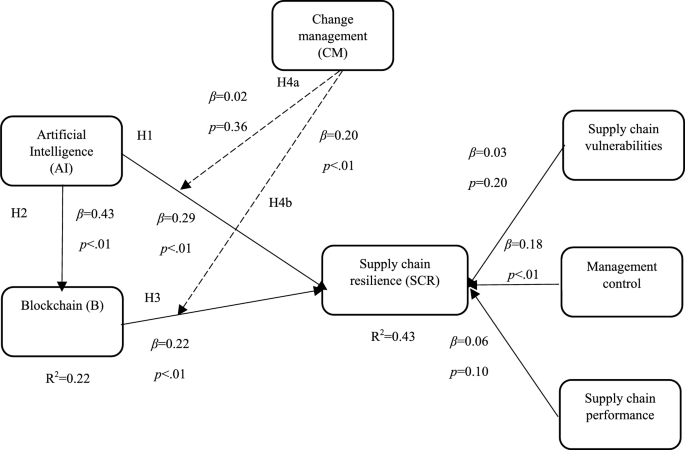
Appendix B indicates the loadings of indicator variables (Fornell et al., 1981). Table 2 indicates sufficient discriminant validity, hence ensuring the construct validity of the study. Figure 2 depicts model after SEM analysis.
Model after SEM analysis
We used WarpPLS in order to calculate the parameters for measuring the model quality. Average path coefficient (APC) and average R-squared (ARS) are in the satisfactory range (less than 0.05 of p- value) which suggest that our research model has a good fit. Likewise, the resulting average variance inflation factor (AVIF) values indicate that there is no multicollinearity problem between indicators and between exogenous variables. Next, we calculate Simpson’s paradox ratio (SPR), R-squared contribution ratio (RSCR) and statistical suppression ratio (SSR). According to Kock (2022) the SPR index is a measure of the extent to which a model is free from Simpson’s paradox instances. The RSCR index is a measure of the extent to which a model is free from negative R squared contributions, which occur together with Simpson’s paradox instances and SSR index is a measure of the extent to which a model is free from statistical suppression instances. Table 3 present causality assessment, hence the model can be accepted on the basis of SPR, RSCR, and SSR since the values are in between 0 and 1.
It can be seen that this research model has a good fit, where the P value for APC < 0.04, ARS and AAR < 0.1, with an APC value = 0.175, ARS value = 0.105 and AARS value = 0. 81.
After observing the latent variable coefficients of the correlation, we can determine that is a reduced common method bias (CMB) (Podsakoff et al. 2012) (B with AI = 0.431; SCR with AI = 0.378; CM with AI = 0.209).
3.2 Hypothesis testing
In our study, we used PLS in order to examine the structural model presented above. The significance of paths is calculated through the t-test (Wamba et al., 2020). We included supply chain vulnerabilities, management control and supply chain performance (Pettit et al. 2010) as control variables for the use of AI and blockchain achieving supply chains resilience.
Regarding SC vulnerabilities, Christopher and Lee (2004, p. 388) for instance argue that “the vulnerability of supply chains to disturbance or disruption has increased”. This is due to a combination of several factors and trends. Regarding factors, we can consider in this category natural disasters, terrorist incidents, operational difficulties and wars. Among trends, we can mention intense competition, pressure from the market and raw material crisis.
Management control is a broad concept, but in essence it represents a strategic and operational control system that integrates the functions of organizational, personnel, and cultural control (Chenhall 2003). It includes instruments and systems that managers use to ensure that the behaviors and decisions of employees are consistent with organizational objectives and strategies (Malmi et al. 2008). Bisbe et al. (2004) who found evidence that management control provides precise information and, in a short space of time, contribute to improving the way organizations deal with uncertainties.
Performance measurement is critical in the context of SCR. Gunasekaran et al. (2004) described effective performance measurement as necessary for SCM in order to control disruptions by emphasizing the weakness and strengths of the supply chain (internal and external). They consider that performance indicators should be balanced and employed on three different levels: strategic, tactical and operational levels. Lai et al. (2002) further asserted that the lack of adequate performance measurement is one of the major obstacles to improve SCM.
The results indicate that supply chain vulnerabilities and management control contribute the most in achieving the supply chain’s resilience. Table 4 indicates the result of hypotheses testing. We consider the path coefficients as standardized beta coefficients (Dubey et al. 2018). The hypotheses testing results indicate H1 (AI-SCR) (β = 0.29 p < 0.01), H2 (AI -B) (β = 0.43 p < 0.01), and H3 (B-SCR) (β = 0.23 p < 0.01). p-values are calculated through 1500 and 2000 bootstrapping runs in order to provide the robustness of PLS results.
Our investigation further analyse the moderating impact of CM on the path connecting AI, B, and SCR. The results reveal the interesting association between AI- B- CM and SCR. After testing the hypotheses on data collected from 197 respondents, we conclude that hypotheses H1-H3 and H4b are supported, except the relationship between AI and SCR moderated by CM. This indicates that B is a strong predictor of SCR.
After testing the hypotheses on the collected data, we found that most of the hypotheses are confirmed, except for the hypothesis that tested the relationship between AI and SCR moderated by CM. The main explanation is that in manufacturing companies, change management is the prerogative of top-level management, which is the main promoter of organizational changes (active role), while employees have a passive role, as acceptors of change (Atligan et al. 2011; Ceptureanu et al. 2024). Unfortunately, in most cases AI is used at the operational management level, at the production sections and workshops level, where intelligent machines carry out activities taken over from specialized workers, creating value within the supply chain by increasing labor productivity, reducing the number of scraps and defects and improving logistics (Reddi et al. 2013). Other explanations include the major changes that have occurred in global supply chains due to COVID, the war in Ukraine, the conflict between China and the US in the field of critical raw materials.
The study confirms the conclusions of previous studies, in which the role of blockchain is supported for SCR (Min 2019; Dutta et al. 2020; Treiblmaier 2018), while some of the studies have also confirmed the role of AI and CM influencing SCR. (Baryannis et al. 2019; Modgil et al. 2021; Min 2010). Therefore, the findings of the study provide empirical evidence in support of the role of B in SCR with the moderating role of CM compared to AI.
4 Findings, limitations and future research avenues
Our study is consistent with previous studies in the field (Min 2019). The present study contributes to the development of literature by: (1) Most of the previous studies discuss the operational aspects of the supply chain and do not focus on the relationships between artificial intelligence, blockchain and change management (Namdar et al. 2018; Lambert et al. 2000). (2) In addition, previous studies do not consider how change management can play a critical role in achieving supply chain resilience (Dutta et al. 2020). By contrary, our empirical findings indicate that change management it is a key factor in order to increase the resilience of supply chain.
This study has several limitations. First of all, the study focuses only on companies in the manufacturing industry, characterized by organizational peculiarities and restrictions regarding the use of modern information technologies in the supply chain. They have their own organizational culture, which creates certain common “languages” for the member organizations of the supply chain and a different understanding of the aspects involved. Second, we focus only on Romanian landscaping and we cannot extrapolate the results even at European level, let alone globally. More, our research is one of the first attempts to conceptualize the moderating impact of change management on the relationship between blockchain and AI to resilience of supply chain. The goal for future studies is expand the database to European Union level in order to identify the difference among countries.
5 Conclusions
In this ilnv, we attempted to answer some of the questions that have arisen in the literature on supply chains and the gaps in the use of AI and blockchain in this area. Even though there are studies that deal with the relationships between AI, blockchain and supply chain resilience, the new approach is novel by introducing a new factor into the equation: change management. This has become particularly relevant in recent years, as the pressure on supply chains has become strong, driven by a number of factors listed above. Furthermore, in our research, we considered a number of new variables such as supply chain vulnerabilities, managerial control and supply chain performance. Our study argues that AI and blockchain have different roles to play in achieving supply chain resilience under the influence of change management. The conclusions of this study provide a theory-based understanding of how blockchain and AI can boost supply chain resilience in the context of change management practices.
