
 info@apippress.com
 +86 18163351462 (WhatsApp)
 +86 182 8014 0209
Article Content
1 Introduction
Henkin (1950) introduced the notion of “implicative model”, as a model of positive implicative propositional calculus. Monteiro (1960) has given the name “Hilbert algebras” to the dual algebras of Henkin’s implicative models. Iséki (1966) introduced a new notion called a BCK algebra. It is an algebraic formulation of the BCK-propositional calculus system of Meredith (1962), and generalizes the concept of implicative algebras (see Abbott 1967). To solve some problems on BCK algebras, Komori (1984) introduced BCC algebras. These algebras (also called BIK+-algebras) are an algebraic model of the BIK+-logic. Then, Buşneag and Rudeanu (2010) introduced the notion of a pre-BCK algebra. A BCK algebra is just a pre-BCK with antisymmetry. Iorgulescu (2016) introduced new generalizations of BCK and Hilbert algebras (RML, pre-BCC, pimpl-RML algebras and many others). Recently, as a generalization of Hilbert algebras, Bandaru et al. (2021) introduced GE algebras (generalized exchange algebras) and Walendziak (2024) introduced pre-Hilbert algebras (the definition of a pre-Hilbert algebra is inspired by Henkin’s Positive Implicative Logic). All of the algebras mentioned above are contained in the class of RML algebras (an RML algebra is an algebra (A, → ,1) of type (2, 0) satisfying the identities: and ).
In this paper, we introduce the notion of a deductive system in a pre-Hilbert algebra and investigate its elementary properties. Deductive systems of algebras of logic are an important algebraic notion. From the logical point of view, deductive systems correspond to those sets of formulas which are closed under the inference rule modus ponens. Note that deductive systems are the same as ideals considered among others in the papers Iséki and Tanaka (1976), Meng (1994) and Jun (2001) on BCK algebras (in these papers, the notation with ∗ and 0 is used). In the theory of Hilbert algebras, the concept of a deductive system was introduced by Diego (1996). This concept was further developed by Buşneag (1985, 1987) and Jun (1966) (see also Hong and Jun 1966).
In particular, we introduce the notion of a disjoint union of pre-Hilbert algebras and describe deductive systems in such algebras. We obtain a characterization of deductive systems and prove that the lattice of deductive systems of a pre-Hilbert algebra is algebraic and distributive. We also introduce and investigate the concept of an R-congruence in pre-Hilbert algebras. We show that the lattice of deductive systems of a pre-Hilbert algebra A is isomorphic to the lattice of R-congruences on A. Furthermore, we construct the quotient algebra A/D of a pre-Hilbert algebra A via a deductive system D of A and obtain the fundamental homomorphism theorem. Finally, we study maximal deductive systems. We give some characterizations of them. We provide the homomorphic properties of maximal deductive systems.
The motivation of this study consists of algebraic and logical arguments. Namely, pre-Hilbert algebras are related to Henkin’s Positive Implicative Logic, they belong to a wide class of algebras of logic. Moreover, the results of the paper may have applications for future studies of some generalizations of Hilbert algebras.
2 Preliminaries and properties of pre-Hilbert algebras
Let A = (A, → ,1) be an algebra of type (2, 0). We define the binary relation on A as follows: for all
We consider the following list of properties (Iorgulescu 2016) that may be satisfied by A:
(An) (Antisymmetry)
(B)
(BB)
(C)
(D)
(Ex) (Exchange)
(K)
(L) (Last element)
(M)
(Re) (Reflexivity)
(Tr) (Transitivity)
(*) y
(**)
(p-1)
(p-2)
(pimpl)
Remark 2.1
The properties in the list are the most important properties satisfied by a Hilbert algebra (the properties (An) – (**) are satisfied by a BCK algebra).
Lemma 2.2
Let A = (A, → ,1) be an algebra of type (2, 0). Then the following hold:
- (i)(M) + (B) imply (Re), (*), (**);
- (ii)(M) + (*) imply (Tr);
- (iii)(M) + (**) imply (Tr);
- (iv)(M) + (L) + (B) imply (K);
- (v)(C) + (An) imply (Ex);
- (vi)(p-1) + (p-2) + (An) imply (pimpl);
- (vii)(M) + (L) + (B) + (An) + (p-1) imply (Ex).
Proof
(i)–(v) follow from Proposition 2.1 and Theorem 2.7 of Iorgulescu (2016).
(vi) is obvious.
(vii) Let . From (p-1) we obtain
By above (i) and (iv), A satisfies (**) and (K). Applying (K), we get and hence, by (**),
From (M) and (**) we conclude that (Tr) holds in A. Using (Tr), from (1) and (2) we have Thus A satisfies (C). Using above (v), we obtain (Ex). □
Following Iorgulescu (2016), we say that (A, → ,1) is an RML algebra if it satisfies the axioms (Re), (M), (L). We introduce now the following definition.
Definition 2.3
Let A = (A, → ,1) be an RML algebra. The algebra A is said to be a:
- 1.pre-BCC algebra if it satisfies (B),
- 2.BCC algebra if it satisfies (B), (An), that is, it is a pre-BCC algebra with (An),
- 3.pre-BCK algebra if it satisfies (B), (Ex), that is, it is a pre-BCC algebra with (Ex),
- 4.BCK algebra if it is a pre-BCK algebra satisfying (An).
Denote by RML, pre-BCC, BCC, pre-BCK and BCK the classes of RML, pre-BCC, BCC, pre-BCK and BCK algebras, respectively. By definitions, we have
It is known that ≤ is an order relation in BCC and BCK algebras. By definition, in RML algebras, is a reflexive relation. By Lemma 2.2 (i), (ii), in pre-BCC and pre-BCK algebras, is reflexive and transitive (i.e., it is a pre-order relation).
Recall that an algebra (A, → ,1) is called a Hilbert algebra if it verifies the axioms (An), (K), (p-1). Diego (1966) proved that the class of all Hilbert algebras is a variety.
In Walendziak (2024), we introduced the following notion:
Definition 2.4
A pre-Hilbert algebra is an algebra (A, → ,1) of type (2, 0) satisfying (M), (K) and (p-1).
Let us denote by pre-H and H the classes of pre-Hilbert and Hilbert algebras, respectively.
Remark 2.5
Since pre-H is defined by identities, we see that pre-H is a variety.
Remark 2.6
Since (An) + (K) + (p-1) imply (M) (see Diego 1966), a Hilbert algebra is in fact a pre-Hilbert algebra satisfying (An).
Remark 2.7
A motivation for the definition of pre-Hilbert algebra is the Positive Implicative Logic given by Henkin (1950). This logic is the part of intuitionistic logic corresponding to formulas in which implication occurs as the only connective. The propositional calculus of the Henkin system of positive logic is specified by the following two axiom schemes:
- (H1),
- (H2)
and the modus ponens inference rule. Conditions (K) and (p-1) of Definition 2.4 are inspired by axioms (H1) and (H2), respectively. Moreover, (M) is inspired by the modus ponens (indeed, from (M) we see that if and , then ).
Theorem 2.8
Pre-Hilbert algebras satisfy (Re), (M), (L), (K), (C), (D), (B), (BB), (Tr), (*), (**), (p-1), (p-2).
Remark 2.9
Pre-Hilbert algebras don’t have to satisfy (An), (Ex), (pimpl); see the example below.
Example 2.10
Consider the set and the operation → given by the following table:
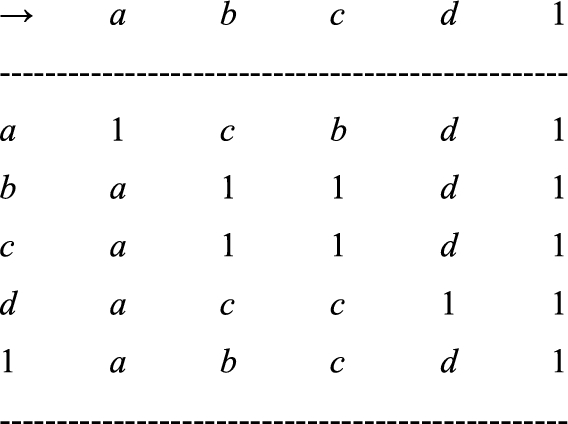
We can observe that the properties (M), (K), (p-1) (hence (Re), (L), (B), (BB), (C), (D), (*), (**), (Tr), (p-2)) are satisfied. Then, is a pre-Hilbert algebra. It does neither satisfy (An) for nor (Ex) and (pimpl) for
Proposition 2.11
Let A = be an algebra of type (2, 0). The following are equivalent:
- (i)A is a pre-Hilbert algebra;
- (ii)A satisfies (M), (L), (B) and (p-1);
- (iii)A is a pre-BCC algebra satisfying (p-1).
Proof
- (i) ⇒ (ii).Follows from Theorem 2.8.
- (ii) ⇒ (iii).By Lemma 2.2 (i), (M) + (B) imply (Re). Therefore A is a pre-BCC algebra with (p-1).
- (iii) ⇒ (i).By Lemma 2.2 (iv), (M) + (L) + (B) imply (K). Then A satisfies (M), (K) and (p-1). Thus A is a pre-Hilbert algebra. □
Proposition 2.12
Let A = be a pre-Hilbert algebra. Then A induces a pre-order on A, defined by: and 1 is the element of A satisfying the following conditions:
(L1)
(L2)
Proof
Straightforward. □
Proposition 2.13
([Walendziak 2024], Proposition 3.18) Let A be a non-void set of elements, be a pre-order relation on A and 1 be an element of A satisfying (L1) and (L2). We define the operation → by.
Then is a pre-Hilbert algebra.
Example 2.14
Let be the set of integers and let for x, y the symbol x∣y mean that x divides y. Then the relation ∣ is a pre-order on which is not an order (for example, and but ). Moreover, for each x and if then . If we define the operation → by.
then is a pre-Hilbert algebra.
Remark 2.15
The class of all pre-Hilbert algebras is a variety. Therefore, if A1 and A2 are two pre-Hilbert algebras, then the direct product A = A1 × A2 is also a pre-Hilbert algebra.
Let I be be any set and, for each let be a pre-Hilbert algebra. Suppose that for ; Set and define the binary operation → on A via
It is easy to check that A = is a pre-Hilbert algebra. We say that A is the disjoint union of , , and write
Remark 2.16
Since a Hilbert algebra is a pre-Hilbert algebra satisfying (An), we have H = pre-H + (An). By Proposition 2.11, pre-H = pre-BCC + (p-1). Therefore H = BCC + (p-1). From Lemma 2.2 (vii) we conclude that BCC + (p-1) = BCC + (Ex) + (p-1) = BCK + (p-1), that is, H = BCK + (p-1).
The interrelationships between the classes of algebras mentioned before are visualized in Fig. 1.
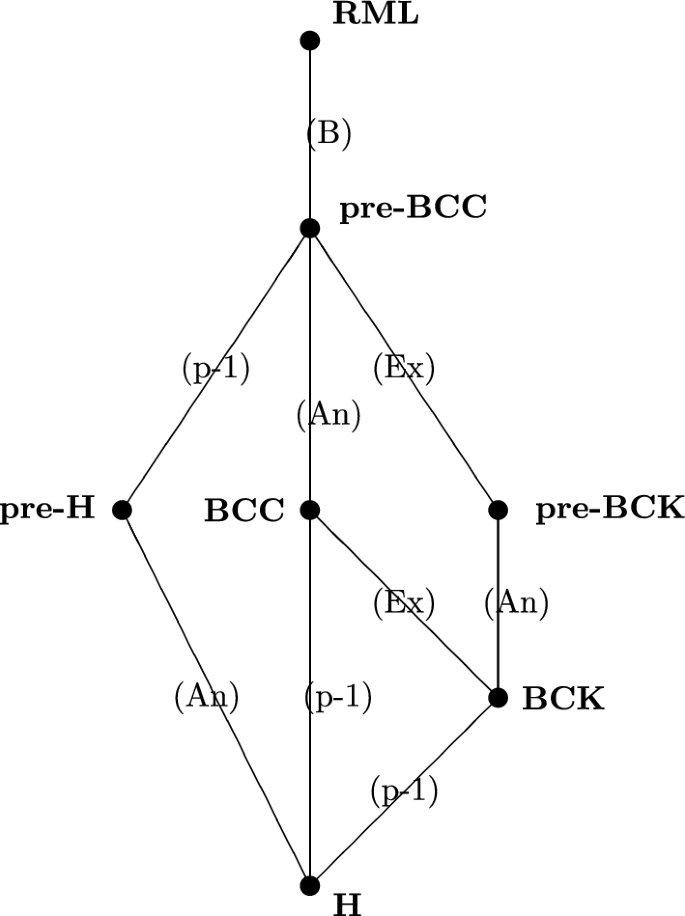
The hierarchy between RML and H
3 Deductive systems of pre-Hilbert algebras
Diego (1966) introduced the notion of a deductive system of a Hilbert algebra. Similarly, if A = is a pre-Hilbert algebra, we say that a subset D of A is a deductive system of A if it satisfies:
(d1),
(d2) for all , if and , then .
By DS(A) we denote the set of all deductive systems of A. It is obvious that
Example 3.1
Let and → be given by the following table:
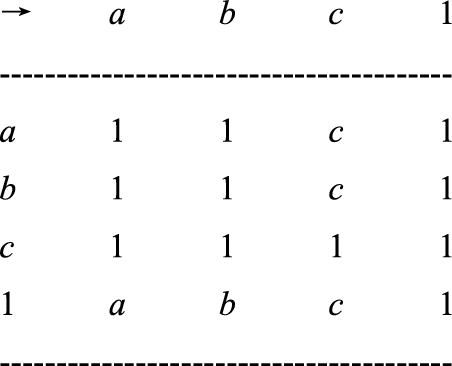
We can observe that the properties (M), (K), (p-1) are satisfied. Then, A = is a pre-Hilbert algebra. It is easy to see that
Proposition 3.2
Let D be a deductive system of a pre-Hilbert algebra (A, → ,1). Then, for any , if and , then .
Proof
Straightforward. □
Remark 3.3
Any deductive system D of a pre-Hilbert algebra (A, → ,1) satisfies the following condition: for every (such deductive systems are called closed).
Proposition 3.4
Let D be a nonempty subset of a pre-Hilbert algebra A = . Then D is a deductive system of A if and only if for any implies .
Proof
Let and Suppose that From Proposition 3.2 we conclude that By the definition of a deductive system,
Conversely, assume that implies for all Since D is nonempty, let By (L), Hence by assumption. Let and From (D) we see that By assumption, Thus D is a deductive system of A. □
Proposition 3.5
A deductive system of a pre-Hilbert algebra A = is a subalgebra of A.
Proof
Let D be a deductive system of A. Obviously Let By (K), Since from Proposition 3.2 we deduce that Therefore, D is a subalgebra of A. □
Remark 3.6
The converse of Proposition 3.5 does not hold. Indeed, the subalgebra of the pre-Hilbert algebra A from Example 3.1 is not a deductive system.
Proposition 3.7
For each let be a deductive system of the pre-Hilbert algebra . Then is a deductive system of
Proof
Straightforward. □
Theorem 3.8
Let be an indexed family of pre-Hilbert algebras and Let be a deductive system of for Then is a deductive system of A. Conversely, every deductive system of A is of this form.
Proof
Let D = . Of course, Let and If and , where then Suppose that Then Since is a deductive system of , we conclude that Hence and consequently,
Now let D be a deductive system of A. It is easy to see that for We have D = □
Let A = and B = be pre-Hilbert algebras and let be a homomorphism. The kernel of f is the set
that is, Ker(f) = where denote the f-inverse image of It is easy to see that the next lemma holds.
Lemma 3.9
Let A = and B = be pre-Hilbert algebras, be a homomorphism and let If then
Proposition 3.10
Let A and B be pre-Hilbert algebras and let be a homomorphism. If then
Proof
The proof is straightforward. □
Proposition 3.11
Let A = and B = be pre-Hilbert algebras and let be a surjective homomorphism. If D is a deductive system of A including Ker(f), then .
Proof
Obviously, Let and let Then there are such that and Since f is surjective, for some We have and hence, by Lemma 3.9, Since we conclude that Therefore Consequently, □
Let A be a pre-Hilbert algebra and The set
D(X) = is a deductive system of A, called the deductive system generated by X. For we write D(a) instead of D({a}). Define and on DS(A) by and It is easy to see that under these operations DS(A) is a lattice. Moreover, this lattice is complete, since it is closed under arbitrary intersections.
Proposition 3.12
Let X be a nonempty subset of a pre-Hilbert algebra A = and let Then D(X) = Y. Moreover, D(∅) = {1}.
Proof
Since A satisfies (L), . Suppose that By the definition of Y, there are such that
and, similarly, there exist such that
Applying (C), we get
Repeating this, by (*) and (C), we have
Then, applying (4), we have and therefore, Hence, by (*),
Thus Consequently, Y is a deductive system of A. Obviously,
To prove that Y is the least deductive system including X, let and For any there are such that (3) holds. Since we have By definition, from (3) we conclude that So Then D(X) = Y.
Moreover, it is easily seen that D(∅) = {1}. □
By Proposition 3.12, the mapping is an algebraic closure operator on the power set of A, that is, for every
D(X) ={D(): is a finite subset of X}.
Hence, by Theorem 2.16 of [McKenzie et al. 1987], we get.
Theorem 3.13
For any pre-Hilbert algebra A, (DS(A), ⊆) is an algebraic lattice whose the compact elements are exactly the finitely generated deductive systems.
Proposition 3.14
Let D be a deductive system of a pre-Hilbert algebra A = and Then D(D ∪ {a}) =
Proof
Set We first show that is a deductive system of A. By (L), Suppose that and Then and Applying (p-1), we get
By Proposition 3.2, and hence since and D ∈ DS(A). Consequently, Thus is a deductive system of A. Let By (K), Hence that is, Therefore, Moreover, Now let E be another deductive system including the set If then This gives and hence Then Consequently, □
Proposition 3.15
Let is a pre-Hilbert algebra. For any
Proof
It is obvious that Applying Proposition 3.14 for we have □
For every D(a) is the principal deductive system generated by a.
Let be a pre-Hilbert algebra and Write
Lemma 3.16
If is a pre-Hilbert algebra and then is a deductive system of A.
Proof
It is clear that Suppose that and Let Applying (K), we see that and hence by Proposition 3.2. Since and we obtain
From (K) and (p-1) we conclude that
Then, using (**), we get
Since E is a deductive system, from (5) and (6) we deduce that
By (B), Since we see that
From (7) and (8) we have Therefore, Thus, is a deductive system of A. □
Lemma 3.17
If is a pre-Hilbert algebra, D and E are deductive systems of A, then is a relative pseudocomplement of D with respect of E in the lattice DS(A).
Proof
By Lemma 3.16 Let It is sufficient to show that
Let and Then Hence Conversely, assume and let Let d be an arbitrary element of D. By (K), Since D is a deductive system and d D, we get By (D), From this we conclude that because and Then and hence Therefore and consequently □
From Theorem 3.13 and Lemma 3.17 we obtain
Theorem 3.18
For any pre-Hilbert algebra A, (DS(A), ⊆) is an algebraic distributive lattice.
Example 3.19
Let A be the pre-Hilbert algebra from Example 2.10. It is easy to see that A has the following deductive systems: Figure 2 is the Hasse diagram of the lattice DS(A).
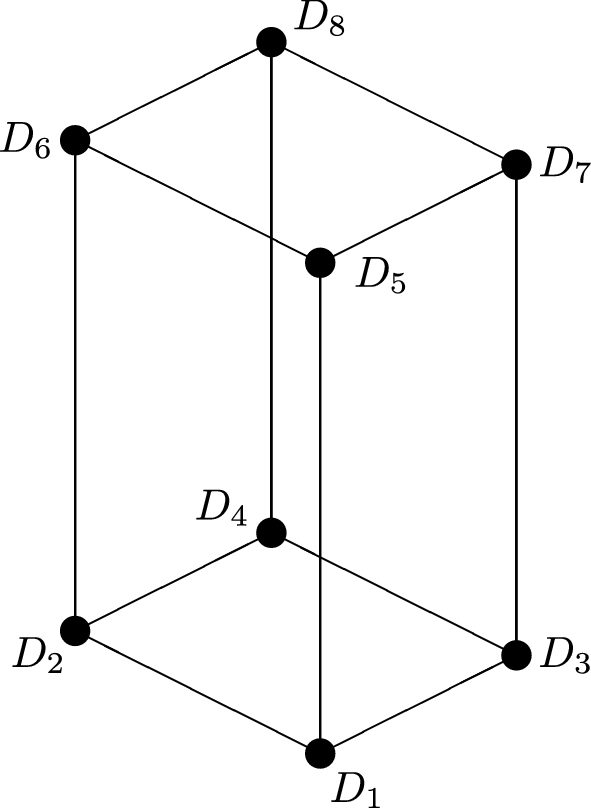
The lattice DS(A), where A is the algebra from Example 2.10
Proposition 3.20
If A is a pre-Hilbert algebra, then is a Hilbert algebra.
Proof
Let D and E be deductive systems of A. Observe that
Indeed, by (9), Obviously, DS(A) satisfies (An). Since we have by (9). Consequently, DS(A) satisfies (K). To prove (p-1), let First we prove that
Since we get On the other hand, and Hence Thus (10) holds. Applying (10), we obtain
Hence by (9), and consequently that is, (p-1) holds in DS(A). Thus (DS(A),) is a Hilbert algebra. □
4 Deductive systems and R-congruences
For we first define
and then define
Therefore
and
Theorem 4.1
Let be a pre-Hilbert algebra and D be a deductive system of A. Then is a congruence on A.
Proof
By (Re), that is, for any This means that is reflexive. From definition, is symmetric. To prove that is transitive, let and Then and By (BB), and Hence, by Proposition 3.2 and the definition of a deductive system, we get and Consequently, and so is transitive. Thus is an equivalence relation on A.
Let and suppose that Then and By (B), Since we obtain that is, Similarly, because Therefore
Applying (BB), we have and Hence and Thus
Thus is an equivalence relation satisfying (11) and (12). Consequently, is a congruence on A. □
Let Con(A) denote the set of all congruences on A. For and we write θ for the congruence class containing x, that is, We say that is an R-congruence on A if it satisfies the following property: for all
(R) and imply
We will denote by the set of all R-congruences on A.
Observe that satisfies (R). Let and Then and Consequently, Thus we have
Proposition 4.2
If A is a pre-Hilbert algebra and then
Example 4.3
Let A be the pre-Hilbert algebra from Example 3.1. Then but it does not satisfy (R). Indeed, and but a b does not hold.
As usual, a deductive system D of a pre-Hilbert algebra A is called the kernel of the congruence on A if
Proposition 4.4
Every deductive system of a pre-Hilbert algebra is the kernel of some R-congruence on A.
Proof
Let By Proposition 4.2, Moreover, we have
Therefore, □
Proposition 4.5
Let be a pre-Hilbert algebra and Then and
Proof
Observe that is a deductive system of A. Obviously, Let and Then and Hence Consequently, that is, Thus
Now observe that Indeed,
since satisfies (R). Therefore, □
Theorem 4.6
Let be a pre-Hilbert algebra. Then the lattices and are isomorphic.
Proof
We consider the function
By Proposition 4.5, maps into DS(A). Since any deductive system of A is the kernel of some R-congruence on A, we conclude that is onto DS(A). Observe that
for all If , then clearly , that is, . Conversely, assume and let Then and hence Similarly, Since satisfies (R), we have Thus Consequently, maps onto DS(A) and satisfies (13). Therefore is isomorphic to □
Example 4.7
Let A be the pre-Hilbert algebra from Example 2.10. By Theorem 4.6 and Example 3.19, is the eight-element Boolean algebra.
Since pre-Hilbert algebras form a variety, from the Homomorphism Theorem for universal algebra we have
Lemma 4.8
Let be a pre-Hilbert algebra and Set for Then is a pre-Hilbert algebra.
Proposition 4.9
Let be a congruence on a pre-Hilbert algebra . Then the following are equivalent:
(i) is an R-congruence on A,
(ii) θ is a Hilbert algebra.
Proof
(i) ⇒ (ii). By Lemma 4.8, is a pre-Hilbert algebra. Let satisfy (R) and Suppose that
Then Hence and Since satisfies (R), we have Therefore, and consequently, (An) holds in
(ii) ⇒ (i). Let Assume that and Hence we obtain (14). Since θ satisfies (An), we get that is, Thus is an R-congruence on A. □
Let D be a deductive system of a pre-Hilbert algebra . For we write It is easy to see that We note that if and only if that is,
In particular,
By the proof of Proposition 4.4, , that is, Then denotes the quotient algebra Instead of and we also write A/D and A/D, respectively.
Now, we define the binary relation on A/D as follows: for all
(that is, ).
Remark 4.10
Since is a transitive relation (this follows from the proof of Theorem 4.1), we conclude that is well defined.
Proposition 4.11
Let D be a deductive system of a pre-Hilbert algebra . Then:
(i) A/D is a Hilbert algebra,
(ii) for all
Proof
(i) From Proposition 4.2 we see that Hence, by Proposition 4.9, is a Hilbert algebra.
(ii) Let We have
Then, (ii) holds. □
Theorem 4.12
Let A be a pre-Hilbert algebra and B be a Hilbert algebra. Let be a homomorphism from A onto B. Then A/Ker(f) is isomorphic to B.
Proof
Since B as a Hilbert algebra satisfies (An), we have if and only if (for all ). Then this theorem follows from the Homomorphism Theorem for universal algebras. □
Proposition 4.13
Let D be a deductive system of a pre-Hilbert algebra and let Then if and only if (where ) for some such that
Proof
Suppose that Let Suppose that By (15), Hence and we obtain Observe that D0 is a deductive system of A. Indeed, and let Then and Hence and therefore Thus It is easy to see that
Conversely, let for some such that Of course, Let Then and Since D0 is a deductive system of A, we see that hence that Consequently, □
5 Maximal deductive systems
Definition 5.1
Let A be a pre-Hilbert algebra and let D be a proper deductive system of A (i.e., ). Then D is called maximal if whenever E is a deductive system such that then either or
The next lemma is obvious and its proof will be omitted.
Lemma 5.2
Every proper deductive system of a pre-Hilbert algebra can be extended to a maximal deductive system.
Theorem 5.3
For each let be a deductive system of the pre-Hilbert algebra A deductive system is maximal in if and only if there is an unique index such that is maximal in and for any
Proof
Straightforward. □
The following two theorems give the homomorphic properties of maximal deductive systems.
Theorem 5.4
Let and be pre-Hilbert algebras and let be a surjective homomorphism. If D is a maximal deductive system of A including Ker(f), then is a maximal deductive system of B.
Proof
By Proposition 3.11, Let and suppose that . Then for some Applying Lemma 3.9 we conclude that and hence a contradiction. Therefore . We take a proper deductive system E of B such that . From Proposition 3.10 we deduce that It is easy to see that Since D is maximal, . Consequently, . Thus is a maximal deductive system of B. □
Theorem 5.5
Let A and B be pre-Hilbert algebras and let be a surjective homomorphism. If D is a maximal deductive system of B, then is a maximal deductive system of A.
Proof
From Proposition 3.10 we conclude that . It is easily seen that By Lemma 5.2 there is a maximal deductive system F of A including E. We have
Since , Theorem 5.4 shows that is a maximal deductive system of B. Obviously, and hence . Then , that is, . Thus is a maximal deductive system of A. □
Theorem 5.6
For every proper deductive system D of a pre-Hilbert algebra , the following conditions are equivalent:
(a) D is a maximal deductive system of A;
(b) for any and ;
(c) ;
(d) A/D has exactly two R-congruences.
Proof
(a) ⇒ (b). Let . Suppose that D is a maximal deductive system of A and let . Then and hence . By Proposition 3.14, .
(b) ⇒ (c). Let D satisfy (b). Let and . Then , since . By Proposition 3.15, Hence . Let E be a deductive system of A/D. From Proposition 4.13 we see that for some such that . If , then . Suppose that . Then for some . Since , we conclude that . Thus
(c) ⇔ (d) follows from Theorem 4.6.
(c) ⇒ (a). Let F be a proper deductive system of A including D. By Proposition 4.13, Observe that On the contrary, suppose that Let and assume Then there exists some with Now we have and and hence , a contradiction. Therefore and by assumption, that is, , which proves that D is maximal. □
Proposition 5.7
Let D be a maximal deductive system of a pre-Hilbert algebra . Then for any we have or
Proof
Let If and then by Theorem 5.6. Similarly, for and If then and , since D is a subalgebra of A (see Proposition 3.5). □
Remark 5.8
Let A be the pre-Hilbert algebra from Example 3.1. Then for any we have or but is not a maximal deductive system of A. Therefore the converse of Proposition 5.7 does not hold.
6 Conclusions
We obtained the properties and characterizations of deductive systems in pre-Hilbert algebras. We described deductive systems in direct products and disjoint unions of such algebras. We showed that the lattice of deductive systems of a pre-Hilbert algebra is algebraic and distributive. We introduced the concept of an R-congruence and proved that the lattice of R-congruences on a pre-Hilbert algebra A is isomorphic to the lattice of deductive systems of A. Moreover, we constructed the quotient algebra A/D of a pre-Hilbert algebra A via a deductive system D of A and obtained the fundamental homomorphism theorem. Finally, we studied maximal deductive systems. We gave some characterizations of them. We provided the homomorphic properties of maximal deductive systems.
