
 info@apippress.com
 +86 18163351462 (WhatsApp)
 +86 182 8014 0209
Article Content
Abstract
Brayton cycle; electrical generation; power systems; s-CO2 mixtures
1. Introduction
2. Methodology
2.1. Cycle Configuration

2.2. Recompression Brayton Cycle Simulation Methodology
2.3. Component Modeling
2.4. Performance Calculation
Once the thermodynamic state points are fully resolved, the performance of the recompression Brayton cycle is evaluated based on both component-level and system-wide metrics. The specific work output of the turbine is determined using an isentropic expansion model, subsequently adjusted by the turbine isentropic efficiency (𝜂𝑡𝑢𝑟𝑏) to account for real-world deviations from ideal behavior:
Similarly, the specific work input for both the main compressor and recompressor is evaluated using the following:
These values are multiplied by the respective mass flow rates to calculate the component-wise power outputs and consumptions:
The total net power output is therefore as follows:
where:
The thermal efficiency of the cycle is defined according to the first law of thermodynamics as the ratio of the net power output to the heat input delivered in the primary heat exchanger (PHX):
where the heat duty in the PHX is
For the recuperative heat exchangers (HTR and LTR), the heat transfer rate is determined by the energy balance between the hot and cold streams:
The corresponding UA evaluation utilizes the logarithmic mean temperature difference (LMTD) method:
where UA is iteratively adjusted to meet the specified performance criteria, using a combination of bisection and secant methods, with convergence achieved when the residual is below a defined tolerance:
Furthermore, the recuperator effectiveness (𝜀𝐻𝑋) is computed as
where
All component pressure drops are incorporated into the thermodynamic property calculations, applied either as absolute or relative drops, as follows:
where applicable; when a heat exchanger’s UA falls below a predefined negligible threshold (1·10−12), the component is considered inactive and bypassed within the model.
Finally, in cases where a target net power output is prescribed, the model employs an iterative adjustment of the total mass flow rate until the calculated net power converges to the desired value within a predefined numerical tolerance. This procedure ensures consistency between the system-level performance requirement and the thermodynamic state configuration, allowing the model to scale the cycle appropriately while preserving component efficiency and design constraints:
The exergetic analysis was conducted in accordance with the relevant equations pertaining to the Second Law of Thermodynamics [39]. Furthermore, the assumption of a steady-state and adiabatic system was made. The exergy balance is expressed in Equation (21).
where 𝐸˙𝑄 denotes the exergy rate of the heat transfer, 𝐸˙𝑊 is the exergy rate of the work, 𝐸˙𝐷 signifies the exergy destruction rate, and 𝑒 is the specific exergy. The specific exergy and exergy values at each state point (𝑖) of the cycle are calculated by Equations (22) and (23), respectively.
The following expressions provide a quantitative representation of the exergetic efficiency of the individual components that constitute the given cycle [40]:
The exergy efficiency of the cycle is defined as the ratio of thermal efficiency to the Carnot efficiency of the cycle [39,41].
The value of 𝜂𝑑𝑖𝑠𝐸𝑞−𝐶𝑎𝑟𝑛𝑜𝑡 represents the equivalent Carnot efficiency of the cycle [39,41,42,43,44]. This can be calculated using Equation (30).
In this Equation (30), 𝑇𝑑𝑖𝑠𝑟𝑒𝑗 denotes the heat rejection temperature and 𝑇𝑑𝑖𝑠𝑎𝑏𝑠 signifies the temperature at which heat is absorbed during the cycle in the discharge stage. The values of these temperatures are determined by means of the following equations:
The Second Law of Thermodynamics provides a framework for quantifying the impact of irreversibilities—such as those arising from heat transfer and fluid flow—on the overall performance of thermodynamic cycles [42]. To account for these effects, the concept of an equivalent Carnot cycle, as introduced in Equation (30), must be extended and refined as follows:
In order to determine the exergy destruction rate of the components of the examined cycle, the following equations are employed [40]:
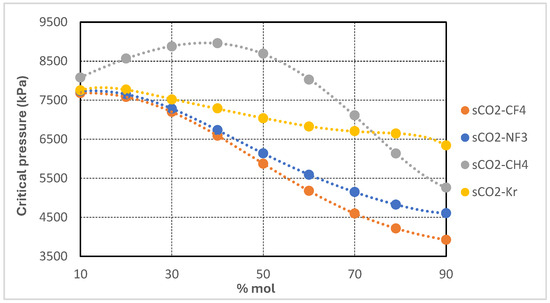
2.5. Fluid Blends Properties




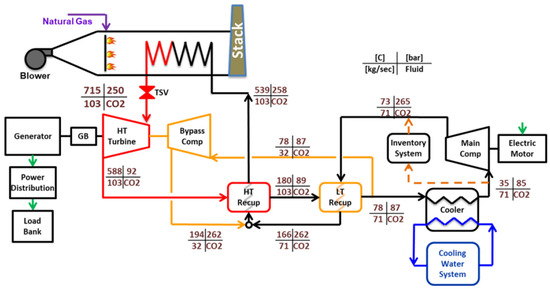
2.6. Thermodynamic Modeling Validation

2.7. Operating Conditions
2.8. Performance Metrics
3. Results and Discussion
3.1. Impact of CO2-Based Binary Mixtures on RBC Performance Under Cold Ambient Conditions
3.1.1. Enhancement of Cycle Thermal Efficiency with CO2/CF4 Mixture
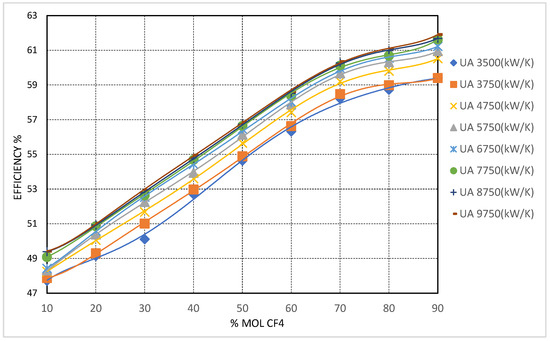
3.1.2. Superior Efficiency Gains with CO2/CH4 Mixture and Challenges in Turbomachinery Integration

3.2. Cycle Optimization Through Critical Pressure Management and Turbomachinery Implications
3.3. Recuperator Performance Optimization and Sensitivity to UA

3.4. Comparative Evaluation of Mixture Performance and Operational Trade-Offs
3.4.1. CO2/CF4 Mixtures
3.4.2. CO2/CH4 Mixtures
3.5. Critical Temperature Reduction and Cycle Performance at Subzero Ambient Conditions
3.5.1. CO2/CF4 Mixture
3.5.2. CO2/CH4 Mixture
3.5.3. CO2/NF3 Mixture
3.5.4. CO2/Kr Mixture

3.5.5. Comparative Performance Under Various CIT Scenarios
3.6. Sensitive Exergy Analysis
3.6.1. Pure CO2

3.6.2. CO2/CF4 Mixture

3.6.3. CO2/CH4 Mixture

3.6.4. CO2/NF3 Mixture

3.6.5. CO2/Kr Mixture

4. Conclusions
- (1)
-
Working Fluid Selection
- (2)
-
Heat Exchanger Design Optimization
- (3)
-
System-Level Integration Considerations
- (4)
-
Environmental and Economic Considerations
Author Contributions
Funding
Institutional Review Board Statement
Data Availability Statement
Acknowledgments
Conflicts of Interest
Nomenclature
| Abbreviations | |
| CF4 | Tetrafluoromethane |
| CH4 | Methane |
| CIP | Compressor inlet pressure |
| CIT | Compressor inlet temperature |
| CO2 | Carbon dioxide |
| CSP | Concentrated solar power |
| LT | Low temperature |
| ℎ | Specific enthalpy [kJ/kg] |
| HT | High temperature |
| HTR | High temperature recuperator |
| Kr | Krypton |
| NF3 | Nitrogen Trifluoride |
| MC | Main Compressor |
| 𝑚˙𝑐𝑜𝑚𝑝 | Mass flow of the compressor [kg/s] |
| 𝑚˙𝑡𝑢𝑟𝑏 | Mass flow of the turbine [kg/s] |
| NIST | National Institute of Standards and Technology |
| RBC | Recompression Brayton cycle |
| RC | Recompressor |
| LTR | Low temperature recuperator |
| PC | Pre-Compressor |
| PHX | Primary heat exchanger |
| 𝑃𝑀𝐶,𝑜𝑢𝑡 | Compressor outlet pressure |
| PreC | Precooler |
| 𝑄˙ | Heat transfer ratio |
| 𝑠 | Specific entropy [kJ/kg·K] |
| s-CO2 | Supercritical carbon dioxide |
| SCSP | Supercritical concentrated solar power plant |
| 𝑇0 | Ambient temperature [K] |
| 𝑇𝑎𝑏𝑠 | Absorption temperature [K] |
| 𝑇𝑟𝑒𝑗 | Rejection temperature [K] |
| 𝑈𝐴𝑡𝑜𝑡𝑎𝑙 | Heat total recuperator conductance [kW/K] |
| 𝑊˙ | Power [kW] |
| Greek Symbols | |
| 𝜂𝐸𝑞−𝐶𝑎𝑟𝑛𝑜𝑡 | Equivalent Carnot efficiency |
| 𝜂𝑐𝑜𝑚𝑝 | Compressor efficiency |
| 𝜂𝑔 | Generator efficiency |
| 𝜂𝑡𝑢𝑟𝑏 | Turbine efficiency |
| 𝜂𝑡ℎ | Thermal efficiency |
| 𝜂𝑒𝑥 | Exergy efficiency |
| 𝜎˙ | Entropy generated [kW/K] |
| 𝛾 | Split flow ratio |
References
- White, M.T.; Bianchi, G.; Chai, L.; Tassou, S.A.; Sayma, A.I. Review of supercritical CO2 technologies and systems for power generation. Appl. Therm. Eng. 2021, 185, 116447. [Google Scholar] [CrossRef]
- Liang, Y.; Lin, X.; Su, W.; Xing, L.; Zhou, N. Thermal-economic analysis of a novel solar power tower system with CO2-based mixtures at typical days of four seasons. Energy 2023, 276, 127602. [Google Scholar] [CrossRef]
- Crespi, F.; de Arriba, P.R.; Sánchez, D.; Muñoz, A. Preliminary investigation on the adoption of CO2–SO2 working mixtures in a transcritical Recompression cycle. Appl. Therm. Eng. 2022, 211, 118384. [Google Scholar] [CrossRef]
- Jeong, S.; Kim, S.Y.; Lee, Y.; Lee, J.; Jeong, J. CO2-based binary mixtures for sodium-cooled fast reactor power systems. Ann. Nucl. Energy 2012, 45, 10–20. [Google Scholar] [CrossRef]
- Wu, C.; Wang, S.; Li, J. Exergoeconomic analysis and optimization of a combined supercritical carbon dioxide recompression Brayton/organic flash cycle for nuclear power plants. Energy Convers. Manag. 2018, 171, 936–952. [Google Scholar] [CrossRef]
- Jeong, S.; Lee, Y.; Lee, J.; Jeong, J. Application of CO2-based mixtures to increase thermal efficiency in nuclear power systems. Energy 2013, 49, 187–197. [Google Scholar] [CrossRef]
- Bonalumi, D.; Casati, A.; Lozza, G. Thermodynamic optimization of CO2/TiCl4 supercritical cycle. Appl. Energy 2014, 113, 1225–1235. [Google Scholar] [CrossRef]
- Invernizzi, C.M.; Martelli, E. Experimental study of TiCl4–CO2 mixtures for power cycle applications. Energy Procedia 2016, 101, 1251–1258. [Google Scholar] [CrossRef]
- Di Marcoberardino, G.; Morosini, E.; Manzolini, G. Experimental and analytical procedure for the characterization of innovative working fluids for power plants applications. Appl. Therm. Eng. 2020, 178, 115513. [Google Scholar] [CrossRef]
- Dostal, V. A Supercritical Carbon Dioxide Cycle for Next Generation Nuclear Reactors in Ph.D. Thesis, Department of Nuclear Engineering MIT 2004. Available online: https://dspace.mit.edu/handle/1721.1/17746 (accessed on 26 May 2025).
- Kulhánek, M.; Dostál, V. Supercritical Carbon Dioxide Cycles Thermodynamic Analysis and Comparison. Proceedings of Supercritical CO2 Power Cycle Symposium. 2011. Available online: https://stc.fs.cvut.cz/history/2009/sbornik/Papers/pdf/KulhanekMartin-319574.pdf (accessed on 26 May 2025).
- Aqel, O.A.; White, M.T.; Khader, M.A.; Sayma, A.I. Sensitivity of transcritical cycle and turbine design to dopant fraction in CO2-based working fluids. Appl. Therm. Eng. 2021, 190, 116796. [Google Scholar] [CrossRef]
- Valencia-Chapi, R.; Coco-Enríquez, L.; Muñoz-Antón, J. Supercritical CO2 mixtures for advanced Brayton power cycles in line-focusing solar power plants. Appl. Sci. 2020, 10, 55. [Google Scholar] [CrossRef]
- Crespi, F.; Rodríguez-de-Arriba, P.; Sánchez, D.; Muñoz, A. A methodology to design air-cooled condensers for supercritical power cycles using carbon dioxide and carbon dioxide mixtures. In Proceedings of the European sCO2 Conference, Prague, Czech Republic, 14–16 March 2024. [Google Scholar] [CrossRef]
- Wang, L.; Pan, L.-M.; Wang, J.; Chen, D.; Huang, Y.; Sun, W.; Hu, L. Investigation on the effect of mixtures physical properties on cycle efficiency in the CO2-based binary mixtures Brayton cycle. Prog. Nucl. Energy 2022, 143, 104049. [Google Scholar] [CrossRef]
- Illyés, V.C.; Di Marcoberardino, G.; Werner, A.; Haider, M.; Manzolini, G. Experimental evaluation of the CO2-based mixture CO2/C6F6 in a recuperated transcritical cycle. Energy 2024, 313, 133713. [Google Scholar] [CrossRef]
- Tafur-Escanta, P.M.; Valencia-Chapi, R.; Muñoz-Antón, J. Exergetic and Entropy Analysis of the PCRC and RCMCI Brayton Cycles Using s-CO2 Mixtures. Case Study: Marine Applications. In Proceedings of the European sCO2 Conference, Prague, Czech Republic, 14–16 March 2024. [Google Scholar] [CrossRef]
- Doninelli, M.; Morosini, E.; Alfani, D.; Astolfi, M.; Di Marcoberardino, G.; Manzolini, G. Analysis of the potential of CO2 based mixtures to improve the efficiency of cogenerative waste heat recovery power plants. In Proceedings of the European sCO2 Conference, Prague, Czech Republic, 14–16 March 2024. [Google Scholar] [CrossRef]
- Rodríguez-de-Arriba, P.; Crespi, F.; Pace, S.; Sánchez, D. Mapping the techno-economic potential of next-generation CSP plants running on transcritical CO2-based power cycles. Energy 2024, 310, 133142. [Google Scholar] [CrossRef]
- Vesely, L.; Manikantachari, K.R.V.; Vasu, S.; Kapat, J.; Dostal, V.; Martin, S. Effect of impurities on compressor and cooler in supercritical CO2 cycles. J. Energy Resour. Technol. 2019, 141, 012003. [Google Scholar] [CrossRef]
- Wang, X.; Zhang, L.; Zhu, Z.; Hu, M.; Wang, J.; Fan, X. Performance improvement overview of the supercritical carbon dioxide Brayton cycle. Processes 2023, 11, 2795. [Google Scholar] [CrossRef]
- Abdeldanyem, A.S.; White, M.T.; Paggini, A.; Ruggiero, M.; Sayma, A.I. Integrated aerodynamic and structural blade shape optimization of axial turbines operating with supercritical carbon dioxide blended with dopants. J. Eng. Gas Turbines Power 2022, 144, 101016. [Google Scholar] [CrossRef]
- Salah, S.I.; Crespi, F.; White, M.T.; Muñoz, A.; Paggini, A.; Ruggiero, M.; Sánchez, D.; Sayma, A.I. Axial turbine flow path design for concentrated solar power plants operating with CO2 blends. Appl. Therm. Eng. 2023, 230, 120612. [Google Scholar] [CrossRef]
- Abdeldanyem, A.S.; Salah, S.I.; White, M.T.; Sayma, A.I. A modified loss breakdown approach for axial turbines operating with blended supercritical carbon dioxide. J. Eng. Gas Turbines Power 2023, 145, 081002. [Google Scholar] [CrossRef]
- Liu, J.; Yu, A.; Lin, X.; Su, W.; Ou, S. Performances of Transcritical Power Cycles with CO2-Based Mixtures for the Waste Heat Recovery of ICE. Entropy 2021, 23, 1551. [Google Scholar] [CrossRef] [PubMed]
- Yu, A.; Su, W.; Zhao, L.; Lin, X.; Zhou, N. New knowledge on the performance of supercritical Brayton cycle with CO2-based mixtures. Energies 2020, 13, 1741. [Google Scholar] [CrossRef]
- Morosini, E.; Alfani, D.; Salah, S.I.; Abdeldanyem, A.; Crespi, F.; Di Marcoberardino, G.; Manzolini, G. Off-design of a CO2-based mixture transcritical cycle for CSP applications: Analysis at part load and variable ambient temperature. Appl. Therm. Eng. 2024, 236, 121735. [Google Scholar] [CrossRef]
- Doninelli, M.; Di Marcoberardino, G.; Invernizzi, C.M.; Iora, P. Experimental isochoric apparatus for bubble points determination: Application to CO2 binary mixtures as advanced working fluids. Int. J. Thermofluid. 2024, 23, 100742. [Google Scholar] [CrossRef]
- Baiguini, M.; Doninelli, M.; Morosini, E.; Alfani, D.; Di Marcoberardino, G.; Iora, P.G.; Manzolini, G.; Invernizzi, C.M.; Astolfi, M. Small scale CO2 based trigeneration plants in heat recovery applications. Appl. Therm. Eng. 2024, 255, 123943. [Google Scholar] [CrossRef]
- Baiguini, M.; Di Marcoberardino, G.; Iora, P.G. High-temperature electrolysis integrated with advanced power cycles for the combined production of green hydrogen, heat and power. Energy Convers. Manag. 2024, 322, 119121. [Google Scholar] [CrossRef]
- Ma, Y.-N.; Hu, P. Thermo-economic comparative study and multi-objective optimization of supercritical CO2-based mixtures Brayton cycle combined with absorption refrigeration cycle. J. Therm. Sci. Eng. Appl. 2023, 15, 084501. [Google Scholar] [CrossRef]
- NIST Chemistry WebBook, Critical Properties of Krypton, Methane, CF4, NF3. Available online: https://webbook.nist.gov/chemistry (accessed on 26 May 2025).
- IPCC Fifth Assessment Report (AR5)—Global Warming Potentials. Available online: https://www.ipcc.ch/report/ar5/ (accessed on 26 May 2025).
- Doninelli, M.; Morosini, E.; Di Marcoberardino, G.; Invernizzi, C.M.; Iora, P. Experimental characterization of CO2–SiCl4 mixture as innovative working fluid. Energy 2024, 299, 131197. [Google Scholar] [CrossRef]
- Crespi, F.; Rodríguez-de-Arriba, P.; Sánchez, D.; García-Rodríguez, L. Principles of operational optimization of CSP plants based on carbon dioxide mixtures. Appl. Therm. Eng. 2025, 260, 124871. [Google Scholar] [CrossRef]
- Deng, Q.; Liu, A.; Li, J.; Feng, Z. A review on supercritical CO2 and CO2-based mixture in power cycle. Energy Conversat. Manag. 2025, 324, 119295. [Google Scholar] [CrossRef]
- Dyreby, J.J. Modeling the Supercritical Carbon Dioxide Brayton Cycle with Recompression. Ph.D. Thesis, University of Wisconsin–Madison, Madison, WI, USA, 2014. Available online: https://sel.me.wisc.edu/publications/theses/dyreby14.zip (accessed on 26 May 2025).
- Coco-Enríquez, L. Nueva Generación de Centrales Termosolares con Colectores Solares Lineales Acoplados a Ciclos Supercríticos de Potencia. Ph.D. Thesis, UPM, Madrid, Spain, 2017. [Google Scholar] [CrossRef]
- Çengel, Y.; Boles, M.; Kanoglu, M. Thermodynamics. In An Engineering Approach, 10th ed.; McGraw Hill: New York, NY, USA, 2024; Available online: https://www.mheducation.com/highered/product/thermodynamics-an-engineering-approach-cengel.html (accessed on 10 February 2025).
- Ökten, K.; Kurşun, B. Thermo-economic assessment of a thermally integrated pumped thermal energy storage (TI-PTES) system combined with an absorption refrigeration cycle driven by low-grade heat source. J. Energy Storage 2022, 51, 104486. [Google Scholar] [CrossRef]
- Sharma, O.P.; Kaushik, S.C.; Manjunath, K. Thermodynamic analysis and optimization of a supercritical CO2 regenerative recompression Brayton cycle coupled with a marine gas turbine for shipboard waste heat recovery. Therm. Sci. Eng. Prog. 2017, 3, 62–74. [Google Scholar] [CrossRef]
- Nieto-Carlier, R.; Gonzalez-Fernandez, C.; Lopez-Paniagua, I.; Jimenez-Alvaro, A.; Rodriguez-Marin, J. Termodinámica; Dextra Editorial S.L.: Madrid, Spain, 2014; Available online: https://l1nq.com/kBQVo (accessed on 26 May 2025).
- Winterbone, D.E.; Turan, A. Advanced Thermodynamics for Engineers, 2nd ed.; Elsevier Ltd.: Amsterdam, The Netherlands, 2015. [Google Scholar] [CrossRef]
- Tafur-Escanta, P.; López-Paniagua, I.; Muñoz-Antón, J. Thermodynamics Analysis of the Supercritical CO2 Binary Mixtures for Brayton Power Cycles. Energy 2023, 270, 126838. [Google Scholar] [CrossRef]
- Lemmon, E.W.; Huber, M.L.; McLinden, M.O. NIST Standard Reference Database 23: REFPROP Version 10.0. 2018. Available online: https://www.nist.gov/srd/refprop (accessed on 26 May 2025).
- Follett IV, W.W.; Moore, J.; Wade, J.; Pierre, S. The STEP 10 MWe sCO2 pilot installation and commissioning status update. In Proceedings of the 8th International Supercritical CO2 Power Cycles Symposium (Paper #74), San Antonio, TX, USA, 26–29 February 2024; Available online: https://sco2symposium.com/proceedings2024/74-paper.pdf (accessed on 26 May 2025).
- afur-Escanta, P.; Valencia-Chapi, R.; Rodríguez-Martín, J.; Muñoz-Antón, J. Brayton Cycle Using s-CO2 Mixtures as Working Fluid for Pumped Thermal Energy Storage: Exergy and Cost Analysis. In Proceedings of the 6th Edition of the European Conference on Supercritical CO2 (sCO2) for Energy Systems, Delft, The Netherlands, 9–11 April 2025; pp. 88–98. Available online: https://duepublico2.uni-due.de/receive/duepublico_mods_00083284 (accessed on 26 May 2025).
- Tafur-Escanta, P.; Valencia-Chapi, R.; Muñoz-Antón, J. Entropy analysis of new proposed Brayton cycle configurations for solar thermal power plants. Therm. Sci. Eng. Prog. 2025, 62, 103670. [Google Scholar] [CrossRef]
- Stamatellos, G.; Stamatelos, T. Effect of Actual Recuperators’ Effectiveness on the Attainable Efficiency of Supercritical CO2 Brayton Cycles for Solar Thermal Power Plants. Energies 2022, 15, 7773. [Google Scholar] [CrossRef]
- Stamatellos, G.; Stamatellou, A.; Kalfas, A.I. CFD–Aided Design Methodology for PCHE-Type Recuperators in Supercritical CO2 Recompression Power Cycles. In Proceedings of the ASME Turbo Expo 2020: Turbomachinery Technical Conference and Exposition. Volume 5: Controls, Di-agnostics, and Instrumentation; Cycle Innovations; Cycle Innovations: Energy Storage, Virtual, 21–25 September 2020.
