
 info@apippress.com
 +86 18163351462 (WhatsApp)
 +86 182 8014 0209
Article Content
Abstract
The bei-construction in Mandarin is a well-studied construction known for exhibiting both passive-like properties and tough-movement-like properties (see e.g., Feng 1995, 2012; Ting 1995a, 1998; Huang 1999; Tang 2001; Huang et al. 2009; Bruening and Tran 2015; a.o.). In this paper, I argue for a novel analysis of the bei-construction in Mandarin as a passive construction where the passive head/bei hosts a composite probe [ϕ+Ā], which triggers composite A/Ā-movement, in the sense of Van Urk (2015). The subject in the bei-construction is derived via (successive-cyclic) composite A/Ā-movement, followed by a terminating step of A-movement, similar to Longenbaugh’s (2017) analysis of English tough-movement. Under the proposed analysis, the mixed A/Ā-properties associated with the bei-construction are direct consequences of composite A/Ā-movement (following Van Urk 2015; Longenbaugh 2017). The proposed analysis of the bei-construction accounts for two restrictions on long-distance dependencies in the bei-construction – a requirement that no overt, case-less NPs should intervene between the subject of bei and the gap in agent-less bei-constructions, and a subject/object contrast with respect to the possibility of crossing a finite clause boundary to become the subject of bei.
Explore related subjects
Discover the latest articles and news from researchers in related subjects, suggested using machine learning.
- Applied Linguistics
- Chinese
- Classical Linguistics
- Confucianism
- Daoism
- Linguistics
1 Introduction
Passivization in a canonical passive construction, such as the English be-passive, derives three characteristics of a canonical passive construction that are apparently different from its corresponding simple transitive construction (in the active voice): object promotion, agent/external argument demotion, and the presence of a passive marker (while constructions that lack at least one of these characteristics are referred to as noncanonical passive constructions; see, e.g., Legate 2021). Traditionally, passivization is motivated as an instance of case-driven movement. According to Burzio’s generalization (Burzio 1986), all and only the verbs that can assign a theta-role to the (logical) subject can assign accusative case to an object. In the English be-passive, the passivized verb does not assign a theta-role to its logical subject, nor does it assign accusative case; as a result, the object of the passivized verb, which cannot obtain case from the passivized verb, must move to the grammatical subject position where it can obtain case (see, e.g., Baker et al. 1989).Footnote1 More recently, Bruening (2013) proposes that the passive construction involves a passive head, which selects a projection of the agent/external-argument-introducing Voice head (Kratzer 1996). In the English be-passive, when the agent/external argument of the passivized verb is overtly expressed, it is introduced in a by-phrase, and the passive head is semantically vacuous; when the agent/external argument is nonovert and is interpreted as existentially bound, the passive head is responsible for existentially binding the agent/external argument.
It is commonly assumed that A-movement, such as subject-to-subject raising and passivization (in a canonical passive construction), and Ā-movement, such as wh-movement, are associated with distinct properties (see, e.g., Postal 1971; Chomsky 1977, 1981; a.o. and Richards 2014 for a comprehensive overview of these properties). From a featural view of the A/Ā-distinction, the distinct properties associated with A-movement and Ā-movement are derived from the distinct ϕ– and Ā-features which trigger A-movement and Ā-movement, respectively (Van Urk 2015). Furthermore, the possibility of composite probing allows ϕ– and Ā-features present on the same head to probe together, attracting the closest NP with both a matching ϕ-feature and a matching Ā-feature (Van Urk 2015). The featural view of the A/Ā-distinction and the possibility of composite probing together predict the existence of composite A/Ā-movement, triggered by the composite probe [ϕ + Ā], and that such movement should be associated with mixed A/Ā-properties. Positive evidence has been found in languages such as Dinka Bor, a Nilotic language, where movement to Spec, CP (e.g., topicalization and relativization) exhibits properties of both A-movement and Ā-movement under the standard diagnostics (Van Urk 2015), and English, where tough-movement exhibits the same mix of A/Ā-properties as Dinka movement to Spec, CP (Longenbaugh 2017; see also Chomsky 1977, 1981; Brody 1993; Rezac 2006; Hicks 2009; Takahashi 2011; Hartman 2011; Keine and Poole 2017; a.o.).
In this paper, I argue that the featural view of the A/Ā-distinction and the possibility of composite probing by the composite probe [ϕ + Ā] also allow a passive construction to involve composite A/Ā-movement, if the passive head hosts a composite probe [ϕ + Ā]. Specifically, I argue for a novel analysis of the bei-construction in Mandarin, which exhibits both passive-like properties and tough-movement-like properties, as a passive construction where the passive head/bei hosts a composite probe [ϕ + Ā], which triggers composite A/Ā-movement, in the sense of Van Urk (2015). The derivation of the subject in the bei-construction involves composite A/Ā-movement, which proceeds successive-cyclically, followed by a terminating step of A-movement, akin to the analysis proposed by Longenbaugh (2017) for English tough-movement. Consequently, the mixed A/Ā-properties associated with the bei-construction emerge as direct consequences of composite A/Ā-movement (following Van Urk 2015; Longenbaugh 2017).
The proposed analysis of the bei-construction as a passive construction where the subject in the bei-construction is derived via A-movement after (successive-cyclic) composite A/Ā-movement diverges from a widely accepted alternative approach that derives the dependency involved in the bei-construction via base-generation of the subject of bei as an argument of bei and Ā-movement of a null operator (NOP) in bei’s complement, on a par with Chomsky’s (1977, 1981) analysis of English tough-movement (see, e.g., Feng 1995, 2012; Ting 1995a, 1998; Huang 1999; Tang 2001; Huang et al. 2009; Bruening and Tran 2015; a.o.).Footnote2
I will argue that two restrictions on long-distance dependencies in the bei-construction provide evidence for the proposed analysis of the bei-construction as a passive construction where the subject in the bei-construction is derived via A-movement after (successive-cyclic) composite A/Ā-movement and, crucially, are not accounted for by the various proposals under the alternative approach to the bei-construction involving base-generation of the subject of bei and NOP movement in bei’s complement. The first restriction involves a ban on any overt, case-less NPs intervening between the subject of bei and the gap in agent-less bei-constructions. This restriction can be accounted for under the proposed analysis of the bei-construction as a passive construction and Burzio’s generalization (Burzio 1986), which states that all and only the verbs that can assign a theta-role to the (logical) subject can assign accusative case to an object. Specifically, in agent-less bei-constructions, when there is an overt NP that cannot be assigned case by the matrix Voice head, that NP must become the subject of bei, where it can receive case from Infl; in such cases, it is predicted that long-distance dependencies between the subject of bei and a deeply embedded gap in bei’s complement is impossible. The second restriction lies in a contrast when the bei-construction involves a cross-finite-clause dependency between the subject of bei and a subject vs. object gap. This contrast can be derived from the possibility of raising to subject via A-movement to Spec, CP, or hyperraising to subject (see, e.g., Fong 2019; Wurmbrand 2019; Lohninger et al. 2022; a.o.), and the ban on improper Ā-movement to Spec, CP followed by composite A/Ā-movement (see Longenbaugh 2017).
The remainder of this paper is organized as follows: In Sect. 2, I will provide a primer on the bei-construction, with the aim of establishing the syntactic properties of the overt or nonovert agent/external argument of the matrix verb, bei, and its complement, as well as demonstrating both the possibility of and two restrictions on long-distance dependencies between the subject of bei and the gap in bei’s complement. In Sect. 3, I will show that the dependency involved in the bei-construction is established via movement and that the bei-construction exhibits the same mix of A/Ā-properties as Dinka movement to Spec, CP and English tough-movement. In Sect. 4, I will provide the details of the proposed analysis of the bei-construction as a passive construction where the passive head/bei hosts a composite probe [ϕ + Ā] and the subject in the bei-construction is derived via A-movement after (successive-cyclic) composite A/Ā-movement. In Sect. 5, I will account for the two restrictions on long-distance dependencies in the bei-construction – namely, the requirement that no overt, case-less NPs should intervene between the subject of bei and the gap in agent-less bei-constructions, and the subject/object contrast with respect to the possibility of crossing a finite clause boundary to become the subject of bei – under the proposed analysis, and argue against the various proposals under the alternative approach to the bei-construction involving base-generation of the subject of bei and NOP movement in bei’s complement. In Sect. 6, I will review the alternative analyses in more detail and recapitulate their problems. In Sect. 7, I will reconcile two conflicting arguments regarding the base-generated vs. derived status of the subject of bei presented in the literature. In Sect. 8, I will extend the proposed analysis of the bei-construction to bei-constructions where the subject of bei is identified with an indirect object in bei’s complement (i.e., the so-called indirect passives; see, e.g., Huang et al. 2009). Finally, Sect. 9 will conclude.
Throughout the paper, the sources of linguistic examples and judgements are cited when they are based on external references; any minor adaptations, such as changes to lexical items among other simplifications and/or modifications, are made without altering the intended purpose of the data. Uncited examples and judgements are my own and have been checked with 15+ additional native speakers.Footnote3,Footnote4
2 A primer on the bei-construction
In this section, I will provide a primer on the bei-construction in Mandarin, which is a well-studied construction known for exhibiting both passive-like properties and tough-movement-like properties (see, e.g., Feng 1995, 2012; Ting 1995a, 1998; Huang 1999; Tang 2001; Huang et al. 2009; Bruening and Tran 2015; a.o.). As schematized in (1), a bei-construction has a subject, followed by bei, followed by one or multiple (extended) verbal projections. The agent/external argument of the matrix verb may be overtly expressed, in which case it immediately follows bei, or it may be nonovert, in which case it is interpreted as existentially bound. The bei-construction involves a dependency between the subject and a gap embedded in the verbal projection(s).
- (1)bei-constructionNPi bei (NP) V ( … V … ) __i ( … )
Concretely, like a canonical passive construction, such as the English be-passive, the bei-construction appears to involve object promotion, agent/external argument demotion, and the presence of bei. Compared with the simple transitive construction (in the active voice) in (2a), both the overt-agent bei-construction in (2b) and the agent-less bei-construction in (2c) appear to involve the promotion of the direct object of the simple transitive verb from the postverbal position to the grammatical subject position. In the overt-agent bei-construction in (2b), the agent/external argument of the simple transitive verb is overtly expressed and immediately follows bei, instead of surfacing in the grammatical subject position. In the agent-less bei-construction in (2c), the agent/external argument of the simple transitive verb is nonovert and is interpreted as existentially bound.
- (2)
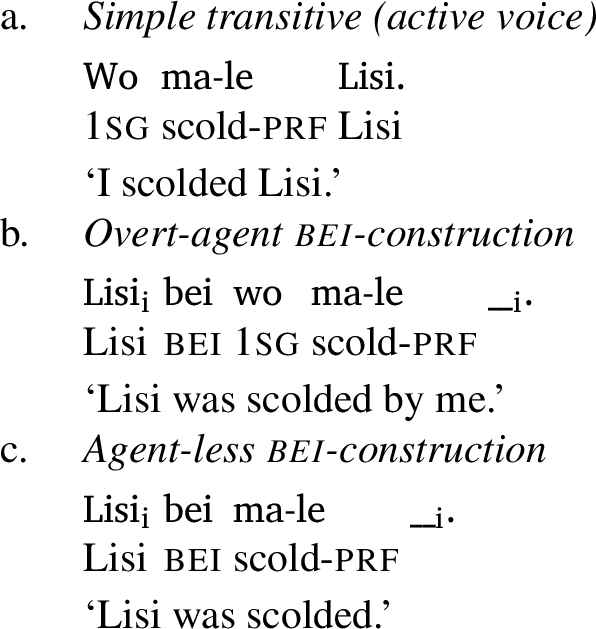
But unlike the English be-passive and like English tough-movement, the bei-construction can also involve multiple verbal projections and a long-distance dependency between the subject of bei and a deeply embedded gap, as seen in (3).
- (3)
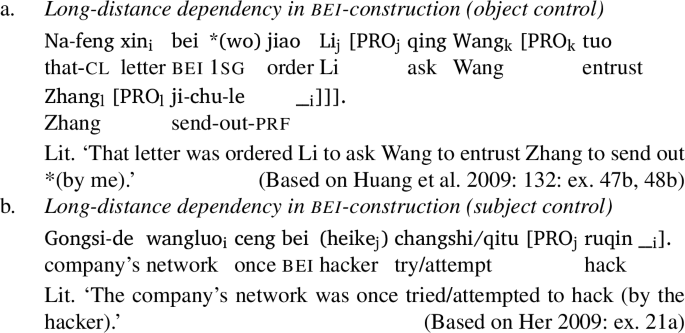
The aim of this section is to establish the syntactic properties of the overt or nonovert agent/external argument of the matrix verb, bei, and its complement, as well as to demonstrate both the possibility of and two restrictions on long-distance dependencies between the subject of bei and the gap in bei’s complement. In Sect. 2.1, I will present evidence that in overt-agent bei-constructions, the agent/external argument of the matrix verb, which immediately follows bei, remains in the thematic subject position as it originates in a simple transitive construction (in the active voice), that is, Spec, VoiceP. In Sect. 2.2, I will present evidence that in agent-less bei-constructions, the nonovert agent/external argument of the matrix verb is semantically present. In Sect. 2.3, I will present additional evidence that bei selects a VoiceP complement (with an overtly expressed agent/external argument of the matrix verb introduced in Spec, VoiceP), and is best analyzed as the spell-out of a passive head, in the sense of Bruening (2013). In Sect. 2.4, I will demonstrate both the possibility of and two restrictions on long-distance dependencies in the bei-construction. Finally, in Sect. 2.5, I will remark on the adversity reading of the bei-construction, which, as I will show, is no longer a requirement in modern Mandarin.
2.1 Overt-agent bei-construction
A distinctive property of overt-agent bei-constructions is that the agent/external argument of the matrix verb, which immediately follows bei, remains in the thematic subject position as it originates in a simple transitive construction (in the active voice), that is, Spec, VoiceP. Effectively, this means that bei is best analyzed as the spell-out of a predicate taking an extended verbal projection as its complement (which must at least be as large as a VoiceP, with an overtly expressed agent/external argument of the matrix verb introduced in Spec, VoiceP), as schematized in (4a) (see, e.g., Feng 1995, 2012; Ting 1995a, 1998; Huang 1999; Tang 2001; Huang et al. 2009; Bruening and Tran 2015; a.o.). Crucially, bei should not be analyzed as a preposition taking the agent/external argument of the matrix verb as its complement and projecting a PP adjunct, as schematized in (4b) (contra Chao 1968; Cheng 1987; Li 1990; a.o.).
- (4)

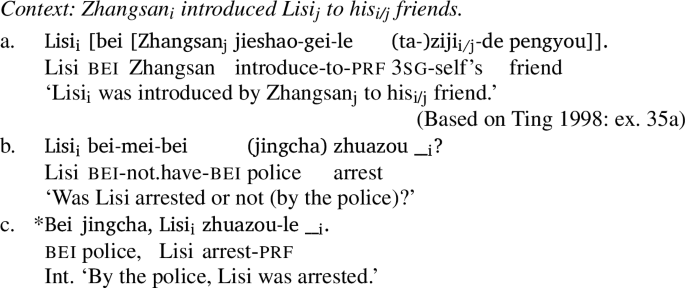
The most compelling evidence has come from reflexive binding (see, e.g., Ting 1995a, 1998; Huang 1999; Huang et al. 2009); additionally, the status of bei as a predicate taking an extended verbal projection as its complement and crucially not as a preposition taking the agent/external argument of the matrix verb as its complement is supported by its ability to incorporate into Infl to form a matrix A-not-A question (see Huang 1991) in the form bei-not-bei and its inability to move with the agent/external argument of the matrix verb as a constituent (see, e.g., Huang 1999; Huang et al. 2009).
Specifically, as seen in (5a), in the bei-construction, either the subject of bei (Lisi) or the agent/external argument of the matrix verb (Zhangsan) can bind the bare reflexive ziji ‘self’ – which is exclusively bound by subjects when it is bound anaphorically (see, e.g., Tang 1989; Cole et al. 1990; Huang and Tang 1991; Huang et al. 2009; a.o.) although it may also be bound logophorically under certain conditions (see, e.g., Huang et al. 1984; Huang and Liu 2001; Huang et al. 2009; a.o.) – as well as the compound reflexive ta-ziji ‘3sg-self’, which is a local anaphor constrained by Principle A (see, e.g., Huang and Tang 1991; Huang and Liu 2001): the ability for the agent/external argument of the matrix verb (Zhangsan) to bind the subject-oriented, bare reflexive ziji ‘self’ (anaphorically) indicates that the agent/external argument of the matrix verb (Zhangsan) must not only c-command the subject-oriented, bare reflexive ziji ‘self’ but also occupy the thematic subject position, that is, Spec, VoiceP; and the ability for the agent/external argument of the matrix verb (Zhangsan) to bind the compound reflexive ta-ziji ‘3sg-self’ further suggests that this binding is not (necessarily) achieved logophorically. Additionally, as seen in (5b), bei can incorporate into an interrogative Infl to form a matrix A-not-A question in the form bei-not-bei, which follows if bei is a predicate taking an extended verbal projection as its complement (which must at least be as large as a VoiceP, with an overtly expressed agent/external argument of the matrix verb introduced in Spec, VoiceP); in contrast, as seen in (5c), bei cannot move with the agent/external argument of the matrix verb as a constituent, indicating that bei is not a preposition taking the agent/external argument of the matrix verb as its complement.
- (5)
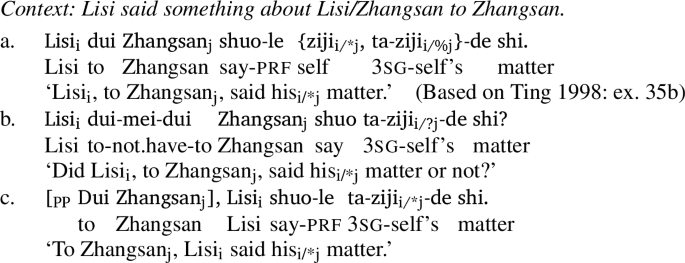
To further support this line of argumentation, consider the contrast between (5) and (6). In (6a), the preverbal applicative argument (Zhangsan) is introduced by an applicative head/preposition (dui ‘to’); while the applicative argument (Zhangsan) fails to bind the subject-oriented, bare reflexive ziji ‘self’ (either anaphorically or logophorically), there is speaker variation with respect to whether the applicative argument (Zhangsan) can bind the compound reflexive ta-ziji ‘3sg-self’. This, I suggest, stems from two possible structures for (6a): the applicative argument (Zhangsan) could be introduced in the specifier of an applicative projection, in which case it c-commands, and hence can bind, the compound reflexive ta-ziji ‘3sg-self’; alternatively, the applicative argument (Zhangsan) could be introduced by a preposition in a PP adjunct, in which case it does not c-command, and hence cannot bind, the compound reflexive ta-ziji ‘3sg-self’. These two structures are independently attested in (6b) and (6c): In (6b), the applicative argument introducer (dui ‘to’) must be an applicative head, hence it can incorporate into an interrogative Infl to form an A-not-A question in the form dui-not-dui; in this case, the applicative argument (Zhangsan) can bind the compound reflexive ta-ziji ‘3sg-self’. In (6c), the applicative argument introducer (dui ‘to’) must be a preposition, hence it can move with the applicative argument (Zhangsan) as a constituent; in this case, the applicative argument (Zhangsan) cannot bind the compound reflexive ta-ziji ‘3sg-self’.
- (6)
As a preview, in Sect. 4, I will analyze overt-agent bei-constructions as (noncanonical) passive constructions where the passive head/bei selects a projection of a Voice[+agent] head (with the [+agent] feature borrowed from Erlewine and Smith 2024) and is responsible for case-licensing the overtly expressed agent/external argument of the matrix verb introduced in Spec, VoiceP, albeit being semantically vacuous.
2.2 Agent-less bei-construction
Like other passive constructions, agent-less bei-constructions are distinguished by the semantic presence of a nonovert agent/external argument of the matrix verb. To provide context, in the English be-passive, a nonovert agent/external argument of the passivized verb must nevertheless be semantically present, because it can be modified by a ‘deliberately’-type adverb, as seen in (7a), and can control the PRO subject of an infinitival purpose clause, as seen in (7b) (see, e.g., Bhatt and Pancheva 2006, 2017).
- (7)

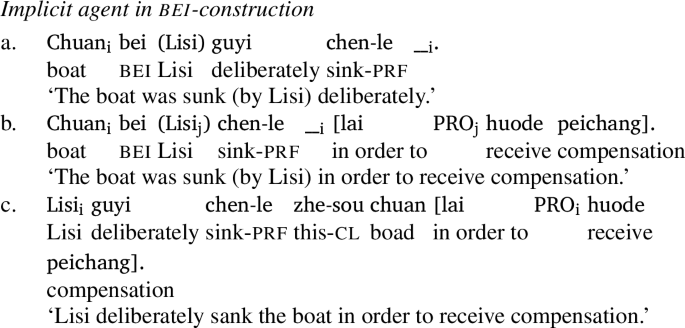
Similarly, in agent-less bei-constructions, the nonovert agent/external argument of the matrix verb must nevertheless be semantically present, as supported by its ability to be modified by a ‘deliberately’-type adverb, as seen in (8a), and its ability to control the PRO subject of an infinitival purpose clause (headed by lai ‘in order to’), as seen in (8b).
- (8)
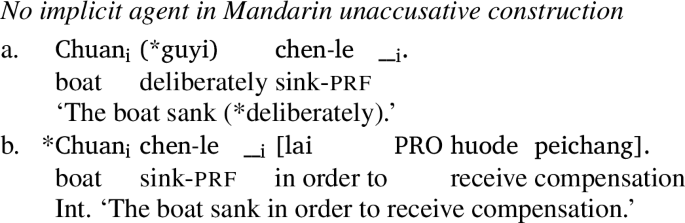
By contrast, neither modification by ‘deliberately’-type adverbs nor control into purpose clauses is possible with unaccusative constructions, which lack an implicit agent/external argument, both in English, as seen in (9) (see, e.g., Bhatt and Pancheva 2006, 2017), and in Mandarin, as seen in (10).
- (9)

- (10)
In addition, it is important to note that in agent-less bei-constructions, while the nonovert agent/external argument of the matrix verb is generally interpreted existentially, a null pronoun reading may be enforced if given a strong context. Hence, without any context, (11) would be judged true if and only if Lisi was not scolded by anyone and, crucially, cannot mean Lisi was not scolded by someone; however, if a strong context is provided, a null pronoun reading becomes possible, as seen in (11) (see Bruening and Tran 2015: 169 for a similar report on the Vietnamese bi-construction and related discussion).Footnote5
- (11)

As a preview, in Sect. 4, I will analyze agent-less bei-constructions as (canonical) passive constructions where the passive head/bei selects a projection of a Voice[-agent] head (with the [-agent] feature borrowed from Erlewine and Smith 2024) and is responsible for existentially binding the agent/external argument (following Bruening 2013; see also Bach 1980; Keenan 1980, 1985; Williams 1987; a.o.).
2.3 Bei and its complement
In Sect. 2.1, I have presented evidence that bei is best analyzed as the spell-out of a predicate taking an extended verbal projection – which must at least be as large as a VoiceP, with an overtly expressed agent/external argument of the matrix verb introduced in Spec, VoiceP – as its complement. Here, I will present two pieces of additional evidence that bei selects a VoiceP complement, and is best analyzed as the spell-out of a passive head, in the sense of Bruening (2013).
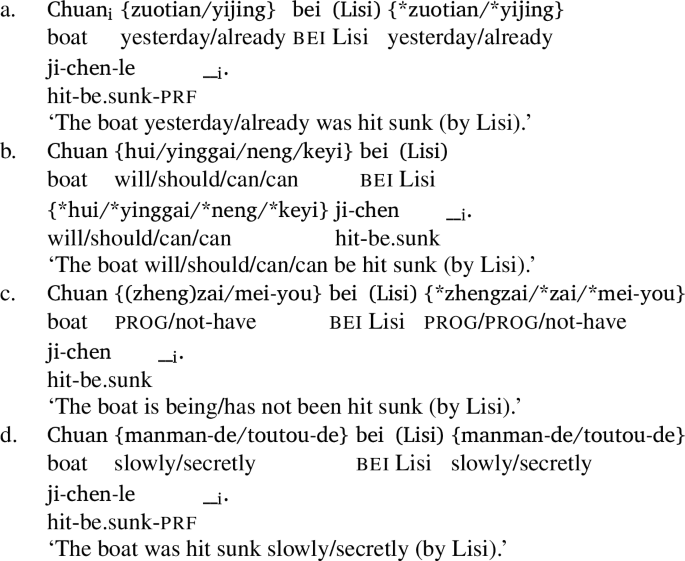
First, bei’s complement must be structurally smaller than an IP/AspP (but nevertheless be as large as a VoiceP, with an overtly expressed agent/external argument of the matrix verb introduced in Spec, VoiceP); more importantly, bei must project within the domain of extended verbal projections/event predicates, making the passive head a compelling candidate for analysis. The evidence comes from the distribution of tense-aspect-modality elements and event modifiers within a bei-construction. Specifically, all of temporal adverbs (zuotian ‘yesterday’), aspectual adverbs (yijing, ‘already’), modal verbs (hui ‘will’, yinggai ‘should’, neng ‘can (be able)’, keyi ‘can (be permissible)’), the progressive aspect (zheng)zai and the perfective negation mei-you ‘not-have’ must precede/be structurally higher than bei and cannot follow/be structurally lower than the agent/external argument of the matrix verb (in Spec, VoiceP), as seen in (12a–c); in contrast, event-internal adverbs (e.g., manner adverbs) can either precede/be structurally higher than bei or follow/be structurally lower than the agent/external argument of the matrix verb (in Spec, VoiceP), as seen in (12d) (see also Ernst 2010).
- (12)
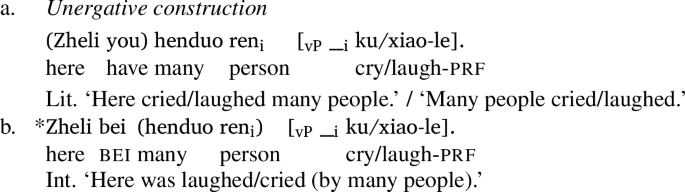
Second, bei imposes a selectional restriction on the matrix verb, requiring it to be transitive, which in turn entails the presence of a VoiceP; effectively, this means that bei selects a VoiceP complement. Specifically, the so-called impersonal passive of unergative, which is possible in languages like German and Dutch but impossible in languages like English, is also impossible in Mandarin, as seen in (14)[b]. If one adopts the proposal that the agent/external argument of an unergative verb is introduced by a v (which categorizes the unergative verbal root as a VP, see, e.g., Massam 2009; Tollan 2018; a.o.) and crucially not by the Voice head, then the incompatibility of bei and an unergative verb would follow if bei (spells out a passive head which) selects a VoiceP complement.
- (13)

- (14)
Similarly, bei is also incompatible with an unaccusative verb that lacks a transitive variant, as seen in (15b) and (16)[b]. Assuming that unaccusative verbs, which lack a thematic subject, also lack a VoiceP, the incompatibility of bei and an unaccusative verb also follows if bei (spells out a passive head which) selects a VoiceP complement (see also Bruening 2013).
- (15)
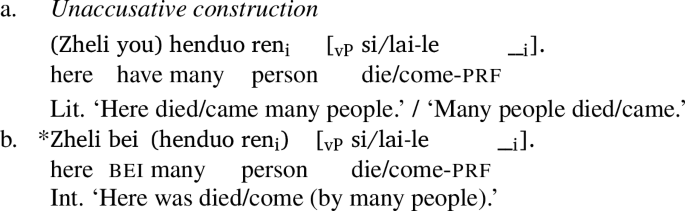
- (16)
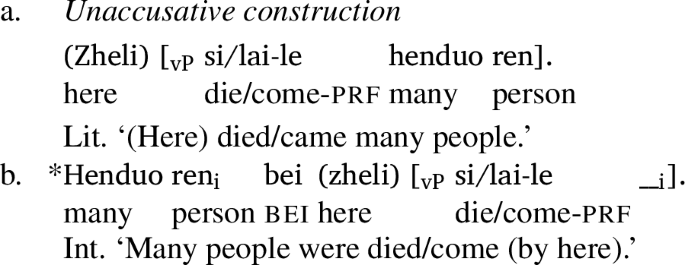
Another related observation of bei’s selectional restriction is its incompatibility with hyperraising predicates, which are CP-taking verbs that lack a thematic subject and effectively a VoiceP. This observation and its analysis will be presented in Sect. 5.2.1.
2.4 Restricted long-distance dependencies
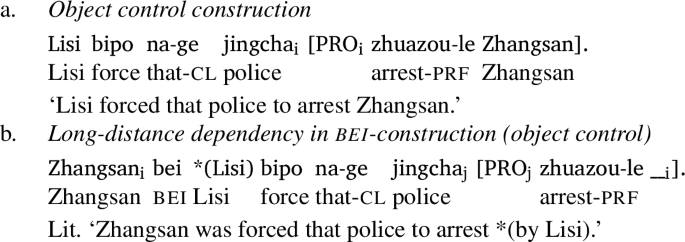
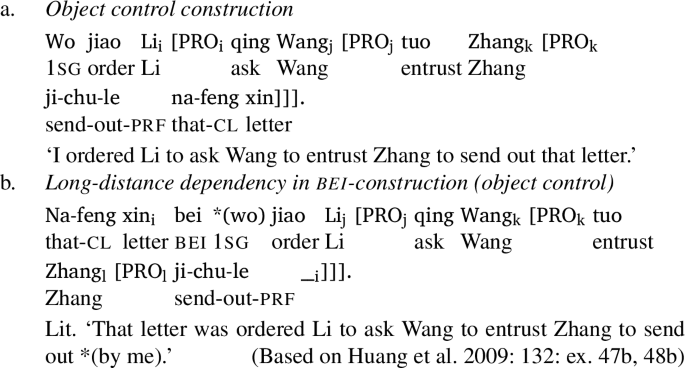
The possibility of long-distance dependencies in the bei-construction has long been recognized in the literature (see, e.g., Feng 1995, 2012; Ting 1995a, 1998; Huang 1999; Tang 2001; Huang et al. 2009; Her 2009; Bruening and Tran 2015; a.o.). Specifically, the bei-construction allows a long-distance dependency between the subject of bei and a deeply embedded object gap in bei’s complement across nonfinite clause boundaries, as seen in (17b) and (18)[b], which involve object control verbs.Footnote6
- (17)
- (18)
Similarly, the bei-constructions in (19b) and (20)[b], which involve a subject control matrix verb, also involve a long-distance dependency between the subject of bei and a deeply embedded object gap in bei’s complement across nonfinite clause boundaries (note that the original examples from Her 2009, where the agent/external argument of the matrix verb is nonovert, are found on the internet).Footnote7
- (19)
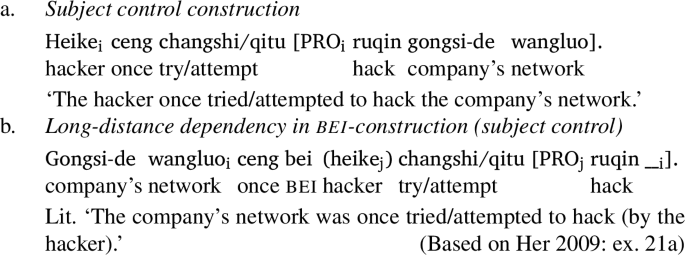
- (20)
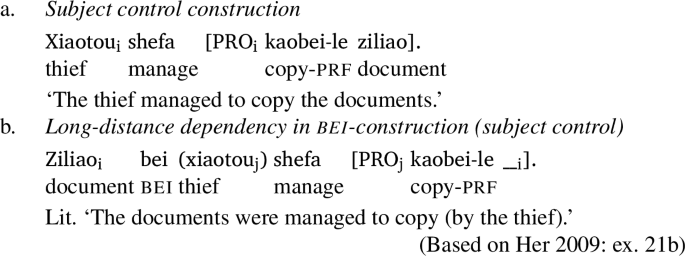
However, the possibility of long-distance dependencies in agent-less bei-constructions has been a controversy in the literature: On the one hand, in (17-b) and (18-b), the agent/external argument of the matrix verb must be overtly expressed and cannot be nonovert – Huang et al. (2009) (see also Ting 1995a, 1998; Huang 1999; a.o.) take this to indicate that only overt-agent bei-constructions but not agent-less bei-constructions can involve a long-distance dependency between the subject of bei and a deeply embedded gap in bei’s complement. On the other hand, in (19b) and (20b), the agent/external argument of the matrix verb can be overtly expressed or nonovert – Her (2009) and subsequently Bruening and Tran (2015) and Ngui (2024) take this to indicate that both overt-agent and agent-less bei-constructions can generally involve a long-distance dependency between the subject of bei and a deeply embedded object gap in bei’s complement across nonfinite clause boundaries.
Contra both sets of proposals, I argue that the contrast between (17-b), (18-b) and (19b), (20b) instantiate a restriction on long-distance dependencies in agent-less bei-constructions, which lies in a ban on any overt NP that would be assigned case by the matrix verb (which would be case-less in agent-less bei-constructions, under the proposed analysis) intervening between the subject of bei and the gap in agent-less bei-constructions.Footnote8 Specifically, (17-b) and (18-b), which are ill-formed when the agent/external argument of the matrix verb is nonovert, involve an overt NP, the matrix object, intervening between the subject of bei and the deeply embedded object gap; in contrast, (19b) and (20b), which are well-formed when the agent/external argument of the matrix verb is nonovert, involve no overt NPs intervening between the subject of bei and the deeply embedded object gap. As is pointed out by a reviewer, to fully demonstrate the stated restriction, a further contrast must be considered: (21b), like (17-b) and (18-b), is ill-formed when the agent/external argument of the matrix verb is nonovert; in contrast, (22)[b] is like (19-b) and (20-b) in that it is well-formed when the agent/external argument of the matrix verb is nonovert, but, crucially, is unlike (19-b) and (20-b) in that there is an overt NP, Lisi, which is the object of the embedded verb (pai/jiao/qing(qiu)/(bai)tuo ‘send/order/ask/entrust’), intervening between the subject of bei and the deeply embedded object gap.Footnote9 Importantly, based on examples like (22)[b], it is incorrect to simply state the restriction as that no overt NPs should intervene between the subject of bei and the gap in agent-less bei-constructions; more examples like (22)[b] will be presented in Sect. 5.1.
- (21)
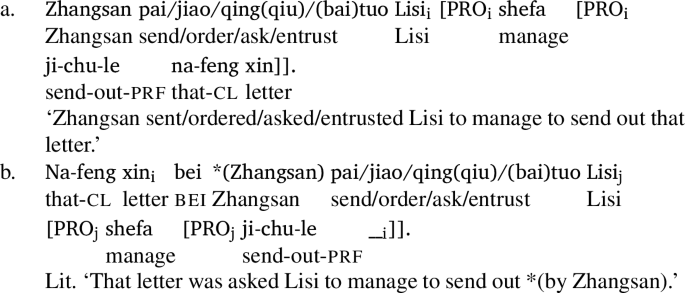
- (22)
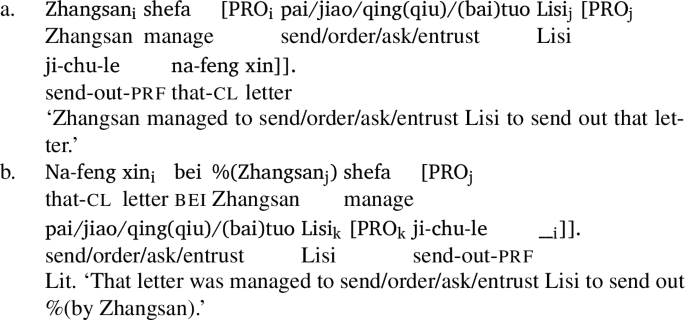
Another restriction on long-distance dependencies in the bei-construction lies in a contrast when the bei-construction involves a cross-finite-clause dependency between the subject of bei and a subject vs. object gap. Specifically, the bei-construction does not allow a cross-finite-clause dependency between the subject of bei and an object gap, as seen in (23b) (see, e.g., Ting 1995a, 1998; a.o.), but allows a cross-finite-clause dependency between the subject of bei and a subject gap, as seen in (23c) (see, e.g., Her 2009).Footnote10
- (23)
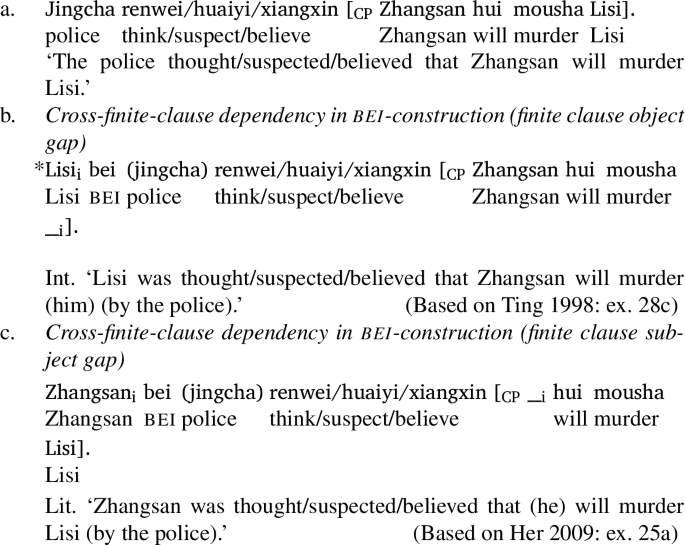
In Sect. 5, 1 will argue that the two restrictions on long-distance dependencies in the bei-construction – namely, the requirement that no overt, case-less NPs should intervene between the subject of bei and the gap in agent-less bei-constructions, and the subject/object contrast with respect to the possibility of crossing a finite clause boundary to become the subject of bei – provide evidence for the proposed analysis of the bei-construction as a passive construction where the subject in the bei-construction is derived via A-movement after (successive-cyclic) composite A/Ā-movement and, crucially, are not accounted for by the various proposals under the alternative approach to the bei-construction involving base-generation of the subject of bei and NOP movement in bei’s complement.
2.5 A note on the adversity reading
Before proceeding, a note is in order on the adversity reading of the bei-construction. Traditionally, bei is described as being confined primarily to signal adversity (e.g., bei ma ‘be scolded’) (see, e.g., Chao 1968; Li and Thompson 1981; Cheng 1987; and especially Li 2007, for the historical development of bei from a lexical verb meaning ‘suffer, receive’ in the pre-Qin period). However, in modern Mandarin, the semantics of bei has become entirely obscure, which is characteristic of functional categories, and the use of bei-constructions in nonadversative contexts has become fully productive (e.g., bei biaoyang ‘be praised’, bei jiu ‘be rescued’, bei anzhuang-hao ‘be assembled’, bei xiu-hao ‘be repaired’, etc.; such instances are abundant and result in a large number of hits in a Google search) (see also Chao 1968; Li and Thompson 1981).
- (24)
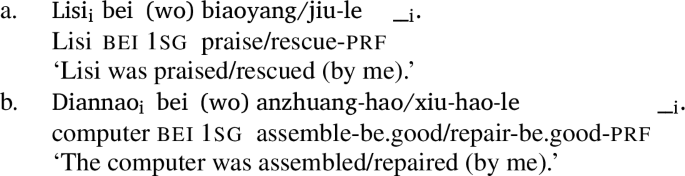
In addition, bei is also compatible with stative predicates, in both adverse and nonadverse contexts:
- (25)

For the present purposes, I take the fully productive use of bei-constructions in (both adverse and) nonadverse contexts to indicate that bei has been fully grammaticalized as a functional category in modern Mandarin (albeit possibly originating from a lexical category associated with adversity semantics).
3 Mixed A/Ā-properties as direct consequences of composite A/Ā-movement
As mentioned previously, it has long been recognized that A-movement and Ā-movement are associated with distinct properties (see, e.g., Postal 1971; Chomsky 1977, 1981; a.o. and Richards 2014 for a comprehensive overview of these properties). More specifically, A-movement, such as subject-to-subject raising and passivization (in a canonical passive construction), (i) is restricted to noun phrases; (ii) is local/cannot cross c-commanding noun phrases; (iii) creates new antecedents for anaphor binding; (iv) is not subject to weak crossover; (v) does not reconstruct for Principle C; (vi) does not license parasitic gaps; and (vii) feeds Ā-movement. By contrast, Ā-movement, such as wh-movement, (i) is not restricted to noun phrases; (ii) can cross c-commanding noun phrases and finite clause boundaries to establish long-distance dependencies; (iii) does not create new antecedents for anaphor binding; (iv) is subject to weak crossover; (v) obligatorily reconstructs for Principle C; (vi) licenses parasitic gaps; and (vii) does not feed A-movement/only feeds Ā-movement (the so-called Ban on Improper Movement; see, e.g., May 1979; Chomsky 1981; Abels 2007; Neeleman and van De Koot 2010; Williams 2011).
The positional view of the A/Ā-distinction holds that the distinct properties associated with A-movement and Ā-movement are derived from the distinct A-positions and Ā-positions that A-movement and Ā-movement target, respectively (see, e.g., Chomsky 1981, 1995; Mahajan 1990; Déprez 1989; Miyagawa 2010). By contrast, the featural view of the A/Ā-distinction, namely, that the distinct properties associated with A-movement and Ā-movement are derived from the distinct ϕ– and Ā-features which trigger A-movement and Ā-movement, respectively, and the possibility of composite probing by the composite probe [ϕ + Ā], which attracts the closest NP with both a matching ϕ-feature and a matching Ā-feature, together predict that mixed properties of both A-movement and Ā-movement emerge as direct consequences of composite A/Ā-movement (Van Urk 2015). Positive evidence has come from the Nilotic language Dinka Bor, where movement targeting Spec, CP (e.g., topicalization and relativization) exhibits properties of both A-movement and Ā-movement under the standard diagnostics (Van Urk 2015), as well as English tough-movement, which exhibits the same mix of A/Ā-properties as Dinka movement to Spec, CP (Longenbaugh 2017; see also Chomsky 1977, 1981; Brody 1993; Rezac 2006; Hicks 2009; Takahashi 2011; Hartman 2011; Keine and Poole 2017; a.o.).
This section (i) reviews the mixed A/Ā-properties and composite A/Ā-movement analyses of Dinka movement to Spec, CP and English tough-movement, which provide the foundation for (ii) examining the mixed A/Ā-properties of the bei-construction and developing a composite A/Ā-movement analysis for the bei-construction. The remainder of the section is organized as follows: In Sects. 3.1 and 3.2, I will review the mixed A/Ā-properties associated with Dinka movement to Spec, CP and Van Urk’s (2015) analysis of Dinka movement to Spec, CP as involving (successive-cyclic) composite A/Ā-movement, triggered by a composite probe [ϕ + Ā] on the C head (and the Voice head(s) involved in the successive-cyclic chain), as well as the same mix of A/Ā-properties associated with English tough-movement and Longenbaugh’s (2017) analysis of tough-movement as involving (successive-cyclic) composite A/Ā-movement, triggered by a composite probe [ϕ + Ā] on the Voice head(s) (involved in the path of tough-movement). In Sect. 3.3, I will show that the dependency involved in the bei-construction is established via movement and that the bei-construction exhibits the same mix of A/Ā-properties as Dinka movement to Spec, CP and English tough-movement. Under the proposed analysis of the bei-construction as a passive construction involving composite A/Ā-movement, the mixed A/Ā-properties associated with the bei-construction are direct consequences of (successive-cyclic) composite A/Ā-movement, triggered by a composite probe [ϕ + Ā] on the passive head/bei (and the Voice head(s) involved in the successive-cyclic chain).
As a preview, the mixed A/Ā-properties associated with Dinka movement to Spec, CP, English tough-movement, and the Mandarin bei-construction are summarized in Table 1.Footnote11
3.1 Dinka
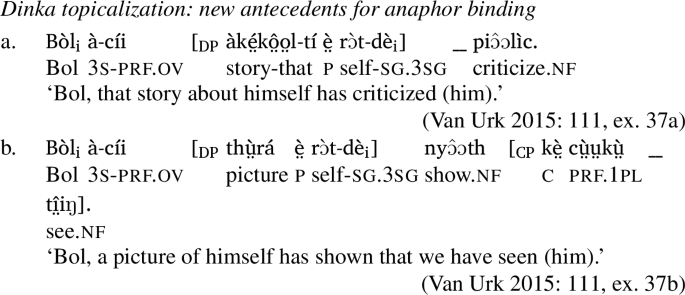
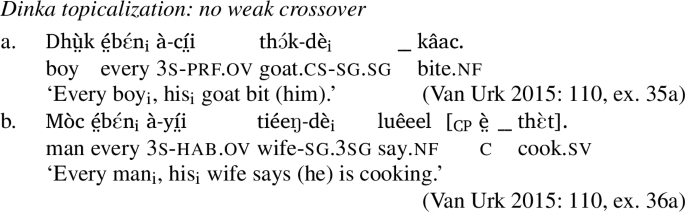
In Dinka, movement targeting Spec, CP, e.g., topicalization and relativization, behaves like A-movement in that it (i) creates new antecedents for anaphor binding, as seen in (26); (ii) is not subject to weak crossover, as seen in (27); and (iii) does not show reconstruction effects for Principle C, as seen in (28).
- (26)
- (27)
- (28)
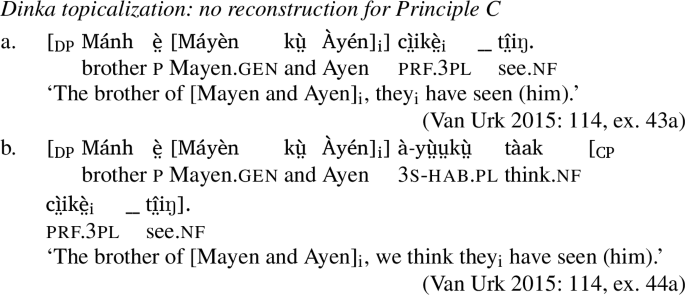
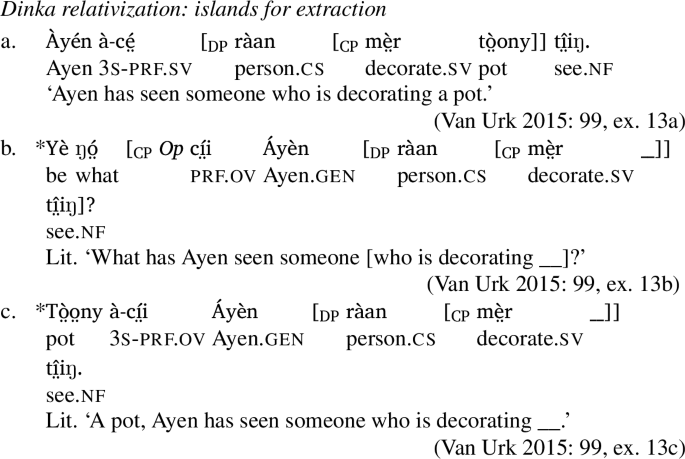
Dinka movement to Spec, CP behaves like Ā-movement in that (i) topicalization can be long-distance, crossing both other c-commanding NPs, as seen in (26), (27), and (28), and finite clause boundaries, as seen in (26-b), (27b), and (28b); and (ii) relativization induces islands for extraction, as seen in (29).
- (29)
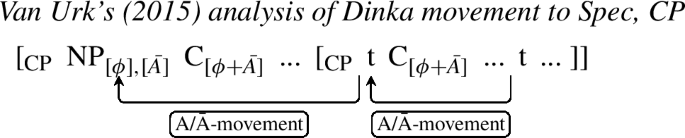
Van Urk (2015) proposes that the mixed A/Ā-properties associated with Dinka movement to Spec, CP emerge as direct consequences of (successive-cyclic) composite A/Ā-movement, triggered by a composite probe [ϕ + Ā] on the C head (and the Voice head(s), for purposes of successive-cyclic composite A/Ā-movement), as illustrated in (30).
- (30)
3.2 English
As noted by Longenbaugh (2017), English tough-movement exhibits the same mix of A/Ā-properties as Dinka movement to Spec, CP. Specifically, English tough-movement behaves like A-movement in that it (i) creates new antecedents for anaphor binding, as seen in (31a); (ii) is immune to weak crossover, as seen in (31b); and (iii) does not show reconstruction effects for Principle C, as seen in (31c).
- (31)
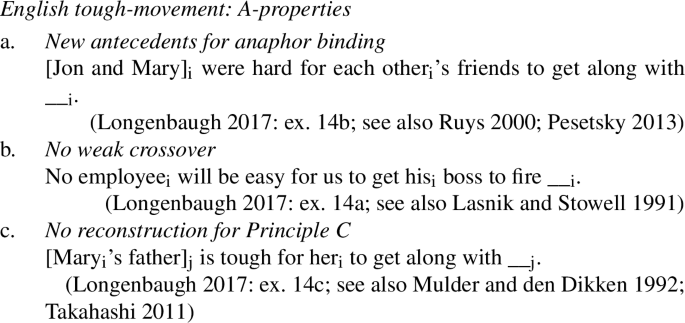
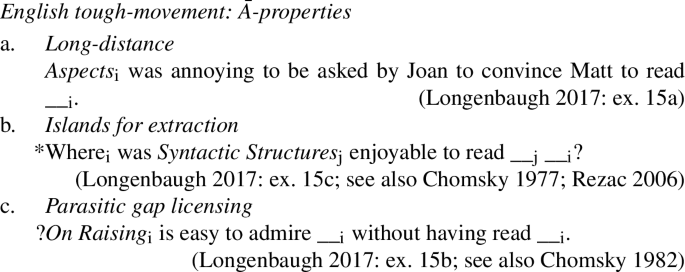
English tough-movement behaves like Ā-movement in that it (i) can be long-distance, crossing other c-commanding NPs, as seen in (32a); (ii) induces weak islands for wh-adjunct extraction, as seen in (32b);Footnote12 and (iii) licenses parasitic gaps, as seen in (32c).
- (32)
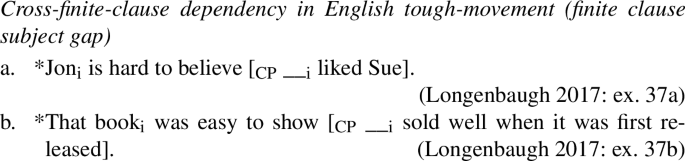
However, unlike Dinka movement to Spec, CP, which can cross finite clause boundaries, English tough-movement, which is possible across nonfinite clause boundaries (which arguably lack a CP projection, see, e.g., Wurmbrand 2014), as seen in (32a), is degraded (but possible) for nonsubjects and impossible for subjects across a phasal CP-projection, as seen in (33) and (34) (Longenbaugh 2017; see also Postal 1971; Bresnan 1972; Chomsky 1973; Lasnik and Fiengo 1974; Browning 1987; Rezac 2006).Footnote13
- (33)

- (34)
Following Van Urk (2015), Longenbaugh (2017) proposes that the mixed A/Ā-properties associated with English tough-movement are direct consequences of (successive-cyclic) composite A/Ā-movement, triggered by a composite probe [ϕ + Ā] on the Voice head(s) (involved in the path of tough-movement); the tough-subject undergoes (successive-cyclic) composite A/Ā-movement to the matrix Spec, VoiceP, triggered by the composite probe [ϕ + Ā] on the matrix Voice head (as well as the Voice head(s) involved in the successive-cyclic chain), followed by a terminating step of A-movement to Spec, IP, which, Longenbaugh (2017) assumes, does not violate the ban on improper (A- after Ā-) movement.Footnote14 The derivation is illustrated in (35).
- (35)

In addition, Longenbaugh (2017) assumes a ban on composite A/Ā-movement after Ā-movement, which extends from the ban on improper A-after-Ā-movement.Footnote15 Specifically, to account for the restrictions on long-distance dependencies with English tough-movement, Longenbaugh (2017) proposes that the distribution of composite probes can be different in different languages: In Dinka, both the C head and the Voice head host a composite probe [ϕ + Ā]; hence, composite A/Ā-movement can cross finite clause boundaries (Van Urk 2015). In English, only the Voice head (involved in the path of tough-movement) hosts a composite probe [ϕ + Ā] while the C head only hosts a pure Ā-probe; hence, composite A/Ā-movement can proceed successive-cyclically through the specifiers of successive VoicePs, but crucially cannot proceed from Spec, CP, i.e., following a step of Ā-movement to Spec, CP triggered by the pure Ā-probe on the C head, due to the ban on improper composite A/Ā-movement after Ā-movement, as illustrated in (36).Footnote16
- (36)

Longenbaugh’s (2017) analysis of English tough-movement diverges from Chomsky’s (1977, 1981) analysis of English tough-movement, in which the tough-predicate is analyzed as a two-place predicate, both introducing the tough-subject and selecting a secondary predicate of the tough-subject, which contains an Ā-moved NOP, which is coindexed with the tough-subject, as illustrated in (37); at the level of Logical Form (LF), the NOP serves as a lambda operator, which turns a proposition into a predicate via lambda abstraction.
- (37)

Chomsky’s (1977, 1981) analysis of English tough-movement is bipartite, in the sense that it attempts to derive the A-properties associated with tough-movement by base-generating the tough-subject as an argument of the tough-predicate, and derives the Ā-properties associated with tough-movement via Ā-movement of a NOP in the tough-predicate’s complement. It is worth noting that weak crossover and Principle C reconstruction might still be expected solely from NOP movement, given that Ā-movement of quantifier phrases and wh-phrases is subject to weak crossover and that Ā-movement in general, including topicalization, is subject to Principle C reconstruction. To address these issues, Lasnik and Stowell (1991) suggest that first, weak crossover is restricted to Ā-movement of quantifier phrases and wh-phrases, while NOP movement and topicalization involve Ā-movement of a nonquantificational R-expression; second, principle C reconstruction is exempted in the case of predication – because predication requires that the tough-subject must A-bind the NOP in the tough-predicate’s complement, principle C does not apply to A-binding relations between the tough-subject and the trace of the NOP (Lasnik and Stowell 1991: 714). One problem with Chomsky’s (1977, 1981) analysis of English tough-movement involving base-generation of the tough-subject and NOP movement in the tough-predicate’s complement is that it does not straightforwardly account for the contrast between (33) and (34). Specifically, if tough-movement involves Ā-movement of a NOP, then cross-finite-clause dependencies between the tough-subject and either a finite clause subject gap or a finite clause object gap should be possible (or impossible, depending on independent assumptions/evidence regarding whether or not NOP movement can cross a finite CP boundary).
3.3 Mandarin
Turning now to Mandarin. In Sect. 3.3.1, I will establish that IP-external topicalization/focalization and relativization in Mandarin are instances of Ā-movement, which will provide a basis for comparing the Ā-properties exhibited by these constructions with the mixed A/Ā-properties exhibited by the bei-construction. In Sect. 3.3.2, I will show that the dependency involved in the bei-construction is established via movement and that the bei-construction exhibits the same mix of A/Ā-properties as Dinka movement to Spec, CP and English tough-movement. Under the proposed analysis of the bei-construction as a passive construction involving composite A/Ā-movement, the mixed A/Ā-properties associated with the bei-construction are direct consequences of (successive-cyclic) composite A/Ā-movement, triggered by a composite probe [ϕ + Ā] on the passive head/bei (and the Voice head(s) involved in the successive-cyclic chain). In Sect. 3.3.3, I will present additional evidence that the Ā-feature triggering the movement in the bei-construction is flat, which can be satisfied by any Ā-feature on the goal (see Rizzi 1997, 2004; Abels 2012; a.o.).
3.3.1 Ā-movement
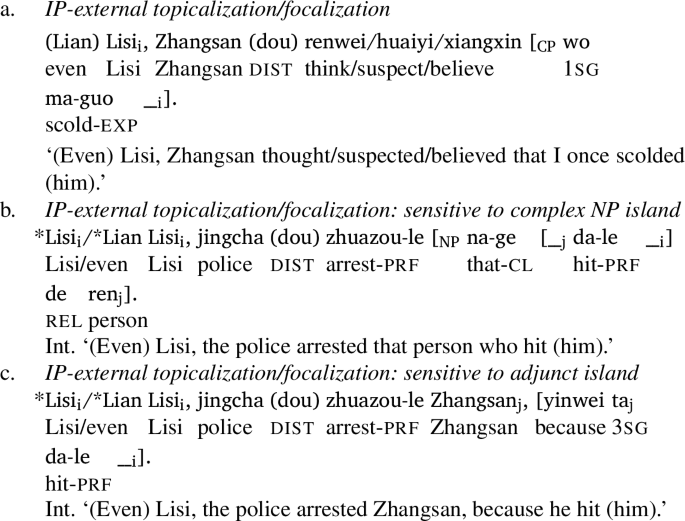
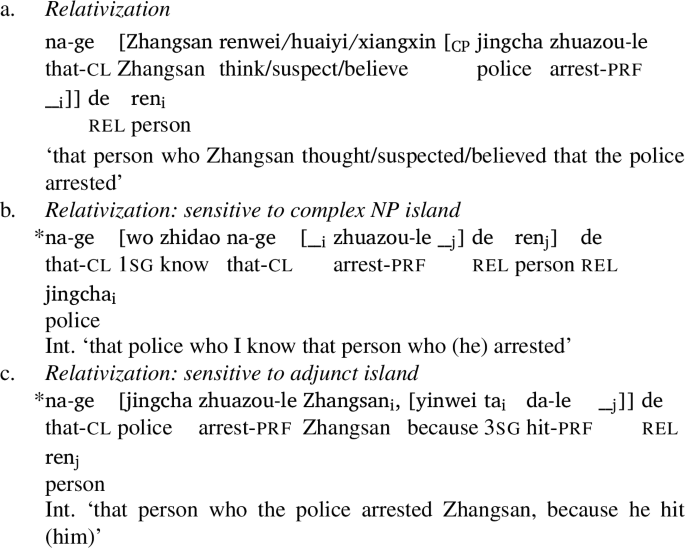
In Mandarin, IP-external topicalization/focalization, which involves a (cross-finite-clause) dependency between a topicalized/focalized NP, which surfaces IP-externally, and a gap, as exemplified by (38a),Footnote17 and relativization, which involves a (cross-finite-clause) dependency between a relativized NP and a gap, as exemplified by (39)[a], are established via movement; this is a well-established fact in the literature (see, e.g., Qu 1994; Shyu 1995; Ting 1995b; Paul 2002, 2005; Kuo 2009). One piece of evidence is their sensitivity to syntactic islands, as seen in (38b), (38c) for IP-external topicalization/focalization and (39)[b], (39)[c] for relativization.
- (38)
- (39)
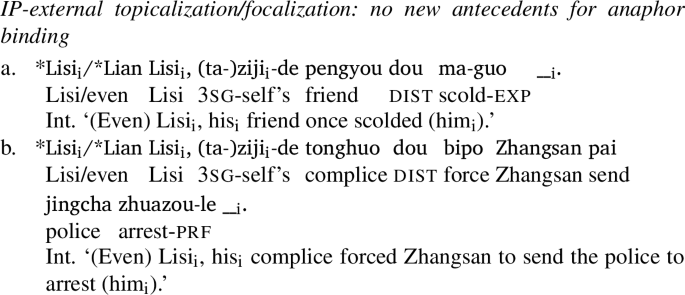
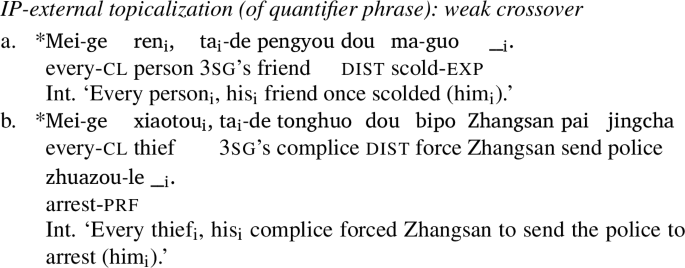
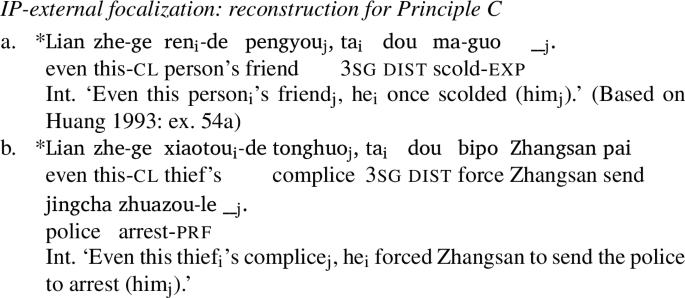
IP-external topicalization/focalization and relativization exhibit properties of Ā-movement, which is also a well-established fact in the literature (see, e.g., Qu 1994; Shyu 1995; Ting 1995b; Paul 2002, 2005; Kuo 2009).Footnote18 Specifically, IP-external topicalization/focalization (i) does not create new antecedents for anaphor binding, as seen in (40); (ii) is subject to weak crossover, as seen in (41); and (iii) shows reconstruction effects for Principle C, as seen in (42) (see, e.g., Huang 1993; Qu 1994; Shyu 1995; Kuo 2009; a.o.).Footnote19,Footnote20
- (40)
- (41)
- (42)
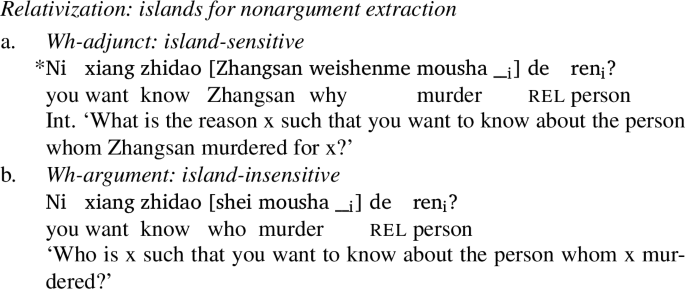
In addition, relativization induces (strong) islands for both argument and nonargument extraction. As seen previously in (38-b) and (39-b), extraction of an argument out of a relative clause (via topicalizion/focalization or relativization) is impossible. In addition, a relative clause cannot contain the wh-adjunct weishenme ‘why’, which undergoes covert movement to its scope position in the matrix Spec, CP, hence is subject to island constraints, as seen in (43a) (cf. English wh-phrases, which undergo overt movement to the matrix Spec, CP, hence are subject to island constraints) (Huang 1982; Tsai 1994/2014); in contrast, a relative clause can contain the wh-argument shei ‘who’, which is subject to unselective binding without needing to move outside the island, hence is not subject to island constraints, as seen in (43b) (Tsai 1994/2014).
- (43)
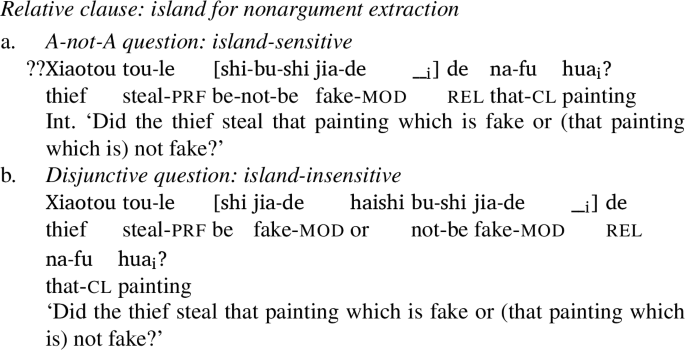
Similarly, a relative clause cannot contain a so-called A-not-A question, which involves an interrogative Infl of the form A-not-A, which undergoes covert head-movement to its scope position in the matrix C, hence is subject to island constraints, as seen in (44a); in contrast, a relative clause can contain a disjunctive question, which involves conjunct reduction and no movement, hence is not subject to island constraints, as seen in (44b) (Huang 1991).
- (44)
3.3.2 The bei-construction
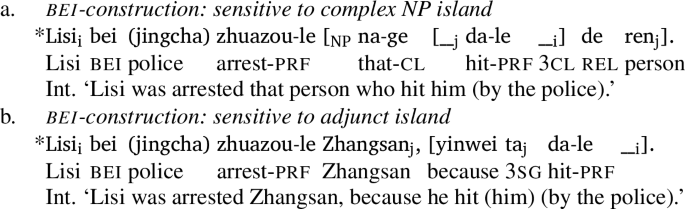
In the bei-construction, the dependency between the subject of bei and the gap in bei’s complement is also derived (entirely or partially) via movement, as supported by its sensitivity to syntactic islands, as seen in (45).Footnote21
- (45)
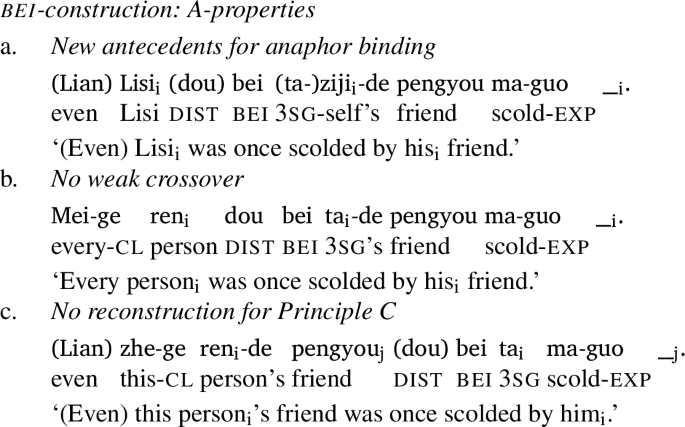
Unlike IP-external topicalization/focalization and relativization, the bei-construction exhibits properties of both A-movement and Ā-movement under the standard diagnostics. Like A-movement and unlike Ā-movement, the bei-construction (i) creates new antecedents for anaphor binding, as seen in (46a); (ii) is immune to weak crossover, as seen in (46b); and (iii) does not show reconstruction effects for Principle C, as seen in (46c) (see also Kuo 2009).
- (46)
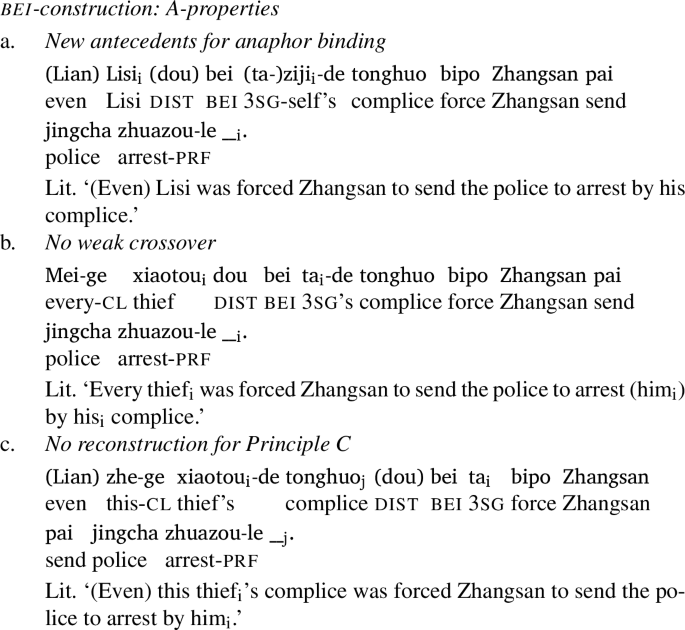
As mentioned previously in Sect. 2, like Ā-movement and unlike A-movement, the bei-construction can also involve multiple verbal projections and a long-distance dependency between the subject of bei and a deeply embedded gap (see, e.g., Feng 1995, 2012; Ting 1995a, 1998; Huang 1999; Tang 2001; Huang et al. 2009; Her 2009; Bruening and Tran 2015; a.o.). Note that in such cases, the bei-construction also exhibits the same A-movement properties, as seen in (47).Footnote22
- (47)
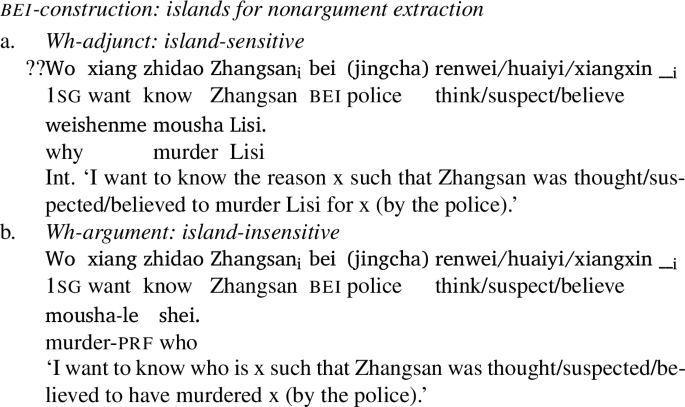
Also, like Ā-movement and unlike A-movement, the bei-construction induces weak islands for nonargument extraction.Footnote23 As seen previously in Sect. 3.3.1, the wh-adjunct weishenme ‘why’ contrasts with the wh-argument shei ‘who’ in that the former undergoes covert movement to its scope position in the matrix Spec, CP and hence is island-sensitive (Huang 1982; Tsai 1994/2014), while the latter is subject to unselective binding without movement and hence is island-insensitive (Tsai 1994/2014); hence, the ill-formedness of (48a) indicates that extraction of a nonargument out of a bei-construction is impossible.
- (48)
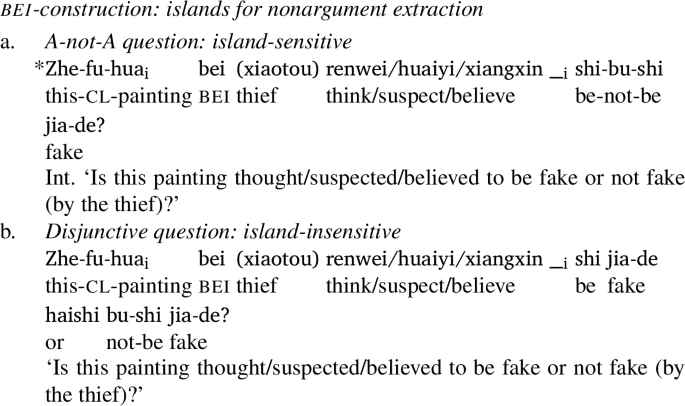
Also recall that an A-not-A question contrasts with a disjunctive question in that the former involves covert head-movement of an interrogative Infl of the form A-not-A to its scope position in the matrix C, and hence is island-sensitive, while the latter involves conjunct reduction and no movement, hence is island-insensitive (Huang 1991); hence, the ill-formedness of (49a) also indicates that extraction of a nonargument out of a bei-construction is impossible.
- (49)
At this point, it can be concluded that the bei-construction exhibits the same mix of A/Ā-properties as Dinka movement to Spec, CP and English tough-movement. Under the proposed analysis of the bei-construction as a passive construction involving composite A/Ā-movement, the mixed A/Ā-properties associated with the bei-construction are direct consequences of (successive-cyclic) composite A/Ā-movement, triggered by a composite probe [ϕ + Ā] on the passive head/bei (and the Voice head(s) involved in the successive-cyclic chain).
3.3.3 A flat Ā-feature on bei
Before proceeding to the proposed analysis of the bei-construction, I will present additional evidence that the Ā-feature triggering the movement in the bei-construction is flat, which can be satisfied by any Ā-feature on the goal (see Rizzi 1997, 2004; Abels 2012; a.o.).
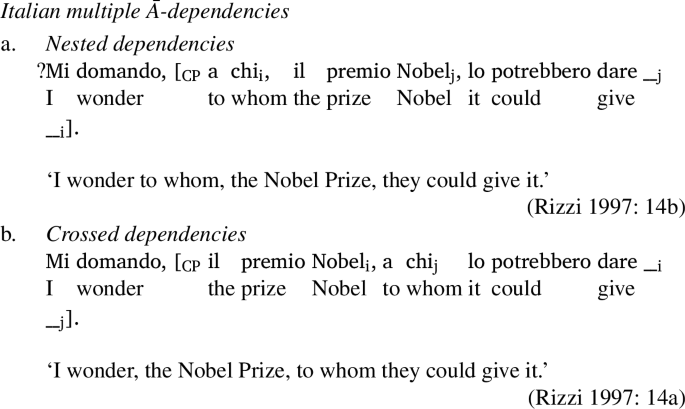
To provide context, crosslinguistically, languages differ with respect to whether multiple instances of Ā-movement can nest or cross, which can be accounted for by assuming that Ā-probes may be relativized to specific features (e.g., [Wh] for wh-movement, [Rel] for relativization, [Top] for topicalization, [Foc] for focalization, etc.), or be flat: while a relativized Ā-probe must be satisfied by a goal that has a specific Ā-feature that matches with the specific feature on the probe, a flat Ā-probe can be satisfied by any Ā-feature on the goal (see Rizzi 1997, 2004; Abels 2012; a.o.). Concretely, in Italian, multiple instances of Ā-movement can proceed in either a nested or a crossed fashion, as seen in (50); this can be accounted for by assuming that in Italian, Ā-probes are relativized to specific features (see Rizzi 1997, 2004; Abels 2012; a.o.).
- (50)
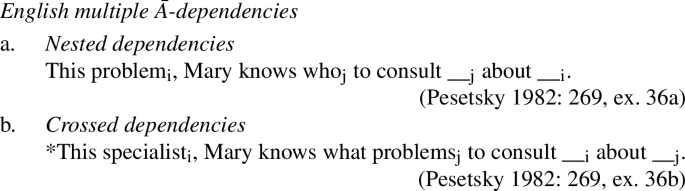
By contrast, in English, multiple instances of Ā-movement (of any kinds) must form nested dependencies, as seen in (51) and (52) (see, e.g., Pesetsky 1982). This can be accounted for by assuming that in English, Ā-probes are flat, which can be satisfied by any Ā-feature on the goal (see Rizzi 1997, 2004; Abels 2012; a.o.).Footnote24
- (51)
- (52)
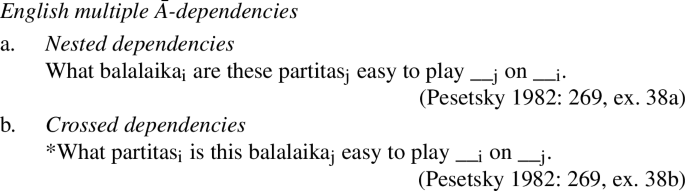
Mandarin, like Italian and unlike English, allows multiple instances of Ā-movement to form either nested or crossed dependencies (see, e.g., Xu 2000; Kuo 2009; a.o.). Concretely, the examples in (53) involve the indirect object and the direct object of a ditransitive verb undergoing IP-external topicalization, in either a nested or a crossed fashion.
- (53)
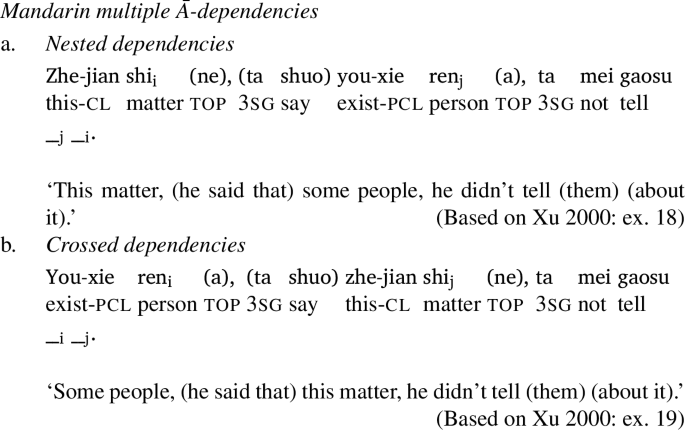
The examples in (54) involve the matrix object and the embedded object undergoing IP-external topicalization and relativization, in either a nested or a crossed fashion.
- (54)
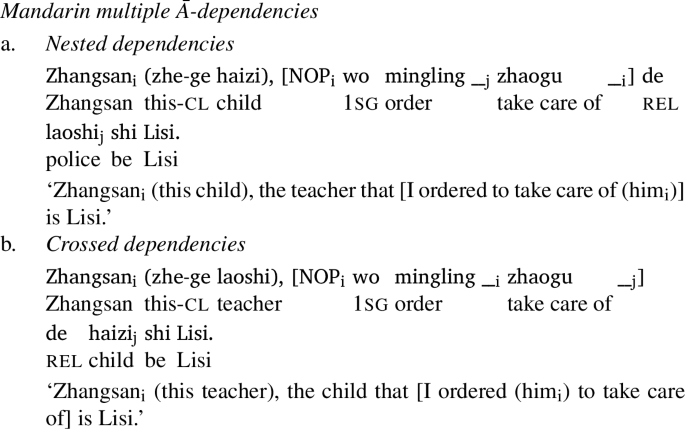
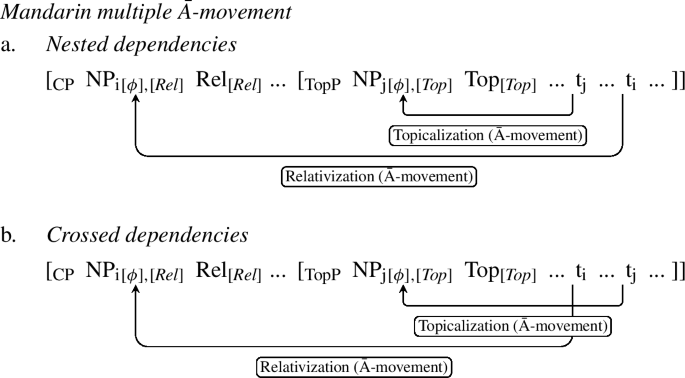
The possibility of either nested or crossed dependencies with multiple instances of Ā-movement in Mandarin suggests that pure Ā-probes in Mandarin are relativized to specific features (e.g., [Wh] for wh-movement, [Rel] for relativization, [Top] for topicalization, [Foc] for focalization, etc.). Specifically, nested dependencies are formed when the structurally higher NP has the specific Ā-feature of the structurally lower probe and the structurally lower NP has the specific Ā-feature of the structurally higher probe, as illustrated in (55a), while crossed dependencies are formed when the structurally higher NP has the specific Ā-feature of the structurally higher probe and the structurally lower NP has the specific Ā-feature of the structurally lower probe, as illustrated in (55b). Note that a detail not illustrated in (55) is successive-cyclic movement – assuming that in the active voice the Voice head heads a phase (Chomsky 2001), topicalization and relativization should proceed successive-cyclically via Spec, VoiceP. Accordingly, the Voice head must also host the specific Ā-features (e.g., [Wh] for wh-movement, [Rel] for relativization, [Top] for topicalization, [Foc] for focalization, etc.).
- (55)
However, when two NPs with both ϕ– and Ā-features move from bei’s complement, only the NP closer to bei can be the subject of bei. Under the proposed analysis of the bei-construction where composite A/Ā-movement is triggered by the passive head/bei, this follows if the Ā-feature on bei is flat, which can be satisfied by any Ā-feature on the goal (see Rizzi 1997, 2004; Abels 2012; a.o.).Footnote25 To set the stage, the examples in (56) show that either the indirect object or the direct object of a ditransitive verb can be the subject in the bei-construction. In particular, the use of mei-you ren ‘nobody’ and mei-you shi ‘nothing’ in (56) is to ensure that these phrases remain as the subject of bei, for they resist topicalization, as seen in (57).
- (56)
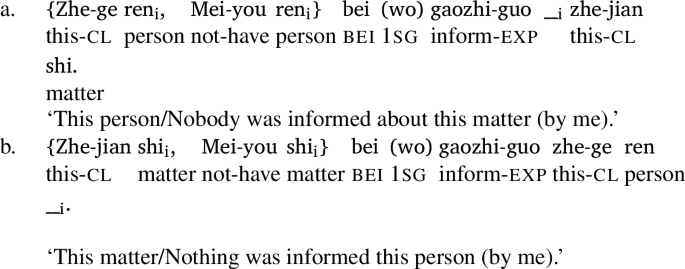
- (57)
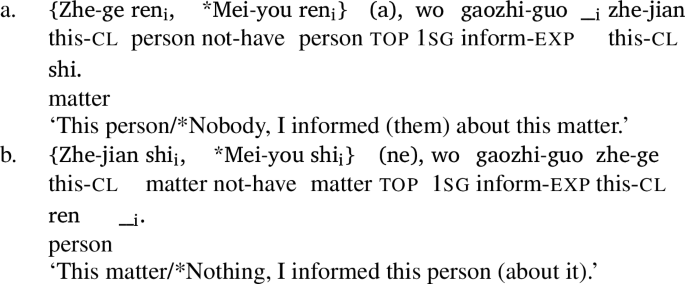
The well-formed example in (58a) is derived from (56a) via topicalization of the direct object (zhe-jian shi ‘this matter’) from bei’s complement. In this case, the subject of bei (mei-you ren ‘nobody’, which remains as the subject of bei for it resists topicalization) is linked to the indirect object gap, and nested dependencies are formed. By contrast, the ill-formed example in (58b) is derived from (56b) via topicalization of the indirect object (Lisi) from bei’s complement. In this case, the subject of bei (mei-you shi ‘nothing’, which remains as the subject of bei for it resists topicalization) is linked to the direct object gap, and crossed dependencies are formed. Note that (58c), which has the same derivation as (58a) except that the subject of bei (zhe-ge ren ‘this person’) undergoes further topicalization, is possible.Footnote26
- (58)
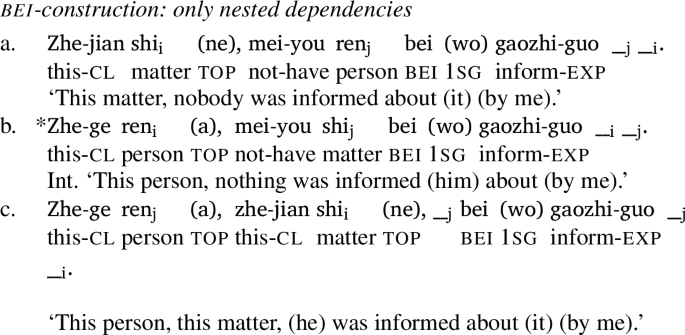
Similar to the examples in (57), the examples in (59) show that either the matrix object or the embedded object can be the subject in the bei-construction.
- (59)
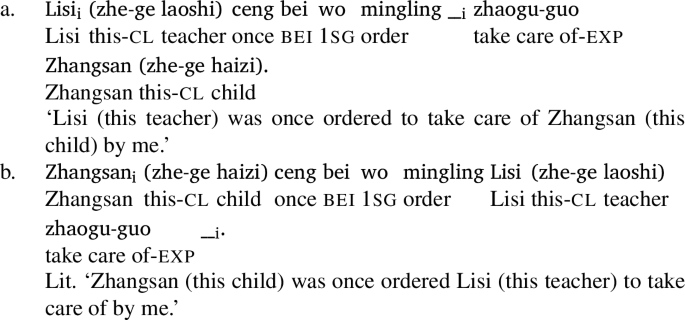
The examples in (60) involve both the matrix object and the embedded object moving from bei’s complement – the matrix and embedded object gaps are linked to the subject of bei and the head of the relative clause. In all of the examples, Zhangsan, mei-ge ren ‘everyone’, or zhe-ge ren ‘this person’ is forced to be the subject of bei, by means of binding the (compound) reflexive (ta-)ziji ‘3sg-self’, as in (60a), or coreference with the pronominal possessor without incurring weak crossover effects, as in (60b), or coreference with the pronoun without incurring reconstruction effects for Principle C, as in (60c).Footnote27 Unlike (59), where the subject of bei can be linked to either the matrix or embedded object gap, the subject of bei in the examples in (60) can only be linked to the matrix object gap (e.g., be interpreted as the care taker, and crucially not the person being taken care of).
- (60)
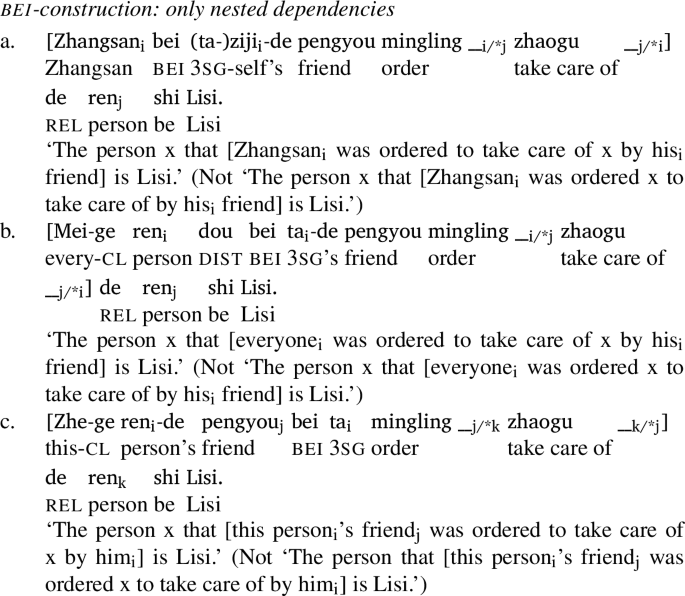
To summarize, both (58) and (60) show that when two NPs with both ϕ– and Ā-features move from bei’s complement, only the NP closer to bei can be the subject of bei. Under the proposed analysis, this follows if the composite probe on the passive head/bei consists of a ϕ-feature and a flat Ā-feature, which can be satisfied by any Ā-feature on the goal (see Rizzi 1997, 2004; Abels 2012; a.o.), as illustrated in (61).
- (61)
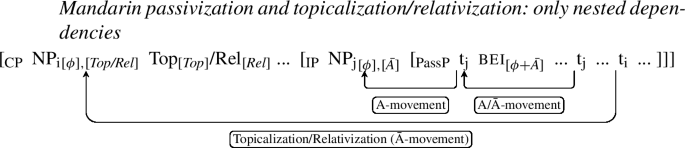
Importantly, the contrast between (53), (54) and (58), (60) suggests a difference between the active voice and the bei-construction, which, under the proposed analysis, is a passive construction. Specifically, the difference is that the Ā-feature on the Voice head must either be relativized to specific features (e.g., [Wh] for wh-movement, [Rel] for relativization, [Top] for topicalization, [Foc] for focalization, etc.) or be flat (for purposes of successive-cyclic composite A/Ā-movement in the bei-construction), while the Ā-feature on the passive head/bei must be flat.
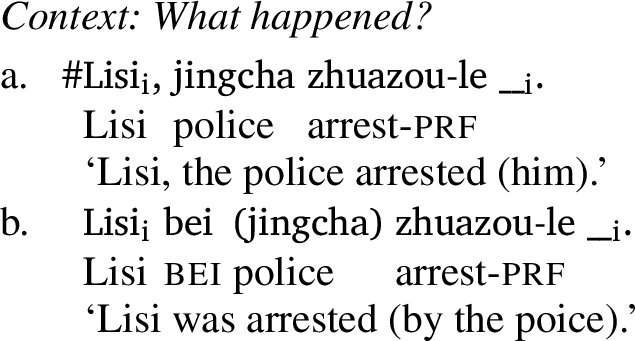
Finally, because in Mandarin, topicalization is triggered by a specific [Top] feature, while the (composite A/Ā-)movement involved in the bei-construction is triggered by (a ϕ-feature and) a flat Ā-feature on bei, it is expected that restrictions imposed specifically on a topic should not be imposed on the subject of bei. As seen previously in (56) and (57), while phrases like mei-you ren ‘nobody’ and mei-you shi ‘nothing’ resist topicalization, as seen in (57), they are fully acceptable as the subject of bei, as seen in (56). A further difference between topicalization and the bei-construction lies in their information-structural effects: answers to questions such as what happened consist solely of new information – in such cases, topicalization is infelicitous, while the use of a bei-construction is felicitous, as seen in (62).
- (62)
4 Proposed analysis
4.1 Bei as a passive head
In a nutshell, I propose to analyze the bei-construction as a passive construction where bei spells out a passive head, which selects a projection of the agent/external-argument-introducing Voice head (Kratzer 1996), in the sense of Bruening (2013). In overt-agent bei-constructions, which might be dubbed noncanonical passive constructions, the passive head/bei selects a projection of a Voice[+agent] head (with the [+agent] feature borrowed from Erlewine and Smith 2024) and is responsible for case-licensing the overtly expressed agent/external argument of the matrix verb introduced in Spec, VoiceP, albeit being semantically vacuous. In agent-less bei-constructions, which might be dubbed canonical passive constructions, the passive head/bei selects a projection of a Voice[-agent] head (with the [-agent] feature borrowed from Erlewine and Smith 2024) and is responsible for existentially binding the agent/external argument (following Bruening 2013; see also Bach 1980; Keenan 1980, 1985; Williams 1987; a.o.).
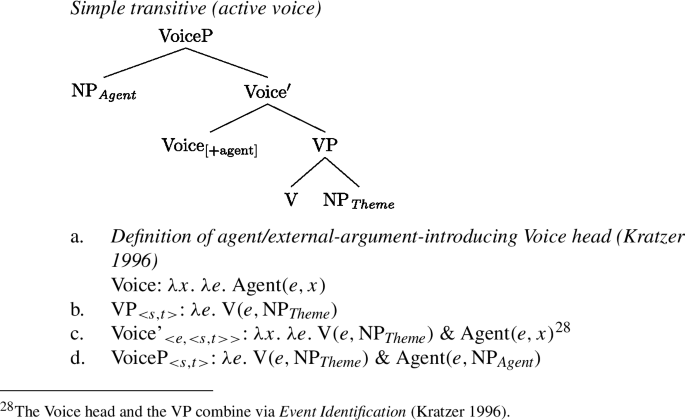
Specifically, I assume, following Kratzer (1996), that a simple transitive construction (in the active voice) has the structure in (63), where the Voice[+agent] head (with the [+agent] feature borrowed from Erlewine and Smith 2024) is responsible for introducing the agent/external argument of the matrix verb in Spec, VoiceP.
- (63)
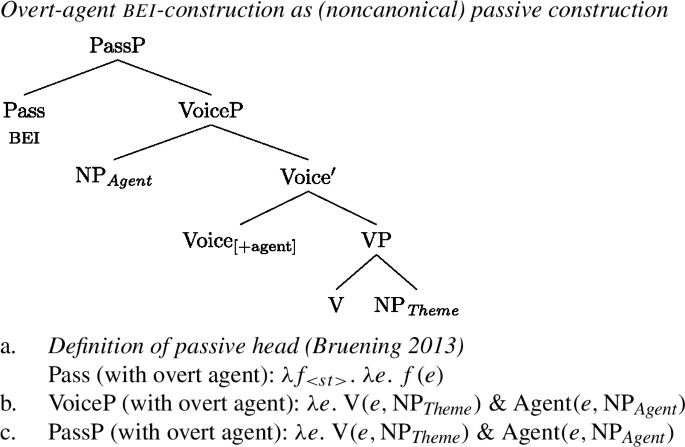
I propose to analyze the bei-construction as a passive construction where bei spells out a passive head, which selects a projection of the Voice head, in the sense of Bruening (2013). Specifically, overt-agent bei-constructions, which might be dubbed noncanonical passive constructions, have the structure in (64). The passive head/bei selects a projection of a Voice[+agent] head (with the [+agent] feature borrowed from Erlewine and Smith 2024), which introduces the agent/external argument of the matrix verb in Spec, VoiceP. In this case, the VoiceP remains both syntactically and semantically identical to that in the active voice. The passive head/bei is responsible for case-licensing the overtly expressed agent/external argument of the matrix verb introduced in Spec, VoiceP, albeit being semantically vacuous (in that it denotes an identity function).
- (64)
Agent-less bei-constructions, which might be dubbed canonical passive constructions, have the structure in (65). The passive head/bei selects a projection of a Voice[-agent] head (with the [-agent] feature borrowed from Erlewine and Smith 2024). In this case, the VoiceP syntactically lacks a specifier and semantically has an “unsaturated” agent/external argument (in Bruening’s 2013 terms). The passive head/bei is responsible for existentially binding the agent/external argument (following Bruening 2013; see also Bach 1980; Keenan 1980, 1985; Williams 1987; a.o.).
- (65)
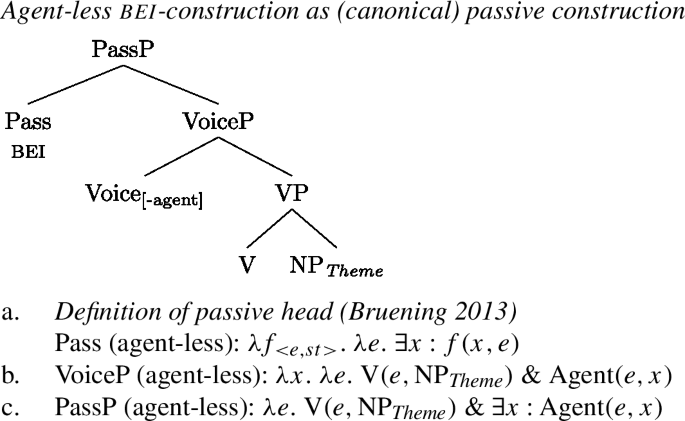
The proposed analysis of the bei-construction straightforwardly incorporates the syntactic properties of the bei-construction presented in Sect. 2 – specifically, that in overt-agent bei-constructions the agent/external argument of the matrix verb is introduced in Spec, VoiceP; that in agent-less bei-constructions, the agent/external argument of the matrix verb is existentially bound; that bei is best analyzed as a predicate selecting a VoiceP complement; and that bei has been fully grammaticalized as a functional category in modern Mandarin.
In addition, I assume Burzio’s generalization (Burzio 1986), which states that all and only the verbs that can assign a theta-role to the (logical) subject can assign accusative case to an object.Footnote28 Hence, in overt-agent bei-constructions, the matrix Voice head not only assigns an agent theta-role to the external argument of the matrix verb but also assigns (accusative) case; in contrast, in agent-less bei-constructions, the matrix Voice head does not assign a theta-role, nor does it assign case. Consequently, in agent-less bei-constructions, when there is an overt NP that cannot be assigned case by the matrix Voice head, that NP must become the subject of bei, where it can receive case from Infl; in such cases, it is predicted that long-distance dependencies between the subject of bei and a deeply embedded gap in bei’s complement is impossible (see Sect. 5.1).
Before proceeding, a few more words are in order on some implementation details of the passive voice. To provide context, at the core of Bruening’s (2013) analysis of the passive construction, which is based on the English be-passive, is a (syntactic and semantic) distinction between the passive head and the agent/external-argument-introducing Voice head, which has two consequences: syntactically, in the English be-passive, the passive head must select a VoiceP with an “unsaturated” agent/external argument (that is, a VoiceP headed by a Voice[-agent], in the sense of Erlewine and Smith 2024), regardless of whether an agent/external argument is overtly expressed (in a by-phrase) or nonovert; semantically, the passive head exhibits distinct semantics depending on whether an agent/external argument is overtly expressed, with vacuous semantics when the agent/external argument is nonovert. The proposed analysis of the bei-construction builds on Bruening’s (2013) analysis of the passive construction, but crucially allows the passive head/bei to also select a VoiceP with a “saturated” agent/external argument (that is, a VoiceP headed by a Voice[+agent], in the sense of Erlewine and Smith 2024). Consequently, the passive head/bei exhibits distinct syntactic and semantic properties in overt-agent bei-constructions, which might be dubbed noncanonical passive constructions, and agent-less bei-constructions, which might be dubbed canonical passive constructions: syntactically, the passive head/bei selects a projection of Voice[+agent] in overt-agent bei-constructions and is responsible for case-licensing the overtly expressed agent/external argument of the matrix verb introduced in Spec, VoiceP, but it selects a projection of Voice[-agent] in agent-less bei-constructions; semantically, the passive head/bei is vacuous (in that it denotes an identity function) in overt-agent bei-constructions, but is responsible for existentially binding the agent/external argument in agent-less bei-constructions.
Alternatively, Legate et al. (2020), building on Legate (2012, 2014), propose an analysis where the passive construction involves a single passive Voice head, treated as a variant of the Voice head. In the English be-passive, the passive Voice head differs from the active Voice head in two respects: syntactically, it introduces but does not project the agent/external argument in Spec, VoiceP, allowing it to be specified by a by-phrase; semantically, it allows the agent/external argument to either be specified by a by-phrase or be existentially bound. If one were to pursue an alternative analysis of the bei-construction along the lines of Legate et al. (2020), bei might be treated as a predicate selecting either an active VoiceP (in overt-agent bei-constructions) or a passive VoiceP (in agent-less bei-constructions), similar to Bruening and Tran (2015) and Ngui (2024), which I will review in Sect. 6.2. However, under such an analysis, the precise nature of bei would remain unclear.
Ultimately, the goal of this paper is not to settle the debate between the two major theories of the passive but to establish a foundation for analyzing the bei-construction as a passive construction. I leave it to future research to refine the implementation of the proposed analysis and to further investigate its implications for the broader theory of the passive.
4.2 Composite A/Ā-movement
To account for the possibility of long-distance dependencies in the bei-construction and, more generally, the mixed A/Ā-properties associated with the bei-construction, which I have considered to be direct consequences of (successive-cyclic) composite A/Ā-movement following Van Urk (2015) and Longenbaugh (2017), I propose that the passive head/bei hosts a composite probe [ϕ + Ā], which attracts the closest NP with both a matching ϕ-feature and a matching Ā-feature – in particular, the Ā-feature on the passive head/bei is flat, which can be satisfied by any Ā-feature on the goal (see Rizzi 1997, 2004; Abels 2012; a.o.); the subject in the bei-construction undergoes (successive-cyclic) composite A/Ā-movement to Spec, PassP, triggered by the composite probe [ϕ + Ā] on the passive head/bei (as well as the Voice head(s) involved in the successive-cyclic chain), as illustrated in (66a), followed by a terminating step of A-movement, as illustrated in (66b), which is akin to the analysis proposed by Longenbaugh (2017) for English tough-movement (see Sect. 3.2).
- (66)
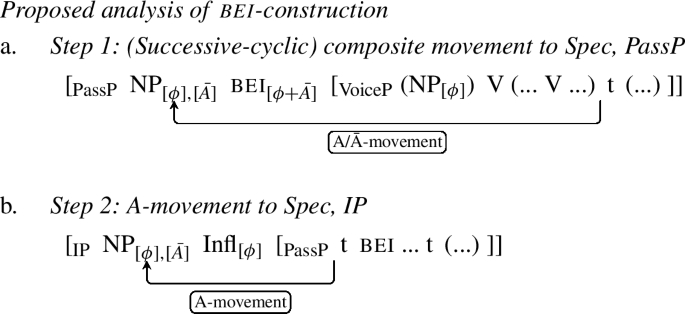
A few clarifications are in order: First, under the proposed analysis of the bei-construction, the composite probe [ϕ + Ā] on the passive head/bei attracts the closest NP with both a matching ϕ-feature and a matching Ā-feature; other NPs between the passive head/bei which hosts the composite probe [ϕ + Ā] and the closest NP with both ϕ– and Ā-features are not interveners if they lack an Ā-feature. In overt-agent bei-constructions, such NPs include the agent/external argument of the matrix verb, which is introduced in Spec, VoiceP.Footnote29 Also recall that, in Sect. 3.3, I have shown that when two NPs with both ϕ– and Ā-features move from bei’s complement, only the NP closer to bei can be the subject of bei. In such cases, the NP closer to bei is an intervener for the other NP.
Second, a few more words are in order on successive-cyclic composite A/Ā-movement involved in (step 1 of) the derivation of the bei-construction. I assume that in the passive voice, it is the passive head (instead of the Voice head immediately below it) that heads a phase (see, e.g., Collins 2005: 98), while in the active voice, the agent/external-argument-introducing Voice head heads a phase (Chomsky 2001). Hence, in addition to the passive head/bei, which hosts a composite probe [ϕ + Ā], the Voice head, when it heads a phase, must also host a composite probe [ϕ + Ā], for purposes of successive-cyclic composite A/Ā-movement. Concretely, I propose that when the bei-construction involves multiple verbal projections and a long-distance dependency between the subject of bei and a deeply embedded gap in bei’s complement, the subject of bei is derived via successive-cyclic composite A/Ā-movement through the specifiers of successive VoicePs, terminating at Spec, PassP, as illustrated in (67).
- (67)

Finally, I assume, following Longenbaugh (2017), that in (step 2 of) the derivation of the bei-construction, (successive-cyclic) composite A/Ā-movement (to Spec, PassP) can be followed by A-movement (to Spec, IP), without violating the ban on improper (A- after Ā-) movement (see footnote 14). I also assume, again following Longenbaugh (2017), a ban on composite A/Ā-movement after Ā-movement, which extends from the ban on improper A-after-Ā-movement (see footnote 15); in particular, if a finite clause object undergoes Ā-movement to Spec, CP (because it crosses over the finite clause subject, which rules out the possibility of it undergoing A-movement to Spec, CP, and under the assumption that the Mandarin C does not host a composite probe [ϕ + Ā], which rules out the possibility of the finite clause object undergoing composite A/Ā-movement to Spec, CP), then it cannot undergo further composite A/Ā-movement (and A-movement), as illustrated in (68) (see Sect. 5.2).
- (68)

4.3 Overview of alternative analyses
As mentioned previously, a widely accepted alternative approach derives the dependency involved in the bei-construction via base-generation of the subject of bei as an argument of bei and Ā-movement of a NOP in bei’s complement, on a par with Chomsky’s (1977, 1981) analysis of English tough-movement (see, e.g., Feng 1995, 2012; Ting 1995a, 1998; Huang 1999; Tang 2001; Huang et al. 2009; Bruening and Tran 2015; a.o.). Hence, like Chomsky’s (1977, 1981) analysis of English tough-movement, the alternative approach to the bei-construction is bipartite, in the sense that it attempts to derive the A-properties associated with the bei-construction by base-generating the subject of bei as an argument of bei, and derives the Ā-properties associated with the bei-construction via Ā-movement of a NOP in bei’s complement.
More specifically, these various proposals differ in their specific analyses of overt-agent and agent-less bei-constructions. For Huang et al. (2009) (see also Ting 1995a, 1998; Huang 1999; a.o.), while the subject of bei is always base-generated, only overt-agent bei-constructions involve NOP movement within bei’s complement. By contrast, agent-less bei-constructions involve A-movement of a PRO, which is controlled by the subject of bei. But for Bruening and Tran (2015) and Ngui (2024), both overt-agent and agent-less bei-constructions uniformly involve base-generation of the subject of bei and NOP movement in bei’s complement. In addition, building on Huang et al. (2009) (see also Ting 1995a, 1998; Huang 1999; a.o.), Liu and Huang (2016) consider the possibility of both a base-generation analysis and a raising analysis of the subject in the bei-construction, but only for (overt-agent and agent-less) bei-constructions involving one, rather than multiple, (extended) verbal projections, in bei’s complement.
In Sect. 5, I will argue that the two restrictions on long-distance dependencies in the bei-construction – namely, the requirement that no overt, case-less NPs should intervene between the subject of bei and the gap in agent-less bei-constructions, and the subject/object contrast with respect to the possibility of crossing a finite clause boundary to become the subject of bei – provide evidence for the proposed analysis of the bei-construction as a passive construction where the subject in the bei-construction is derived via A-movement after (successive-cyclic) composite A/Ā-movement and, crucially, are not accounted for by the various proposals under the alternative approach to the bei-construction involving base-generation of the subject of bei and NOP movement in bei’s complement. Then, in Sect. 6, I will review the alternative analyses in more detail and recapitulate their problems.
5 On the restricted long-distance dependencies in the bei-construction
In this section, I will account for the two restrictions on long-distance dependencies in the bei-construction presented previously in Sect. 2.4. Specifically, in Sect. 5.1, I will account for the ban on any overt, case-less NPs intervening between the subject of bei and the gap in agent-less bei-constructions, which follows from the proposed analysis of the bei-construction as a passive construction and Burzio’s generalization (Burzio 1986); in Sect. 5.2, I will account for the contrast when the bei-construction involves a cross-finite-clause dependency between the subject of bei and a subject vs. object gap, which crucially relies on the proposed analysis of the bei-construction where the subject in the bei-construction is derived via (successive-cyclic) composite A/Ā-movement, followed by a terminating step of A-movement.
Before proceeding, a few words are in order about the finite vs. nonfinite distinction in Mandarin, which has implications for clause size (see, e.g., Huang 1982, 1989, 2022; Li 1990; Tang 2000; Lin 2011, 2012, 2015; a.o.). Specifically, as is commonly assumed, a distinction between finite and nonfinite clauses in Mandarin “may be made on the basis of the potential occurrence of any element of the auxiliary category (such as an aspect marker or a modal)” (Huang 1989: 189). Both object control verbs like bi(po) ‘force’ (also pai ‘send’, jiao ‘order’, qing(qiu) ‘ask’, (bai)tuo ‘entrust’) and subject control verbs like shefa ‘manage (Lit. find a way)’ (also changshi ‘try’, qitu ‘attempt’) take a nonfinite clausal complement, because their complement cannot contain a modal verb (hui ‘will’, yinggai ‘should’, neng ‘can (be able)’, keyi ‘can (be permissible)’) or the progressive aspect (zheng)zai, as seen in (69).
- (69)
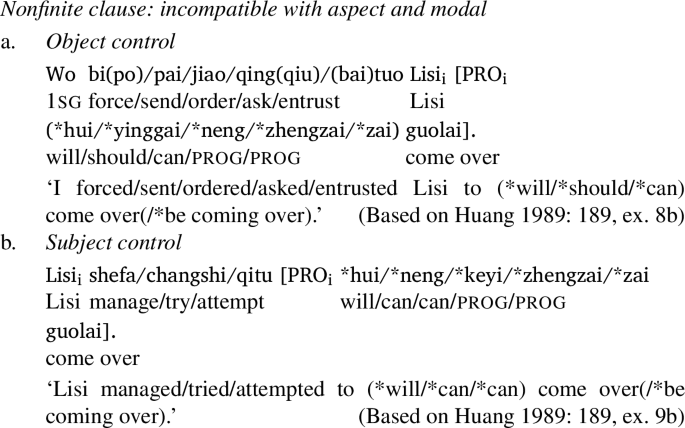
By contrast, verbs like shuo ‘say’ (also renwei ‘think’, huaiyi ‘suspect’, xiangxin ‘believe’) take a finite CP complement, which can contain a modal verb as well as the progressive aspect (zheng)zai, as seen in (70).
- (70)
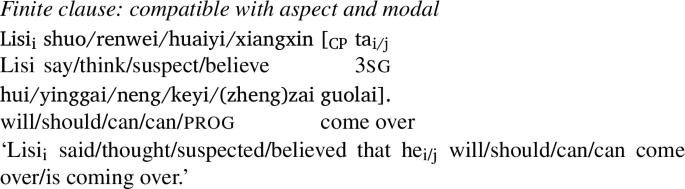
Importantly, based on the contrast between (69) and (70), it is commonly assumed that infinitival complements of object control and subject control verbs are nonfinite clauses that lack a CP projection (see, e.g., Huang 1982, 1989, 2022; Li 1990; Tang 2000; Lin 2011, 2012, 2015; see also, e.g., Wurmbrand 2014 for English). The absence of the C head in the embedded clause(s) will be necessary for the analysis of the requirement that no overt, case-less NPs should intervene between the subject of bei and the gap in agent-less bei-constructions, which I will present in Sect. 5.1. Similarly, the presence of the C head in the embedded clause will also be crucial to the analysis of the subject/object contrast with respect to the possibility of crossing a finite clause boundary to become the subject of bei, which I will present in Sect. 5.2.
5.1 Long-distance dependencies in agent-less bei-constructions
In this section, I will account for the ban on any overt, case-less NPs intervening between the subject of bei and the gap in agent-less bei-constructions, which follows from the proposed analysis of the bei-construction as a passive construction and Burzio’s generalization (Burzio 1986), which states that all and only the verbs that can assign a theta-role to the (logical) subject can assign accusative case to an object.
Recall that, under the proposed analysis of the bei-construction as a passive construction, in overt-agent bei-constructions, the passive head/bei selects a projection of a Voice[+agent] head (with the [+agent] feature borrowed from Erlewine and Smith 2024), which introduces the agent/external argument of the matrix verb in Spec, VoiceP, while in agent-less bei-constructions, the passive head/bei selects a projection of a Voice[-agent] head (with the [-agent] feature borrowed from Erlewine and Smith 2024), which lacks a specifier. Furthermore, according to Burzio’s generalization, in overt-agent bei-constructions, the matrix Voice head not only assigns an agent theta-role to the external argument of the matrix verb but also assigns (accusative) case; in contrast, in agent-less bei-constructions, the matrix Voice head does not assign a theta-role, nor does it assign case. Consequently, in agent-less bei-constructions, when there is an overt NP that cannot be assigned case by the matrix Voice head, that NP must become the subject of bei, where it can receive case from Infl; in such cases, it is predicted that long-distance dependencies between the subject of bei and a deeply embedded gap in bei’s complement is impossible.
In the remainder of this section, I will show that the possibility of long-distance dependencies in agent-less bei-constructions with object control matrix verbs (Case 1, in Sect. 5.1.1), subject control matrix verbs (Case 2, in Sect. 5.1.2), and exceptional case-marking (ECM) matrix verbs (Case 3, in Sect. 5.1.3), all depends on whether there is an overt NP – the thematic object of an object control verb, or an overt controllee in the case of subject control, or an overt NP that is underlying the subject of the infinitival complement to an ECM verb – that cannot be assigned case by the matrix Voice head. Lastly, in Sect. 5.1.4, I will discuss the possibility of analyzing agent-less bei-constructions which (apparently) involve a long-distance dependency between the subject of bei and a deeply embedded object gap in bei’s complement across nonfinite clause boundaries as involving (voice) restructuring in bei’s complement, on a par with Wurmbrand’s (2001, 2007) analysis of the German long passive.
5.1.1 Case 1: Object control
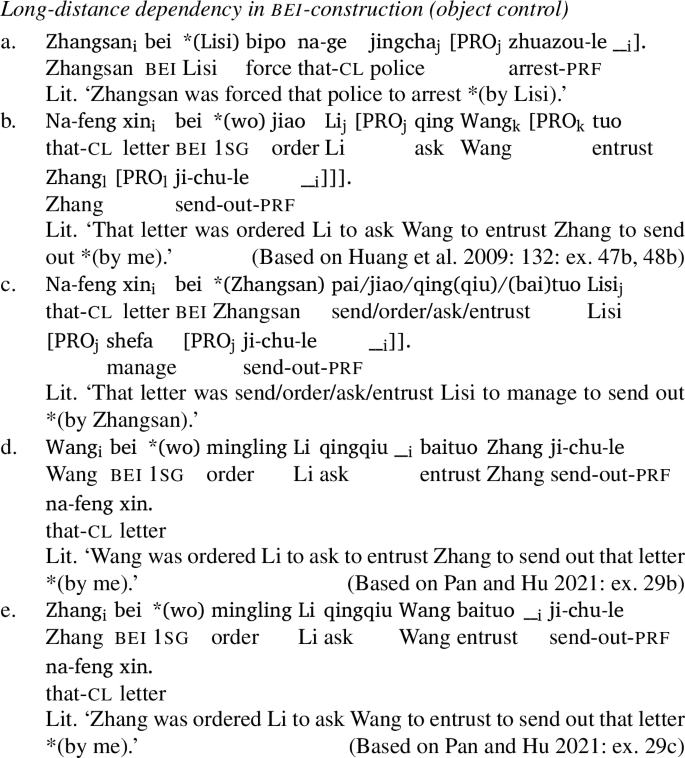
First, I consider the (im)possibility of long-distance dependencies in agent-less bei-constructions with object control matrix verbs, which has long been recognized, but has been a controversy, in the literature (see, e.g., Feng 1995, 2012; Ting 1995a, 1998; Huang 1999; Tang 2001; Huang et al. 2009; Her 2009; Bruening and Tran 2015; a.o.). Recall that in the following bei-constructions in (71), which involve a long-distance dependency between the subject of bei and a deeply embedded object gap in bei’s complement across nonfinite clause boundaries, the agent/external argument of the matrix verb must be overtly expressed and cannot be nonovert. All of the bei-constructions in (71) involve an overt NP, the matrix object, between the subject of bei and the deeply embedded object gap. Under the proposed analysis, the bei-constructions in (71) cannot be agent-less, because the matrix object would not be assigned case by the matrix Voice head.
- (71)
A digression is necessary at this point. Her (2009) provides two apparent counterexamples found on the internet (the % signs are mine to indicate speaker variation on the judgements):
- (72)
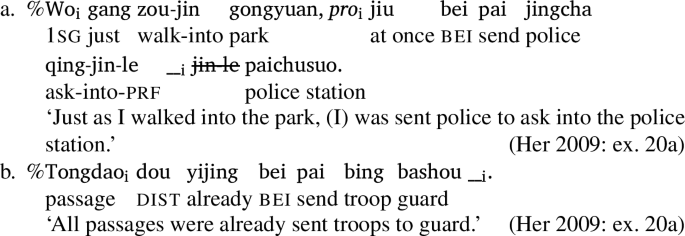
While virtually every speaker I have consulted (many of whom offered to consult additional speakers who reported the same judgements) reported that these examples in (72) are entirely unacceptable (and not just ‘admittedly odd’, as Her 2009 describes them), two suggestions have been made to improve their acceptability. First, Yitong Luo (p.c.) notes that (72a) could be made acceptable with a strong contextual setup. For instance, imagine Zhang has been sending police to escort anyone entering the park to the police station for interrogation. Previously, Li entered the park and was brought to the police station by some police sent by Zhang. Then, just as I walked into the park, I too was brought to the police station by some of Zhang’s police. Note that, with such a context, (72a) in fact receives a null pronoun reading, where the null pronoun coreferences with Zhang – that is to say, (72a) is not truly agent-less. Second, most of the speakers, including myself, find (72b) more acceptable than (72a), possibly because in (72b), bing ‘troop’ is more readily interpreted as an indefinite expression. In Mandarin, indefinite NPs arguably receive inherent case, allowing them to surface in case-less positions (e.g., the thematic object position of an unaccusative verb), in contrast to definite NPs, as seen in (73):Footnote30
- (73)
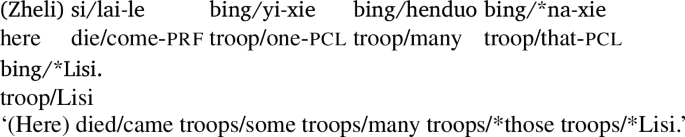
Notably, the acceptability of (72) (for some but arguably not the majority of speakers, and potentially due to one of the two confounds discussed above) was taken to the extreme by Her (2009) – and subsequently by Bruening and Tran (2015) and Ngui (2024) – as evidence for the general possibility of long-distance dependencies in agent-less bei-constructions, which, I contend, is wrong-headed.
Returning to the proposed analysis, it is also expected that the following bei-constructions in (74) are well-formed when agent-less, because the matrix object becomes the subject of bei, where it can receive case from Infl.
- (74)
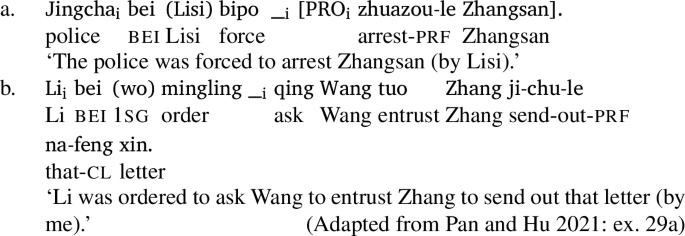
5.1.2 Case 2: Subject control
Second, I consider the possibility of long-distance dependencies in agent-less bei-constructions with subject control matrix verbs (see, e.g., Her 2009; Bruening and Tran 2015; a.o.). Recall that in the following bei-constructions in (75), which also involve a long-distance dependency between the subject of bei and a deeply embedded object gap in bei’s complement across nonfinite clause boundaries, the agent/external argument of the matrix verb can be overtly expressed or nonovert (note that the original examples from Her 2009, where the agent/external argument of the matrix verb is nonovert, are found on the internet). In contrast to the bei-constructions in (71), the bei-constructions in (75) involve no overt NPs between the subject of bei and the deeply embedded object gap. Under the proposed analysis, the bei-constructions in (75) can be agent-less, because no NP needs to be assigned case by the matrix Voice head.Footnote31
- (75)
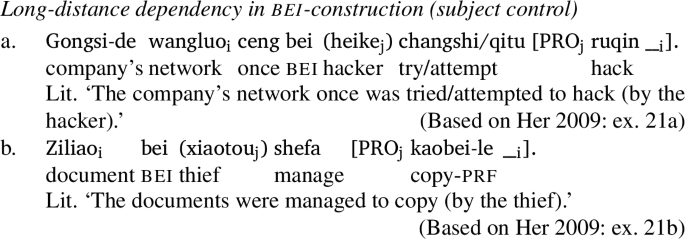
In (76), there is an overt NP, Lisi, which is the object of the embedded verb (pai/jiao/qing(qiu)/(bai)tuo ‘send/order/ask/entrust’), intervening between the subject of bei and the deeply embedded object gap. In this case, the embedded object Lisi is assigned case by the embedded Voice head; hence, no case problem arises when the agent/external argument of the matrix verb is nonovert (in which case it is the matrix Voice head that cannot assign case) (see footnote 9).
- (76)
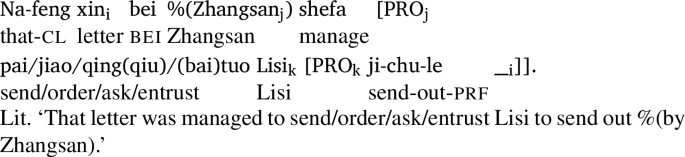
In Mandarin, certain subject control verbs, e.g., jihua ‘plan’, jueding ‘decide’, allow an overt controllee in their complement, as seen in (77) (see, e.g., Zhang 2016; Li 2024).
- (77)
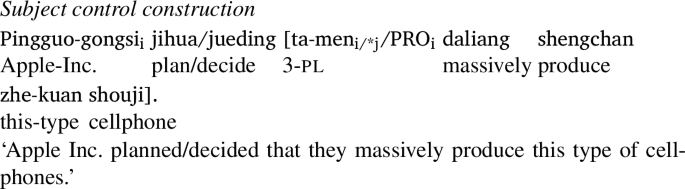
Note that in (78a), where the controllee is overt, the agent/external argument of the matrix verb must be overtly expressed – in this case, I suggest that the overt controllee needs to be assigned case by the matrix Voice head, hence the bei-construction cannot be agent-less. By contrast, in (78b), where the embedded subject is a PRO, the agent/external argument of the matrix verb can be overtly expressed or nonovert – in this case, no NP needs to be assigned case by the matrix Voice head, hence the bei-construction can be agent-less.Footnote32
- (78)
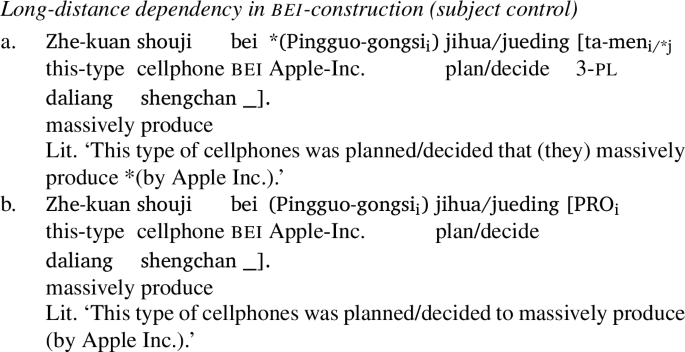
In (79), there is an overt NP, Pingguo-gongsi ‘Apple Inc.’, which is the object of the embedded verb (pai/jiao/qing(qiu)/(bai)tuo ‘send/order/ask/entrust’), intervening between the subject of bei and the deeply embedded object gap. In this case, the embedded object Pingguo-gongsi ‘Apple Inc.’ is assigned case by the embedded Voice head; hence, no case problem arises when the agent/external argument of the matrix verb is nonovert (in which case it is the matrix Voice head that cannot assign case).Footnote33
- (79)
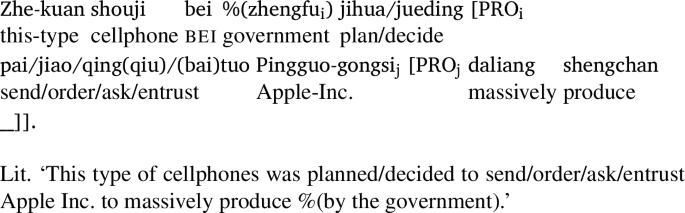
5.1.3 Case 3: Exceptional case-marking
Lastly, I consider the possibility of long-distance dependencies in agent-less bei-constructions with matrix verbs like yunxu ‘allow’, jinzhi ‘forbid’, tongyi ‘agree’, fandui ‘object’, which I analyze as ECM verbs (contra Li 1990, who refutes the existence of ECM verbs in Mandarin). Like object control verbs, these verbs take a nonfinite clause complement that lacks a CP projection, which cannot contain a modal verb or the progressive aspect (zheng)zai, as seen in (80).
- (80)
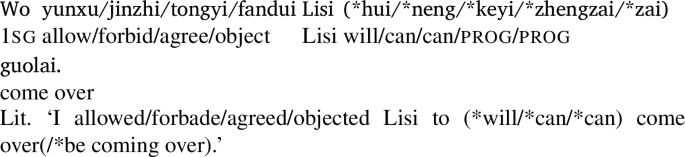
But unlike object control verbs, these verbs allow the apparent matrix object to be identified with the thematic object of the embedded verb, which can be achieved by means of embedding a bei-construction, as seen in (81a); this suggests that the apparent matrix object is underlyingly the embedded subject, which is not thematically related to the matrix verb.
- (81)
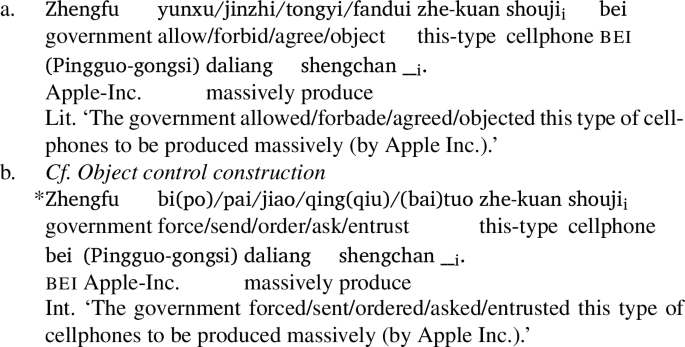
Also unlike object control verbs, these verbs allow the subject of the embedded clause to be an arbitrary PRO, as seen in (82a).
- (82)
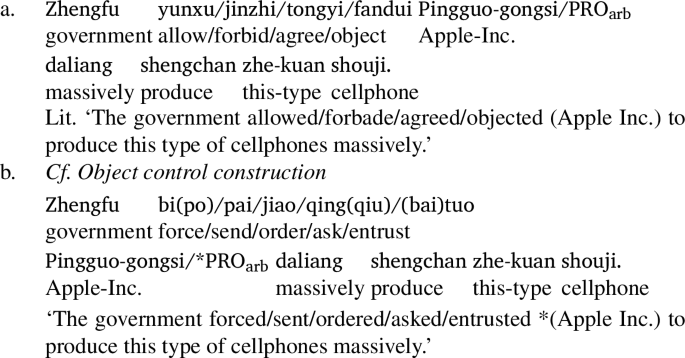
Note that in (83a), where the embedded subject is overt, the agent/external argument of the matrix verb must be overtly expressed – in this case, the overt embedded subject needs to be assigned case by the matrix Voice head, hence the bei-construction cannot be agent-less. By contrast, in (83b), where the embedded subject is an arbitrary PRO, the agent/external argument of the matrix verb can be overtly expressed or nonovert – in this case, no NP needs to be assigned case by the matrix Voice head, hence the bei-construction can be agent-less.Footnote34
- (83)
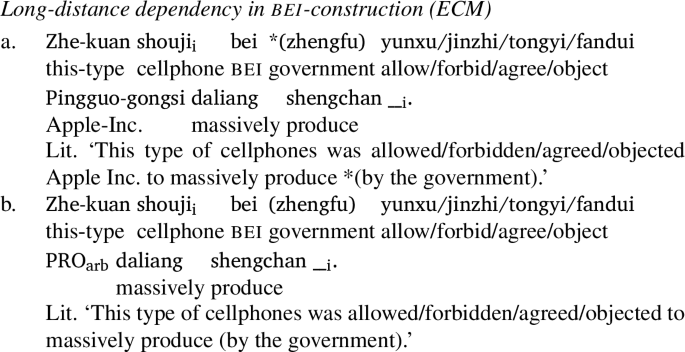
In (84), there is an overt NP, Pingguo-gongsi ‘Apple Inc.’, which is the object of the embedded verb (pai/jiao/qing(qiu)/(bai)tuo ‘send/order/ask/entrust’), intervening between the subject of bei and the deeply embedded object gap. In this case, the embedded object Pingguo-gongsi ‘Apple Inc.’ is assigned case by the embedded Voice head; hence, no case problem arises when the agent/external argument of the matrix verb is nonovert (in which case it is the matrix Voice head that cannot assign case).Footnote35
- (84)
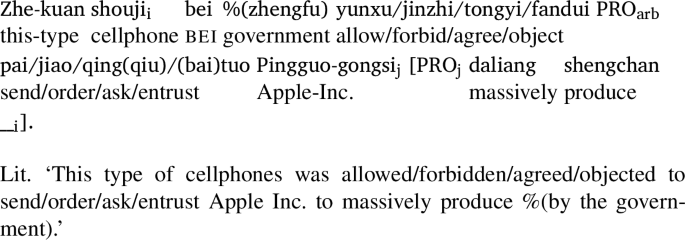
Also, the bei-construction in (85) is well-formed, because the otherwise case-less NP (i.e., the embedded subject) becomes the subject of bei, where it can receive case from Infl.
- (85)
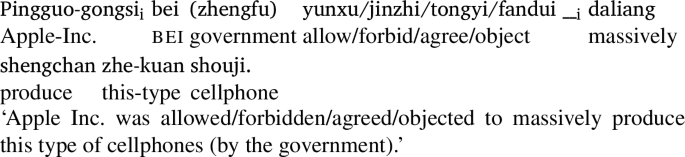
5.1.4 Not (necessarily) restructuring
To summarize, all of the three cases I have considered in Sects. 5.1.1, 5.1.2, and 5.1.3 suggest that long-distance dependencies in agent-less bei-constructions are possible, but, crucially, are restricted by the requirement that no overt, case-less NPs should intervene between the subject of bei and the gap in agent-less bei-constructions. Under the proposed analysis of the bei-construction as a passive construction and in light of Burzio’s generalization (Burzio 1986), this restriction arises because in agent-less bei-constructions, when there is an overt NP that cannot be assigned case by the matrix Voice head, that NP must become the subject of bei, where it can receive case from Infl. With this, it can be maintained that both overt-agent and agent-less bei-constructions uniformly involve composite A/Ā-movement.
As mentioned previously, the alternative proposals differ in their analysis of agent-less bei-constructions: Huang et al. (2009) (see also Ting 1995a, 1998; Huang 1999; a.o.) propose that agent-less bei-constructions involve A-movement of a PRO, which is controlled by the subject of bei; in contrast, both Bruening and Tran (2015) and Ngui (2024) maintain that agent-less bei-constructions still involve Ā-movement of a NOP. I contend that both sets of proposals are problematic: Huang et al.’s (2009) (see also Ting 1995a, 1998; Huang 1999; a.o.) analysis of agent-less bei-constructions fails to account for the well-formedness of certain agent-less bei-constructions which (apparently) involve a long-distance dependency between the subject of bei and a deeply embedded object gap in bei’s complement across nonfinite clause boundaries (namely, Case 2, with a subject control matrix verb and a PRO subject in the infinitival complement; and Case 3, with an ECM matrix verb and an arbitrary PRO subject in the infinitival complement). By contrast, the analyses proposed by Bruening and Tran (2015) and Ngui (2024) encounter the opposite problem: they fail to account for the ill-formedness of certain agent-less bei-constructions that involve a long-distance dependency between the subject of bei and a deeply embedded object gap in bei’s complement across nonfinite clause boundaries (namely, Case 1, with an object control matrix verb; and Case 2, with a subject control matrix verb and an overt controllee in the infinitival complement; and Case 3, with an ECM matrix verb and an overt subject in the infinitival complement).
Nevertheless, it is still worth considering the possibility of analyzing agent-less bei-constructions which (apparently) involve a long-distance dependency between the subject of bei and a deeply embedded object gap in bei’s complement across nonfinite clause boundaries as involving (voice) restructuring in bei’s complement, on a par with Wurmbrand’s (2001, 2007) analysis of the German long passive. In the remainder of this section, I will first highlight the differences between the German long passive and agent-less bei-constructions which (apparently) involve a long-distance dependency between the subject of bei and a deeply embedded object gap in bei’s complement across nonfinite clause boundaries, and then show that it is indeed possible, but crucially not necessary, for (agent-less) bei-constructions to involve (voice) restructuring.
To provide context, in German, the so-called long passive, which involves a long-distance dependency between the passive-subject and a deeply embedded gap, is licensed by a so-called restructuring verb (e.g., versuchen ‘to try’), as seen in (86a); crucially, the long passive cannot be licensed by a so-called nonrestructuring verb (e.g., planen ‘to plan’ and beschliessen ‘to decide’), as seen in (86b) (Wurmbrand 2001).
- (86)
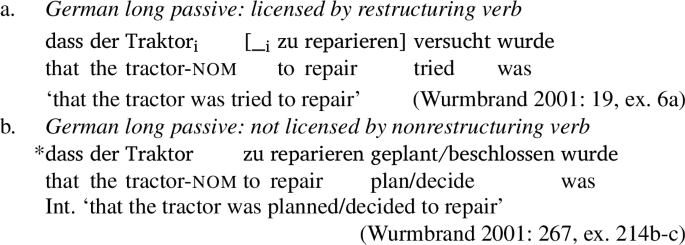
Furthermore, in German, a distinction between restructuring verbs like versuchen ‘to try’ and nonrestructuring verbs like planen ‘to plan’ and beschliessen ‘to decide’ can be made on the basis of the possibility of embedded tense (and negation): restructuring verbs do not allow future adverbials, which introduce independent tense, in their infinitival complement, as seen in (87a), which indicates that their complement is structurally smaller than an IP; in contrast, nonrestructuring verbs allow future adverbials in their infinitival complement, as seen in (87b), which indicates that their complement is structurally as large as an IP.
- (87)
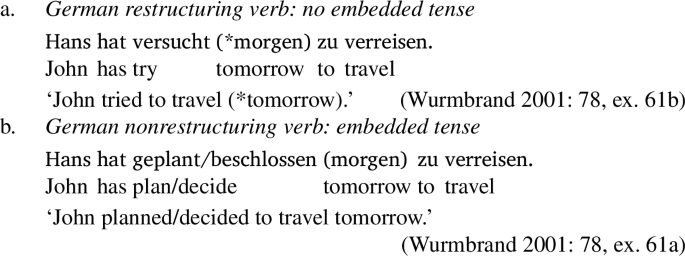
Wurmbrand (2001, 2007) proposes that in German, (voice) restructuring is necessary to license a long passive, because apparent long-distance dependencies in the German long passive are nevertheless derived via A-movement, with the restructuring verb taking a VoiceP(-less) infinitival complement (see Wurmbrand 2016 and Wurmbrand and Shimamura 2017 for a more fine-grained analysis of voice restructuring involving a special VoiceR head), as illustrated in (88).
- (88)
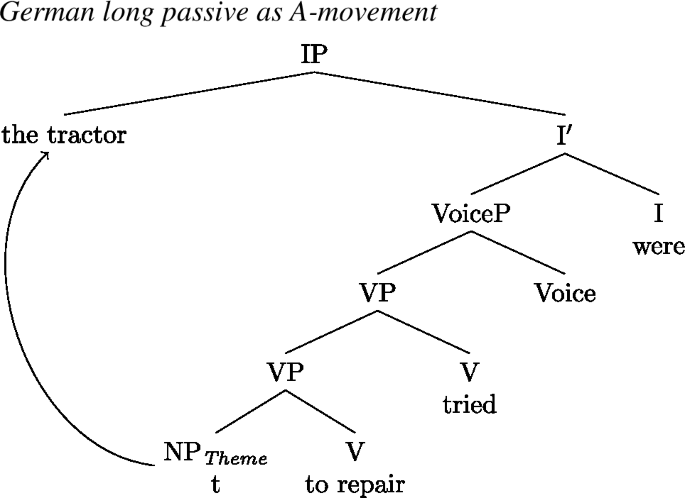
To support the restructuring analysis of the German long passive, it is further shown that, in the German long passive, which is only possible with restructuring verb, it is also the case that neither future adverbials nor sentential negation can be embedded within the restructuring infinitival complement (Wurmbrand 2001).
- (89)
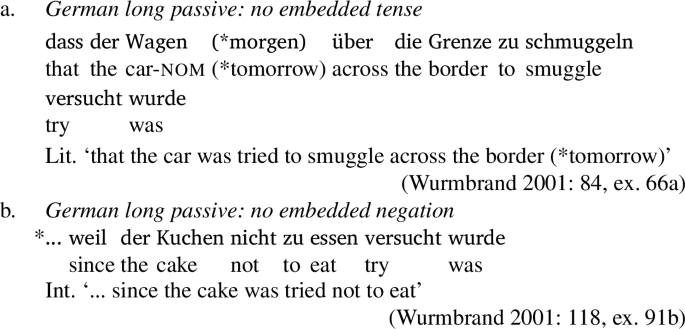
In Mandarin, (subject control) verbs like shefa ‘manage (Lit. find a way)’ (which might be a candidate of a restructuring verb), (subject control) verbs like jihua ‘plan’, jueding ‘decide’ (which might be candidates of nonrestructuring verbs), as well as (ECM) verbs like yunxu ‘allow’, tongyi ‘agree’ exhibit no distinction in their ability to both allow embedded tense and negation in their infinitival complements and license long-distance dependencies in the bei-construction. Hence, in contrast to German, there is no apparent evidence that Mandarin makes a distinction between restructuring and nonrestructuring verbs. More importantly, in contrast to the German long passive, it is easy to show that (voice) restructuring is not required to license long-distance dependencies in agent-less bei-constructions: as seen in (90), both future adverbs and sentential negation can occur in the infinitival complement of the subject control or ECM verb, suggesting that the infinitival complement of these verbs can be structurally as large as an IP.Footnote36
- (90)
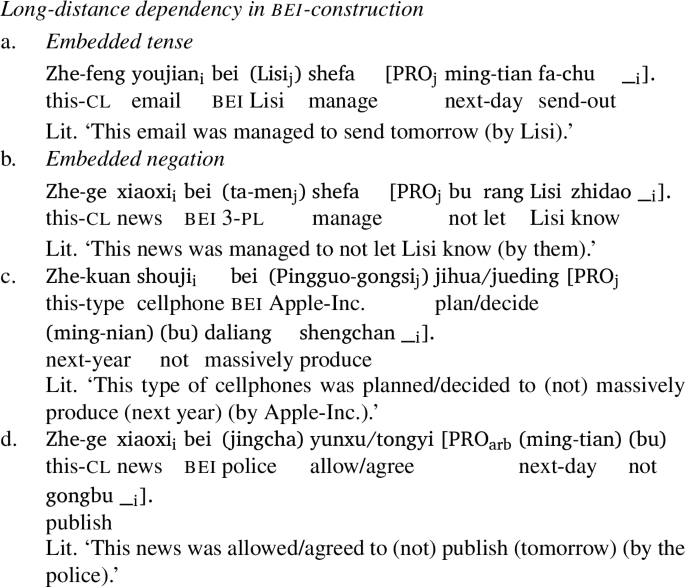
Nevertheless, it should be noted that the ability for these subject control or ECM verbs to take an IP complement does not rule out their possibility of taking a VoiceP(-less) complement. As noted in footnotes 9, 34, and 36, a few speakers I have consulted reported that the examples in (91) (which are fully acceptable when agent-less, but crucially with embedded tense) would not be entirely acceptable when agent-less (with varying degree of degradedness reported), without the future-oriented adverb embedded within the infinitival complement of the subject control matrix verb:Footnote37
- (91)
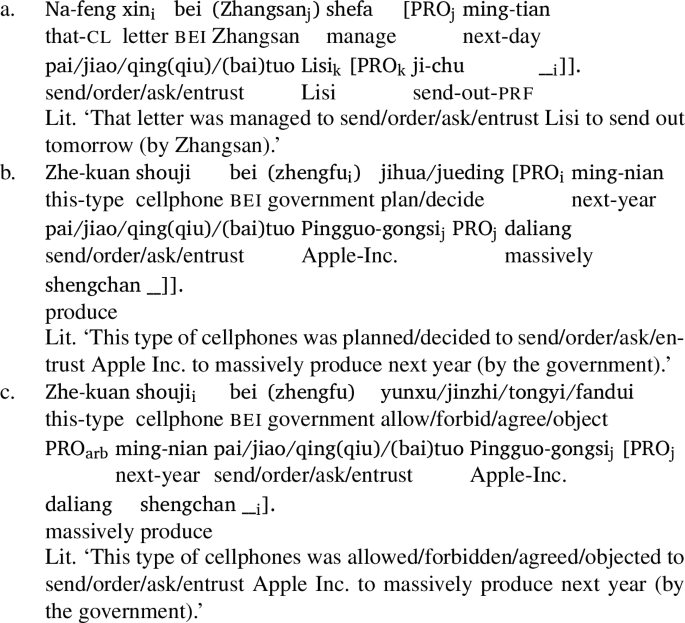
This, I suggest, is because for some speakers, without the presence of the future-oriented adverb, restructuring indeed occurs in the above examples, which renders the embedded infinitival complement(s) VoiceP-less; as a result, even an embedded object (Lisi or Pingguo-gongsi ‘Apple-Inc.’) would require case from the matrix Voice head, which is unavailable when the examples are agent-less. However, with the presence of a future-oriented adverb, a nonrestructuring analysis is enforced, in which case the embedded object (Lisi or Pingguo-gongsi ‘Apple-Inc.’) is assigned case by the embedded Voice head; in such a case, no case problem arises when the examples are agent-less.
5.2 Long-distance dependency across finite clause boundary
Recall that another restriction on long-distance dependencies in the bei-construction lies in a contrast when the bei-construction involves a cross-finite-clause dependency between the subject of bei and a subject vs. object gap. Specifically, the bei-construction does not allow a cross-finite-clause dependency between the subject of bei and an object gap, as seen in (92a) (see, e.g., Ting 1995a, 1998; a.o.), but allows a cross-finite-clause dependency between the subject of bei and a subject gap, as seen in (92b) (see, e.g., Her 2009).
- (92)
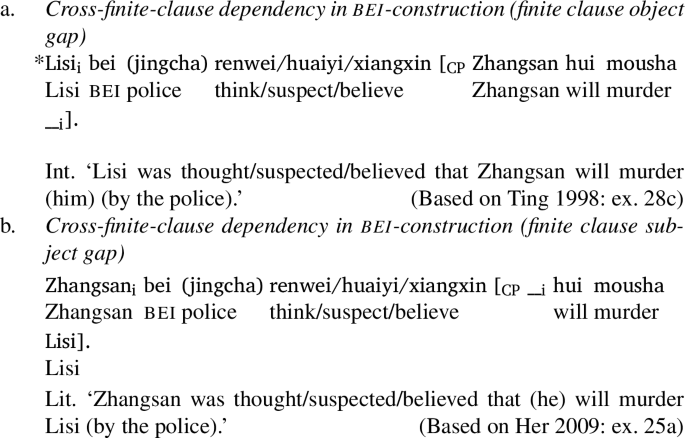
In this section, I will account for this subject/object contrast, which crucially relies on the proposed analysis of the bei-construction where the subject in the bei-construction is derived via (successive-cyclic) composite A/Ā-movement, followed by a terminating step of A-movement. In Sect. 5.2.1, I will propose that the possibility of cross-finite-clause dependency between the subject of bei and a subject gap follows from the possibility of raising to subject via A-movement to Spec, CP, or hyperraising to subject (see, e.g., Fong 2019; Wurmbrand 2019; Lohninger et al. 2022; a.o.). In Sect. 5.2.2, I will propose that the impossibility of cross-finite-clause dependency between the subject of bei and an object gap follows from the ban on improper Ā-movement to Spec, CP followed by composite A/Ā-movement (see Longenbaugh 2017).Footnote38 The proposed analysis of the subject/object contrast with respect to the possibility of crossing a finite clause boundary to become the subject of bei has implications for the feature composition of the probe on the Mandarin C head, which I will discuss in Sect. 5.2.3.
Importantly, this subject/object contrast does not receive a straightforward explanation under the alternative approach to the bei-construction involving base-generation of the subject of bei and NOP movement in bei’s complement (see, e.g., Feng 1995, 2012; Ting 1995a, 1998; Huang 1999; Tang 2001; Huang et al. 2009; Bruening and Tran 2015; a.o.). Specifically, if the dependency involved in the bei-construction is derived via Ā-movement of a NOP, then cross-finite-clause dependencies between the subject of bei and either a finite clause subject gap or a finite clause object gap should be possible (or impossible, depending on independent assumptions/evidence regarding whether or not NOP movement can cross a finite CP boundary).Footnote39
5.2.1 Case 1: Finite clause subject gap
I propose that in the bei-construction, cross-finite-clause dependencies between the subject of bei and a subject gap boundary are possible, as seen in (92b), as the result of raising to subject via A-movement to Spec, CP, or hyperraising to subject (see, e.g., Fong 2019; Wurmbrand 2019; Lohninger et al. 2022; a.o.): if the finite clause subject can undergo A-movement to Spec, CP, triggered by a pure ϕ-probe on the C head, then it can undergo further composite A/Ā-movement to Spec, PassP and A-movement to Spec, IP, as illustrated in (93).
- (93)

In (93), the assumption that the Mandarin C head hosts a pure ϕ-probe, which licenses hyperraising to subject, is important, which, I argue, is supported by the general possibility of hyperraising to subject in Mandarin.
To provide context, Lee and Yip (2024) observe that in Cantonese and Vietnamese, some CP-selecting verbs, e.g., gamgok ‘feel like (Cantonese)’, tengman ‘hear (Cantonese)’, cảm giác ‘feel like (Vietnamese)’, nghe nói ‘hear (Vietnamese)’, but crucially not some other CP-selecting verbs, e.g., gokdak/jingwai ‘think (Cantonese)’, cho/nghĩ ‘think (Vietnamese)’, can license hyperraising to subject, as seen in (94) and (95).
- (94)
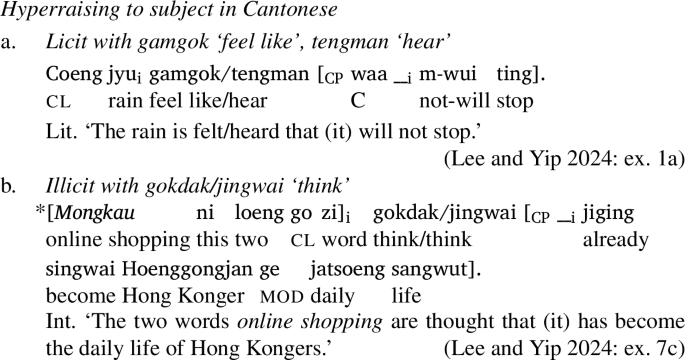
- (95)
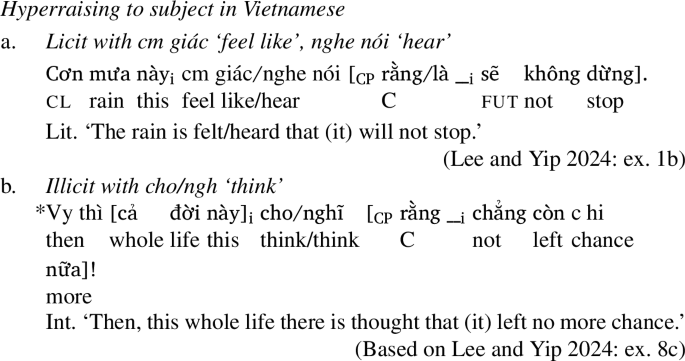
Lee and Yip (2024) propose that a CP-selecting verb licenses hyperraising to subject if it lexically encodes indirect evidence (in the sense that “the source of the speaker’s information is of a secondary nature, e.g., reportative and inferential, and the information does not settle the truth of the associating proposition”) and not direct evidence (in the sense that “the source of the speaker’s information is of a primary nature and the information settles the truth of the associating proposition”), based on the following contrasts in Cantonese and Vietnamese:
- (96)
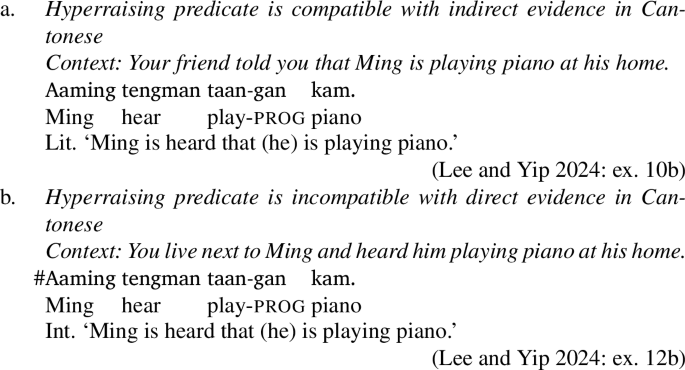
- (97)
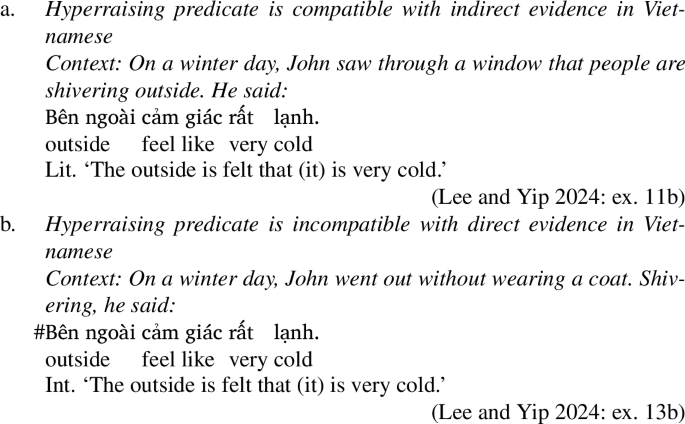
In Mandarin, it is also the case that CP-selecting verbs like ganjue ‘feel like’ and tingshuo ‘hear’ license hyperraising to subject, as seen in (98a), but CP-selecting verbs like renwei ‘think’, huaiyi ‘suspect’, xiangxin ‘believe’ do not license hyperraising to subject, as seen in (98b) (Ka Fai Yip, p.c.).
- (98)
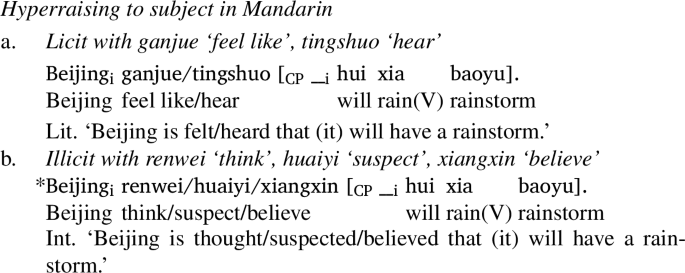
In addition, it is also the case that verbs that can license hyperraising to subject are compatible with indirect evidence but not direct evidence, as seen in (99) and (100).
- (99)
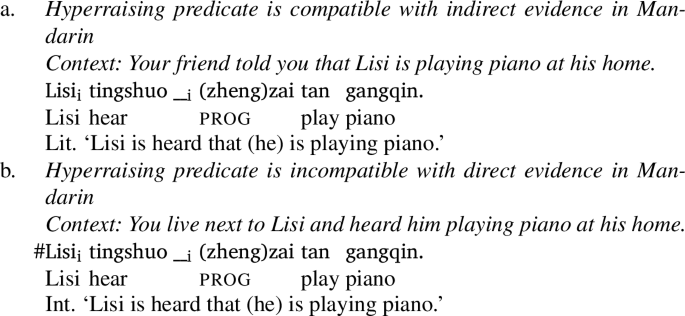
- (100)
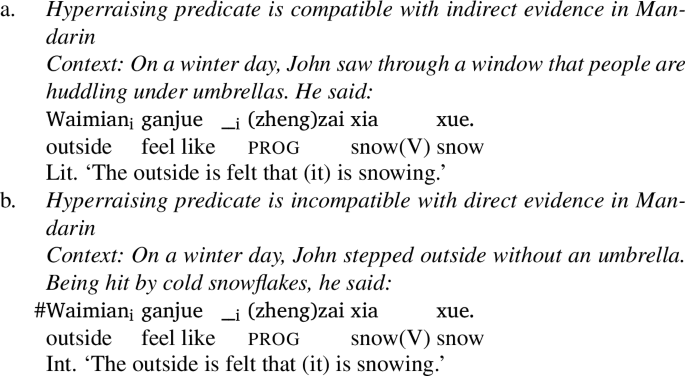
Importantly, bei is incompatible with verbs that can license hyperraising to subject in (98-a), as seen in (101a) (Ka Fai Yip p.c.), while bei is compatible with verbs that cannot license hyperraising to subject in (98-b), as seen previously in (92-b) and repeated in (101b).
- (101)
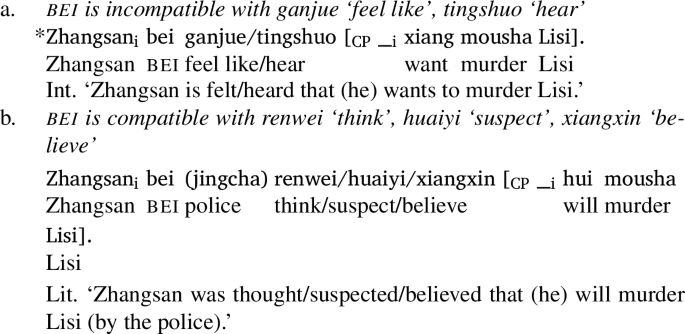
I propose that hyperraising is generally possible in Mandarin, as a result of the Mandarin C head generally hosting a pure ϕ-probe which triggers A-movement to Spec, CP, which can feed further A-movement to Spec, IP in the active voice, and can feed further composite A/Ā-movement to Spec, PassP and A-movement to Spec, IP in the bei-construction, as illustrated previously in (93). Furthermore, I propose that verbs like ganjue ‘feel like’ and tingshuo ‘hear’, which have been shown to encode indirect evidence, lack a thematic subject, hence can license hyperraising to subject in the active voice, as seen in (98-a). By contrast, verbs like renwei ‘think’, huaiyi ‘suspect’, xiangxin ‘believe’ necessarily have a thematic subject (introduced in Spec, VoiceP); these verb cannot license hyperraising, because their thematic subject will undergo A-movement to Spec, IP in the active voice, effectively blocking the embedded subject from hyperraising into the matrix clause. Importantly, under the proposed analysis of the bei-construction as a passive construction, it is expected that verbs (that encode indirect evidence) that lack a thematic subject not only license hyperraising to subject in the active voice but also resist passivization (cf. English: *Mary was appeared/seemed to be smart.). Hence, the ill-formedness of (101a). By contrast, it is expected that verbs that cannot license hyperraising to subject in the active voice (because it is blocked by their thematic subject), when passivized – with their thematic subject embedded under and case-licensed by the passive head/bei, if overtly expressed, or being existentially bound by the passive head/bei, if nonovert – can license hyperraising to subject. This, I suggest, is the case of (101b).Footnote40
It is worth mentioning that in Mandarin, hyperraising predicates like ganjue ‘feel like’ and tingshuo ‘hear’ also have apparently transitive uses, as seen in (102a), and yet the bei-construction in (102b) is still ill-formed (Ka Fai Yip, p.c.).
- (102)
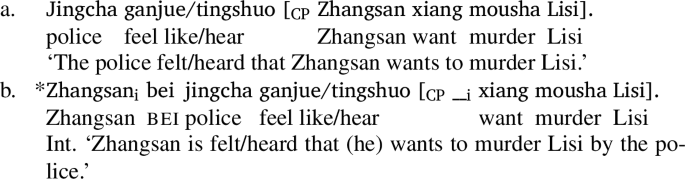
I suggest that in (102a) the grammatical subject of hyperraising predicates like ganjue ‘feel like’ and tingshuo ‘hear’ is not a thematic subject introduced by the Voice head but an experiencer indirect object introduced by an applicative head (cf. English, where experiencer arguments of raising predicates are introduced in PPs: Mary seems/appears [PP to John] to be smart.), as illustrated in (103). Under the proposed analysis of the bei-construction as a passive construction where the passive head/bei selects a VoiceP, it is expected that (102a), which lacks a thematic subject and effectively a VoiceP, cannot be passivized with bei, hence the ill-formedness of (102b) (see also Sect. 2.3 for the incompatibility of bei and an unaccusative verb).
- (103)
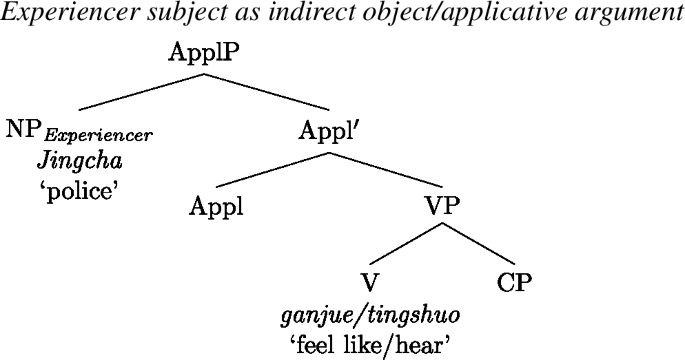
One piece of evidence supporting the analysis in (103) is that the grammatical subject of hyperraising predicates like ganjue ‘feel like’ and tingshuo ‘hear’ in their apparently transitive use cannot be modified by a ‘deliberately’-type adverb, as seen in (104a); in contrast, the grammatical subject of nonhyperraising predicates like renwei ‘think’, huaiyi ‘suspect’, xiangxin ‘believe’ can be modified by a ‘deliberately’-type adverb, as seen in (104b) (Ka Fai Yip, p.c.) (see Sect. 7.1 for a discussion on the distribution and interpretations of ‘deliberately’-type adverbs).
- (104)
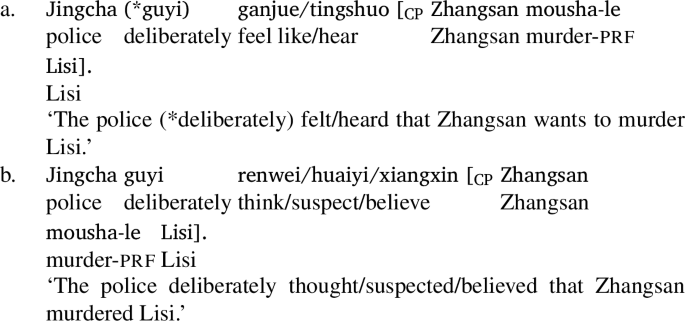
5.2.2 Case 2: Finite clause object gap
I propose that in the bei-construction, cross-finite-clause dependency between the subject of bei and an object gap is impossible, as seen in (92-b), due to the ban on improper Ā-movement to Spec, CP followed by composite A/Ā-movement (Longenbaugh 2017): if a finite clause object undergoes Ā-movement to Spec, CP (because it crosses over the finite clause subject, which rules out the possibility of it undergoing A-movement to Spec, CP, and under the assumption that the Mandarin C does not host a composite probe [ϕ + Ā], which rules out the possibility of the finite clause object undergoing composite A/Ā-movement to Spec, CP), then it cannot undergo further composite A/Ā-movement (and A-movement), as illustrated in (105) (see also Sect. 4.2).
- (105)

In (105), the assumption that the Mandarin C head does not host a composite probe [ϕ + Ā], albeit hosing a pure ϕ-probe (which licenses hyperraising to subject, as seen in Sect. 5.2.1), as well as pure Ā-probes (which are relativized to specific features, as previously discussed in Sect. 3.3.3), is important, which, I argue, is supported by the general clause-boundedness of composite A/Ā-movement movement in Mandarin.
To provide context, in Mandarin, in addition to the bei-construction, there are several other constructions – IP-internal topicalization and IP-internal focalization constructions – that both exhibit mixed A/Ā-properties and are clause-bound (see, e.g., Qu 1994; Shyu 1995; Ting 1995b; Paul 2002, 2005; Kuo 2009; see also 18). Under the assumption that mixed A/Ā-properties are direct consequences of (successive-cyclic) composite A/Ā-movement and in light of the proposed analysis of the bei-construction as a passive construction involving composite A/Ā-movement, triggered by a composite probe [ϕ + Ā] on the passive head/bei, the IP-internal topicalization and IP-internal focalization constructions may be analyzed as also involving (successive-cyclic) composite A/Ā-movement, triggered by a composite probe [ϕ + Top] on the IP-internal Topic head and a composite probe [ϕ + Foc] on the IP-internal Focus head, respectively. Under such an analysis, the clause-boundedness of all of these constructions would follow from the assumption that Mandarin C head does not host a composite probe [ϕ + Ā]. This line of analysis has been developed further in Chen (to appear), which I will not go into details of here.
5.2.3 Feature composition of probe on C
As mentioned previously in Sect. 3.2, Longenbaugh (2017) proposes that the distribution of composite probes can be different in different languages: In Dinka, both the C head and the Voice head host a composite probe [ϕ + Ā]; hence, composite A/Ā-movement can cross finite clause boundaries (Van Urk 2015). In English, only the Voice head (involved in the path of tough-movement) hosts a composite probe [ϕ + Ā] while the C head only hosts a pure Ā-probe; hence, composite A/Ā-movement can proceed successive-cyclically through the specifiers of successive VoicePs, but cannot proceed from Spec, CP, i.e., following a step of Ā-movement to Spec, CP triggered by the pure Ā-probe on the C head, due to the ban on improper composite A/Ā-movement after Ā-movement.
Under the proposed analysis of the subject/object contrast with respect to the possibility of crossing a finite clause boundary to become the subject of bei, the Mandarin C head is not only unlike the Dinka C head in that it does not host a composite probe [ϕ + Ā] and like the English C head in that it hosts pure Ā-probes, but also unlike the English C head in that it also generally hosts a pure ϕ-probe, which triggers A-movement to Spec, CP in the case of hyperraising to subject. This suggests a three-way difference in the feature composition of the probe on the C head across the three languages, as illustrated in (106).Footnote41
[]
- (106)
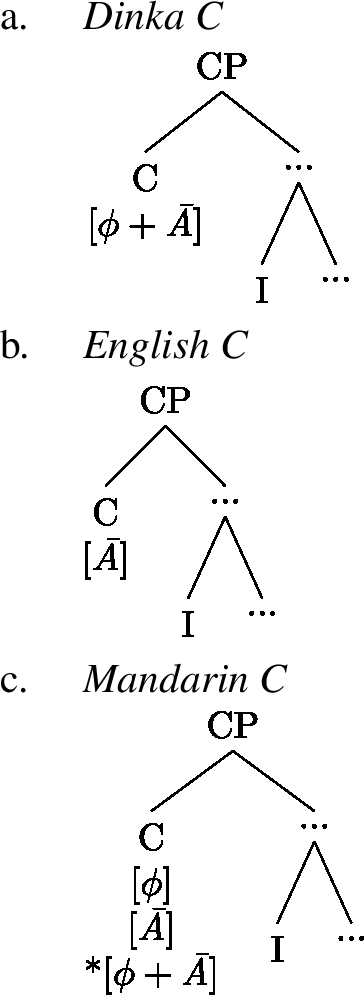
6 Remarks on alternative analyses
As mentioned previously, the various proposals under the alternative approach to the bei-construction involving base-generation of the subject of bei and NOP movement in bei’s complement differ in their specific analyses of overt-agent and agent-less bei-constructions. In this section, I will review the alternative analyses in more detail and recapitulate their problems.
6.1 Huang et al. (2009)
Huang et al. (2009) (see also Ting 1995a, 1998; Huang 1999; a.o.) analyze bei as a two-place predicate (meaning ‘undergo’ or ‘experience’), both introducing the subject of bei (as an experiencer argument of bei) and selecting a secondary predicate of the subject of bei. Additionally, they assume that different types of dependencies are involved in overt-agent bei-constructions, which they dub long-passives, and agent-less bei-constructions, which they dub short-passives.Footnote42
Specifically, in their analysis of long-passives/overt-agent bei-constructions, as illustrated in (107), bei’s complement is an IP, which contains an Ā-moved NOP, which is coindexed with the subject of bei; at LF, the NOP serves as a lambda operator, which turns a proposition into a predicate via lambda abstraction.Footnote43
- (107)
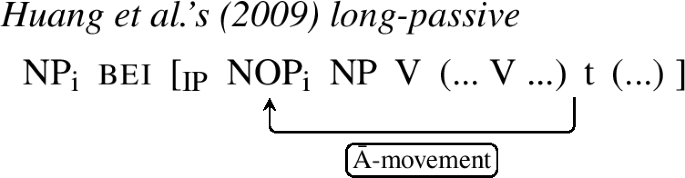
In their analysis of short-passives/agent-less bei-constructions, bei’s complement is a VP, which contains an A-moved PRO, which is controlled by the subject of bei, as illustrated in (108) (see Hoshi 1991, 1994a, 1994b for a similar analysis of the English get-passive and the Japanese ni-passive).
- (108)
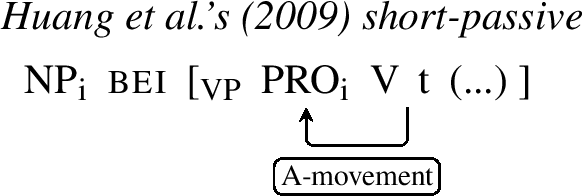
To recapitulate, in Sect. 5.1, I have argued that Huang et al.’s (2009) (see also Ting 1995a, 1998; Huang 1999; a.o.) analysis of agent-less bei-constructions fails to account for the well-formedness of certain agent-less bei-constructions which (apparently) involve a long-distance dependency between the subject of bei and a deeply embedded object gap in bei’s complement across nonfinite clause boundaries (namely, Case 2, with a subject control matrix verb and a PRO subject in the infinitival complement; and Case 3, with an ECM matrix verb and an arbitrary PRO subject in the infinitival complement). In Sect. 5.1.4, I further argued that (voice) restructuring is not required to license long-distance dependencies in agent-less bei-construction; hence, their assumption that agent-less bei-constructions (must) involve A-movement dependencies, hence needing a different analysis from overt-agent bei-constructions which involve Ā-dependencies, is untenable.
In addition, in Sect. 5.2, I have argued that the alternative approach to the bei-construction involving base-generation of the subject of bei and NOP movement in bei’s complement generally fails to account for the contrast when the bei-construction involves a cross-finite-clause dependency between the subject of bei and a subject vs. object gap. Huang et al.’s (2009) analysis is no exception to this general problem.
6.2 Bruening and Tran (2015)
Bruening and Tran (2015) also analyze bei as a two-place predicate, both introducing the subject of bei as its argument and selecting a secondary predicate of the subject of bei, and provide different analyses for overt-agent and agent-less bei-constructions. But Bruening and Tran (2015) propose that bei selects an active VoiceP in overt-agent bei-constructions and a passive VoiceP in agent-less bei-constructions; both overt-agent and agent-less bei-constructions involve an Ā-moved NOP, which is coindexed with the subject of bei, as illustrated in (109a) and (109b), respectively.
- (109)
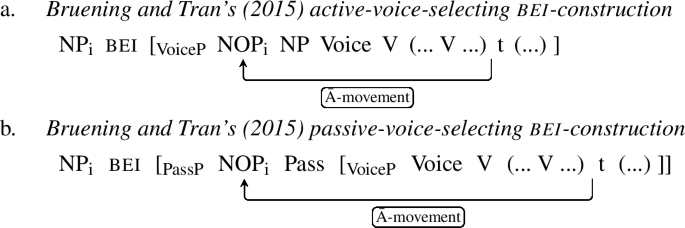
More recently, Ngui (2024) proposes a variant of Bruening and Tran’s (2015) analysis, which is different in two ways: first, the complement of bei always contains a passive VoiceP in the sense of Legate (2012, 2014) – in particular, in overt-agent bei-constructions, the agent/external argument of the matrix verb (which is dubbed an initiator, following Legate 2012, 2014) is introduced within a PP adjunct of the passive VoiceP; second, it is assumed that NOP movement targets Spec, beiP, instead of bei’s complement. This analysis is illustrated in (110).Footnote44
- (110)
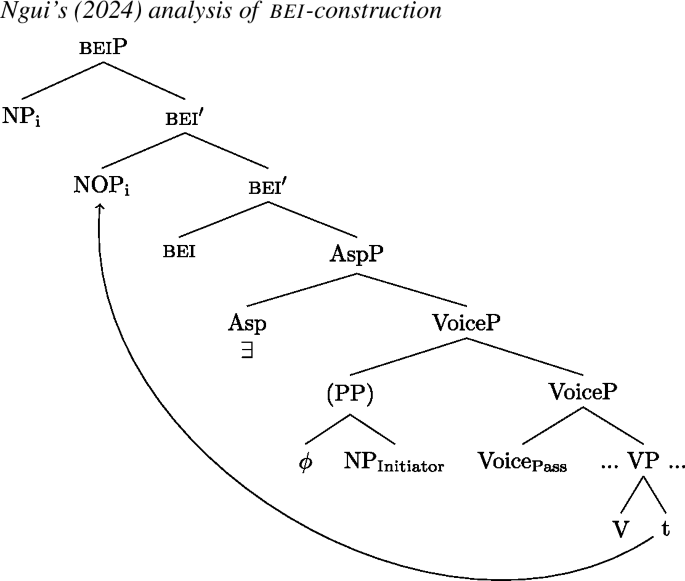
Again, to recapitulate, in Sect. 5.1, I have argued that the analyses proposed by Bruening and Tran (2015) and Ngui (2024) encounter the opposite problem: they fail to account for the ill-formedness of certain agent-less bei-constructions that involve a long-distance dependency between the subject of bei and a deeply embedded object gap in bei’s complement across nonfinite clause boundaries (namely, Case 1, with an object control matrix verb; and Case 2, with a subject control matrix verb and an overt controllee in the infinitival complement; and Case 3, with an ECM matrix verb and an overt subject in the infinitival complement). Importantly, while both Bruening and Tran (2015) and Ngui (2024) indeed assume that in agent-less bei-constructions bei’s complement contains a passive VoiceP, they would not predict the base-generated subject of bei to be in any way sensitive to any case problem that might arise in bei’s complement.Footnote45
In addition, the analyses proposed by Bruening and Tran (2015) and Ngui (2024) are also no exception to the general difficulty of accounting for the subject/object contrast with respect to the possibility of crossing a finite clause boundary to become the subject of bei encountered by the alternative approach to the bei-construction involving base-generation of the subject of bei and NOP movement in bei’s complement, as discussed in Sect. 5.2.
6.3 Liu and Huang (2016)
Lastly, Liu and Huang (2016), as a representative proposal considering both a base-generation analysis and a raising analysis of the subject in the bei-construction, argue, following Huang (2013), that the subject of bei may indeed be either base-generated or derived. This is an attempt to reconcile two conflicting arguments regarding the base-generated vs. derived status of the subject of bei presented in the literature, which I will discuss in Sect. 7.
Specifically, they propose to decompose bei into a two-place predicate meaning ‘experience’ (Exp) and a raising predicate meaning ‘become’ (Bec), and suggest that overt-agent and agent-less bei-constructions involving just a simple transitive verbal projection (which they dub local long-passives and short-passives, respectively) can be analyzed as involving either base-generation of the subject of bei (as an argument of the Exp head) and A-movement of a PRO (to Spec, BecP), controlled by the subject of bei, as illustrated in (111a), or a derived subject of bei via A-movement (to Spec, BecP, in which case the Exp head is absent), as illustrated in (111b).
- (111)
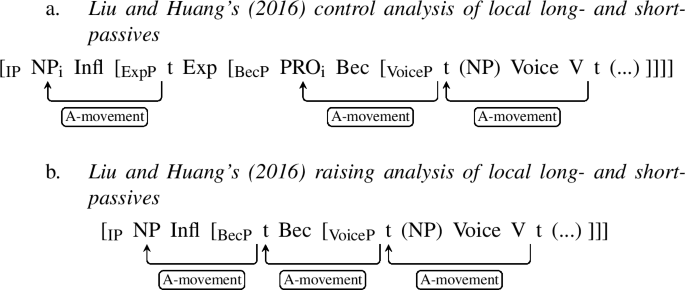
Note that Liu and Huang (2016) assume with Huang et al. (2009) that agent-less bei-constructions (must) involve A-movement dependencies – hence, they also fail to account for the possibility of (apparent) long-distance dependencies in agent-less bei-constructions.
Furthermore, for bei-constructions involving multiple verbal projections (which they dub nonlocal long-passives), Liu and Huang (2016) maintain Huang et al.’s (2009) analysis involving base-generation of the subject of bei and NOP movement in bei’s complement. Hence, they also fail to account for the subject/object contrast with respect to the possibility of crossing a finite clause boundary to become the subject of bei.
7 More on the base-generated vs. derived status of the subject of bei
In this section, I will reconcile two conflicting arguments regarding the base-generated vs. derived status of the subject of bei presented in the literature. Specifically, in Sect. 7.1, I will show that the distribution and interpretation of ‘deliberately’-type adverbs in the bei-construction can be accounted for under the proposed analysis of the bei-construction in which the subject of bei is derived rather than base-generated, with ‘deliberately’-type adverbs having two possible attachment sites in the bei-construction; in Sect. 7.2, I will provide a critical review of the argument for a raising analysis of the subject in the bei-construction based on the possibility for the subject of bei and a (deeply embedded) verb in bei’s complement to form an idiom and the availability of its idiomatic meaning.
7.1 ‘Deliberately’-type adverbs
In the literature, an assumption has been made that ‘deliberately’-type adverbs can only modify a base-generated subject (see, e.g., Lakoff 1971; Lasnik and Fiengo 1974; Huang 1999, 2013; Huang et al. 2009; Bruening and Tran 2015; Liu and Huang 2016; a.o.). Under such an assumption, the contrast between the English be-passive and the English get-passive with respect to whether ‘deliberately’-type adverbs can modify the grammatical subject, as seen in (112), is taken to indicate that the subject of a be-passive is derived, while the subject of a get-passive is base-generated as an argument of get.Footnote46
- (112)
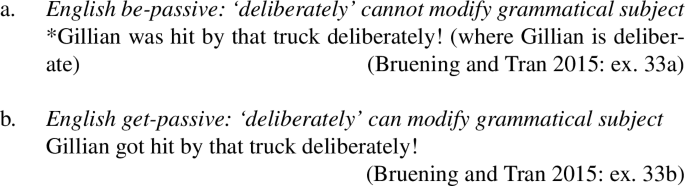
In the same vein, the major argument for a base-generation analysis of the subject of bei has come from the possibility for ‘deliberately’-type adverbs to modify the subject of bei, as seen in (113) (see, e.g., Huang 1999, 2013; Huang et al. 2009; Bruening and Tran 2015; Liu and Huang 2016; a.o.).
- (113)

Note that guyi ‘deliberately’ can also modify the agent/external argument of the matrix verb, whether it is overtly expressed or is nonovert, as seen in (114).
- (114)

However, the assumption that ‘deliberately’-type adverbs can only modify a base-generated subject is falsified by the possibility for ‘deliberately’-type adverbs to modify the derived subject/underlying object of an unaccusative construction, both in English, as seen in (115) (see, e.g., Bruening and Tran 2015), and in Mandarin, as seen in (116).
- (115)
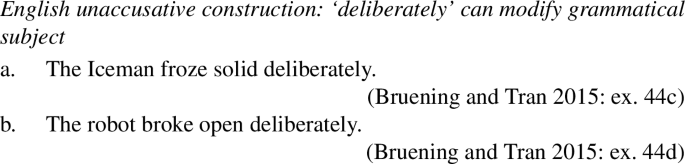
- (116)

Although, as seen in (117), transitivizing the unaccusative constructions in (115) removes the possibility for ‘deliberately’-type adverbs to modify the underlying object of the unaccusative matrix verb (see, e.g., Bruening and Tran 2015).
- (117)

Based on examples like (115) and (117), Bruening and Tran (2015: 144) suggest that “when a ‘deliberately’-type adverb attaches to [a projection of] a predicate, it associates with the structurally highest argument of that predicate”: in (115) and (116), the highest argument of the unaccusative (matrix) verb is the underlying object; in (117), or indeed any transitive construction, it is the agent/external argument. Building on Bruening and Tran (2015), I propose allowing ‘deliberately’-type adverbs to attach to projections of two particular predicates: the Voice head and the passive head/bei. In the former case, the adverb associates with the agent/external argument of the matrix verb, while in the latter case, it associates with the subject of bei.
Concretely, I assume the following denotation of deliberately in (118).
- (118)Definition of ‘deliberately’deliberately: λx. λe. deliberately(e,x)
In the bei-construction, guyi ‘deliberately’ has two attachment sites. When it attaches to a projection of the Voice head, it associates with the agent/external argument of the matrix verb in Spec, VoiceP, as illustrated in (119).
- (119)
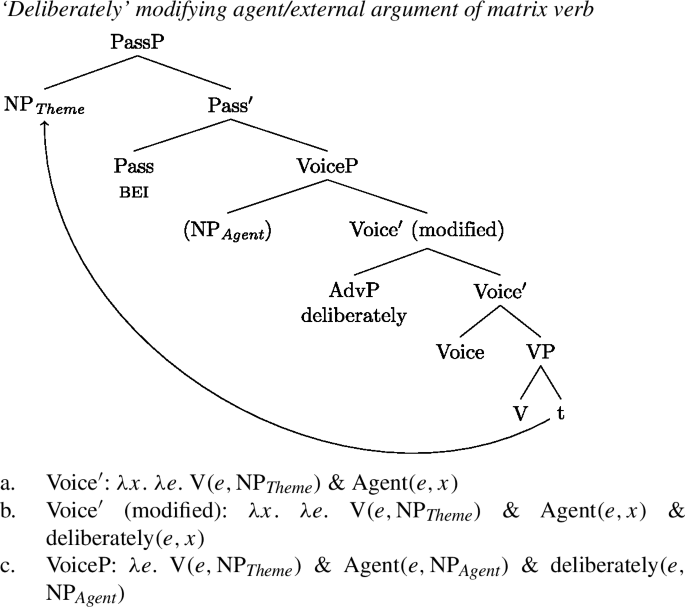
When guyi ‘deliberately’ attaches to a projection of the passive head/bei, it associates with the subject of bei in Spec, PassP, as illustrated in (120).Footnote47
- (120)
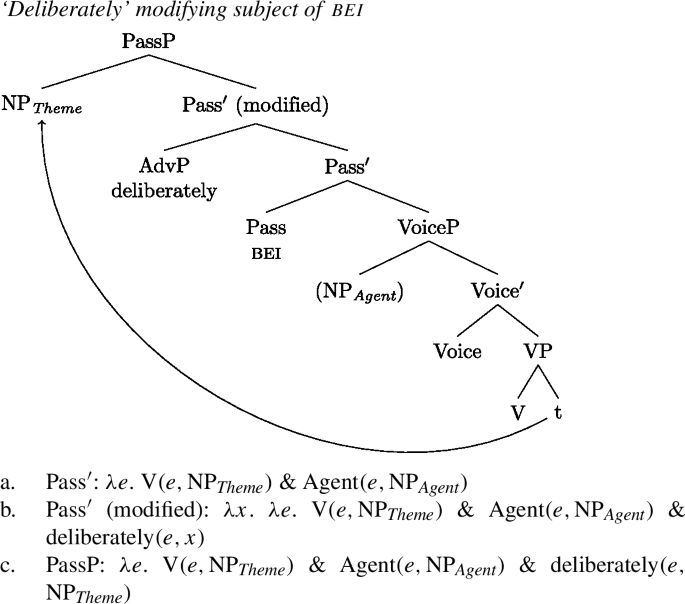
For present purposes, it suffices to show that the distribution and interpretation of ‘deliberately’-type adverbs in the bei-construction can be accounted for under the proposed analysis of the bei-construction in which the subject of bei is derived rather than base-generated, with ‘deliberately’-type adverbs having two possible attachment sites in the bei-construction. I leave it to future research to provide a full account of the distribution and interpretation of ‘deliberately’-type adverbs in broader contexts, which would require both expanding and restricting the possible attachment sites of ‘deliberately’-type adverbs, in order to account for both the possibility for ‘deliberately’-type adverbs to modify the derived subject/underlying object of an unaccusative construction, as seen in (116), and the impossibility for ‘deliberately’-type adverbs to modify the derived subject/underlying experiencer indirect object of an apparently transitive construction with a hyperraising predicate, as seen previously in (104) in Sect. 5.1.
7.2 Idioms
The major argument for a raising analysis of the subject in the bei-construction has come from the possibility for the subject of bei and a (deeply embedded) verb in bei’s complement to form an idiom and the availability of its idiomatic meaning. Concretely, in the bei-constructions in (121), the idiom chunks niu ‘cow’ and pianyi ‘advantage’ are part of the idioms chui niu ‘bluff’ and zhan pianyi ‘take advantage’, respectively, and the idiomatic meanings of the idioms are preserved. Hence, Huang (2013), Liu and Huang (2016), among others, have argued that the subject of bei must be base-generated in the gap position in bei’s complement, in order for the idiomatic meanings of the idioms to be available.
- (121)
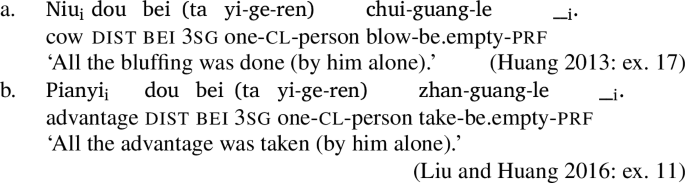
For all speakers I have consulted, including myself, the idiomatic meaning of zhan pianyi ‘take advantage’ is also available in (122a), where the subject of bei and a deeply embedded verb in bei’s complement form an idiom (contra Huang 2013; Liu and Huang 2016), as well as in (122b), which involves long-distance topicalization (see also Huang et al. 2009: 206, ex. 37).Footnote48
- (122)
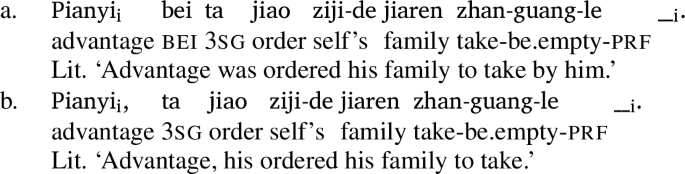
While these idiom facts are consistent with the proposed analysis of the bei-construction in which the subject of bei is derived (via A-movement after (successive-cyclic) composite A/Ā-movement), the compositional nature of the idioms chui niu ‘bluff’ and zhan pianyi ‘take advantage’ raises a concern: as is pointed out by Nunberg et al. (1994), compositional idioms whose meanings are distributed among their parts – for example, in ‘take advantage’, “`take’ is assigned a meaning roughly paraphrasable as ‘derive’, and ‘advantage’ means something like ‘benefit’’’ – are allowed to be separated syntactically, so long as their interpretations are composed in the permitted manner; hence, as is pointed out by Bruening and Tran (2015), basing an argument in favor of a raising analysis of the subject in the bei-construction on the above idiom facts is particularly weak (if not invalid). In Mandarin, it can be argued that the idiom chunks niu ‘cow’ and pianyi ‘advantage’ in the idioms chui niu ‘bluff’ and zhan pianyi ‘take advantage’ have idiomatic meanings on their own. Consider (123), where the idiom chunks zhe-zhong niu ‘this kind of cow’ and zhe-zhong pianyi ‘this kind of advantage’ are base-generated topics linked to a null object inside islands for extraction (via an Ā-moved NOP which is coindexed with the base-generated topic; see Huang 1984: 570). In these cases, the idioms chui zhe-zhong niu ‘this kind of bluffing’ and zhan zhe-zhong pianyi ‘take this kind of advantage’ are not constituents (underlyingly), and yet the idiomatic meanings of the idioms are available.
- (123)
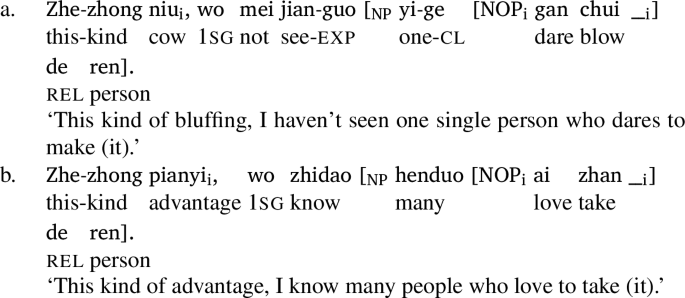
In contrast to compositional idioms, truly noncompositional idioms, such as kick the bucket ‘die’ in English and ling hefan ‘die (Lit. take boxed meal)’ in Mandarin, lose their idiomatic interpretations both in a be-passive or a bei-construction and under topicalization, as seen in (124) and (125).
- (124)

- (125)
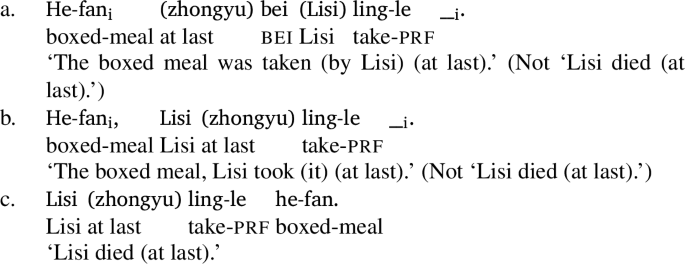
Because the availability or unavailability of the idiomatic meaning of an idiom in the bei-construction ultimately depends on the compositional or noncompositional nature of the idiom, I contend that the idiom facts are not evidence for or against a raising analysis of the subject in the bei-construction.
8 Indirect object as the subject of bei
Finally, in this section, I will extend the proposed analysis of the bei-construction to bei-constructions where the subject of bei is identified with an indirect object in bei’s complement (i.e., the so-called indirect passives; see, e.g., Huang et al. 2009), without an analysis of which the paper would feel incomplete. Specifically, I will provide an analysis of bei-constructions where the subject of bei is identified with the recipient indirect object of a canonical double-object construction or the affectee indirect object of an affective double-object construction.
Concretely, in (126b), the subject of bei is identified with the recipient indirect object of a canonical double-object construction, where the verb is intrinsically ditransitive, subcategorizing for both a recipient indirect object and a theme direct object.
- (126)
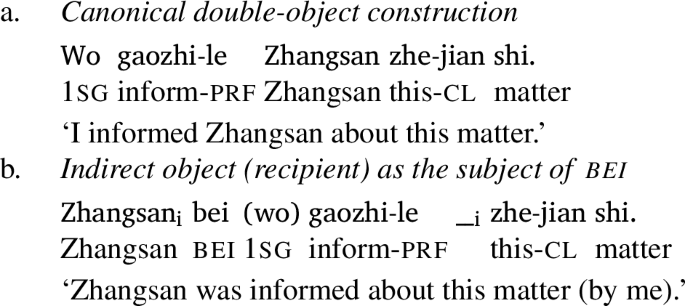
In (127b) and (128)[b], the subject of bei is identified with the affectee indirect object of an affective double-object construction, where the verb is transitive, subcategorizing for a theme direct object but not an affectee indirect object. Note that in (127b) but not (128)[b], the affectee indirect object and the theme direct object are in a possessor–possessum relation.Footnote49
- (127)
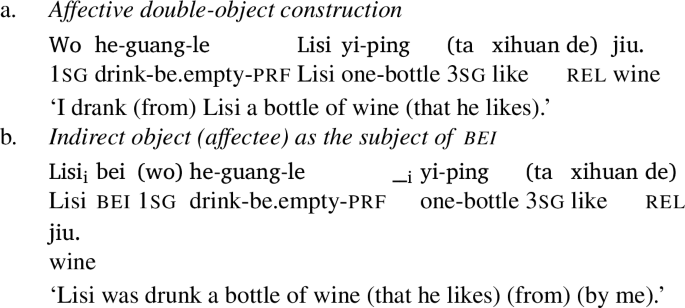
- (128)
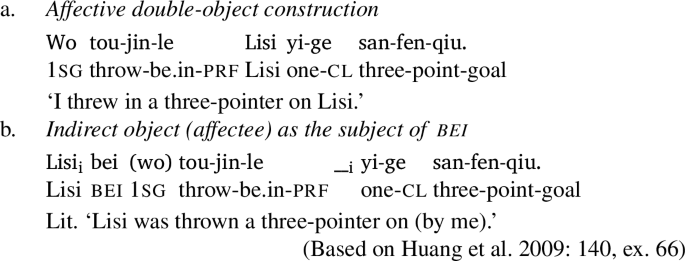
In addition, there is a contrast between canonical and affective double-object constructions with respect to whether the theme direct object can be the subject of bei: in canonical double-object constructions, it can, while in affective double-object constructions, it cannot. There is also a contrast between canonical and affective double-object constructions with respect to whether either the indirect or direct object can be Ā-extracted: for canonical double-object construction, Ā-extraction of either the recipient indirect object or the theme direct object is possible, while for affective double-object construction, Ā-extraction of neither the affectee indirect object nor the theme direct object is possible. These facts are not illustrated with examples here but will be taken into consideration in the analysis.
I assume that both canonical and affective double-object constructions in Mandarin have the structure in (129), where the theme direct object is introduced by the verb, and the recipient or affectee indirect object is introduced by an applicative head which projects above the VP, following Marantz (1993), Bruening (2010), Holmberg et al. (2019) and others.Footnote50 In addition, I assume that the applicative head can either assign case to the recipient or affectee indirect object (in which case the Voice head assigns case to the theme direct object) or assign case to the theme direct object (in which case the Voice head assigns case to the recipient or affectee direct object), following Holmberg et al. (2019).
- (129)
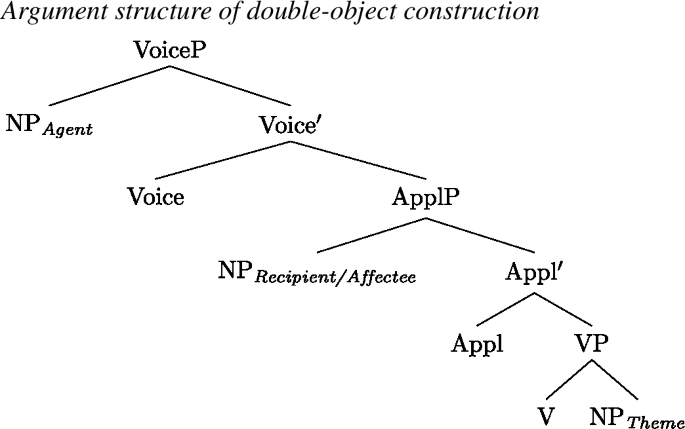
To account for the contrasts between canonical and affective double-object constructions with respect to whether the theme direct object can be the subject of bei and whether either object can be Ā-extracted, I further assume that ApplP is not a phase in a canonical double-object construction, while it is a phase without a phase-EPP feature in an affective double-object construction (cf. McGinnis 2001). A direct consequence of such an assumption is that in an affective double-object construction, extraction of the theme direct object is never possible (neither in a bei-construction nor in cases of Ā-extraction) (cf. Tsai 2018).
In a canonical double-object construction, either the indirect or direct object can be the subject of bei and can be Ā-extracted. Under the proposed analysis of the bei-construction, either object of a canonical double-object construction can be the subject of bei, because either object can be targeted by the composite probe [ϕ + Ā] on the passive head/bei. In particular, either object of a canonical double-object construction can be the subject of bei in an agent-less bei-construction (where the Voice head does not assign a theta-role, nor does it assign case), because the applicative head can assign case to either the recipient indirect object (when the theme direct object becomes the subject of bei) or the theme direct object (when the recipient direct object becomes the subject of bei). Similarly, either object of a canonical double-object construction can be Ā-extracted, because either object can be targeted by an Ā-probe.Footnote51
By contrast, in an affective double-object construction, the affectee indirect object can be the subject of bei, but cannot be Ā-extracted. Under the assumption that in an affective double-object construction both VoiceP and ApplP are phases, the affectee indirect object must undergo movement from Spec, ApplP to the adjacent Spec, VoiceP – from a phase edge to an adjacent phase edge – to be Ā-extracted. I suggest that such a movement is banned for independent reasons.Footnote52 Furthermore, under the proposed analysis of the bei-construction, in the bei-construction, it is the passive head/bei, instead of the Voice head, that heads a phase; in this case, the affectee indirect object would move from Spec, ApplP to Spec, PassP, crossing the VoiceP, which, I suggest, is licit.
It is worth noting that while the subject of bei can be identified with an indirect object introduced by an applicative head, it cannot be identified with an NP introduced in a PP adjunct. Concretely, the well-formedness of (130a) and the ill-formedness of (131)[a] suggest that in (130b), the locative NP fangjian-li ‘in the room’ is an indirect object introduced by an applicative head in Spec, ApplP, hence it can be targeted by the composite probe [ϕ + Ā] on the passive head/bei, whereas in (131), the locative NP fangjian-li ‘in the room’ is introduced by the preposition zai ‘at’ in a PP adjunct, hence it cannot be targeted by the composite probe [ϕ + Ā] on the passive head/bei.Footnote53
- (130)
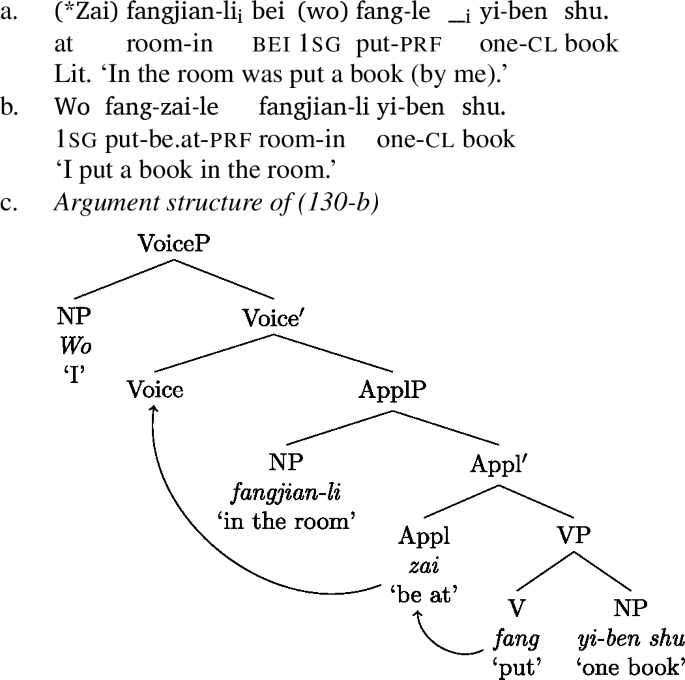
- (131)
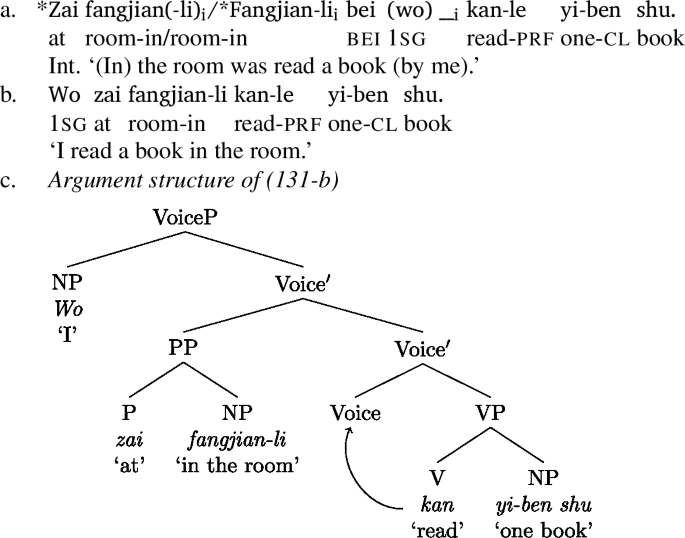
9 Conclusion
The bei-construction in Mandarin is a well-studied construction known for exhibiting both passive-like properties and tough-movement-like properties (see, e.g., Feng 1995, 2012; Ting 1995a, 1998; Huang 1999; Tang 2001; Huang et al. 2009; Bruening and Tran 2015; a.o.). I argued for a novel analysis of the bei-construction in Mandarin as a passive construction where the passive head/bei hosts a composite probe [ϕ + Ā], which triggers composite A/Ā-movement, in the sense of Van Urk (2015). The subject in the bei-construction is derived via (successive-cyclic) composite A/Ā-movement, followed by a terminating step of A-movement, similar to Longenbaugh’s (2017) analysis of English tough-movement. Under the proposed analysis, the mixed A/Ā-properties associated with the bei-construction are direct consequences of composite A/Ā-movement (following Van Urk 2015; Longenbaugh 2017).
The proposed analysis of the bei-construction accounted for two restrictions on long-distance dependencies in the bei-construction – namely, the requirement that no overt, case-less NPs should intervene between the subject of bei and the gap in agent-less bei-constructions, and the subject/object contrast with respect to the possibility of crossing a finite clause boundary to become the subject of bei. I argued that the ban on any overt, case-less NPs intervening between the subject of bei and the gap in agent-less bei-constructions follows from the proposed analysis of the bei-construction as a passive construction and Burzio’s generalization (Burzio 1986), which states that all and only the verbs that can assign a theta-role to the (logical) subject can assign accusative case to an object. Specifically, in agent-less bei-constructions, when there is an overt NP that cannot be assigned case by the matrix Voice head, that NP must become the subject of bei, where it can receive case from Infl; in such cases, it is predicted that long-distance dependencies between the subject of bei and a deeply embedded gap in bei’s complement is impossible. I argued that the contrast when the bei-construction involves a cross-finite-clause dependency between the subject of bei and a subject vs. object gap follows from the possibility of raising to subject via A-movement to Spec, CP, or hyperraising to subject (see, e.g., Fong 2019; Wurmbrand 2019; Lohninger et al. 2022; a.o.), and the ban on improper Ā-movement to Spec, CP followed by composite A/Ā-movement (see Longenbaugh 2017).
Notes
-
According to Baker et al. (1989), it is actually the passive suffix that ‘absorbs’ both the agent theta-role and the accusative case of the passivized verb.
-
These various proposals differ in their specific analyses of bei-constructions with and without an overt agent/external argument of the matrix verb. See Sect. 4.3 for an overview and Sect. 6 for a more detailed review of each specific proposal.
-
During the development of the paper, the examples were constructed, and judgements determined, in consultation with 3 additional native speakers: one (nonlinguist) speaking the Beijing/northern dialect and two (linguists) speaking southern dialects. Additionally, in view of some existing controversies regarding the grammaticality of certain examples in the literature, two judgement-check sessions were conducted on December 27 and 30, 2024, during which judgements on the Mandarin examples presented throughout the paper were checked with 6 additional native speakers (nonlinguists) of the Beijing/northern dialect (many of whom offered to consult additional speakers, resulting in 10+ judgement reports on a few controversial examples, which are noted throughout the paper) and 7 additional native speakers (linguists) of various dialects, respectively. I myself am a speaker of the Beijing/northern dialect.
-
Abbreviations in glosses follow the Leipzig glossing conventions, with the following additions: c=complementizer; cl=classifier; cs=construct state; dist=distributivity marker; exp=experiential aspect; hab=habitual; mod=modification marker; nf=nonfinite; ov=object voice; p=preposition; sv=subject voice.
-
Ruling out a null pronoun reading of an apparently agent-less bei-construction will be crucial when investigating the possibility of and restrictions on long-distance dependencies in agent-less bei-constructions (see Sect. 5.1.1).
-
Following Huang (1989) and many others, I assume that object control verbs, including bi(po) ‘force’, pai ‘send’, jiao ‘order’, qing(qiu) ‘ask’, (bai)tuo ‘entrust’, take a nonfinite clausal complement, because their complement cannot contain an aspect marker or a modal. See Sect. 5 for more details.
-
Following Huang (1989) and many others, I assume that subject control verbs, including changshi ‘try’, qitu ‘attempt’, shefa ‘manage (Lit. find a way)’, take a nonfinite clausal complement, because their complement cannot contain an aspect marker or a modal. See Sect. 5 for more details.
-
Despite Mandarin lacking overt morphological marking for case, as I will argue extensively in Sect. 5.1, it is crucial to appeal to case in this restriction.
-
A few speakers I have consulted reported that while (21-b) is completely unacceptable when agent-less, (22-b) is also not (entirely) acceptable when agent-less (with varying degree of degradedness reported); interestingly, the degradedness of (22-b) can be mitigated by embedding a future-oriented adverb such as ming-tian ‘tomorrow’ within the infinitival complement of the subject control matrix verb, as in (21):
- (i)

This piece of data will be accounted for in Sect. 5.1.4.
- (i)
-
Following Huang (1989) and many others, I assume that verbs like renwei ‘think’, huaiyi ‘suspect’, xiangxin ‘believe’, take a finite CP complement, because their complement can contain an aspect marker as well as a modal. See Sect. 5 for more details.
-
I leave it to future research to determine whether the bei-construction can license parasitic gaps. Despite some existing work arguing for the existence of parasitic gaps in Mandarin (see, e.g., Lin 2005; Ting and Huang 2008), given the prevalence of null object constructions in Mandarin (see, e.g., Aoun and Li 2008; Li 2014; Li and Wei 2014), I contend that it is still necessary to examine the relevant constructions with scrutiny, so as to establish that parasitic gaps indeed exist in Mandarin, before drawing further conclusions.
-
Note that it is possible to extract a wh-argument from the tough-predicate’s complement, as seen in (32).
- (i)

- (i)
-
Judgements immediately preceding the square brackets and in the square brackets and are provided by Longenbaugh (2017) and the other cited author(s), respectively. In addition, there seems to also be speakers who generally accept cross-finite-clause tough-movement (e.g., David Pesetsky, p.c.).
-
For Longenbaugh (2017), this assumption builds on Neeleman and van De Koot’s (2010) insight that A-movement can feed Ā-movement, because A-movement does not reconstruct, but Ā-movement cannot feed A-movement, because Ā-movement must reconstruct, which renders the highest copy of an Ā-movement chain unavailable for (carrying the relevant selectional feature for) further A-movement. Because composite A/Ā-movement does not show reconstruction effects – it is equivalent to A-movement from the perspective of Neeleman and van De Koot (2010) – it should be able to feed A-movement.
In addition, the assumption that (successive-cyclic) composite A/Ā-movement can feed A-movement can be made on the basis of Obata and Epstein’s (2011) insight that the ban on improper (A- after Ā-) movement follows if a pure Ā-probe only triggers Ā-movement (implemented as copying) of the matching Ā-feature on the goal and crucially not the A-features ([ϕ] and [case]) on the goal: if it is only the (goal with its) Ā-feature that undergoes Ā-movement, it is expected that the (goal with its) Ā-feature alone cannot undergo further A-movement. Because a composite probe [ϕ + Ā] must at least trigger movement/copying of both the matching ϕ-feature and the matching Ā-feature on the goal, it is expected that this goal (with both of its ϕ-feature and Ā-feature) can undergo further A-movement.
-
One can derive the ban on composite A/Ā-movement after Ā-movement from the perspective of either Neeleman and van De Koot (2010) or Obata and Epstein (2011). From the perspective of Neeleman and van De Koot (2010), if Ā-movement must reconstruct, which renders the highest copy of an Ā-movement chain unavailable for (carrying the relevant selectional feature for) further A-movement, then it should also render the highest copy of an Ā-movement chain unavailable for (carrying the relevant selectional feature for) further composite A/Ā-movement. From the perspective of Obata and Epstein (2011), if it is only the Ā-feature that is present on the higher copy of the goal in an Ā-movement chain, then it is predicted that this copy of the goal only with an Ā-feature cannot undergo further composite A/Ā-movement (just like how it cannot undergo further A-movement).
-
Longenbaugh (2017: 10) suggests that degraded (but possible) instances of tough-movement, as seen in (33), are derived without an intermediate step of Ā-movement to Spec, CP. Alternatively, for speakers who generally accept cross-finite-clause tough-movement, one might assume that the C head (involved in the path of tough-movement) also hosts a composite probe [ϕ + Ā].
-
In the lian … dou focalization constructions, lian ‘even’ is a focus marker and dou is a predicate quantifier, according to Shyu (1995). The syntax and semantics of dou have been a topic of much discussion but they are not the focus of this paper; for an overview of the distribution and interpretations of dou, see, e.g., Lin (1998); Xiang (2008); a.o.
-
It is worth mentioning here that topicalization/focalization in Mandarin may also target an IP-internal topic/focus position. In contrast to IP-external topicalization/focalization, IP-internal topicalization/focalization exhibit mixed A/Ā-properties and are clause-bound – that is, they allow dependencies across nonfinite clause boundaries but not finite ones (see, e.g., Qu 1994; Shyu 1995; Ting 1995b; Paul 2002, 2005; Kuo 2009) (see Sect. 5.2.2 for further discussion).
-
Principle C reconstruction effects with topicalized phrases exhibit speaker variation (see Huang 1993, footnote 17), but they are relatively robust with focalized phrases, which are reported here.
-
Note that IP-external topicalization/focalization also shows reconstruction effects for Principle A, as seen in (40).
- (i)
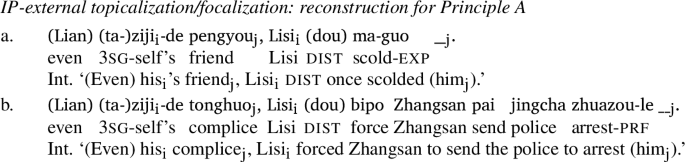
- (i)
-
Note that the ungrammaticality of (45-a) can be repaired with resumption: (45) is acceptable, with the gap in (45-a) filled with an overt, coreferent pronoun (see also Huang et al. 2009: 125, ex. 27). Also note that (45) is acceptable as a neutral statement of fact – in particular, the subject of bei (Zhangsan) needs not be negatively affected by the event specified by the matrix verb (zhuazou ‘arrest’).
- (i)

By contrast, the ungrammaticality in (45-b) cannot be repaired, even with resumption. This, I suggest, is because the head probing the movement in the bei-construction (which, under the proposed analysis, is the passive head/bei) cannot target an NP introduced in an adjunct (see Sect. 8 for a related discussion).
- (i)
-
Also note that, unlike Ā-movement, the bei-construction does not show reconstruction effects for Principle A, whether it involves just a simple transitive verbal projection or multiple verbal projections, as seen in (47).
- (i)
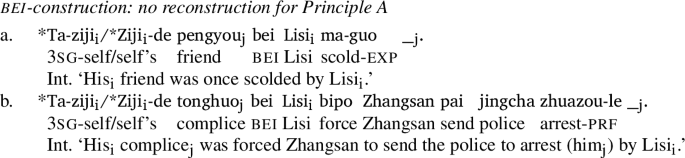
Crosslinguistically, Ā-movement shows reconstruction effects for Principle A, while languages differ with respect to whether A-movement also shows reconstruction effects for Principle A. In languages like English, both Ā-movement and A-movement show reconstruction effects for Principle A (and for scope), as seen in (47) (see also Fox 1999, 2000, 2003; Wurmbrand and Bobaljik 1999).
- (ii)

In languages like Dutch, Ā-movement shows reconstruction effects for Principle A, as seen in (47).
- (iii)

However, A-movement does not show reconstruction effects for Principle A, as seen in (47).
- (iv)

In addition, scrambling in languages like German and Japanese is famously known for exhibiting reconstruction effects for binding (and scope) in cases of Ā-scrambling (also referred to as long/medium or IP scrambling), but a lack of reconstruction effects for binding in cases of A-scrambling (short or VP scrambling); notably, reconstruction effects for scope remain present with A-scrambling (see Saito 1989, 2003; Mahajan 1990; Tada 1993; Nemoto 1993; Lasnik 1999; a.o. see also Wurmbrand 2010 for references therein and further discussion).
I suggest that Mandarin is like Dutch, German, and Japanese and unlike English in that only Ā-movement shows reconstruction effects for Principle A. I leave it to future research to explore reconstruction effects for scope in Mandarin.
- (i)
-
The islands induced by the bei-construction are deemed weak, because it is possible to extract an NP-argument from bei’s complement, e.g., when bei’s complement is a double-object construction, it is possible that the direct object becomes the subject of bei while the indirect object undergoes Ā-movement; similarly, when bei’s complement involves multiple object control verbs, it is possible that the matrix/more local object becomes the subject of bei while the embedded/more remote object undergoes Ā-movement. Such cases will be discussed in detail in Sect. 3.3.3.
-
It is worth mentioning here that the exact analysis of English tough-movement by Longenbaugh (2017) assumes that the composite probe on the Voice head consists of a ϕ-feature and a relativized Ā-feature, [AT] (for ‘aboutness topic’) (see Longenbaugh 2017: 21–22); such an assumption is made in order to prevent generalized composite A/Ā-movement in English (see Longenbaugh 2017: 26–28), but is problematic, because it would allow crossed dependencies as in (52-b). In order to account for the requirement for nested dependencies as in (52-a), it must be assumed that the composite probe on the Voice head consists of a ϕ-feature and a flat Ā-feature. Hence, one must restrict composite probing in English by positing that only the Voice head(s) involved in the path of tough-movement can host the composite probe [ϕ + Ā].
-
By contrast, the various proposals under the alternative approach to the bei-construction involving base-generation of the subject of bei and NOP movement in bei’s complement do not specify that the NOP movement is triggered by a specific head (in bei’s complement) (see, e.g., Feng 1995, 2012; Ting 1995a, 1998; Huang 1999; Tang 2001; Huang et al. 2009; Bruening and Tran 2015; a.o.), with the exception of Ngui (2024), who makes an explicit assumption that NOP movement targets Spec, beiP.
-
Holmberg et al. (2019) (see also Newman 2021) observe that in North-West English and a number of other languages (e.g., Norwegian, Zulu, and Lubukusu) where either object in a double-object construction is free to undergo passivization and wh-movement, while it is possible to passivize the indirect object and wh-move the direct object, as seen in (58a), it is impossible to passivize the direct object and wh-move the indirect object, as seen in (58b).
- (i)

Note that the contrast in (57) can also be viewed in terms of a contrast between (well-formed) nested and (ill-formed) crossed dependencies.
- (i)
-
Recall that the bei-construction but not Ā-movement (i) creates new antecedents for anaphor binding; (ii) is immune to weak crossover; and (iii) does not show reconstruction effects for Principle C. These facts have been established in Sects. 3.3.1 and 3.3.2.
-
It is worth noting here that recent studies on various languages have argued against the universality of Burzio’s generalization (see, e.g., Legate 2014 on grammatical object passives in Icelandic and certain Slavic and Celtic languages; Bruening and Tran 2015 on the Vietnamese bi-construction; Šereikaitė 2021 on Lithuanian active existentials; Akkuş 2022 on Sason Arabic causatives; a.o.).
-
It is worth mentioning here that the agent/external argument of the matrix verb cannot become the subject of bei, as seen in (67a), and resists extraction in general, as seen in (67b-c).
- (i)
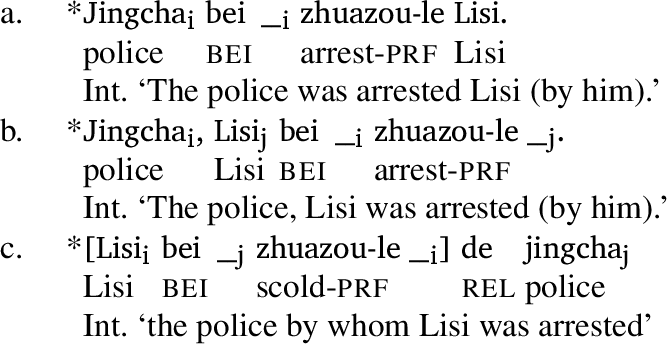
The ungrammaticality of the examples in (66) could be due to several reasons, which I will leave for further investigation in future research: (i) (composite A/Ā-)movement from Spec, VoiceP to Spec, beiP would violate Spec-to-Spec anti-locality in the sense of Erlewine (2016, 2020) (which is also suggested by a reviewer); (ii) extracting the agent/external argument of the matrix verb stranding bei might be ruled out due to a ban on predicate stranding in certain contexts in Mandarin, which is also observed in cases of matrix object extraction from object control constructions with a monosyllabic matrix verb (see, e.g., Tang 2002) and in the extraction of an NP located between two verbs in (purposive) serial verb constructions (see, e.g., Liao and Lin 2019) (which aligns better with my native speaker intuition). Crucially, the examples in (66) should not be taken as evidence that the agent/external argument of the matrix verb is introduced in a PP adjunct (contra Ngui 2024).
- (i)
-
In light of this potential confound, the examples presented in this paper are carefully constructed to always use a definite NP in this position.
-
I conveniently assume that PROs are case-less, but this assumption is not strictly required – even if PROs require a special null case, such a case would be assigned by the embedded Infl, and hence the PROs are expected to be insensitive to whether or not the matrix Voice head can assign case.
-
A plausible alternative explanation for this contrast is that overt controllees and PROs achieve coreference with their controllers in different ways: overt controllees, being pronouns, cannot, for independent reasons, be bound by a nonovert agent/external argument of the matrix verb; in contrast, PROs are subject to implicit control, a phenomenon that is crosslinguistically well-established (Julie Legate, p.c.). Here, I will not attempt to explore the binding possibilities of implicit arguments further, but to note that in numerous other context where there is an overt NP that cannot be assigned case by the matrix Voice head, long-distance dependencies between the subject of bei and a deeply embedded gap in bei’s complement are indeed impossible.
-
Similar to the case reported in footnote 9, a few speakers I have consulted reported that (79) is not (entirely) acceptable when agent-less (with varying degree of degradedness reported); interestingly, the degradedness of (79) can be mitigated by embedding a future-oriented adverb such as ming-nian ‘next year’ within the infinitival complement of the subject control matrix verb, as in (79):
- (i)

This piece of data will be accounted for in Sect. 5.1.4.
- (i)
-
As with controlled PROs, I conveniently assume that arbitrary PROs are also case-less, but this assumption is not strictly required – to reiterate, even if PROs require a special null case, such a case would be assigned by the embedded Infl, and hence the PROs are expected to be insensitive to whether or not the matrix Voice head can assign case.
-
Similar to the cases reported in footnotes 9 and 34, a few speakers I have consulted reported that (84) is not (entirely) acceptable when agent-less (with varying degree of degradedness reported); interestingly, the degradedness of (84) can be mitigated by embedding a future-oriented adverb such as ming-nian ‘next year’ within the infinitival complement of the ECM matrix verb, as in (84):
- (i)

This piece of data will be accounted for in Sect. 5.1.4.
- (i)
-
This should not be confused with the evidence that bei’s complement is structurally smaller than an IP/AspP, presented in Sect. 2.3.
-
In particular, Danfeng Wu (p.c.) notes that for her, while (91-a) and (91-c) are degraded when agent-less without the future-oriented adverb, (91-b), which involves jihua/jueding ‘plan/decide’, is fully acceptable when agent-less without the need of a future-oriented adverb. This indicates that, despite the lack of contrast in (90), a restructuring vs. nonrestructuring distinction could still be present in Mandarin, in the sense that restructuring verbs are assumed to take a VoiceP-less complement by default (although they can also take an IP complenent), while nonrestructuring verbs are assumed to take an IP complement by default.
-
Recall that English tough-movement shows the opposite pattern: it is degraded for nonsubjects and impossible for subjects across a phasal CP-projection (Longenbaugh 2017; see also Postal 1971; Bresnan 1972; Chomsky 1973; Lasnik and Fiengo 1974; Browning 1987; Rezac 2006) (see Sect. 3.2). To account for the English tough-movement pattern, Longenbaugh (2017: 10) suggests that degraded (but possible) instances of tough-movement, as seen in (33), are derived without an intermediate step of Ā-movement to Spec, CP (see 16). In contrast, to account for the ill-formedness of (92-a), it must be assumed that an intermediate step of Ā-movement to Spec, CP is strictly required in Mandarin.
-
As mentioned previously in Sect. 3.2, Chomsky’s (1977, 1981) analysis of English tough-movement involving base-generation of the tough-subject and NOP movement in the tough-predicate’s complement faces similar problems in accounting for the (opposite) subject/nonsubject contrast.
-
Note that the contrast between (101a) and (101b) does not receive a straightforward explanation under the alternative approach to the bei-construction involving base-generation of the subject of bei and NOP movement in bei’s complement (see, e.g., Feng 1995, 2012; Ting 1995a, 1998; Huang 1999; Tang 2001; Huang et al. 2009; Bruening and Tran 2015; a.o.). More generally, it is only under the proposed analysis of the bei-construction as a passive construction that the (im)possibility of passivization with bei diagnoses agentivity: the passive head/bei requires the matrix verb to have a thematic subject, either assigning case to it (if it is overt) or existentially closing it (if it is nonovert).
-
Lohninger et al. (2022) arrive at a similar conclusion that ϕ– and Ā-features present on the same head may trigger movement together (which is the case of the Dinka C head) or must be satisfied independently (which is the case of the Mandarin C head).
-
As is pointed out by Bruening and Tran (2015), their naming of overt-agent and agent-less bei-constructions as long- and short-passives is misleading, as there is nothing “passive” – neither object promotion nor agent/external argument demotion – in their analysis of the bei-construction.
-
As is pointed out by Ernst (2010), an apparent problem with Huang et al.’s (2009) analysis of long-passives/overt-agent bei-constructions is that bei’s complement cannot be as large as an IP/AspP (see Sect. 2.3); such a problem can be avoided by simply reanalyzing bei’s complement as an extended verbal projection while maintaining other components of the analysis, i.e., the base-generation of the subject of bei and NOP movement in bei’s complement.
-
Ngui (2024) rejects the evidence from reflexive binding that in overt-agent bei-constructions, the agent/external argument of the matrix verb is introduced in Spec, VoiceP, assuming, instead, that in the relevant cases a bare reflexive ziji ‘self’ can (always) be bound logophorically (but see Sect. 2.1). He also assumes that the general ban on extracting the agent/external argument of the matrix verb in the bei-construction could only stem from the ban on preposition stranding (but see footnote 30). In addition, he also refutes any restriction on long-distance dependencies in agent-less bei-constructions, which was extensively discussed in Sect. 5.1 (see especially the discussion in Sect. 5.1.1), and explicitly sets aside for his analysis the subject/object contrast with respect to the possibility of crossing a finite clause boundary to become the subject of bei, which was discussed in Sect. 5.2. In light of these (unwarranted) assumptions and data excluded from consideration, a natural concern arises regarding the empirical adequacy of his analysis.
-
Based on the Vietnamese bi-construction, Bruening and Tran (2015: 166, footnote 25) specifically assume that in Vietnamese case assignment does not differ from the active to the passive.
-
A few speakers, such as Jackendoff (1972: 83), David Pesetsky (p.c.), have reported that ‘deliberately’-type adverbs can modify the grammatical subject of a be-passive in examples like (112).
- (i)

- (i)
-
The speaker variation with respect to whether or not the grammatical subject of the English be-passive can be modified by ‘deliberately’-type adverbs might suggest that for some/most speakers, ‘deliberately’-type adverbs can only attach to a projection of the Voice head (hence ‘deliberately’-type adverbs can only associate with the (overtly expressed or nonovert) agent/external argument of the passivized verb), but for a few speakers, ‘deliberately’-type adverbs can also attach to a projection of the passive head (hence ‘deliberately’-type adverbs can also associate with the grammatical subject of the English be-passive).
-
Huang (2013) makes an assumption that the idiomatic meaning of an idiom is preserved only under A-movement, which is simply incorrect.
-
This kind of affective double-object construction is productive in Mandarin:
- (i)
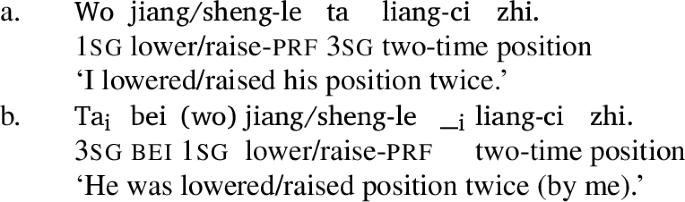
- (ii)
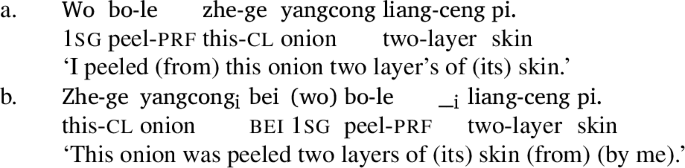
- (i)
-
In other approaches to the double-object constructions, the indirect and direct objects are contained in a small-clause-like constituent, which is the complement of the verb (see, e.g., Harley 1995, Harley and Ritter 2002; Pesetsky 1995; Pylkkänen 2002, 2008).
-
Note that in a canonical double-object construction, the recipient indirect object would undergo movement from Spec, ApplP to Spec, VoiceP, crossing ApplP but no other maximal projections, to be Ā-extracted. Such a movement would violate Spec-to-Spec antilocality, in the sense of Erlewine (2016, 2020) (see also Deal 2019). Here, I will not attempt to resolve this issue, but simply note that crosslinguistically, languages do exhibit variation in whether the recipient indirect object can be Ā-extracted: in standard English, the recipient indirect object cannot be Ā-extracted, whereas in Mandarin, North-West English, Norwegian, Zulu, Lubukusu, and other languages, the recipient indirect object can be Ā-extracted (see, e.g., Holmberg et al. 2019).
-
In particular, Bošković (2015) shows that extraction from a double-phase (or phase-over-phase) configuration is banned crosslinguistically, and proposes an account of the relevant facts under particular assumptions about the domain and timing of spell-out.
-
Note that the postposition –li ‘in’ is conventionality treated as a marker for locative NPs and crucially does not make the subject fangjian-li ‘in the room’ a PP in (130-a) (see Huang et al. 2009: 13–14). A PP such as zai fangjian-li ‘in the room’ cannot surface as the subject of bei or a grammatical subject more generally. Another test that can tease apart (130-b) and (131-b) is locative inversion: while a locative indirect object is subject to locative inversion, as seen in (130a), a locative NP introduced in a PP adjunct cannot undergo locative inversion, as seen in (130b). Again, note that the subject in (130a) must be a locative NP and not a PP.
- (i)
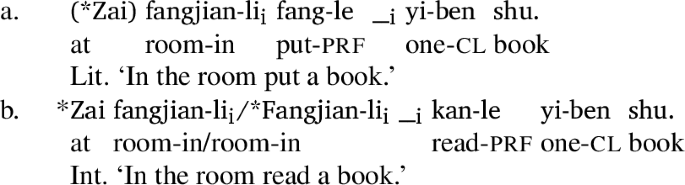
- (i)
References
-
Abels, K. 2007. Towards a restrictive theory of (remnant) movement! Linguistic Variation Yearbook 7(1):53–120.
-
Abels, K. 2012. The Italian left periphery: A view from locality. Linguistic Inquiry 43(1):229–254.
-
Akkuş, F. 2022. On causee in Sason Arabic. Syntax 25(3):299–334.
-
Aoun, J., and Y. H. A. Li. 2008. Ellipsis and missing objects. Foundational issues in linguistic theory: Essays in honor of Jean-Roger Vergnaud 45:251.
-
Bach, E. 1980. In defense of passive. Linguistics and Philosophy 3(3):297–341.
-
Baker, M., K. Johnson, and I. Roberts. 1989. Passive arguments raised. Linguistic Inquiry 20(2):219–251.
-
Bhatt, R., and R. Pancheva. 2006. Implicit arguments. In The Blackwell companion to syntax, eds. M. Everaert and H. van Riemsdijk, 558–588. Malden: Blackwell.
-
Bhatt, R., and R. Pancheva. 2017. Implicit arguments. In The Wiley Blackwell companion to syntax, eds. M. Everaert and H. van Riemsdijk. Malden: Blackwell.
-
Bošković, Ž. 2015. Deducing the generalized XP constraint from phasal spell-out. Slavic languages in the perspective of formal grammar. Proceedings of FDSL 10:79–100.
-
Bresnan, J. 1972. Theory of complementation in English syntax. PhD thesis, Massachusetts Institute of Technology.
-
Brody, M. 1993. Theta-theory and arguments. Linguistic Inquiry 24(1):1–24.
-
Browning, M. 1987. Null operator constructions. PhD thesis, Massachusetts Institute of Technology.
-
Bruening, B. 2010. Ditransitive asymmetries and a theory of idiom formation. Linguistic Inquiry 41(3):519–562.
-
Bruening, B. 2013. By phrases in passives and nominals. Syntax 16(1):1–41.
-
Bruening, B., and T. Tran. 2015. The nature of the passive, with an analysis of Vietnamese. Lingua 165:133–172.
-
Burzio, L. 1986. Italian syntax: A government-binding approach. Dordrecht: Reidel.
-
Chao, Y. R. 1968. A grammar of spoken Chinese. Berkeley: University of California Press.
-
Chen, F. 2022. Three anti long-distance dependency effects in the Mandarin bei-construction. Proceedings of the 57th annual meeting of the Chicago Linguistic Society (CLS 57) 57:45–62.
-
Chen, F. 2023. Obscured universality in Mandarin. PhD thesis, Massachusetts Institute of Technology.
-
Chen, F. Generalized composite probing in Mandarin. In Proceedings of the 42nd West Coast Conference on Formal Linguistics (WCCFL 42). To appear.
-
Cheng, L. L. S. 1987. On the ‘passive’ construction in Mandarin. Toronto Working Papers in Linguistics 8:42–59.
-
Chomsky, N. 1973. Conditions on transformations. In A festschrift for Morris Halle, eds. S. Anderson and P. Kiparsky, 232–286. New York: Academic Press.
-
Chomsky, N. 1977. On wh-movement. In Formal syntax, eds. P. W. Culicover, T. Wasow, and A. Akmajian, 71–132. New York: Academics Press.
-
Chomsky, N. 1981. Lectures on government and binding. Dordrecht: Foris.
-
Chomsky, N. 1982. Some concepts and consequences of the theory of government and binding. Cambridge: MIT Press.
-
Chomsky, N. 1995. The minimalist program. Cambridge: MIT Press.
-
Chomsky, N. 2001. Derivation by phase. In Ken Hale: A life in language, ed. M. Kenstowicz, 1–52. Cambridge: MIT Press.
-
Cole, P., G. Hermon, and L. M. Sung. 1990. Principles and parameters of long-distance reflexives. Linguistic Inquiry 1–22.
-
Collins, C. 2005. A smuggling approach to raising in English. Linguistic Inquiry 36(2):289–298.
-
Dalrymple, M., and T. H. King. 2000. Missing-object constructions: Lexical and constructional variation. In On-line proceedings of the LFG2000 conference, eds. M. Butt and T. Holloway King.
-
Deal, A. R. 2019. Raising to ergative: Remarks on applicatives of unaccusatives. Linguistic Inquiry 50(2):388–415.
-
Déprez, V. 1989. On the Typology of Syntactic Positions and the Nature of Chains. PhD thesis, Massachusetts Institute of Technology.
-
Erlewine, M. Y. 2016. Anti-locality and optimality in Kaqchikel agent focus. Natural Language & Linguistic Theory 34:429–479.
-
Erlewine, M. Y. 2020. Anti-locality and subject extraction. Glossa: A Journal of General Linguistics 5(1).
-
Erlewine, M. Y., and G. Smith. 2024. Bornean passives in comparative perspective. Unpublished manuscript.
-
Ernst, T. 2010. Adverbs and light verbs. In Proc. Of NACCL-22 & IACL-18, Vol. 2, 178–195.
-
Feng, S. 1995. Prosodic structure and prosodically constrained syntax in Chinese. PhD thesis, University of Pennsylvania.
-
Feng, S. 2012. Empty operator movement in Chinese passive syntax. In Festschrift for Professor Fang Li, ed. L. Wang, 117–136. Beijing: Beijing Language and Culture University Press.
-
Fong, S. 2019. Proper movement through Spec-CP: An argument from hyperraising in Mongolian. Glossa: A Journal of General Linguistics 4(1):1–42.
-
Fox, D. 1999. Reconstruction, binding theory, and the interpretation of chains. Linguistic Inquiry 30(2):157–196.
-
Fox, D. 2000. Economy and semantic interpretation, Vol. 35. Cambridge: MIT Press.
-
Fox, D. 2003. On logical form. Minimalist Syntax 82–123.
-
Harley, H. 1995. Abstracting away from abstract case. In Proceedings of the North East Linguistic Society, ed. J. Beckman. Vol. 25 of Graduate linguistic student association, 207–222. University of Pennsylvania.
-
Harley, H., and E. Ritter. 2002. Person and number in pronouns: A feature-geometric analysis. Language 78(3):482–526.
-
Hartman, J. 2011. (non-) intervention in A-movement: Some cross-constructional and cross-linguistic considerations. Linguistic Variation 11(2):121–148.
-
Her, O. S. 2009. Unifying the long passive and the short passive: On the Bei construction in Taiwan Mandarin. Language and Linguistics 10(3):421–470.
-
Heycock, C. 1991. Layers of predication: The non-lexical syntax of clauses. PhD thesis, University of Pennsylvania.
-
Hicks, G. 2009. Tough-constructions and their derivation. Linguistic Inquiry 40(4):535–566.
-
Holmberg, A., M. Sheehan, and J. Van der Wal. 2019. Movement from the double object construction is not fully symmetrical. Linguistic Inquiry 50(4):677–722.
-
Hoshi, H. 1991. The generalized projection principle and the subject position of passive constructions. Journal of Japanese Linguistics 13:53–89.
-
Hoshi, H. 1994a. Passive, causative, and light verbs: A study on theta role assignment. PhD thesis, University of Connecticut.
-
Hoshi, H. 1994b. Theta-role assignment, passivization, and excorporation. Journal of East Asian Linguistics 3(2):147–178.
-
Huang, C. T. J. 1982. Logical relations in Chinese and the theory of grammar. PhD thesis, Massachusetts Institute of Technology.
-
Huang, C. T. J. 1984. On the distribution and reference of empty pronouns. Linguistic Inquiry 531–574.
-
Huang, C. T. J. 1989. Pro-drop in Chinese: A generalized control theory. The Null Subject Parameter 185–214.
-
Huang, C. T. J. 1991. Modularity and Chinese A-Not-A questions. In Interdisciplinary approaches to language, eds. C. Georgopoulos and R. Ishihara, 305–332. Berlin: Springer.
-
Huang, C. T. J. 1993. Reconstruction and the structure of VP: Some theoretical consequences. Linguistic Inquiry 103–138.
-
Huang, C. T. J. 1999. Chinese passives in comparative perspective. Tsing Hua Journal of Chinese Studies 29(4):423–509.
-
Huang, C. T. J. 2013. Variations in non-canonical passives. In Non-canonical passives, eds. A. Alexiadou and F. Schäfer, 97–114. Amsterdam: Benjamins.
-
Huang, C. T. J. 2022. Finiteness, opacity, and Chinese clausal architecture. In New explorations in Chinese theoretical syntax: Studies in honor of Yen-Hui Audrey Li, 17–76.
-
Huang, C. T. J., and C. S. L. Liu. 2001. Logophoricity, attitudes and ziji at the interface. In Long distance reflexives, eds. P. Cole, G. Hermon, and C. T. J. Huang, 141–195. San Diego: Academic Press.
-
Huang, C. T. J., and C. C. J. Tang. 1991. On the local nature of the long distance reflexive in Chinese. In Long distance anaphora, eds. J. Koster and E. Reuland, 263–282. Cambridge: Cambridge University Press.
-
Huang, C. T. J., Y. H. Huang, T. H. Teng, and R. Tiedeman. 1984. Reflexives in Chinese and the teaching of Chinese. In Proceedings of the First World Conference on Chinese Language, 205–215. World Chinese Language Association Taipeih.
-
Huang, C. T. J., Y. H. A. Li, and Y. Li. 2009. The syntax of Chinese. Cambridge: Cambridge University Press.
-
Hukari, T. E., and R. D. Levine. 1991. On the disunity of unbounded dependency constructions. Natural Language & Linguistic Theory 9(1):97–144.
-
Jackendoff, R. 1972. Semantic interpretation in generative grammar. Cambridge: MIT Press.
-
Kaplan, R. M., and J. Bresnan. 1982. Lexical-functional grammar: A representation. In The mental representation of grammatical relations, ed. J. Bresnan, 173–281. Cambridge: MIT Press.
-
Keenan, E. 1980. Passive is phrasal (not sentential or lexical). In Lexical grammar, eds. T. Hoekstra, H. van der Hulst, and M. Moortgat, 181–214. Dordrecht: Foris.
-
Keenan, E. 1985. Passive in the world’s languages. In Language typology and syntactic description: Vol. 1, clause structure, ed. T. Shopen, 243–281. Cambridge: Cambridge University Press.
-
Keine, S., and E. Poole. 2017. Intervention in tough-constructions revisited. The Linguistic Review 34(2):295–329.
-
Kratzer, A. 1996. Severing the external argument from its verb. In Phrase structure and the lexicon, 109–137. Berlin: Springer.
-
Kuo, P. J. 2009. IP internal movement and topicalization. PhD thesis, University of Connecticut.
-
Lakoff, G. 1971. Irregularity in syntax. New York: Holt, Rinehart & Winston.
-
Lasnik, H. 1999. Chains of Arguments. In Working Minimalism, eds. S. D. Epstein and N. Hornstein, 189–215. Cambridge: MIT Press.
-
Lasnik, H., and R. Fiengo. 1974. Complement object deletion. Linguistic Inquiry 5(4):535–571.
-
Lasnik, H., and T. Stowell. 1991. Weakest crossover. Linguistic Inquiry 22(4):687–720.
-
Lee, T. T. M., and K. F. Yip. 2024. Hyperraising, evidentiality, and phase deactivation. Natural Language & Linguistic Theory 1–52.
-
Legate, J. A. 2012. Subjects in Acehnese and the nature of the passive. Language 495–525.
-
Legate, J. A. 2014. Voice and v: Lessons from Acehnese. Cambridge: MIT Press.
-
Legate, J. A. 2021. Noncanonical passives: A typology of voices in an impoverished universal grammar. Annual Review of Linguistics 7(1):157–176.
-
Legate, J. A., F. Akkuş, M. Šereikaitė, and D. Ringe. 2020. On passives of passives. Language 96(4):771–818.
-
Li, Y. 1990. Conditions on X-movement. PhD thesis, Massachusetts Institute of Technology.
-
Li, C. 2007. Evolution of the bei constructions in Chinese. Journal of Chinese Linguistics 35(1):98–127.
-
Li, Y. H. A. 2014. Born empty. Lingua 151:43–68.
-
Li, D. 2024. Controlling overt subjects in Mandarin. Journal of East Asian Linguistics 33(3):333–366.
-
Li, C. N., and S. A. Thompson. 1981. Mandarin Chinese: A functional reference grammar. Berkeley: University of California Press.
-
Li, Y. H. A., and T. C. Wei. 2014. Ellipsis. The Handbook of Chinese Linguistics 275–310.
-
Liao, W. W. R., and T. H. J. Lin. 2019. Syntactic structures of Mandarin purposives. Linguistics 57(1):87–126.
-
Lin, J. W. 1998. Distributivity in Chinese and its implications. Natural Language Semantics 6(2):201–243.
-
Lin, J. 2005. Does wh-in-situ license parasitic gaps? Linguistic Inquiry 298–302.
-
Lin, T. H. J. 2011. Finiteness of clauses and raising of arguments in Mandarin Chinese. Syntax 14(1):48–73.
-
Lin, T. H. J. 2012. Multiple-modal constructions in Mandarin Chinese and their finiteness properties1. Journal of Linguistics 48(1):151–186.
-
Lin, T. H. J. 2015. Tense in Mandarin Chinese sentences. Syntax 18(3):320–342.
-
Liu, N., and C. T. J. Huang. 2016. Control and raising passives, and why Mandarin does not smuggle. Journal of East Asian Linguistics 25:385–404.
-
Lohninger, M., I. Kovač, and S. Wurmbrand. 2022. From prolepsis to hyperraising. Philosophies 7(2):32.
-
Longenbaugh, N. 2017. Composite A/A’-movement: Evidence from English tough-movement. Unpublished manuscript, Massachusetts Institute of Technology.
-
Mahajan, A. 1990. The A/A-bar distinction and movement theory. PhD thesis, Massachusetts Institute of Technology.
-
Marantz, A. 1993. Implications of asymmetries in double object constructions. In Theoretical aspects of Bantu Grammar 1, ed. S. A. Mchombo, 113–151. University: Stanford. CSLI Publications.
-
Massam, D. 2009. The structure of (un)ergatives. In Proceedings of the sixteenth meeting of the Austronesian Formal Linguistics Association (AFLA 16), eds. Sandra Chung, I. P. Daniel Finer, and E. Potsdam, 125–135.
-
May, R. 1979. Must COMP-to-COMP movement be stipulated? Linguistic Inquiry 10(4):719–725.
-
McGinnis, M. 2001. Variation in the phase structure of applicatives. Linguistic Variation Yearbook 1(1):105–146.
-
Miyagawa, S. 2010. Why agree? Why move? Unifying agreement-based and Discourse configurational languages. Cambridge: MIT Press.
-
Mulder, R., and M. den Dikken. 1992. Tough parasitic gaps. In The proceedings of NELS 22, ed. K. Broderick, 303–317. Amherst: University of Massachusetts, Graduate Linguistic Student Association.
-
Neeleman, A., and H. van De Koot. 2010. A local encoding of syntactic dependencies and its consequences for the theory of movement. Syntax 13(4):331–372.
-
Nemoto, N. 1993. Chains and case positions: A study from scrambling in Japanese. University of Connecticut.
-
Newman, E. S. B. 2021. The (in)distinction between wh-movement and c-selection. PhD thesis, Massachusetts Institute of Technology.
-
Ngui, J. G. 2024. Bei-Passive Constructions in Mandarin. PhD thesis, The University of Arizona.
-
Nunberg, G., I. A. Sag, and T. Wasow. 1994. Idioms. Language 70(3):491–538.
-
Obata, M., and S. D. Epstein. 2011. Feature-splitting internal merge: Improper movement, intervention, and the A/A’ distinction. Syntax 14(2):122–147.
-
Pan, H., and X. Hu. 2021. The passive construction in Chinese. In Oxford Research Encyclopedia of Linguistics.
-
Paul, W. 2002. Sentence-internal topics in Mandarin Chinese: The case of object preposing. Language and Linguistics 3(4):695–714.
-
Paul, W. 2005. Low IP area and left periphery in Mandarin Chinese. Recherches Linguistiques de Vincennes 33:111–134.
-
Perlmutter, D., and P. Postal. 1984. The 1-advancement exclusiveness law. In Studies in Relational Grammar, eds. D. Perlmutter and C. Rosen. Vol. 2. Chicago: University of Chicago Press.
-
Pesetsky, D. 1982. Paths and categories. PhD thesis, Massachusetts Institute of Technology.
-
Pesetsky, D. 1995. Zero syntax: Experiencers and cascades. Cambridge: MIT Press.
-
Pesetsky, D. 2013. Phrasal movement and its discontents: Diseases and diagnoses. In Diagnosing syntax, eds. L. L. S. Cheng and N. Corver, 123–157. Oxford: Oxford University Press.
-
Postal, P. 1971. Cross-over phenomena. New York: Holt, Rinehart & Winston.
-
Pylkkänen, L. 2002. Introducing Arguments. PhD thesis, Massachusetts Institute of Technology.
-
Pylkkänen, L. 2008. Introducing arguments. Cambridge: MIT Press.
-
Qu, Y. 1994. Object noun phrase dislocation in Mandarin Chinese. PhD thesis, University of British Columbia.
-
Rezac, M. 2006. On tough-movement. In Minimalist essays, ed. C. Boeckx, 288–325. Amsterdam: Benjamins.
-
Richards, N. 2014. A-bar movement. In The Routledge handbook of syntax, 167–191.
-
Rizzi, L. 1997. The fine structure of the left periphery. In Elements of grammar, ed. L. Haegeman, 281–337. Berlin: Springer.
-
Rizzi, L. 2004. Locality and left periphery. In Structures and beyond: The cartography of syntactic structures, ed. A. Belletti, 223–251. Oxford: Oxford University Press.
-
Ruys, E. G. 2000. Weak crossover as a scope phenomenon. Linguistic Inquiry 31(3):513–539.
-
Saito, M. 1989. Scrambling as semantically vacuous A’-movement. Alternative Conceptions of Phrase Structure/University of Chicago.
-
Saito, M. 2003. A derivational approach to the interpretation of scrambling chains. Lingua 113(4–6):481–518.
-
Šereikaitė, M. 2021. Active existential in Lithuanian: Remarks on Burzio’s generalization. Linguistic Inquiry 52(4):747–789.
-
Shyu, S. I. 1995. The syntax of focus and topic in Mandarin Chinese. California: University of Southern California.
-
Tada, H. 1993. A/A-bar partition in derivation. PhD thesis, Massachusetts Institute of Technology.
-
Takahashi, S. 2011. The composition and interpretation of tough movement. Talk Presented at GLOW 34:26–30.
-
Tang, C. C. J. 1989. Chinese reflexives. Natural Language & Linguistic Theory 7(1):93–121.
-
Tang, T. C. 2000. Finite and nonfinite clauses in Chinese. Language and Linguistics 1(1):191–214.
-
Tang, S. W. 2001. A complementation approach to Chinese passives and its consequences. Linguistics 39(2):257–295.
-
Tang, S. W. 2002. Extraction in control structure in Chinese. Cahiers de Linguistique Asie Orientale 31(2):261–272.
-
Ting, J. 1995a. Deriving the secondary topic construction in Mandarin Chinese. In Proceedings of the 7th North American conference on Chinese linguistics, 289–302.
-
Ting, J. 1995b. A non-uniform analysis of the passive construction in Mandarin Chinese. PhD thesis, University of Rochester.
-
Ting, J. 1998. Deriving the bei-construction in Mandarin Chinese. Journal of East Asian Linguistics 7(4):319–354.
-
Ting, J., and Y. C. Huang. 2008. Some remarks on parasitic gaps in Chinese. Concentric: Studies in Linguistics 34(1):27–52.
-
Tollan, R. 2018. Unergatives are different: Two types of transitivity in Samoan. Glossa: A Journal of General Linguistics 3(1):1–41.
-
Tsai, W. T. D. 1994. On economizing A-bar dependencies, Doctoral dissertation, Massachusetts Institute of Technology (MIT).
-
Tsai, W. T. D. 2014. On economizing the theory of A-bar dependencies. London: Routledge.
-
Tsai, W. T. D. 2018. High applicatives are not high enough: A cartographic solution. Lingua Sinica 4:1–21.
-
van Urk, C. 2015. A uniform syntax for phrasal movement: A case study of Dinka Bor. PhD thesis, Massachusetts Institute of Technology.
-
Williams, E. 1987. Implicit arguments, the binding theory, and control. Natural Language & Linguistic Theory 5(2):151–180.
-
Williams, E. 2011. Regimes of derivation in syntax and morphology. London: Taylor & Francis.
-
Wurmbrand, S. 2001. Infinitives: Restructuring and clause structure. New York: de Gruyter.
-
Wurmbrand, S. 2007. How complex are complex predicates? Syntax 10(3):243–288.
-
Wurmbrand, S. 2010. Reconstructing the A/A-bar distinction in reconstruction. In Proceedings of the 33rd annual Penn linguistics colloquium, Vol. 16, 245–254.
-
Wurmbrand, S. 2014. Tense and aspect in English infinitives. Linguistic Inquiry 45(3):403–447.
-
Wurmbrand, S. 2016. Complex predicate formation via voice incorporation, approaches to complex predicates 248-290. Leiden: Brill.
-
Wurmbrand, S. 2019. Cross-clausal A-dependencies. In Proceedings of the 54th annual meeting of the, Vol. 54 of In Chicago Linguistic Society (CLS), 585–604.
-
Wurmbrand, S., and J. Bobaljik. 1999. Modals, raising and A-reconstruction. Talk given at University of Leiden.
-
Wurmbrand, S., and K. Shimamura. 2017. The features of the voice domain: Actives, passives, and restructuring. In The verbal domain, 179–204.
-
Xiang, M. 2008. Plurality, maximality and scalar inferences: A case study of Mandarin dou. Journal of East Asian Linguistics 17:227–245.
-
Xu, L. 2000. The topic-prominence parameter. ZAS Papers in Linguistics 20:21–41.
-
Zhang, N. N. 2016. Identifying Chinese dependent clauses in the forms of subjects. Journal of East Asian Linguistics 25:275–311.
Acknowledgements
This paper develops work presented in my earlier publication (Chen 2022) and in Chap. 2 of my PhD dissertation (Chen 2023). I am deeply grateful to those acknowledged in my thesis, especially my committee members – David Pesetsky, Danny Fox, and Lisa Cheng – for their guidance and support. I also thank the two anonymous reviewers and Julie Legate for their constructive feedback, which has led to a significant improvement of the paper. I am further indebted to Julie Legate and Daniel Harbour for their careful and supportive handling of the manuscript. Special thanks to Ka Fai Yip for insightful discussions and continued support throughout the development of this work. For judgements, I thank Keyi Zhao, Lisa Cheng, Zhouyi Sun, my linguist friends in the Many-Time-Zone Reading Group: Danfeng Wu, Haoming Li, Ka Fai Yip, Minqi Liu, Tommy Tsz-Ming Lee, Xuetong Yuan, Yitong Luo, and my friends in the Boston-Beijing Quad (BBQ): Jiatong Yang, Qi Hong, Wentao Xu, Xueqiu Deng, Yangyang Chen, Yonglin Wang. All remaining errors are mine.
Funding
Open Access funding provided by the MIT Libraries.
Ethics declarations
Competing Interests
The author declares no competing interests.
Additional information
Publisher’s Note
Springer Nature remains neutral with regard to jurisdictional claims in published maps and institutional affiliations.
Supplementary Information
Below is the link to the electronic supplementary material.
(PDF 153 kB)
Rights and permissions
Open Access This article is licensed under a Creative Commons Attribution 4.0 International License, which permits use, sharing, adaptation, distribution and reproduction in any medium or format, as long as you give appropriate credit to the original author(s) and the source, provide a link to the Creative Commons licence, and indicate if changes were made. The images or other third party material in this article are included in the article’s Creative Commons licence, unless indicated otherwise in a credit line to the material. If material is not included in the article’s Creative Commons licence and your intended use is not permitted by statutory regulation or exceeds the permitted use, you will need to obtain permission directly from the copyright holder. To view a copy of this licence, visit http://creativecommons.org/licenses/by/4.0/.
Reprints and permissions
About this article
Cite this article
Chen, F. Passivization and composite A/Ā-movement in the Mandarin bei-construction. Nat Lang Linguist Theory (2025). https://doi.org/10.1007/s11049-025-09669-1
- Received
- Accepted
- Published
- DOI https://doi.org/10.1007/s11049-025-09669-1
Keywords
- Bei-construction
- Composite A/Ā-movement
- Passive
- Mandarin
- Syntax
