
 info@apippress.com
 +86 18163351462 (WhatsApp)
 +86 182 8014 0209
Article Content
Abstract
In this paper, we make two main claims: (i) we claim that a proposed prefix-suffix asymmetry (the absence of dominant prefixes in bi-directional dominant-recessive vowel harmony systems) is in fact a special case of a broader generalization that should be stated in hierarchical terms (domains), not linear order (prefixes), (ii) we contend moreover that the relevant domains are best defined in morphosyntactic terms (the juncture between Aspect and Tense, cf. “phases”) rather than in morphophonological terms (the “stem” of Stratal OT and other work). We offer an account under a slight modification of an existing constraint-based cyclic approach to Vowel Harmony (Kiparsky 2024) and compare this to a rule-based (feature-filling) implementation of the Cyclic Spell-Out of morphosyntactic structure.
Explore related subjects
Discover the latest articles and news from researchers in related subjects, suggested using machine learning.
- Asymmetric Synthesis
- Classical Linguistics
- Comparative Linguistics
- Linguistics
- Phonology and Phonetics
- Theoretical Linguistics / Grammar
1 Introduction: NoDomPref
A Dominant-Recessive Vowel Harmony pattern is one in which vowels in a given language are divided into two classes, dominant and recessive, where a morpheme with an underlyingly dominant vowel causes all underlyingly recessive vowels in the word to shift to their dominant counterpart (Aoki 1966; Halle and Vergnaud 1981). Bidirectional Dominant-Recessive (bidr) systems are neither directional nor exclusively root-controlled. The dominant feature may be introduced by a root or by an affix, and may spread from right-to-left or left-to-right (Sect. 2). It has been claimed that dominant prefixes in bidr harmony systems are cross-linguistically unattested (Hall et al. 1974; Baković 2000; Moskal 2015). Existing accounts of this No Dominant Prefix generalization (NoDomPref) couch the observation as a prefix-suffix asymmetry, but ultimately resort to some type of stipulation, in the sense that the theoretical machinery used to characterize the generalization could just as easily have described the reverse: a hypothetical but unattested No Dominant Suffix generalization (Sect. 3).
In this paper, we propose that the empirical generalization should better be stated in terms of structure, rather than in terms of linear order: No Dominant High affixes (NoDomHigh):
- (1)No Dominant High Affix Generalization: Syntactically high affixes are not dominant with respect to syntactically low elements (root and low affixes).
We contend that the NoDomHigh generalization is empirically superior to NoDomPref: to the extent that NoDomPref is observationally adequate, it is a special case of NoDomHigh. There is a noted cross-linguistic tendency for prefixes to be more peripheral than suffixes, and to often (but not always) be identified with syntactically higher affixes (Julien 2002), accounting for why the generalization seems to be about prefixes, but we show here that there is just as robust a trend regarding suffixes, once the syntactic high-low distinction is recognized (Sect. 4). In many languages with bidr harmony, high suffixes are also exclusively recessive, a generalization about which NoDomPref is silent. Additionally, our account predicts the existence of a class of exceptions to NoDomPref, for which we identify plausible candidates.
We propose further that the generalization NoDomHigh can be succinctly characterized in a cyclic approach to morpho-phonology which recognizes privileged domains (levels, strata) in the derivation of a complex word (Sect. 5). Key to our account will be the assumption that certain aspects of the phonological representation are malleable on the first cycle (the first domain), but then fixed, such that subsequent operations are limited in the types of phonological change they may impose on the output of prior cycles. We implement this by adapting Kiparsky’s (2024) Stratal OT account of some other cyclic effects in vowel harmony systems, making use of a faithfulness constraint similar, but not identical, to Kiparsky’s Ident-Stem, which takes the input of cycle n to be the output of a previous cycle n − 1. We contend that a cyclic account of NoDomHigh is more explanatory than available accounts of NoDomPref in that it avoids the reversibility problem: the assumptions that characterize NoDomHigh as an effect of cyclic phonology cannot be co-opted to derive the inverse—a putative *NoDomLow is excluded on principled, rather than stipulated, grounds.
One way in which our account differs from that in Kiparsky (2024) is that we propose that the first phonological domain is identified in syntactic, rather than strictly morphological terms—specifically, we argue (with Marvin 2003; Newell 2008; Šurkalović 2015; Crippen 2019; Fenger 2020; Guekguezian 2021b, a.o.) that the cyclic domain whose effects we see in NoDomHigh, reflects a syntactic domain boundary (the “phase”), rather than Kiparsky’s “stem,” a morpho-phonological, rather than a syntactically defined domain. Since there is no consensus on diagnostics for either phases or stems, it is tricky to tease these apart, but we show that the relevant domains for the harmony systems we look at are more similar to what a syntactic-based theory would lead one to expect than they are to the domains identified by Kiparsky’s criteria, and that consideration of noun-verb asymmetries in some languages lends itself better to a phase-based, rather than a stem-based, account, on plausible assumptions (Sect. 6). While the stem, as identified in Kiparsky (2024), fails to correctly delineate the relevant domain for the languages we investigate, our phase does not correspond to the domain for the phenomena that Kiparsky investigates—we return at the end of the paper to a brief discussion of one possibility for reconciling the differences under a unified approach (Sect. 8).
Before concluding the paper, we discuss various additional qualifications and refinements of the core account. For example, by casting the account in a constraint-based framework, we expect (via variation in constraint ranking) to find bidr harmony systems that lack domain effects—Nez Perce, which we discuss in Sect. 7.1, appears to have instantiated this until the latter part of the last century. Other languages in the literature that have been characterized as having dominant high affixes (or dominant prefixes) illustrate other states of affairs that are admitted by our approach within the factorial typology derived by varying the ranking of the relevant constraint, and are discussed in the remainder of Sect. 7. The full factorial typology is discussed in an Appendix, and a second Appendix defends a technical point in our interpretation of the identity constraint we adapt from Kiparsky (2024).
2 Background: BiDR harmony and NoDomX
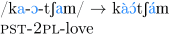
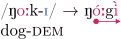
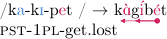
Empirically, our focus is on bidr vowel harmony systems. Kipsigis (iso 693-3 sgc, Kalenjin, Southern Nilotic, Kenya) illustrates such a system. Vowels may be + or − [atr] (Advanced Tongue Root) (see (2)), with [+atr] being the dominant value. In the general case, all vowels in a word must share their [atr] value. Thus, since [+atr] is the dominant value, a single [+atr] vowel in a word causes all other vowels to become [+atr] (a.o. Hall et al. 1974; Halle and Vergnaud 1981; Baković 2000; Casali 2003). Examples are given in (3–6). Here and further on, we use colour (in the online version) to highlight the distinction between dominant ( ) and recessive (
 ) vowels—this is intended as a visual aid for the reader and provides only redundant information. When a word consists of morphemes that only have [−atr] vowels, the surface form is identical to the underlying form (3). However, when a morpheme, like the root, has a dominant vowel, it causes suffixes (4) and prefixes (5) to become [+atr] as well.Footnote1 Finally, (6) shows a dominant suffix that alters the vowel quality of the root and the prefix.Footnote2
- (2)

- (3)
- (4)
- (5)
- (6)
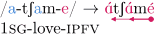
The example in (7) shows a minimal pair (with two types of applicative suffixes, one recessive, one dominant). Both root and prefix are underlyingly [−atr], but harmonize to the [+atr] vowel in the suffix in (7b).
- (7)
- a.

- b.

- a.
The examples in (8)–(9) show that the system is bi-directional. The same recessive morpheme, causative  , takes its [+atr] value from a dominant applicative morpheme to its right in (8), but from a dominant morpheme (in this case, a root) to its left in (9).Footnote3
- (8)

- (9)

Bi-directional harmony interactions between two (or more) roots are also seen in Chukchi, which has a rich inventory of compounding or incorporation processes. The examples in (10) from Skorik (1961: 34–35) and Krause (1979: 5) illustrate incorporation of adjectival modifiers to nouns. In the resultant A-N compounds, harmony may proceed from N to A as in (10b) (changing recessive { } to dominant {
 } or from A to N as in (10c). The inflected form of the adjective and absolutive form of the noun are given as well to show the underlying dominant or recessive vowels in the A and N roots involved.
- (10)
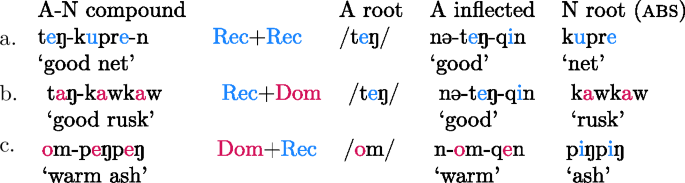
Object incorporation into verbs likewise triggers harmony from a dominant root to a recessive one, regardless of order. The following examples (from Polina Kasyanova, personal communication) show this process with incorporation structures involving three roots: in (11a) incorporation proceeds leftwards from the dominant verb root to two incorporated objects, whose underlying forms are seen in the unincorporated example in (11b).
- (11)
- a.

- b.

- a.
In (12a), the incorporated object noun with dominant vowels triggers harmony on the incorporated numeral to its left and the verb root to its right, both of which are underlyingly recessive (12b).
- (12)
- a.

- b.

- a.
One family of proposals treats bidr in terms of underspecification and feature-filling spreading rules: (morphemes with) dominant vowels bear a feature, such as [+a(tr)] for Kipsigis, while recessive vowels are underlyingly unspecified for their [atr] value. This feature, if present, spreads throughout the word, causing all unspecified vowels to take on the dominant feature value, as schematized in (13). In the absence of a [+a] feature in a word, all vowels are redundantly specified as [−atr].Footnote4
- (13)
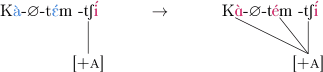
Although bidr systems allow spreading from left to right and right to left, and from stem to affix or affix to stem, Hall et al. (1974) reported that in languages like Kipsigis only suffixes and roots have vowels with a dominant quality. It is now a widely reported claim that dominant prefixes in bidr systems seem to be cross-linguistically unattested (Hall et al. 1974; Baković 2000; Moskal 2015, among others)—the NoDomPref generalization. This is abstractly represented in (14), where a root can have a dominant vowel, and the quality spreads to the suffix and the prefix; suffixes can change the quality on the root or the prefix, (14b), but (14c) is claimed to be unattested.
- (14)
- a.

- b.

- c.

- a.
Several proposals have been put forward as accounts for NoDomPref.Footnote5 Some of these proposals are supposed to cover prefix-suffix asymmetries more generally, but for the purposes of this paper we only focus on what the claims are with regard to vowel harmony.
One type of account deals with the differences between prefixes and suffixes through constraint rankings. Baković (2000: 227–238) proposes a class of faithfulness constraints that compare the stem vowel in an affixed form to the same stem vowel without the affix. He divides these further into faithfulness constraints for stem vowels in suffixed versus prefixed forms, and proposes that the absence of dominant prefixes can be captured if the faithfulness constraints for stem vowels in prefixed forms are ranked universally higher than the faithfulness constraints for stem vowels in suffixed forms. If the harmony-inducing constraint is ranked between the two types of faithfulness constraints, then the atr value of a vowel in the stem may be overridden by that of a suffix, but not by that of a prefix. As Baković (2000: 236–7) notes: “[a] lack of dominant prefix vowels has been successfully analyzed here as a possible state of affairs, but not as a universal. A simple re-ranking of the proposed constraints would …predict an unattested language with dominant prefixes and no dominant suffixes!” The constraint-ranking proposal is thus not explanatory in the important sense that it is fundamentally reversible—the same theoretical device could just as easily have been invoked to derive the unattested mirror-image, e.g., *NoDomSuff.Footnote6
Another type of account argues that the juncture between prefixes and the (lexical) stem has a different status from that between stem and suffixes (Nespor and Vogel 1986; Moskal 2015; Bogomolets 2020). When prosodic words are built, a suffix will be part of the relevant prosodic unit with the stem, whereas the prefixes will not be. This means that the stem and the suffix can prosodically interact with each other, but once this unit is built and prefixes are attached, it cannot alter the prosodic content anymore. As with the constraint-ranking approach, it is not immediately clear why the status of prefixes should be different from that of suffixes: One could imagine that the juncture in prosodic theories is more special for suffixes than prefixes. Like the previous account, the machinery is reversible, and could also have characterized the opposite asymmetry, a hypothetical *NoDomSuff generalization.Footnote7
Existing accounts thus face two challenges: First, they are reversible, and therefore do not explain why the apparent prefix-suffix asymmetry goes the way it does, rather than the opposite. Second, they are silent about the properties of suffixes. Since only prefixes are blocked from being dominant, suffixes may be either dominant or recessive. Though this is descriptively true, we argue below that it misses a generalization, namely that syntactically high suffixes are just as robustly consistently recessive as the prefixes. A complete theory should unify these generalizations, which is not possible if the fundamental pieces of the explanation are tied to linear order. We argue that a cyclic theory has the potential to resolve both of these issues. To the extent that the location of an affix in the lower or higher domain can be established on independent (syntactic/semantic) grounds, this family of approaches is not reversible. It is possible to derive NoDomHigh (as we show below), but a putative mirror-image *NoDomLow is unstatable. In this sense, the cyclic view is more explanatory than the order-based accounts. We argue that NoDomHigh is also empirically superior, based on the evidence currently available.
3 Domains not order
We argue here that the restriction identified by Hall et al. (1974) and others is best understood as a cyclic, that is hierarchical, rather than a linear effect. A morphologically complex word may contain more than one cyclic domain (or “phase” in syntacticians’ parlance), as schematized in (15).Footnote8
- (15)

We suggest moreover that the domain boundary is derived from the syntax, in the manner of Cyclic Spell-Out proposals (see, e.g., Marvin 2003; Newell 2008; Fenger 2020; Guekguezian 2021b, with notable antecedents at least as early as Bresnan 1971). For verbs, we follow Wurmbrand (2014), Harwood (2015), Fenger (2020), Guekguezian (2021a) and many references therein, who hold not only that there is a fixed functional sequence in the clausal domain, but that this sequence is divided into two domains (“phases”) in the syntax—with the relevant domain boundary lying, to a first approximation, between tense and (viewpoint) aspect, shown in (16).Footnote9 In the construction of a complex word, for example, via head-movement or equivalent operations, the first cycle stops at this boundary, thus the inner domain contains heads from the verbal root up to and including aspect. Morphemes corresponding to heads representing tense and above are mapped to the outer domain, and are expected to be peripheral to lower affixes in the verb word. With the exception of viewpoint aspect, an inflectional category that we take to mark the top of the first phase, our divide aligns fairly closely to the somewhat pre-theoretical divide between derivational (low) and inflectional (high) morphology, at least in verbs, and we have used this as a rough first guide in classifying affixes according to the grammatical descriptions we consulted. Note that we do not take category-defining heads (the little n,v,a of Distributed Morphology) to be phase heads in the relevant sense (contra Embick 2010, 2014 for example).Footnote10
- (16)
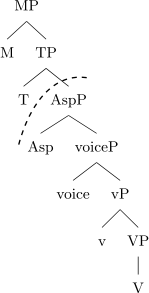
Bi-directional dominant-recessive harmony may apply in the inner domain, in which any vowel may be underlyingly dominant or recessive, but, we suggest, once vowel harmony has applied on the inner domain, the relevant quality of vowels in that domain is fixed. Therefore, affixes in the outer domain will essentially only ever be recessive (with some qualifications to which we return): a dominant vowel in the outer domain would lead to a disharmonic word, which is in general disallowed. We hasten to clarify that we do not take all phonological properties to be cyclically established and subsequently immutable in this way. We limit our discussion to the type of vowel harmony that characterizes bidr systems.
There are two aspects to our account that we keep separate. The first part is the argument that hierarchical structure (cyclic domains) provides a better account than left-right order of the observed asymmetries. Specifically, we argue that the Kalenjin languages, for which NoDomPref was first proposed, are misleading, in that almost all prefixes are high, and almost all suffixes low, conforming to a widely suspected cross-linguistic trend (Julien 2002). This means that in these languages, NoDomPref and NoDomHigh are effectively indistinguishable empirically. Arguments to distinguish these will have to come from languages with richer inventories of prefixes and suffixes.
The second part of our account concerns the criteria for distinguishing low and high, the inner and outer domains. We share the cyclic hypothesis, at least in broad strokes, with Kiparsky (2024), but part ways with that approach in terms of the identification of the inner domain: for us it is syntactic: the phase, for Kiparsky (2024) it is morphophonological: the stem.
Section 4 makes the empirical case for structure over order, and we turn to the question of stem versus phase there. Nevertheless, we presuppose in the descriptive presentation the domain boundary identified in (16)—that is, we take inflection versus derivation as a rough proxy for syntactic height, but with the proviso that among inflectional morphemes, aspect morphology is low, following Fenger (2020).
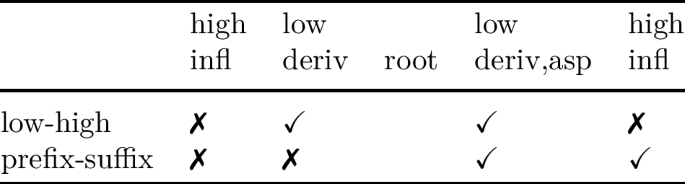
Table 17 represents schematically the different predictions made by the structural (NoDomHigh) and the linear (NoDomPref) approaches as regards the possibilities of classes of affixes having dominant vowels.
- (17)Patterns for generalizations: dominant vowels
4 Argument I—structure, not order: Case studies
We consider now the verbal morphology of three languages from different families that have figured in the discussion of bidr vowel harmony. For each language, we classified all the verbal affixes in the available descriptive sources as either low or high (to the extent possible using the criteria identified above) and as dominant or recessive, where this can be determined in the grammars. The tables that follow reflect the outcome of this exercise. In addition to the numbers of attested prefixes and suffixes in each category, we have also given abbreviations of the features represented by the affixes in each cell so the reader may see what categories we have taken to be high and low. Numbers given with a plus in parentheses count affixes that were not in the primary source consulted but have been added on the basis of a wider literature search and/or field notes, with a question mark indicating uncertainty in classification.Footnote11
4.1 Kipsigis
We begin with Kipsigis, a Kalenjin (Nilotic) language, chosen since this is the language group for which the original generalization in terms of a prefix-suffix asymmetry was made in Hall et al. (1974: 247). Examples of bidr harmony in Kipsigis were given in (7) above, and repeated here as (18). This pair shows the same verb occurring with two derivational (syntactically low) suffixes, the ins which is recessive, and the appl, which is dominant. As shown, the dominant [+atr] suffix  causes both the root and prefix vowels to harmonize to their [+atr] counterparts.
- (18)
- a.

- b.

- a.
The table in (19) presents the distribution of dominant and recessive affixes in Kipsigis, based on Toweett (1979) and verified by the second author’s field notes. We have identified twenty-three verbal affixes in Kipsigis from the literature, plus one additional possible prefix.Footnote12
- (19)The Kipsigis (Kalenjin) verb
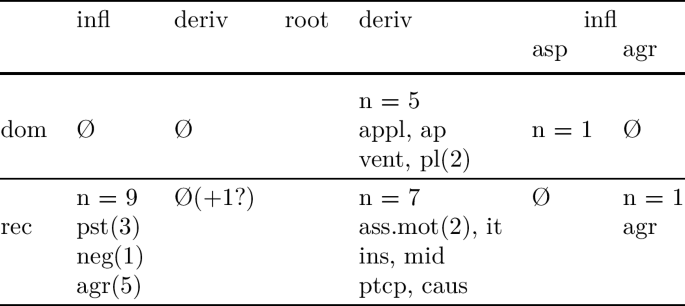
Of the twenty-three affixes in the table, only 6 are dominant. All are suffixes, and all are low. It is easy to see why Kipsigis would be seen in terms of a prefix-suffix asymmetry: there are no dominant prefixes, whereas there are dominant suffixes. However, it is also the case that Kipsigis shows a fairly strong correlation between syntactic height and linear position: all prefixes in the original source express high inflectional categories, and most suffixes are derivational. There are only two inflectional suffixes, of which moreover the only dominant one is the low category, aspect. Thus Kipsigis is actually consistent with both NoDomPref and NoDomHigh and so indeterminate between the two approaches.
4.2 Diola-Fogny
A slightly more complex picture is presented by Diola-Fogny (also: Jola-Fonyi, Kujamatay, iso 693-3 dyo, Niger-Congo, Senegal), for which morpheme counts from Sapir (1965) and Casali (2018) are given in (20):Footnote13
- (20)The Diola-Fogny verb
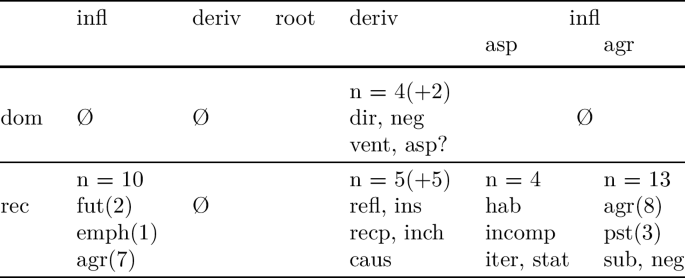
Though the situation with the prefixes is similar to Kipsigis (and likewise indeterminate between the two competing approaches), Diola-Fogny has a richer inventory of suffixes. While all 10 high prefixes are recessive, so too are the even more numerous (n = 13) high inflectional suffixes. Only the NoDomHigh approach accounts for the recessivity of inflectional prefixes and suffixes as a single generalization. Put differently, NoDomHigh accounts for the recessive nature of all 23 high inflectional affixes, where NoDomPref provides an account only of the prefixes, slightly less than half of the inflectional affixes.
4.3 Chukchi
The same point can be made from Chukchi (iso 693-3 ckt, Chukotko-Kamchatkan, Russia). Most of the Chukotko-Kamchatkan languages, including Chukchi, have a bidr harmony system with two sets of vowels, recessive {i, u, e1} and corresponding dominant {e2, o, a}. There is some debate about the phonetic nature of dominant versus recessive /e/,Footnote14 but phonologically, the patterning is clear: a dominant vowel (or morpheme) anywhere in the word causes all underlyingly recessive vowels to shift to their dominant counterpart.
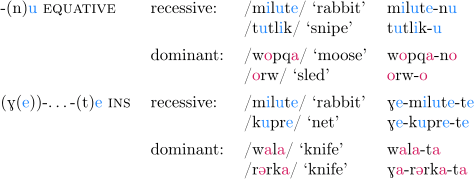
The examples in (21) show the alternation in affix vowels, controlled by the root. Affixes with a recessive vowel surface as such with recessive roots, but the dominant alternants are used with roots containing dominant vowels (Krause 1979: 4, Skorik 1961: 37).
- (21)Root controls affix (prefix and suffix)
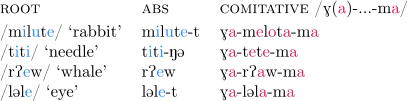
The inverse pattern is shown in (22). Here, the roots alternate, surfacing with dominant vowels when the affix contains a dominant vowel, and with recessive vowels otherwise.Footnote15
- (22)Affix controls root
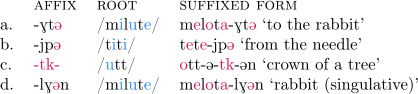
It should also be noted that morphemes (both affixes and roots) with no full vowels may be diacritically marked as being dominant or not (Krause 1979: 13-14; Muravyova 1979: 138–141). For example, the affixes in (23) have only schwa or no vowel at all, but trigger harmony alternations in the roots they attach to:
- (23)
With these descriptive points in mind, the table in (24) presents the distribution of dominant and recessive affixes, with base morpheme counts from Dunn (1999), supplemented (in parentheses) with examples from Bogoras (1922), Skorik (1977), and Weinstein (n.d.).Footnote16
- (24)The Chukchi verb
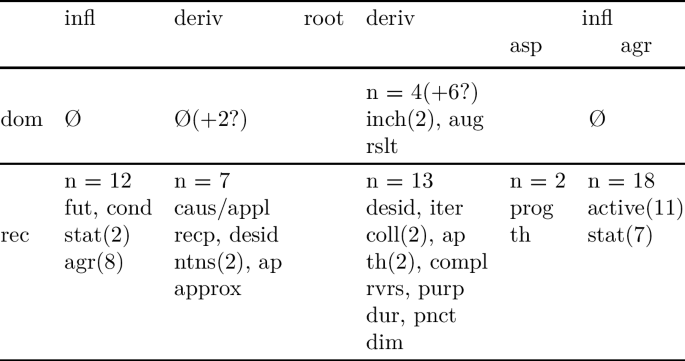
Like Diola-Fogny and unlike Kipsigis, Chukchi has a rich inventory of inflectional suffixes, and has more suffixes than it has prefixes. Notably, all inflectional affixes are recessive. For the high inflectional affixes (those higher than aspect), the NoDomPref generalization is accurate, but weakly so: it accounts for only 40% of the affixes (12/30) covered correctly by the NoDomHigh proposal. Accounts that invoke or derive NoDomPref leave the recessive nature of the other 60% of the affixes (all the high inflectional suffixes) as a mere accident. On the strength of this, NoDomHigh is a stronger proposal, with broader empirical coverage and consistent with the verbal inflection of Chukchi, as well as that of Diola-Fogny and Kipsigis. All else being equal, NoDomHigh should thus be preferred on these grounds alone.
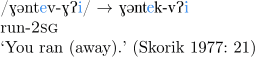
But Chukchi might add an additional point, not seen in Diola-Fogny, regarding the prefixes. Dunn’s description lists no dominant verbal prefixes of any sort, but other descriptions contain morphemes identified as dominant prefixes, apparently in violation of the putative NoDomPref generalization.Footnote17 Two of these occur as prefixes to verbs (a third appears to be more regularly attached to nouns). One such apparent dominant prefix identified in Skorik (1977) is the intensifier  , given in (25a). Example (25b) establishes that the root
  ‘run (away)’ is underlyingly recessive.
- (25)
- a.

- b.
- a.
Weinstein (2023: 45) gives the prefix  ‘impossible to V’ as dominant.Footnote18 He gives examples, including
  ‘he could not go hunting [any more],’ which is evidently built on a recessive verb
  ‘to hunt,’ and a recessive suffix
  ‘to go V,’ both identified elsewhere in Weinstein’s works.
For completeness, it should be noted that both of these apparent prefixes, like many other derivational affixes in Chukchi, are at least historically related to independent roots, and thus an analysis in terms of compounding might also be possible, and cannot be definitively resolved here. Dunn (1999: §14) notes that some, not all, suffixes show phonological differences to their cognate roots, suggesting the affixes have been grammaticalized. Note in this regard that as a property root, -kət-∼-ɣtə- ‘heavy’ is given as recessive in Volodin and Skorik (1997: 26), though dominant in Skorik (1977: 231). Importantly, although there may be some uncertainty surrounding the proper identification of these morphemes, if they are now truly prefixes, then both are derivational rather than inflectional, compatible with the NoDomHigh proposal, but problematic for the NoDomPref generalization.Footnote19
Note that even if these are compounds, the dominant morpheme precedes the verbal root. As we saw in Sect. 2, Chukchi compounds are right headed (the rightmost root determines the category of the whole word), but any member of a compound may be dominant. Thus the low prefixes (if that is what they are) and, in any event, the Chukchi compounds show clearly that material to the left of the root (or stem) may indeed be dominant and enforce a change on the root and suffixes. Any account of NoDomPref would have to take this into account, and could not simply refer to linear precedence with respect to the root. For NoDomHigh, so long as all members of the compounds are within the inner domain, there is no issue, and bidr harmony is as expected.
4.4 Summary and implications
Before we move on to our theoretical account, we may summarize the empirical arguments. The tables that follow aggregate the information from the three languages above, first (a.) with all affixes, including those with a + in parentheses in the preceding tables, and then (b.) excluding the uncertain affixes, notably such as the two potential low prefixes in Chukchi. Each table gives the number of dominant affixes as a fraction of the overall number of affixes in each of the four categories high-low×prefix-suffix.
- (26)Proportions of dominant affixes
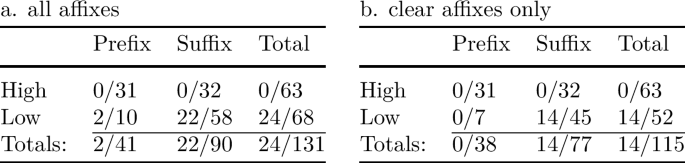
As far as the verbal systems of these three languages are concerned, we contend that NoDomHigh is a more accurate generalization than NoDomPref. This is clearest in (26a), which is consistent only with NoDomHigh, because it includes the two Chukchi morphemes identified in the descriptive literature as dominant prefixes, which stand as (previously unrecognized) counter-examples to NoDomPref.
Our primary arguments, however, do not rest solely on these two morphemes, which, as we have noted, might be characterized as compounds, rather than affixes. As no criteria that we know of will settle the issue, let us consider the “worst case” scenario (26b), in which we exclude the various uncertain morphemes, including these Chukchi morphemes. This leaves us with 115 affixes across the three languages. The distribution of these affixes is observationally consistent with both NoDomPref and NoDomHigh. Both generalizations correctly exclude dominant high prefixes (0/31), and both admit dominant low suffixes, which are attested (14/45). And both generalizations are statistically significant: Seen as a prefix versus suffix distribution, 0/38 prefixes are dominant, as opposed to 14/77 suffixes—a significant asymmetry (by Fisher’s Exact test, p = .0044). Conversely, classifying the same data by high versus low also yields a significant asymmetry: 0/63 high affixes are dominant as opposed to 14/52 low affixes (by Fisher’s Exact test, p<.0001). This is in part because the two generalizations are entangled—there is a significant (one-way) correlation between height and prefix-suffix-hood (, p = 0.0001): while the suffixes are split roughly evenly between high and low—32/77 are high; the prefixes are overwhelmingly high—31/38 prefixes are high, and only 7 are low.
Where the generalizations (and thus the theories that derive them) differ is in the high suffixes and the low prefixes. That is, each generalization explains the 0/n in one of these cells, but leaves the other unexplained—an accidental gap. But the two gaps are of different sizes, and thus the two approaches diverge in their conditional entropy, i.e., the amount of the overall data that they leave to unexplained accident. NoDomPref, as noted above, leaves the absence of dominant vowels in the 32 dominant high suffixes as an unexplained accident, close to the amount of data that it purports to explain (0/38 prefixes are dominant). By contrast, NoDomHigh leaves only the absence of dominant vowels in a pool of just 7 low prefixes as an accidental gap, compared to the 0/63 dominant high affixes that it explains. NoDomHigh explains a sizeably larger amount of the data than NoDomPref. These numbers are consistent with our contention that the original NoDomPref observation is correct (and on its own statistically significant), but it is an artifact of the rarity of low prefixes, distracting from the real generalization, NoDomHigh. Put differently, if one were to place a bet on the dominant or recessive nature of any given morpheme, one would be more likely to be correct with the knowledge of whether the affix in question is high or low than whether it is a prefix or a suffix.
Though the empirical evidence is not on its own dispositive, we have shown that as a generalization, NoDomHigh should be preferred, all else being equal, as it has broader empirical coverage, even without the Chukchi prefixes. We will show in the next section that the theory that derives NoDomHigh is also superior in that it does not fall prey to the reversibility issue that characterizes theories that derive NoDomPref.
5 Structure, not order: A cyclic account
We turn now to an account of NoDomHigh for the languages just considered. In addition to richer empirical coverage, as we have just documented, we suggest that NoDomHigh is more readily amenable to a theoretical explanation than NoDomPref, for which, as we have seen, existing accounts are reversible. Other than by stipulation, there is no reason why NoDomPref should hold as opposed to *NoDomSuff with reversal of the constraints (Baković 2000) or a prosodic boundary on the other side (Moskal 2015).Footnote20 Our account of NoDomHigh will not suffer from this: no re-ranking of the constraints yields a hypothetical mirror image, but unattested, *NoDomLow. That said, inasmuch as our account invokes ranking of violable constraints, our theory will share with all other OT-based theories the property that it is possible to rank the relevant constraints in such a way that there will be no asymmetry (whether prefix-suffix or high-low)—our factorial typology will include a language type that has no restrictions on the distribution of dominant affixes. We take that as a feature, not a bug: just as there are many languages that show no harmony at all, there is at least one language, Nez Perce, as described in the 1960s, that seems to fit the characterization as a language with bidr harmony, but no domain effect. We return to this in Sect. 7.1.
The core of our proposal is an adaptation of previous cyclic phonological approaches to vowel harmony, notably that of Kiparsky (2024), with earlier antecedents, such as Baković (2000), and specifically the idea that serial phonological derivations respect domains: designated chunks of structure or points in the derivation that hold a special status over and above whatever serial effects hold at each step of the derivation—the strata of Lexical Phonology or Stratal OT, or the phases of contemporary syntax. We contend that the syntactic phase, specifically the boundary between AspectP and Tense as in (16), constitutes one such domain in the phonology—we will call it for now the inner domain (InDom). We invoke a type of faithfulness constraint, Ident-InDom(F) for some feature F (modeled on the Ident-Stem-F of Baković 2000; Kiparsky 2024) that, when highly ranked, enforces faithfulness in the output to properties that are established at the first phonological stratum, potentially overriding other pressures. Since the constraint is vacuous (or undefined) on the inner domain itself, this has the effect that vowel harmony will apply freely in this domain, but when phonology applies to higher domains, the values of F in the inner domain are fixed and cannot be over-ridden. An underlyingly dominant vowel in the outer domain (syntactically high) will thus fail to show dominant behaviour, in the sense that it cannot modify the feature values established on the inner domain. Linear order plays no role in the account: descriptively NoDomPref emerges from the independent trend for prefixes to be primarily in the outer syntactic domain. We present the basic account first, and then return to a discussion of various refinements and consequences. In Sect. 7.2, we offer some tentative remarks on the kind of evidence that may distinguish between the Stratal OT implementation of cyclicity and a rule-based approach in terms of underspecification and feature-filling (but not feature changing) harmony rules.
Kiparsky (2024) presents an account of certain cyclic effects in vowel harmony, in which directionality effects in select harmony systems appear to change across cyclic domains in one and the same language. Although the effect we are looking at is somewhat different than the effect Kiparsky examines, the core of his system provides a convenient (more or less) off-the-shelf formalism in which to cash out the intuitive discussion we have presented above. In this section, we present the key components of his model and consider how it derives (something tantamount to) NoDomHigh. We leave a comparison between the models—and in particular why we think there is a syntactic component (phases) rather than a purely morphophonological definition (stems) for the identification of the inner domain—for Sect. 5.
Kiparsky’s proposal is cast in Stratal OT (Kiparsky 2015; Bermúdez-Otero 2022). The leading idea of this framework that is relevant for present purposes is that phonology is cyclic, specifically in the sense “that certain constituents in the morphosyntactic structure of a linguistic expression define domains for phonological computation. Phonology applies iteratively over these domains, starting with the smallest, least inclusive cyclic domains, and moving progressively outwards to larger, more inclusive cyclic domains” (Bermúdez-Otero 2022). In order to remain neutral for now about how the cyclic domains (Kiparsky posits stem and word) are established, we will refer simply to the “inner domain” (InDom), rather than the stem.
Before we get to the role of domains, consider first the basic mechanism of harmony. Kiparsky proposes to account for bi-directional harmony effects as the combined working of three constraints, as in (27).
- (27)
- a.*[αF][−αF]
- b.Max[F]
- c.Max[μF]
The markedness constraint in (27a) bans disharmony (conflicting values of a feature on consecutive segments in some domain). Max[F] in (27b) is the run-of-the-mill faithfulness constraint that penalizes any change to an underlying feature value. If the input contains a sequence [αF][−αF], then the two constraints conflict. Harmony effects obtain when *[αF][−αF] outranks Max[F]. The key work in a bidr system is done by a third constraint, Max[μF], (27c), where μ is to be read as “marked,” which ensures that underlying disharmonic sequences are consistently resolved in favor of the marked value of the feature. When Max[μF] outranks Max[F], a single occurrence of the marked value in the input will be preserved, and all other occurrences of F will harmonize to the marked value, i.e., [μF] is dominant.Footnote21 We illustrate the workings with reference to the basic Kipsigis example.
The relevant syntagmatic markedness constraint in Kipsigis is *[αatr][−αatr], blocking any combination of (consecutive) vowels that do not share a value for [atr]. The relativized faithfulness constraint prefers harmonization to the marked [atr] value: Max[+atr]. With no further assumptions, Kipsigis harmony is thus bidirectional: whenever there is at least one [+atr] segment, switching all [−atr] vowels to [+atr] is preferred. The tableau in (28) shows this for the example in (7b).Footnote22
- (28)

We now add in the notion of cyclic domains, or strata. Following the core tenet of Stratal OT, we assume that there are at least two cycles of phonological computation (constraint evaluation). In the case at hand, one happens after the suffix is added, defining the inner domain, and a second cycle after the prefix is added. Keep in mind that the delineation of the strata or domains is up for discussion (see below); neither for us nor for Kiparsky does the root constitute a cyclic domain on its own, and neither we nor Kiparsky assume that each added affix creates a new domain. We use this two-step derivation as a simple example of the workings of the theory.
The key proposal when a derivation spans more than one cyclic domain, as mentioned above, is a constraint family Ident-InDom(F). Where IO faithfulness constraints enforce identity of a feature-value in the output to the corresponding value in the underlying representation; Ident-InDom(F) compares the output of the current cycle to the (output of) the previous cycle, which may have changed from the underlying representation.Footnote23
Although this will have no effect for the example just considered, we add the constraint in here to show how it works. For maximum explicitness, we break the tableau into two, representing the first cycle (stem+suffix) in (29), and the second cycle in (30). As above, the root harmonizes to [+atr] from the suffix on Cycle 1, and this spreads to the prefix on Cycle 2.
- (29)

- (30)
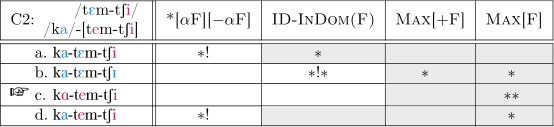
Since the prefix in this example is underlyingly recessive, splitting this into strata does no actual work for this word. But now consider what happens if a high affix, such as the tense prefix, were (hypothetically) to have an underlyingly [+atr] vowel. The relevant case is the combination with an inner domain that has only [−atr vowels], for example, when the root is combined first with the ins suffix instead of the appl. The result is shown here (only the second cycle is considered, as the first cycle is trivial):
- (31)

The highly ranked ID-InDom(atr), not applicable on the first cycle, ensures that the [atr] value established on the first cycle wins out over any higher values, even at the cost of forcing otherwise illicit violations of Max[+atr] in the affix introduced on Cycle 2, here the prefix.
This effectively derives NoDomHigh. Since the vowel quality on the first cycle cannot be overridden on a later cycle, but harmony still applies, all affixes beyond the first cycle (that is, all our high affixes) will harmonize with the atr value of the stem, regardless of whether this is [+] or [−]. As a matter of observation, the underlying value of the high affixes is thus irrelevant; high affixes will almost always behave as if they had (underlyingly) recessive vowels. (We return below to potential exceptions.)
Unlike the accounts of NoDomPref in Baković (2000) and Moskal (2015), which appeal to linear asymmetries, the cyclic/Stratal OT account we have given is not reversible. While there is an independent question of which affixes are part of the inner domain and which are not (to which we return), there is no way to limit dominant vowels to higher affixes and prohibit them from the lower domain. High-ranked Ident-InDom(atr) makes the underlying value of outer affixes irrelevant (rendering them recessive as shown above), but a low-ranked Ident-InDom(atr) would simply be irrelevant—dominant and recessive vowels would be free to occur anywhere in the word (as appears to happen in Nez Perce, see Sect. 7.1). That is, the mechanisms on offer to derive NoDomPref could just as well have been formulated so as to derive *NoDomSuff. But the cyclic account of harmony asymmetries in terms of structure, rather than as a prefix-suffix asymmetry, is not reversible: we derive NoDomHigh or nothing, but cannot derive a putative *NoDomLow. We take this, of course, to be an advantage of ours and Kiparsky’s approaches.
In sum, we contend that our approach improves upon previous approaches in two ways: first, it derives a broader generalization, covering a large number of suffixes as well as prefixes, and second, it is irreversible—re-ranking constraints does not yield an unattested mirror-image version of the generalization. We turn now to ways in which our account interacts with other assumptions to derive various points of variation. We return later to the Warlpiri facts that motivated Kiparsky’s account, and why our inner domain differs from his stem. In Sect. 8, we offer tentative remarks on a direction one might pursue in order to provide an account with the flexibility to encompass the bidr harmony systems we are concerned with along with the type of directionality reversal that Kiparsky describes.
6 Argument II: Stems vs phases
In the previous section, we have borrowed technical machinery from Kiparsky (2024), but we have implemented the notion of an inner domain differently. In this section, we present two arguments in favor of seeing the inner domain, at least for the bidr cases, as a syntactic domain, like phases, as opposed to Kiparsky’s morphophonological unit, the stem. These arguments are not fully conclusive, since, as far as we can tell, there is no consensus in the relevant literature on how to identify either stems or phases. Despite this concern, we think the two points below suggest that the available evidence is more likely to support an eventual syntactic, phase-based account of Kipsigis, Diola-Fogny, and Chukchi. To appreciate the difference between the approaches, we make a brief detour in Sect. 6.1 to present Kiparsky’s analysis of Warlpiri harmony. We then argue that the facts of Kipsigis and Chukchi differ from those Kiparsky considered, such that Kiparsky’s account in terms of a stem does not extend directly to those languages. Conversely, our account does not extend to Warlpiri. We postpone until Sect. 8 a discussion of how an internally consistent account of both the Warlpiri directionality reversal, and the bidr systems we discuss, could be had in the Stratal OT framework.
6.1 Warlpiri—stem as domain
Kiparsky (2024) considers three cases of apparent directionality-reversals in harmony processes, which he describes as sharing the property that “roots combine with their first affix in dominant-recessive fashion, outputting a derived stem which then cyclically passes the harmonic feature outward to subsequently added affixes by stem faithfulness.” (page 195). Here, we illustrate with his presentation of rounding harmony in Warlpiri, on which we modeled our account of NoDomHigh in bidr harmony. After doing so, we argue that our facts require, however, that the relevant inner domain is the syntactic phase (or something close to it), rather than the stem, as in his account.
In Warlpiri (iso 693-3: wbp, Pama-Nyungan), as Kiparsky presents things, the core generalization is that the sequence *i …u may not occur in consecutive syllables (though the reverse is allowed). If this sequence would arise in morphological concatenation, it is resolved by an iterative harmony process. In verbs, if the first suffix is [+round], harmony will be regressive, spreading from suffix to root (as in (32)). But for all suffixes beyond the first, and for nouns, harmony is progressive, rather than regressive, and spreads [−round] (rather than [+round]) from stem to suffix, as in (33).Footnote24 Harmony in Warlpiri does thus apply in both directions, but unlike the languages we have examined above, this is not a bidr harmony system as we have used this term. Example (32b) shows that Warlpiri rounding harmony is asymmetric in its directionality: i may follow u, but u may not follow i. Example (32c) shows that the process constrains vowels that are adjacent on the vocalic tier, rather than the whole word—intervening a blocks further spreading.
- (32)
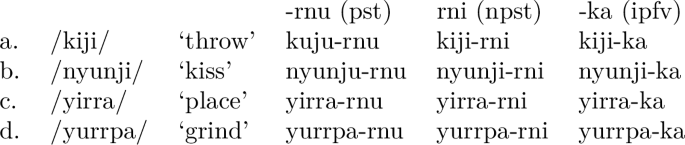
- (33)

Kiparsky argues that the directionality reversal seen in Warlpiri is a cyclic effect. The first relevant cycle is the stem, which for Warlpiri verbs, Kiparsky treats as the root plus the first suffix. On the stem cycle, the constraints relevant for harmony are those in (34).
- (34)
- a.*
- b.Max[+round]
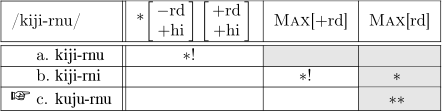
Both constraints are ranked above the simple IO faithfulness constraint Max[+round]. Constraint (34a) enforces harmony, while constraint (34b) ensures that harmony resolves to the marked value, namely [+round], if the suffix is [+round]. The tableau in (35) illustrates for the simple root-plus-suffix combinations in (32).
- (35)
Now, since constraint evaluation is cyclic, it is the output of the stem cycle, not (always) the underlying lexical representation, that functions as the input to the next cycle. Cyclic effects are enforced by Ident-Stem(F), on which we modeled our Ident-InDom(F) above. This is shown in the tableau for (33):
- (36)

On the (first) stem cycle, all vowels are [−round], so the optimal candidate matches the input. On the second cycle, Ident-Stem(F) enforces preservation of the stem vowel value [−round], forcing a Max[+round] violation in the suffix, which would have been fatal on the first cycle (as it is in (35b)).Footnote25
Although Kiparsky’s focus is a class of harmony effects where there is a directionality reversal after the first affix, and not bidr systems as such (the Warlpiri system is directional, but changes directionality after the first cycle), the similarity is striking: the system applies in one fashion on the first cycle, but then becomes effectively stem-controlled on later cycles. The difference between Kiparsky’s constraint and ours (in our implementation, but see Appendix B) lies solely in the definition of the inner cyclic domain it references.
6.2 Multiple affixes: Stems and syntactic domains
In addition to Warlpiri, Kiparsky describes data from Nen (Tunen) and Telugu. In all three, the relevant differences distinguish the behaviour of the first affix from all subsequent affixes (at least in verbs, see below). Thus Kiparsky says (p3): “The pattern is that roots combine with their first affix in dominant-recessive fashion, outputting a derived stem which then cyclically passes the harmonic feature outward to subsequently added affixes by stem faithfulness.” Kiparsky holds that this is because the (verbal) root alone does not constitute a stem, but the root plus the first affix does. Thus, any affix beyond the first must be (or behave as if it is) recessive.Footnote26 Defining the inner domain as the stem in this way would make the wrong predictions for Kipsigis and Chukchi. It is not the case that only the first affix can be dominant, and we have numerous examples of an affix beyond the first being dominant, but only if it is inside the syntactically-defined inner domain.
For example, in Kipsigis both the recessive causative suffix and the dominant applicative suffix can be the first affix attaching to the root, illustrated in (37a) and (37b), respectively. As shown in (37c), when the two suffixes co-occur, the applicative remains dominant despite being the second affix to be added.
- (37)
- a.

- b.

- c.

- a.
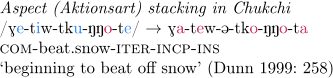
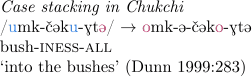
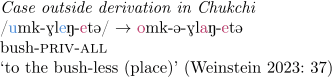
In Chukchi likewise, the prediction of Kiparsky’s approach that only stem-forming affixes can be dominant is not borne out. The examples in (38) show that a dominant suffix may attach outside a recessive one, affecting the vowels of all morphemes, including the root:Footnote27
- (38)
- a.
- b.
- c.
- a.
Whatever definition of stem from this literature is chosen (root + first affix, base of inflection, etc.), the dominant affix in each of these examples is not part of the (first) stem.
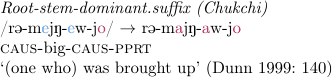
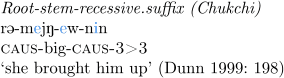
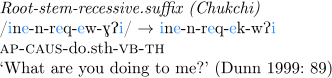
As another illustration of this point, consider the suffix -ew∼-aw, which is a plausible candidate for a verbal stem formative (“little v”). This suffix serves to make verbs from roots of other categories, and also transitivizes intransitive verbs (as well as simply being lexically required by some verb roots). It frequently co-occurs with the causative prefix n(ə)-∼r(ə)-. The suffix is underlyingly recessive, but suffixes that follow it may be dominant, changing both the suffix and the root to their dominant counterparts. Dominant suffixes that follow the verbalizer include participial -jo in (39a) and aspectual (aktionsart) suffixes, such as inceptive -mɣo in (40a) (also dialectal variant  ). The (b) examples provide corresponding forms with no dominant affixes, affirming the underlying recessive status of the root and verbalizer:Footnote28
- (39)
- a.
- b.
- a.
- (40)
- a.

- b.
- a.
In agreement with Kiparksy, we maintain that the effects we see are cyclic and distinguish between affixes in an inner versus an outer domain. But for Kipsigis and Chukchi, it is clear that we cannot take the first affix (or first suffix) to delineate the relevant inner domain for the purposes of the Ident-InDom constraint. To the extent that the stem is defined (as Kiparsky does) by the first suffix that attaches outside the root, the inner domain in bidr is not the stem.
6.3 Category differences in phonology
Phase-based and stem-based approaches might also be distinguishable in terms of what expectations they lead to regarding cross-categorial asymmetries. Our case studies in Sect. 4 were all drawn from the verbal systems of the languages we investigated. When we look beyond verbs, a different picture emerges.
The structure that we proposed, where Aspect is the relevant phase head, makes no claims about phases/domains beyond verbs. In other words, according to our theory, no affix can be dominant if it spells out a head higher than the head introducing a phase boundary; but positing that the intermediate phase in verbs lies between Aspect and Tense does not automatically lead to any predictions about where, or whether, one will find such an intermediate phasal boundary in the nominal and adjectival domains. Although there is no consensus on where phases are in the syntactic literature, our sense of the state of the literature is that to the extent there is evidence for an intermediate phase (around AspP) in the extended verbal/clausal spine, there is far less, if any, evidence for a corresponding intermediate phase in the extended nominal domain. A claim along these lines has been made on independent grounds, albeit tentatively, in Bobaljik (2008: fn.7) (see also Guekguezian 2021b).Footnote29 More specifically, Bobaljik (2008) discusses a noun-verb asymmetry in epenthesis in Itelmen (Chukotko-Kamchatkan), which he accounts for by arguing that epenthesis applies cyclically in verbs, but not in nouns; he then speculates that the lack of cyclicity in nouns may be due to the lack of a phase boundary in the nominal domain, situating this in a broader cross-linguistic tendency for nouns to show more phonological distinctions (and thus less “regularity”) than verbs (Smith 2011). If these speculations are on the right track, then a phase-based approach might lead one to expect cyclic (inner domain) effects in verbs, but not in nouns or adjectives.
By contrast, the stem-based approach would seem to lead to the opposite expectation, namely that the inner domain (first cycle) in nouns will be, if anything, smaller than that in verbs. Just as there is no consensus on what constitutes a phase, there are also varying diagnostics regarding the identification of stems. Regarding the verb-noun asymmetry in Warlpiri, Kiparsky adopts the proposal of Nash (1979), suggesting that unlike verb roots, which are bound, “Nouns, being free forms, are inherently stems.” (p5). Thus, nouns trigger progressive spreading of [−round], even to the first affix, as in (41a), (example (41b) shows that the suffix vowels are underlyingly /u/, as they surface faithfully as such after stem-final /a/, where no harmony violation is at issue).
- (41)
- a./maliki-kurlu/ → maliki-kirli ‘dog-prop’
- b./minija-kurlu/ → minija-kurlu ‘cat-prop’
In sum, taking syntactic phases as the relevant domain might lead to the expectation that only verbs, but not nouns, have a word-internal cyclic domain boundary: all affixes in a complex noun would be part of the first domain and NoDomHigh would appear to hold only in verbs. Taking stems to be the relevant domain might lead to the contrasting expectation that in nouns, but not verbs, since the root corresponds to the first cyclic domain boundary, all affixes in nouns would count as high for the purposes of NoDomHigh.
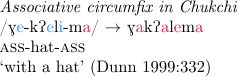
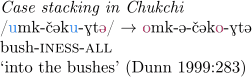
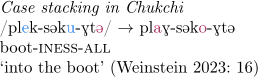
For Chukchi, the facts support, if anything, the phase-based expectation. There is (unsurprisingly) less morphological complexity in nouns than in verbs, but the most peripheral suffixes include dominant ones, such as the allative (dative), and associative case markers. Note that the allative case, across Chukotko-Kamchatkan, can be built on top of the (stative) locative case—the forms are morphologically complex, reflecting a common cross-linguistic decompostion (Radkevich 2010), and it is the higher (more peripheral) of the two cases that is underlyingly dominant.Footnote30
- (42)
- a.
- b.
- c.
- a.
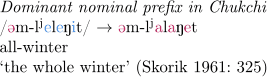
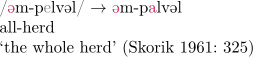
Skorik (1961: 325) also identifies one dominant prefix in the Chukchi nominal system, əm- ‘all, whole,’ corresponding to the root əm- ‘all, whole,’ illustrated here:
- (43)
- a.
- b.
- a.
Though one could debate whether these examples constitute compounds or prefixation, either way, if the nominal root is a stem on its own (à la Kiparsky), the dominant element would be external to that stem, but if there is no internal phase in the nominal domain (our view), then the dominant element is in the same phase as the root.
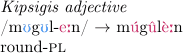
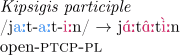
A parallel argument can be made for Kipsigis adjectives (and participles). Adjectives are morphologically simpler than verbs, and adjectives (and participles), unlike verbs, have a dominant, plural agreement suffix, presumably high within the morphological structure, but, evidently, still within the inner domain. This is consistent with assuming that the inner domain effect is tied to phases, which occurs word-internally only in verbs, but not with the assumption that stems identify a morphological constituent that across categories excludes inflectional suffixes.
- (44)
- a.
- b.
- a.
In the case of Kipsigis, there is independent evidence from suppletion, which also points towards the adjectival plural marker –eːn being in the same domain as the root. The adjective oː ‘big’ is suppletive in the presence of the plural marker: eːtʃ-eːn ‘big(pl).’ There are competing views on the locality domain for suppletion, but at least some proposals (e.g., Bobaljik 2012) make reference to the idea that the trigger and target must be in the same cyclic domain.
The Chukchi noun and Kipsigis adjective data present, on the face of it, a challenge to the empirical claim that there are no dominant high affixes. The apparent challenge is resolved under the hypothesis we have maintained throughout, namely that “high” in the relevant sense is defined relative to a designated domain boundary—the phase. Assuming that there is no intermediate phase head similar to Aspect in the nominal and adjectival domain would explain the Kipsigis and Chukchi data above, and has precedents in the literature on noun-verb asymmetries in the phonology (e.g., Bobaljik 2008; Smith 2011; Hyman 2019). More broadly, it allows us to be consistent with an approach that treats observed phonological asymmetries among categories in terms of a prior difference in cyclic structure, and without direct reference to syntactic categories in phonological rules, preserving a type of modularity (d’Alessandro and Scheer 2015; Newell and Sailor t.a.). At the same time, the examples considered appear to present a challenge to a program to understand the observed differences in terms of stems, as in the specific Stratal OT proposal put forward by Kiparsky.
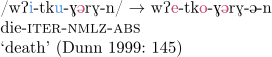
Going further, the hypothesis that there is a phase boundary in verbs but not in nouns raises an interesting question about cross-categorial derivations, such as deverbal nominalizations (possibly including the participles discussed above). Since our theory does not refer to categories directly, we predict that nominalizations that embed only the lower, phase-internal verbal projections should be noun-like, that is, consisting of a single domain in which even the outermost affixes may be dominant. This is borne out by the available data. In Chukchi, deverbal nominalizations may embed Aktionsart suffixes (i.e., “lexical aspect”—importantly distinct from the viewpoint Aspect that defines the phase), and when they do, they behave as a single domain for vowel harmony. Nominalizing affixes, outside of these Aktinosart suffixes, may be dominant and will change the vowels of the root and internal affixes. Example (45) illustrates this point with nominalizer  in combination with the iterative suffix (45a) and the verbal collectivizer (45b).Footnote31
- (45)
- a.
- b.

- a.
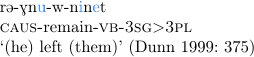
The following example makes the same point with the stem-formative -ew- followed by the (passive) participial suffix -jo-. If the participle is treated as nominal, and the verbalizer as little v (see above), then this reinforces the conclusion above that the stem-forming categorizer v is not in and of itself a phase-domain defining head: dominant suffixes may occur outside it.
- (46)
- a.

- b.
- a.
Like the examples considered in Sect. 6.2, these show that the inner domain is not closed off by the first suffix. The examples also indicate that the domain (phase) is not simply the highest verbal (extended) projection in the derivation (see discussion in Bobaljik and Wurmbrand 2013). Under such an approach, one might consider that the iterative lexical Aktionsart head in (45a) might introduce a phase in nominalizations (even though it does not in verbs), because it is the highest head of the verbal part of the projection. But the facts do not bear this out and are instead consistent with the approach that heads that do not introduce phases as part of the verbal extended projection also do not do so when the extended projection is truncated, as when it is embedded under the nominalizer.
In principle, we would predict that syntactically larger nominalizations that contain a (verbal) phase boundary, if possible, should be verb-like: phase-external affixes should not be dominant. Here, Chukchi is uninformative. While verbs with Aktionsart (lexical aspect) suffixes can be nominalized, grammatical/viewpoint aspect affixes and inflectional affixes do not appear in nominalizations in the sources we have consulted.
6.4 Affixes with variable behaviour
Another point on which a stem-based and a phased-based analysis might differ lies in the conditions under which they might predict the existence of affixes with variable harmonic behaviour. Specifically, the stem-based approach, where the inner domain is defined by the first affix that attaches to the (verbal) root, predicts that any affix with an underlyingly dominant vowel will behave as dominant when it attaches directly to the root, but as recessive when it attaches after any other affix.Footnote32 We saw in (37b)–(37c) that the applicative suffix is dominant in Kipsigis, irrespective of whether it is the first or second affix following the root, which seems problematic for the stem-based account. Nevertheless, we show in this subsection (see also the discussion of (Tu)Nen in Sect. 7.2.1) that there are affixes with variable behaviour, but that the variation is not conditioned along the lines a “first-affix” definition of the stem would predict.
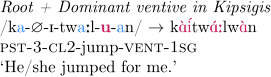
A minimal pair to (37b)–(37c) can be seen in (47) (below): unlike the applicative suffix, which is always dominant, the ventive suffix –u is dominant when attaching directly to the root (47a), but recessive when attaching to the root + causative complex (47b).Footnote33 In (47), the ventive suffix is used to introduce the first person benefactive argument.Footnote34
- (47)
- a.
- b.

- a.
The variable behaviour of the ventive, and in particular the fact that it is recessive when following the causative suffix –sɪ, indicates that the latter should be treated as a stem-forming affix in Kiparsky’s account. This means that any affix attaching after the causative will be attaching at the stem level, and should thus be recessive in the language. This, however, is not borne out: as already shown in (37c) above, repeated here as (48), the applicative is dominant when it follows the causative.
- (48)

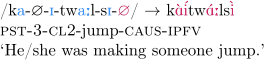
Not only the applicative, but also the imperfective affix is dominant when following the causative or even the causative + ventive combination. Examples of the relevant forms are given in (49).
- (49)
- a.
- b.

- a.
The imperfective suffix has a null allomorph in these examples, and thus determining its linear position is more challenging. Nevertheless, there is indirect evidence that it follows the causative and the ventive. Toweett (1979) notes that the causative does “not behave like the other formatives […] For all practical purposes they (=verbs with the causative suffix) behave as if they were basic verbals” (Toweett 1979: 137). This description is consistent with the idea that the causative is stem-forming, and it indicates that it is always the suffix closest to the root. Thus, the imperfective suffix would have to follow the causative in (49a). As for its position relative to the ventive, we know that the null allomorph of the imperfective follows the applicative: as shown in (50), the applicative suffix has the form tʃiːn in the imperfective, which is the allomorph of –tʃi when in non-final position.Footnote35 Since the ventive has a similar function to the applicative in these examples (they both introduce applied arguments), the most natural assumption is that the imperfective is merged after the ventive as well.
- (50)

To sum up, Kiparsky’s account predicts the existence of affixes with variable behaviour, but the case of the Kipsigis ventive shows that attributing such behaviour to the existence of stem-based domains makes incorrect predictions about the behaviour of other affixes in the language. More specifically, in order to account for the variable behaviour of the ventive, one has to postulate a very small inner domain for the Kipsigis verb, incorrectly predicting recessive behaviour for applicative and imperfective affixes in the language. If, on the other hand, the inner domain is defined in terms of phases, as proposed in this paper, any morpheme below the phase-delineating head (which we argued in Sect. 3 is the aspect head) should always have the ability to be dominant. Thus, we correctly predict that the applicative and imperfective suffixes in Kipsigis will remain dominant, irrespective of the presence of other morphemes lower (or higher) in the structure.Footnote36
At this point, one might argue that while the stem-based account undergenerates with respect to the morphemes that are dominant in Kipsigis, a phase-based account overgenerates: since the ventive is lower than the Asp head, it is not clear why it loses its dominance when following the causative. Though we do not have a full explanation yet, we note that overgeneration is a less severe problem than undergeneration, since the recessive behaviour of the ventive when following the causative could be due to factors other than phasehood. For example, it is possible that the ventive is merged differently in causative vs non-causative structures, affecting the way in which the morpheme is phonologically integrated with the rest of the verb, or alternatively, that the ventive simply has two allomorphs, one with a dominant vowel and the other with a recessive one, the latter appearing after the causative.Footnote37 We leave the analysis of the ventive as a topic for further research.
6.5 Interim summary
This completes our main arguments: we hope to have shown in the first place that a cyclic (domain-based) account provides a more comprehensive account of the limitations on the distribution of dominant affixes in bidr harmony systems than a prefix-suffix asymmetry does. On this point, our results converge with Kiparsky (2024) from a different empirical domain. But we diverge from Kiparsky in how the inner domain is defined: we argue (albeit somewhat tentatively) that the evidence leans in favor of a syntactic identification of the inner domain—the phase, particularly as identified in Fenger (2020)—the border, in verbs, between (viewpoint) aspect and tense, and not, as in Kiparsky’s approach, the stem. Kiparsky provides two ways of identifying stems: addition of the first affix to the root (in verbs) and the ability of a root to stand free (for noun-verb asymmetries). Both of these make the wrong predictions in the languages we have investigated, whereas positing a domain boundary between aspect and tense in verbs, and no boundary in nouns, consistent with independent proposals in the syntactic literature, makes the right cut.
7 Refinements: Dominant high affixes after all?
At this point we turn to various claims in the literature for dominant prefixes and/or dominant high-affixes. We start this section with a clear example in which a high affix by our syntactic criteria is dominant both in terms of feature value and behaviour, namely a past tense suffix in (older varieties of) Nez Perce. As mentioned, since we adapt Kiparsky’s (Stratal) OT model for implementing our account, any generalization that is accounted for by a crucial constraint ranking should not be universal—in our case, low ranking of the Ident-InDom(atr) constraint will lead to a language with bidr harmony, but no domain effect. Nez Perce conforms to this characterization.
Beyond Nez Perce, we note that describing a morpheme (or vowel) as dominant has thus far meant two things: on the one hand a particular, marked value of a binary contrast (such as [+atr]) and on the other, a particular behaviour: effecting a change on neighbouring vowels. In the examples in Sects. 7.2 and 7.3, these properties diverge. In Sect. 7.2, we look at examples that have been offered of (high) prefixes with a dominant value (i.e., [+atr]), but which fail to show consistent dominant behaviour. The fate of underlyingly dominant (e.g., [+atr]) vowels in high affixes is particularly interesting, since it points to a subtle way in which the Stratal OT account of cyclicity that we have offered is not merely a recasting of the older derivational account appealing to underspecification (i.e., of recessive vowels), where one might posit a default feature-filling rule at the end of the first cycle, and a ban on feature-changing, to achieve almost, but not quite, the same effects as we have described.
In Sect. 7.3, we look at examples of apparent high suffixes that show dominant behaviour, but which, exceptionally, have the atr value that is not the normally dominant one in the systems in which they occur (these are cases of “dominance reversal” in Baković 2000). We present a brief summary of the facts, but note in addition that the systems are independently not straightforward bidr harmony systems, and so, while accounting for them is clearly within the remit of a typology of vowel harmony, they fall outside the narrow scope of the focus of this paper.
7.1 Nez Perce: The exception that proves the rule
As noted in the introduction, one consequence of embedding our theoretical proposal within OT is (as emphasized by two reviewers) that we cannot in principle derive NoDomHigh as a universal generalization. The key work is being done by the ranking of Ident-InDom above the constraint that forces harmony to resolve to the marked value. Since it is a key tenet of OT that constraints may be ranked differently across languages, nothing short of stipulation could preclude a language in which Ident-InDom is ranked low. This would yield the same effect as we saw in Chukchi and Kipsigis nominals: just as the absence of a domain (phase) boundary treats the whole word as a single (thus trivially, inner) domain, so too would ranking the ident constraint low effectively render it ineffective. All else being equal, in such a language, affixes that are syntactically high would nevertheless behave as if they are in the first domain, since nothing enforces the priority of the values determined in the first domain. Before proceeding to consider an example, we hasten to remind the reader that unlike re-ranking of constraints in Baković (2000)—which would yield an unattested mirror-image effect of the generalization he aimed to describe (NoDomPref)—this re-ranking in our approach does not yield a putative, but unattested, NoDomLow. Instead it yields an effect where the domain boundary is, for the purposes of vowel harmony, effectively ignored. Unlike NoDomLow, it seems that such a state of affairs is indeed attested, and in fact characterizes one of the first systems to be identified as a bidr harmony system, namely that of Nez Perce as of the first part of the 20th century.Footnote38
Nez Perce (or nimipuutímt, iso 693-3: nez, Sahaptian) is the locus classicus for the description of bidr harmony systems (Aoki 1966; Halle and Vergnaud 1981). The language has 5 vowels (which all occur both as short and long): /i, æ, a, u, o/. Dominant vowels include /i, a, o/, and recessive vowels include /i, æ, u/.Footnote39
The table in (51) characterizes the Nez Perce verbal affix inventory and classifies the morphemes as dominant or recessive. The classification is based on Aoki (1970).Footnote40 Although Aoki (1966) lists in addition a number of dominant verbal prefixes, Hall and Hall (1980) argue that the apparent prefixes are in fact compound roots. We accept this for the sake of argument and include no root compounds in (51), but note that even if it turns out that some of these are better seen as prefixes (synchronically), then just as parallel elements in Chukchi, they are low prefixes, and not an issue for our approach.
- (51)The Nez Perce verb
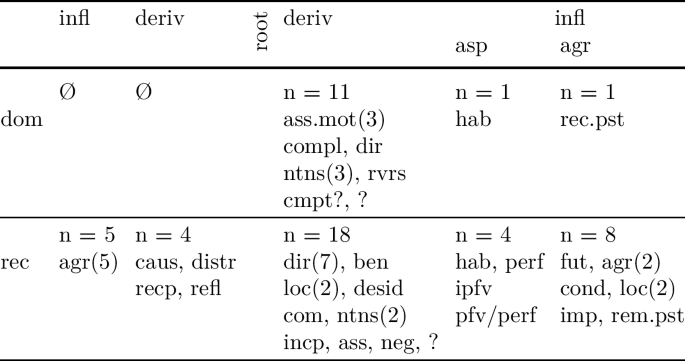
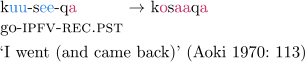
Of primary interest here is the one dominant high (inflectional) suffix, namely the recent past tense marker  (as well as complex combinations containing this, such as the conditional
  from prospective + recent.past
  , not counted separately in the table). An example is given in (52).
- (52)
The minimal pair that follows, from Deal and Wolf (2017: 33), shows that it is the recent past  that contributes the dominant feature—the same stem morphemes are all recessive in the remote past
  .
.
- (53)

This establishes that the recent past suffix is dominant. In Aoki and in other older sources (Phinney 1934; Aoki 1966; Rigsby and Silverstein 1969), the recent past is consistently final in the verb; it is a tense marker (thus high by our criteria), and it is consistently dominant.Footnote41 There is some variability among authors as to whether other high dominant affixes are recognized. In general, these are tense-aspect combinations, where it is arguably the aspectual element (low in our terms) that has the dominant vowel. We will not delve into these disagreements here, since for present purposes, it ultimately does not matter if there is one high dominant affix, or two, or three.Footnote42
Nez Perce thus fills out a key piece of the factorial typology. From an OT perspective, the best we can hope for is to derive an implicational, rather than an absolute universal: if a language shows an asymmetry, then it will be NoDomHigh, but languages with no domain asymmetry are permitted (and attested). That said, our account does permit dominant prefixes, so long as they are low in languages with a domain effect, like Chukchi and Kipsigis. Such prefixes have been described both for Chukchi and for Nez Perce, but as we have noted, there may be reason to discount these and to treat the relevant morphemes as compound roots, rather than as prefixes, in both languages. In the worst case, then, we must treat the absence of dominant (low) prefixes in these languages as a synchronic accident—something that would have been permitted, but simply doesn’t arise. This seems to us to be not unreasonable: prefixes are rare compared to suffixes, and low prefixes rarer still. Moreover, the proportion of affixes in any position that are dominant is low. Thus if accidental gaps are to be posited anywhere, we suggest better in the prefixes (as we do) than in the suffixes (as NoDomPref must, see Sect. 4.4). In Nez Perce for example, only 1 out of 9 high inflectional suffixes is dominant—if the same proportion of inflectional prefixes were dominant, we would expect fewer than one dominant prefix. Similarly for derivational (and aspectual) affixes: if the proportion of dominant low prefixes were the same as for dominant low suffixes, we would still only expect one or two. None of the theories on offers seek to explain the dominant or recessive nature of each individual affix, or even the overall proportions of affixes containing dominant vowels where those are permitted. Because the total number of (low) prefixes is quite low to begin with, a much larger proportion of the overall data is accounted for by banning high dominant affixes in languages that show a restriction, leaving the absence of dominant vowels among the few low prefixes that there are as an accident, as compared to banning dominant prefixes, and leaving the absence of dominant high suffixes in Chukchi, Kipsigis, and Diola-Fogny as an accident.
7.2 Dominant value, recessive behaviour
To this point, we have implemented our approach in terms of the Stratal OT model, since it provides an off-the-shelf theory for capturing cyclic effects in vowel harmony. At this point, we turn to a comparison with a conceivable derivational alternative, in terms of underspecification and feature-filling rules, much as in older accounts of vowel harmony. Interestingly, the literature, as far as we can tell, presents an ambivalent picture; in some cases presenting conflicting descriptions of the same language. We cannot definitively resolve the conflict here, but present two cases to illustrate the nature of the predictions.
From the perspective of a derivational, feature-sharing and feature-filling account, one could assume that dominant vowels are underlyingly specified as [+F] (where F is atr or whatever other feature is harmonic), while recessive vowels are underlyingly unspecified  . If there is at least one instance of [+F], it spreads (in both directions) and fills in unspecified values of F as [+]. At the end of the derivation, default rules specify any remaining unvalued features as [−]. This readily characterizes a system like Nez Perce (with no domain effects): all vowels in a word will share their F-value. There are many proposals to understand vowel-harmony as a feature-filling operation in these terms (for Kalenjin see Lodge 1995, and for differing implementations which nevertheless share the intuition of a representational asymmetry in which recessive vowels lack a value that dominant vowels can provide, see Halle and Vergnaud 1981; Nevins 2010). To account for the cyclicity effect (NoDomHigh), one could assume that the default rule applies at the end of the first cycle, rather than at the end of the derivation. On the assumption that feature-spreading rules are feature-filling, but not feature-changing, then this will have similar effects to the Stratal OT approach: internal to the first cycle, underlyingly unspecificed vowels will harmonize, but at the end of the first cycle, atr-values will be set as either + or − and will not be subsequently changed. For the effects discussed so far, Ident-InDom (or Ident-Stem) is effectively the constraint-based analogue of a ban on feature-changing (ident) applying after a default feature-filling operation fixes values on the first cycle.
But the two approaches differ in the predictions they make about the fate of underlyingly dominant affixes in the higher cycle. In the cyclic OT approach, as we have seen, if a vowel in the higher domain had an underlyingly dominant value (for example [+atr]), it would nevertheless show recessive behaviour: all else being equal, the ranking of Ident-InDom over Max[+atr] will ensure that the underlying atr value of affixes in the outer domain will harmonize to the value of the stem. As a matter of observation, high affixes will thus appear to always be recessive: NoDomHigh.Footnote43 In the underspecification+default-filling approach, the predictions are less straightforward. If nothing further is said, then high affixes could have dominant values, such as [+atr], but they would not show dominant behaviour (relative to inner vowels), because vowels on the inner domain would already have had their values set. When the inner domain has exclusively [−atr] vowels, this would yield surface disharmonic forms. As we will see shortly, potential examples of this state of affairs have been proposed to exist. But holding that in abeyance for a moment, the derivational account could derive NoDomHigh in its stronger form if there is an additional constraint against surface disharmony: high affixes with underlyingly dominant values would thus run afoul of this constraint. With this additional assumption, both approaches would be compatible with languages that respect NoDomHigh: we do not observe dominant values in high affixes.
The two approaches could be distinguished if there are affixes that could occur either in the inner or outer domain. If such affixes exist, and could have an underlyingly dominant value, then the OT approach would predict that they show dominant behaviour in the inner domain but recessive behaviour in the outer domain. The underspecification approach might predict either that such affixes shows dominant behaviour in the inner domain, but surface disharmony in the outer domain, or if there is a general constraint on disharmony, that such affixes are excluded. We turn now to two examples discussed in the literature, which seem to bear out the expectations of the Stratal OT account under the constraint ranking we have proposed above.
7.2.1 (Tu)Nen
Nen or Tunen (iso 693-3 tvu, Mbam, Bantu, Cameroon) has been previously discussed in the context of dominant-recessive harmony, as one of a handful of apparent examples of dominant prefixes in atr harmony (Mous 1986; Moskal 2015; McCollum and Essegbey 2020).Footnote44 Kiparsky (2024) presents Nen specifically as an illustration of the OT prediction of variable behaviour.
The basic pattern in Nen, as in other languages discussed above, is that [+atr] vowels ( ) are dominant and [−atr] vowels (
 ) are recessive.Footnote45 In (54), the root
  ‘oil palms’ with a dominant vowel triggers harmony on the Class 6 prefix, whose underlying [−atr] form surfaces as such with the recessive root
  ‘clothes’:
- (54)
- a.

- b.

- a.
But Nen is widely discussed for showing some dominant class prefixes (an apparent challenge to the NoDomPref generalization). Example (55) shows that the emphatic proximal demonstrative has the [+atr] form  when combined with the Class 3 prefix, but [−atr] vowels
  when combined with the Class 2 prefix. Since the demonstrative alternates in the manner of a recessive element, this has been taken to show that the Class 3 prefix must be underlyingly [+atr], a dominant prefix. (The plural counterpart
  shows the same behaviour as Class 3 singular).
- (55)
- a.

- b.

- a.
Seemingly paradoxically, when the Class 3 prefix  (and its plural counterpart
  combines with lexical nouns, it shows recessive behaviour. Kiparsky (2024) illustrates with the root
  ‘story’ in (56):
- (56)
- a.

- b.

- a.
The pair in (57) (Boyd 2015: 28) shows the contrasting realizations of the Class 3 prefix with a [+atr] nominal root  ‘tendril’ versus a [−atr] root
  ‘tail’ (from a variety in which the [−atr] counterpart of [u] is [ʊ]).
- (57)
- a.

- b.

- a.
Both Moskal (2015) and Kiparsky (2024) analyze the Nen facts as indicating that there is a (cyclic) domain boundary between class prefixes and lexical noun stems, but that there is no such domain boundary between prefixes and function words (for Moskal this is a special instance of a general claim as part of a theory of domains).Footnote46
This resolves the apparent paradox, but also speaks in support of the Stratal OT cyclic account over the underspecification one. As mentioned in introducing this subsection, the underspecification account would predict that an underlying dominant prefix would either be disallowed in the outer domain (no Class 3 prefixes with recessive nouns) or that such a prefix would yield exceptionally disharmonic forms. Only the Stratal OT account predicts the observed variable behaviour.Footnote47
If the special case of the function words did not exist, we would never know that the Class 3 (and plural 4) prefixes are underlyingly [+atr], since the behaviour with open class nouns in (56) is indistinguishable from what would be expected from underlying [−atr]  . Yet this variable behaviour, depending (by hypothesis) on whether the prefix is or is not in the same domain as the element with which it combines, is precisely the behaviour expected from the Stratal OT approach.
7.2.2 Eastern Nilotic I: The Maasai opaque prefix
According to the description in Baković (2000: 232–236), citing Levergood (1984), Maasai (iso 693-3 mas, Eastern Nilotic, Kenya and Tanzania) has one prefix that comes closer to what the underspecification analysis predicts. This is the 3sg prefix /e-/. When the prefix occurs with Class 1 verbs, its atr value is controlled by the stem, just as the Stratal OT, and Baković’s earlier cyclic model, predict. But when the 3sg prefix occurs with Class II verbs, which have a semantically empty class marking prefix before the verb root, the vowel is reported to be opaque. The following examples are relevant:
- (58)
- a.

- b.

- c.

- a.
When the prefix combines with a dominant root (stem), as in (58a), it surfaces as [+atr] [e-], which is of course uninformative. What is interesting is that it retains its [+atr] value when it combines with recessive stems as in (58b–c), yielding disharmonic words. Furthermore, this [e-] is not merely opaque to harmony, but on Baković’s description, it spreads its [+atr] value to more peripheral prefixes, if any, that are underlyingly [−atr], such as the future  in (58c). This characterization aligns with the predictions of the underspecification-based account: the underlyingly dominant value of the prefix cannot show dominant behaviour with respect to elements in the inner domain (root and verb class prefix), but in its own higher domain it retains both its dominant value and dominant behaviour.
Although this looks like a potential reason to rehabilitate underspecification-based accounts (or the equivalent constraint ranking, see Appendix A) we note that Quinn-Wriedt (2013) devotes a chapter to this prefix and contends on the basis of phonetic evidence that it has been misdescribed. Specifically, Quinn-Wriedt suggests that the proximity to the Class II prefix [ɪ] triggers an anticipatory lowering of the F1 of the [e-] prefix in Class II (as compared to Class I) and suggests that this has been misanalyzed as [+atr]. This interpretation is further supported by a (marginal) difference in F1 values for this prefix before [+atr] and [−atr] roots, suggesting that it is not undergoing atr harmony after all. Quinn-Wriedt found in addition no statistically significant difference in the F1 values for the negative prefix seen in (58c), preceding the 3sg prefix in Class I and Class II verbs, whereas there should have been a difference if the prefix was undergoing atr harmony conditioned by a consistently [+atr] 3sg prefix in Class II (but not Class I) verbs, independent of the root.
In sum, we have seen in this section that in principle, two families of implementations of a cyclic account of NoDomHigh (or NoDomPref) should be distinguishable in terms of what they predict about the fate of a high affix with an underlyingly dominant value.
If the Nen and Maasai data represent the general case, then this presents a problem for the underspecification-based version of a cyclic account. All else being equal, such an account predicts that underlyingly dominant vowels in high affixes should fail to trigger harmony inwards (on stem vowels), but should trigger harmony outwards (on more peripheral affixes). The two cases that have been presented as instantiating this, on closer inspection, seem (although the evidence is somewhat slender) to go in the opposite direction: underlyingly dominant vowels in high affixes show recessive behaviour, submitting to stem-controlled harmony, as predicted by the Stratal OT implementation of cyclicity given in Sect. 5. This is, though, not all there is to say: the behaviour that our Stratal OT proposal predicts comes from the ranking of *[αF][−αF] ≫ Ident-InDom[F] ≫ Max[+F]. Changing the ranking to Ident-InDom[F] ≫ Max[+F] ≫ [αF][−αF] yields the same results for the basic cases, but replicates the underspecification account for underlyingly dominant vowels in high affixes. Thus, as far as we can see, though the Stratal OT account may overgenerate (admitting an unattested pattern), the underspecification account both over- and under-generates, failing in addition to generate attested patterns.
7.3 Eastern Nilotic II: Dominant behaviour, recessive value
Having discussed cases of high affixes that have an underlyingly dominant value [+atr], but recessive behaviour, we now move on, for completeness, to acknowledge examples of high affixes that exhibit dominant behaviour, but do so in the usually recessive value, i.e., [−atr]. The clearest examples of such affixes come from the Eastern Nilotic languages Turkana and Karimojong.Footnote48
In both of these languages, peripheral affixes can be dominant in the sense of being able to determine the [atr] value of vowels in the rest of the word. For example, in the Turkana example in (59b), the subjunctive marker rɛ, which has a [−atr] vowel, causes the otherwise [+atr] vowel of the root rem ‘to spear’ to become [−atr]; example (59a) shows that the root is underlyingly [+atr], since the prefixes appear as [+atr]. Subjunctive being a mood marker, we expect this morpheme to realize a high syntactic head, and its dominant behaviour is thus unexpected.Footnote49
- (59)

A similar picture emerges in Karimojong, where Lesley-Neuman (2007: p33) writes that “the TAM marker which is at the right edge of the verb” is often dominant. An example is given in (60) below, where the last (+atr) suffix is what determines the [atr] value of the word according to Lesley-Neuman (2007).
- (60)

These data from Turkana and Karimojong indicate that syntactically high affixes can indeed trigger harmony in certain cases.Footnote50 What is interesting, however, is that these affixes will spread their [atr] value irrespective of whether it is [+atr] or [−atr], which is quite unusual. While we do not have an explanation for these facts, we believe that they indicate that these harmony systems are fundamentally different from dominant-recessive systems of the Kipsigis or Chukchi type. Indeed, Lesley-Neuman (2012) convincingly shows that affixes in Karimojong belong to three strata: she argues that harmony is root-controlled in the first stratum, while it is dominant-recessive in the second stratum; affixes in the third stratum are outside the harmony domain. Note, however, that in Lesley-Neuman’s classification, no dominant (in the second stratum) suffix is ever followed by a harmonizing suffix. This means that we only have evidence that these suffixes cause affixes (including the root) to their left to harmonize, but we cannot know whether they would affect suffixes to their right. It is, thus, impossible to know whether what we see is bidirectional dominant-recessive harmony or just a special type of regressive harmony.
8 Domains: Phases and stems redux
To this point, we have argued that even though NoDomHigh is not universal (see discussion of Nez Perce above), it is nevertheless a superior generalization to the existing NoDomPref in at least two ways: it has broader empirical coverage, extending to suffixes as well as prefixes, and second, it is susceptible to a non-reversible account. The account we have provided is crucially cyclic, in the sense of invoking privileged domains at which phonology applies, above and beyond the incremental cyclicity of step-by-step derivations. We proposed to spell this out in terms of Stratal OT, adapting an analysis of related, but distinct, cyclic harmony effects in Kiparsky (2024). In doing so, we argued that we needed a different characterization of the cyclic domains for Chukchi and Kipsigis than that which Kiparsky invoked for Warlpiri. Kiparsky’s account, narrowly construed, does not extend to Kipsigis and Chukchi, where, for example, dominant affixes need not be root-adjacent in verbs. However, our account does not subsume that Warlpiri data, where the domain seems to be smaller. Before closing the paper, we take a moment to suggest one direction in which the two accounts may be made compatible after all.
Ultimately, what is needed (it seems) is that the relevant ident constraints reference different domains in Warlpiri on the one hand and Chukchi and Kipsigis on the other. There are a variety of ways one could achieve this. One, of course, is to simply assume there are two types of constraint: ID-Stem and ID-InDom, where the inner domain is the phase. A more interesting approach, following a suggestion to us by Paul Kiparsky, is to exploit the possibility in Stratal OT of allowing different constraint rankings at the Stem and Word strata. Recall that Kiparsky’s account of Warlpiri relies on the iterative nature of stem formation: adding a stem-level affix to a root creates a stem, but adding a stem-level affix to a stem creates another stem. This is loosely schematized in (61).
- (61)

Assume further for the sake of argument that the transition between stem and word corresponds to our phase (the boundary between AspP and TP). Under this view, if ID-Stem is active (i.e. highly ranked) in the stem phonology, it will apply iteratively, as in Kiparsky’s account, but if it is only active in the word-level phonology, it will be effectively the same as our ID-InDom—it will only reference the outermost stem level, i.e., the phase. More concretely, the main effects we have considered in the paper revolve around the two rankings in (62).
- (62)
- a.*[αF][−αF] ≫ Ident-Stem(F) ≫ Max[+F]
- b.*[αF][−αF] ≫ Max[+F] ≫ Ident-Stem(F)
Chukchi, Kipsigis and the like are characterized by having the ranking in (62b) at the Word level, but (62a) at the stem level. Any affix within the (iterative) stem can be dominant, but at the word level, harmony will be stem-prioritizing. Nez Perce has (62a) at both Word and Stem level, and thus no domain effects. Conversely, the ranking of (62b) at both Word and Stem level would yield a system where bidr harmony applies only at the first stem, i.e., only the first affix may be dominant, all subsequent affixes will show recessive behaviour. This is like Warlpiri in that only the first affix may be dominant—iterative stem formation will respect the values set on the first stem cycle (although Warlpiri harmony is recessive, not bidirectional on the first level, so strictly speaking, no language characterized here illustrates exactly this configuration). It is worth noting that this approach, while allowing for a characterization both of Warlpiri and the bidr harmony systems considered here, does also seem to overgenerate. The fourth combination, having (62b) on the Stem stratum but (62a on the Word stratum would yield a pattern that is to our knowledge unattested: only the first low prefix may be dominant (like Warlpiri) but Word-level affixes may also be dominant, and would over-ride any stem-priority effects on the stem cycle.
While this account has the advantage of bringing the accounts of verbs more in line with one another, it might raise an issue with the non-verbal domain: if noun roots, being free, are stems, then all nominal inflection should pattern with ‘high’ verbal affixes, rather than low ones. This is right for Warlpiri, but wrong for Chukchi and Kipsigis. In addition, we note that the languages that Kiparsky considers, such as Warlpiri, are not bidr systems, so the apparent consistency across such systems remains unexplained—why shouldn’t there be bidr systems with Warlpiri’s domains? Since Warlpiri is not a bidr system to begin with, we will not pursue the reconciliation of the accounts further here, but we have included these remarks to provide a demonstration of principle that a common account is, at least in theory, obtainable under the general framework presented here.
9 Conclusions
In this paper, we have revisited the NoDomPref generalization of Hall et al. (1974) and much subsequent work and argued that it is better seen as a special case of a structural, not a linear, generalization: NoDomHigh. We offered empirical and distributional arguments that NoDomHigh is a stronger generalization in that it covers the distribution of dominant vowels in suffixes as well as prefixes, and that there may in fact be a small number of dominant prefixes, but they are all low, as predicted by NoDomHigh, but contrary to NoDomPref. In addition to providing better empirical coverage, we have argued that NoDomHigh is to be preferred in that it can in turn be explained as a function of cyclycity, in a way that NoDomPref cannot. Existing accounts of NoDomPref are not explanatory in the sense that they could be reversed and the same theoretical devices could be used to characterize a counter-factual mirror-image generalization (NoDomSuf). A cyclic account explains instead why if there is a generalization, it must be NoDomHigh—the mirror image NoDomLow would be unstatable. In proposing an account in terms of cyclic domains, our account of NoDomHigh converges in many respects with the account of directionality reversals in other vowel harmony systems in Kiparsky (2024). We part ways with Kiparsky however in that we argue that the first cyclic domain is defined in morpho-syntactic (rather than morpho-phonological) terms: the phase, i.e., a constituent that includes the verb root and affixes up to and including viewpoint aspect. In this, our account contributes to ongoing debates about the nature of cyclicity across syntax, morphology and phonology, joining with the growing body of literature that sees a cyclic model of Spell-Out relating key syntactic domains to those implicated in cyclic phonology (see Marvin 2003; Newell 2008; Šurkalović 2015; Crippen 2019; Fenger 2020; Guekguezian 2021b, among others).
In order to keep this project manageable, we have circumscribed the domain of inquiry to focus primarily on bidr vowel harmony systems. We do not argue for a general ban on phonological operations targeting material in a low domain when the trigger is introduced in a high domain, nor do we claim that our theory is a general theory of prefix-suffix asymmetries. To be sure, many issues arise as one broadens the scope of inquiry even a little bit to encompass other types of vowel harmony system. We have identified some of those issues in the final sections of this paper. While we have not solved these other issues, we see our contribution here as the first phase of a larger research program, for which we might claim that the generalization NoDomHigh can be taken as having been established, and hopefully thus not to be revised on subsequent phases.
Notes
-
There are also (rare) harmony systems in E. Nilotic in which either value (+/−) of a feature may be dominant depending on the morpheme. We will return to these briefly in Sect. 7.3.
-
We use the following abbreviations (see also the list in the Leipzig Glossing Conventions): abs = absolutive, all = allative, ap = antipassive, appl = applicative, approx = approximative, asp = aspect, ass = associative, ass.mot = associated motion, aug = augmentative, caus = causative, cl2 = (conjugation) class 2, coll = collective, com = comitative, compl = completive, cmpt = competitive, cond = conditional, dat = dative, dem = demonstrative, desid = desiderative, deriv = derivational, dim = diminutive, dir = directional, distr = distributive, dur = durative, e = epenthetic (vowel), emph = emphatic, erg = ergative, equ = equative (case), freq = frequentative, fut = future, hab = habitual, inch = inchoative, incomp = incomplete, incp = inceptive, iness = inessive, infl = inflectional, ins = instrumental, ipfv = imperfective, iter = iterative, it = itive, imp = imperative, lk = linking vowel, loc = locative, mid = middle, mot = motion, neg = negation, nmlz = nominalizer, nom = nominative, ntns = intensifier, pass = passive, pnct = punctual, ptcp = participle, pprt = passive participle, priv = privative, prog = progressive, prs = present, pst = past, purp = purposive, recp = reciprocal, rec.pst = recent past, refl = reflexive, rem.pst = remote past rslt = resultative, rvrs = reversative, stat = stative, sub = subordinate, th = theme, vb = verbalizer, vent = ventive. Unless otherwise indicated, Kipsigis examples are from the second author’s field notes.
-
Nevins (2010: 44–53) presents an alternative characterization of Kalenjin, claiming, in effect, that rather than being a bidirectional system, recessive morphemes (or classes of morphemes) may be specified for the direction from which they take a dominant value. For his system to work, it is also important that morphemes can be either underspecified for [atr] or inherently specified for [+atr] or [−atr]. The latter type of morphemes are very rare in our data, and they are all clitics at the right edge of the word. Even if we analyze them along the lines of Nevins (2010), we see in (i) that there are data that falsify his analysis’ predictions: if the causative suffix were specified to always copy from its right, which we would need to account for (8), then it should copy the [−atr] value of the reflexive in (i). However, we see that it copies a [+atr] value from the root to its left. Specifying a direction of copying is either incorrect or uninformative: the generalization is that this morpheme takes on a [+atr] specificaiton from either direction, if there is a [+atr] value elsewhere in the word.
- (i)
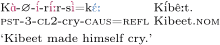
- (i)
-
This simplifies in various important ways, but our purpose is not to review the history of competing proposals here. In early treatments, such as Aoki (1966) and Chomsky and Halle (1968), the harmony feature is taken to be a diacritic, since in bidr systems, such as those in Nez Perce and Chukotko-Kamchatkan, it does not have a stable phonetic correlate. Proposals such as Halle and Vergnaud (1981) do not use underspecification as such, but their account in terms of autosegmental representations is tantamount to what we describe in the text.
-
We leave aside the possibility that the observation is just an accidental gap—the gap is statistically significant in our three-language sample (see the end of Sect. 4). We also put aside proposals such as Fábregas and Krämer (2020), which proposes an account of why (some) prefixes do not participate in vowel harmony at all. Under their account, as we understand it, prefixes will either participate in harmony fully, or will fail to participate at all, whether as triggers or targets. While there are some opaque affixes, in all of the languages we investigate, prefixes (and high suffixes) quite generally undergo harmony: they are obligatory targets of harmony, just not triggers, an asymmetry that as far as we can see must be left as accidental in their terms.
-
These few sentences of course do little justice to other aspects of the account in Baković (2000). We note that his proposal, unlike a simple claim of an accidental gap (see previous note), does allow underlyingly dominant vowels in prefixes, as long as they are opaque and thus outside the harmony system, a situation that reportedly arises in Maasai (but see Sect. 7.2.2). Note that Baković does suggest that the prefix-suffix asymmetry may ultimately be a consequence of affixal height/peripherality, as we will indeed argue, but to make this work, he relies on the assumption that prefixes are always more peripheral than suffixes (p238), a trend but not an absolute. Any account treating the generalization as a prefix-suffix asymmetry, whatever its merits, also says nothing about the lack of high dominant suffixes, a key point in our discussion below.
-
Bogomolets, looking at the phenomenon of lexical accent, also considers a (partial) syntactic motivation for the prefix-suffix asymmetry, but, ultimately, like Moskal, settles only on a correlation: the special prosodic boundary lines up with a morphosyntactic distinction, though nothing ensures that it must. Bogomolets also considers some prefixes in the languages that she looks at to be ‘low,’ and thus the boundary cannot follow from the morpho-syntax only.
-
There is a bit of an ambiguity in the literature regarding the term “cyclic.” Beyond simply meaning serial derivation, we specifically mean that certain key points in the iterative derivation are special and demarcate a constituent to which a set of rules/constraints/operations apply, which do not apply at every step in the derivation. That is, we mean the sense of “cyclic” as in Stratal OT, Lexical Phonology, and the earliest sense of “cyclic nodes” (later bounding nodes, now “phases”) in the syntax, for example, as in Chomsky (1973: 275).
-
We follow the literature in distinguishing between lexical and viewpoint aspect (Comrie 1976: a.o.). Lexical aspect, also called Aktionsart, is generally more associated with argument structure, and structurally lower, whereas viewpoint (grammatical) aspect has to with the boundedness of the event (especially the contrast between perfective and imperfective), and is structurally higher (Cinque 1999; Travis 2010). We hold (see Fenger 2020) that it is the boundary between viewpoint aspect (AspP) and tense (T) that corresponds to the phase boundary in syntax and thus, by hypothesis, the domain boundary in morphophonology, although both types of aspect are thus in the inner domain.
-
For present purposes, we may abstract away from the specific inventory of heads and affixes as well as the question of whether all heads are at least abstractly present in all languages. What is important for us is the claim that the relative order among attested heads is consistent across languages (Bybee 1985; Dahl 1985; Cinque 1999) and permits a syntactically-determined bifurcation into a high and a low domain.
-
In all of the languages under investigation, certain affixes display a number of allomorphs. A note is, thus, in order regarding how different allomorphs are counted in the tables presented in this section. For example, the imperfective suffix in Kipsigis has (at least) the allomorphs -∅, –i or –e, with their distribution being determined by phonological factors (Kouneli 2022). For allomorphs of this type, which have a similar phonological shape and whose distribution is phonologically-conditioned, we count all allomorphs as one morpheme. For allomorphs that are clearly suppletive, on the other hand, we count each allomorph as a separate morpheme. For example, Kipsigis has a verbal number suffix that has the form –jɑ in the perfective and the form –toːs in the imperfective; these are counted as two morphemes in Table 19.
-
We use the term “possible,” because this prefix (which is a causative prefix) is moraic in nature, making it slightly different from traditional morphemes. This mora is usually realized in the form of vowel length (i.e., it causes lengthening of adjacent vowels), but in some cases the moraic prefix is realized as the epenthetic vowel [i] (Kouneli 2022). This vowel is recessive, indicating that the moraic prefix does not come with a dominant [atr] feature.
-
The emphatic marker is listed as a high morpheme in Diola-Fogny, as it is classified in Sapir (1965) as a mood marker also expressing subjunctive/desire. Moreover, there are 5 derivational, non-dominant affixes that are not listed in the table. They are, according to Sapir (1965) highly infrequent, and stilted, which is why we decided not to list them.
-
Bogoras (1922), Skorik (1961: 22ff), and Asinovsky and Volodin (1987) report that the two /e/ vowels are distinct, whereas Mel’nikov (1948: 209), Fortescue (1998: 128), Dunn (1999), and Weinstein (2023: 43) dispute this.
-
The comitative in (22) is presented as a circumfix in descriptive grammars and appears to contain a dominant vowel in the prefixal portion. The prefixal portion can instead be analyzed as the same (recessive) element as in the instrumental ɣ(
 )-⋯ -(t)
 in (21) (Dunn 1999: 248). The trigger for harmony is the dominant vowel in the suffix,
  .
. -
As above, there is some degree of analytical uncertainty in classifying Chukchi affixes. In addition to the derivational prefixes listed here are others that occur only in non-finite forms termed “verbal bases” by Dunn (which are obligatorily subordinate to an auxiliary or light verb). The six he lists (p241), including the two negative-marking circumfixes, are all recessive. Many of the derivational suffixes (and some of the prefixes) are clearly cognate with free roots, and for at least some, it is not clear whether these are affixes or compounds. See Dunn (1999: 252–262) for discussion. The element marked th in the Aspect column is included there since it is in complementary distribution with the progressive marker.
-
We thank Alex Vaxman for assistance in tracking these down in the context of a different project.
-
Weinstein (2023: 43–45) notes that there is inter- and intra-speaker variation in the pronunciation of morphemes as dominant or recessive, and we have found some amount of variability in and across sources. For example, Weinstein (2023: 45,313) notes a recessive variant of the prefix just mentioned as ʔeqe-, which he says had been previously undocumented. Similarly, Weinstein (2023: 128) also describes taŋ- ‘able to’ as if it were dominant, but elsewhere the prefix behaves as recessive teŋ-. In the Chukchi variety described by Dunn (1999), both of these prefixes are recessive, as expected on etymological grounds for the latter.
-
The issue of distinguishing affixes from compounds arises in the analysis of Nez Perce as well. In defending the generalization that there are not dominant prefixes in bidr harmony systems, Hall and Hall (1980: 227–228) acknowledge that Aoki (1966) claims that Nez Perce has a few dominant prefixes, but they argue that apparent examples of dominant prefixes in Nez Perce are “clearly compounds,” a position for which they give supporting evidence. See also Moskal (2015: 255–259).
-
It is of course conceivable that grammar-external considerations are implicated in prefix-suffix asymmetries (see, for example, Wynne et al. 2021), but we have argued above that the patterning of syntactically high suffixes together with (high) prefixes militates against seeing the distribution of dominance as a linear effect in the first place.
-
As Kiparsky notes, and the reader can verify in (28), this ranking avoids “majority rules” effects, noted as a problem for other theories (Baković 2000). With just (27a) and (27b), the candidate that incurs the fewest violations would be the one that preserves whichever value of F occurs the most times in the UR, an unattested language type. For this to work, it must hold generally that Max[μF] outranks Max[F], which Kiparsky points out could be seen as a consequence of elsewhere ordering. If this were not the case, then majority rules effects could emerge even in the Stratal OT model, when Max[F] outranks Max[μF]. See Appendix A for a brief discussion.
-
For reasons of spacing and readability, the zero third person prefix is omitted, and “F” in the tableaux beyond the first is to be read as “atr.”
-
We take Ident-InDom(atr) to be undefined on the first cycle (thus we have shaded it). In Kiparsky’s presentation, Ident-InDom(atr) is a type of Positional Faithfulness, and applies, but can never be decisive on the first cycle. See note 25 and Appendix B.
-
Data and glosses are from Kiparsky (2024). We abstract away here from numerous additional complexities, interesting their own right, but not directly relevant to the point we wish to make here. We return to some issues in an Appendix.
-
Note that our implementation of Ident-Stem(F) is similar to S[tem]-A[ffixed Form]-Ident[F] in Baković 2000: 23. The actual implementation in Kiparsky (2024) is not presented as serial constraint evaluation, but instead treats Ident-Stem(F) as a type of positional faithfulness (Beckman 1997) that selectively privileges Input-Output faithfulness for features in the stem. As far as we can see, the two implementations are mostly equivalent for the cases below, but Kiparsky’s implementation as positional faithfulness may encounter a technical issue, as discussed in Appendix B. Since Stratal OT is inherently serial, we take the serial implementation to be what the framework intends.
-
Stratal OT allows for iterative formation of stems, such that a stem plus an affix may also be a stem. For the properties under discussion, ID-Stem as we have interpreted it, privileges the features established on the first stem cycle. This is consistent with Kiparsky’s characterization: (p6) “Because affixation turns a root into a stem, regressive harmony happens only in the innermost, noncyclic root layer of verb morphology, where it is obligatory.” If iterative stem formation is allowed, our implementation of Ident-Stem(F) and Kiparsky’s (see n. 25) could in principle make distinct predictions. We return to this point in Sect. 8.
-
Occurrences of schwa between hyphens in surface representations in Chukchi examples are not separate morphemes; they represent epenthesis to break up consonant clusters. Morphemic glosses correspond to the underlying representations.
-
A similar point can be made with the Kipsigis data in (44b), where a recessive participle-forming suffix (i.e., an affix that turns a verb into an adjective) can be followed by a dominant plural suffix.
-
While we share with Guekguezian (2021b) the hypothesis that nouns constitute only a single cyclic domain, where verbs have two, our implementation differs, at least superficially, we argue that because nouns have only a single domain, there is no inner domain distinct from the word for ID-InDom to refer to. Guekguezkian argues instead that in nouns, the inner domain (stem) and the outer domain (word) coincide. For present purposes, these appear to us to have the same effect: all affixes in nouns, regardless of their absolute syntactic height, will behave for the purposes of harmony as if they are within the first domain.
-
The comitative and associative cases combine a prefix and suffix. It is arguably the suffix that contains the dominant vowel. See fn. 15.
-
Dunn does not give the root for ‘worry’ on its own, but it is assumed to be underlyingly recessive and occurs as such (vič-) in Tal’pygyrgina and Pupynina (2017).
-
The phase-based account also predicts that there will be morphemes with variable behaviour, but under different conditions, namely in cases where they can attach both below and above the Asp head.
-
To our knowledge, the variable behaviour of the ventive has not been documented in previous descriptions of Kipsigis.
-
This is part of a more general rule, where the applicative suffix, seen in (37b) above, is used for third person applied arguments and the ventive suffix—otherwise used to indicate direction towards the deictic center—is used for local person applied arguments.
-
Bossi (2023) analyzes the form –tʃi(ː)n as the allomorph of –tʃi in the context of imperfective (and not as the allomorph of the suffix when in non-final position). Nevertheless, there are clear counterexamples to this claim. For example, in (ia)–(ib), the (linearly first) applicative suffix has the –tʃin form, even though the verb is inflected in the perfective. What these forms have in common, however, is that the applicative is followed by another suffix in both cases—the instrumental in (ia) and another instance of the applicative in (ib). Comparing (ib) to (ic), we see that the first applicative suffix has the form –tʃin irrespective of aspect, whereas the second applicative suffix has the form –tʃin only in the imperfective. These data support the view that –tʃin is used when another morpheme follows the applicative, and can be used as evidence that imperfective forms involve a null aspect suffix that is attached after the applicative.
- (i)
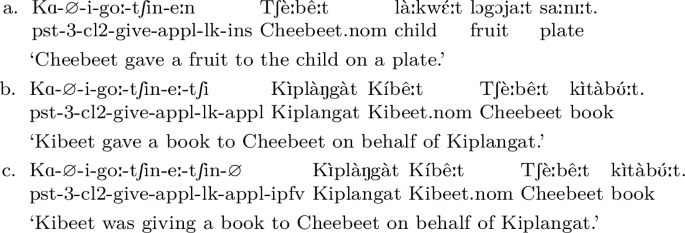
It should also be noted that the –tʃiːn allomorph sometimes appears with a short vowel (as in the examples above). Such vowel shortening is quite common in Kipsigis morphophonology, and while the factors that determine it are not well-understood, they are phonological (Kouneli 2019: Chap. 2).
- (i)
-
Recall from above that we do not take categorizing heads to define phases, as is done in some DM approaches. This is particularly relevant for the causative, since Kouneli (2022) claims that –sɪ attaches above vP in Kipsigis. A proposal assuming that the causative suffix in Kipsigis is a phase head would run into the same problem as the stem-defining proposal we have just discussed.
-
All of our examples are from causatives of unergative verbs, and interestingly there are proposals according to which the sole argument of an unergative verb is introduced differently in causative vs non-causative environments (e.g., Legate 2014; Nie 2020). It is thus possible that this would affect an argument-introducing morpheme like the ventive.
-
The language has evidently changed between then and now, and we thank Paul Kiparsky for comments that helped us better understand this literature.
-
The reader will note that /i/ is part of both sets, and there does not seem to be an acoustic difference between dominant and recessive /i/ (Aoki 1970; Crook 1999). As with Chukotkan /e/, this has led some authors (Aoki 1966; Chomsky and Halle 1968) to see dominance for vowel harmony in Nez Perce as a diacritic feature, rather than a phonetically grounded one, such as [+atr].
-
Several notes regarding segmentation and classification are in order. As the basis for compiling the table, we used the grammar from Aoki, since this is the stage of the language where high dominant affixes are found. One deviation from this in our table is that Aoki treated tense-aspect combinations as portmanteaus/complex suffixes: we have segmented out the tense and aspect components since the segmentation is straightforward on the basis of the information Aoki himself provided. To make sure we made the right cut, and also used up-to-date glosses, we checked our segmentation with that of Crook (1999) and Deal (2010). In the table (and the grammar), there are two affixes listed as ‘?’ since they could not be classified, but since we couldn’t determine their frequency, we added them to the table for the sake of completeness. This in the end did not matter for the ultimate classification, since the high dominant suffixes are more easily classifiable. The affix pfv/perf is not clear as to what type aspect this is, and is sometimes dubbed p-aspect, since it can take either aspectual reading (Deal 2010).
-
Reports of work with younger speakers suggest that the situation is in flux. Crook (1999: 253) states that -qa is the only dominant inflectional suffix, but notes further that “the harmonizing alternations that still obtain [with -qa] are just those for the most common words like ‘go’ and ‘boil’. Otherwise, speakers use [disharmonic forms like (i)].” Crook also suggests that the past tense suffix is dominant when it co-occurs with either the incompletive aspect marker or with the 3sg object marker, but when both of these co-occur, the past tense marker ceases to show dominant behaviour, and the surface form is disharmonic (i):
- (i)

Similarly, Deal (2010: 16) says that “speakers of Nez Perce do not always produce full vowel harmony. Of my main consultants, one rarely used harmony; one frequently used harmony, and two others were more variable. The consultant who rarely used harmony showed an absence of harmony, even in single morphemes like u’qa, expected to harmonize to o’qa.” (Her ‘single morpheme’ here is the conditional which we decompose as /
 /, but this is orthogonal to the observation that the sequence is now disharmonic.)
 - (i)
-
In addition to the recent past
 , Kiparsky (2021) identifies two other morphemes as high, dominant suffixes. One of these,
  , is a conjunction which triggers harmony only when in combination with a function word, namely the relativizer
  , itself a clitic. This does not occur as a dominant affix in the verbal system, and its dominant behaviour with a function word suggests an account along the same lines as our (and Kiparsky’s) treatment of variability in (Tu)Nen, below. The second affix is
  . Historically, this is
  habit-remote.past, in which the dominant vowel is in the habitual (lexical) aspect morpheme—the tense morpheme is recessive. Kiparsky treats this as synchronically fused into a single, high suffix, noting that it does not always occur with transparently compositional meaning. This fusion is further supported by its special behaviour with respect to conditioning allomorphy of the applicative affix, for which the combination appears to pattern with tense suffixes rather than with other aspectual suffixes. Though this is orthogonal to our concerns, we note that the curious behaviour in triggering applicative allomorphy also obtains when the meaning of the example does transparently contain the (dominant) habitual aspect. We leave the matter unresolved, as for us, the recent past
  is sufficient to make the point that Nez Perce does not show domain effects in harmony.
 -
The opposite ranking—Max[+atr] over Ident-InDom—will mimic the underspecification approached described here.
-
Other languages with similar patterns include Tuki, KiBudu, and Kinande (Moskal 2015, McCollum and Essegbey 2020: 18). In her discussion of these patterns, Moskal (2015: 224–235) questions whether the exponents of the class prefixes in KiBudu are the same in lexical nouns and function words.
-
Numerous additional complexities arise, including interaction with rounding harmony, apparent surface neutralizations of underlying contrasts (note that [o] appears both as [+atr] and [−atr]), and differences in the vowel inventories across varieties. The most comprehensive treatment we are aware of is Boyd (2015).
-
In Sect. 6.3 above, we suggested that nouns lack an internal domain boundary, explaining the apparent category differences in the distribution of high dominant affixes in Chukchi and Kipsigis. The analysis of (Tu)Nen would seem to require some parameterization in whether nouns do or do not have an internal phase-domain; see also Marvin (2003) and Newell and Piggott (2014) on domain-implying phonological reflexes of alienably and inalienably possessed nouns (but see Bogomolets 2024 for a contrasting perspective).
-
For the record, we note that Moskal (2015: 220–224) makes the opposite claim about Nen, namely that the combination of Class 3 /
 / and a [−atr] lexical noun results in a surface disharmonic form, as would be predicted by the underspecification account. In support of this, Moskal cites the following from Dugast (1971: 69), which shows the opposite behaviour from (57b):
- (i)

Though the form is interesting, it is anomalous within Dugast’s data. Dugast (1971: 68–69) gives 39 singular:plural pairs with these Class 3–4 prefixes, roughly evenly split across [−atr] and [+atr] variants. Of 21 stems with [−atr], only two, both vowel-initial and thus showing hiatus, show the pattern in (i)—all others have the [−atr] variants of the prefixes (mo-, me-). Authors subsequent to Dugast (1971) consistently report that Class 3–4 prefixes behave as recessive with lexical nouns and harmonize to the noun root, both for the variety studied by Dugast, in which the [−atr] counterpart to /u/ is [o] (Mous 1986) and for the variety in which it is [ʊ] (Boyd 2015: 28), with examples showing the prefix vowel alternating, as in (56) and (57).
- (i)
-
Maasai, which belongs to the same family and was discussed above, does not have such affixes.
-
Noske (2000) does not provide glosses, but explains in footnote 6, p780 that rɛ is a subjunctive marker. Noske (2000) uses this type of Turkana data to argue that FaithSuffix may be ranked higher than FaithStem in some languages.
-
While this is quite clear for Turkana, the status of the peripheral suffixes is more complicated in Karimojong. As seen in the gloss in (60), those affixes are fusional, expressing (high) TAM and agreement information, but also voice distinctions, which are arguably low in the structure. Whether these affixes will count as “low” or “high” will depend on how fusional morphology should be analyzed (see Kouneli et al. 2024 for some thoughts). We leave the analysis of such morphemes and the implications for our theory as a topic for further research.
-
This is Kiparsky’s tableau (16), but Kiparsky gives only one Ident-Stem[round] violation in the c. line, asserting (p198) that as a consequence “Max[+round] [acts] as a tie-breaker.” This works only if Ident is categorical—either the stem is identical to the UR or it isn’t and the number of violations is not counted—but this in turn seems to be at odds with the earlier discussion in the paper where it is noted that comparing the number of Ident violations is what leads to the Majority Rules problem that Max[+round] is intended to circumvent: simply not letting constraints count violations (McCarthy 2003) would also have avoided Majority Rules—the problem is only to be considered in the first place if Ident violations are gradient, as are other constraints in Kiparsky’s paper.
References
-
Aoki, H. 1966. Nez Perce vowel harmony and Proto-Sahaptian vowels. Language 42(4):759–767.
-
Aoki, H. 1970. Nez Perce grammar University of California publications in linguistics. Berkeley: University of California Press.
-
Asinovsky, A. S., and A. P. Volodin. 1987. The typology of vocalic structures of the word in Chukchi-Kamchatkan languages. In Proceedings of the eleventh international congress of phonetic sciences, ed. T. Gamkrelidze, 362–364. Tallinn: Academy of Sciences of the Estonian SSR.
-
Baković, E. 2000. Harmony, Dominance, and Control, Ph. D. thesis, Rutgers University.
-
Beckman, J. 1997. Positional faithfulness, positional neutralization, and Shona vowel harmony. Phonology 14:1–46.
-
Bermúdez-Otero, R. 2022. Stratal optimality theory: An overview. http://www.bermudez-otero.com/Stratal_Optimality_Theory.htm.
-
Bobaljik, J. 2008. Paradigms (optimal and otherwise): A case for skepticism. In Inflectional identity, eds. A. Bachrach and A. Nevins, 29–54. Oxford: Oxford University Press.
-
Bobaljik, J. 2012. Universals in comparative morphology: Suppletion, superlatives, and the structure of words. Cambridge: MIT Press.
-
Bobaljik, J. D., and S. Wurmbrand. 2013. Suspension across domains. In Distributed Morphology today: Morphemes for Morris Halle, eds. A. Marantz and O. Matushansky, 185–198. Cambridge: MIT Press.
-
Bogomolets, K. 2020. Lexical Accent in Languages with Complex Morphology, Ph. D. thesis, University of Connecticut.
-
Bogomolets, K. 2024. Possessive prefixes across Algonquian: Evidence for two separate paradigms. In Proceedings of the 53rd Algonquian conference, eds. I. Genee, M. Macaulay, and M. Noodin, 17–38. East Lansing: Michigan State University Press.
-
Bogoras, W. 1922. Chukchee. Washington: Government Printing Office.
-
Bossi, M. 2023. Epistemic modality across syntactic categories in Kipsigis, Ph. D. thesis, University of California, Berkeley.
-
Boyd, V. L. 2015. The phonological systems of the Mbam languages of Cameroon with a focus on vowels and vowel harmony, Ph. D. thesis, Universiteit Leiden, Leiden.
-
Bresnan, J. 1971. Sentence stress and transformations. Language 47:257–297.
-
Bybee, J. L. 1985. Morphology. A study of the relation between meaning and form. Amsterdam: Benjamins.
-
Casali, R. 2003. [ATR] value asymmetries and underlying vowel inventory structure in Niger-Congo and Nilo-Saharan. Linguistic Typology 7:307–382.
-
Casali, R. 2018. Markedness and dominance in the ATR harmony system of Diola-Fogny. Journal of African Languages and Linguistics 39:201–239.
-
Chomsky, N. 1973. Conditions on transformations. In A Festschrift for Morris Halle, eds. S. R. Anderson and P. Kiparsky, 232–286. New York: Holt, Rinehart and Winston.
-
Chomsky, N., and M. Halle. 1968. The sound pattern of English. New York: Harper and Row.
-
Cinque, G. 1999. Adverbs and functional heads: A cross-linguistic perspective. Oxford studies in comparative syntax.
-
Comrie, B. 1976. Aspect. Cambridge textbooks in linguistics. Cambridge: Cambridge University Press.
-
Crippen, J. 2019. The syntax in Tlingit verbs, Ph. D. thesis, University of British Columbia.
-
Crook, H. 1999. The phonology and morphology of Nez Perce stress, Ph. D. thesis, University of California at Los Angeles.
-
Dahl, O. 1985. Tense and aspect systems. Oxford: Blackwell Sci.
-
d’Alessandro, R., and T. Scheer. 2015. Modular PIC. Linguistic Inquiry 46(4):593–624.
-
Deal, A. R. 2010. Topics in the Nez Perce verb, Ph. D. thesis, University of Massachusetts, Amherst.
-
Deal, A. R., and M. Wolf. 2017. Outwards-sensitive phonologically-conditioned allomorphy in Nez Perce. In The morphosyntax-phonology connection, eds. V. Gribanova and S. Shih, 29–60. Oxford: Oxford University Press.
-
Dugast, I. 1971. Grammaire du tùnεn. Paris: Éditions Klincksieck.
-
Dunn, M. 1999. A grammar of Chukchi, Ph. D. thesis, Australian National University.
-
Embick, D. 2010. Localism versus globalism in morphology and phonology. Cambridge: MIT Press.
-
Embick, D. 2014. Phase cycles, phi-cycles, and phonological (in)activity. In The form of structure, the structure of forms: Essays in honor of Jean Lowenstamm, eds. S. Bendjaballah, M. Lahrouchi, N. Faust, and N. Lampitelli, 270–286. Amsterdam: Benjamins.
-
Fábregas, A., and M. Krämer. 2020. Why prefixes (almost) never participate in vowel harmony. Evolutionary Linguistic Theory 2(1):84–111.
-
Fenger, P. 2020. Words Within Words: The internal syntax of verbs, Ph. D. thesis, University of Connecticut.
-
Fortescue, M. 1998. Language relations across Bering Strait. London: Cassell.
-
Guekguezian, P. A. 2021a. Aspectual phase heads in Muskogee verbs. Natural Language and Linguistic Theory 39:1129–1172.
-
Guekguezian, P. A. 2021b. Morphosyntax-phonology mismatches in Muskogee. Phonology 38:277–316.
-
Hall, B. L., and R. M. R. Hall. 1980. Nez Perce vowel harmony: An Africanist explanation and some theoretical consequences. In Issues in vowel harmony, ed. R. Vago, 201–236. Amsterdam: John Benjamins.
-
Hall, B., R. Hall, M. D. Pam, A. Myers, S. A. Antell, and G. K. Cherono. 1974. African vowel harmony systems from the vantage point of Kalenjin. Afrika und Übersee 57(4):241–267.
-
Halle, M., and J. R. Vergnaud. 1981. Harmony processes. In Crossing the boundaries in linguistics: Studies presented to Manfred Bierwisch, 1–22. Dordrecht: Springer.
-
Harwood, W. 2015. Being progressive is just a phase: Celebrating the uniqueness of progressive aspect under a phase-based analysis. Natural Language and Linguistic Theory 33:523–573.
-
Hyman, L. 2019. Prosodic asymmetries in nominal vs. verbal phrases in Bantu. UC Berkeley Phonetics and Phonology Lab Annual Report 15(1):90–107.
-
Julien, M. 2002. Syntactic heads and word formation: A study of verbal inflection. Oxford: OUP.
-
Kiparsky, P. 2015. Stratal OT: A synopsis and FAQs. In Capturing phonological shades within and across languages, eds. Y. E. Hsiao and L. H. Wee, 2–44. Newcastle-upon-Tyne: Cambridge Scholars Publishing.
-
Kiparsky, P. 2021. Phonology to the rescue: Nez Perce morphology revisited. The Linguistic Review 38(3):391–442.
-
Kiparsky, P. 2024. A Stratal OT perspective on vowel harmony. In Oxford handbook of vowel harmony, eds. N. Ritter and H. van der Hulst, 192–219. Oxford: Oxford University Press.
-
Kouneli, M. 2019. The syntax of number and modification: An investigation of the Kipsigis DP, Ph. D. thesis, New York University.
-
Kouneli, M. 2022. Inflectional classes in Kipsigis. Glossa: A Journal of General Linguistics 47(1). https://doi.org/10.16995/glossa.8549.
-
Kouneli, M., P. Fenger, and J. D. Bobaljik. 2024. Syntactic limits on phonological dominance. In Proceedings of the 40th West Coast Conference on Formal Linguistics, eds. J. Lu, E. Petersen, A. Zaitsu, and B. Harizanov, 173–181. Somerville: Cascadilla Proceedings Project.
-
Krause, S. 1979. Topics in Chukchee phonology and morphology, Ph. D. thesis, University of Illinois, Urbana-Champaign, IL.
-
Legate, J. 2014. Voice and v: Lessons from Acehnese. Cambridge: MIT Press.
-
Lesley-Neuman, D. 2007. ATR Harmony in Karimojong: Justification for a Stratal Optimality Theory, MA thesis, University of Colorado at Boulder.
-
Lesley-Neuman, D. 2012. Morpho-phonological levels and grammaticalization in Karimojong: A review of the evidence. Studies in African Linguistics 41(1).
-
Levergood, B. 1984. Rule governed vowel harmony and the Strict Cycle. Proceedings of NELS 14:275–293.
-
Lodge, K. 1995. Kalenjin phonology and morphology: A further exemplification of underspecification and non-destructive phonology. Lingua 96(1):29–43.
-
Marvin, T. 2003. Topics in the Stress and Syntax of Words, Ph. D. thesis, Massachusetts Institute of Technology.
-
McCarthy, J. J. 2003. OT constraints are categorical. Phonology 20:75–138.
-
McCollum, A. G., and J. Essegbey. 2020. Initial prominence and progressive vowel harmony in Tutrugbu. Phonological Data & Analysis 2(3):1–37.
-
Mel’nikov, G. I. 1948. Фонемы чукотского языка. Язык и мышление 11: 208–229.
-
Moskal, B. 2015. Domains on the border: Between Morphology and Phonology, Ph. D. thesis, University of Connecticut.
-
Mous, M. 1986. Vowel harmony in Tunen. In The phonological representation of suprasegmentals: Studies on African languages offered to John M. Stewart on his 60th birthday, eds. K. Bogers, H. van der Hulst, and M. Mous, 281–295. Dordrecht: Foris.
-
Muravyova, I. A. 1979 Сопоставительное исследование морфонологии чукотского, корякского и алюторского языков. Ph. D. thesis, Moscow State University.
-
Nash, D. 1979. Warlpiri vowel assimilations. In Papers on syllable structure, metrical structure and harmony processes, ed. K. Safir. Vol. 1. 12–24. Cambridge: MIT Working Papers in Linguistics.
-
Nespor, M., and I. Vogel. 1986. Prosodic phonology. Dordrecht: Foris.
-
Nevins, A. 2010. Locality in vowel harmony. Cambridge: MIT Press.
-
Newell, H. 2008. Aspects of the morphology and phonology of phases, Ph. D. thesis, McGill.
-
Newell, H., and G. Piggott. 2014. Interactions at the syntax-phonology interface: Evidence from Ojibwe. Lingua 150:332–362.
-
Newell, H., and C. Sailor. t.a. Minimalism and the syntax-phonology interface. In The Cambridge Handbook of Minimalism, eds. K. K. Grohmann and E. Leivada. Cambridge: Cambridge University Press.
-
Nie, Y. 2020. Licensing arguments, Ph. D. thesis, NYU.
-
Noske, M. 2000. [ATR] harmony in Turkana: A case of Faith Suffix ≫ Faith Root. Natural Language & Linguistic Theory 18(4):771–812.
-
Phinney, A. 1934. Nez Percé Texts. New York: Columbia University Press.
-
Quinn-Wriedt, L. 2013. Vowel Harmony in Maasai, Ph. D. thesis, University of Iowa, Iowa.
-
Radkevich, N. 2010. On location: The structure of case and adpositions, Ph. D. thesis, University of Connecticut.
-
Rigsby, B., and M. Silverstein. 1969. Nez Perce vowels and Proto-Sahaptian vowel harmony. Language 45(1):45–59.
-
Sapir, J. D. 1965. A grammar of Diola-Fogny. Cambridge: Cambridge University Press.
-
Skorik, P. Ja.. 1961. Грамматика чукотского языка, часть I. Moscow: Izdatel’stvo akademii nauk SSSR.
-
Skorik, P. Ja.. 1977. Грамматика чукотского языка, часть II: глагол, наречие, служебные слова. Leningrad: Nauka.
-
Smith, J. 2011. Category-specific effects. In The Blackwell companion to phonology, eds. M. van Oostendorp, C. Ewen, E. Hume, and K. Rice. Oxford: Wiley-Blackwell.
-
Šurkalović, D. 2015. The No-Reference Hypothesis: A Modular Approach to the Syntax-Phonology Interface. Phd dissertation, UiT the Arctic University of Norway, Tromsø, Norway.
-
Tal’pygyrgina, D. G., and M. J. Pupynina. 2017. Чукотский словарь [Chukchi dictionary]. http://chukdict.com.
-
Toweett, T. 1979. A study of Kalenjin linguistics. Nairobi: Kenya Literature Bureau.
-
Travis, L. 2010. Inner aspect: The articulation of VP. Dordrecht: Springer.
-
Volodin, A. P., and P. Ja. Skorik. 1997. Чукотский язык [Chukchi]. In Палеоазиатские языки [Paleo-Asiatic languages], ed. A. P. Volodin, 23–39. Moscow: Indrik.
-
Weinstein, C. 2023. Éléments du functionnement de la langue tchouktche. Paris: L’Harmattan.
-
Weinstein, C. n.d. Grammaire du tchouktche. http://charles.weinstein.free.fr/chukches/GRAM/gram.html.
-
Wurmbrand, S. 2014. Tense and aspect in English infinitives. Linguistic Inquiry 45(3):403–447.
-
Wynne, H. S. Z., S. Kotzor, B. Zhou, S. Schuster, and A. Lahiri. 2021. Asymmetries in the processing of affixed words in Bengali. Language 97:599–628.
Acknowledgements
For helpful comments, questions, and suggestions, we thank audiences at Universität Leipzig, Harvard University, Masaryk University, WCCFL 40, IMM 20, the University of Connecticut, and Pennsylvania State University, and especially Paul Kiparsky and Heather Newell, as well as two anonymous reviewers and our editor Daniel Harbour. We are grateful to our Kipsigis speakers Enock Kirui, Wesley Kirui, Hillary Mosonik, and Donald Mutai for their valuable work as linguistic consultants. Maria Kouneli’s work was funded in part by DFG grant 439622645 for the project Layers of morphosyntactic number in Eastern Sudanic, part of the Research Unit Cyclic Optimization.
Funding
This research was partially funded by the DFG grant 439622645 (“Layers of morphosyntactic number in Eastern Sudanic”), part of the research unit “Cyclic Optimization” at Leipzig University.
Ethics declarations
Competing Interests
There are no conflicts of interest for the authors.
Additional information
Publisher’s Note
Springer Nature remains neutral with regard to jurisdictional claims in published maps and institutional affiliations.
Appendices
Appendix A: Factorial typology
Our account of bidr vowel harmony systems invoked four constraints:
- (63)
- a.*[αF][−αF]
- b.Ident-InDom(F)
- c.Max[μF]
- d.Max[F]
All else being equal, and excluding ties and re-ranking across strata, this allows for 4!=24 logically possible rankings, as given in (64), where a,b,c,d correspond to the constraints just given. Where appropriate a section number after a ranking indicates the section where the effects of this ranking are considered.
- (64)
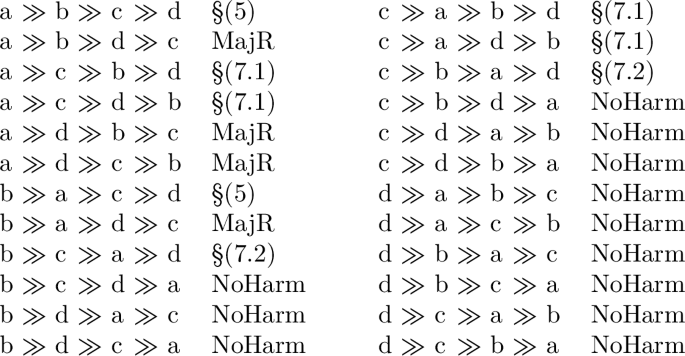
In half of these (12 rankings), Max[F] ≫ *[αF][−αF], and these (indicated as NoHarm) will show no harmony, as there is no impetus to depart from the underlying feature values. Of the remainder, two rankings derive the bidr system obeying NoDomHigh, as in Kipsigis, Chukchi, and Diola-Fogny: {*[αF][−αF], Ident-InDom(F)} ≫ Max[μF] ≫ Max[F]. The relative ranking of the two highest constraints do not yield distinct outcomes. As we discussed in Sect. 7.1, ranking Ident-InDom(F) below Max[μF] will eliminate the domain-sensitivity effect, and would characterize a bidr system like Nez Perce. There are four rankings that would characterize Nez Perce, since if Ident-InDom(F) is not ranked between *[αF][−αF] and Max[μF], then the relative order of those two constraints does not yield distinct outcomes. Two further rankings mimic the classic account in terms of underspecification and feature-filling as discussed in Sect. 7.2. We noted above that the literature is somewhat ambivalent about key examples, but if such patterns are not attested, then the system overgenerates. This leaves four rankings remaining, in all of which Max[F] ≫ Max[μF]. These yield majority rules effects, a potential issue that our proposal inherits from that in Kiparsky (2024) as discussed in note 21 and the next Appendix. As noted there, it appears that Kiparsky’s approach is to assume axiomatically that Max[μF] cannot be lower ranked than Max[F], in which case these four would be excluded outright (as would eight of the twelve rankings that do not yield harmony in the first place.)
Appendix B: Kiparsky 2023: Ident-stem redux
For completeness, we elaborate briefly on how the cyclic interpretation of Ident-InDom(F) that we have made use of (following Baković 2000) might differ from the version presented in Kiparsky (2024), and why we have chosen the serial implementation.
Kiparsky (p194) presents it as an advantage of his model that it avoids the Majority Rules problem (Baković 2000): An underlying disharmonic sequence *[+F][−F] could in principle be resolved either way, changing both values to + or both values to −. If elements with the two values are unequally distributed in a given UR, then resolution should be to whichever value is in the majority, since that candidate will incur fewer Ident[F] violations. Kiparsky presents Max[μF] (Max marked value of F) as in part a means to avoid this problem: when Max[μF] outranks Ident[F] (or other faithfulness constraints), counting violations of Ident[F] is irrelevant—a single dominant (i.e., [μF]) segment will be sufficient to force all others to harmonize to [μF]. We saw this in the Warlpiri tableau in (35) in which underling kiji-rnu becomes surface kuju-rnu: the single round vowel is sufficient to ensure the harmonic form with all round vowels wins. If Ident[F] outranked Max[μF], the majority rules effect would arise.
But the key to the cyclic domain effects (Kiparsky’s directionality reversals) is the ranking of Ident-Stem(F) above Max[μF]. This ensures that dominant vowels that are outside of the stem will be unable to influence the stem vowels—the effects of Max[μF] are neutralized outside of the stem. As far as we can see, though, Kiparsky’s implementation of Ident-Stem(F) in this way has the potential to reintroduce the Majority Rules problem: since Ident-Stem(F) unlike Ident[F] is ranked above Max[μF], counting violations of Ident-Stem(F) will matter. To see this, consider (65) which repeats the tableau from (35) above, but with the interpretation of Ident-Stem(F) as a type of positional faithfulness (Beckman 1997), rather than ours. Under Kiparsky’s interpretation, so far as we can tell, Ident-Stem[round] incorrectly selects  the candidate with the fewest Ident-Stem[round] violations and prevents the evaluation from considering Max[+round] which would have favoured the correct output
  .Footnote51
- (65)

On our interpretation, Ident-Stem[round] is inactive/undefined and thus unviolated on the stem cycle and Max[+round] applies as it is supposed to, outranking other faithfulness constraints and thereby enforcing resolution of harmony for all mixed URs to dominant outputs. On the second and subsequent cycles, no Majority Rules problem arises, since Ident-Stem[round] enforces stem-controlled harmony, whatever value the stem vowels have. We take it then that our interpretation, which seems to us to most closely implement the fundamental idea that the output of one cycle is the input to the next, is the interpretation that the framework suggests.
Rights and permissions
Open Access This article is licensed under a Creative Commons Attribution 4.0 International License, which permits use, sharing, adaptation, distribution and reproduction in any medium or format, as long as you give appropriate credit to the original author(s) and the source, provide a link to the Creative Commons licence, and indicate if changes were made. The images or other third party material in this article are included in the article’s Creative Commons licence, unless indicated otherwise in a credit line to the material. If material is not included in the article’s Creative Commons licence and your intended use is not permitted by statutory regulation or exceeds the permitted use, you will need to obtain permission directly from the copyright holder. To view a copy of this licence, visit http://creativecommons.org/licenses/by/4.0/.
Reprints and permissions
About this article
Cite this article
Fenger, P., Kouneli, M. & Bobaljik, J.D. Dominant domains in vowel harmony: A structural approach to a linear asymmetry. Nat Lang Linguist Theory (2025). https://doi.org/10.1007/s11049-025-09668-2
- Received
- Accepted
- Published
- DOI https://doi.org/10.1007/s11049-025-09668-2
Keywords
- Dominant-recessive vowel harmony
- Phases
- Domains
- Syntax-phonology interface
- Cyclic spell-out
