
 info@apippress.com
 +86 18163351462 (WhatsApp)
 +86 182 8014 0209
Article Content
Abstract
Climate change is the biggest threat humanity is facing and will face in the future. In teaching, its interdisciplinary and complex nature raises conceptual, epistemological, relational, and institutional challenges. We present a module aimed at preparing preservice teachers to deal with some of these challenges: embracing complexity and managing scientific uncertainties. The module is part of the IDENTITIES project, and it is designed for pre-service teachers’ education as an interdisciplinary boundary zone. Its main novelty concerns the emphasis on complexity and uncertainty, implemented as conceptual contents fundamental for climate change and, more in general, for developing a sustainability mindset, as “epistemological activators” to activate a meta-reflection on the nature of science, and as “boundary objects” to foster a dialogue among disciplines. The module was implemented in an international summer school (June 2022) with 14 preservice teachers coming from France, Greece, Italy, and Spain. The analysis of the implementation has been carried out to investigate the type of knowledge that pre-service teachers activate in dealing with these themes. Findings show that an interdisciplinary environment can help unveil disciplinary presuppositions that prevent the embracing of complexity and uncertainty in science. The module implementation showed how complexity and uncertainty can be considered powerful boundary objects to explore and navigate climate change from different perspectives. The trust in Newtonian classical linearity and determinism still represents an important obstacle to developing sustainability competences. Criticalities that emerged from the implementation are our piece of evidence that contributes to arguing to what extent climate change represents a deep epistemological challenge, avoiding in this way stereotyped ideas of science or artificial barriers between scientific disciplines and Social Science and Humanities.
Explore related subjects
Discover the latest articles and news from researchers in related subjects, suggested using machine learning.
- Climate-Change Adaptation
- Climate Change Management
- Complex Systems
- Complexity
- Environmental Studies
- Higher Education
1 Introduction
Climate change is a Grand Challenge of the twenty-first century (Christensen & Fensham, 2011), affecting not only the natural environment but also society, the economy, and numerous other spheres of human life. Because of its vast scope and deep implications, addressing climate change requires a profound cultural transformation in how we view the relationship between humans and nature, how we integrate scientific knowledge with an understanding of social and human behaviours, and how we imagine future scenarios and act at the individual, collective, and political level (Bianchi et al., 2022).
Climate change, with its intricate and interdisciplinary aspects, along with its social, economic, political, and ecological effects, challenges our conventional understanding of science and its practices. It disrupts the traditional methods of teaching scientific and STEM subjects, which often detach them from their socio-cultural contexts and simplify the processes involved in constructing meaning and defining clear laws.
Within this context, education, and STEM education in particular, plays a critical role in helping students develop both a sustainability mindset and the new competences needed to “think, plan and act with empathy, responsibility, and care for our planet and for public health.” (Bianchi et al., 2022, p. 2).
Promoting a sustainability mindset throughout education prompts us to reconsider the epistemological foundations and methods of science as they are commonly taught. The deterministic view that often characterizes formal science education is challenged by the realities of complexity and uncertainty, which are intrinsic to the science of climate and should be embraced not as limitations but as opportunities (Rosenberg et al., 2022; Stevenson et al., 2017). As articulated by Kampourakis and McCain (2020), it is precisely the way in which science grapples with uncertainty that delineates its essence and propels its progress, thereby equipping us to navigate our quotidian existence. Consequently, science education and educators must implement methodologies that recognise and embrace complexity while addressing uncertainty. By elucidating the diverse manifestations of uncertainty, we can cultivate a more nuanced comprehension of science and avoid oversimplifications or mystifications.
Furthermore, the inherently inter-, multi-, and trans-disciplinary nature of climate challenges requires a deeper integration of diverse fields and compels us to question rigid disciplinary boundaries in our educational systems and curricula.
To contribute to this effort, the present paper introduces an interdisciplinary module for preservice teachers (PST) designed to explore the role of complexity and uncertainty in climate change. Its main innovation lies in how it positions complexity and uncertainty: as conceptual content, as “epistemological activators” (Ravaioli, 2020) that spark meta-reflection on the nature of science, and as “boundary objects” (Akkerman & Bakker, 2011) that promote dialogue across disciplinary lines.
The module was developed within the IDENTITIES project and implemented in an international summer school (June 2022) with pre-service teachers (PSTs) in STEM fields. The study participants comprised 14 Master’s students from France, Greece, Italy, and Spain. The participants’backgrounds included various STEM disciplines, specifically Biology, Computer Science, Mathematics, Natural Sciences, and Physics. These participants mainly came from courses on disciplinary education with the goal of becoming secondary school teachers in their respective countries. Due to the different backgrounds of the PSTs, both in terms of disciplines and geographical provenience, the environment created by the summer school allowed for a deep interchange and exchange of positions, views, and ways of thinking.
The paper’s orientation is primarily theoretical, with the implementation analysis serving as support to clarify our design principles and to enhance our understanding of the type of knowledge that students engage with when facing complexity and uncertainty. Criticalities that emerged from the implementation are our pieces of evidence that contribute to arguing the extent to which climate change and the development of a sustainability mindset represent deep epistemological challenges. This aspect contrasts the way in which education usually tends to create stereotyped ideas of science or artificial barriers between STEM disciplines and Social Science and Humanities.
In Sect. 2, we present the state of the art on how Climate Change Education has been treating the themes of complexity and uncertainties and what epistemological effort has been made to unpack them as foundations of the science of climate. In Sect. 3, we introduce the theoretical framework behind the module’s design, while in Sect. 4, we present the study’s goals and articulation. Section 5 is dedicated to the module’s structure, specifically to describing how we implemented the themes of complexity and uncertainties in the module to exploit their conceptual, epistemological, and social relevance and foster confrontation and integration between different disciplines, particularly physics and chemistry. Section 6 presents and discusses the data collected during the module’s implementation. In Sect. 7, we then conclude with a discussion on the epistemological challenges emerging from the analysis.
2 Complexity and Uncertainties in Climate Change Education: State of the Art
Climate Change Education has been growing as a field of study in recent years (Monroe et al., 2017). The reasons are connected to different factors, spanning from the rising interest in students and society (Suitner et al., 2023), the increase of events tied to climate change (IPCC, 2014, 2022), and the push by institutions to develop policies for sustainability and respect for the environment (Bianchi et al., 2022).
Climate Change Education includes several types of difficulties and issues: contents, teaching practices, curricula, and social aspects are all important factors to deal with when we address climate change.
We focus here on the challenges related to science’s core epistemological aspects and the teaching practices needed to address them.
2.1 Open Issues in Climate Change Education
Due to its complex nature and the many fields of knowledge affected by the issue, it is very difficult to determine where and from whom climate change should be taught. Rousell and Cutter-Mackenzie-Knowles (2020) systematic literature review from 1993 to 2014 regarding Climate Change Education for children and young people showed how the understanding of climate change is limited, erroneous, and highly influenced by mass media, while didactic approaches to Climate Change Education have been largely ineffectual in affecting students’ attitudes and behaviour. The review stresses the need for “participatory, interdisciplinary, creative, and affect-driven approaches to climate change education” (Rousell & Cutter-Mackenzie-Knowles, 2020, 1).
Climate change cannot be forced to belong to one specific knowledge domain, as it regards many different disciplines and areas of study, but must leverage new informal and hybrid spaces (such as schools and communities) that provide alternative opportunities for learning and acting (Boon, 2016; Stevenson et al., 2017). The interdisciplinary nature of climate change makes it hard to include it in scientific curricula, creating difficulties both for students and teachers (Stevenson et al., 2017). Teachers feel they do not have the proper formation to teach climate change (Greer et al., 2023; Tolppanen & Aksela, 2018), although the literature on teacher education is relatively limited (Rousell & Cutter-Mackenzie-Knowles, 2020). Mochizuki and Bryan (2015) expressed the need for Climate Change Education to be “approached from an interdisciplinary and systems perspective so that the scientific, ecological, economic, political, ethical and social dimensions of CC [Climate Change] can be more fully appreciated” (p. 5). Monroe et al. (2017) showed how many approaches to Climate Change Education are prevalently subject-specific and knowledge-led, while other authors expressed the need for developing competences that are considered of high relevance to address climate change, such as system and strategic thinking, anticipation and future envisioning, embracing complexity, and promoting action (Bianchi et al., 2022; Wiek et al., 2011).
A relevant aspect in Climate Change Education lies also in the dimensions that have a deep impact on our society. As shown by the review of Trott et al. (2023), climate justice is increasingly recognized as a critical component of Climate Change Education, yet it remains conceptually underdeveloped and inconsistently applied across educational contexts. The term is often used as a theoretical lens rather than as a clearly defined content area, limiting its practical integration. Emerging research points to the potential of community-based initiatives and youth-led activism to advance climate justice education, particularly in informal and non-traditional learning spaces. However, systemic and institutional barriers continue to hinder the widespread implementation of justice-informed approaches (Trott et al., 2023). The review also notes that educational programs incorporating a justice framework critically examine climate change problems, which inherently involve navigating complex and uncertain scenarios so as to empower students to imagine solutions despite the uncertainties surrounding climate change.
Despite the significance of an interdisciplinary approach to climate change, only a few examples of implementations are found in the literature, the majority of them in higher education (Rousell & Cutter-Mackenzie-Knowles, 2020). Liu (2022) reports an empirical study regarding undergraduate STEM and non-STEM students’ system thinking capacity during a climate change course designed with an interdisciplinary approach. Results from this study indicate the importance of interdisciplinary instruction on climate change oriented on the complexity and system thinking in addressing climate change problems as well as the importance of taking into consideration the students’ backgrounds in the design of interdisciplinary instruction regarding climate change. On the other hand, there are several reports that present climate change in sustainability education (Lehtonen et al., 2019; Mokski et al., 2023; Zacchia et al., 2022) and very few that introduce climate change as a unique subject or discipline or in a transdisciplinary approach (Eilam, 2022; Lehtonen et al., 2019).
For Kumar et al. (2023), climate change should be taught as part of the school curriculum due to its relevance. Improving fundamental education, awareness of climate issues, and a public grasp of local climate change aspects are essential for fostering engagement and backing for climate initiatives (Lee et al., 2015).
Integrating climate change into school curricula is increasingly seen as vital for equipping students to address the climate crisis. Incorporating Climate Change Education across various subjects enables students to recognise the urgency of the situation while cultivating crucial skills like critical thinking, inquiry, media literacy, and decision-making (Stevenson et al., 2017). Studies indicate that for students to engage meaningfully with climate change, they need not only to understand the science but also to feel an emotional and social connection to the topic, which boosts their motivation to act (Lorenzoni et al., 2007; Wolf & Moser, 2011). Climate Change Education that resonates with students’ lives, promotes social change, and emphasises action can enhance agency and sustained commitment (Lotz-Sisitka, 2015). Monroe et al. (2017) highlight that effective programs must be personally relevant and involve students through strategies like deliberative discussion, expert collaboration, hands-on projects, and addressing misconceptions. These approaches encourage deeper learning and shift students from passive knowledge acquisition to active involvement in climate solutions.
Despite these pedagogical insights, the integration of climate change into school curricula remains uneven and often limited to scientific content, with little attention to justice, ethics, or systemic causes. As Trott et al. (2023) note, most formal education settings still marginalize justice-oriented content, despite growing awareness of its importance in addressing climate change equitably. Svarstad (2021) further argues that students must be equipped to critically evaluate climate policies and mitigation strategies, recognizing how power dynamics and historical responsibilities shape both local and global outcomes.
To fulfill the transformative potential of Climate Change Education, schools must adopt interdisciplinary approaches that reflect the complex and interconnected nature of the climate crisis. This includes not only expanding the content of what is taught but also rethinking how it is taught, making space for inquiry, critique, civic engagement, and collective action. When students are invited to explore the causes and consequences of climate change through multiple lenses and are given opportunities to act, they are more likely to develop the understanding and motivation needed to participate meaningfully in shaping a sustainable future.
What emerges from the literature is that to create an effective way to address climate change, it is necessary to consider the inner complexity of the issue, its interdisciplinary nature, its uncertain entity, and its social consequences. STEM education can help in this direction, as it creates a fruitful environment where both knowledge and competences can be increased to address climate change (Phanphet et al., 2019).
2.2 The Role of Complexity in Climate Change Education
Complexity as a term is multifaceted, and it can have many different meanings depending on the viewpoint under which it is discussed. In natural sciences, complex systems have garnered increased attention in the last 40 years due to their relevance to socially significant themes, including climate change. The 2021 Nobel Prize in Physics, awarded jointly to Manabe & Hasselmann and Parisi, recognised their groundbreaking contributions to understanding complex physical systems, particularly Earth’s climate (https://www.nobelprize.org/prizes/physics/2021).
As the climate is a complex system, complexity can hinder its understanding and public engagement as it questions how science is perceived and treated; therefore, it “is crucial to identify ways to improve science communication of complex concepts to media, to foster action based on ‘the best scientific understanding’” (Sterman, 2011, p. 813; Wibeck, 2014, p. 397). Stevenson et al. (2017) emphasise the importance of teaching climate hange to address its complexities and uncertainties. This approach involves engaging students through inquiry and collaborative learning, highlighting the consequences and emergencies it triggers.
Pietrocola et al. (2021) proposed to focus on wicked problems through a multidimensional schema called “amplified risk perception space” (p. 209), a tool useful for understanding the risk perception of students. Through studying events where uncertainty plays a big role, like climate change or COVID-19, it is possible to learn and develop citizenship competences to understand their role in society to reach justice for all.
The complexity of climate change can be an obstacle for people to grasp its severity or recognise their role in addressing it (Mochizuki & Bryan, 2015). For Chen (2011), it is vital to consider the peculiarities of climate as a complex process (characterised by nonlinear dynamics and multiscale inertia) to grasp the time-related aspects of climate change, like how the carbon cycle creates a delay between the atmosphere and biomass, as well as the heat exchanges between our atmosphere and the oceans. For Fazio (2024), integrating complexity and systems thinking in science curricula can help overcome the classical either/or dichotomy, as they play a big role in addressing sustainability-related issues like biodiversity loss, overconsumption, and climate disruption. These characteristics, proper to complex systems, can hinder the appropriation process and prevent students from learning about it and understanding the difficulty in predicting or modelling climate phenomena.
The concept of complex systems in climate change education is highlighted in reports by the Intergovernmental Panel on Climate Change (IPCC) and is crucial for teaching sustainability (e.g., Bianchi et al., 2022; Jacobson et al., 2017). Despite its importance, there is limited research on teaching these concepts as complex systems (Jacobson et al., 2017). Understanding complexity not only aids in grasping climate change mechanisms but also addresses societal issues stemming from misunderstandings of this complexity (e.g., “alternative facts,” “fake news,” etc.) (Schauss & Sprenger, 2021).
2.2.1 Epistemology of Complexity
Basic concepts of complex systems science have been adapted for educational purposes, either in the reconstruction of educational frameworks for school teaching (Duit et al., 1997; Komorek et al., 2003) or for analysing and interpreting complex learning or teaching dynamics (Bloom & Volk, 2007; Jacobson et al., 2017). Several studies have explored these basic concepts’ educational significance and learnability (e.g., diSessa, 2014; Duit et al., 1997; Jacobson & Wilensky, 2006; Stavrou & Duit, 2014; Wilensky & Resnick, 1999).
At the heart of these educational applications are fundamental concepts that originate from nonlinearity. Nonlinearity highlights the fact that in a complex system there is no proportionality between magnitudes of causes and effects, with a small change in one factor or parameter of the system able to lead to large changes in the system. Nonlinearity leads to certain characteristics like high sensitivity to initial conditions, feedback, self-organisation, and emergence. The first one indicates a shift of causality’s conception from linear to circular, making cause-effect relationships circular loops where an effect can amplify (positive feedback) or soften (negative feedback) the cause that originally led to this effect. The third one, self-organisation, is closely linked with the concept of emergence (the fourth characteristic), where the system’s components (also called agents), due to their interactions, can lead to the emergence of novel properties or functions of the system. These interactions are self-organised, from “local” interactions between agents to interactions between groups of agents.
As it will be discussed in Sect. 3, these concepts are crucial as boundary objects, since they have been successfully and extensively applied also to the social sciences (Turner & Baker, 2019).
In addition to their capacity to transgress disciplinary borders, these concepts activate deep epistemological reflections since they challenge and revise the reductionist paradigm inherent in Newtonian physics. Understanding individual components is essential in complex systems, but knowledge of the parts alone is insufficient to explain the entire system’s behaviour. The nonlinear interactions between individual parts give rise to structures that, despite their material basis in the underlying components, can often be conceptualised independently of the parts.
These aspects, along with the inner dynamics of nonlinear systems, have paved the way for a new epistemology (Morin, 1986, 2000), replacing Newtonian determinism, predictability, and linear causality with new forms of causality and time structures. This new perspective emphasises concepts such as feedback loops and circular causality, highlighting potential future scenarios and projections rather than predictions. This evolving epistemology is seen as having the potential to cultivate critical thinking skills for navigating our rapidly changing society (Barelli et al., 2022; Cilliers, 2007; Morin, 2000), aligning with current reports from the IPCC and Futures Studies (Levrini et al., 2019). Studies in Science Education contribute to arguing the relevance of complex systems to pursue educational goals, like guiding students in developing systemic, multilayered, nonlinear perspectives to address environmental issues and foster future scaffolding skills (Levrini et al., 2019, 2021).
As already mentioned, teaching complexity in a variety of systems is not a novel idea (Hull et al., 2021; Yoon et al., 2018), with many examples from, among others, physics, chemistry, biology, ecology, and mathematics. These scientific fields highlighted that research in teaching complex systems has a “strong representation” in ecology (Yoon et al., 2018). It is highlighted that, when teaching about a complex system, the students encounter epistemological obstacles, as they tend to view a system in linear terms. Specifically, they view actions taken within the system as linear and predictable (instead of non-linear and uncertain) and the processes of the system as distinct from events that have a beginning, an unfolding, and an end (instead of a series of dynamic equilibriums) (Jacobson et al., 2017). Furthermore, students tend to attribute more importance to the structures of a system and not to the casual behaviours the system structures exhibit and how they affect the system’s functions (Hmelo-Silver et al., 2007). Additionally, it is highlighted by the literature (Breslyn & McGinnis, 2019) that an important tool for teaching complex systems is the introduction of the principles of “system thinking” (part of the Computation Thinking Framework (Weintrop et al., 2016)). Especially in STEM education, “system thinking” has been recognised both as a cognitive ability and a learning strategy that aids in understanding and interpreting complex systems (Bielik et al., 2023). Finally, many researchers highlight that students view complex systems as deterministic (Hull et al., 2021; Stavrou & Duit, 2014). They adopt an “ontology framework” where a system is either deterministic (deterministic ontology) or completely random (random ontology), and they struggle with the possibility that a system can be an interplay between the two (a nonlinear system), as Hull and colleagues state: “how can a situation be random and predictable at the same time?” (Hull et al., 2021, p. 69). For students to make this transition, concepts such as “chance”, “uncertainty”, and “measurement” should be introduced in tandem with complex systems (Hull et al., 2021; Schauss & Sprenger, 2021; Stavrou & Duit, 2014).
2.3 The Need for Dealing with Uncertainties in Science and Climate Change Education
Uncertainty, in all its different forms, is an inherent aspect of science that shapes almost every aspect of the scientific process in many different ways, together with our daily choices (Dessai et al., 2007). From an educational perspective, treating and studying the role of uncertainties is necessary for the understanding of scientific models and to promote decision-making. Kampourakis and McCain (2020) consider uncertainty an unavoidable aspect of science that does not hinder our acquisition of scientific knowledge and comprehension but gives it more credibility. For the authors, uncertainty, and more importantly, the way in which we approach it, stays at the core of the scientific process itself (Kampourakis & McCain, 2020). The authors distinguish between psychological certainty, i.e., how strongly we believe something, and epistemic certainty, i.e., how much we believe in something and we can demonstrate with enough proof the validity of that particular statement. Epistemic certainty is very difficult to reach, in that there will never be enough proof that a certain statement connected to our ability to understand the world is and will be always true (Kampourakis & McCain, 2020). Nonetheless, “risk society” (Beck, 1992) shaped itself including scientific advocacy as a central part of the decision-making process, opening a debate on how uncertainty should be discussed and treated (Marcus, 1988).
Literature in science education treated uncertainty at different levels and with different goals. Many works focused on how to teach contents that are linked to uncertainty in science, like the theory of measurement, statistics, and probability concepts and laws (Pollard et al., 2021) or Heisenberg’s uncertainty principle. Uncertainty can be conceived as a “threshold concept” (Hall, 2006, p. 49), i.e., a concept that can lead to a transformation in student understanding of a particular phenomenon, allowing to grasp inner aspects to change the approach toward the phenomenon. For the author, uncertainty can help unify many key concepts within a certain phenomenon (for example, climate change) to create an overall understanding of the subject.
Uncertainty has also been used to discuss how, through uncertainty, it is possible to learn how science works (Chen et al., 2024; Covitt & Anderson, 2022; Tiberghien et al., 2014). For Tiberghien et al. (2014), uncertainty “is an essential component of the growing of knowledge, in the scientist’s activity as well as in the science classroom activity” (p. 934) that drives research forward. Covitt and Anderson (2022) state that a key objective of science education is to guide students in understanding how science can serve as an uncertain, limited, but nevertheless critical tool for making informed decisions regarding socioscientific issues.
A third level of research focuses on how to develop probabilistic thinking using uncertainty. Rosenberg et al. (2022) argued, for example, how a Bayesian approach can “support science learners to make sense of uncertainty” (p. 1). The Bayesian approach, also used by Shepherd (2019) and other colleagues in the Detection and Attribution research field, can help in taking into consideration prior knowledge based on everyday experience with new aspects based on scientific reasonings (Rosenberg et al., 2022) and in understanding the roles of the different causes connected to scientific phenomena (Miani & Levrini, 2024).
The fourth level of studies considers uncertainty a way to inhabit and act in the so-called risk society (Christensen & Fensham, 2011; Fazio, 2023, 2024; Pietrocola et al., 2021). Risks continually increase due to technological innovation and spreading inequalities (Beck, 1992), and science plays a big part in this change (Christensen & Fensham, 2011). To the authors, science educators need to address the complexity and uncertainty behind the grand challenges we face. Concepts like manufactured risk change how we should address the so-called “wicked problems” (Termeer et al., 2019), like climate change or pandemics, leading to a shift in the way we address science problems in schools (Cross & Congreve, 2021; Peters & Tarpey, 2019; Pietrocola et al., 2021).
Climate Change Education should take from these types of studies, as uncertainty covers a central role in the study of climate. Treating uncertainties tied to climate is necessary to develop decision-making competences, which can be considered one of the most important parts of climate change communication (Christensen & Fensham, 2011). The IPCC (2014, 2022) has made large use of the language of uncertainty to both detect and attribute Anthropogenic Climate Change (ACC) and also help country representatives and policy-makers with the decision-making process. The way scientists treat and use uncertainty is an important aspect to consider when advising policy-makers (Webster, 2003). Besides policy-makers, it is also important to understand how the general public perceives scientific uncertainty. In a study aimed at investigating people’s perception of uncertainty in climate science and the relationship between understanding and concerns, Visschers (2017) found that people distinguish between “ambiguity in climate research, measurement uncertainty, and uncertainty about future consequences” (p. 53). The authors stressed, therefore, that these aspects are deeply tied to climate change concerns and that trust in climate science working through uncertainty should be fostered to increase the “willingness to adopt climate-friendly behaviours and policy measures” (ibidem).
What emerges from the literature is therefore the need of giving enough importance to uncertainty. Very often, uncertainty is perceived with a negative connotation, both from students and teachers, as something that is necessary to delete or minimise at all costs. While it is true that, in order to reach consensus and make decisions, informations need to be as clear as possible, it is also true that without a proper preparation on how to handle and give credit to uncertainty, it is not possible to deal with complex, non-predictable, and high-uncertain issues, such as climate change. The main resource that science has, and the main reason why scientific methods have succeeded in shaping the society we live in today, lies exactly in the methods that scientists have created to handle uncertainties (Kampourakis & McCain, 2020).
2.4 The Specific Uncertainties of Climate
For this paper, we use a categorisation from Shepherd (2019), which distinguishes between three types of uncertainties in climate science: uncertainty in human behaviour, also called reflexive uncertainty (Dessai & Hulme, 2004), epistemic uncertainty (Kahneman & Tversky, 1982), and aleatoric uncertainty. This distinction has been used to differentiate between models used for detecting and attributing extreme meteorological and climatic events to Anthropogenic Climate Change (Lloyd & Oreskes, 2018; Miani & Levrini, 2024; Trenberth et al., 2015).
The first type of uncertainty is directly linked to human behaviour, as they can reflect critically on their actions and change them in the light of experience (Berkhout et al., 2022). Unlike other systems, human systems are the only type of system sensible to information about the future enough to change their behaviour. In this sense, we can understand the sense of definition from Shepherd: at our state of knowledge, we do not know what will be the future climate forcing because we do not know how humans will behave in future and what kind of carbon emissions they will produce. This type of uncertainty is influenced mainly by social phenomena, like politics and the economy, and cannot be reduced. Instead, the approach used to address this particular uncertainty is related to the differences between future scenarios and the actual realisation of those predictions due to the variability of human behaviour and can be used to create future possible or plausible scenarios differing from each other for the type of decisions taken at the political and economic level. An example of this approach can be found in the Shared Socio-Economic Pathways used by the IPCC starting from the 5 th Assessment Report (2014), where five different scenarios have been built depending on factors such as international cooperation, investments in research about renewable energies, use of fossil fuels, and economical incentives for dealing with world differences and inequalities.
The second type of uncertainty, the epistemic one already described before (Kahneman & Tversky, 1982; see Helton & Davis, 2003, for a mathematical description of this type of uncertainty), is directly connected to the level of knowledge and to the scientific process itself, in that, we know that there is a certain truth about a phenomenon but our degree of knowledge is not enough to comprehend it fully, or we have a certain knowledge about a certain phenomenon but future research or discoveries may change our level of understanding of it. In climate studies, this uncertainty is linked to our capability to understand and reproduce climate dynamics using climate models. As Shepherd (2019) notices, climate models are “imperfect representations of reality and share many deficiencies; they may exhibit a collective bias and fail to explore important aspects of climate change” (p. 5). Going back to the description of the types of uncertainty, epistemic uncertainty is therefore tied to the process of understanding what kind of response will be realised by the climate system depending on the possible future external forcings, since we do not know how our knowledge represents the actual functioning of the system.
Aleatoric uncertainty (Helton & Davis, 2003; Smith, 2002) is profoundly connected to the inner variability of the climate system, due to its complexity and chaotic nature (Lorenz, 1995). Climate is a complex dynamic system (Dijkstra, 2013; Kirchner et al., 2021; Provenzale, 2014) due to several aspects, like nonlinearity, emergent properties, and dependence on the initial conditions. This type of uncertainty cannot be reduced because its nature is epistemologically very different from the epistemic one, but it can be quantified. The quantification of aleatoric uncertainty can be done by taking coarser spatial and temporal averages (Shepherd, 2019). Even if this process can be very difficult, it can help understand what kind of climate will be experienced through a frequentist approach.
The link between uncertainty and complexity is present in the literature in Science education and STEM education on climate change. However, few studies directly address these two concepts and use them as central topics for developing educational materials such as courses or teaching modules.
Our aim with this work is to present and describe an interdisciplinary setting suitable for exploring the epistemological and ontological issues arising from the study of complexity and uncertainty, using the internal characteristics of climate change to address these concepts.
3 Interdisciplinary Context
The trend of recent years in STEM education (Li et al., 2020; Thibaut et al., 2018) has seen an increased commitment to interdisciplinary and transdisciplinary STEM integration (English, 2016). The traditional siloed subject teaching of STEM disciplines addressed by several authors (Bybee, 2010; Develaki, 2020; Millar, 2020) is being overcome by an integration of the various disciplines. Nonetheless, there is a strong need to produce materials, curricula, and assessment tools to help teachers nurture and assess their students’ conceptual understandings (Margot & Kettler, 2019).
This study is part of the IDENTITIES project, an acronym for “Integrate Disciplines to Elaborate Novel Teaching approaches to InTerdisciplinarity and Innovate pre-service teacher Education for STEM challenges.” The project, which started in September 2019 and finished in December 2022, involved five universities from France, Greece, Italy, and Spain. To enhance PST education, the project developed a framework for interdisciplinarity that explicitly positions the meaning of interdisciplinarity within a set of strategic principles aimed at designing “boundary zones” where people with different disciplinary backgrounds are stimulated to dialogue and share their knowledge.
In the IDENTITIES approach, the existing tension between disciplines is turned into the research problem to “find an equilibrium, in teaching, between exploiting the educational potential of disciplines to develop epistemic skills and fostering scientific authenticity” (Branchetti & Levrini, 2019, p.1).
The IDENTITIES project has been designed with the assumption that the search for the meaning of interdisciplinarity cannot ignore the meaning of “disciplines” and their epistemological identities. To deal with STEM topics, it is therefore necessary to work on the different disciplines that are involved in the discussion of that specific topic and, at the same time, to find the commonalities and the shared aspects provided by an open and broad vision that connects all the disciplines together (Barelli et al., 2022; Satanassi et al., 2023). In the project, the central theme of the modules is interdisciplinarity in STEM fields like data science and computation, artificial intelligence, or climate science, with a focus on the links and interweaving between physics, mathematics, and computer science.
3.1 The IDENTITIES Approach to Interdisciplinarity
The IDENTITIES approach to interdisciplinarity assumes the definition provided by Klein (2010) where interdisciplinarity is distinguished from multi- and trans-disciplinarity. Interdisciplinarity refers to processes of “integrating, interacting, linking, and focusing”’different disciplinary domains. It differs from multidisciplinarity since the latter refers to an approach that juxtaposes disciplines. It is also different from trans-disciplinarity, where a common system of knowledge is pointed out that transcends the narrow scope of disciplinary worldviews through an overarching synthesis (Klein, 2010). In interdisciplinary, the interaction between disciplines “may range from simple communication of ideas to the mutual integration of organising concepts, methodology, procedures, epistemology, terminology, data, and organisation of research and education in a fairly large field” (OECD-CERI, 1972, p.25). Depending on the relation between the integrated disciplines interdisciplinarity can be characterised as narrow for neighbouring disciplines or wide for disciplines that are conceptually and methodologically remote (Bruun et al., 2005; Klein, 2017).
This meaning of interdisciplinarity implies the need to still attach a fundamental role to the disciplines. As Alvargonzález (2011) argues, “the word ‘discipline’, in the sense that is used in the word ‘interdisciplinarity’ and the like, means a branch of knowledge, instruction, learning, teaching, or education” (p. 387).
The IDENTITIES project assumes that inter-disciplinarity, through the activation of a compare-and-contrast approach among disciplines, provides the opportunity to discuss the epistemic core of each discipline (Dagher & Erduran, 2016) and recognise the domain-general and domain-specific disciplinary aspects (Satanassi et al., 2023).
To unpack the learning and relational dynamics that occur in an interdisciplinary context, we included in the IDENTITIES approach the metatheory developed by Akkerman and Bakker (2011), based on the metaphor of “boundary”. This metaphor incorporates the tension that we consider deeply characteristic of IDENTITIES’ sense of interdisciplinarity: at the same time, it connects disciplines, fostering integration, and separates them,fostering the definition of disciplinary identities. Indeed, according to Akkerman and Bakker (2011), when dialogue is developed in an interdisciplinary zone among different disciplines, the boundaries express both differences and the need to overcome unnecessary differences. When the differences are emphasised, these “give rise to discontinuities in interaction and action” (Akkerman & Bakker, 2011, p. 139) and constitute a fundamental element of the process of establishing a discipline as specialised knowledge. Through different reasoning, methods, practices, and tools, this specialisation or disciplinarization is prominent, leading to the creation of communities of practices with different interests, cultures, and traditions (Chettiparamb, 2007; Dagher & Erduran, 2016; Kähkönen et al., 2016) and, more specifically, with different epistemological, ontological, and methodological grounds (Dillon, 2008; Klaassen, 2018; Lehrer & Schauble, 2021). However, mainly in transition phases, crossing the boundaries and searching for new perspectives can be a deep driver for change. In historical moments, transgressing disciplinarization and pursuing processes of co-evolution among disciplines proved to be fruitful in regenerating knowledge and fostering the emergence of new theories (Tzanakis, 2016) or new fields. For example, fields like Artificial Intelligence, data science, and climatology are nowadays becoming new “disciplines” through the institutionalisation in universities or PhD courses that combine and integrate knowledge developed in the past within what we call today “traditional S-T-E-M or SSH disciplines” like mathematics, physics, chemistry, computer science, economy, sociology, and so on.
To interpret the aforementioned functions among two intersecting disciplines, a boundary is conceived as an intermediate space developed between two or more disciplines (Akkerman & Bakker, 2011; Star & Griesemer, 1989), while hybrid states are referred to as a third space (Akkerman & Bakker, 2011; Gutiérrez, 2008; Klaassen, 2018). In any case, the boundaries do not act as distinguishable lines that separate the disciplines but mainly as a shared space between them (Star, 2010). Given the boundaries’ position, they feature a specific property that presents the boundaries belonging to neither the first nor the second and simultaneously to both the first and second disciplines. Akkerman and Bakker (2011) use the phrase “sandwich effect” (Fig. 1) to describe the double nature of a boundary to connect and separate. This analogy expresses the enactment of the boundary and its simultaneous transcendence, leading to an in-depth integration while preserving disciplines’ uniqueness and integrity.
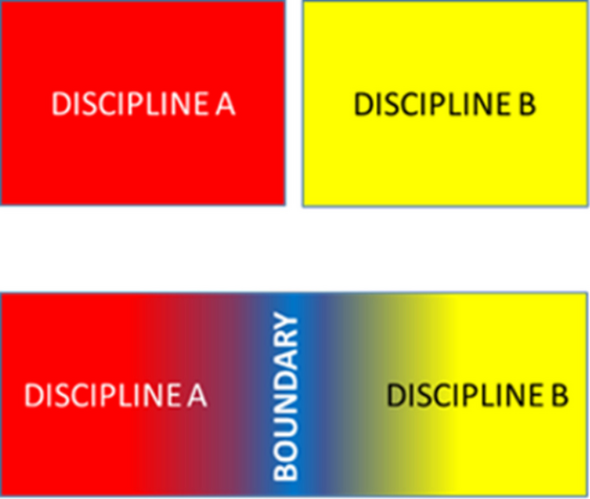
The “sandwich effect” between the two intersecting disciplines
Akkerman and Bakker’s metatheory introduces key concepts to orient the creation and management of an interdisciplinary context. The first concept is the “boundary object.” According to the initial definition by Star and Griesemer (1989), boundary objects emerge when different sites intersect. They provide distinguishing characteristics and express multiple perspectives and meanings that accomplish the bridging among those sites and, as a result, permit cooperation and communication (Akkerman & Bakker, 2011).
Given the position of the boundaries, both boundaries and boundary objects articulate an ambiguous nature. Examining the boundaries as a space that belongs to neither one discipline nor the other, then both boundaries and boundary objects constitute an “unspecified quality”. Due to this dimension of the boundary objects’ nature, they possess specific properties such as boundary transcendence or reconstruction, leading to highlighting the commonalities. On the other hand, examining the boundaries as a space that belongs to both one discipline and the other, both boundaries and the boundary objects express the multivoicedness of the intersecting disciplines. Due to this dimension of the boundary objects’ nature, they possess specific properties such as boundaries’ enactment, leading the disciplines to become recognisable and prominent in a specific boundary object as well as a specific boundary object to become recognisable by all the intersecting disciplines as a “property” of them.
The second term that Akkerman and Bakker conceptualise is that of boundary peoples, used to describe personal experiences of living at the boundaries and their ambiguities. Boundary peoples make the experience of “marginal strangers ‘who sort of belong and sort of don’t’” (Akkerman & Bakker, 2011, p. 460). Their identity is a direct experience with alterity and it is the result of a continuous process of renegotiation of sense and meanings. These mechanisms of renegotiation are expressed by a third term, namely “learning mechanisms that occur at the boundary”, and are distinguished using the terms identification, coordination, reflection, and transformation (Akkerman & Bakker, 2011).
The definition of Thompson Klein and the metatheory of Akkerman and Bakker were turned, in IDENTITIES, into a set of strategic principles aimed at designing teaching modules able to create “boundary zones”. In the following, we illustrate such principles and their implementation in the design of the module on climate change.
3.2 Design Principles
In IDENTITIES, two types of modules have been produced, each focusing on a specific kind of interdisciplinarity. One type of module focuses on curricular themes that are usually separated in different fields when teaching (for example, cryptography, parabola and parabolic motion, and modelling) (Satanassi et al., 2023). The other module type focuses on advanced, intrinsically interdisciplinary, STEM topics that are societally relevant but difficult to include in official curricula. The module on climate change is part of this type, together with modules on coronavirus evolution, nanotechnologies, and quantum technologies. The themes of these modules are not yet necessarily part of teacher education and, more in general, are not yet “disciplinarised” because they are not yet consolidated in stable disciplinary narratives within the school and teacher education curricula.
These modules on STEM advanced interdisciplinary topics have been designed to implement the following principles:
DP1) Value “authentic” forms of interdisciplinarity, basing the module on important boundary concepts (like the concepts of complexity and uncertainty for the module on climate change) that are intrinsically interdisciplinary and cannot be brought back to any of the traditional disciplinary contexts, or even to a sum of other S+T+E+M concepts.
DP2) Introduce and articulate the metaphor of the boundary to share a common language for interdisciplinarity, as it is conceptualised by Akkerman and Bakker (2011). The metaphor can guide, for example, to recognise processes of communication or translation between different areas of knowledge, practices of conceptual hybridisation, meaning negotiation, perspective taking and making; the metaphor can also be used to recognise boundary objects, their ambiguity and interpretative flexibility, as well as the different mechanisms of “disciplinary closure of meanings” (Satanassi et al., 2023).
DP3) Make “disciplines matter” for epistemological and identity reasons. From an epistemological point of view, disciplines should be valued as background sources of resources to deal with interdisciplinary issues. These resources include knowledge, but also methodological elements and epistemic practices that characterise the single disciplines, such as their specific argumentations, conceptualisation, and validation processes. From an identity point of view, disciplines should be valued to play the role of grounding new explorations on a solid basis and protecting against the insecurity given by the uncertainty and ambiguity of a new experience.
DP4) Activate an epistemological reflection that problematises the classical image of science and regenerates science’s capacity to deal with advanced STEM topics. Epistemological activators can be boundary objects or other linguistic or conceptual tools that can support the discussion on the epistemic core of the different disciplines. In the module on climate change, the role of epistemological activators has been played by the concepts of complexity and uncertainty. They have been valued to activate reflections on epistemic issues such as order–disorder organization (systemic thinking), determinism probability, linear causality, feedback loop, intrinsic–emergent properties (embracing ambiguity and uncertainty), nonlinearity, and predictability scenarios (future literacy).
The module’s design has also been deeply influenced by the fact that the main target of the IDENTITIES project was Preservice Teachers (PSTs). Thus, we decided to structure the module according to an adaptation of the “Study and Research Path to Teacher Education” (SRP-TE model) developed by Barquero et al. (2018). The model is framed within the Anthropological Theory of Didactics (ATD) developed by Chevallard and colleagues (Bosch & Gascon, 2014; Chevallard, 1985).
Adapting the structure of the particular SRP-TE consists of articulating the activities to guide the participants to assume different roles and positions concerning knowledge: explorers, students, and analysts. When asked to cover the explorer role, participants are involved in exploring a certain topic and are guided by the educators in distinguishing and discussing different disciplinary and interdisciplinary nuances of that topic. In this role, the participants are asked to share their knowledge and expertise and use this to explore the topic. For the student role, participants are guided to experience interdisciplinary project/activities under the role of “student” or “apprentice”. This means that new knowledge is introduced by the teacher educators, and the participants are invited and guided to participate in an active way in their learning. For the analyst role, participants are guided to apply the knowledge acquired as students in analysing the experience or other materials, adopting the role of “interdisciplinary analysts”. For example, participants are asked to analyse the experienced activity on different levels or layers, e.g., epistemological, educational, and meta-reflect on the activities to develop a more conscious vision of the topics treated.
The original SRP-TE model included a further role (designer), where the participants are asked to share some secondary school experiences with participants (or, if there is a change, design and implement by themselves), linked to interdisciplinary topics and teaching projects initiated in the previous activities. The participants are expected to use the tools for interdisciplinary analysis previously introduced to now question what and how can happen in a secondary classroom (under some specific conditions). In the international summer schools of IDENTITIES, this submodule was often omitted for two reasons: the students were still not so used to the school reality, and the definition of the context risked becoming an artificial exercise. Moreover, each country had school context specificities, and it would have introduced a complicated and time-consuming phase of explanation of the contexts within the teamwork.
4 Goals and Articulation of the Study
The module described in this paper was implemented in the summer of 2022 during the 2nd Summer School of the IDENTITIES project. The summer school was held at the University of Barcelona and saw the participation of 28 PreService Teachers (PSTs) from the five universities who participated in the IDENTITIES project from France, Greece, Italy, and Spain, with approximately five students for each university. Two Italian universities were partners in the project and, consistently, ten Italian students were selected for the Summer School. In Europe, the programmes of PST education are very different. In order to build a group with a comparable background, we decided to restrict the selection to Master Students (Second cycle at Higher Education Level) who had attended at least one course for PSTs from Physics, Mathematics, or Computer Science curricula. To select the participants, the partnership followed criteria to guarantee representativeness along the following parameters: partner (4 PSTs from the French partner; 5 PSTs from the Greece partner; 10 PSTs from the two Italian partners; 9 PSTs from the Spanish Partner); disciplinary background (distributed mainly along Computer Science, Mathematics, Physics, Biotechnology and Natural Science); gender (14 Female and 14 Males).
The participants were volunteers who expressed genuine appreciation for being selected to attend the international school. Consequently, although this cohort of PSTs reflects the varied cultural backgrounds of the partner institutions, it is not necessarily representative of all master’s students enrolled in teacher preparation programmes. From this vantage point, the challenges and difficulties discussed below are more plausibly attributable to cultural factors than to individual shortcomings.
The Summer School proposed two types of topics: advanced STEM and interdisciplinary curricula. Participants took part in one module for each type of topic (2 modules in total) and devoted about one day and a half to each module. The activities focused on the modules were alternated with plenary moments useful to both present PSTs with the overall structure and goals of the summer school and the frameworks used throughout the modules. Also, the last day of the school was dedicated to group presentations made by the PSTs regarding their perception of the school.
The modules offered to the PSTs were “Climate Change” and “Modelling COVID” for the Advanced STEM topics and “Cryptography” and “Linguistic and Epistemological Aspects of Interdisciplinarity” for the Interdisciplinary curricular topics.
Here, we focus on the Climate Change module, in which 14 students (eight females and six males; three from computer science, four from physics, four from mathematics, one from biotechnology, and one from natural science) participated. Specifically, we focus on the data collected during the Analyst Submodule. In this module, PSTs were asked to reflect on the concepts of complexity and work with the three different types of uncertainties.
The study we present in this paper has been conducted in two phases. In the first phase, we describe how uncertainties and complexity could be used to design and develop a module on climate change that would address its core issues from an interdisciplinary perspective. Section 5 describes the module’s contents, structure, and connection with the design principles.
The second part of the study was conducted to analyse and study in detail the effects of the course on PSTs. In particular, we identified two objectives:
- O1. To understand the effectiveness of the module in developing a productive boundary zone that allowed PSTs to develop interdisciplinary discussions and interdisciplinary skills;
- O2. To explore the effect that working with the concepts of complexity and uncertainty in an interdisciplinary setting had on PSTs, looking in particular at the criticalities and epistemological challenges that emerged, and the moments of discussion and disciplinary identification.
For the second part of the study, we rely on the data collected through the module. Data have been collected through the recordings of the different parts of the module, both plenaries and group activities.
For the recordings, we focused on the group work held during the module implementation and the moments when PSTs from different groups were asked to present and discuss their work. For the last part of the module, we also used the artefacts produced by the PSTs during the second activity (posters and post-its). Moreover, at the end of the Summer School, a questionnaire was given to the PSTs, where they were asked to comment on their experience and express their agreement/disagreement with questions related to their opinion on the overall structure of the school, its content and activities, and the interdisciplinary experience acquired. The questionnaire consisted of closed and open-ended questions.
From a methodological point of view, we conducted a qualitative thematic analysis of the recordings collected during the module implementation. The recordings were transcribed using the software nVivo. In the following phase, two authors analysed the recordings, looking for moments where PSTs discussed the concepts of complexity and uncertainty. We focused on those moments where PSTs discussed how those concepts were related to their discipline and perspective, why they saw that concept closer or further from their discipline, and what difficulties they had with those concepts.
The analysis has been conducted by two of the authors independently and then confronted and discussed. The results of this analysis are presented in Sect. 6.
5 The Module
The module presented in this paper does not consider climate change a topic to be taught but a new field that involves all the disciplines and their interconnections. In this sense, climate change expands and questions the disciplinary boundaries to hybrid situations and transdisciplinary approaches (Klein, 2010).
The Climate Change module has features common to all activities developed within the IDENTITIES project and to the design principles described above (Fig. 2). We now explain in detail the structure of each part of the module. The materials used in the module are public and available at the website https://identitiesproject.eu/.
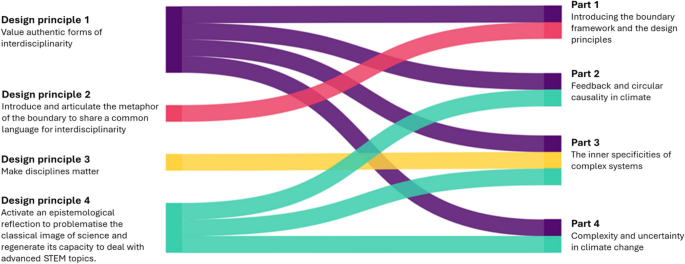
Links between the design principles and how they have been used in the different parts of the module
5.1 Part 1—Introducing the Boundary Framework and the Design Principles
The learning outcomes of the first part of the module include the following:
- 1.Becoming acquainted with the main aspects of complexity,
- 2.Understanding how complexity can be used to describe various facets of our society, and
- 3.Exploring the boundary framework to develop the language needed to describe processes at work in climate change.
To achieve these outcomes, two activities were designed. In the first activity, PSTs were introduced to a complexity perspective on climate change and other STEM challenges, such as COVID-19. They received an overview of key complexity concepts, such as emergent properties, circular causality, non-linearity, and feedback, and were introduced to tools and methods used in studying climate and other complex STEM problems. Particular focus was placed on computational models and simulations, especially on the typologies of models used to build and run simulations, i.e., equation-based models and agent-based models.
In the second activity, PSTs investigated how to recognize disciplinary boundaries and explored various ways of crossing them. They were presented with the core terminology from the Akkerman and Bakker (2011) Boundary framework, like boundary, boundary crossing, and boundary object, and the potential learning mechanisms it describes: Identification, Coordination, Reflection, and Transformation. By engaging with these ideas, PSTs were encouraged to consider the roles different disciplines play in climate change research and to examine how, when, and why disciplinary boundaries may be traversed, reinforced, or transformed.
Throughout this introductory section, complexity itself is framed as a boundary object: a concept that can be interpreted and deployed differently depending on the context, yet which addresses multiple societal challenges. By highlighting the ubiquity and versatility of complexity, PSTs begin to see how it pervades every discipline and why it can serve as a unifying boundary object. In this way, both Design Principles (DP1 and DP2) are evident in the module’s structure, emphasizing the intrinsically interdisciplinary nature of climate change and the importance of fostering robust boundary-crossing dialogue.
As shown in Fig. 2, the first part of the module is aligned with the first Design Principle (DP1). PSTs are introduced to the module’s scope and provided with a shared vocabulary for discussing both complexity and interdisciplinarity. Given the backgrounds of the participants, these disciplines are highlighted to mobilize their specialized knowledge in creating and inhabiting a shared boundary zone. According to the second Design Principle (DP2), this part also introduces the metaphor of the boundary, as conceptualized by Akkerman and Bakker (2011).
5.2 Part 2—Feedback and Circular Causality in Climate
The second part of the module focuses on introducing and contextualizing fundamental concepts of complexity within the area of climate change. To achieve this, we highlight two defining features of the science of complexity in the context of climate change: feedback and circular causality. Two activities are carried out, inviting PSTs to act as explorers, working in small groups to investigate the complexity inherent in biofuels and their broader implications.
Activity 1 begins with an introductory short lecture on the concept of feedback. Through examples and videos, PSTs learn and discuss the meaning, importance, implications, and everyday effects of feedback loops. This exploration underlines how climate can be understood as a complex system by examining causal circularity (or feedback loops), including when and why they occur. As an illustrative example, Arctic feedback is discussed: diminishing ice cover reduces albedo (the reflective capacity of a surface), which leads to increased absorption of solar energy by the ocean. This, in turn, raises the water temperature and accelerates ice melting, forming a clear example of a feedback loop in action.
Activity 2 involves reading a text on biofuels, chosen for their interdisciplinary nature and relevance to climate change. Biofuels are incorporated into sustainable mobility policies partly because they reduce certain pollutants that contribute to climate change and air quality issues. For instance, biodiesel lowers emissions of CO and CO₂ by releasing the same carbon originally absorbed by plants from the atmosphere. However, the overall effectiveness of biofuels in mitigating climate change depends on production methods, raw materials, and life-cycle considerations (Rial, 2024). These interwoven scientific, economic, political, and social dimensions highlight the interdisciplinary character of biofuels.
In small groups, PSTs analyze a text developed by the course organisers that explains the origins of biofuels, various production processes, and the consequences of their use. After reading, they create causal maps to visualize connections and complexities behind biofuel use. This mapping exercise is divided into steps, each adding depth to the discussion and uncovering both positive and negative feedback loops.
Following these activities, three main claims about biofuels are presented for collective examination:
- 1.The biodiesel story exemplifies why climate change requires us to change our ways of reasoning. Let’s discuss this claim.
- 2.Through this activity, you have been guided to build and use a causal map to analyze a scientific text. What is a causal map, and how can it serve as an analytic tool?
- 3.Imagine being a decision-maker… How would you incorporate the concepts of positive and negative feedback into envisioning and shaping future scenarios?
Each claim is paired with a guiding question to spark group discussions. Overall, this second part of the module enables PSTs to engage more deeply with aspects of complexity that bridge STEM fields and broader ethical, political, and social considerations. Emphasis is placed on understanding that not all systems behave linearly, encouraging PSTs to avoid oversimplifying complex phenomena. In this way, DP1 and DP4 are clearly implemented, demonstrating both the value of applied interdisciplinary topics and the epistemological reflection needed to critique and evolve traditional scientific perspectives. Through this process, complexity emerges both as content and as an epistemological activator, prompting PSTs to adopt new ways of thinking and reasoning about advanced STEM topics.
5.3 Part 3—The Inner Specificities of Complex Systems
The third part of the module dives into additional features that characterize climate as a complex system, with the primary aim for PSTs to identify three core concepts of complexity – sensitivity to initial conditions, emergence, and feedback – and understand how these contribute to the inherent limits of predictability in complex systems. Drawing on disciplinary knowledge (DP3), the examples presented in this section help PSTs explore the internal characteristics of complexity while also encouraging them to revisit the epistemological implications highlighted in Part 2 (DP4). By the end of this part, PSTs should recognize the inherent limitations in predicting the evolution of deterministic chaotic systems, understand that some chaotic systems exhibit underlying order despite appearing random, and appreciate how systems evolve through critical states that determine their final “form” via feedback processes.
In this part, PSTs are asked to assume the role of learners, closely examining each topic and practising how to lead informed discussions. In the first activity, PSTs compare long-term weather forecasts (7, 5, 3, and 1 day in advance) to actual weather conditions for the same location and date, observing how forecasts vary over time and illustrating the time sensitivity and limited predictability of weather as a complex system. The second activity challenges the notion that systems must be strictly deterministic or entirely random; PSTs investigate a deterministic chaotic system by analyzing a chaotic pendulum’s behaviour in both harmonic oscillation and deterministic chaos, revealing how apparent randomness can still exhibit underlying patterns. In the third activity, PSTs discuss the significance of critical states in shaping the emergent “form” of a system, focusing on the study of Bénard cells, which showcase the importance of feedback and feedback loops and how a system passes through pivotal phases that affect its overall behaviour. Finally, in the last activity, PSTs return to the biofuel concept map from an earlier part of the module, identifying points where different choices in biofuel production trigger specific effects within the system. This exercise aims to reinforce how sensitivity to initial conditions, emergence, and feedback influence real-world scenarios.
Overall, the third part of the module fosters systems thinking, inquiry-based learning, and problem-solving skills. By delving more deeply into key concepts of complexity, PSTs are expected to gain an appreciation for the inherent unpredictability in certain systems and the value of disciplinary perspectives (particularly physics and chemistry) when addressing interdisciplinary issues. This approach aligns with Design Principles 1, 3, and 4, emphasizing how interdisciplinarity is enriched by understanding complexity across various STEM fields and beyond, grounding discussion in concrete scientific examples, and prompting reflection on how complexity challenges traditional views of science. Complexity thus continues to function as a boundary object, enabling PSTs to engage in meaningful, interdisciplinary dialogues that integrate multiple epistemological perspectives.
5.4 Part 4—Complexity and Uncertainty in climate change
The fourth part introduces the concept of uncertainty in climate change while focusing on the epistemological aspects and consequences of complex systems. The last part aims to have PSTs reason on the consequences of complexity from an epistemological and interdisciplinary level and analyse the topic of uncertainty in a disciplinary and interdisciplinary context, starting with climate change and generalising to other themes belonging to each PSTs’ own background discipline. The last part focused on the complexification of their image of science and the relations between different disciplines (DP1 and DP4).
The learning outcomes for PSTs were to work on their ability to grasp the epistemological consequences of complexity and to differentiate among the three types of uncertainty present in climate studies, both in their disciplines of belonging and from an interdisciplinary perspective.
In this part, PSTs participated actively in the lesson. Most of the activity was developed through group work and joint discussions, allowing the different groups to discuss, analyse, and reason in detail about the questions. PSTs were asked to fill the role of analyst, in which the goal is to develop discussions that go beyond the purely descriptive level of the two concepts and focus instead on the epistemological aspects. Complexity and uncertainty can be seen here as epistemological activators aimed at bringing together the different disciplinary views in the groups. As in the other parts of the module, we developed two activities.
In the first activity, the role of complexity as an epistemological activator and boundary object has been presented and discussed. PSTs were asked to reason on the topic of complexity, as discussed in parts 1 and 2 of the module. PSTs have been divided into three groups and have been asked to discuss three questions:
- A1.1) Which epistemological questions (i.e., on the nature of science) can open a reflection on complexity and the properties of complex systems (e.g., non-linearity, feedback, emergent properties, limited predictability, critical states, tipping points, bifurcations, …)?
- A1.2) What impact on curricular topics? What do these themes “activate” at an epistemological level to highlight and/or question foundational aspects of the disciplines? (prompt: think about the parabolic motion)
- A1.3) Which of these concepts would you choose as an example of a boundary object to show the interdisciplinarity and the features of the disciplines?
The second activity focuses on discovering and reflecting on the three types of uncertainty in climate studies. Specifically, taking references from the work of Shepherd (2019), Dessai and Hulme (2004) and Kahneman and Tversky (1982), PSTs explored how the three types of uncertainty (reflexive, epistemological, and aleatoric) can be recognised within their disciplines, the world of complex systems, and the study of climate change. After a presentation on the different types of uncertainty, each group of PSTs was assigned one type of uncertainty and was asked to answer three questions related to that particular uncertainty:
- A2.1) Which examples of this type of uncertainty can you identify in your discipline of expertise?
- A2.2) How can this type of uncertainty be related to the complexity and/or properties of complex systems?
- A2.3) How can this type of uncertainty be related to the study of climate?
PSTs were then asked to present their answers and reasoning, with the mediation of the instructor. After the three presentations, the instructor asked the PSTs to fill out a scheme to meta-reflect the perspectives these issues opened, thinking simultaneously about the three types of uncertainty.
In this part, the discussion of complexity and uncertainty has moved to a different level than in the previous two parts. Here, the discussion has been directed to an epistemological and ontological level (DP4) to make PSTs think about the importance that these concepts have for teaching about climate change. The questions posed to the PSTs focused on the idea that both concepts can be studied in detail with the proper tools of each discipline but are pervasive to the whole epistemology of science and are necessary for dealing with climate change. The aim was for PSTs to establish an exploratory dialogue between different disciplines (DP1) and to compare and explore different perspectives on the same topic (perspective-making and perspective-taking). In addition, the need to reason about complex systems broadly, and to reason about them in terms of uncertainty aimed to create a space for PSTs to develop critical reasoning and systematic thinking skills. PSTs worked on their attitudes towards looking at the uncertainties within the scientific process and the different disciplines not as a limitation but as an opportunity to recognise the value of the scientific process and its importance. Moreover, the activities aimed to help PSTs broaden their perspective, to compare peers and to look at differences between different backgrounds in a proactive way.
6 Implementation Results and Emerging Themes
As stated previously, our study is mainly theoretical. Nevertheless, we present here some empirical results gathered from the data collected in the two modules, first by presenting how PSTs dealt with the concepts of complexity and uncertainty and what kind of epistemological discussions emerged during the activities. Then, we discuss how the setting and the design principles influenced the discussion of the PSTs. To present the results and show how the conversation evolved, we report some interactions made by the PSTs. We anonymised the data but decided to represent each student’s background discipline to show the differences in the type of approach on both conceptual and epistemological levels (PH = Physics, M = Mathematics, CS = Computer Science, BT = Biotechnology, NS = Natural Sciences).
Considering the explorative nature of the study, we utilised, as mentioned previously, qualitative thematic analysis of the recordings collected during the module implementation. Our analysis was guided by three axes related to interdisciplinarity, complexity, and uncertainty. More specifically, we examined the data collected in part 3 to identify excerpts during PSTs’ conversations that expressed their views on the concepts of complexity stated in Sect. 5.3. Likewise, we elaborated on the data derived from part 4, focusing on PSTs’ views on uncertainty and its types: aleatoric, epistemic, and reflexive. Finally, we examined both parts of the module concerning the PSTs’ interaction at the boundary zone created when dealing with climate change complexity and uncertainty. The data selection, coding, and analysis were initially drafted by Authors 1 and 2, who also were immersed in the activities, and then triangulated among all the authors throughout a three-round analysis. In the following subsection, the results regarding the three aforementioned axes are presented.
6.1 PSTs’ Interactions at the Boundary Zone
During the module, depending on their background, each student used a different type of reasoning to explore the boundary zone of climate change, like, for example, simulations, calculus, experiments, recreation of initial conditions, or study of trajectories. The richness of the discussion can be connected to the boundary zone activated by each student’s different backgrounds, as the epistemologies connected to STEM disciplines emerged evidently depending on the type of problem discussed.
The boundary zone created some difficulties for some PSTs, as the same term can often have multiple meanings depending on the discipline. In many cases, PSTs were forced to discuss and negotiate on the meaning of certain words. At the same time, this confrontation can be seen as a moment of perspective-taking, as it allowed PSTs to enlarge their perspectives on certain phenomena. We report here some examples.
PH: We didn’t finish. Because we have many different backgrounds, someone here doesn’t know the meaning of that. Even me. Instead of discussing the experiment we saw, we are simply explaining to each other the phenomenon.
This comment illustrates how constructing a boundary zone made of people with diverse backgrounds can lead to a shift from discussing experimental outcomes to simply explaining fundamental concepts to each other. This process, while time-consuming, can promote a deeper understanding of the main issues at stake and resembles the everyday situations in which experts from different fields are exposed in cases of multi- and interdisciplinary issues like climate change. The same issue is backed by another quote from two other students:
PH: We weren’t sure because we didn’t quite grasp yesterday what in our simulation of the pendulum was the critical state. We saw that in different backgrounds, we used the term critical state for different meanings.
PH: I didn’t understand the definition of a critical state. Because I don’t know if we’re talking about physics, we’re talking about what?
The students’ reflections highlight the challenge of different interpretations of key terms, such as, for example, “critical state.” This ambiguity necessitated further discussion to reach a common understanding, demonstrating how boundary zones can lead to fruitful negotiations. At the same time, the need to clarify whether the term is being used in a physics context or another context reveals the complexities that students coming from a disciplinary setting can face when exposed to an interdisciplinary learning space.
In many cases, it was evident how PSTs with a background in physics were leading the discussion as they felt entitled to talk about something usually perceived as belonging to the physics domain (disciplinary capture). Nonetheless, other PSTs participated actively in the discussion. They reasoned together with other PSTs, mainly thanks to the distribution in the groups where they probably felt more secure in sharing their perspectives and ideas in the plenary moments.
Discussions about the proper meaning of some specific terms, together with the struggle of analysing phenomena out of their own disciplinary comfort zone, gave PSTs the possibility to experience a true boundary zone in which meaning and knowledge must be agreed upon and constructed at every step. This type of process, although frustrating and difficult to accept, can lead to new insights and possibly to a redefinition of specific aspects of the studied phenomena. To overcome their challenges, PSTs, regardless of their discipline, tried to identify their disciplinary characteristics in comparison to the characteristics of other disciplines.
The added value of the aforementioned negotiations among the PSTs is their impact on how PSTs approach complexity and uncertainty as an inherited property of deterministic systems. The transcripts of the three group discussions as well as the plenary sessions revealed a significant contribution of the boundary zone as a learning space for the PSTs. At the boundary zone, PSTs were able to discuss with each other and approach the different aspects of complexity, starting from expressing vague ideas about it and ending up making conclusions and embracing those aspects.
6.2 PSTs’ Views on Complexity
While dealing with the concept of complexity during the module, PSTs encountered some difficulties as they tried to follow linear reasoning in an unsuitable context. In this case, we report and comment on some data from the activities of the chaotic (magnetic) pendulum, the weather prediction, and the Benard cells.
By studying the weather patterns, for example, PSTs embraced the idea that in certain systems there are limitations in our capability to make predictions. By doing so, they recognised the complexity of the climate system by realising that linear reasoning does not always apply, also by recalling the explanations made in the introductory part of the module (biofuels). At the same time, some PSTs tried to find other possible motivations for those results. For example, in this excerpt, a student expressed how the lack of information about long-term data would prevent them from actually understanding exactly what type of future weather would be there the next day.
PH: The long-term data kind of allows us to have more probabilistic points of view. But it’s an intrinsic problem in the sense that we can have the data in the variable in the most precise way that we wanted, but we couldn’t determine with 100% accuracy, the weather for tomorrow.
Similarly, another student stated that the lack of data on specific variables, such as pressure, could not give them the possibility to understand future data.
CS: We don’t know how they will interact with each other in the long term and add a difference […] we know that usually when you have high pressure or low pressure, then we will have rain or whatnot. But we don’t know in this case, maybe we have some high temperatures or whatnot. So we don’t know in this particular case, maybe something influenced the pressure and we don’t know if there is a connection.
From these excerpts, we can see how both students tried to overcome the lack of knowledge as an obstacle, particularly in a way that reveals the different reasoning of the two disciplines. In the first case (physics), they express the idea that a better-informed dataset would reduce uncertainty:
PH: But the data from the past days allows us to use in the better way, in the best way, the big number of data that we have from the other years because it narrows the system in a certain position.
On the other hand, the student with a background in computer science expresses the idea that this uncertainty can be resolved by developing more efficient technology.
CS: So it’s either a problem if we are not collecting enough data, even though we have the technology, or they’re doing something else […], that it’s maybe connected to what we were talking before about the cables and everything that even changes about the weather in general. Even so, even if you have accurate data, maybe you will read that it is 31, but it’s like 31.00001, and that little change can produce a very big change in 2–3-4 days.
In another excerpt, PSTs discuss the accuracy of the predictions. The discussion revolves around the capability to embrace the limits of predictions and the necessity to have accurate data in order to make proper predictions.
M: Let’s see. I have an idea. We see that the prediction span…
BT: Is it accurate enough, or something like that?
PH: Or the accurate span is accurate enough between two and four days.
CS: Why? Why?
PH: If you want, we can say that there are too many variables. Yeah, I would say that.
CS: Or because… Or not. Also, the data that we have are not so accurate, no?
BT: No, data is accurate because you know what’s…
PH: The data is accurate, but we have too many variables. So it’s difficult to predict.
CS: I think it is not accurate enough because you can…
PH: No, there is a difference in how accurate the data is and what we can predict with the data. So the data can be as accurate as we want.
CS: Yes, but is the actual data accurate?
PH: The actual accuracy of the data can be top-notch. Okay. But we will never be able to predict any divergence.
M: [reading the assignment] In your opinion, why do these divergences occur? Discuss with your group.
CS: Because the effect of the missing variables becomes stronger in the meanwhile… Or the interaction between the variables.
It is interesting to note how the discussion about the concepts activates a conversation on the nature of complex systems, leading to a confrontation that questions the epistemological aspect of data analysis and forecasting.
Following the same discussion, we can see how some PSTs thought that the incapability of predicting the final results was due to hidden variables. In contrast, others recognised that the complexity of the system hinders the capability of reaching total accuracy in the predictions.
BT: We know, I think we know, but there are a lot of connections. We can’t know which one is going to…
CS: We miss a connection between variables, or we miss a variable. I think that… Some variables.
PH: We know the variables, but we don’t know how the variables interact. Ah, okay.
BT: Well, we know how they interact, but there are so many interactions that you cannot predict easily. I think there is wind from the north, wind from the south, humidity…
CS: Yes, we don’t know what the outcome will be.
BT: Yes, it’s difficult to predict because there are so many interactions.
The discussion on the critical states led to an acceptance of the limited predictability and the fact that the visible part of the system can result from a critical state but not the critical state per se. For example:
PH: So, whenever a bubble is formed, many bubbles are formed, […] and then this is the outcome of a critical state passage. I mean, okay, yeah, it means that there was a critical state, we passed through a critical state, and now we are in a stable one. So I don’t think that […] we can see a critical state till we pass it here in this example, different from what we saw yesterday with the magnetic pendulum [the chaotic pendulum].
PH: I mean, I think that the question is, if I take this, right, the same liquid, and I hit it up again, do I expect to see the same bubbles? Forming the same process in the same way? And obviously, the answer is no.
In another part of the module, PSTs’ discussions revolved around the capability of replicating a certain experiment when initial conditions are the same. For some PSTs, the same initial conditions in the same environment should lead to the same exact results, while for others, the inner complexity of the system would change the final results.
M: It is my opinion, if we don’t – if we take the same point and don’t change the angle…
BT: It will happen the same.
M: If we let it fall. And don’t give any strength to it. It shouldn’t change.
CS: But. You can’t be perfect.
M: But imagine it is perfect. That is the question if it is the exact same.
CS: If it is the exact same. But it is not possible.
M: I agree.
BT: He said you throw it from the same position.
CS: But you use your hand.
BT: Maybe you don’t do it with your hand. Maybe not with the hand.
CS: You can use a machine.
BT: Yes.
CS: Also, the machine has an error. Ok. It is impossible to take a perfect angle. And perfect strength.
M: Yes. We need to look at the accuracy. I think with a machine we can have 99% accuracy if we take the same point and the same angle.
CS: Over time, this error can influence the trajectory. Because at first, it was minimal, like a prediction, but over time, this error can propagate.
In this case, we can see how “perfection” in recreating the initial conditions (through better launches or with machines) was seen as a possible solution for PSTs to recreate the same results. During the same activity, another group reasoned on the impossibility of replicating the same simulation multiple times when dealing with a chaotic system due to the difficulty of recreating the same initial conditions.
M: Really? Even if you control everything.
PH: Because in physics, you don’t have a perfect number that represents the perfect position in which you are.
M: The angle would change. But will it change that much? No.
PH: It’s an infinite number of positions. Between two points, there is an infinite number of positions.
CS: It’s a real number.
The reactions show the difficulties of breaking out of the classical and linear deterministic vision of science and stress that climate change requires a deep epistemological change in the very fundamental ways of conceiving knowledge (Levrini et al., 2024). Cultural repositioning toward complexity, although it has been advocated for decades (e.g. Jacobson & Wilensky, 2006; Morin, 2000, 2023), is still rather difficult.
6.3 PSTs’ Views on Uncertainty
The discussion on how to deal with the different types of events, together with the last activity carried out in the module, revealed interesting insights into the epistemological challenges that PSTs faced in dealing with different types of uncertainty inside and outside their discipline, with respect to complex systems, and in relation to climate change.
The first interesting result of the activity is the difference in how PSTs addressed uncertainty. Let’s take this excerpt of an exchange with Author 5.
CS: Think of three kinds of error in these predictions. There are those of the … of the data and those of the models. There are two kinds of error taken into account –
Author 5: Errors. Let’s change the word. Uncertainty.
CS: And this can be modelled in a probabilistic way. In the sense that probabilistic is when we don’t know anything. We use probability to manage the complexity when we don’t know how it works. So the probability can help us to solve this problem.
In this case, the student referred first to the uncertainties as errors, and then referred to probability as an instrument that can be used when we do not have knowledge about the functioning of the system under study. This excerpt shows a general view on the role of uncertainties in science, that is, the view of limit and not of possibility.
Throughout the module, PSTs started to enlarge their perspective. An interesting result worth noticing is that depending on the type of uncertainty PSTs faced, they activated different forms of reasoning and approaches towards the epistemological aspect of science.
In dealing with the first type of uncertainty, i.e., “uncertainty on human behaviour” or reflexive uncertainty, PSTs showed many difficulties in establishing a connection between their disciplines and, more in general, to their idea of what science is and what “scientific” means. In particular, they emphasised several times how they could not see how the role of human beings could affect the scientific process. In this regard, it is interesting to report two excerpts in which this difficulty was explicitly described.
CS: But the human behaviour is the thing. The human behaviour influences knowledge, and not the other way around, like humans reflecting on themselves. That’s why I think it’s very hard.”
CS: I really find it hard to see this kind of uncertainty in our fields. Because, especially as a scientific figure, you want to eliminate human behaviour as much as possible; that’s the scientific method. That’s why you have experiments that are repeated many, many, many, many times so that you are sure of reality without human influence. That’s why I really do not know how you can see this in our fields.
These transcriptions show how the student, with a computer science background, struggles to understand the role of human behaviour in the scientific process. In their discussion, PSTs differentiate between what is science and what is not, and most importantly, they do not see knowledge as a human product but rather as an abstract property detached from the rest when discussing the relation between reflexive uncertainty and complexity. See, for example, the following answer to one of the questions asked in the second activity of the last part of the module.
Q: How can this kind of uncertainty [reflexive] be related to the study of climate?
S: Decisions about policies: how to act once you know the science.
It seems that once people “know the science”, they are capable of making decisions. This kind of assumption thus seems to aim to “erase” uncertainty and not to “deal with it”.
When discussing epistemic uncertainty, PSTs reasoned differently, as it seems that with this type of uncertainty they have activated their disciplinary knowledge. In answering the questions, PSTs referred to a broad pool of knowledge related to their study paths, referencing those problems that remain open but can, in principle, be solved through deeper knowledge. This uncertainty seems to activate cognitive resources from disciplinary knowledge (open questions in the history of their proper discipline). Here, PSTs focused on the knowledgeable limits or model limits that each discipline has considered and faced. The analysis of the recordings did not reveal particularly relevant moments of confrontation, so much as a dialogue in which each participant brought their knowledge to bear. This can also be observed in part by the organisation of the poster, which is clearly divided by questions (rows) and disciplines (columns) (Fig. 3a and 3b). Each student focused on their own field and separated the results by discipline.
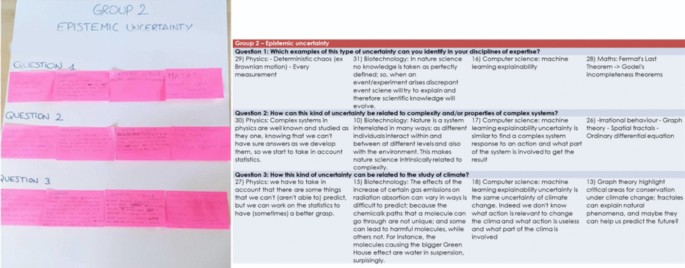
Left (a) Poster prepared by the group who worked on the epistemic uncertainty. (b) Transcription of the answers given to each question
When dealing with aleatoric uncertainty, the group members reasoned about the topic of uncertainty reducibility, trying to figure out which topics had inherent uncertainty specific to their disciplines, complex systems, and climate change.
The reasoning done gives the idea of a more reflective type of approach and not just a content approach, in which each topic is discussed and analysed to understand what is the origin of the type of uncertainty that characterises it. What emerged from the discussion is that, for the PSTs, the uncertainty from internal variability is fundamentally irreducible (leaving aside the possibility of finite-time prediction from specified initial conditions); therefore, users of climate information need to understand that the mantra of ‘reducing uncertainty’ is inappropriate in this case; rather, the scientific goal is to better “quantify the uncertainty” (Shepherd, 2019). The third kind of uncertainty seems to have activated a question of the kind “which uncertainty is reducible with knowledge and which isn’t?”.
In the final discussion, the confrontation between the different types of uncertainties led PSTs to revise their opinion and enlarge their perspectives outside of scientific concepts.
For example, some PSTs changed their perspective on humans’contribution to the scientific process and the interconnections between different types of uncertainty.
CS: So I think this was connected to policies. Science can be exact and everything, but what you do depends on how humans react to that science; what to do with data is not easy to do; it depends on human behaviour and what humans decide, and it was kind of the definition we were given in some sense. Scientists say CO2 will go up; are we letting it go up or will we do nothing to let it go up and adapt? That was the thing; it was everything based on the definition.
PH: At the beginning, I perceived aleatoric uncertainty completely unlinked to the uncertainty due to human behaviour because I searched for aleatoric uncertainty on the fundamental [level]. I am a physicist, so I search very deeply into the causes of things, but at the blackboard [final confrontation], I realized that there are multiple factors and human behaviour can activate some very deep problems of the discipline. For example, we decided to put at the intersection of human behaviour and aleatoric uncertainty the behaviour of cells in human cancer.
7 Conclusions
As presented in the state of the art, teaching about climate change calls for confronting the role that complexity and uncertainty play in wicked problems and questioning beliefs on the foundations of science and its mechanisms (Christensen & Fensham, 2011; Jacobson et al., 2017). This endeavour is far from straightforward because the nature of complexity and uncertainty often clashes with the oversimplified notion of science as a ready-made set of tools that offers certainty and guarantees for the general public. Rather, these concepts urge us to reconsider how knowledge is generated and to recognize the critical mechanisms underpinning scientific inquiry (Fazio, 2023, 2024; Pietrocola et al., 2021). Despite occasional reluctance to address such issues, stemming from a desire to see science as a provider of security, teaching climate change requires explicit engagement with complexity and uncertainty, accepting their roles in navigating a wicked problem of this scale. It also entails questioning disciplinary boundaries and adopting a stance of “epistemological nomadism” that moves between various fields of knowledge (Miani & Levrini, 2024; Miani et al., 2025).
In our study, we provided a module designed as a boundary zone for pre-service teachers (PSTs) to investigate climate change from multiple disciplinary angles (perspective-making) and to cross disciplinary boundaries. This approach exposed PSTs to a shared vocabulary and diverse methodologies suited to an interdisciplinary environment. The varied ways PSTs reasoned, ranging from computational simulations to experimental inquiry, underscored how different epistemological backgrounds influence the way they approach climate challenges. Negotiating and clarifying terms with multiple meanings, such as “critical state,” illuminated both the difficulties and the benefits of interdisciplinary learning, ultimately deepening collective understanding through active perspective-taking. The boundary zone, though occasionally challenging, enabled PSTs to confront complexity and uncertainty in tangible ways, broadening their viewpoints and contributing to a more holistic grasp of climate change.
By centering on complexity and uncertainty as both content and epistemological constructs, we identified critical opportunities for PSTs to address the intrinsic complexity of climate change (Liu, 2022). A recurring theme was the value of sharing and debating ideas with peers from different backgrounds, which encouraged critique, reinforcement, and the generation of new knowledge. When examining complex systems, PSTs often grappled with non-linearity and the limitations of prediction, initially oscillating between viewing such systems as either entirely chaotic or fully solvable through scientific progress (Hull et al., 2021; Stavrou & Duit, 2014). These reactions hinted at a lingering “Newtonian” mindset that seeks deterministic certainty, revealing a significant obstacle to developing sustainability competences (Levrini et al., 2024).
Nevertheless, the interdisciplinary structure of the module and the collaboration with peers from other fields gradually fostered a more nuanced understanding of complexity. PSTs learned to define and redefine complexity outside the comfort zone of their own disciplines by drawing on both shared and contrasting perspectives. This creation of a boundary zone, where terms and concepts were collectively negotiated, was crucial for forming deeper, more unified interpretations (Akkerman & Bakker, 2011). The experience helped PSTs hone the interdisciplinary skills needed for teaching complex STEM content and for stepping beyond disciplinary silos.
In terms of uncertainty, our observations suggest that PSTs respond differently depending on the type of uncertainty involved. When the uncertainty related primarily to human behaviour, PSTs often defaulted to a deficit model, distinguishing between what they regarded as “real” science and other forms of understanding (Simis et al., 2016). This stance implies that PSTs may, at times, view human decision-making as existing outside the realm of valid scientific discourse, possibly overlooking the role that values, ethics, and choices play in shaping climate outcomes (Majid et al., 2023; Tolppanen & Kärkkäinen, 2021). By contrast, when uncertainty fell into epistemic or aleatoric categories, PSTs explored their own disciplinary knowledge more deeply and adopted a more critical lens, acknowledging the inherent limits of scientific inquiry and its interplay with real-world issues.
Our analysis reveals how PSTs with diverse disciplinary backgrounds activate different forms of knowledge and reasoning when confronted with an interdisciplinary phenomenon like climate change. The boundary-zone structure enabled them to broaden their perspectives, reassessing the human role in dealing with both the complexity and the uncertainties of climate. Although the module proved effective in sparking crucial discussions, PSTs’ strong reliance on classical linearity and determinism remains a noteworthy challenge, suggesting that additional efforts are required to embrace complexity and uncertainties as vital epistemological catalysts. This result suggests the need to also revise the educational environments in the disciplines, since they are still mainly focused on a classical Newtonian determinist view that, if it is not problematized and discussed in its limits of validity, can represent an epistemological obstacle for a sustainability mindset. Overall, this study highlights the promise of interdisciplinary modules in cultivating reflective, flexible educators who can meet the demands of teaching sustainability and addressing the pressing global challenges that define our era.
Data Availability
The materials used for the module are available on the website https://identitiesproject.eu, while the transcripts of the group work are safely stored and available on the data repository portal of the University of Bologna.
References
-
Akkerman, S. F., & Bakker, A. (2011). Boundary crossing and boundary objects. Review of Educational Research, 81(2), 132–169. https://doi.org/10.3102/0034654311404435
-
Alvargonzález, D. (2011). Multidisciplinarity, interdisciplinarity, transdisciplinarity, and the sciences. International Studies in the Philosophy of Science, 25(4), 387–403. https://doi.org/10.1080/02698595.2011.623366
-
Barelli, E., Barquero, B., Romero, O., Aguada, M. R., Giménez, J., Pipitone, C., Sala-Sebastià, G., Nipyrakis, A., Kokolaki, A., Metaxas, I., Michailidi, E., Stavrou, D., Lodi, M., Sbaraglia, M., Bartzia, E. -I., Modeste, S., Martini, S., Durand-Guerrier, V., Satanassi, S., Fantini, P., Bagaglini, V., Kapon, S., Branchetti, L., & Levrini, O. (2022). Disciplinary identities in interdisciplinary topics: Challenges and opportunities for teacher education. In Evagorou, M., & Jimenez Liso, M. R. (Eds.), ESERA 2021: Fostering scientific citizenship in an uncertain world (pp. 934–943).
-
Barquero, B., Bosch, M., & Romo, A. (2018). Mathematical modelling in teacher education: Dealing with institutional constraints. ZDM, 50, 31–43. https://doi.org/10.1007/s11858-017-0907-z
-
Beck, U. (1992). Risk society: Towards a new modernity. Sage.
-
Bianchi, G., Pisiotis, U., & Cabrera Giraldez, M. (2022). GreenComp – The European sustainability competence framework. In M. Bacigalupo & Y. Punie (Eds.), European Commission, Joint Research Centre. Luxembourg: Publications Office of the European Union.https://doi.org/10.2760/13286
-
Bielik, T., Delen, I., Krell, M., Assaraf, O., & B., Z. (2023). Characterizing the literature on the teaching and learning of system thinking and complexity in STEM education: A bibliometric analysis and research synthesis. Journal for STEM Education Research, 6, 199–231. https://doi.org/10.1007/s41979-023-00087-9
-
Bloom, J. W., & Volk, T. (2007). The use of metapatterns for research into complex systems of teaching, learning, and schooling—Part II: Applications. Complicity: An International Journal of Complexity and Education, 4(1), 45–68. https://doi.org/10.29173/cmplct8760
-
Boon, H. J. (2016). Pre-service teachers and climate change: A stalemate?. Australian Journal of Teacher Education, 41(4), 39–63. https://doi.org/10.14221/ajte.2016v41n4.3
-
Bosch, M., & Gascón, J. (2014). Introduction to the anthropological theory of the didactic (ATD). In Bikner-Ahsbahs, A., & Prediger, S. (Eds.), Networking of theories as a research practice in mathematics education. Advances in mathematics education. Springer. https://doi.org/10.1007/978-3-319-05389-9_5
-
Branchetti, L., & Levrini, O. (2019). Disciplines and interdisciplinarity in STEM education to foster scientific authenticity and develop epistemic skills. Presented at ESERA2019 conference within the invited symposium “Crossing boundaries – problematizing interdisciplinarity in science education” – 2019, August 26th-30th.
-
Breslyn, W. & McGinnis, J., R. (2019) Investigating preservice elementary science teachers’ understanding of climate change from a computational thinking systems perspective. EURASIA Journal of Mathematics, Science and Technology Education, 15(6), 1–16. https://doi.org/10.29333/ejmste/103566
-
Bruun, H., Hukkinen, J. I., Huutoniemi, K. I., & Thompson Klein, J. (2005). Promoting interdisciplinary research: The case of the Academy of Finland (Publications of the Academy of Finland No. 8). Academy of Finland.
-
Bybee, R. W. (2010). Advancing STEM education: A 2020 vision. Technology and Engineering Teacher, 70(1), 30–35.
-
Chen, X. (2011). Why do people misunderstand climate change? Heuristics, mental models, and ontological assumptions. Climatic Change, 108(1), 31–46. https://doi.org/10.1007/s10584-010-0013-5
-
Chen, Y.-C., Jordan, M., Park, J., & Starrett, E. (2024). Navigating student uncertainty for productive struggle: Establishing the importance for and distinguishing types, sources, and desirability of scientific uncertainties. Science Education, 108(4), 1099–1133. https://doi.org/10.1002/sce.21864
-
Chettiparamb, A. (2007). Interdisciplinarity: A literature review. Centre for Languages, Linguistics and Area Studies, University of Southampton.
-
Chevallard, Y. (1985). La transposition didactique: Du savoir savant au savoir enseigné. La Pensée Sauvage.
-
Christensen, C., spsampsps Fensham, P. J. (2011). Risk, uncertainty and complexity in science education. Second International Handbook of Science Education, 751–769. https://doi.org/10.1007/978-1-4020-9041-7_50
-
Cilliers, P. (2007). On the importance of a certain slowness: Stability, memory, and hysteresis in complex systems. In C. Gershenson, D. Aerts, & B. Edmonds (Eds.), Worldviews, science and us: Philosophy and complexity (pp. 53–62). World Scientific.
-
Covitt, B. A., & Anderson, C. W. (2022). Untangling trustworthiness and uncertainty in science. Science & Education, 31, 1155–1180. https://doi.org/10.1007/s11191-022-00322-6
-
Cross, I. D., & Congreve, A. (2021). Teaching (super) wicked problems: Authentic learning about climate change. Journal of Geography in Higher Education, 45(4), 491–516.
-
Dagher, Z. R., & Erduran, S. (2016). Reconceptualizing the nature of science for science education: Why does it matter? Science & Education, 25, 147–164. https://doi.org/10.1007/s11191-015-9800-8
-
Dessai, M., O’Brien, K., & Hulme, M. (2007). Uncertainty in climate change adaptation in mitigation. Global Environmental Change Part A, 17(1). https://doi.org/10.1016/j.gloenvcha.2006.12.001
-
Dessai, S., & Hulme, M. (2004). Does climate adaptation policy need probabilities? Climate Policy, 4(2), 107–128. https://doi.org/10.1080/14693062.2004.9685515
-
Develaki, M. (2020). Comparing crosscutting practices in STEM disciplines. Modeling and reasoning in mathematics, science, and engineering. Science & Education, 29, SI: Nature of STEM, 949–979. https://doi.org/10.1007/s11191-020
-
Dijkstra, H. A. (2013). Nonlinear climate dynamics. Cambridge University Press.
-
Dillon, P. (2008). A pedagogy of connection and boundary crossings: Methodological and epistemological transactions in working across and between disciplines. Innovations in Education and Teaching International, 45(3), 255–262. https://doi.org/10.1080/14703290802176121
-
diSessa, A. A. (2014). A history of conceptual change research: Threads and fault lines. In R. K. Sawyer (Ed.), The Cambridge handbook of the learning sciences (pp. 88–108). Cambridge University Press. https://doi.org/10.1017/CBO9781139519526.007
-
Duit, R., Komorek, M., & Wilbers, J. (1997). Studies on educational reconstruction of chaos theory. Research in Science Education, 27(3), 339–357. https://doi.org/10.1007/BF02461758
-
Eilam, E. (2022). Climate change education: The problem with walking away from disciplines. Studies in Science Education, 58(2), 231–264. https://doi.org/10.1080/03057267.2021.2011589
-
English, L. D. (2016). STEM education K-12: Perspectives on integration. International Journal of STEM Education, 3(3), 1–8. https://doi.org/10.1186/s40594-016-0036-1
-
Fazio, X. (Ed.) (2023). Science curriculum for the Anthropocene, Volume 1: Complexity, systems, and sustainability perspectives. Palgrave Macmillan. https://doi.org/10.1007/978-3-031-14287-1
-
Fazio, X. (Ed.) (2024). Science curriculum for the Anthropocene, Volume 2: Curriculum models for our collective future. Palgrave Macmillan. https://doi.org/10.1007/978-3-031-37391-6
-
Greer, K., Sheldrake, R., Rushton, E., Kitson, A., Hargreaves, E., Walshe, N. (2023). Teaching climate change and sustainability: A survey of teachers in England. University College London. London, UK. The report can be accessed at:www.ucl.ac.uk/ioe/departments-and-centres/centres/uclcentre-climate-change-and-sustainability-education
-
Gutiérrez, K. D. (2008). Developing a sociocritical literacy in the third space. Reading Research Quarterly, 43(2), 148–164. https://doi.org/10.1598/RRQ.43.2.3
-
Hall, B. (2006). Teaching and learning uncertainty in science: The case of climate change. Planet, 17(1), 48–49. https://doi.org/10.11120/plan.2006.00170048
-
Helton, J. C., & Davis, F. J. (2003). Latin hypercube sampling and the propagation of uncertainty in analyses of complex systems. Reliability Engineering & System Safety, 81(1), 23–69. https://doi.org/10.1016/S0951-8320(03)00058-9
-
Hmelo-Silver, C. E., Marathe, S., & Liu, L. (2007). Fish swim, rocks sit, and lungs breathe: Expert-novice understanding of complex systems. The Journal of the Learning Sciences, 16(3), 307–331. https://doi.org/10.1080/10508400701413401
-
Hull, M., M., Jansky, A. & Hopf, M. (2021) Probability-related naïve ideas across physics topics. Studies in Science Education, 57(1), 45-83. https://doi.org/10.1080/03057267.2020.1757244
-
IPCC. (2022). Summary for Policymakers. In Pörtner H. -O., Roberts, D. C., Poloczanska, E. S., Mintenbeck, K., Tignor, M., Alegría, A., Craig, M., Langsdorf, S., Löschke, S., Möller, V., & Okem, A. (Eds.), Climate change 2022: Impacts, adaptation, and vulnerability. Contribution of working group II to the sixth assessment report of the intergovernmental panel on climate change (pp. 3–33). Cambridge University Press. https://doi.org/10.1017/9781009325844.001
-
IPCC. (2014). Climate change 2014: Synthesis report. In Core Writing Team., Pachauri, R. K., & Meyer, L. A. (Eds.), Contribution of working groups I, II and III to the fifth assessment report of the intergovernmental panel on climate change (p. 151). IPCC.
-
Jacobson, M., J., Markauskaite, L., Portolese, A., Kapur, M., Lai, P., K., & Roberts, G. (2017). Designs for learning about climate change as a complex system. Learning and Instruction, 52, 1-14. https://doi.org/10.1016/j.learninstruc.2017.03.007
-
Jacobson, M. J., & Wilensky, U. (2006). Complex systems in education: Scientific and educational importance and implications for the learning sciences. Journal of the Learning Sciences, 15(1), 11–34. https://doi.org/10.1207/s15327809jls1501_4
-
Kähkönen, A.-L., Laherto, A., Lindell, A., spsampsps Tala, S. (2016). Interdisciplinary nature of nanoscience: Implications for education. In K. Winkelmann spsampsps B. Bhushan (Eds.), Global perspectives of nanoscience and engineering education (pp. 35–81). Springer. https://doi.org/10.1007/978-3-319-31833-2_2
-
Kahneman, D., & Tversky, A. (1982). Variants of uncertainty. Cognition, 11, 143–157.
-
Kampourakis, K., & McCain, K. (2020). Uncertainty. Oxford University Press, New York. https://doi.org/10.1093/oso/9780190871666.001.0001
-
Kirchner, M., Mitter, H., Schneider, U. A., Sommer, M., Falkner, K., & Schmid, E. (2021). Uncertainty concepts for integrated modeling-Review and application for identifying uncertainties and uncertainty propagation pathways. Environmental Modelling & Software, 135, 104905. https://doi.org/10.1016/j.envsoft.2020.104905
-
Klaassen, R. G. (2018). Interdisciplinary education: A case study. European Journal of Engineering Education, 43(6), 842–859. https://doi.org/10.1080/03043797.2018.1442417
-
Klein, J. T. (2010). A taxonomy of interdisciplinarity. In Frodeman, R., Klein, J. T., & Mitcham, C. (Eds.), The Oxford handbook of interdisciplinarity (pp. 15–30). Oxford University Press. https://doi.org/10.1093/oxfordhb/9780198733522.001.0001
-
Klein, J. T. (2017). Typologies of interdisciplinarity. The Oxford Handbook of Interdisciplinarity, 2, 21–34.
-
Komorek, M., Stavrou, D., & Duit, R. (2003). Nonlinear physics in upper physics classes: Educational reconstruction as a frame for development and research in a study of teaching and learning basic ideas of nonlinearity. In Psillos, D., Kariotoglou, P., Tselfes, V., Hatzikraniotis, E., Fassoulopoulos, G., & Kallery, M. (Eds.), Science Education Research in the Knowledge-Based Society. Springer. https://doi.org/10.1007/978-94-017-0165-5_29
-
Kumar, P., Sahani, J., Rawat, N., Debele, S., Tiwari, A., Emygdio, A. P. M., Abhijith, K. V., Kukadia, V., Holmes, K., & Pfautsch, S. (2023). Using empirical science education in schools to improve climate change literacy. Renewable and Sustainable Energy Reviews, 178, 113232. https://doi.org/10.1016/j.rser.2023.113232
-
Lee, T. M., Markowitz, E. M., Howe, P. D., Ko, C. Y., & Leiserowitz, A. A. (2015). Predictors of public climate change awareness and risk perception around the world. Nature Climate Change, 5(11), 1014–1020. https://doi.org/10.1038/nclimate2728
-
Lehrer, R., & Schauble, L. (2021). Stepping carefully: Thinking through the potential pitfalls of integrated STEM. Journal for STEM Education Research, 4(1), 1–26. https://doi.org/10.1007/s41979-020-00042-y
-
Lehtonen, A., Salonen, A.O. spsampsps Cantell, H. (2019). Climate change education: A new approach for a world of wicked problems. In: Cook, J.W. (eds) Sustainability, human well-being, and the future of education. Palgrave Macmillan, Cham. https://doi.org/10.1007/978-3-319-78580-6_11
-
Levrini, O., Tasquier, G., Branchetti, L., & Barelli, E. (2019). Developing future-scaffolding skills through science education. International Journal of Science Education, 41(18), 2647–2674.
-
Levrini, O., Tasquier, G., Barelli, E., Laherto, A., Palmgren, E., Branchetti, L., & Wilson, C. (2021). Recognition and operationalization of future-scaffolding skills: Results from an empirical study of a teaching–learning module on climate change and futures thinking. Science Education, 105(2), 281–308. https://doi.org/10.1002/sce.21612
-
Levrini, O., Pietrocola, M., & Erduran, S. (2024). Breaking free from Laplace’s chains: Reimagining science education beyond determinism. Science & Education, 33(3), 489–494. https://doi.org/10.1007/s11191-024-00528-w
-
Li, Y., Wang, K., Xiao, Y., & Froyd, J. E. (2020). Research and trends in STEM education: A systematic review of journal publications. International Journal of STEM Education, 7(11), 1–16. https://doi.org/10.1186/s40594-020-00207-6
-
Liu, S. C. (2022). Examining undergraduate students’ systems thinking competency through a problem scenario in the context of climate change education. Environmental Education Research, 29(12), 1–16. https://doi.org/10.1080/13504622.2022.2120187
-
Lloyd, E. A., & Oreskes, N. (2018). Climate change attribution: When is it appropriate to accept new methods? Earth’s Future, 6(3), 311–325. https://doi.org/10.1002/2017EF000665
-
Lorenz, E. N. (1995). The essence of chaos. University of Washington Press.
-
Lorenzoni, I., Nicholson-Cole, S., & Whitmarsh, L. (2007). Barriers perceived to engaging with climate change among the UK public and their policy implications. Global Environmental Change, 17(3–4), 445–459. https://doi.org/10.1016/j.gloenvcha.2007.01.004
-
Lotz-Sisitka, H., Wals, A. E., Kronlid, D., & McGarry, D. (2015). Transformative, transgressive social learning: Rethinking higher education pedagogy in times of systemic global dysfunction. Current Opinion in Environmental Sustainability, 16, 7380. https://doi.org/10.1016/j.cosust.2015.07.018
-
Majid, N., Marston, S., Reed Johnson, J. A., & Happle, A. (2023). Reconceptualising preservice teachers’ subject knowledge in climate change and sustainability education: A framework for initial teacher education from England. UK. Sustainability, 15(16), 12237. https://doi.org/10.3390/su151612237
-
Marcus, A. A. (1988). Risk, uncertainty, and scientific judgement. Minerva, 26(2), 138–152. https://www.jstor.org/stable/41820721
-
Margot, K. C., & Kettler, T. (2019). Teachers’ perception of STEM integration and education: A systematic literature review. International Journal of STEM Education, 6(2), 1–16. https://doi.org/10.1186/s40594-018-0151-2
-
Miani, L., & Levrini, O. (2024). Analysing the storyline approach’s competence-developing potential for climate change in science education. In Faletič, S., & Pavlin, J. (Eds.), Teaching and learning physics effectively in challenging times (pp. 253–266). Springer. https://doi.org/10.1007/978-3-031-72541-8_17
-
Miani, L., De Zuani, F., & Levrini, O. (2025). Raising awareness on the complexity of decision-making through climate change education. Research in Science Education. Accepted.
-
Millar, V. (2020). Trends, issues and possibilities for an interdisciplinary STEM curriculum. Science & Education, 29, SI: Nature of STEM, 929–948. https://doi.org/10.1007/s11191-020-00144-4
-
Mochizuki, Y., & Bryan, A. (2015). Climate change education in the context of education for sustainable development: Rationale and principles. Journal of Education for Sustainable Development, 9(1), 4–26. https://doi.org/10.1177/0973408215569109
-
Mokski, E., Leal Filho, W., Sehnem, S., Guerra, A., & J.B.S.O.d. (2023). Education for sustainable development in higher education institutions: An approach for effective interdisciplinarity. International Journal of Sustainability in Higher Education, 24(1), 96–117. https://doi.org/10.1108/IJSHE-07-2021-0306
-
Monroe, M. C., Plate, R. R., Oxarart, A., Bowers, A., & Chaves, W. A. (2017). Identifying effective climate change education strategies: A systematic review of the research. Environmental Education Research, 23(4), 1–22. https://doi.org/10.1080/13504622.2017.1360842
-
Morin, E. (2000). La testa ben fatta. Riforma dell’insegnamento e riforma del pensiero. Raffaello Cortina Editore.
-
Morin, E. (1986). Il metodo 3. La conoscenza della conoscenza. Milano: Raffaello Cortina Editore
-
Morin, E. (2023). The challenge of complexity: Essays by Edgar Morin (A. Montuori, Intro.; A. Heath-Carpentier, Ed.). Liverpool University Press. https://doi.org/10.2307/j.ctv3029jw9
-
Organisation for Economic Co-operation and Development (OECD), & Centre for Educational Research and Innovation (CERI). (1972). Interdisciplinarity: Problems of teaching and research in universities. OECD Publications Center.
-
Peters, B. G., & Tarpey, M. (2019). Are wicked problems really so wicked? Perceptions of policy problems. Policy and Society, 38(2), 218–236.
-
Phanphet, S., Jomjunyong, S., Wangmai, A., Sukprasert, N., Boonyaprapa, P., & Suttipong, R. (2019). The Creation of Perception and Collaboration in Decreasing the Effects of Climate Change through Stem Education. IOP Conference Series: Earth and Environmental Science, 347(1), 1–5. https://doi.org/10.1088/1755-1315/347/1/012125
-
Pietrocola, M., Rodrigues, E., Bercot, F., & Schnorr, S. (2021). Risk society and science education: Lessons from the COVID-19 pandemic. Science & Education, 30(2), 209–233. https://doi.org/10.1007/s11191-020-00176-w
-
Pollard, B., Hobbs, R., Henderson, R., Caballero, M. D., & Lewandowski, H. J. (2021). Introductory physics lab instructors’ perspectives on measurement uncertainty. Physical Review Physics Education Research, 17(1), 010133. https://doi.org/10.1103/PhysRevPhysEducRes.17.010133
-
Provenzale, A. (2014). Climate as a complex dynamical system. In A. Celletti, U. Locatelli, T. Ruggeri, spsampsps E. Strickland (Eds.), Mathematical models and methods for Planet Earth (pp. 135–142). Springer. https://doi.org/10.1007/978-3-319-02657-2_11
-
Ravaioli, G. (2020). Epistemological activators and students’ epistemologies in learning modern STEM topics. Doctoral dissertation. Alma Mater Studiorum Università di Bologna. Dottorato di ricerca in Fisica, 32 Ciclo. Retrieved from. https://doi.org/10.6092/unibo/amsdottorato/9482
-
Rial, R. C. (2024). Biofuels versus climate change: Exploring potentials and challenges in the energy transition. Renewable and Sustainable Energy Reviews, 196, 114369. https://doi.org/10.1016/j.rser.2024.114369
-
Rosenberg, J. M., Kubsch, M., Wagenmakers, E. J., et al. (2022). Making sense of uncertainty in the science classroom. Science & Education, 31, 1239–1262. https://doi.org/10.1007/s11191-022-00341-3
-
Rousell, D., & Cutter-Mackenzie-Knowles, A. (2020). A systematic review of climate change education: Giving children and young people a ‘voice’and a ‘hand’in redressing climate change. Children’s Geographies, 18(2), 191–208.
-
Satanassi, S., Branchetti, L., Fantini, P., Casarotto, R., Caramaschi, M., Barelli, E., & Levrini, O. (2023). Exploring the boundaries in an interdisciplinary context through the family resemblance approach: The dialogue between physics and mathematics. Science & Education, 32, 1287–1320. https://doi.org/10.1007/s11191-023-00439-2
-
Schauss, M., & Sprenger, S. (2021). Students’ conceptions of uncertainties in the context of climate change. International Research in Geographical and Environmental Education, 30(4), 332–347. https://doi.org/10.1080/10382046.2020.1852782
-
Shepherd, T. G. (2019). Storyline approach to the construction of regional climate change information. Proceedings of the Royal Society A: Mathematical, Physical and Engineering Sciences, 475(2225). https://doi.org/10.1098/rspa.2019.0013
-
Simis, M. J., Madden, H., Cacciatore, M. A., & Yeo, S. K. (2016). The lure of rationality: Why does the deficit model persist in science communication? Public Understanding of Science, 25(4), 400–414. https://doi.org/10.1177/0963662516629749
-
Smith, M. (2002). Evaluation, uncertainty and motivation. Ethical Theory and Moral Practice, 5, 305–320. https://doi.org/10.1023/A:1019675327207
-
Star, S. L. (2010). This is not a boundary object: Reflections on the origin of a concept. Science Technology & Human Values, 35(5), 601–617. https://doi.org/10.1177/0162243910377624
-
Star, S. L., & Griesemer, J. R. (1989). Institutional ecology, ‘translations’, and boundary objects: Amateurs and professionals in Berkeley’s museum of vertebrate zoology, 1907–39. Social Studies of Science, 19(3), 387–420. https://doi.org/10.1177/030631289019003001
-
Stavrou, D., & Duit, R. (2014). Teaching and learning the interplay between chance and determinism in nonlinear systems. International Journal of Science Education, 36(3), 506–530.
-
Sterman, J. (2011). Communicating climate change risks in a skeptical world. Climatic Change, 108(4), 811–826. https://doi.org/10.1007/s10584-011-0189-3
-
Stevenson, R. B., Nicholls, J., & Whitehouse, H. (2017). What is climate change education? Curric Perspect, 37, 67–71. https://doi.org/10.1007/s41297-017-0015-9
-
Suitner, C., Badia, L., Clementel, D., Iacovissi, L., Migliorini, M., Casara, B. G. S., Solimini, D., Formanowicz, M., & Erseghe, T. (2023). The rise of #climateaction in the time of the FridaysForFuture movement: A semantic network analysis. Social Networks, 75, 170–185. https://doi.org/10.1016/j.socnet.2022.06.003
-
Svarstad, H. (2021). Critical climate education: Studying climate justice in time and space. International Studies in Sociology of Education, 30(1–2), 214–232. https://doi.org/10.1080/09620214.2020.1855463
-
Termeer, C. J., Dewulf, A., & Biesbroek, R. (2019). A critical assessment of the wicked problem concept: Relevance and usefulness for policy science and practice. Policy and Society, 38(2), 167–179.
-
Thibaut, L., Ceuppens, S., De Loof, H., De Meester, J., Goovaerts, L., Struyf, A., Boeve-de Pauw, J., Dehaene, W., Deprez, J., De Cock, M., Hellinckx, L., Knipprath, H., Langie, G., Struyven, K., Van de Velde, D., Van Petegem, P. and Depaepe, F. (2018). Integrated STEM education: A systematic review of instructional practices in secondary education. European Journal of STEM Education, 3, 1–12.https://doi.org/10.20897/ejsteme/85525
-
Tiberghien, A., Cross, D., & Sensevy, G. (2014). The evolution of classroom physics knowledge in relation to certainty and uncertainty. Journal of Research in Science Teaching, 51(7), 930–961. https://doi.org/10.1002/tea.21152
-
Tolppanen, S., & Aksela, M. (2018). Identifying and addressing students’ questions on climate change. The Journal of Environmental Education, 49(2), 1–15. https://doi.org/10.1080/00958964.2017.1417816
-
Tolppanen, S., & Kärkkäinen, S. (2021). The blame-game: Pre-service teachers views on who is responsible and what needs to be done to mitigate climate change. International Journal of Science Education, 43(14), 2402–2425. https://doi.org/10.1080/09500693.2021.1965239
-
Trenberth, K. E., Fasullo, J. T., & Shepherd, T. G. (2015). Attribution of climate extreme events. Nature Climate Change, 5(8), 725–730. https://doi.org/10.1038/nclimate2657
-
Trott, C. D., Lam, S., Roncker, J., Gray, E.-S., Courtney, R. H., & Even, T. L. (2023). Justice in climate change education: A systematic review. Environmental Education Research, 29(11), 1535–1572. https://doi.org/10.1080/13504622.2023.2181265
-
Turner, J. R. & Baker, R. M. (2019) Complexity theory: An overview with potential applications for the social sciences. Systems, 7(1), 4, 1–22. https://doi.org/10.3390/systems7010004
-
Tzanakis, C. (2016). History and pedagogy of mathematics. Archives Ouvertes.
-
Visschers, V. H. M. (2017). Public perception of uncertainties within climate change science. Risk Analysis, 38(1), 43–55. https://doi.org/10.1111/risa.12818
-
Webster, M. (2003). Communicating climate change uncertainty to policy-makers and the public. Climatic Change, 61, 1–8. https://doi.org/10.1023/A:1026351131038
-
Weintrop, D., Beheshti, E., Horn, M., Orton, K., Jona, K., Trouille, L., & Wilensky, U. (2016). Defining computational thinking for mathematics and science classrooms. Journal of Science Education and Technology, 25(1), 127–147. https://doi.org/10.1007/s10956-015-9581-5
-
Wibeck, V. (2014). Enhancing learning, communication, and public engagement about climate change: Some lessons from recent literature. Environmental Education Research, 20(3), 387–411. https://doi.org/10.1080/13504622.2013.812720
-
Wiek, A., Withycombe, L., & Redman, C. L. (2011). Key competencies in sustainability: A reference framework for academic program development. Sustainability Science, 6(2), 203–218. https://doi.org/10.1007/s11625-011-0132-6
-
Wilensky, U., & Resnick, M. (1999). Thinking in levels: A dynamic systems approach to making sense of the world. Journal of Science Education and Technology, 8(1), 3–19. https://doi.org/10.1023/A:1009421303067
-
Wolf, J., & Moser, S. C. (2011). Individual understandings, perceptions, and engagement with climate change: Insights from in-depth studies across the world. Wires Climate Change, 2(4), 547–569. https://doi.org/10.1002/wcc.120
-
Yoon, S., A., Goh, S., Park, M. (2018) Teaching and learning about complex systems in K-12 science education: A review of empirical studies 1995-2015. Review of Educational Research, 88(2), 285–325. https://doi.org/10.3102/0034654317746090
-
Zacchia, G., Cipri, K., Cucuzzella, C., & Calderari, G. (2022). Higher education interdisciplinarity: Addressing the complexity of sustainable energies and the green economy. Sustainability, 14(4), 1998. https://doi.org/10.3390/su14041998
Funding
The research leading to these results received funding from the Erasmus + KA2 IDENTITIES project under Grant Agreement No. 2019–1- IT02-KA203- 063184.
Ethics declarations
Ethics Approval
Participants in the study consented to have non-personal data collected from the activities to be recorded, analysed, published, and used for research purposes. Recordings have been anonymised before publication. Data collected are safely stored and available on the data repository portal of the University of Bologna–AMS Acta.
Conflict of Interest
The authors declare that they have no conflict of interest.
Additional information
Publisher’s Note
Springer Nature remains neutral with regard to jurisdictional claims in published maps and institutional affiliations.
Rights and permissions
Open Access This article is licensed under a Creative Commons Attribution-NonCommercial-NoDerivatives 4.0 International License, which permits any non-commercial use, sharing, distribution and reproduction in any medium or format, as long as you give appropriate credit to the original author(s) and the source, provide a link to the Creative Commons licence, and indicate if you modified the licensed material. You do not have permission under this licence to share adapted material derived from this article or parts of it. The images or other third party material in this article are included in the article’s Creative Commons licence, unless indicated otherwise in a credit line to the material. If material is not included in the article’s Creative Commons licence and your intended use is not permitted by statutory regulation or exceeds the permitted use, you will need to obtain permission directly from the copyright holder. To view a copy of this licence, visit http://creativecommons.org/licenses/by-nc-nd/4.0/.
Reprints and permissions
About this article
Cite this article
Miani, L., Bitsaki, C., Metaxas, I. et al. Embracing Complexity and Uncertainties to Deal with Climate Change Challenges: An Interdisciplinary Module for Preservice Teacher Education. Sci & Educ (2025). https://doi.org/10.1007/s11191-025-00658-9
- Received
- Revised
- Accepted
- Published
- DOI https://doi.org/10.1007/s11191-025-00658-9
Keywords
- Interdisciplinarity
- STEM education
- Climate change education
- Complexity
- Uncertainty
