
 info@apippress.com
 +86 18163351462 (WhatsApp)
 +86 182 8014 0209
Article Content
1. Introduction
Aim of the Work
2. Materials and Methods
2.1. The Peggy Guggenheim Collection in Venice: Strategy and Planning for Monitoring

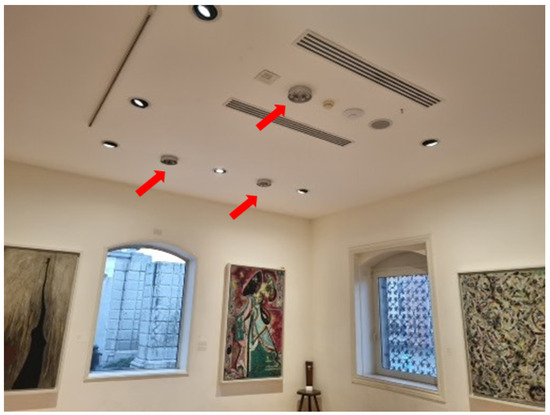
2.2. T and RH Monitoring

2.3. Sampling and Analysis of Gaseous Pollutants
2.4. Visitor Data: Acquisition
3. Results and Discussion
3.1. T and RH Monitoring
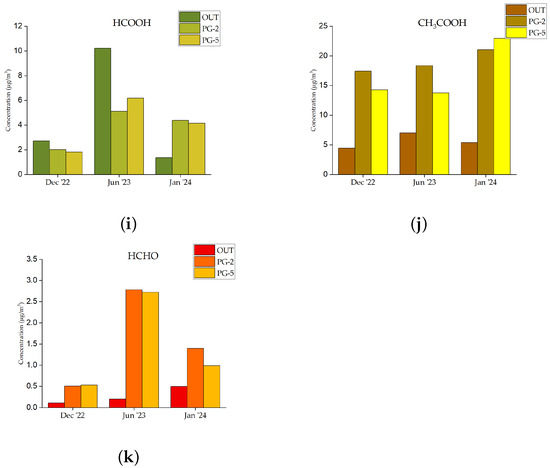
3.2. IAQ

Considering the homogeneous reaction between O3 and NO2 [41]:
during daylight hours outdoors, this reaction has little impact because the NO∗3 (nitrate radical) is photolytically unstable and rapidly breaks down in sunlight. Indoors, in the absence of direct sunlight, considering also that windows have glass with UV protection, NO∗3 can react with NO2 to form N2O5 (dinitrogen pentoxide), as shown in reaction (2):
N2O5 can then undergo hydrolysis with water (reaction (3))
or react with organic compounds (ORGs) via reaction (4)
both of which contribute to the formation of HNO3.
Considering the high concentration of O3, this reaction could result in a decrease in NO2 and the formation of nitric acid. Moreover, NO2 is a precursor of HONO and HNO3 through reaction (5), involving water absorbed on surfaces [42,43]:
Reaction 5 can evolve as follows:
with the release of acid into the surrounding environment. The concentrations of HONO indoors were invariably higher than those outdoors, with a maximum value of 13 μg/m3 in December (PG-5), while the June campaign showed the highest value of the ratio I/O, with an average of 16. In contrast, indoor concentrations of HNO3 were invariably lower than outdoor concentrations due to the elevated deposition velocity on the surface [44]. The concentration of HNO3 deposited on a surface can be evaluated from the HONO measurements in the atmosphere [45].
3.3. Effect of Visitors on NH3 Concentration

Elevated ammonia levels can have significant and detrimental effects on cultural artifacts over the long term. These effects can vary based on the material of the artifacts and their environmental exposure. Ammonia is highly soluble in water, which can contribute to chemical reactions that lead to deterioration and can lead to corrosion of metal artifacts. It reacts with copper-based artifacts to form copper ammine complexes, which are water-soluble and can result in a loss of metal from the surface layer [54]. On paintings and coated surfaces, ammonia can act as a catalyst for various degradation processes. It can also potentially react with inorganic pigments, altering the visual properties and historical accuracy of artworks [54]. Moreover NH3 can react with HNO3 (reaction (7))
to form ammonium nitrate, a strong oxidizer in the aerosol phase, which then deposits on the surfaces [55].
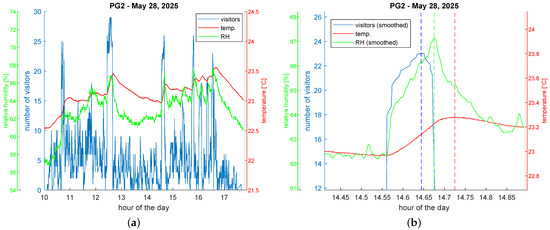
3.4. Effect of Visitors on T and RH




4. Conclusions
-
Prioritize NH3 and HCHO reduction through improved ventilation during peak hours;
-
Cost-effective passive samplers (as used in this study) can provide reliable data for long-term IAQ assessment to balance public access with long-term conservation goals;
-
Keep to the minimum fluctuations of the number of visitors in each room;
-
Limit occupancy in sensitive areas and use real-time IAQ monitoring to adjust connected HVAC systems dynamically.
