
 info@apippress.com
 +86 18163351462 (WhatsApp)
 +86 182 8014 0209
Article Content
Abstract
Rationality is a widely accepted assumption in psychology and economics, but there is limited understanding of its elements. This study uses an experimental methodology, the beauty contest game, and extends it to a newly designed cheating contest game to distinguish rationality into optimality and consistency. The experiment consists of seven rounds. We include N = 52 participants. The results show that (1) human rationality is comprised of optimality and consistency, and (2) optimality is the dominant notion. In conclusion, we observe a dualism of rationality. This study provides insight into the elements of rationality and can guide future research in psychology and economic sciences.
Explore related subjects
Discover the latest articles and news from researchers in related subjects, suggested using machine learning.
- Behavioral Economics
- Behaviorism
- Cognitivism
- Economic Psychology
- Experimental Economics
- Game Theory
Introduction
The question of how humans make decisions has fascinated philosophers and psychologists for centuries. One long-standing debate in the field of psychology and economics is whether human rationality is a unified, singular entity or dualistic. The dualism of human rationality refers to the idea that our cognitive processes can be separated into two distinct modes of thinking: the notion of optimality and consistency. This dualistic approach has important implications for our understanding of cognitive processes and decision making. By examining a dualism of rationality, we can better understand how we make decisions and how we can improve our decision making in future.
Seminal work by Nagel (1995) as well as Grosskopf and Nagel (2008) has utilized guessing games to study rational thinking in experimental psychology and economics. Those studies are analyzing the depth and sequencing of reasoning. They corroborate the psychology of bounded rationality in decision making (Hoff & Stiglitz, 2016; Hursh & Roma, 2016).
In this paper, we will explore the determinants of the dualism of rationality. Since we study the notions of optimality and consistency, we equally denote this as the optimality–consistency dualism. This term is borrowed from the wave–particle dualism first introduced in physics nearly a century ago by De Broglie in 1924. Uncovering a dualism would be a ground-breaking notion regarding human decision making. Furthermore, we are examining the implications of this approach in order to obtain a better understanding for decision making in everyday life. Ultimately, we aim to provide an overview of the dualism of rationality and its impact on the human mind.
Max Weber, the sociologist, proposed this concept, wherein he distinguished between two types of rationality: instrumental rationality and value rationality (Weber, 1925). Instrumental rationality refers to the motivation of selecting the optimal means (Kalberg, 1980). Conversely, value rationality refers to behavior where individuals choose consistent outcomes. Our focus is to investigate whether rationality encompasses both notions, such as optimality (i.e., optimal means) and consistency (i.e., consistent outcomes). We explore this idea through an experimental study. This study aims to determine the significance and predominance of each notion of rationality.
To investigate the dualism, we employ the “beauty contest game” as a benchmark methodology. This game was originally introduced by Keynes in 1936. We provide further details in the section on “Experimental Methodology.” In general, the experiment involves n participants who simultaneously select a number from a closed interval between 0 and 100. After each round, the winner is the person whose chosen number is closest to the mean of all participants multiplied by a predetermined and known p-parameter, for instance, p = ½ (Nagel, 1995). The winner receives a monetary reward, while the other participants receive nothing.
Yet, our study aim goes beyond the depth of rationality discovered among others by Nagel (1995). We aim to disentangle the two notions of rationality. To achieve this goal, we introduce a variant of the beauty contest game, known as the “cheating contest game” (Herzog, 2015). In this game, all participants are provided with instructions of the beauty contest game and play the (beauty contest) game for three consecutive rounds, allowing all participants to witness the working of the game. To win the beauty contest game, participants must exhibit consistent reasoning and adhere to the optimality notion by the Nash equilibrium. Starting from the fourth round, we switch to playing the cheating contest game, without disclosing the change to the participants.
This means that all players must assume that they are still playing the beauty contest game. The mere difference under the cheating contest game is that the winning number is manipulated by a hidden algorithm that is not observable by anyone, including the instructor and the players. Thus, in the cheating contest game, players who continue to follow the beauty contest strategy cannot win the game. Those who adjust their behavior have a higher probability of winning. Noteworthy, in the cheating environment, the optimal strategy is a backward-looking heuristic, which contradicts the instruction of the (beauty contest) game. By observing behavioral adaption in the cheating contest game, we can determine the dualism and which of the notions are dominant. Through the new variant and sequencing of two guessing games, we aim to investigate both the consistency and optimality notion of rationality.
The experimental design allows us to determine whether participants utilize the optimality and consistency notion with different degrees over time. The rationale is straightforward: If players’ guesses converge toward zero in the first three rounds, they are acting in an optimal and consistent manner, following the Nash equilibrium of the beauty contest game. However, if players deviate from this pattern in later rounds, specifically in the cheating contest game, they are following the optimal notion of winning but contradict the consistency principle, which is following the rule of the game. The sequential and hidden structure of both games illuminates the dualism of rationality.
Overall, we are testing two hypotheses: (1) Players’ guesses converge toward zero in rounds I to III of the beauty contest game. (2) Players’ guesses deviate from the Nash equilibrium of zero in rounds IV and onward of the cheating contest game.
Our study finds support for both hypotheses. Indeed, we cannot reject hypothesis (1) and (2). The consistent behavior entails following the rule of the beauty contest game and the Nash equilibrium. The notion of optimality, on the other hand, involves choosing numbers to win the game even after round IV. Playing the beauty contest game demonstrates that rationality follows the optimality and consistency notion in general. Yet, behavioral adaption demonstrates that human rationality mainly consists of optimality, while it is inconsistent to the rule of the game and rather follows a consistent heuristic. Our study reveals that humans are prioritizing winning the game or the optimality notion. Thus, optimality is the dominant feature in the dualism of human rationality. Overall, our experimental approach sheds light on the hidden interplay of rationality in human decision making.
Literature Review
Keynes (1936) introduced the concept of a beauty contest game, which compares professional investment strategies with newspaper competitions in which participants select the six most attractive faces out of one hundred pictures based on what they believe others will find most beautiful. Moulin (1982) subsequently developed the beauty contest game in theory, which Nagel (1995) examined in a first experimental study. Since then, research on the beauty contest game has gained popularity, including studies by Weber (2003), Kocher et al. (2005; 2006), Sutter (2005), Slonim (2005), and Chou and McConnel (2009).
The beauty contest game challenges the rationality assumption in economics and particularly game theory. Nagel (1995) found that the depth of reasoning was shorter than the prescription in economic theory. However, convergence to the Nash equilibrium was still achieved through learning theories (Erev & Roth, 1995; Evans & Honkapohja, 2005; Selten & Buchta, 1994; Weber, 2003). Modifications to guessing games demonstrate that the group size and information setting have an impact on the notion of rationality. For instance, Weizsäcker (2003) found that participants underestimated the rationality of their opponents, while Grosskopf and Nagel (2007) showed that individuals behaved rationally, but the group as a whole adapted. Similarly, Sbriglia (2008) found that social learning, particularly imitation, accelerates the learning process. Crawford (2013) argued that the Nash equilibrium is achieved through learning over time, while MacLeod (2016) developed a model to examine how individuals learn.
In this paper, we introduce a new variant of guessing games, denoted as the cheating contest game designed by Herzog (2015). A cheating contest game is a generalization of the beauty contest game. Furthermore, our research is related to the axiomatic literature in decision theory (Samuelson 1948; Aumann 1995, 1999; Halpern, 2003) that traces the origins of rationality to the work of von Neumann (1928) and Samuelson (1938). Equally, Mailath (1998) studied the notion of rational thinking over time and identified two elements for achieving the Nash equilibrium: optimization and consistency. We resume this idea and develop the first experimental examination for this theory.
Experimental Methodology
The p-beauty contest game has n participants. They simultaneously choose a number from a closed interval between 0 and 100. The winner is the person whose chosen number is closest to the mean of all number’s times the p-parameter (), where p is a predetermined and known, e.g., p = ½ (Nagel, 1995). The winner receives a fixed amount of money, whereas the other subjects receive nothing. If there is a tie, the prize is split equally.
In this study, a control group is formed by playing the first three rounds of the beauty contest game, followed by a treatment group of four consecutive rounds of the p-cheating contest game. The game change is not made public to the participants. They only have the description for the p-beauty contest game (Appendix A). The p-cheating contest game follows the same rule as the beauty contest, but with a twist. In the treatment group, the instructor announces a twisted winning number (“announced number”), which is automatically manipulated by an algorithm. Neither the participants nor the instructor is aware of this manipulation, and they expect the same rule of the game in each round as before. Thus, the cheating contest game follows the objective rule of the beauty contest game, but a hidden algorithm manipulates the winning numbers.
The algorithm creates a zigzag pattern of announced numbers, leading to a backward-looking heuristic for winning. A consistent heuristic always anchors the past outcome due to uncertainty under the cheating contest game according to the literature (Gigerenzer et al., 1999). If participants adopt to this heuristic, we reject the consistency notion under the beauty contest game in our experiment, while mainly persevering the optimality notion.
The experimental design is based on the rationale that the winning strategy in rounds I to III of the beauty contest game is a gradual convergence to the Nash equilibrium at zero, which follows both notions of optimality and consistency. In contrast, the strategy in the cheating contest game is different. Players who follow the objective rule do not win and violate the optimality notion of rationality. However, players who adapt to the heuristic are likely to win and optimize their overall payoff, but violate the consistency notion by breaking with the Nash equilibrium under the beauty contest game. Therefore, if we observe behavioral adaption in the cheating game, we can confirm the presence of both notions. Additionally, we can identify which notion dominates rational thinking.
We aim to reduce any selection and time bias in our experiments. Thus, we conducted the experiment on different days in 2018. Our sample consisted of N = 52 participants who were randomly selected and had no prior knowledge of the beauty contest game. The participants had an average age of 36.4 years and a standard deviation of 17.3 years, with a 50% female representation. On average, participants had 13.8 years of professional experience, and 14 of them were students. We invited six to ten participants to our laboratory at the same time. Each participant was seated at a separate desk to prevent communication (Appendix C). The instructor provided a clear explanation of the game and addressed any questions. In order to incentivize rational thinking, we followed the literature and offered a 50 Euro reward to the winner, either in pecuniary or equivalent gift form. We supplemented the experimental results with two questionnaires: one after round three and another at the end (Appendix D & E).
Results and Discussion
The analysis of our results is divided into two parts. The first part focuses on rounds I to III of the beauty contest game, which serves as the control group. In the second part, we examine the cheating contest game of rounds IV and higher, which is the treatment group. By comparing the two game setups, we aim to shed light on the dualism of rationality.
Rounds I to III: p-Beauty Contest Game (control group)
Following Nagel’s (1995) methodology, we analyze the adjustment toward the Nash equilibrium over time. First, we focus on rounds I to III of the beauty contest game, which serves as our control group. In Fig. 1, we display the relative frequencies of participants’ first-round choices. Notably, none of the participants chose the Nash equilibrium of zero in round one, with only 9.5 percent opting for numbers below ten. This finding supports Nagel’s (1995, p. 1325) observation of a low degree of reasoning, as the statistical mode of 25 is the “naive best response” (Fig. 1).
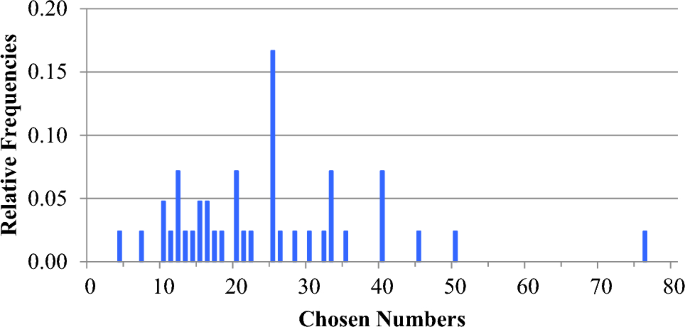
Source: authors calculations
Relative frequencies of first-period choices.
To delve deeper into the depth of reasoning, we examine the histogram of responses. We set the reference point for all guesses in round I at the number of 50 and calculate the iterated reference points by multiplying 50 * 0.5*(1/r), where r is the number of rounds. We find that 89 percent of first-period choices fall within iteration steps zero to three, with more than 50 percent of choices within the intervals of step one and two. This follows Nagel’s (1995) seminal findings. Only 5 percent of agents exhibit a higher degree of reasoning. Based on these results, we conclude, on average, all participants play optimally and consistently according to the rules of the beauty contest game in the first rounds (Fig. 2).
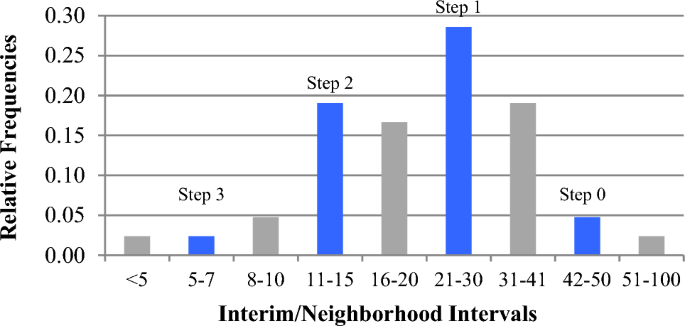
Source: authors calculations
Interval classification with reference point 50.
However, it is noteworthy that our experimental results show slightly higher outcomes than those reported by Nagel (1995), with a mean value of 14.4 and a median of 9.5, whereas Nagel reported a mean of 3.8 and a median of 2.8. We calculate the convergence rates, denoted by w, over three rounds, using the formula:
The mean convergence rate is of 0.85, and the median convergence rate is of 0.59 in our study. Notably, Nagel (1995) reports a mean convergence rate of 0.46 and a median of 0.75, which suggests that participants in our study converge slower to the Nash equilibrium in round I to III. One possible explanation for this is the smaller group size in our experiments, which has been shown to promote a slower adjustment to the Nash equilibrium (Camerer et al., 1998).
Figure 3 depicts the progression of choices from one round to the next. In rounds I to II, choices range between 10 and 20. From rounds II to III, the majority of choices are below the trend line, indicating that participants are converging faster toward the Nash equilibrium at zero. In round III,Footnote1 we find that 59 percent of the choices display an optimal adjustment factor according to learning theory (Weber, 2003).
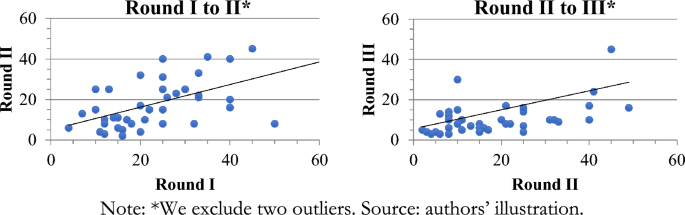
Source: authors’ illustration
Game results round I to III. *We exclude two outliers.
Rounds IV and Higher: p-Cheating Contest Game (treatment group)
In round IV and subsequently, we elucidate the behavioral reaction under the cheating contest game. Note, in the cheating contest game, the algorithm computes the announced number in round IV based on all guesses multiplied by a predefined cheating parameter of 1.2. In round V, the cheating parameter is of 0.7, and in round VI it is of 1.1. This zigzag pattern exhibits a weak trend toward the Nash equilibrium with significant up- and down-swings.
Figure 4 represents the primary result of our study. The blue line denotes the mean guesses, while the gray line shows the median guesses. For rounds I to III, we observe the adjustment of the control group under the beauty contest game. The results of rounds IV to VII represent the treatment group in the cheating contest game. The dashed lines indicate the transition period between the two (hidden) games.
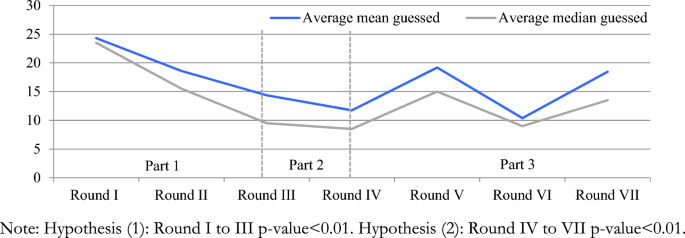
Source: authors
Development of the average mean/median guessed from round I to VII. Notes: Hypothesis (1): round I to III p-value < 0.01. Hypothesis (2): round IV to VII p-value < 0.01.
According to Nagel (1995), we observe adjustment of guesses and convergence to zero until round IV, which is expected since the beauty contest game has the Nash equilibrium at zero (Fig. 4). After the completion of round III, we administered our first questionnaire. Although the game change is hidden, agents in the treatment group do not follow the beauty contest game anymore. We observe a zigzag pattern and a divergence from the equilibrium of zero in the treatment group. The majority of agents adapted to a backward-looking heuristic instead of adhering to the rule of the beauty contest game. As a result, they play according to the optimality notion in the cheating contest game but reject the notion of consistency in the beauty contest game.
We confirm the behavioral adaptation in the cheating contest game by conducting ANOVA tests. Table 1 presents the results and significance of the test-statistic. We found that 88% of participants decreased their guesses according to the rationale in the beauty contest game. However, under the cheating contest game, this number dropped significantly to 14% (p-value < 0.01).
It is worth noting that in round V, approximately two-thirds of all participants increased their guesses in order to win, demonstrating that the optimality notion is prevalent. In summary, our study shows that agents in the control group follow the rule of the game. Thus, we cannot reject hypothesis (1). On the other hand, agents in the treatment group adopt, which cannot reject hypothesis (2). We observe that agents behave optimally in both environments; thus, the optimality notion is prevalent and dominant. As a result, human rationality comprises both optimality and consistency, with the optimality notion being dominant.
Table 2 summarizes the relationship between announced numbers and guessed numbers in our treatment group. Until round III, agents conform to the rule of the beauty contest game by selecting decreasing numbers toward zero. However, this behavior changes after round IV, and agents adjust their guesses to numbers well above zero in order to increase their chances of winning the game. Of course, under uncertainty previous studies such as Gigerenzer et al. (1999), Gigerenzer and Gaissmaier (2011), and Neth and Gigerenzer (2015) have shown that agents tend to rely on heuristics rather than given rules. Our finding even confirms the evidence from this literature, even though we apply a different experimental design. This cross-check strengthens the robustness of our experimental setup. It is noteworthy that none of the participants in the treatment group adhered to a declining pattern of the Nash equilibrium. This finding underscores the dominance of the optimality notion of rationality.
However, our experimental design is not without limitations. One major limitation is the timing of the first questionnaire, which was conducted after round III. It is possible that this questionnaire may have affected the game outcome. Further research is necessary to explore this possibility. Additionally, our sample size of N = 52 is relatively small, although it is comparable to other studies in this field. To address this limitation, we plan to conduct further experiments and employ Bayesian statistical methods to increase the sample size.
Our findings suggest the following implications. There is a dualism of human rationality comprised of both optimality and consistency. Moreover, the two notions of rationality may not always be aligned. Specifically, the optimality notion is dominant and it refers to the ability to make choices that maximize expected utility, whereas the consistency notion refers to the ability to follow rules or norms. Our research suggests that, in some contexts, individuals may prioritize the optimality notion over the consistency notion, leading them to behave heuristically rather than following established rules or norms. These findings have important implications for our understanding of human decision making and the design of decision-making environments in public policy, e.g., carbon taxation in order to mitigate greenhouse gas emissions.
Conclusion
In conclusion, this article analyzes the beauty contest game in combination with the novel cheating contest game. Within this game architecture, we observe a dualism of rationality which is elucidated through a comparison of both games. In the control group, the analysis shows that agents play both optimally and consistently with the rule of the beauty contest game. On the contrary, the treatment group exhibits a zigzag pattern with a clear divergence away from the Nash equilibrium of zero. The game change is hidden, which implies that agents should always follow the consistent rule of the beauty contest game in all rounds.
These results contribute to a better understanding of human rationality and the impact of decision-making environments in public policy. We uncover and confirm a dualism of rationality. The experiment exhibits a new vantage point of rationality and corroborates the behavioral literature. Future research could explore the impact of different game structures, the timing of the questionnaire, and the effects of communication among participants on the outcomes.
Data Availability
The availability of data and material is guaranteed.
Code Availability
Not applicable.
Notes
-
We introduce a cheating for the first time to expedite convergence. The announced number of 6 is computed by multiplying the mean guess of 13.4 by p = 0.5 and the predefined cheating coefficient of 0.9.
References
-
Ariely, D. (2008). Predictably irrational. HarperCollins.
-
Arrow, K. J. (1989). Economic theory and the hypothesis of rationality. In J. Eatwell, M. Milgate, spsampsps P. Newman (Eds.), The new palgrave: Utility and probability (pp. 25–39). Macmillan. https://doi.org/10.1007/978-1-349-21315-3_27
-
Conlisk, J. (1996). Why Bounded Rationality? Journal of Economic Literature, 34(2), 669–700. http://www.jstor.org/stable/2729218
-
Conlisk, J. (1996a). Why bounded rationality? Journal of Economic Literature, 34(2), 669–700. https://doi.org/10.1257/jel.34.2.669
-
De Broglie, L.-V. (1924). A tentative theory of light quanta. Philosophical Magazine, 47(281), 446–458. https://doi.org/10.1080/14786442408634378
-
Dualism. (2016). In Oxford English dictionary online. Oxford University Press.
-
Erev, I., & Roth, A. E. (1995). Learning in extensive-form games: Experimental data and simple dynamic models in the intermediate term. Games and Economic Behavior, 8(1), 164–212. https://doi.org/10.1016/S0899-8256(05)80020-X
-
Evans, G. W., & Honkapohja, S. (2005). An interview with Thomas. J. Sargent. Macroeconomic Dynamics, 9(4), 561–583.
-
Gigerenzer, G., Todd, P. M., & ABC Research Group. (1999). Simple heuristics that make us smart. Oxford University Press.
-
Gigerenzer, G., & Gaissmaier, W. (2011). Heuristic decision making. Annual Review of Psychology, 62(1), 451–482. https://doi.org/10.1146/annurev-psych-120709-145346
-
Grosskopf, B., & Nagel, R. (2007). Rational reasoning or adaptive behavior? Evidence from two-person beauty contest games. Harvard NOM Research Paper, (01–09). https://papers.ssrn.com/sol3/papers.cfm?abstract_id=286573#
-
Grosskopf, B., & Nagel, R. (2008). The two-person beauty contest. Games and Economic Behavior, 62(1), 93–99. https://doi.org/10.1016/j.geb.2007.03.004
-
Halpern, J. Y. (2003). A computer scientist looks at game theory. Games and Economic Behavior, 45(1), 114–132. https://doi.org/10.1016/S0899-8256(02)00529-8
-
Herzog, B. (2015). Anchoring of expectations: The role of credible targets in a game experiment. Journal of Economic and Financial Studies, 3(6), 1–15. https://doi.org/10.18533/jefs.v3i6.169
-
Ho, T.-K., Camerer, C. & Weigelt, K. (1998). Iterated dominance and iterated best response in “p-beauty contests”. American Economic Review, 88(4), 947–969. https://www.jstor.org/stable/117013
-
Hoff, K., & Stiglitz, J. E. (2016). Striving for balance in economics: Towards a theory of the social determination of behavior. Journal of Economic Behavior & Organization, 126(June), 25–57. https://doi.org/10.1016/j.jebo.2016.01.005
-
Hursh, S. R., & Roma, P. G. (2016). Behavioral economics and the analysis of consumption and choice. Managerial and Decision Economics, 37(4–5), 224–238. https://doi.org/10.1002/mde.2724
-
Jager, W. (2003). Breaking bad habits: a dynamical perspective on habit formation and change. In: L. Hendrickx, W. Jager, L. Steg, eds. Human decision-making and environmental perception – understanding and assisting human decision-making in real-life settings. Liber Amicorum for Charles Vlek. Groningen: University of Groningen.
-
Kalberg, S. (1980). Max Weber’s types of rationality: Cornerstones for the analysis of rationalization processes in history. American Journal of Sociology, 85(5), 1145–1179.
-
Keynes, J. M. (1936). The General Theory of Employment, Interest and Money, Chapter 12. Harcourt Brace and Co.
-
Khrennikov, A., Basieva, I., Pothos, E.M. & Yamato, I. (2018). Quantum probability in decision making from quantum information representation of neural states. Nature, Scientific Report No. 8, No. 16225, p. 1–8. https://doi.org/10.1038/s41598-018-34531-3
-
Kydland, F. E., & Prescott, E. C. (1977). Rules rather than discretion: The inconsistency of optimal plans. Journal of Political Economy, 85(3), 473–491. https://www.jstor.org/stable/1830193
-
Lucas, R.E. (1976). Econometric policy evaluation: A critique. Carnegie-Rochester Conference Series on Public Policy, 1(1), 19–46. http://www.sciencedirect.com/science/article/pii/S0167-2231(76)80003-6
-
MacLeod, W. B. (2016). Human capital: Linking behavior to rational choice via dual process theory. Labor Economics, 41(1), 20–31. https://doi.org/10.1016/j.labeco.2016.05.019
-
Mailath, G. J. (1998). Do people play Nash equilibrium? Lessons from evolutionary game theory. Journal of Economic Literature, 36(3), 1347–1374. http://www.e-jel.org/archive/sept1998/Mailath.pdf
-
Muth, J. F. (1961). Rational expectations and the theory of price movements. Econometrica, 29(3), 315–335. https://doi.org/10.2307/1909635
-
Nagel, R. (1995). Unraveling in guessing games: An experimental study. American Economic Review, 85(5), 1313–1326. https://www.jstor.org/stable/2950991
-
Nagel, R., Heinemann, F., & Ockenfels, P. (2009). Measuring strategic uncertainty in coordination games. Review of Economic Studies, 76, 181–221. https://doi.org/10.1111/j.1467-937X.2008.00512.x
-
Neth, H., & Gigerenzer, G. (2015). Heuristics: Tools for an Uncertain World. Emerging Trends in the Social and Behavioral Sciences. https://doi.org/10.1002/9781118900772.etrds0394
-
Sbriglia, P. (2008). Revealing the depth of reasoning in p-beauty contest games. Experimental Economics, 11(2), 107–121. https://doi.org/10.1007/s10683-006-9157-6
-
Selten, R., & Buchta, J. (1994). Experimental sealed bid first price auction with directly observed bid functions. discussion Paper No. B–270. Bonn: University of Bonn.
-
Selten, R., & Stoecker, R. (1986). End behavior in sequences of finite prisoner’s dilemma supergames: A learning theory approach. Journal of Economic Behavior, 7(1), 47–70. https://doi.org/10.1016/0167-2681(86)90021-1
-
Simon, H. A. (1959). Theories of decision-making in economics and behavioral science. American Economic Review, 49(3), 253–283. https://www.jstor.org/stable/1809901
-
Von Neumann, J. (1928). Zur Theorie der gesellschaftsspiele. Mathematische Annalen, 100, 295–320. https://doi.org/10.1007/BF01448847
-
Weber, M. (1925). Wirtschaft und Gesellschaft (2nd ed.). Mohr.
-
Weber, R. A. (2003). ‘Learning’ with no feedback in a competitive guessing game. Games and Economic Behavior, 44(1), 134–144. https://doi.org/10.1016/S0899-8256(03)00002-2
-
Weizsäcker, G. (2003). Ignoring the rationality of others: Evidence from experimental normal-form games. Games and Economic Behavior, 44(1), 145–171. https://doi.org/10.1016/S0899-8256(03)00017-4
-
Weizsäcker, G. (2010). Do We follow others when we should? A simple test of rational expectations. American Economic Review, 100(5), 2340–2360. https://doi.org/10.1257/aer.100.5.2340
Acknowledgements
We appreciate remarks on a preliminary paper version at different workshops and conferences. In addition, we thank our research assistants Mara Möller and Adrian Elsässer for valuable comments on the paper.
Funding
Open Access funding enabled and organized by Projekt DEAL. No external or special public funding is utilized in this project. The project was funded from regular, basic, and non-competitive university funds.
Ethics declarations
Conflict of Interest
The authors declare that they have no conflict of interest.
Consent to Participate
Consent to participate is given by each person. We include an appropriate statement in our paper.
Consent for Publication
Consent for using the data and for publication is given by participants.
Ethics Approval
The authors have an ethics waiver, and the experiment does not contain ethical conflicts.
Additional information
Rights and permissions
Open Access This article is licensed under a Creative Commons Attribution 4.0 International License, which permits use, sharing, adaptation, distribution and reproduction in any medium or format, as long as you give appropriate credit to the original author(s) and the source, provide a link to the Creative Commons licence, and indicate if changes were made. The images or other third party material in this article are included in the article’s Creative Commons licence, unless indicated otherwise in a credit line to the material. If material is not included in the article’s Creative Commons licence and your intended use is not permitted by statutory regulation or exceeds the permitted use, you will need to obtain permission directly from the copyright holder. To view a copy of this licence, visit http://creativecommons.org/licenses/by/4.0/.
Reprints and permissions
About this article
Cite this article
Herzog, B., Schnee, S. Dualism of Rationality: Evidence from a New Guessing Game. Psychol Stud (2025). https://doi.org/10.1007/s12646-025-00839-0
- Received
- Accepted
- Published
- DOI https://doi.org/10.1007/s12646-025-00839-0
Keywords
- Guessing games
- Dualism of rationality
- Optimality
- Consistency
- Behavioral economics
- 2260
- 3320
- 2343
- 3312
