
 info@apippress.com
 +86 18163351462 (WhatsApp)
 +86 182 8014 0209
Article Content
Abstract
To explore the relationship between depression and life meaning of police college students, and analyze the mediating effects of negative cognitive processing bias and core self-evaluation. A questionnaire survey was conducted among 400 police college students by convenient sampling method. A general information questionnaire, negative cognitive processing bias questionnaire, meaning of life questionnaire, core self- evaluations scale, and the center for epidemiologic studies depression Scale were administered to the students. The relationship between negative cognitive processing bias, core self-evaluation, depression and sense of meaning in life was analyzed by Pearson. Amos 26.0 software was used to establish the structural equation model and test the mediation effect. A total of 410 questionnaires were received in this study, and 400 valid questionnaires were obtained by excluding incomplete data, with an effective rate of 97.56%. Pearson correlation analysis showed that depression was negatively correlated with sense of life meaning and core self-evaluation. It was positively correlated with negative cognitive processing bias (P < 0.05). Negative cognitive processing bias and its dimensions were negatively correlated with sense of life meaning and core self-evaluation (P < 0.05). The core self-evaluation was positively correlated with the sense of life meaning (P < 0.05). In addition, negative cognitive processing bias and core self-evaluation play a chain mediating effect between depression and sense of meaning in life. The total indirect effect accounted for 72.65% of the total effect, among which the specific mediating effect of core self-evaluation accounted for 18.39%, the specific mediating effect of negative cognitive processing bias accounted for 43.05%, and the chain mediating effect of negative cognitive processing bias and core self-evaluation between depression and life meaning accounted for 11.21%. There is significant correlation between depression and sense of meaning of life, negative cognitive processing bias and core self-evaluation, and the negative cognitive processing bias and core self-evaluation play a chain mediating effect between depression and sense of meaning of life. Therefore, while paying attention to students’ depression, we should pay attention to the assessment of negative cognitive processing bias and core self-evaluation level, and take targeted measures to reduce the impact of students’ depression on their sense of meaning in life.
Explore related subjects
Discover the latest articles and news from researchers in related subjects, suggested using machine learning.
- Cognitive Psychology
- Cognition
- Critical Psychology
- Mental Health
- Positive Psychology
- Psychological Assessment
Introduction
The sense of life meaning is the degree to which an individual is aware of the meaning and goal of his life, that is, a subjective evaluation of whether his life is meaningful and whether life has goals (Mulahalilović 2021). The sense of meaning of life plays a key protective role in individual mental health, and plays an important role in shaping mental health, slowing down mental illness, and predicting suicidal behavior. It consistently predicts mental health to a certain extent, and individuals with a strong sense of meaning in life tend to have higher life satisfaction. Individuals with a low sense of life meaning are prone to anxiety, depression and other diseases and suicidal thoughts, while individuals with a high sense of life meaning have more harmonious interpersonal relationships and higher learning and work efficiency (Sutin 2023). In recent years, as the health education of college students is mostly a mere formality, especially the lack of life meaning education, it warns that college management workers should pay attention to and strengthen the education of life meaning while continuously improving the quality of college students. Therefore, it is of great practical and social significance to study the influence mechanism of life meaning of police college students.
Depression is a kind of emotional disorder characterized by significant long-term and stable depression, loss of interest and loss of pleasure, etc., which is characterized by high incidence, high recurrence rate, high suicide rate and high disability rate (Koh 2023). Depression is the main cause of the global total burden of disease and the main cause of disability. College students are in the stage of transition from late adolescence to early adulthood, and their psychological development is not mature enough, so they are a high incidence group of depression. Studies show that the overall depression detection rate of Chinese college students from 2011 to 2020 is 31.38%, much higher than the general population (Liu 2020). As the guardian of the future social security, police college students often face high-intensity training and psychological pressure. Depressive symptoms are not uncommon in this group, and not only do they affect an individual’s emotional state and daily life, they can also have long-term effects on careers. And students’ depressed mood may make it difficult for students to see the positive aspects of life and personal future goals, thus feeling that life lacks meaning. Therefore, this study puts forward hypothesis 1: depression has a negative predictive effect on the life meaning of police college students.
Cognitive Behavioral Therapy (CBT) and Rational Emotive Behavior Therapy (REBT) are two types of psychotherapy widely used in the treatment of depression. CBT emphasizes the role of individual cognitive processes in emotion regulation and believes that negative cognitive patterns are an important factor in the maintenance and exacerbation of depressive symptoms. REBT further points out that individual unreasonable beliefs are the main cause of emotional distress. Both therapies emphasize improving emotional states by changing an individual’s cognitive patterns. According to the theories of CBT and REBT, negative stressful events can trigger an individual’s cognitive mode, and then affect the way of receiving and processing information, forming a cognitive processing mode biased toward negative information, and thus producing a negative cognitive processing bias. Negative cognitive processing bias refers to a cognitive trait in which individuals have processing preferences for negative information during information processing, including negative attention bias, negative memory bias and negative interpretation bias (Wang 2020). Depression has a significant impact on individual cognition and mental health, which can increase individual sensitivity to negative information and form and maintain negative cognitive bias. Therefore, hypothesis 2 is proposed: negative cognitive bias plays a mediating role between depression and the life meaning of police college students.
Core self-evaluation, including individuals’ overall evaluation of their own abilities, values and performance, is a central factor affecting individuals’ mental health and behavior choices (Zou 2022) and is closely related to depression. People with a high core self-evaluation have a good mental state and level, have a recognized attitude toward their own abilities, and will formulate a career planning direction that is more in line with their interests, and have a clear pursuit of life goals. However, depression can affect individuals’ core self-evaluation, causing them to have a negative view of their own abilities and values, and such negative self-perception may further reduce their perceived meaning of life (Chen et al., 2022c). Therefore, hypothesis 3 is proposed: Core self-evaluation plays a mediating role between depression and the life meaning of police college students.
The classic schema theory of depression points out that there is a negative cognitive processing bias towards the world, the future and the self, which is an important pathogenic factor for the occurrence and development of depression. Relevant studies have shown that negative cognitive bias is reflected in the fact that individuals will have stronger emotional experience in response to negative stimuli, and will cause individuals to show more negative emotions, which will further affect their perception of the meaning of life and increase their susceptibility to depressive episodes (Duyser 2020). Other empirical studies have shown that core self-evaluation plays a mediating or regulating role between social environment, happiness and negative emotion (Chen 2022b). From the viewpoint of mediating effect, negative cognitive processing tends to exert a directional effect on external information processing through cognitive schema. When individuals are faced with unfavorable situations, they are prone to form negative cognitive schema of self-denial and doubt, which leads to lower core self-evaluation, lower happiness and even loss of life meaning. Therefore, hypothesis 4 is proposed: negative cognitive bias and core self-evaluation play a chain mediating role in depression and the life meaning of police college students.
Based on the above four hypotheses, this study intends to build a chain mediation model (Fig. 1), taking negative cognitive bias and core self-evaluation as the mediating variables, to deeply explore the impact of depression, negative cognitive bias and core self-evaluation on the meaning of life of police college students and their mechanism of action, and to provide educational effective countermeasures for improving the level of police college students’ sense of meaning of life.
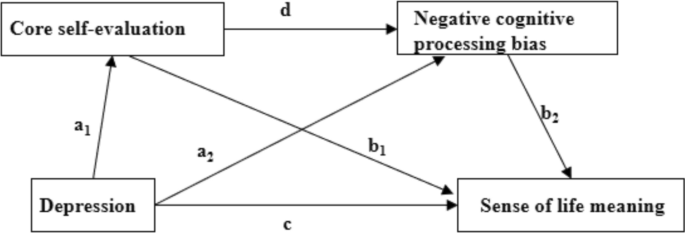
Conceptual models of depression, negative cognitive processing bias, core self-evaluation, and sense of meaning in life
Data and Methods
General Information
The convenient sampling method was used to conduct a questionnaire survey on police college students. A total of 410 questionnaires were received, and 400 valid questionnaires were obtained by excluding incomplete data, with an effective rate of 97.56%. Among them, 279 were male and 121 were female. The average age was 20.30 ± 1.21 years.
Investigation Method
After obtaining the informed consent of the participants, the research team followed standardized guidelines, used consistent guidelines to explain the contents of the questionnaire and the filling guidelines to the students in detail, and instructed them to fill out the questionnaire according to their actual situation. The questionnaire is issued and recovered by on-site operation.
Instrument of Survey
General Information Questionnaire: Collect general information such as gender and age of students. (2) Negative cognitive processing bias questionnaire (NCPBQ) Miao(2022) negative cognitive processing Bias questionnaire was used to compile a total of 15 items (such as “My attention is easily attracted by negative things and difficult to shift” and “I always remember my mistakes clearly”), including three dimensions: negative attention bias, negative memory bias and negative interpretation bias. The scale was scored on a 4-point Likert scale, with 1 indicating complete disagreement and 4 indicating complete agreement. Cronbach’s α coefficients of the three subscales in this study were 0.84, 0.88 and 0.82, respectively, while the α coefficients of the improved version in this study were 0.93. The higher the total score of the questionnaire, the higher the degree of negative cognitive processing bias. (3) Meaning of Life Questionnaire (MLQ) (Luo 2022): The life meaning questionnaire compiled by Steger was adopted, with a total of 10 items and a 7-level score (1 means “completely inconsistent”, 7 means “completely consistent”). The higher the total score, the stronger the sense of life meaning of an individual. The Cronbach’s α coefficient of this questionnaire in this study was 0.84. (4) Core self-evaluation (Lin 2022): This study adopted the Chinese revised version of the Core Self-Evaluations Scale (CSES), which was revised by domestic scholar Lin (2022) on the basis of the CSES compiled by Judge. It is often used to measure the core self-evaluation of domestic students. The revised scale contains a total of 10 items after eliminating the two questions that do not conform to the domestic culture, and each item adopts a 5-point score, from 1 representing “completely disagree” to 5 representing “completely agree”. Among them, items 2, 3, 5, 7, 8 and 10 of the scale are scored in reverse, and the total score is 10–50 points. The higher the score, the higher the core self-evaluation of the individual. Cronbach’s α of this scale was 0.82. (5) Center for Epidemiologic Studies Depression Scale (Cosco 2020): This study used the Center for Epidemiologic Studies Depression Scale (CES-D) developed by Radloff, which mainly evaluated the depressive symptoms of the participants in the last two weeks. A total of 20 items were included in the scale, all of which were scored in four grades, from 1 (occasionally) to 4 (most of the time), with the total score ranging from 0 to 60. The higher the score, the higher the frequency of depressive symptoms. In this study, the Cronbach α coefficient of this scale was 0.88.
Statistical Method
Statistical analysis was performed by SPSS 23.0. Measurement data were expressed as mean (M) ± standard deviation (SD) and were compared between groups using T-test. Count data use cases (%) were expressed, and chi-square test was used for comparison. Then AMOS 26.0 was used to establish the structural equation model and modify the model, and SPSS macro program PROCESS was used to test the effect size and standardized path coefficient of the intermediary model, so as to achieve a better model correction effect. P < 0.05 was considered to be statistically significant.
Results
Descriptive Analysis
Independent sample t test was conducted on gender in the dimensions of depression level, negative cognitive processing bias, core self-evaluation and sense of life meaning of police college students, and the results are shown in Table 1, from which it can be seen that students of different genders have no significant differences in depression level, negative cognitive processing bias, core self-evaluation and sense of life meaning (P > 0.05).
Common Method Bias
Common method bias was tested according to Harman single factor test. The results show that two of the unrotated eigenroots have factors greater than 1. The variance explained by the first factor is 38.42%, which is below the critical standard of 40%. Therefore, it can be concluded that the data in this study do not show significant common methodological bias.
Correlation Analysis of Depression, Negative Cognitive Processing Bias, Core Self-Evaluation and Sense of Life Meaning
The correlation analysis of depression, negative cognitive processing bias, core self-evaluation and sense of life meaning shows that depression level is negatively correlated with sense of life meaning and sense of core self-evaluation. It was positively correlated with negative cognitive processing bias (P < 0.05). The meaning of life and core self-assessment score decreased with the increase of depression level, and the negative cognitive processing bias and its dimensions increased with the increase of depression level. Negative cognitive processing bias and its dimensions were negatively correlated with sense of meaning of life and core self-evaluation (P < 0.05), which showed that sense of meaning of life and core self-evaluation score decreased with the increase of negative attention bias, negative memory bias, negative interpretation bias and negative cognitive bias. The core self-evaluation was positively correlated with the sense of life meaning (P < 0.05), which showed that the core self-evaluation score increased with the increase of the sense of life meaning score, as shown in Table 2.
Chain Mediation Model Validation
In order to effectively control the measurement error and test the mediating effect of NCPB and CSE on depression and sense of meaning of life, the structural equation modeling method was used to test the chain mediating effect. AMOS 26.0 was used to analyze the relationship between depression, NCPB, CSE and sense of meaning of life. After model modification, the fitting index was basically up to the standard (χ2/df = 0.163 < 3.000, CFI = 1.000 > 0.900, GFI = 0.999 > 0.900, RFI = 0.986 > 0.900, NFI = 0.994 > 0.900, RMSEA = 0.001 < 0.05), indicating that the model is valid.
As shown in Fig. 2, all standardized path coefficients were significant (P < 0.05). The results showed that depression could positively predict NCPB (β = 0.032, P < 0.001), and negatively predict CSE and sense of life meaning (β = − 0.119, P < 0.001; β = -0.061, P < 0.05). The results confirm hypothesis H1. CSE predicted the sense of life meaning positively (β = 0.345, P < 0.001) and NCPB negatively (β = − 0.068, P < 0.05). NCPB could negatively predict the sense of meaning of life (β = − 3.016, P < 0.05). Through the Bootstrap program, 2000 times of repeated sampling of the data were used to test the mediating effect, and it was found that NCPB and CSE did not contain 0 in the 95% confidence interval of depression and sense of life meaning, indicating that the mediating effect was significant. The results confirm hypotheses H2, H3 and H4. Further analysis of the effect size of each variable on sense of meaning of life: the total effect of depression to sense of meaning of life was – 0.223, the direct effect was – 0.061 (effect size 27.35%), and the total indirect effect was – 0.162 (effect size 72.65%). In addition, in the analysis of the chain-mediated effect of CSE and NCPB, the 95% confidence interval did not contain 0, indicating that the chain-mediated effect was significant, and the indirect effect size was – 0.025, accounting for 11.21% of the effect (Table 3).
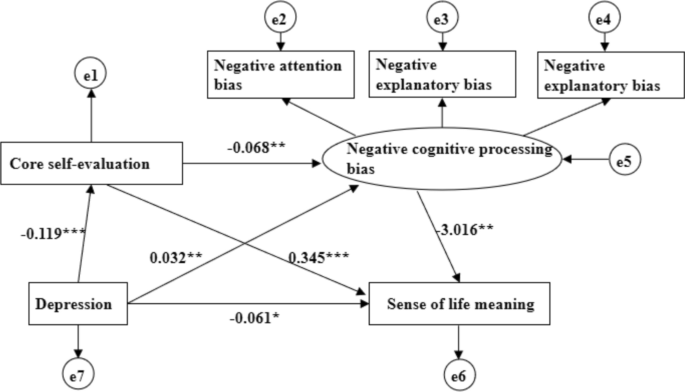
The model of the chain mediating effect of depression on the sense of life meaning. Note: *P < 0.05,**P < 0.01,***P < 0.001。
Discussion
This study constructed a chain mediation model to comprehensively explore the effects of depression, negative cognitive bias and core self-evaluation on police college students’ sense of meaning in life. The results show that depression can not only directly affect the sense of meaning of life of police college students, but also indirectly affect the sense of meaning of life of police college students through the mediating effect of negative cognitive bias and core self-evaluation and the chain mediating effect of negative cognitive bias and core self-evaluation.
The influence of Depression on the Meaning of Life of Police College Students
The results show that there is a negative correlation between depression and police college students’ sense of meaning in life, which verifies hypothesis 1. This is consistent with Chan (2022) findings that the higher the students’ sense of meaning in life, the lower the level of depression. Possible reasons for this are that depressed individuals often have problems with poor self-perception and decreased concentration. Moreover, numerous previous studies have shown that many depressed individuals have bad behaviors such as smoking, drinking and promiscuity, and are associated with the risk of self-injury or suicide (Chow 2021 & Binnewies 2021). In this study, the high score of students’ depression also indicates that students in the current environment are more likely to lose their pursuit and desire for life when facing pressure because of depression, that is, depression has a negative predictive effect on the sense of meaning of life.
The Mediating Role of Negative Cognitive Processing Bias
The research shows that the negative cognitive processing bias is a mediating variable of the influence of depression level on the meaning of life of police college students. That is, negative cognitive bias plays a mediating role in the relationship between depression and police college students’ sense of meaning in life. Hypothesis 2 is verified. This study shows that depression positively predicts negative cognitive processing bias, which is basically consistent with the research results of Li (2022), that is, individuals with a higher depressive tendency also have a higher negative cognitive processing bias. Orchard (2018) found that negative cognitive processing bias could accurately predict the level of depression, which was also confirmed by this study. Based on the cognitive schema theory, negative cognitive bias is the main cause of emotional problems. In the perception of environmental stimulation, ordinary people have a bias towards positive stimuli, while depressed emotions have a bias towards negative stimuli (Golonka et al., 2024). Through the analysis of the research results, it can be seen that the negative cognitive processing bias is positively correlated with the level of depression, showing that the negative cognitive processing bias and its dimensions increase with the increase of the level of depression, and then affect the students’ sense of life meaning.
The Mediating Role of Core Self-Evaluation
Research data show that core self-evaluation is another mediating variable for depression to predict the sense of life meaning of police college students, that is, depression can indirectly affect the sense of life meaning of students through core self-evaluation, which verifies hypothesis 3. The research results show that the level of depression can negatively predict the core self-evaluation, which is basically consistent with the research conclusion of Wang (2021). That is, higher levels of depression are associated with lower levels of core self-evaluation tendencies. As a protective factor of individual mental health, core self-evaluation is closely related to individual mental health. Individuals with high levels of depression tend to have lower core self-evaluation, which may be because when individuals are in a negative cognitive state, they will be more sensitive to negative information in life and take a pessimistic perspective on themselves, society and the future, thus affecting their sense of life meaning.
The Chain Mediating Effect of Negative Cognitive Processing Bias and Core Self-Evaluation
In exploring the mechanism between depression and students’ sense of meaning in life, the study also found an important chain mediating path from core self-evaluation to negative cognitive processing bias, and hypothesis 4 was verified. The research results show that core self-evaluation can negatively predict negative cognitive processing bias, which is consistent with the research results of Fredrick (2020). In other words, students’ depression will further affect students’ negative cognitive processing bias through affecting individual core self-evaluation, and finally affect students’ sense of life meaning. Core self-evaluation, as the overall evaluation of individual ability, value and performance, is the protective factor of individual mental health. Individuals with high core self-evaluation are more likely to adopt positive cognitive mode, while individuals with low core self-evaluation are more likely to fall into negative cognitive processing bias. Depressed mood may cause individuals to have a negative view of their own abilities and worth, which can lower core self-evaluation (Beevers 2019). Individuals with low core self-evaluation are more likely to intensify their sensitivity to negative information, forming a negative cognitive processing bias, and ultimately weakening students’ sense of life meaning. Therefore, police colleges should pay attention to students’ mental health while cultivating their professional skills. By providing psychoeducation, cognitive behavioral therapy, and positive psychological interventions, students are helped to identify and adjust negative cognitive biases, improve their core self-evaluation, and ultimately enhance their sense of meaning in life.
In summary, the influence of police college students’ sense of meaning of life is mainly related to students’ depression, negative cognitive processing bias and core self-evaluation, and the negative cognitive processing bias and core self-evaluation play a chain mediating effect between depression and sense of meaning of life. It is suggested that police colleges can reduce the negative impact of negative emotions on mental health by strengthening students’ mental health education, so as to enhance students’ sense of life meaning. However, this study still has some limitations. This is a cross-sectional study, and the relationships can then be better validated through multiple data collections using a longitudinal design based on the framework construction scheme. In addition, the samples of this study are from specific police college students, which may have sample bias, and the sample size needs to be further expanded to verify the establishment of the model.
Data availability
No datasets were generated or analysed during the current study.
References
-
Beevers, C. G., Mullarkey, M. C., Dainer-Best, J., Stewart, R. A., Labrada, J., Allen, J. J. B., McGeary, J. E., & Shumake, J. (2019). Association between negative cognitive bias and depression: A symptom-level approach. Journal of Abnormal Psychology, 128(3), 212–227. https://doi.org/10.1037/abn0000405
-
Binnewies, J., Nawijn, L., van Tol, M. J., van der Wee, N. J. A., Veltman, D. J., & Penninx, B. W. J. H. (2021). Associations between depression, lifestyle and brain structure: A longitudinal MRI study. NeuroImage, 231, Article 117834. https://doi.org/10.1016/j.neuroimage.2021.117834
-
Chan, W. C. H., Tin, A. F., & Yu, T. K. (2022a). Professional quality of life, depression, and meaning in life among helping professionals: The moderating role of self-competence in death work. Death Studies, 46(4), 958–968. https://doi.org/10.1080/07481187.2020.1793431
-
Chen, W., Yang, T., & Luo, J. (2022b). Core self-evaluation and subjective wellbeing: A moderated mediation model. Frontiers in Public Health, 10, 1036071. https://doi.org/10.3389/fpubh.2022.1036071
-
Chen, Y., Yu, X., Ma’rof, A. A., Zaremohzzabieh, Z., Abdullah, H., Halimatusaadiah Hamsan, H., & Zhang, L. (2022c). Social identity, core self-evaluation, school adaptation, and mental health problems in migrant children in China: A chain mediation model. International Journal of Environmental Research and Public Health, 19(24), 16645. https://doi.org/10.3390/ijerph192416645
-
Chow, M. S. C., Poon, S. H. L., Lui, K. L., Chan, C. C. Y., & Lam, W. W. T. (2021). Alcohol consumption and depression among university students and their perception of alcohol use. East Asian Archives of Psychiatry, 31(4), 87–96. https://doi.org/10.12809/eaap20108
-
Cosco, T. D., Lachance, C. C., Blodgett, J. M., Stubbs, B., Co, M., Veronese, N., Wu, Y. T., & Prina, A. M. (2020). Latent structure of the centre for epidemiologic studies depression scale (CES-D) in older adult populations: A systematic review. Aging & Mental Health, 24(5), 700–704. https://doi.org/10.1080/13607863.2019.1566434
-
Duyser, F. A., van Eijndhoven, P. F. P., Bergman, M. A., Collard, R. M., Schene, A. H., Tendolkar, I., & Vrijsen, J. N. (2020). Negative memory bias as a transdiagnostic cognitive marker for depression symptom severity. Journal of Affective Disorders, 274, 1165–1172. https://doi.org/10.1016/j.jad.2020.05.156
-
Fredrick, J. W., & Luebbe, A. M. (2020). Fear of positive evaluation and social anxiety: A systematic review of trait-based findings. Journal of Affective Disorders, 265, 157–168. https://doi.org/10.1016/j.jad.2020.01.042
-
Golonka, K., Piątek, E., & Stach, R. (2024). Study directions and development of cognitive theory of depression. Psychiatria Polska, 58(4), 669–680. https://doi.org/10.12740/PP/OnlineFirst/161676
-
Koh, S. J., Kang, K. A., Kim, H., Cheon, J., Im, H. S., Lee, J. H., Ock, M., Cho, J., & Lee, E. H. (2023). Perceptions of the meaning of life among Korean patients with advanced cancer: A mixed-methods study. Palliative & Supportive Care, 21(4), 658–669. https://doi.org/10.1017/S1478951522000979
-
Li, L., Li, R., Shen, F., Wang, X., Zou, T., Deng, C., Wang, C., Li, J., Wang, H., Huang, X., Lu, F., He, Z., & Chen, H. (2022). Negative bias effects during audiovisual emotional processing in major depression disorder. Human Brain Mapping, 43(4), 1449–1462. https://doi.org/10.1002/hbm.25735
-
Lin, X., Luan, Y., Zhao, G., Zhao, T., & Ding, H. (2022). Core self-evaluations increases among Chinese employees: A cross-temporal meta-analysis, 2010–2019. Frontiers in Psychology, 12, Article 770249. https://doi.org/10.3389/fpsyg.2021.770249
-
Liu, Q., He, H., Yang, J., Feng, X., Zhao, F., & Lyu, J. (2020). Changes in the global burden of depression from 1990 to 2017: Findings from the Global Burden of Disease study. Journal of Psychiatric Research, 126, 134–140. https://doi.org/10.1016/j.jpsychires.2019.08.002
-
Luo, J., Tang, F. C., Yang, R., Gong, J., Yao, C. K., Huang, X., Chen, W., & Zhao, S. Y. (2022). Longitudinal measurement invariance of the meaning in life questionnaire in Chinese college students. Frontiers in Psychology, 13, 1001548. https://doi.org/10.3389/fpsyg.2022.1001548
-
Miao, K., Liu, X., Zhang, X., Li, Y., Liao, X., Zhang, R., Feng, Z., & Chen, Z. (2022). Revision and psychometric properties of the negative cognitive processing bias scale. Frontiers in Psychiatry, 13, 1013108. https://doi.org/10.3389/fpsyt.2022.1013108
-
Mulahalilović, A., Hasanović, M., Pajević, I., & Jakovljević, M. (2021). Meaning and the Sense of Meaning in Life from a Health Perspective. Psychiatria Danubina, 33(Suppl 4), 1025–1031.
-
Orchard, F., & Reynolds, S. (2018). The combined influence of cognitions in adolescent depression: Biases of interpretation, self-evaluation, and memory. British Journal of Clinical Psychology, 57(4), 420–435. https://doi.org/10.1111/bjc.12184
-
Sutin, D. A. R., Luchetti, M., Aschwanden, D., Stephan, Y., Sesker, A. A., & Terracciano, A. (2023). Sense of meaning and purpose in life and risk of incident dementia: New data and meta-analysis. Archives of Gerontology and Geriatrics, 105, Article 104847. https://doi.org/10.1016/j.archger.2022.104847
-
Wang, M. Y., Liu, J., Wu, X., Li, L., Hao, X. D., Shen, Q., Huang, M. T., & Sun, R. H. (2020). The prevalence of depression among students in Chinese universities over the past decade: A Meta-analysis. Journal of Hainan Medical University, 26(9), 686–693. https://doi.org/10.13210/j.cnki.jhmu.20200218.001
-
Wang, Q., Tu, R., Hu, W., Luo, X., & Zhao, F. (2021). Childhood psychological maltreatment and depression among Chinese adolescents: multiple mediating roles of perceived ostracism and core self-evaluation. International Journal of Environmental Research and Public Health, 18(21), 11283. https://doi.org/10.3390/ijerph182111283
-
Zou, S., Song, X., Tan, W., Deng, F., Zhang, H., Xu, H., Tao, Y., Tang, X., Tang, X., Xiong, P., Huang, H., Huang, Y., Li, L., Yang, W., Zeng, H., Liu, G., Shen, X., Zhao, H., Chen, Y., … Yin, L. (2022). Core self-evaluation as mediator between depressive symptoms and suicidal ideation in adolescents. Journal of Affective Disorders, 302, 361–366. https://doi.org/10.1016/j.jad.2022.01.093
Funding
The 2023 Guangxi Education Department’s research project on ideological and political education theory and practice for college students in Guangxi, titled ‘The Application of Chinese Excellent Traditional Culture in Alleviating College Students’ Depression (No. 2023SZ084).
Ethics declarations
Conflict of interest
The authors declare that they have no conflict of interest.
Additional information
Rights and permissions
Open Access This article is licensed under a Creative Commons Attribution-NonCommercial-NoDerivatives 4.0 International License, which permits any non-commercial use, sharing, distribution and reproduction in any medium or format, as long as you give appropriate credit to the original author(s) and the source, provide a link to the Creative Commons licence, and indicate if you modified the licensed material. You do not have permission under this licence to share adapted material derived from this article or parts of it. The images or other third party material in this article are included in the article’s Creative Commons licence, unless indicated otherwise in a credit line to the material. If material is not included in the article’s Creative Commons licence and your intended use is not permitted by statutory regulation or exceeds the permitted use, you will need to obtain permission directly from the copyright holder. To view a copy of this licence, visit http://creativecommons.org/licenses/by-nc-nd/4.0/.
Reprints and permissions
About this article
Cite this article
Xiang, Y., Ming, X. & Liu, Y. The Impact of Depression on the Meaning of Life of Police College Students: The Chain Mediating Role of Negative Cognitive Processing Bias and Core Self-Evaluation. J Rat-Emo Cognitive-Behav Ther 43, 41 (2025). https://doi.org/10.1007/s10942-025-00599-w
- Published
- DOI https://doi.org/10.1007/s10942-025-00599-w
Keywords
- Students
- Depression
- Sense of meaning in life
- Negative cognitive processing bias
- Core self-evaluation
