
 info@apippress.com
 +86 18163351462 (WhatsApp)
 +86 182 8014 0209
Article Content
Abstract
This study explores the factors that influence employees’ intention to use distributed ledger-based smart contracts in supply chains, addressing a gap in current research by applying the Unified Theory of Acceptance and Use of Technology (UTAUT) to this emerging technology within logistics contexts. Based on a quantitative survey of employees in German supply chain companies, the study measured constructs such as performance expectancy, effort expectancy, and social influence. Using Partial Least Squares Structural Equation Modelling (PLS-SEM), the findings reveal that performance expectancy is a key driver of behavioural intention. In contrast, effort expectancy and social influence have no significant impact. Additionally, demographic variables such as gender, age, experience, and voluntariness do not moderate these relationships. These results highlight the central role of perceived performance benefits in shaping adoption intentions. As the first study to apply an adoption framework to smart contract use specifically in supply chains, it offers valuable insights into the socio-technical dynamics of technology acceptance at the employee level. The findings suggest that supply chain managers should focus on communicating and demonstrating performance gains, supporting adoption through pilot implementations, and providing targeted training initiatives to encourage the integration of smart contracts in operational processes.
Explore related subjects
Discover the latest articles and news from researchers in related subjects, suggested using machine learning.
- Industrial Psychology
- Intrinsic Motivation
- Motivated Behavior
- Policy Adoption
- Policy Implementation
- Supply Chain Management
1 Introduction
Smart contracts hold significant potential to transform business processes across industries, particularly in supply chain management (Agrawal et al. 2022). Traditional supply chains face issues like lack of trust from multi-party involvement, errors due to manual processes, and delays due to human interactions (Chen et al. 2014). Additional challenges include limited transparency poor traceability of goods, services, and their components (Kayikci et al. 2022). With upcoming regulations demanding legally backed and transparent supply chains, smart contracts could address these issues. (Casado-Vara et al. 2018; Dietrich et al. 2022; Grosse et al. 2021).
Though decentralised applications are gaining momentum, smart contract use in supply chains remains immature and underexploited, despite their potential for transparency and traceability (Gurzhii et al. 2023). To utilise the potential, supply chain companies must consider the organisational and individual perceptions of their employees (Russell and Hoag 2004). One of the most critical success factors of a technology at the employee level is the employees’ intention to use this technology (Fan and Fang 2006; Taherdoost 2019). Previous studies have confirmed the applicability of technology acceptance models like UTAUT or Task-Technology Fit to blockchain and its adoption in the supply chain (Alazab et al. 2021; Park 2020).
Despite these promising pilots, broad adoption of smart contracts in supply chains remains nascent. The technology is still evolving, and questions remain about integrating smart contracts into established supply chain processes (Lumineau and Oliveira 2020). Existing literature mainly addresses conceptual frameworks or technical designs, with few empirical studies examining real-world effects (Büttgen et al. 2021; Sodhi and Tang 2021). Moreover, even though distributed ledger–based smart contracts could theoretically improve coordination and lower transaction costs in supply chains, their uptake is currently limited (Guo 2025). This calls for systematically investigating the concrete, process-level implications of implementing smart contracts in supply chains.
To fill this research gap, the objective of this study is to examine the behavioural intention of supply chain employees to use distributed ledger-based smart contracts and to identify the factors influencing that intention. Our aim is to generate practical insights into how usage intention can be enhanced and how smart contract technology can be effectively introduced in supply chain environments. This objective is reflected in the following research questions: RQ1: To what extent are employees willing to use distributed ledger-based smart contracts in supply chains? RQ2: What factors influence the intention to use distributed ledger-based smart contracts in supply chains?
We utilise the Unified Theory of Acceptance and Use of Technology (UTAUT) by Venkatesh et al. (2003) and use structural equation modelling to analyse behavioural intention. As part of a quantitative online survey in Germany, we collected responses from employees in supply chain companies. The study contributes to the existing literature by analysing the role of individual usage intentions, particularly performance expectations, in adopting smart contracts in supply chains. The paper discusses the technological and theoretical background (Sect. 2), presents the methodology and sample (Sect. 3), reports results (Sect. 4), and concludes with a discussion and conclusion (Sects. 5–6).
2 Theoretical background and hypotheses development
2.1 Smart contracts and distributed ledger in supply chain networks
In addition to material and financial flows, modern supply chains increasingly depend on the flow of information(Pfohl and Gomm 2009). Demand for transparency, traceability, and data availability is growing, driven by digitisation and the increasing customisation of products (Bäckstrand and Fredriksson 2022; Premm and Kirn 2015).
Smart contracts can enhance transparency and security while streamlining information flows. These automated, conditional “if-this-then-that” agreements are executed via distributed ledger technologies (DLT) like blockchain (Vo et al. 2021). These technologies share fundamental characteristics like immutability, transparency, and traceability of cryptographically secured data (El Ioini and Pahl 2018). Smart contracts execute automatically once predefined conditions are met, eliminating the need for intermediaries and reducing the likelihood of human error. This automation improves supply chain performance by enhancing legal security and trust (Vo et al. 2021; Wang et al. 2019).
When information must be exchanged with actors not directly connected within the supply chain, intermediaries can make communication inefficient and error-prone. DLT enables direct information exchange between decentralised actors, even without sequential involvement in the chain. Relevant data may include transportation information (e.g., real-time tracking), product data (e.g., batch numbers, quality), origin data (e.g., factory of production), or customer data (e.g., proof of ownership) (Vo et al. 2021). Based on such input, smart contracts can automatically trigger the transfer of goods, services, or data once specified conditions are fulfilled (Casado-Vara et al. 2018).
In addition to automation, smart contracts help address traditional supply chain issues such as data reliability and production transparency (Casado-Vara et al. 2018). Smart contracts can also promote environmental and social sustainability. They enable better tracking of goods and their ecological footprint and help companies comply with sustainability standards more effectively (Groschopf et al. 2021). Smart contracts can reduce emissions through process optimisation and automatically calculate, verify, and report emissions to ensure accountability and accuracy (Arinze et al. 2024). Furthermore, streamlining processes and reducing costs can facilitate more sustainable business practices and promote economic development (Dal Mas et al. 2020).
2.2 State of the art of smart contracts in supply chains
umerous use cases illustrate how smart contracts can enhance supply chain management. They support end-to-end product tracking and ensure transparency and authenticity at every stage (Kumar and Chopra 2022). The SCeFSTA system utilises smart contracts to ensure fair and cost-effective allocation of healthcare transport services through secure, transparent auctions (Bunia et al. 2024). Based on predefined conditions, smart contracts can automate inventory management processes, such as reordering and restocking (Ahmad et al. 2021). They can decrease document and database errors (Bingzhang and Zirianov 2021; Chen et al. 2022) and reduce transaction costs by reducing paperwork (Raj et al. 2022). Shortening the information path through decentralisation also increases supply chain exchange efficiency (Kajikawa et al. 2010). Automatic penalty features can ensure the implementation of the agreements (Xu et al. 2020). Also, smart contracts allow transparent traceability of transactions in supply chains and thus increase the trust of the actors involved (Wang et al. 2019). Another advantage is the real-time availability of smart contracts (Vo et al. 2021), which can also make processes more efficient.
Smart contracts can thus promote environmental and social sustainability. They enable better tracking of goods and their environmental footprint (Groschopf et al. 2021) and can automatically calculate, verify and report emissions to ensure accuracy and accountability (Arinze et al. 2024). For green bond reporting, smart contracts can be used to randomly select files for audits, feed data from various sources into the blockchain and ensure that no duplicate reporting occurs (Darwish et al. 2023). Also, streamlining processes and reducing costs can enable sustainable business practices within supply chains (Dal Mas et al. 2020). Nevertheless, smart contracts have their limitations, especially concerning legal and regulatory challenges. Traditional legal frameworks may not fully accommodate the validity and enforceability of smart contracts. This can create uncertainty and potential legal disputes regarding contract interpretation, liability, and dispute resolution (Alnodel et al. 2020).
2.3 Distributed ledger and smart contract usage intention
Although primarily a back-end technology, smart contracts can influence employees’ work experiences by reshaping organisational processes (Harter et al. 2010). As such, employees’ intention to use this technology is of key importance for organisational leadership and technology adoption strategies.
Several studies have examined usage intention with varying and sometimes contradictory results. A study focusing on the public sector van Geldere (2023) found that the perceived value of smart contracts significantly and positively influenced users’ intention to use them. In contrast, resistance to change and perceived switching costs were not found to have a significant impact. In a broader study involving students and employees Lee et al. (2019) reported neutral to negative attitudes toward distributed ledger technologies (DLT). Neither perceived ease of use nor trust influenced intention positively, although operational usefulness was found to be relevant.
Ferri et al. (2021) identified performance expectancy and social influence as auditors’ main drivers of DLT adoption. However, other research challenges the relevance of these factors. Pieters et al. (2021) found that effort expectancy had no significant effect on usage intention. Similarly, a study on Bangladeshi banks showed that usage intention was driven by trust, perceived ease of use, and usefulness, while social influence had no effect (Kabir and Islam 2021). Leadership and management also remain key influences in promoting acceptance and adoption of innovative technologies, even when IT systems are introduced mandatorily (Van Dun and Kumar 2021; Xue et al. 2011).
Although there are several studies on the intention to use a smart contract or DLT, some contradict each other in their results. This may be because different groups of people were surveyed. Addressing this specific field in the survey is also necessary to identify concrete implications for supply chain management. With a focus on general blockchain use in logistics and supply chains, a significant effect of performance expectancy, effort expectancy, social influence and facilitating conditions on the intention to adopt blockchain was found (Park 2020). Another cross-sectoral survey found that the following constructs positively influence employees’ willingness to adopt DLT in supply chains: performance expectations, effort expectations, facilitation of conditions, DLT efficiency, user satisfaction and task technology fit. The social influence construct was perceived as non-significant (Alazab et al. 2021). It was also found that behavioural intentions are positively and significantly influenced by performance expectancy, effort expectancy, hedonic motivation, price value, and trust (Sheel and Nath 2020).
2.4 Research model
This study is based on the unified theory of acceptance and use of technology (UTAUT) (Venkatesh et al. 2003). UTAUT combines elements from major acceptance theories (e.g., TAM, TPB, SCT) to explain technology adoption. While UTAUT2 and TAM3 are common in DLT research, they focus on consumer contexts and often overlook organisational factors. In contrast, the original UTAUT is well-suited for workplace settings and has shown strong predictive validity for usage intentions (Bouwman and Wijngaert 2009; Chatterjee et al. 2023).
Recent empirical meta-analyses have highlighted the pivotal role of attitude as a mediating construct in technology adoption models, despite its omission from the original UTAUT framework (Dwivedi et al. 2019). While Venkatesh et al. (2003) they did not explicitly include attitude in their model, Dwivedi et al. (2019) they demonstrated that it significantly influences behavioural intention. Therefore, this model has been selected for the current study. Since smart contracts have hardly found any applications in practice so far, we decided only to analyse the intention of usage. A study of the actual use would only be possible to a limited extent due to the minimal and often only rudimentary use. Accordingly, we did not include behavioural intention and the related construct of facilitating conditions from the original UTAUT model in our research model, as seen in Fig. 1.
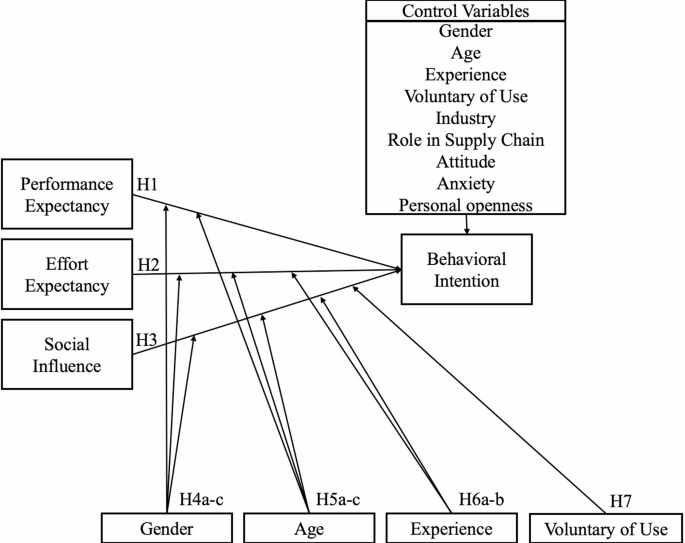
Research model adapted from Venkatesh et al. (2003) and hypotheses
2.5 Hypothesis development
Smart contract applications are seen as a way to simplify business processes (Sánchez-Gómez et al. 2019). They can optimise processes (Nelaturu et al. 2021), automatically perform supply chain tasks, (Prause 2019) and therefore be seen as a technology to improve job performance. For other technologies like IoT or DLT, a positive correlation between performance expectations and usage intention in supply chains has already been confirmed (Alazab et al. 2021; Ferri et al. 2021; Shi et al. 2022). We therefore assume the following:
H1
Performance expectancy has a positive effect on behavioural intention.
Although the initial implementation of smart contracts may be effort-intensive, continued use becomes significantly easier (Hamledari and Fischer 2021). Empirical findings suggest that effort expectancy positively influences behavioural intention across various technologies, including blockchain (Nguyen et al. 2023), cryptocurrency (Li et al. 2023), IoT, and Big Data (Queiroz and Pereira 2019; Shi et al. 2022).:
H2
Effort expectancy has a positive effect on behavioural intention.
According to Groschopf et al. (2021) different social interactions during smart contract implementation need to be considered. Conversely, social expectations can also influence behavioural intention. This influence has also been found for general technology use in supply chains (Russell and Hoag 2004). We argue that this general statement can be applied to the specific technology of DLT-based smart contracts and propose the following hypothesis:
H3
Social influence has a positive effect on behavioural intention.
Beyond direct effects, we consider potential moderation effects that are aligned with the original UTAUT model (Venkatesh et al. 2003). Considering the research by Merhi et al. (2021) and Magsamen-Conrad et al. (2015) we can hypothesise that gender may moderate the intention to use smart contracts in supply chain management. Drawing on results from Phichitchaisopa and Naenna (2013), age could moderate the intention to use smart contracts in the supply chain. Research by Celik (2016) and Puriwat and Tripopsakul (2021) suggests that experience might play a role in moderating intentions related to technology adoption. Similarly, we can hypothesise that individuals with prior experience using similar technology may exhibit a stronger intention to use smart contracts than those without such knowledge. When users feel they have control over whether or not to use technology, they may be more likely to adopt it (Cranor and Wright 2000). Also, the voluntary nature of technology can influence users’ intention to use a technology (Schultz 2020). When individuals perceive the adoption of smart contracts as a voluntary choice, they will likely approach it differently. We therefore hypothesise the following for the moderating variables:
H4
Gender influences the relationship between (a) performance expectancy, (b) effort expectancy and (c) social influence and intention to use smart contracts technology in supply chains.
H5
Age influences the relationship between (a) performance expectancy, (b) effort expectancy and (c) social influence and intention to use smart contracts technology in supply chains.
H6
Experience influences the relationship between (a) effort expectancy and (b) social influence and intention to use smart contracts technology in supply chains.
H7
Voluntary of use influences the relationship between social influence and intention to use smart contract technology in supply chains.
As a control variable at the organisational level, we included the industry and the company’s role within the supply chain as potential variables influencing behavioural intention. Individually, we included personal openness, anxiety, and attitude toward smart contracts as control variables in the research model.
3 Research method
3.1 Questionnaire
A structured online questionnaire was developed based on established scales. We adopted all UTAUT constructs from Venkatesh et al. (2003), with wording adapted to the smart contract context. For example, Performance Expectancy (PE) was measured by four items (adapted from Venkatesh et al. 2003), capturing the degree to which respondents believe smart contracts will improve their job performance. Effort Expectancy (EE) was measured by four items, based on the ease of using smart contracts. Social Influence (SI) and Facilitating Conditions (FC) were each measured by three items assessing peer encouragement and resource availability, respectively. Behavioural intention (BI) was measured by three items (Venkatesh et al. 2003) indicating respondents’ readiness to use smart contracts. All items used a 7-point Likert scale (1=“strongly disagree” to 7=“strongly agree”). The complete item list is provided in the data repository. For clarity and reproducibility, we included attention checks and random ordering of blocks to minimise bias.
3.2 Sample
An a priori power analysis was conducted to determine the necessary sample size. We used G*Power (Faul et al. 2007), setting parameters to an α error probability of 0.05, power of 0.8, and a small effect size of 0.05, based on Cohen’s (1992) guidelines for behavioural research. After calculation, a required sample size of 125 was given to reach a statistical power of 0.8, which is appropriate in behavioural research, according to Cohen (1977). Therefore, a minimum sample size of 125 allows for the detection of theoretically meaningful relationships and supports the empirical testing of our conceptual framework.
We targeted supply chain professionals using a non-probability panel. Participants were recruited via Clickworker, which was used to collect responses from supply chain employees in Germany, a region suitable for the study due to the advanced use of Industry 4.0 technologies and employees’ familiarity with their benefits (da Silva et al. 2019). Clickworker was chosen for its ability to quickly reach a diverse sample of practitioners while ensuring high data quality through built-in verification. The survey was administered in two stages (waves) to reduce common-method bias as recommended by Podsakoff et al. (2003): in Stage 1, respondents answered questions on UTAUT constructs and trust; in Stage 2, the follow-up survey (sent two months later) measured the intention and behavioural outcomes. Anonymous ID codes were used to link each respondent’s Stage 1 and Stage 2 data without revealing identities. The first round yielded 147 complete responses, while the second round was completed with 125 responses. Table 1 below shows the demographics of the participants and their role in the supply chain.
The most strongly represented industry was plant/mechanical engineering, with 18%, followed by automotive manufacturers/ automotive suppliers with 12% and transportation/ logistics with 10%. The other industries represented are 8% electronics, 8% trade, and 8% IT/telecommunications. 7% consumer goods manufacturing, 4% public-sector institutions and 4% banking/ insurance/ financial services. Chemicals and health care/ social services each accounted for 3%. Energy supply, fabricated metals, and pharmaceuticals represent 2% of each. Other industries accounted for 3%. The relative amounts of the different types of industry and detailed demographic data can also be found in the data repository.
3.3 Model evaluation
We employed Partial Least Squares SEM (PLS-SEM) using SmartPLS 4.0.8.9 to test the measurement and structural models. PLS-SEM is extensively used in information systems, marketing, and behavioural research, especially in emerging technology studies (Becker et al. 2023). Compared to traditional regression, PLS-SEM allows researchers to model multiple dependent relationships that include latent constructs in a single model (Henseler et al. 2016). PLS-SEM handles such complexity well, even with moderately sized samples, without requiring multivariate normality assumptions (Hair et al. 2022; Sarstedt et al. 2022).
We carried out bootstrapping with 5,000 samples and conducted a one-sided test with a significance level 0.05. We followed Sarstedt et al. (2023) and evaluated the reflective measurements and the structural model to assess our overall model. While all detailed statistical tests, the specific settings used, the data set and results can also be found in the data repository, the most relevant results will be presented following Table 2:
In addition, a post-hoc test was conducted for our data to assess bias due to the common method. Harman’s one-factor test shows that the total variance of the main factor is only 34.71%. Thus, we conclude that the bias due to the common method is either non-existent or negligible.
4 Results
4.1 Descriptive results
The results reveal a generally positive perception of smart contracts among employees in supply chain organisations. Participants were highly willing to use the technology, with a mean behavioural intention of 5.00 on a 7-point Likert scale (SD = 1.21). This openness was supported by positive attitudes (M = 5.11, SD = 1.19) and a relatively high degree of personal openness (M = 4.89, SD = 1.25), while technology-related anxiety remained comparatively low (M = 3.43, SD = 1.44), Descriptive statistics of all variables in the structural equation model are shown below in Table 3.
4.2 Test of hypotheses
The study tested several hypotheses regarding adopting smart contract technology in supply chains. It found that performance expectancy positively influences behavioural intention, which was supported. However, effort expectancy and social influence did not significantly affect behavioural intention, as neither hypothesis was supported. Additionally, gender, age, and experience did not influence the relationships between performance expectancy, effort expectancy, social influence, and the intention to use smart contracts. Finally, the hypothesis that the voluntary nature of use affects the relationship between social influence and intention to adopt smart contracts was also not supported. Figure 2 shows the results of the hypothesis and control variables testing in the research model:
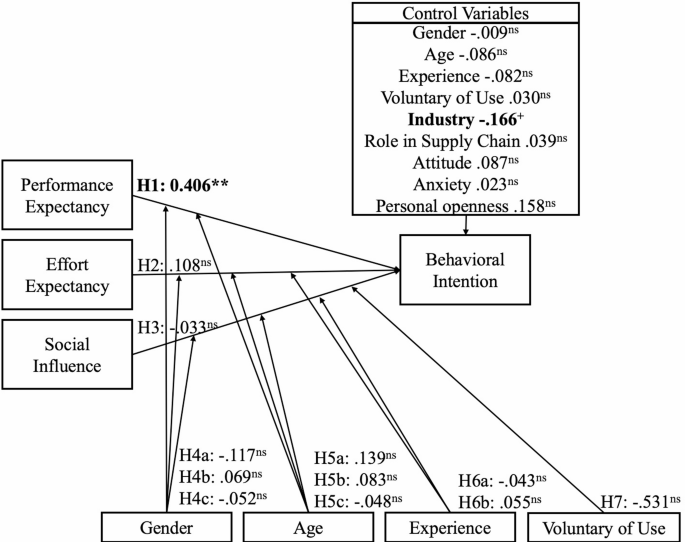
Research model adapted from Venkatesh et al. (2003) and results (Notes: + p <.1; * p <.05; ** p <.01; *** p <.001)
4.3 Comparative analysis of results and prior literature
In our model, performance expectancy strongly predicted adoption intention (H1 supported). This finding aligns with prior work. For example, Park (2020) found that performance expectancy positively influences blockchain usage intention, as did Alazab et al. (2021) for DLT adoption in supply chains. Ferri et al. (2021) similarly reported that performance expectations drive auditors’ intentions to use DLT. Sheel and Nath (2020) also, performance expectancy is a significant antecedent of blockchain adoption in supply chains. Together, these correspondences reinforce that anticipated performance gains (analogous to TAM’s perceived usefulness) are a robust motivator of smart-contract adoption in our context.
Contrary to H2, effort expectancy had no significant effect on intention. This null result diverges from earlier studies: Park (2020), Alazab et al. (2021) and Sheel and Nath (2020) each found that higher effort expectancy (greater ease of use) positively influences adoption intention. It is, however, consistent with other research. Pieters et al. (2021) likewise reported no effect of effort expectancy (perceived ease of use) on blockchain adoption, and Lee et al. (2019) found perceived ease of use did not significantly predict DLT use. These mixed patterns suggest that ease-of-use considerations may be less salient for a novel, technically complex technology like smart contracts, or may only emerge once users gain experience.
Similarly, social influence (peer/managerial pressure) was insignificant (H3 not supported). This contrasts with Park (2020) and Ferri et al. (2021), both of whom observed significant social-influence effects on blockchain/DLT adoption. However, it aligns with other findings: Alazab et al. (2021) they reported that social influence was non-significant in their supply-chain DLT study. Similarly, Kabir and Islam (2021) they found no social-influence effect in the context of Bangladeshi banking. The overall picture suggests that social pressures may play a weaker role for smart-contract use, perhaps because use is mainly voluntary and individual perceptions of utility dominate.
Beyond the core UTAUT constructs, we also examined moderator and control variables to explore whether contextual or personal factors influence adoption pathways. None of the proposed moderators (gender, age, experience, and voluntariness of use) had a significant moderating effect. This aligns with findings from Kabir and Islam (2021), who also reported non-significant moderation by demographic variables in a DLT context. While Merhi et al. (2021) found moderating effects of gender and age in mobile banking, such influences may be highly context-specific and less relevant in early-stage enterprise technologies like smart contracts. Among the control variables, contrary to expectations and prior findings by Dwivedi et al. (2019), attitude did not show a significant impact in our model. This suggests its relevance may depend on context-specific factors such as technology maturity or user proximity. In enterprise settings like supply chains, where smart contracts operate mainly in the background, attitudinal factors may play a less central role.
5 Discussion
This study offers valuable insights into how employees in supply chain organisations perceive smart contracts and what drives their intention to adopt them. Beyond statistical relationships, the findings shed light on the dynamics of early-stage technology adoption.
One notable observation is the general open-mindedness of employees towards smart contracts, even though they have little direct experience. This suggests that the resistance is not due to fundamental scepticism or fear, but ignorance and limited application experience. In such an early adoption context, behavioural intentions are shaped less by practical usability and more by abstract notions of benefit. The results emphasise that employees make decisions based primarily on how a technology could improve their work performance, rather than how easy it is to use or what their colleagues think. Individual judgements take precedence over social cues in environments where systems are still unfamiliar and social norms have not yet emerged.
From a theoretical perspective, the study extends the application of the UTAUT model to a new technological and industrial context. Performance expectancy emerged as a clear and consistent predictor of behavioural intention, whereas effort expectancy and social influence showed no significant effect. This deviation from the original UTAUT assumptions indicates that specific constructs may have reduced explanatory power in early voluntary adoption scenarios. These results highlight the importance of a socio-technical view, where successful adoption depends not only on technical capabilities but also on the organisational environment, users’ familiarity, and the stage of technological maturity.
Additionally, the study offers new insights into the uniformity of adoption patterns between demographic and organisational subgroups. Traditional assumptions about the moderating effect of gender, age or experience were not confirmed, suggesting that at the beginning of a technology’s diffusion, such differences are flattened by a general lack of exposure. This emphasises the importance of performance-based design of communication strategies, as task relevance is the only factor that all user groups equally well receive.
On a practical level, the findings have several implications for organisations looking to implement smart contracts in their supply chains. Since performance expectancy was identified as the primary driver of adoption intention, implementation strategies should focus on clearly communicating the operational benefits of smart contracts. Rather than overemphasising technical details or ease of use, messages should focus on how the technology can improve process transparency, reduce errors or increase efficiency.
Secondly, pilot projects and prototypes should be developed to demonstrate these benefits tangibly and understandably. These initiatives can help bridge the gap between abstract expectations and concrete understanding, especially in low awareness. Employees are more likely to adopt smart contracts if they see how these tools solve problems in day-to-day operations.
Given the limited role of demographic or contextual moderators, adoption strategies do not require extensive segmentation. Broad-based communication and training initiatives focused on task performance will likely be effective and resource-efficient. Moreover, the study underscores the importance of organisational support structures in early technology adoption. Leadership fosters a culture of openness, learning, and experimentation. Structured training sessions, workshops, and collaborative forums can help employees make sense of the technology and form realistic expectations. Creating a supportive socio-technical environment is essential for turning positive attitudes into actual use.
Finally, the results suggest that successful adoption of smart contracts is not solely a technical or user-level issue, but a strategic task for management. It requires framing the innovation in terms that align with employees’ work goals, embedding learning processes, and maintaining visible leadership support throughout the rollout.
6 Conclusion
6.1 Summary
This study examined the determinants of employees’ intention to adopt smart contracts in supply chain settings using the UTAUT framework. The results indicate that performance expectancy is the only significant factor influencing behavioural intention, while effort expectancy and social influence do not have a notable impact. Furthermore, demographic variables such as gender, age, experience, and voluntariness of use do not moderate the relationships in the model. These findings highlight the critical importance of perceived performance benefits and suggest that adoption strategies should prioritise demonstrating the operational value of smart contracts in real-world supply chain processes.
6.2 Limitations and future research
As with all research, this study has limitations that may be relevant to future investigations. Firstly, our findings are based on a sample drawn exclusively from Germany, which may limit their cross-cultural generalisability. While this region provides valuable insight due to its advanced use of Industry 4.0 technologies, the role of national culture in shaping adoption behaviours should not be underestimated. Venkatesh and Zhang (2010) demonstrated that social influence exerts a significantly more substantial effect in collectivist cultures such as China than in individualistic contexts like the United States. This underscores the importance of incorporating cultural dimensions into future studies on smart contract adoption.
When interpreting our results, the sample size, which could influence the data, must be considered. Although our sample of 125 people is sufficient for statistical analysis, it may limit the generalisability of the results. A larger sample would increase confidence in the results. Furthermore, this study examined hypothetical behavioural intentions, as the adoption of smart contracts in supply chains is still nascent. This can lead to a mismatch between intentions and actual behaviour. Future research should investigate the real-world adoption and utilisation of smart contracts in supply chains to understand their impact better.
Future studies should consider and examine influences such as organisational culture, regulatory environment and technological infrastructure to deepen insights into smart contract adoption. Qualitative methods can help identify contextual factors by analysing adoption patterns and challenges, leading to more tailored strategies for successful implementation. Next, a more comprehensive examination of the factors influencing performance expectations is recommended. Furthermore, exploring the integration of smart contracts with emerging technologies such as the IoT, AI, and blockchain can highlight their synergistic impact on transforming supply chain operations. Finally, a deeper exploration of organisational change processes related to the adoption of smart contracts is crucial. Researchers should explore the challenges and opportunities of integrating smart contracts into existing supply chain systems, emphasising the role of change agents, communication strategies and employee engagement. By addressing these areas, future research can improve the understanding of smart contract adoption in supply chains and contribute to effective implementation strategies.
References
-
Agrawal TK, Angelis J, Khilji WA, Kalaiarasan R, Wiktorsson M (2022) Demonstration of a blockchain-based framework using smart contracts for supply chain collaboration. Int J Prod Res 61(5):1497–1516. https://doi.org/10.1080/00207543.2022.2039413
-
Ahmad RW, Salah K, Jayaraman R, Yaqoob I, Omar M, Ellahham S (2021) Blockchain-Based forward supply chain and waste management for COVID-19 medical equipment and supplies. IEEE Access 9:44905–44927. https://doi.org/10.1109/access.2021.3066503
-
Alazab M, Alhyari S, Awajan A, Abdallah AB (2021) Blockchain technology in supply chain management: an empirical study of the factors affecting user adoption/acceptance. Cluster Comput 24(1):83–101. https://doi.org/10.1007/s10586-020-03200-4
-
Alnodel A, Khlaifah N, Elnafabi H (2020) Evaluating the quality of services provided by the financial controller in governmental organizations: using the SERVPERF model. J Gov Regul 9:123–132. https://doi.org/10.22495/jgrv9i2art10
-
Arinze CA, Ajala OA, Okoye CC, Ofodile OC, Daraojimba AI (2024) Evaluating the integration of advanced IT solutions for emission reduction in the oil and gas sector. Eng Sci Technol J 5(3):639–652. https://doi.org/10.51594/estj.v5i3.862
-
Bäckstrand J, Fredriksson A (2022) The role of supplier information availability for construction supply chain performance. Prod Plann Control 33(9–10):863–874. https://doi.org/10.1080/09537287.2020.1837933
-
Becker J-M, Cheah J-H, Gholamzade R, Ringle CM, Sarstedt M (2023) PLS-SEM’s most wanted guidance. Int J Contemp Hospitality Manage 35(1):321–346. https://doi.org/10.1108/IJCHM-04-2022-0474
-
Bingzhang L, Zirianov V (2021) Blockchain in agricultural supply chain management. E3S Web of Conferences, 273(1), 1–10
-
Bouwman H, Wijngaert Lvd (2009) Coppers context, and conjoints: a reassessment of TAM. J Inform Technol 24(2):186–201. https://doi.org/10.1057/jit.2008.36
-
Bunia S, Campbell O, Carvalho A, Alluri V (2024) 15–18 April 2024). SCeFSTA: Smart Contract enabled Fair, Secure, and Transparent Auction for Healthcare Transportation. 2024 IEEE International Systems Conference (SysCon)
-
Büttgen M, Dicenta J, Spohrer K, Venkatesh V, Raman R, Hoehle H, De Keyser A, Verbeeck C, Zwienenberg TJ, Jørgensen KP (2021) Blockchain in service management and service research–developing a research agenda and managerial implications. J Service Manage Res 5(2):71–102. https://doi.org/10.15358/2511-8676-2021-2-71
-
Casado-Vara R, Prieto J, De la Prieta F, Corchado JM (2018) How blockchain improves the supply chain: case study alimentary supply chain. Procedia Comput Sci 134(1):393–398. https://doi.org/10.1016/j.procs.2018.07.193
-
Celik H (2016) Customer online shopping anxiety within the unified theory of acceptance and use technology (UTAUT) framework. Asia Pac J Mark Logistics 28(2):278–307. https://doi.org/10.1108/APJML-05-2015-0077
-
Chatterjee S, Rana NP, Khorana S, Mikalef P, Sharma A (2023) Assessing organizational users’ intentions and behavior to AI integrated CRM systems: a Meta-UTAUT approach. Inform Syst Front 25(4):1299–1313. https://doi.org/10.1007/s10796-021-10181-1
-
Chen JV, Wang C-L, Yen DC (2014) A causal model for supply chain partner’s commitment. Prod Plann Control 25(9):800–813. https://doi.org/10.1080/09537287.2013.764578
-
Chen W, Botchie D, Braganza A, Han H (2022) A transaction cost perspective on blockchain governance in global value chains. Strategic Change 31(1):75–87. https://doi.org/10.1002/jsc.2487
-
Cohen J (1977) Statistical power analysis for the behavioral sciences. Appl Psychol Meas 7(3):249. https://doi.org/10.1177/014662168300700301
-
Cohen J (1992) Quantitative methods in psychology: A power primer. Psychol Bull 112(1):155–159
-
Cranor LF, Wright RN (2000) Influencing software usage. Proceedings of the tenth conference on Computers, freedom and privacy: challenging the assumptions, 45–55
-
da Silva VL, Kovaleski JL, Pagani RN (2019) Technology transfer in the supply chain oriented to industry 4.0: a literature review. Technol Anal Strateg Manag 31(5):546–562. https://doi.org/10.1080/09537325.2018.1524135
-
Dal Mas F, Dicuonzo G, Massaro M, Dell’Atti V (2020) Smart contracts to enable sustainable business models. A case study. Manag Decis 58(8):1601–1619. https://doi.org/10.1108/MD-09-2019-1266
-
Darwish A, Lindman J, Hjertqvist J, Tona O (2023) Design Principles for Blockchain-based Applications in Green Bond Reporting. Hawaii International Conference on System Sciences (HICSS-56)
-
Dietrich F, Hoffmann M, Mediavilla MA, Louw L, Palm D (2022) Towards a model for holistic mapping of supply chains by means of tracking and tracing technologies. Procedia CIRP 107(1):53–58. https://doi.org/10.1016/j.procir.2022.04.009
-
Dwivedi Y, Rana N, Jeyaraj A, Clement M, Williams M (2019) Re-examining the unified theory of acceptance and use of technology (UTAUT): towards a revised theoretical model. Inform Syst Front 21:1–16. https://doi.org/10.1007/s10796-017-9774-y
-
El Ioini N, Pahl C (2018) A review of distributed ledger technologies. On the Move to Meaningful Internet Systems. OTM 2018 Conferences: Confederated International Conferences: CoopIS, C&TC, and ODBASE 2018, Valletta, Malta, October 22–26, 2018, Proceedings, Part II, 277–288
-
Fan JC, Fang K (2006) ERP implementation and information systems success: a test of DeLone and mclean’s model. 2006 Technol Manage Global Future-PICMET 2006 Conf 3(1):1272–1278
-
Faul F, Erdfelder E, Lang A-G, Buchner A (2007) G* power 3: A flexible statistical power analysis program for the social, behavioral, and biomedical sciences. Behav Res Methods 39(2):175–191
-
Ferri L, Spanò R, Ginesti G, Theodosopoulos G (2021) Ascertaining auditors’ intentions to use blockchain technology: evidence from the big 4 accountancy firms in Italy. Meditari Account Res 29(5):1063–1087. https://doi.org/10.1108/MEDAR-03-2020-0829
-
Groschopf W, Dobrovnik M, Herneth C (2021) Smart contracts for sustainable supply chain management: conceptual frameworks for supply chain maturity evaluation and smart contract sustainability assessment [Hypothesis and Theory]. Front Blockchain 4. https://doi.org/10.3389/fbloc.2021.506436
-
Grosse N, Guerpinar T, Henke M (2021) Blockchain-Enabled trust in intercompany networks applying the agency theory. Blockchain Internet Things Conf 3(1):8–14. https://doi.org/10.1145/3475992.3475994
-
Guo L (2025) Smart contracts in supply chains. J Mark Res 0(0):00222437251314003. https://doi.org/10.1177/00222437251314003
-
Gurzhii A, Islam N, Marella V (2023) Understanding the Challenges Surrounding Decentralized Applications: An Empirical Study. In M. Janssen, L. Pinheiro, R. Matheus, F. Frankenberger, Y. K. Dwivedi, I. O. Pappas, & M. Mäntymäki, New Sustainable Horizons in Artificial Intelligence and Digital Solutions Cham
-
Hair JF Jr, Hult GTM, Ringle CM, Sarstedt M (2021) A primer on partial least squares structural equation modeling (PLS-SEM). 38. 2https://doi.org/10.1080/1743727X.2015.1005806
-
Hair J, Hult GTM, Ringle C, Sarstedt M (2022) A primer on partial least squares structural equation modeling (PLS-SEM), 3 edn. Sage
-
Hamledari H, Fischer M (2021) Measuring the impact of blockchain and smart contracts on construction supply chain visibility. Adv Eng Inform 50(1):101444. https://doi.org/10.1016/j.aei.2021.101444
-
Harter JK, Schmidt FL, Asplund JW, Killham EA, Agrawal S (2010) Causal impact of employee work perceptions on the bottom line of organizations. Perspect Psychol Sci 5(4):378–389. https://doi.org/10.1177/1745691610374589
-
Henseler J, Hubona G, Ray P (2016) Using PLS path modeling in new technology research: updated guidelines. Industrial Manage Data Syst 116:2–20. https://doi.org/10.1108/IMDS-09-2015-0382
-
Kabir MR, Islam MA (2021) Behavioural intention to adopt blockchain technology in Bangladeshi banking companies. AIP Conference Proceedings, 2347(1), 020025. https://doi.org/10.1063/5.0051654
-
Kajikawa Y, Takeda Y, Sakata I, Matsushima K (2010) Multiscale analysis of interfirm networks in regional clusters. Technovation 30(3):168–180. https://doi.org/10.1016/j.technovation.2009.12.004
-
Kayikci Y, Subramanian N, Dora M, Bhatia MS (2022) Food supply chain in the era of industry 4.0: blockchain technology implementation opportunities and impediments from the perspective of people, process, performance, and technology. Prod Plann Control 33(2–3):301–321. https://doi.org/10.1080/09537287.2020.1810757
-
Kumar NM, Chopra SS (2022) Leveraging blockchain and smart contract technologies to overcome circular economy implementation challenges. Sustainability 15(15):9492. https://doi.org/10.3390/su14159492
-
Lee C, Kriscenski J, Lim HS (2019) An empirical study of behavioral intention to use blockchain technology. J Int Bus Disciplines 14(1):1–21
-
Li C, Khaliq N, Chinove L, Khaliq U, Popp J, Oláh J (2023) Cryptocurrency acceptance model to analyze consumers’ usage intention: evidence from Pakistan. SAGE Open 13(1):21582440231156360. https://doi.org/10.1177/21582440231156360
-
Lumineau F, Oliveira N (2020) Reinvigorating the study of opportunism in supply chain management. J Supply Chain Manage 56(1):73–87
-
Magsamen-Conrad K, Upadhyaya S, Joa CY, Dowd J (2015) Bridging the divide: using UTAUT to predict multigenerational tablet adoption practices. Comput Hum Behav 50(1):186–196. https://doi.org/10.1016/j.chb.2015.03.032
-
Merhi M, Hone K, Tarhini A, Ameen N (2021) An empirical examination of the moderating role of age and gender in consumer mobile banking use: a cross-national, quantitative study. Journal of Enterprise Information Management, 34(4), 1144–1168. https://doi.org/10.1108/JEIM-03-2020-0092
-
Nelaturu K, Beillahit SM, Long F, Veneris A (2021) Smart Contracts Refinement for Gas Optimization. 2021 3rd Conference on Blockchain Research and Applications for Innovative Networks and Services, BRAINS 2021
-
Nguyen L-T, Nguyen D-T, Ngoc KN-N, Duc DTV (2023) Blockchain adoption in logistics companies in Ho Chi Minh city, Vietnam. Cogent Bus Manage 10(2):2216436. https://doi.org/10.1080/23311975.2023.2216436
-
Park KO (2020) A study on sustainable usage intention of blockchain in the big data era: logistics and supply chain management companies. Sustainability 12(24):10670. https://doi.org/10.3390/su122410670
-
Pfohl H-C, Gomm M (2009) Supply chain finance: optimizing financial flows in supply chains. Logistics Res 1(3):149–161. https://doi.org/10.1007/s12159-009-0020-y
-
Phichitchaisopa N, Naenna T (2013) Factors affecting the adoption of healthcare information technology. EXCLI J 12(1):413–436. https://doi.org/10.19082/2713
-
Pieters JJ, Kokkinou A, van Kollenburg T (2021) Understanding blockchain technology adoption by Non-experts: an application of the unified theory of acceptance and use of technology (UTAUT). Oper Res Forum 3(1):1. https://doi.org/10.1007/s43069-021-00113-9
-
Prause G (2019) Smart contracts for smart supply chains. IFAC-PapersOnLine 52(13):2501–2506. https://doi.org/10.1016/j.ifacol.2019.11.582
-
Premm M, Kirn S (2015) A multiagent systems perspective on industry 4.0 supply networks. German Conf Multiagent Syst Technol 101–118. https://doi.org/10.1007/978-3-319-27343-3_6
-
Puriwat W, Tripopsakul S (2021) Explaining social media adoption for a business purpose: an application of the UTAUT model. Sustainability 13(4):2082. https://doi.org/10.3390/su13042082
-
Queiroz M, Pereira S (2019) Intention to adopt big data in supply chain management: A Brazilian perspective. Revista De Administração De Empresas 59:389–401. https://doi.org/10.1590/s0034-759020190605
-
Raj PVRP, Jauhar SK, Ramkumar M, Pratap S (2022) Procurement, traceability and advance cash credit payment transactions in supply chain using blockchain smart contracts. Comput Ind Eng 167:108038. https://doi.org/10.1016/j.cie.2022.108038
-
Russell DM, Hoag AM (2004) People and information technology in the supply chain. Int J Phys Distribution Logistics Manage 34(2):102–122. https://doi.org/10.1108/09600030410526914
-
Sánchez-Gómez N, Morales-Trujillo L, Torres-Valderrama J (2019) Towards an approach for applying early testing to smart contracts. WEBIST 2019 – Proceedings of the 15th International Conference on Web Information Systems and Technologies
-
Sarstedt M, Hair JF, Pick M, Liengaard BD, Radomir L, Ringle CM (2022) Progress in partial least squares structural equation modeling use in marketing research in the last decade. Psychol Mark 39(5):1035–1064. https://doi.org/10.1002/mar.21640
-
Sarstedt M, Hair Jr JF, Ringle CM (2023) PLS-SEM: indeed a silver bullet– retrospective observations and recent advances. J Mark Theory Pract 31(3):261–275. https://doi.org/10.1080/10696679.2022.2056488
-
Schultz TL (2020) Certified crop advisers’ intention to use smartphones for mobile learning. Iowa State University]
-
Sheel A, Nath V (2020) Antecedents of blockchain technology adoption intentions in the supply chain. Int J Bus Innov Res 21(4):564–584
-
Shi Y, Siddik AB, Masukujjaman M, Zheng G, Hamayun M, Ibrahim AM (2022) The antecedents of willingness to adopt and pay for the IoT in the agricultural industry: an application of the UTAUT 2 theory. Sustainability 14(11):6640. https://doi.org/10.3390/su14116640
-
Sodhi MS, Tang CS (2021) Supply chain management for extreme conditions: research opportunities. J Supply Chain Manage 57(1):7–16. https://doi.org/10.1111/jscm.12255
-
Taherdoost H (2019) Importance of technology acceptance assessment for successful implementation and development of new technologies. Global J Eng Sci 1(3). https://doi.org/10.33552/GJES.2019.01.000511
-
The data supporting the findings of this study are available anonymously in an open access data repository at: https://osf.io/c9zh3/?view_only=802969cca4b74d11a67ef06d9191e401
-
Van Dun D, Kumar M (2021) Enablers of industry 4.0 technology adoption: transformational leadership and emotional intelligence. Acad Manag Proc 20211:13696. https://doi.org/10.5465/AMBPP.2021.13696abstract
-
van Geldere E (2023) Determinants influencing user resistance and the usage intention of smart contracts within the public sector. A status-quo bias perspective. Tilburg School of Economics and Management (TISEM)]
-
Venkatesh V, Zhang X (2010) Unified theory of acceptance and use of technology: U.S. Vs. China. J Global Inform Technol Manage 13(1):5–27. https://doi.org/10.1080/1097198X.2010.10856507
-
Venkatesh V, Morris MG, Davis GB, Davis FD (2003) User acceptance of information technology: toward a unified view. MIS Q 27(3):425–478. https://doi.org/10.2307/30036540
-
Vo KT, Nguyen-Thi AT, Nguyen-Hoang TA (2021) Building sustainable food supply chain management system based on hyperledger fabric blockchain. Int Conf Adv Comput Appl (ACOMP) 15(1):9–16. https://doi.org/10.1109/ACOMP53746.2021.00008
-
Wang S, Li D, Zhang Y, Chen J (2019) Smart contract-based product traceability system in the supply chain scenario. IEEE Access 7(1):115122–115133. https://doi.org/10.1109/ACCESS.2019.2935873
-
Xu L, Tu P, Tang Q (2020) Contract design for cloud logistics (cl) based on blockchain technology (BT). Complexity 2020(4):1–13. https://doi.org/10.1155/2020/5305808
-
Xue Y, Liang H, Wu L (2011) Punishment, justice, and compliance in mandatory IT settings. Inform Syst Res 22(2):400–414. https://doi.org/10.1287/isre.1090.0266
Funding
Open Access funding enabled and organized by Projekt DEAL.
Ethics declarations
Competing interests
The authors have no relevant financial or non-financial interests to disclose.
Additional information
Rights and permissions
Open Access This article is licensed under a Creative Commons Attribution 4.0 International License, which permits use, sharing, adaptation, distribution and reproduction in any medium or format, as long as you give appropriate credit to the original author(s) and the source, provide a link to the Creative Commons licence, and indicate if changes were made. The images or other third party material in this article are included in the article’s Creative Commons licence, unless indicated otherwise in a credit line to the material. If material is not included in the article’s Creative Commons licence and your intended use is not permitted by statutory regulation or exceeds the permitted use, you will need to obtain permission directly from the copyright holder. To view a copy of this licence, visit http://creativecommons.org/licenses/by/4.0/.
Reprints and permissions
About this article
Cite this article
Müller, W. Determinants of smart contract adoption in supply chains: a UTAUT-based PLS-SEM analysis. Oper Manag Res (2025). https://doi.org/10.1007/s12063-025-00560-1
- Received
- Revised
- Accepted
- Published
- DOI https://doi.org/10.1007/s12063-025-00560-1
Keywords
- Smart contracts
- UTAUT
- Supply chain
- PLS-SEM
- Technology adoption
