
 info@apippress.com
 +86 18163351462 (WhatsApp)
 +86 182 8014 0209
Article Content
Abstract
Effects of a changing climate, including drought, wildfire, and invasive species encroachment, are evident on public lands across the United States. Decision making on Federal public lands requires analyses under the National Environmental Policy Act (NEPA), and there are guidelines for considering climate in NEPA analyses. To better understand how climate most recently has been considered, we analyzed a stratified random sample of 130 environmental assessments (EAs) completed by the Bureau of Land Management (BLM) from 2021 to 2023 across the contiguous United States. We assessed whether EAs considered (1) potential effects of the proposed action on climate (2) potential climate effects on the proposed action, and (3) potential climate effects on resources of concern. We also identified whether EAs included data and science about climate or greenhouse gas emissions, and which datasets and documents were cited. We used two approaches: automated keyword searches and document analysis. Thirty-seven percent of EAs considered the potential effects of the proposed action on climate, 8% considered the potential effects of climate on the proposed action, and 4% of individual resource analyses considered the potential effects of climate on the resource. EAs in the ‘oil and gas development,’ ‘renewable energy,’ and ‘forestry and timber management’ proposed action categories most frequently considered the potential effects of climate and used climate data and science. Our findings suggest an opportunity for scientists to work more closely with public land managers to identify available data and science for considering climate in environmental effects analyses and to provide science delivery mechanisms that can facilitate the consideration and use of climate science in decision making.
Explore related subjects
Discover the latest articles and news from researchers in related subjects, suggested using machine learning.
- Climate Change Ecology
- Climate-Change Impacts
- Environmental Sciences
- Environmental Psychology
- Environmental Social Sciences
- Environmental Studies
Introduction
Climate change in the United States (U.S.) is evident—temperatures have risen 1.39 °C in the contiguous U.S. and 2.33 °C in Alaska since 1970 (Marvel et al. 2023). During this time, the U.S. has also experienced prolonged periods of drought and more precipitation in the form of rain rather than snow. Temperatures in the U.S. are expected to increase relative to current conditions anywhere from 1.7 to 6 °C by the end of the century (Marvel et al. 2023). Climate change is intensifying fire regimes, drought occurrence, and invasive annual grass establishment and spread (McMahon et al. 2021; Pastick et al. 2021). In the western U.S., invasive annual grass encroachment has caused increases in fire activity and decreases in vegetation cover that have affected species of conservation concern such as sage-grouse, songbirds (e.g., Brewer’s sparrow), big game (e.g., pronghorn), and small mammals (e.g., pygmy rabbit; Remington et al. 2021). As a result, climate change is adding another layer of stress to soils, water, wildlife, and the communities that depend on western landscapes for resources like livestock grazing, energy, recreation, and clean water.
A significant portion of the western U.S. consists of multiple-use public lands, and climate change effects are becoming increasingly pervasive in these landscapes as well (Weiskopf et al. 2020; West et al. 2009; Renwick et al. 2018; Kleinhesselink, Adler (2018)). Public land managers are working to understand how climate and land use change interact to affect public lands (Miller Hesed et al. 2023). Some Department of the Interior bureaus (e.g., National Park Service) have introduced and implemented climate change scenario planning to account for climate and land use change (National Park Service 2013; Rowland et al. 2014).
The Bureau of Land Management (BLM), which manages the largest area of public land in the U.S., has a complex mission: “to sustain the health, diversity, and productivity of the public lands for the use and enjoyment of present and future generations” (BLM n.d.). Because of its mandate to manage lands for multiple uses and sustained yield of renewable resources (43 U.S.C. § 1701–1787) while maintaining and restoring land health (43 CFR § 4180.1), BLM land managers need to consider the potential effects of changing environmental conditions to continue to manage lands and resources effectively (West et al. 2009).
Actions occurring on public lands, from planning to permitting, require analyses under the National Environmental Policy Act (NEPA; 42 U.S.C. § 4321 et seq.), and as of May 2025, there is interim guidance for considering climate in NEPA analyses (81 FR 51866 et seq.). NEPA and other bedrock environmental laws also require the use of science to inform federal agency decisions (42 U.S.C. § 4321 et seq., 33 U.S.C. § 1251 et seq., 42 U.S.C. ch. 85). Further, resource managers have demonstrated an interest in and commitment to science-informed decision making (Cerveny and Ryan 2008; Larios et al. 2020; Kitchell et al. 2015), including integrating high quality and best available information into their NEPA analyses (Cerveny et al. 2011). Resource managers generally perceive peer-reviewed literature to be one of the most useful forms of climate science information (Peters et al. 2018).
Previous studies have investigated how the U.S. Forest Service has applied climate science in land use planning (Timberlake and Schultz 2017), the influence of climate science on objectives for forest management projects (Clifford et al. 2020), and how managers interface with data and science (e.g., models) about climate futures and downscaled effects (Blades et al. 2016; Brown and Bachelet 2017). Additional studies have assessed whether climate was considered in land use planning and NEPA documents published by the BLM, including resource management plans (RMPs) and environmental impact statements (EISs), and found that climate was seldom mentioned (Nave et al. 2020; Webb et al. 2022). Interviews with BLM and U.S. Forest Service staff have identified a lack of time, resources, and climate science products that are directly relevant to management actions as barriers to the use of climate science in designing management activities on Federal lands (Kemp et al. 2015; Ielmini et al. 2021).
Litigation, along with evolving guidance and regulations regarding climate considerations in NEPA, complicates managers’ efforts to meet policy requirements, address litigation outcomes, and adapt to changing tools that demonstrate how public lands, resources, and decisions may affect and be affected by changing climate conditions. Many climate science and data products relevant to environmental effects analyses exist, and their absence in NEPA analyses has led to litigation (Foster et al. 2023; Reiley 2011). In addition, climate-specific executive orders and guidance have changed multiple times within the past decade. For example, the Council on Environmental Quality (CEQ) initially published draft guidance for considering the potential effects of climate and greenhouse gas emissions in environmental effects analyses in 2010; this guidance was subsequently revised and finalized in 2016, rescinded in 2017, updated in 2019, rescinded in 2021, and republished as interim guidance in 2023 that, as of May 2025, is still available guidance (CEQ 2016; 81 FR 51866 et seq.).
NEPA requires analysis of the potential environmental effects of proposed actions and the use of science in those analyses, and guidance for considering climate in NEPA analyses is available (81 FR 51866 et seq.). We sought to understand how climate is currently being considered in Federal decision making. To do this, we assessed the consideration of climate in NEPA analyses from 2021–2023. We used the previous Department of the Interior Departmental Manual 523 1 definition of climate change to guide our analysis: “Changes in averages and variability of weather conditions that persist over multiple decades or longer. Climate change encompasses both increases and decreases in temperature, as well as shifts in precipitation, changing risk of certain types of severe weather events, and changes to other features of the climate system” (Office of Policy Analysis 2023, 523 DM 1). Our research objectives were to determine whether agency environmental effects analyses considered the potential effects of: (1) different categories of proposed actions (e.g., oil and gas development, livestock grazing) on climate; (2) climate on different categories of proposed actions; and (3) climate on different types of resources of interest (e.g., terrestrial wildlife, invasive plant species) (Fig. 1). When analyses did consider climate, we also asked (4) whether those analyses used climate data and science, and what resources or citations were used most frequently. Additionally, we explored (5) whether automated searches for climate-related keywords correlated with consideration of climate in NEPA analyses, potentially improving the efficiency of future document analysis efforts.
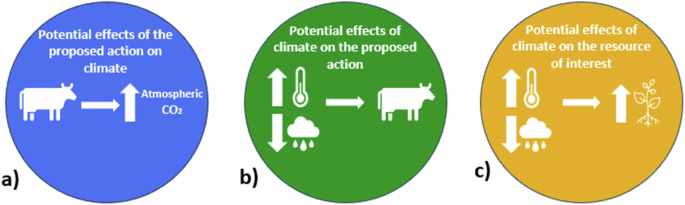
Example scenarios (related to a proposed livestock grazing action), illustrating each of the three ways we sought to identify consideration of climate in environmental effects analyses: a does the environmental effects analysis consider the potential effects of the proposed action on climate, b does the environmental effects analysis consider the potential effects of climate on the proposed action, and c does the environmental effects analysis consider the potential effects of climate on the resource of interest? Abbreviations used in the figure include carbon dioxide (CO2)
This study provides an important benchmark for understanding how climate has been considered, and how climate data and science have been used in public lands decision making. Additionally, our findings can help inform future efforts to synthesize relevant climate science information in a format that aligns with key steps in Federal public lands decision-making processes. We sought to use results from this study to identify opportunities for strengthening consideration of how a changing climate may affect proposed actions and resources of concern rather than highlight deficiencies in NEPA analyses. Our findings can help scientists provide key science information that public land managers can use to manage landscapes to be more durable under a changing climate.
Methods
This project was coproduced (Meadow et al. 2015; Beier et al. 2017) by staff from the U.S. Geological Survey (USGS), the BLM, and the U.S. Fish and Wildlife Service (USFWS) using coproduction tools developed by Selby et al. (2024) that help scientists and resource managers better understand coproduction roles and responsibilities and implement an effective coproduction process at the project level, including how science from the project could be used to inform management. The interagency project team members were actively engaged in decision making throughout project scoping and design, methods development, data collection, analysis, and writing.
Document Sampling
We sampled environmental assessments (EAs) finalized October 1, 2021–September 30, 2023, from all BLM-managed lands in the contiguous United States. This initial document pool totaled to 1578 EAs. These EAs are publicly available on the BLM National NEPA Register, ePlanning, which hosts all BLM land use planning and NEPA documents (BLM 2024). Any EAs that were unavailable or not published as a final record on ePlanning were omitted from the analysis.
We randomly sampled 10 EAs from each of the 13 most common categories of proposed actions using a random number generator (Table 1). We stratified our sample for each action category by BLM State office to better represent the variety of States making decisions about each type of action (Benoit 2014). The number of BLM States represented within each proposed action category varied because the distribution of proposed action categories varies across States (Carter et al. 2025). Our final sample consisted of 130 EAs that collectively represented all BLM State offices across the contiguous U.S. (Table S-1; see Table S-2 for a list of all EAs used in this analysis).
Document Analysis
We reviewed the purpose and need statement of each EA to confirm that the proposed action in each EA aligned with the BLM-assigned proposed action category across all States (40 CFR § 1502.13). Because of topical overlaps of proposed actions in the ‘livestock grazing’ and ‘rangeland management’ proposed action categories, we reclassified EAs in these two categories into two separate groups: grazing permit renewal EAs and rangeland improvement EAs. We then resampled as needed to reach a total sample of 10 grazing permit renewal EAs and 10 rangeland improvement EAs.
Examples of other types of proposed actions in our sampled EAs included wildlife habitat improvement efforts, trail construction projects, wild horse herd management, prescribed burns, land use authorizations, oil and gas permit and lease renewals, and mineral exploration projects (Table S-3). Prior to our document analysis, we ensured each document included only the EA and available appendices.
We then developed a two-step document analysis process for the EAs. Step one involved conducting automated searches for climate keywords. We derived terms from Department of the Interior departmental manuals about climate that were in place during our study period (Office of Environmental Policy and Compliance 2023, 522 DM 1; Office of Policy Analysis 2023, 523 DM 1; Office of Policy Analysis 2023, 526 DM 1; Office of Policy Analysis 2023, 604 DM 1; Office of Policy Analysis 2023, 301 DM 7) and CEQ guidance on considering greenhouse gas emissions and the effects of climate in NEPA reviews (81 FR 51866 et seq.; Table S-4). We searched for keywords such as “climate change,” “greenhouse gases,” “temperature,” “drought,” “adaptation,” “mitigation,” “resilience,” and “uncertainty” (Table S-4). Automated keyword searches were completed using the R packages “quanteda” (Benoit et al. 2018) and “readtext” (Benoit and Obeng (2023); RStudio Team (2020)).
Step two involved manual document analysis, a process used to assign codes to qualitative and quantitative data, such as environmental assessments (Saldaña 2016). We used document analysis to record the presence and absence of considerations of climate, including the use of climate data and science. We developed document assessment questions with our interagency project team that asked questions at the document- and resource-level based on the same climate policies used to identify keywords for the automated searches (Table S-4). Resource-level questions focused on content specific to analyses on the potential effects of the proposed action on resources of interest. We answered document-level questions using any other content present in the EA. We categorized resources analyzed in each EA using a predetermined list of resources provided by the BLM (Carter et al. 2025). As a result, we analyzed 130 EAs at the document-level and 893 analysis sections for individual resources within these EAs.
To address our three core objectives, we searched for consideration of the potential effects of (1) the proposed action on climate, (2) climate on the proposed action, and (3) climate on the affected resource(s). The EA language we assessed included any information disclosed within the ‘issues considered but not analyzed in detail’ section of the EA, as this indicated that the EA still considered the potential effect of the action on climate, even if it was determined to not warrant detailed analysis (BLM 2008).
When climate was considered, we assessed whether climate data or science were mentioned or used in the EAs, and which products were used most frequently. We looked for the inclusion of climate or greenhouse gas (GHG) models, projections, or tools, as well as climate-relevant publications (e.g., publications that used any of our climate keywords within the title) that helped to inform the analysis. In our assessment questions, we defined the term “mention” as any reference to climate-related material (e.g., emissions estimate, climate projection data), and the term “use” as instances where the EA applied a tool and provided context that was specific to the project area and related to information about a potential effect in their analysis.
We asked whether the number of climate keywords found throughout each EA correlated with a climate consideration documented within the EA. We explored correlations between a number of select keywords present in each EA and answers to each of our three main objectives: did the EA consider the potential effects of (1) the proposed action on climate, (2) climate on the proposed action, and (3) climate on the affected resource(s). We considered the following climate-related keywords for all three analyses: “climate change,” “climat*,” “global warming,” “greenhouse gas,” “emission*,” “carbon*,” “precipitation,” “temperature,” “extreme weather,” “drought,” “arid*,” “snow*,” “social cost*,” “global warming potential,” “resilien*,” “scenario,” “model*,” and “simulat*”. The wildcard function (*) ensured that all variations of the keywords were captured in our correlations.
Four team members tested the assessment questions on a sample of EAs to refine the questions to maximize clarity and reliability across team members before analyzing the full document sample. We brought question discrepancies to the full interagency project team for discussion so we had consensus on our interpretation of EA material and tested the assessment questions until each team member could consistently answer all assessment questions (Saunders et al. 2018). For the final data collection process, one team member assessed and annotated each EA, and a second conducted quality assurance checks of all data.
Data Analysis
To address our first two objectives, we determined the proportion of EAs that considered the potential effects of (1) the proposed action on climate, and (2) climate on the proposed action. To address our third objective, for each resource, we determined the proportion of analysis sections for each resource type that considered the potential effects of climate on the resource. We developed word clouds to visually represent the diversity and frequency of words used within the climate considerations using the “wordcloud” and “tm” packages in R Studio (Fellows et al. 2018; Feinerer et al. 2015; RStudio Team (2020)). We excluded standard English stopwords and included the 50 most frequently used words within the text coded as a consideration of climate. Additional data visualizations were completed using the R packages “tidyverse” (Wickham et al. 2019) and “RColorBrewer” (Neuwirth 2014).
To address our fourth objective, we summarized the climate and GHG models and projections mentioned and used across proposed action categories to look for patterns in climate data use. To understand the use of climate science across proposed action categories, we counted climate citations and categorized citations into six groups: “journal articles”; “law, policy, manuals, or guidance documents”; “federal agency reports, plans, strategies, or NEPA analyses”; “state, local, tribal, or regional agency reports, plans, strategies, or analyses”; “international agency reports, plans, strategies, or analyses”; and “other reports, plans, strategies, or documents.” Taking this one step further, we categorized citations by topics for the “journal articles” and “state, local, tribal, or regional agency reports, plans, strategies, or documents”.
For our fifth objective, to identify whether there was a relationship between climate-related keywords and any of the three types of climate considerations, we computed a correlation matrix using the Pearson correlation coefficient. In this analysis, strong positive correlations (0.7–0.9) indicate a relationship between considerations of climate and the number of times climate-related keywords were used.
Results
Consideration of Climate in Environmental Assessments
Objective 1: Consideration of the Potential Effects of the Proposed Action on Climate
At the document-level, 56% of the EAs we sampled mentioned climate. To address this objective further, we searched for (1) EAs that addressed the potential effects of the proposed action on climate, and (2) consideration of climate or GHGs in the ‘issues considered but not analyzed in detail’ section of the EAs. Thirty-seven percent of the EAs considered the potential effects of the proposed action on climate (Fig. 2), including through estimates of GHG emissions or ecosystem carbon sequestration (Table S-5). ‘Renewable energy’, ‘oil and gas development’, and ‘forestry and timber management’ EAs considered these potential effects most frequently. Of the EAs that considered the potential effects of the proposed action on climate, 27% additionally compared the potential effects of the proposed action with broader regional, national, or global GHG emissions. The words used most frequently in relation to this research objective included “emissions,” “project,” “proposal,” and “greenhouse gas” (Fig. 3).
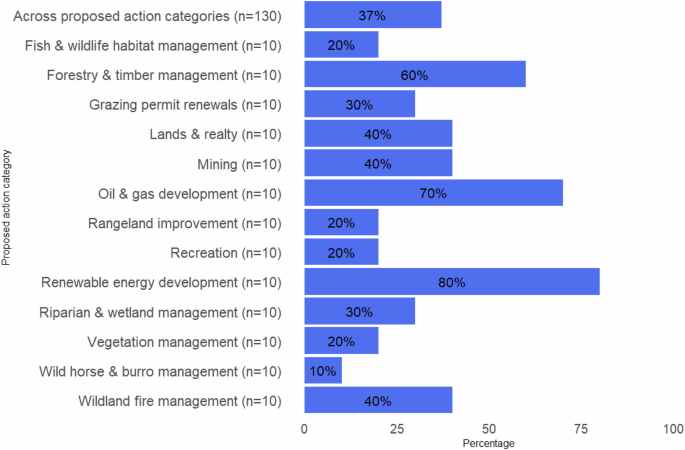
The percentage of environmental assessments (EAs) by proposed action category that considered a potential effect of the proposed action on climate
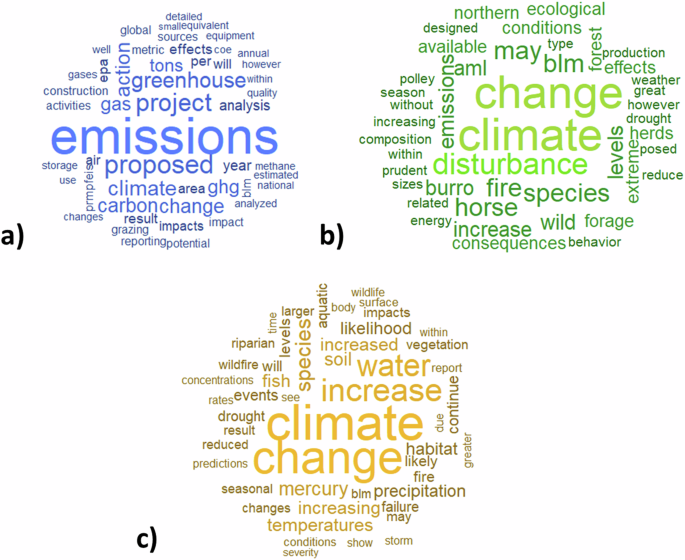
The diversity and frequency of words across climate considerations addressing a the potential effects of the proposed action on climate, b the potential effects of climate on the proposed action, and c the potential effects of climate on the resource.1 1Abbrieviations used in the figure include greenhouse gas (GHG), Environmental Protection Agency (EPA), Bureau of Land Management (BLM), cost of energy (COE), Proposed Resource Management Plan Final Environmental Impact Statement (PRMPFEIS), appropriate management level (AML)
We observed that 38% of the EAs included climate or GHGs as a component of the ‘issues considered but not analyzed in detail’ (Fig. S-1). The level of detail provided in these considerations varied across EAs. Some analyses provided GHG emissions calculations to justify their decision to not move forward with a detailed analysis for the resource (Table S-6).
Objective 2: Consideration of the Potential Effects of Climate on the Proposed Action
In contrast, only 8% of EAs considered the potential effects of climate on the proposed action (Fig. 4). Potential climate effects mentioned included anticipated temperature change, prolonged drought periods, invasive species encroachment, and increased wildfire risk (Table S-7). ‘Forestry and timber management’ and ‘wild horse and burro management’ EAs considered these potential effects most frequently. In some instances, proposed actions were designed to mitigate negative effects of climate on a resource, such as potential spread of invasive annual grasses. Other EAs discussed that the proposed action was generally designed to increase the resilience of a landscape or resource to adverse effects of environmental changes driven by climate. The words used most frequently within the language in relation to this research objective included “climate,” “change,” “disturbance,” “fire,” “horse,” and “species” (Fig. 3).
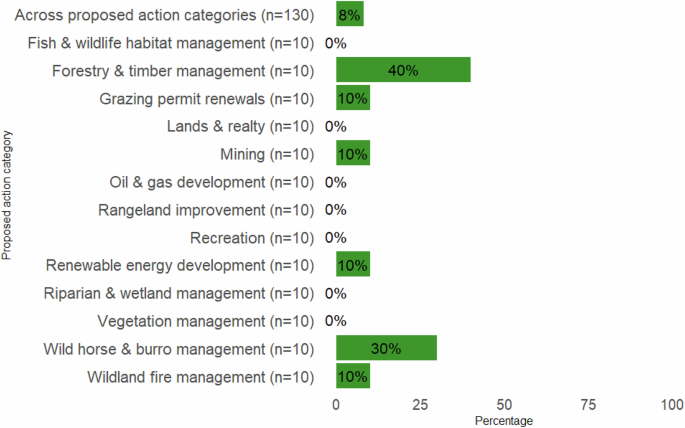
The percentage of environmental assessments (EAs) by proposed action category that considered a potential effect of climate on the proposed action
Objective 3: Consideration of the Potential Effects of Climate on the Resource
At the resource-level, 12% of the analysis sections for each resource mentioned climate, and 4% considered the potential effects of climate on the resource (Fig. 5; Fig. S-2; Table S-8). Of the analysis sections for resources that considered the potential effects of climate, 10% quantified a potential effect of climate on the resource using climate or GHG projections or calculations. Resource analysis sections considered the potential effects of climate on the resource in analysis about the effects of past, present, and reasonably foreseeable future actions less than 6% of the time. The words used most frequently within the language in relation to this research objective included “climate,” “change,” “increase,” and “water” (Fig. 3).
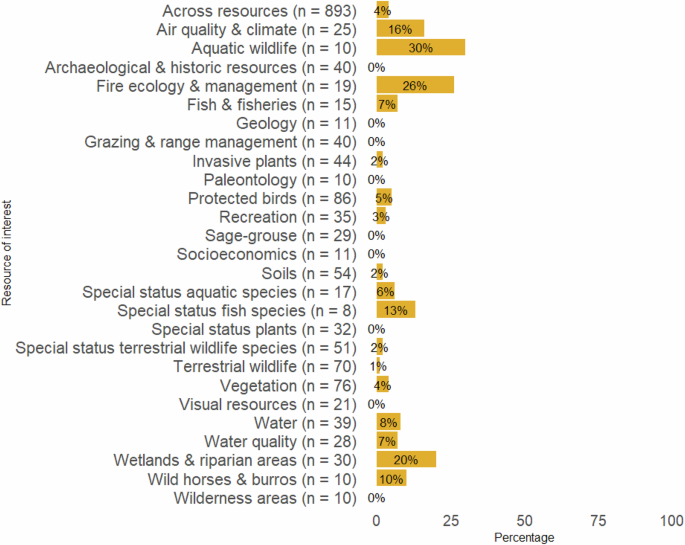
The percentage of 130 environmental assessments (EAs) completed by the Bureau of Land Management (BLM) from 2021 to 2023 across the contiguous United States by resource type (n = 893 analysis sections for resources, sample size for each resource listed within the resource row) that considered a potential effect of climate on the resource. Listed resources include those with at least one instance of an EA considering a potential effect of climate on the resource, or at least 10 analysis sections for the resource across EAs and proposed action categories. Resources analyzed less than five times are not included in the figure
Objective 4.1: Use of Climate Data
We looked at the use of climate data in two ways. First, we looked for instances where climate data were mentioned in the document. Mentions included any reference to climate-related products. At the document-level, 4% of the sampled EAs mentioned climate or carbon models, projections, scenarios, or simulations, while 15% mentioned GHG models, projections, calculations, inventories, or estimates (Table S-9). At the resource-level, 1% of analysis sections mentioned climate or carbon models, projections, scenarios, or simulations, while 2% mentioned GHG models, projections, calculations, inventories, or estimates. Nearly all these mentions occurred within ‘air quality and climate’ resource analysis sections (7 out of 9 resource analysis sections for climate or carbon models, and 17 out of 17 resource analysis sections for GHG calculations, inventories, or estimates, respectively).
Taking this one step further, we looked at the use of climate data, which included any applications of climate information to the project analysis. At the resource-level, five resource analysis sections (<0.05%) used climate or carbon models, projections, scenarios, or simulations. All of these examples stated the time-period considered in their analysis, and two out of the five sections stated the spatial extent. Sixteen resource analysis sections (<0.5%) used GHG models, projections, calculations, inventories, or estimates. Thirteen of these uses stated the time-period considered in their analysis, and 11 of these uses stated the spatial extent.
Seven percent of the EAs referred to uncertainty about climate data at the document-level, while 6% referred to assumptions about climate data. Two percent of the analysis sections for resources referred to uncertainty about climate data, while less than 1% referred to assumptions about climate data.
Objective 4.2: Use of Climate Science
Six percent of the EAs included climate-related citations. In many instances, citations that were used at the document-level were also referred to in relevant resource analysis sections.
Of the climate-related citations included, 42% came from Federal agency reports, plans, strategies, or NEPA analyses, including those published by the BLM, EPA, Department of Energy, National Oceanic and Atmospheric Administration, and National Aeronautics and Space Administration; 5% came from law, policy, manual, or guidance documents; 20% came from journal articles; 7% came from State, local, Tribal, or regional agency reports, plans, strategies, or analyses; 7% came from international agency reports, plans, strategies, or analyses (e.g., Intergovernmental Panel on Climate Change, United Nations Environmental Programme); and 4% came from other reports, plans, strategies, or documents (Fig. S-3; Table S-10). An additional 15% of climate-related parenthetical citations used in the EAs did not include enough reference information to be able to identify the source and, as a result, were not categorized in our analysis.
EAs also referred to relevant information about climate using tiering to other BLM NEPA documents or incorporation by reference of material from relevant resources. Tiering is one mechanism that agencies can use to refer to material from another NEPA analysis (e.g., EA or EIS) to avoid duplicating information from previous analyses (40 CFR § 1501.11). Incorporation by reference is another mechanism that agencies can use to refer to material from other resources to minimize the length of an analysis (40 CFR § 1501.12). Three percent of the EAs tiered to climate or GHG information in another BLM NEPA document, while 2% incorporated by reference climate data or science from another document. No analysis sections for resources within our sampled EAs tiered to climate or GHG information in another BLM NEPA document, and less than 1% of the resource analysis sections incorporated by reference climate data or science from another document.
Objective 5: Correlations Between Climate Consideration and Climate-related Keywords
At the document-level, there were no significant, positive relationships between the number of keywords and consideration of the potential effects of (1) the proposed action on climate, and (2) climate on the proposed action (Table S-11). Similarly, there were no significant, positive relationships between the number of keywords and consideration of the potential effect of climate on the resource (Table S-11).
Discussion
We asked how climate is being considered in NEPA analyses for Federal public lands decisions. We found that 37% of BLM NEPA analyses considered the potential effects of the proposed action on climate, 8% considered the potential effects of climate on the proposed action, and 4% considered the potential effects of climate on resources of concern. Of the analyses that did consider climate, less than 1% used climate data (in the form of climate or GHG models, projections, simulations, or calculations) and 6% used climate science (in the form of climate-related citations) in their effects analysis for the proposed project. Additionally, we found that climate consideration was not significantly correlated with the use of climate-related keywords such as climate, greenhouse gases, or emissions.
Consideration of the Potential Effects of the Proposed Action on Climate
Through this study, we found that 37% of EAs completed by the BLM within our document sample considered the potential effect of the proposed action on climate. Similarly, 38% of analyses considered climate or GHGs as a component of their ‘issues considered but not analyzed in detail.’ Not surprisingly, most of these considerations focused on project-level GHG estimates. This may be due to (1) the history of litigation on GHG emissions from BLM authorized actions (e.g., WildEarth Guardians et al.vs.BLM 2019), which has caused increased agency-wide efforts to address the issue, (2) the CEQ guidance that was available during our study period that strongly encouraged bureaus to incorporate GHG emissions data in their environmental effects analyses (81 FR 51866 et seq.), or (3) the improved access over the past four years to online resources and tools that can calculate GHG estimates quickly and accurately (e.g., EPA 2024).
There was variation in the level of detail provided in these considerations of climate. In some of the analyses where climate or GHGs were an ‘issue considered but not analyzed in detail’, the analysis provided an emissions calculation that justified the decision to not move forward with a detailed analysis. Twelve analyses (9%) used the EPA’s reporting threshold of 25,000 metric tons of carbon dioxide equivalence (CO2e) to indicate project-level significance and whether the issue warranted detailed analysis. This threshold was previously included within CEQ’s 2014 guidance (79 FR 77802 et seq.), but has been removed from the updated guidance, and, as a result, may have caused confusion on the use of reporting thresholds in recent NEPA analyses. Moreover, this reporting threshold is not specific to any of the proposed actions conducted or authorized by the BLM, and, as a result, may not be the appropriate metric to justify the effect of BLM proposed actions on climate (74 FR 56374, amended in 2024 to 89 FR 42218). Nevertheless, this emphasizes that while guidance or other resources may be available for managers to use, there is typically a lag in consistent implementation at the bureau level.
Other studies assessing the inclusion of climate within land use planning and NEPA documents (e.g., RMPs, EISs) did not observe strong consideration of the potential effects of the proposed action on climate (Nave et al. 2020; Webb et al. 2022). Developing tailored information and tools to help managers consider climate for a variety of frequently proposed actions may be one opportunity to strengthen climate consideration in future NEPA analyses. These documents and tools could also provide guidance for when projects may not warrant further climate or GHG analysis. Currently, there are no approved GHG thresholds to indicate when projected project-level GHG emissions or impacts would be considered significant, which makes the decision on whether to move forward with a detailed analysis subjective.
Consideration of the Potential Effects of Climate on the Proposed Action
We found few instances (8%) of consideration of the potential effects of climate on the proposed action (e.g., whether the design of the proposed action accounted for potential climatic changes). The potential effects of climate on a number of actions are well-understood, including grazing and range management (e.g., Polley et al. 2013), recreation (e.g., Miller et al. 2022), and oil and gas development (e.g., Cruz and Krausmann 2013). The lack of consideration of the effects of climate on proposed actions that we observed may be explained by the nature of BLM’s NEPA process, which focuses more on analyzing the potential effects of the proposed action on resources (BLM 2008). The potential effects of climate were most frequently considered for ‘forestry and timber management’ actions, which may be due to (1) the historic use of adaptive management strategies on forests (Keenan 2015), (2) the need for productive forest regeneration (Boucher et al. 2020), or (3) harvest losses from forest pests because of changing climate and wildfire regimes (Ramsfield et al. 2016).
Consideration of the Potential Effects of Climate on Resources
Only 4% of resource analysis sections considered the potential effects of climate on the resource, with resources such as ‘air quality and climate,’ ‘aquatic wildlife,’ and ‘fire ecology and management’ considered most frequently. Nave et al. (2020) found differing results in their assessment of climate considerations within RMPs, with resources such as ‘water’ and ‘vegetation’ considered most frequently. However, their sample was focused on RMPs published by the BLM in Colorado, which may have influenced the resources considered (Dawadi and Ahmad 2012; Beeton and McNeeley 2020).
Much like our results on consideration of the potential effects of climate on the proposed action, the timeline, associated impacts of the proposed projects, and uncertainty of the project impact on specific resources may have influenced climate consideration in individual resources. Additionally, the impacts from a project need to interact with both climate and resource impacts, and these connections can be more challenging. Resources such as ‘archaeological and historic resources,’ ‘grazing and range management,’ ‘sage-grouse,’ ‘special status plants,’ and ‘visual resources’ were consistently analyzed, but resource analysis sections for these resource types never considered the potential effects of climate. This lack of climate consideration could indicate a lack of awareness of or readily accessible science about the local effects of climate vulnerability on those resources. Additional contributing factors could be a mismatch between the timeframe of the project and the expected timeframe of significant climate impacts to the resource, or high levels of uncertainty about the potential effects of climate on these resources, all of which suggest a need for additional research to better understand the nature and intensity of likely climate impacts.
Broader Challenges in Considering Climate in NEPA Analyses
Considering climate in Federal decision-making and minimizing levels of uncertainty within decision analyses is complex because of additional NEPA and science-related challenges. These challenges include (1) consideration of past, present, and reasonably foreseeable future actions, (2) use of tiering, and (3) incorporation of data that are scaled to the project or planning area.
Consideration of Past, Present, and Reasonably Foreseeable Future Actions
During our study period, NEPA regulations required the consideration of incremental impacts of the project with other past, present, and reasonably foreseeable future actions (43 CFR § 46.30). We found that less than 6% of analyses assessed in this study considered climate in relation to the effects of present, and reasonably foreseeable actions. This may be related to the fact that agencies historically have had limited capacity to conduct detailed effects analyses (Squillace and Hood 2012).
Use of Tiering
Tiering to other NEPA analyses can provide broader spatial or temporal understanding for a project-level NEPA analysis, but we observed tiering to climate and GHG information in only 3% of EAs in our sample. A few EAs tiered to climate and GHG information in NEPA planning documents, such as field office RMPs or overlapping project area EISs, to provide additional spatial and temporal context and amplify their climate considerations (BLM 2021a, 2021b, 2021c). When done appropriately, tiering is an opportunity to connect to broader scale analyses and provide additional information on the potential long-term climate effects and GHG emissions in the area.
Incorporation of Data Scaled to the Project Area
Identifying climate models or other climate data products that are scaled in a way that they are useful to a project is the third challenge. Climate effects and GHG emissions are often analyzed at regional or national scales (Marvel et al. 2023). While this information is useful for some project-level considerations of climate, additional products that go further by applying GHG emissions or projected temperature change to different types of actions or resources of concern (e.g., livestock grazing, recreation, special status wildlife species) could make climate science products more helpful for the project-level analyses that comprise the vast majority of NEPA analyses conducted by agencies each year (Jagannathan et al. 2023; Carter et al. 2025). Regularly updating and providing open access to such climate tools and products could help ensure that the climate science and data available for use in such analyses remain accessible, relevant, and up to date. Additionally, step by step guidance and examples of how these climate tools and products can be used in environmental effects analyses could promote more frequent and effective use in decision making.
Other climate-relevant considerations, such as the potential effects of extreme weather events on ‘oil and gas development’ or ‘renewable energy development’ actions, may not have been addressed as frequently because of the timelines of those projects and their associated impacts. The projected effects from these projects were typically short in duration. Translating the long-term impacts of climate change often found in the literature to a site-level project and its anticipated effects that are short-term in nature may introduce levels of uncertainty that could be more effectively addressed in other land-use planning and NEPA documents that are of longer duration and broader scale (Gaur and Simonovic 2015). Webb et al.’s (2022) findings highlight this notion: they observed that 30% of the EISs sampled in their analysis considered the potential effects of climate on the proposed action, and the type and duration of the proposed action (e.g., liquified natural gas or nuclear energy projects spanning 10 or more years) affected the level of detailed provided in the consideration.
Broader Opportunities in Considering Climate in NEPA Analyses
Despite these challenges, we found examples of EAs in which climate was considered for multiple resources. The “Rainy River Withdrawal” EA for a proposed mining action in Minnesota mentioned climate for 70% of the 23 resources analyzed in detail and considered the potential effect of climate on 44% of those resources (BLM 2022a). To comply with NEPA page number limitations, the authors included resource-specific appendices that detailed potential climate effects. The “Upper Snake Field Office Aquatic and Riparian Habitat Restoration” EA from Idaho mentioned climate and considered the potential effect of climate for all eight of the resources analyzed in detail (BLM 2022b). They used climate science citations and datasets that were region-specific and relevant for each resource. These EAs provide examples that agency staff may be able to learn from for future analyses.
Other agencies in the U.S. government have climate-focused NEPA guidance. The National Park Service (2015) recommended that park planners consider climate in the affected environment and effects analyses sections of their NEPA analyses. Considering climate in the affected environment section of NEPA analyses helps ensure that resource conditions are comprehensively addressed, regardless of the potential effects of the proposed action or alternatives. The U.S. Forest Service published their “Climate Change Considerations in Project Level NEPA Analysis” resource in 2009 (United States Forest Service 2009). These resources have a strong emphasis on ‘forestry and timber management’ and ‘wildland fire management’ proposed actions, which other agencies such as the BLM conduct as well. However, the volume, breadth, and diversity of NEPA analyses published by the BLM is somewhat unique compared to other agencies, potentially complicating the application of climate guidance from other agencies.
Use of Climate Data and Science
The inclusion of climate data varied in quantity and quality across proposed action categories. More EAs mentioned climate data than used it, which reiterates the potential opportunity for scientists to help public land managers use climate data and science to inform project-level environmental effects analyses by developing clear, easy to use, spatially and temporally relevant climate data products. Collectively, EAs mentioned or used GHG emissions estimates more frequently (17%) than other climate or carbon models (5%), potentially reflecting what managers see as the most relevant and easier to use climate data for site-specific proposed actions. Analyses may be strengthened by using (1) GHG emissions calculations to quantify the potential effects of proposed actions on climate and using (2) climate projections or other related site-specific climate products to quantify potential effects of climate on proposed actions and resources of concern.
The inclusion of climate-related science also varied in quantity and quality. Citations from Federal agencies such as the EPA or BLM were often related to air quality and GHGs (BLM 2020; BLM 2023; EPA 2022; EPA 2024). Interestingly, the ‘fish and wildlife habitat management’ proposed action category did not use any climate-related citations, despite the breadth of science available on observed impacts of climate change to fish and wildlife habitat (e.g., McElwee et al. 2023). Six EAs cited the fourth National Climate Assessment (United States Global Change Research Program USGCRP (2018)), and an additional 12 EAs cited region-specific climate or emissions inventory reports (e.g., Nevada Climate Initiative 2022; New Mexico Environment Department NMED (2020)). Three improvements may help managers incorporate climate science more easily and regularly in their decision making, including by making resources that are (1) easy to understand and use, (2) produced at spatial and temporal scales relevant to NEPA analyses, and (3) updated at frequencies (e.g., every five years) that align with typical EA project timelines. Additionally, providing climate data and science that are framed around issues that can be used to develop alternatives or project design features rather than individual resources may strengthen applications to land management decisions.
The Department of the Interior recently produced technical guidance on incorporating climate change science into analyses such as those conducted under NEPA (Terando et al. 2024). However, this guidance became available after the publication of all NEPA analyses sampled in this study, illustrating the amount of time often needed to develop guidance that can help users implement climate-related policy in their land management decisions and actions. This new guidance may provide the practical information and examples land managers need to strengthen their consideration of climate in NEPA analyses for the projects they are conducting or permitting.
Developing climate science syntheses and vulnerability assessments that are specific to proposed actions on public lands and the issues and resources potentially affected by those actions could also help public land managers better translate and apply the current state of scientific understanding to their management decisions (Halofsky et al. 2015; Specht et al. 2015). Coproducing these syntheses and assessments with land managers can help ensure that these products are even more applicable and useful under a changing climate (Jagannathan et al. 2023).
Correlations Between Climate Consideration and Climate-related Keywords
We explored whether findings from our manual document analysis were correlated with the occurrence of climate-related keywords in EAs and found that they were not. Laparra et al. (2023) assessed whether metadata could be extracted in an automated fashion from EISs and found similar results to ours. Using an automated approach to analyze content of documents with varying formats, page lengths, figures, and tables is complicated but holds promise, and could potentially allow for expanded studies and sample sizes in the future. However, for this study, manual document assessment, while requiring significant time and effort, was the best way to answer our questions about the current consideration of climate in agency NEPA analyses.
Limitations
Climate change is occurring rapidly in Alaska (Huntington et al. 2023; Thoman and McFarland 2024). As such, we would anticipate greater consideration of climate in EAs conducted in Alaska. While our study area included the entire contiguous U.S., most lands managed by the BLM are in the west, so our information on consideration of climate in eastern States is limited. Finally, few studies have been conducted on climate consideration within Federal NEPA analyses (Nave et al. 2020; Webb et al. 2022), so our ability to compare our results to others is limited. Our study is thus an important benchmark for understanding how climate has been considered in the recent past by the BLM in light of available Federal guidance, and our findings reveal some strong examples of climate consideration that land managers can consider to strengthen future analyses.
Conclusion
We found that less than 40% of BLM EAs considered the potential effect of the proposed action on climate, and less than 10% considered the potential effect of climate on the proposed action or on resources of concern. Even fewer analyses used climate data or science products. These findings highlight opportunities for scientists and managers to work together to strengthen consideration of climate in future decisions, including through (1) development of templates and examples of the appropriate level of detail for considering climate in different projects and contexts, (2) additional guidance and site-specific climate products to help managers analyze the potential effects of project-level actions, including through the use of tiering, (3) the regular updating of national and regional climate datasets and assessments to align with typical project timelines, and (4) the synthesis of climate science using approaches that are tailored and relevant to project-level land management decisions. Additionally, future research could assess the technical and institutional reasons for not using climate science in environmental effects analyses, as this could further inform opportunities.
Regardless of the nature, scale, and timeline of individual projects and actions completed on public lands, environmental change related to climate will have a lasting effect on landscapes across the western United States (Weiskopf et al. 2020; West et al. 2009; Renwick et al. 2018; Kleinhesselink and Adler 2018). As a result, to achieve management goals, public land managers may need to consider climate more fully and frequently in their NEPA analyses, including in the purpose and need for proposals. Environmental change related to climate is an overarching context for public lands management, and thus affects and is affected by many decisions that are regularly made on multiple-use public lands, such as the number of oil and gas well pads approved for development, species managed, recreational trails built, or roads constructed. Considering the potential effects and uncertainties of environmental change, using the best available climate data and science, can help ensure that public lands decisions are more durable and defensible, and that projects and resources are sustainable over the long-term and able to adapt to our changing climate.
Data availability
Data is provided within the supplementary information files.
Abbreviations
- U.S.:
- United States
- BLM:
- Bureau of Land Management
- CFR:
- Code of Federal Regulations
- USC:
- United States Code
- NEPA:
- National Environmental Policy Act
- RMP:
- Resource Management Plan
- EIS:
- Environmental Impact Statement
- CEQ:
- Council on Environmental Quality
- GHG:
- Greenhouse gases
- USGS:
- United States Geological Survey
- USFWS:
- United States Fish and Wildlife Service
- EA:
- Environmental Assessment
- EPA:
- Environmental Protection Agency
- CO2e:
- carbon dioxide equivalence
References
-
Beeton TA, McNeeley SM (2020) San Luis Valley Field Office social vulnerability assessment to climate variability and change. Natural Resource Ecology Laboratory and Colorado Natural Heritage Program, Colorado State University. Available at https://www.cnhp.colostate.edu/wp-content/uploads/download/documents/misc/COBLM-SLV-SVA_Technical-Assessment_Report-Final.pdf.
-
Beier P, Hansen LJ, Helbrecht L, Behar D (2017) A how-to guide for coproduction of actionable science. Conserv Lett 10:288–296. https://doi.org/10.1111/conl.12300.
-
Benoit WL (2014) Content analysis in political communication. In: Holbert RL, Garrett RK (eds) Sourcebook for political communication research. Routledge, pp 290-302.
-
Benoit K, Obeng A (2023) Readtext: import and handling for plain and formatted text files. R package version 0.82. Available at https://github.com/quanteda/readtext.
-
Benoit K, Watanabe K, Wang H, Nulty P, Obeng A, Müller S, Matsuo A (2018) Quanteda: An R package for the quantitative analysis of textual data. J Open Source Softw 3:774. https://doi.org/10.21105/joss.00774.
-
Blades JJ, Klos PZ, Kemp KB, Hall TE, Force JE, Morgan P, Tinkham WT (2016) Forest managers’ response to climate change science: Evaluating the constructs of boundary objects and organizations. Ecol Manag 360:376–387. https://doi.org/10.1016/j.foreco.2015.07.020.
-
Boucher D, Gauthier S, Thiffault N, Marchand W, Girardin M, Urli M (2020) How climate change might affect tree regeneration following fire at northern latitudes: a review. New 51:543–571. https://doi.org/10.1007/s11056-019-09745-6.
-
Brown M, Bachelet D (2017) BLM sagebrush managers give feedback on eight climate web applications. Weather Clim Soc 9:39–52. https://doi.org/10.1175/WCAS-D-16-0034.1.
-
Bureau of Land Management (BLM) (2008) BLM National Environmental Policy Act Handbook H-1790-1. Available at https://www.ntc.blm.gov/krc/system/files?file=legacy/uploads/16011/BLM_NEPA_Handbook_H-1790.pdf.
-
Bureau of Land Management (BLM) (2020) Air Resources Technical Report for Oil and Gas Development: New Mexico, Colorado, Texas, and Kansas. Available at https://www.blm.gov/programs/energy-and-minerals/oil-and-gas/about/new-mexico.
-
Bureau of Land Management (BLM) (2021a) Trail Creek Forest Management Plan Environmental Assessment. Available at https://eplanning.blm.gov/eplanning-ui/project/2014299/510.
-
Bureau of Land Management (BLM) (2021b) Cascades Field Office Roadside Hazard Tree Removal Project Environmental Assessment. Available at https://eplanning.blm.gov/eplanning-ui/project/2011918/510.
-
Bureau of Land Management (BLM) (2021c) Rogue Gold Forest Management Plan Environmental Assessment. Available at https://eplanning.blm.gov/eplanning-ui/project/2015764/510.
-
Bureau of Land Management (BLM) (2022a) Rainy River Withdrawal Environmental Assessment. Available at https://eplanning.blm.gov/eplanning-ui/project/2022642/510.
-
Bureau of Land Management (BLM) (2022b) Upper Snake Field Office Aquatic and Riparian Habitat Restoration Environmental Assessment. Available at https://eplanning.blm.gov/eplanning-ui/project/2018419/510.
-
Bureau of Land Management (BLM) (2023) 2023 BLM Specialist Report on Annual Greenhouse Gas Emissions and Climate Trends. Available at https://www.blm.gov/content/ghg/?year=2023.
-
Bureau of Land Management (BLM) (2024) BLM National NEPA Register. Available at https://eplanning.blm.gov/eplanning-ui/home.
-
Bureau of Land Management (BLM) (n.d.) BLM Our Mission. Available at https://www.blm.gov/about/our-mission.
-
Carter SK, Haby TS, Samuel EM, Foster AC, Meineke JK, McCall LE, Gilbert MA (2025) Identifying Priority Science Information Needs for Managing Public Lands. Environ Manage 1-20. https://doi.org/10.1007/s00267-024-02080-3.
-
Cerveny LK, Ryan C (2008) Agency capacity for recreation science and management: The case of the US Forest Service. US Dept Agric For Serv Pac Northwest Res Stn 757.
-
Cerveny LK, Blahna DJ, Stern MJ, Mortimer MJ, Predmore SA, Freeman J (2011) The use of recreation planning tools in US Forest Service NEPA assessments. Environ Manag 48:644–657. https://doi.org/10.1007/s00267-011-9701-9.
-
Clifford KR, Yung L, Travis WR, Rondeau R, Neely B, Rangwala I, Wyborn C (2020) Navigating climate adaptation on public lands: How views on ecosystem change and scale interact with management approaches. Environ Manag 66:614–628. https://doi.org/10.1007/s00267-020-01336-y.
-
Council on Environmental Quality (CEQ) (2014) Revised Draft Guidance for Federal Departments and Agencies on Consideration of Greenhouse Gas Emissions and the Effects of Climate Change in NEPA Reviews. 79 FR 77802 et seq. Available at https://www.govinfo.gov/content/pkg/FR-2014-12-24/pdf/2014-30035.pdf.
-
Council on Environmental Quality (CEQ) (2016) Final guidance for Federal Departments and Agencies on Consideration of Greenhouse Gas Emissions and the Effects of Climate Change in National Environmental Policy Act Reviews. 81 FR 51866 et seq. Available at https://ceq.doe.gov/docs/ceq-regulations-and-guidance/nepa_final_ghg_guidance.pdf.
-
Cruz AM, Krausmann E (2013) Vulnerability of the oil and gas sector to climate change and extreme weather events. Clim Change 121:41–53. https://doi.org/10.1007/s10584-013-0891-4.
-
Dawadi S, Ahmad S (2012) Changing climatic conditions in the Colorado River Basin: Implications for water resources management. J Hydrol 430:127–141. https://doi.org/10.1016/j.jhydrol.2012.02.010.
-
Environmental Protection Agency (EPA) (2022) Inventory of U.S. greenhouse gas emissions and sinks: 1990-2020. Available at https://www.epa.gov/ghgemissions/inventory-us-greenhouse-gas-emissions-and-sinks-1990-2020.
-
Environmental Protection Agency (2024) Greenhouse gas equivalencies calculator. Available at https://www.epa.gov/energy/greenhouse-gas-equivalencies-calculator.
-
Feinerer I, Hornik K, Feinerer MI (2015) Package ‘tm’. Corpus 10(1). Available at https://mirror.linux.duke.edu/cran/web/packages/tm/tm.pdf.
-
Fellows I, Fellows MI, Rcpp L, Rcpp L (2018) Package ‘wordcloud’. R package version 2:331.
-
Foster AC, Carter SK, Haby TS, Espy LD, Burton MK (2023) Using public litigation records to identify priority science needs for managing public lands. Ecol Soc 28(1). https://doi.org/10.5751/ES-13708-280111
-
Gaur A, Simonovic SP (2015) Towards reducing climate change impact assessment process uncertainty. Environ Process 2:275–290. https://doi.org/10.1007/s40710-015-0070-x.
-
Halofsky JE, Peterson DL, Marcinkowski KW (2015) Climate change adaptation in United States federal natural resource science and management agencies: A synthesis. Washington, DC: U.S. Global Change Research Program.
-
Huntington HP, Strawhacker C, Falke J, Ward EM, Behnken L, Curry TN, Herrmann AC, Itchuaqiyaq CU, Littell JS, Logerwell EA, Meeker D, Overbeck JR, Peter DL, Pincus R, Quintyne AA, Trainor SF, Yoder SA (2023) Ch. 29. Alaska. In: Crimmins AR, Avery CW, Easterling DR, Kunkel KE, Stewart BC, Maycock TK (eds) Fifth National Climate Assessment. U.S. Global Change Research Program, Washington, DC, U.S.A. https://doi.org/10.7930/NCA5.2023.CH29.
-
Ielmini MR, Hopkins TE, Mayer KE, Goodwin K, Boyd C, Mealor B, Christiansen T (2021) Invasive plant management and greater sage-grouse conservation: A review and status report. Invasive Alien Species: Observ Issues World 4:165–211. https://doi.org/10.1002/9781119607045.ch43.
-
Jagannathan K, Buddhavarapu S, Ullrich PA, Jones AD, HyperFACETS Project Team (2023) Typologies of actionable climate information and its use. Glob Environ Change 82:102732. https://doi.org/10.1016/j.gloenvcha.2023.102732.
-
Keenan RJ (2015) Climate change impacts and adaptation in forest management: A review. Ann Sci 72:145–167. https://doi.org/10.1007/s13595-014-0446-5.
-
Kemp KB, Blades JJ, Klos PZ, Hall TE, Force JE, Morgan P, Tinkham WT (2015) Managing for climate change on federal lands of the western United States: Perceived usefulness of climate science, effectiveness of adaptation strategies, and barriers to implementation. Ecol Soc 20(2). https://doi.org/10.5751/ES-07522-200217.
-
Kitchell K, Cohn S, Falise R, Hadley HK, Herder MJ, Libby K, Schlanger S (2015) Advancing science in the BLM: An implementation strategy. Department of the Interior, Bureau of Land Management. Available at https://www.blm.gov/sites/default/files/documents/files/Advancing%20Science%20in%20the%20BLM_Implementation%20Strategy.pdf.
-
Kleinhesselink AR, Adler PB (2018) The response of big sagebrush (Artemisia tridentata) to interannual climate variation changes across its range. Ecology 99(5):1139–1149. https://doi.org/10.1002/ecy.2191.
-
Laparra E, Binford-Walsh A, Emerson K, Miller ML, López-Hoffman L, Currim F, Bethard S (2023) Addressing structural hurdles for metadata extraction from environmental impact statements. J Assoc Inf Sci Technol 74(9):1124–1139. https://doi.org/10.1002/asi.24809.
-
Larios D, Brooks TM, Macfarlane NB, Roy S (2020) Access to scientific literature by the conservation community. PeerJ 8:e9404. https://doi.org/10.7717/peerj9404.
-
Marvel K, Su W, Delgado R, Aarons S, Chatterjee A, Garcia ME, Hausfather Z, Hayhoe K, Hence DA, Jewett EB, Robel A, Singh D, Tripati A, Vose RS (2023) Ch. 2. Climate trends. In: Crimmins AR, Avery CW, Easterling DR, Kunkel KE, Stewart BC, Maycock TK (eds) Fifth National Climate Assessment. U.S. Global Change Research Program, Washington, DC, U.S.A. https://doi.org/10.7930/NCA5.2023.CH2.
-
McElwee PD, Carter SL, Hyde KJW, West JM, Akamani K, Babson AL, Bowser G, Bradford JB, Costanza JK, Crimmins TM, Goslee SC, Hamilton SK, Helmuth B, Hoagland S, Hoover F-AE, Hunsicker ME, Kashuba R, Moore SA, Muñoz RC, Shrestha G, Uriarte M, Wilkening JL (2023) Ch. 8. Ecosystems, ecosystem services, and biodiversity. In: Crimmins AR, Avery CW, Easterling DR, Kunkel KE, Stewart BC, Maycock TK (eds) Fifth National Climate Assessment. U.S. Global Change Research Program, Washington, DC, U.S.A. https://doi.org/10.7930/NCA5.2023.CH8.
-
McMahon DE, Urza AK, Brown JL, Phelan C, Chambers JC (2021) Modelling species distributions and environmental suitability highlights risk of plant invasions in western United States. Divers Distrib 27(4):710–728. https://doi.org/10.1111/ddi.13232.
-
Meadow AM, Ferguson DB, Guido Z, Horangic A, Owen G, Wall T (2015) Moving toward the deliberate coproduction of climate science knowledge. Weather Clim Soc 7(2):179–191. https://doi.org/10.1175/WCAS-D-14-00050.1.
-
Miller AB, Winter PL, Sánchez JJ, Peterson DL, Smith JW (2022) Climate change and recreation in the western United States: Effects and opportunities for adaptation. J 120(4):453–472. https://doi.org/10.1093/jofores/fvab072.
-
Miller Hesed CD, Yocum HM, Cross M, Bamzai-Dodson A, Wheeler B, Beckmann JP, Jaffe S (2023) Seventy questions of importance to the conservation of the North Central grasslands of the United States in a changing climate. Conserv Sci Pr 5(9):e12998. https://doi.org/10.1111/csp2.12998.
-
National Park Service (2013) Using Scenarios to Explore Climate Change: A Handbook for Practitioners. National Park Service Climate Change Response Program. Fort Collins, Colorado. Available at https://www.nps.gov/subjects/climatechange/upload/scenarioshandbook-july2013-508compliant-smaller.pdf.
-
National Park Service (2015) National Park Service NEPA handbook. Available at https://www.nps.gov/subjects/nepa/upload/NPS_NEPAHandbook_Final_508.pdf.
-
Nave J, Knapp CN, McNeeley S (2020) Planning for change? Assessing the integration of climate change and land-based livelihoods in Colorado BLM planning documents. Reg Environ Change 20(1):29. https://doi.org/10.1007/s10113-020-01590-0.
-
Neuwirth, E (2014) RColorBrewer: colorbrewer palettes. R package version 1(2).
-
Nevada Climate Initiative (2022) Climate change in Nevada. Nevada Department of Conservation and Natural Resources. Carson City, Nevada. Available at https://www.climateaction.nv.gov/policies/climate-nv/.
-
New Mexico Environment Department (NMED) (2020) New Mexico oil and gas greenhouse gas emissions inventory for year 2020. Available at https://www.env.nm.gov/air-quality/wp-content/uploads/sites/2/2022/12/NewMexico-2020-Oil-and-Gas-GreenhouseGas-Inventory-2022-08-31.pdf.
-
Office of Environmental Policy and Compliance (2023) 522 DM 1, Adaptive Management [PDF]. Department of the Interior. Available at https://www.doi.gov/sites/doi.gov/files/elips/documents/522-dm-1_0.pdf.
-
Office of Policy Analysis (2023) 523 DM 1, Climate Change Adaptation [PDF]. Department of the Interior. Available at https://www.doi.gov/sites/doi.gov/files/elips/documents/523-dm-1_0.pdf.
-
Office of Policy Analysis (2023) 526 DM 1, Climate Change Science [PDF]. Department of the Interior. Available at https://www.doi.gov/sites/doi.gov/files/elips/documents/526-dm-1_1.pdf.
-
Office of Policy Analysis (2023) 604 DM 1, Landscape-Level Management [PDF]. Department of the Interior. Available at https://www.doi.gov/sites/doi.gov/files/elips/documents/604-dm-1_1.pdf.
-
Office of Policy Analysis (2023). 301 DM 7, Departmental Responsibilities for Consideration and Inclusion of Indigenous Knowledge in Departmental Actions and Scientific Research [PDF]. Department of the Interior. Available at https://www.doi.gov/document-library/departmental-manual/301-dm-7-departmental-responsibilities-consideration-and.
-
Pastick NJ, Wylie BK, Rigge MB, Dahal D, Boyte SP, Jones MO, Wu Z (2021) Rapid monitoring of the abundance and spread of exotic annual grasses in the western United States using remote sensing and machine learning. AGU Adv 2(2):e2020AV000298. https://doi.org/10.1029/2020AV000298.
-
Peters CB, Schwartz MW, Lubell MN (2018) Identifying climate risk perceptions, information needs, and barriers to information exchange among public land managers. Sci Total Environ 616:245–254. https://doi.org/10.1016/j.scitotenv.2017.11.015.
-
Polley HW, Briske DD, Morgan JA, Wolter K, Bailey DW, Brown JR (2013) Climate change and North American rangelands: trends, projections, and implications. Rangel Ecol Manag 66(5):493–511. https://doi.org/10.2111/REM-D-12-00068.1.
-
Ramsfield TD, Bentz BJ, Faccoli M, Jactel H, Brockerhoff EG (2016) Forest health in a changing world: effects of globalization and climate change on forest insect and pathogen impacts. Forestry 89(3):245–252. https://doi.org/10.1093/forestry/cpw018.
-
Reiley, R (2011) The evolution of NEPA in the fight against climate change. Pitt. J. Envtl. Pub. Health. L. 5(1).
-
Remington TE, Deibert PA, Hanser SE, Davis DM, Robb LA, Welty JL (2021) Sagebrush conservation strategy—Challenges to sagebrush conservation 2020-1125 [Report]. Available at https://pubs.usgs.gov/of/2020/1125/ofr20201125.pdf.
-
Renwick KM, Curtis C, Kleinhesselink AR, Schlaepfer D, Bradley BA, Aldridge CL, Adler PB (2018) Multi-model comparison highlights consistency in predicted effect of warming on a semi-arid shrub. Glob Change Biol 24(1):424–438. https://doi.org/10.1111/gcb.13900.
-
Rowland EL, Cross MS, Hartmann H (2014) Considering multiple futures: Scenario planning to address uncertainty in natural resource conservation. U.S. Fish & Wildlife Service.
-
RStudio Team (2020) RStudio: Integrated development for R. RStudio, PBC, Boston, MA. Available at http://www.rstudio.com/.
-
Saldaña J (2016) The coding manual for qualitative researchers (3rd ed.). SAGE.
-
Saunders B, Sim J, Kingstone T, Baker S, Waterfield J, Bartlam B, Jinks C (2018) Saturation in qualitative research: exploring its conceptualization and operationalization. Qual Quant 52:1893–1907. https://doi.org/10.1007/s11135-017-0574-8.
-
Selby LB, Carter SK, Haby TS, Wood DJA, Bamzai-Dodson A, Anderson PJ, Herrick JE, Samuel EM, Tull JC (2024) Coproduction in the public lands context: An informational tool provided as part of a toolkit for researchers and resource managers with an interest in coproducing actionable science to support public land management. Denver (CO): U.S. Department of the Interior, Bureau of Land Management. Available at https://www.blm.gov/noc/report/toolkit-coproducing-actionable-science-support-public-land-management.
-
Specht A, Guru S, Houghton L, Keniger L, Driver P, Ritchie EG, Treloar A (2015) Data management challenges in analysis and synthesis in the ecosystem sciences. Sci Total Environ 534:144–158. https://doi.org/10.1016/j.scitotenv.2015.03.092.
-
Squillace M, Hood A (2012) NEPA, Climate change, and public lands decision making. Envtl L 42:469.
-
Terando AJ, Tucker A, Runyon A, Miller J, Perkins J, Kimbrel S, Cross A, Boyles R (2024) Best practices for incorporating climate change science into Department of the Interior analyses, consultations, and decision making: The U.S. Department of the Interior technical and applications guide. Climate Science Applications Coordination Team, U.S. Department of the Interior, Washington, DC. https://doi.org/10.21429/hjgj-j073.
-
Thoman R, McFarland HR (Eds) (2024) Alaska’s changing environment 2.0. Alaska Center for Climate Assessment and Policy, International Arctic Research Center, University of Alaska Fairbanks. Available at https://media.alaskapublic.org/wp-content/uploads/2024/12/Alaskas-Changing-Environment2024-report.pdf.
-
Timberlake TJ, Schultz CA (2017) Policy, practice, and partnerships for climate change adaptation on US national forests. Clim Change 144:257–269. https://doi.org/10.1007/s10594-017-2031-z.
-
United States Forest Service (2009) Climate change considerations in project level NEPA analysis. Available at https://www.fs.usda.gov/emc/nepa/climate_change/includes/cc_nepa_guidance.pdf.
-
United States Global Change Research Program (USGCRP) (2018) Impacts, Risks, and Adaptation in the United States: Fourth National Climate Assessment, Volume II. Reidmiller DR, Avery CW, Easterling DR, Kunkel KE, Lewis KL, Maycock TK, Stewart BC (eds) U.S. Global Change Research Program, Washington, DC, U.S.A. 1515 p. https://doi.org/10.7930/NCA4.2018.
-
Webb RM, Panfil M, Jones SH, Adler D (2022) Evaluating climate risk in NEPA reviews: Current practices and recommendations for reform. Sabin Center for Climate Change Law, Columbia Law School & Environmental Defense Fund.
-
Weiskopf SR, Rubenstein MA, Crozier LG, Gaichas S, Griffis R, Halofsky JE, Whyte KP (2020) Climate change effects on biodiversity, ecosystems, ecosystem services, and natural resource management in the United States. Sci Total Environ 733:137782. https://doi.org/10.1016/j.scitotenv.2020.137782.
-
West JM, Julius SH, Kareiva P, Enquist C, Lawler JJ, Petersen B, Shaw MR (2009) US natural resources and climate change: concepts and approaches for management adaptation. Environ Manag 44:1001–1021. https://doi.org/10.1007/s00267-009-9345-1.
-
Wickham H, Averick M, Bryan J, Chang W, McGowan LDA, François R, Yutani H (2019) Welcome to the Tidyverse. J Open Source Softw 4(43):1686. https://doi.org/10.21105/joss.01686.
-
WildEarth Guardians et al. vs. BLM, No. 4:18-cv-00073-BMM (2019) Motion for Summary Judgement. Available at https://climatecasechart.com/wp-content/uploads/case-documents/2019/20190222_docket-418-cv-00073_motion-for-summary-judgment.
Acknowledgements
We are grateful to staff at the BLM for providing input that was critical to developing this project, including Karen Prentice, Travis Haby, and Julian Scott. Many others contributed to this effort through work on the broader project or by providing helpful feedback along the way, including Frederick Klasner, David Jeppesen, Joey Milan, Seth Flanigan, Courtney Schultz, Alex Stoneburner, Jake Ferguson, Steve Hanser, Nathan Kleist, Claudia Mengelt, Brian Miller, Imtiaz Rangwala, Lief Wiechman, John Bradford, Stefan Tangen, Blaine Potts, Brenda Witkowski, Carmia Woolley, and Janna Simonsen. We thank Olivia Pearman, Amanda Hardy, and William (Austin) Rutherford for reviewing earlier drafts of this manuscript. We gratefully acknowledge Colorado State University and FORT Writes hosted by Kristina Quynn and Kimi Conro for providing expertise, time, incentive, and accountability that aided in the writing process. Any use of trade, firm, or product names is for descriptive purposes only and does not imply endorsement by the U.S. Government.
Funding
This work was supported by the U.S. Geological Survey North Central Climate Adaptation Science Center, Ecosystems Mission Area, and Land Management Research Program.
Ethics declarations
Conflict of interest
The authors declare no competing interests.
Additional information
Supplementary information
Rights and permissions
Open Access This article is licensed under a Creative Commons Attribution-NonCommercial-NoDerivatives 4.0 International License, which permits any non-commercial use, sharing, distribution and reproduction in any medium or format, as long as you give appropriate credit to the original author(s) and the source, provide a link to the Creative Commons licence, and indicate if you modified the licensed material. You do not have permission under this licence to share adapted material derived from this article or parts of it. The images or other third party material in this article are included in the article’s Creative Commons licence, unless indicated otherwise in a credit line to the material. If material is not included in the article’s Creative Commons licence and your intended use is not permitted by statutory regulation or exceeds the permitted use, you will need to obtain permission directly from the copyright holder. To view a copy of this licence, visit http://creativecommons.org/licenses/by-nc-nd/4.0/.
Reprints and permissions
About this article
Cite this article
Whipple, S.E., Carter, S.K., Rutherford, T.K. et al. Climate Consideration in Environmental Effects Analyses on Federal Public Lands in the United States. Environmental Management (2025). https://doi.org/10.1007/s00267-025-02189-z
- Received
- Accepted
- Published
- DOI https://doi.org/10.1007/s00267-025-02189-z
Keywords
- National Environmental Policy Act
- Bureau of Land Management
- environmental effects analyses
- environmental assessments
