
 info@apippress.com
 +86 18163351462 (WhatsApp)
 +86 182 8014 0209
Article Content
Introduction
Hong Kong was a British colony from 1842 to 1997, comprising three main parts, Hong Kong Island which was ceded to Britain in 1842 under the Treaty of Nanking, the Kowloon Peninsula which was ceded to Britain in 1860 under the Convention of Peking, and the New Territories which was leased to Britain for ninety-nine years in 1898 under the Convention Respecting an Extension of Hong Kong’s Territory (Carroll, 2007). On 1 July 1997, China assumed sovereignty over Hong Kong. Since then, Hong Kong has been a Special Administrative Region of the People’s Republic of China under the “One Country, Two Systems” principle. Although geographically Hong Kong is located just across a river, adjacent to the province of Guangdong, a physical border exists between mainland China and Hong Kong, constituting a clear boundary between two closely connected yet distinct economic, social, and political systems.
The border between Hong Kong and mainland China was first drawn in 1898; over time, the border patrol and immigration policies in Hong Kong have gone through several changes (Leung & Waters, 2022). After the handover in 1997, the border functions similarly to an international border for restricting the movement of goods and people. Existing immigration policies can be roughly classified into two categories. One category is the policy for the purpose of family reunification. This is also known as the One-way Permit policy, with a daily quota, as well as the upper limit, of 150 being issued by the relevant authorities of the Public Security Bureau in mainland China. Children who are born in mainland China with either parent holding Hong Kong permanent residency can apply for the One-way Permit, and these children will have the right of abode in Hong Kong either in accordance with the Basic Law, or after they have ordinarily resided in Hong Kong for a continuous period of not less than seven years (Immigration Department, 2015, 2021). The other category is the policy for the purpose of post-secondary study and attracting investments and talented people and professionals around the world. Since 1999, the Hong Kong government has launched several schemes to facilitate the settlement of people who are highly educated, highly skilled, and able to make capital investment in Hong Kong, such as the Capital Investment Entrant Scheme launched in 2003, the Quality Migrant Admission Scheme implemented in 2006, and the Top Talent Pass Scheme introduced in 2022. People who successfully admitted to Hong Kong under these schemes can apply to bring their spouse and children below 18 as dependants to Hong Kong.
Such complicated geopolitical context and evolving immigration policies shape a unique educational composition of school-age children from diverse residential and immigration backgrounds in Hong Kong (Wu et al., 2021). As shown in Fig. 1, we present a typology of different groups of children, cross-classified by children’s migration status, residential location, and school location. Generally, there are four types of children that are identified in the context of cross-border migration: local children who are born and raised in Hong Kong (HKLS); cross-border students (CBS) who hold Hong Kong permanent residency, reside in mainland China, but attend Hong Kong schools and commute between mainland China and Hong Kong on a daily basis; new immigrant students (NIS) who are born in mainland China, of Chinese nationality, usually immigrate with their parents, and have stayed in Hong Kong for less than seven years; and Hong Kong born students living in mainland China (HKMS) who hold Hong Kong permanent residency, reside and attend schools in mainland China. It is undeniable that cross-border migration between mainland China to Hong Kong is complicated and its consequences on children are multi-faceted. As illustrated in Fig. 1, a comparison between NIS and HKLS enables the examination of the impact of children’s migration status (Comparison 1); a comparison between CBS and HKLS reveals the impact of residential location (Comparison 2); a comparison between HKMS and CBS demonstrates the impact of school location (Comparison 3); and a comparison between NIS and CBS measures the impact of family migration strategies (Comparison 4). Children’s migration status, residential and school choices, and family migration strategies are different but interrelated processes that lead to varying development outcomes for children involved in cross-border migration.
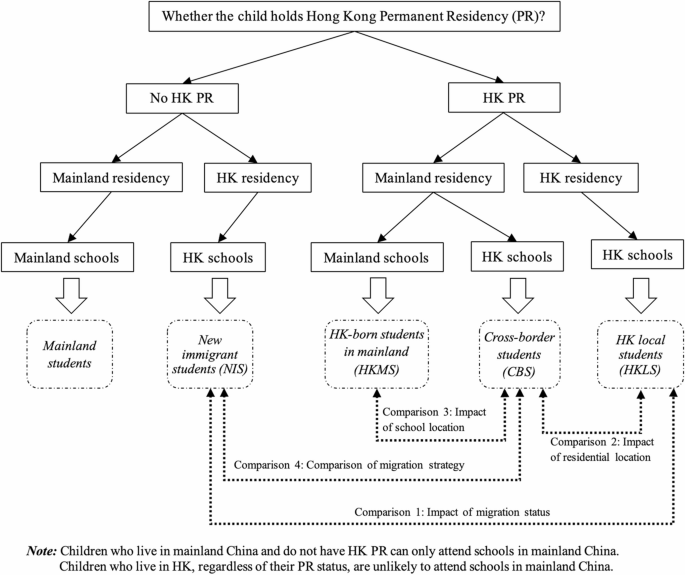
Typology of children involved in cross-border migration
In this study, we draw on a large-scale, school-based sample in Hong Kong and Shenzhen and utilized a counterfactual causal inference framework to distinguish different patterns of cross-border migration and estimate the effects of cross-border migration on children’s well-being. In total, 25 indicators from 5 dimensions of children’s well-being were selected, including physical health, mental health, resilience, educational outcomes, and interpersonal relationships. Propensity score matching method (PSM) was employed to control for the self-selection on observable factors and guarantee the comparability across different types of children. Our study contributes to existing literature in two major ways. We first narrow the knowledge gap and extend discussions from CBS and NIS to HKMS, a typically ignored group in the literature. Second, we provide a complete and comprehensive picture of the patterns and consequences of cross-border migration. Our study can be seen as the first attempt to compare four groups of children in the context of cross-border migration, and to reveal the impacts of migration status, residential location, school choice, and migration strategy on a wide set of indicators of children’s well-being.
Literature Review and Research Hypothesis
Divergent Patterns and Unequal Outcomes of Children with Immigration Background
Scholars have long sought to understand the processes by which children with immigration background assimilate into the receiving society and integrate into its polity and institutions. Sociologists have focused more on the educational and occupational outcomes of immigrants and their descendants, leading to the development of segmented assimilation theory. Psychologists, meanwhile, have focused more on the psychological adaptation during cross-cultural interactions and have proposed acculturation theory. Both perspectives have demonstrated significant explanatory power and hold important implications for studies on children involved in cross-border migration.
Unlike the classical assimilation theory which proposes that all immigrants will eventually integrate into the mainstream of the receiving society and achieve upward mobility (Gordon, 1964; Warner & Srole, 1945), segmented assimilation theory emphasizes the segmented pathways and divergent outcomes of incorporation in the receiving society. It argues that interactions between immigrants’ human capital, family socioeconomic status, and the host society’s contextual conditions predict divergent trajectories and varied incorporation outcomes (Portes & Rumbaut, 2001; Zhou & Gonzales, 2019). Based on observations in the United States, scholars have identified three possible patterns: the classical upward mobility pattern, characterized by complete acculturation and incorporation into the mainstream; the downward mobility pattern, marked by acculturation and incorporation into marginalized groups; and the ethnic upward mobility pattern, which combines selective acculturation with socioeconomic incorporation in the host society while preserving cultural values and social norms from the sending society.
Acculturation theory, pioneered by Berry (1997), seeks to explain the experiences of individuals who relocate from their native culture to a new and unfamiliar one. Focusing on psychological adaptation and shifts in cultural values, the theory posits that individuals and groups navigate cultural adaptation through strategies shaped by their intentions to retain their heritage culture and engage with the culture of the receiving society (Berry, 1974, 1980, 1997). Berry’s model identifies four acculturation strategies: integration (embracing both cultures), assimilation (adopting the culture of the receiving society), separation (retaining the culture of the sending society), and marginalization (rejecting both). Scholars highlight that successful psychological adaptation depends not only on migrants’ agency but also on the openness and inclusivity at the family, school, and societal levels (Sam & Berry, 2010; Ward & Geeraert, 2016).
Although the two perspectives mentioned above differ in emphasis and are developed in distinct disciplines, they share two key ideas that holds important implications for cross-border migration studies: first, there is diversity in patterns and outcomes of integration or assimilation; second, outcomes are shaped by a combination of factors operating at multiple levels. Just as children with immigration background navigate divergent integration pathways, those involved in cross-border migration may similarly experience heterogeneous outcomes subject to the interplay of factors across different levels. Situating cross-border migration within an ecological model can unveil the complexity of cross-border migration patterns and deepen our understanding of their impact on children’s well-being.
Situating Cross-Border Migration Within an Ecological Model
Bronfenbrenner’s ecological systems theory posits that a child’s development is influenced by dynamic interactions across interconnected environmental systems, including immediate settings like families and schools, and broader societal structures, such as institutional barriers (Bronfenbrenner, 1979). As the theory evolved, scholars widely acknowledge that connections between home and school environments, as well as political and cultural divides, interact to shape opportunities and challenges that significantly influence children’s well-being (Darling, 2007; Gu & Yeung, 2020; Hong & Eamon, 2012; Neal & Neal, 2013).
CBS, who reside in mainland China while attending schools in Hong Kong, face challenges rooted in microsystemic conflicts. Daily commutes between mainland residences and Hong Kong schools create a divided microsystem (Leung & Waters, 2022). Constantly shifting between and interacting with people in two sociocultural settings may expose CBS to conflicting languages, behaviours, and social norms, leading to psychological stress and confusion about their cultural identity (Chan & Ngan, 2018; Chiu & Choi, 2019). Moreover, the mesosystem for CBS, which depends on collaboration between families and schools, is further strained. Parental involvement in school activities and teachers’ understanding of students’ home lives are critical to children’s development (Ho, 2006; Ho & Willms, 1996). However, the physical separation between mainland parents and Hong Kong teachers hinders communication and cooperation between families and schools (Leung & Waters, 2022).
NIS, who move from mainland China to Hong Kong, are disproportionately affected by exosystemic discrepancies and inequalities. Despite the few racial and ethnic differences between mainland Chinese and Hong Kong populations, NIS still need to navigate differences in social and cultural environments and, in particular, educational systems. Apart from differences in written language (traditional Chinese characters used in Hong Kong and simplified Chinese characters used in mainland China), students in Hong Kong schools typically communicate in Cantonese, while students in mainland schools primarily use Mandarin. Additionally, Hong Kong schools place greater emphasis on learning and using English compared to mainland schools. Earlier studies and reports have shown that Hong Kong’s school placement policies often assign NIS students to schools with fewer resources, while unfavourable housing markets push low-income NIS families into poorer communities (Rao & Yuen, 2001; Hui et al., 2012).
HKMS, who were born in Hong Kong but live and receive education in mainland China, experience structural barriers and tensions at the macrosystem level. Due to the household registration system (hukou) in mainland China, HKMS had long been excluded from public education until the 2017 policy reforms. Although HKMS are now allowed to enroll in public primary and secondary schools, significant challenges persist, including insufficient public school placements and high tuition fees at private schools. Moreover, the split between their legal identity and spatial reality may disrupt stability in their development and affect their well-being, though no studies have yet explored this issue.
To sum up, in the context of cross-border migration, residential and school locations, migrant status, and migration strategies can be seen as spatial anchors that position children within the disruptions or construction of interconnections in the surrounding hierarchical systems, ultimately shaping children’s well-being. Therefore, it is necessary to distinguish cross-border migration patterns and examine their distinct impacts on children’s well-being.
Studies on New Immigrant Students (NIS)
In 2021, there were a total of 23,934 NIS who were aged under 15, had come from mainland China and had resided in Hong Kong for less than seven years, dropping from 34,181 in 2011 (Census and Statistics Department, 2023). As mentioned earlier, NIS come to Hong Kong either via the One-way Permits Scheme or as dependants with their sponsors being admitted to Hong Kong under certain admission schemes. As of 2019, mainland spouses and children had to wait for at least four years, depending on the age of applicants and duration of separation, before receiving the One-way Permit and reuniting with their Hong Kong family members (The Government of the Hong Kong Special Administrative Region, 2019). A proportion of NIS move to Hong Kong along with their parent(s). For both the NIS and their migrated family members, migration is accompanied by tremendous changes in several life aspects including social, cultural and psychological transitions (Wu & Ou, 2021).
Earlier studies have reported that NIS had adaptation problems in the school curriculums and instruction of languages used in the class (Cheung & Hui, 2003), and NIS scored significantly lower than their non-immigrant peers in terms of academic performance, especially in English literacy (Pong, 2009; OECD, 2006). The disadvantages in academic performance also led NIS to have higher incidences of repeating a grade compared to HKLS (Pong, 2009). Scholars also examined the mental health and well-being of NIS but reached mixed findings. A study covering 5,809 Hong Kong adolescents reported that NIS rated significantly lower than HKLS in school engagement and life satisfaction which were measured by attitudes towards families and friends (Yuen, 2016). Some studies also found that in relative to their local peers, NIS had lower levels of life satisfaction, higher rates of child poverty and more stress (Chou et al., 2014; Kwan, 2010). However, other studies documented that NIS did not fare worse than HKLS in perceived stress level, psychological well-being, self-esteem, delinquent behavior, and overall mental health (Tam & Lam, 2005; Wong et al., 2003; Wong, 2008).
Based on the studies mentioned above, we expect that NIS have worse educational outcomes than HKLS (Hypothesis 1). Due to the lack of studies or mixed results of existing studies, we do not propose any hypothesis on other domains including physical and mental health, resilience, and interpersonal relationships.
Studies on Cross-border Students (CBS)
Every school day morning, CBS leave their homes in mainland China, cross the border and head for schools in Hong Kong. In the afternoon or evening, they cross the border again, and return home. According to different family configurations, there are roughly three types of CBS. Some CBS were born in cross-border marriages between mainland mothers and Hong Kong fathers. These children are also called “single-not” (danfei) children since one of their parents is not a Hong Kong permanent resident. While some cross-border families choose to move to Hong Kong after the mother has obtained the One-way Permit, others still reside in mainland China for reasons such as existing social networks and work opportunities, lower costs of living, and better housing environments. Some CBS are born to two mainland parents in the phenomenon of birth tourism during 2001 to 2012. They are also called “double-not” (shuangfei) children because neither of their parents is a Hong Kong permanent resident. In July 2001, the Court of Final Appeal ruled that babies born in Hong Kong to Chinese nationals had the right of abode in Hong Kong. Numerous mainland families decided to give birth to children in Hong Kong to avoid the one-child policy in the mainland and/or as a family migration strategy. The number of “double-not” children born in Hong Kong surged from 620 in 2001 to 35,736 in 2011 (Census and Statistics Department, 2022). Birth tourism quickly led to protests by locals over the resulting shortage of obstetric services and school placements. On 1 January 2013, the Hong Kong government banned mainland birth tourism and prohibited obstetric services for mainland women whose spouses are not Hong Kong residents. A small proportion of CBS are born to both parents holding Hong Kong permanent residency who choose to live in Shenzhen. In recent years, the rapid economic growth and urbanization in mainland China has narrowed the income gap and attracted Hong Kong residents to work and settle their families in mainland China. As of October 2023, there were a total of 14,492 CBS who commuted between mainland China and Hong Kong on a daily basis, dropping from 27,055 in September 2019 (Education Bureau, 2024), mainly due to the natural growing out of school-aged children as well as the relocation of CBS families in response to the prolonged school closures and border shutdown during the COVID-19 pandemic.
The fact that CBS legally hold Hong Kong permanent residency entitles them to receive education in Hong Kong. Meanwhile, the household registration system (hukou) in mainland China has restricted CBS’s access to various social services and benefits in mainland China. Therefore, CBS are ineligible to attend public schools in mainland China for a long time. Cross-border schooling seems to be CBS’s only choice until the hukou reforms in recent years. Based on small-scale case studies, interviews, and questionnaires, studies have widely reported that CBS face multiple challenges, such as the long-time daily transportation, limited chances for after-school extracurricular activities, unfamiliarity with Hong Kong’s political and social environment, identity confusion, and stigmatization of their legal though second-class citizenship (Bu et al., 2023; Chan et al., 2020; Chan & Ngan, 2018; Chee, 2012, 2017; Chiu & Choi, 2019; Wu & Qiu, 2024; Yuen, 2009, 2010). However, little is known about how CBS behave relative to HKLS or other groups of students. To the best of our knowledge, only one study to date has compared the life satisfaction and school engagement of CBS to that of HKLS and NIS, and surprisingly found that CBS fared similarly to HKLS and even outperformed NIS (Yuen, 2016).
Social media and existing studies portray a very negative picture of CBS’s lives and situations, with very few being exceptional. Hence, in this study, we anticipate that CBS fare worse in mental health and educational outcomes than HKLS (Hypothesis 2). Due to the lack of sufficient evidence, we do not make any assumptions on the differences between CBS and NIS.
Studies on HK-born Students Living in Mainland China (HKMS)
In 2020, there were a total of 121,893 Hong Kong permanent residents who were aged under 15 and lived in mainland China (National Bureau of Statistics, 2023). The majority of HKMS live in Guangdong province (National Bureau of Statistics, 2023). Like CBS, HKMS are also born in Hong Kong and do not have hukou in mainland China, so HKMS do not have access to social benefits, including state-funded education for a long time. Since 2017, Shenzhen has allowed Hong Kong children to apply, through a points system, for free education in public schools. Prior to that, HKMS could only attend private or international schools in mainland China. The research on HKMS is even rarer. Within the very limited studies, scholars are more concerned with the university choices and life experiences of Hong Kong adults in mainland China (Te & Postiglione, 2018; Xu, 2023). These studies fail to examine the well-being of those HKMS in primary and secondary schools, let alone their relative situations to other groups of students in Hong Kong. As such, we do not propose any hypothesis regarding the differences between HKMS and CBS in terms of their well-being in all life domains.
Data, Variable, and Analytical Strategies
Data and Sample
The data utilized in this study came from a large-scale cross-sectional survey in Hong Kong and Shenzhen that was conducted in 2016–2017. Hong Kong and Shenzhen are direct adjacent neighbors, just across a river. These two study sites provide a good research context for examining the impact of cross-border migration. The survey followed a school-based multi-stage cluster sampling procedure. In the Hong Kong site, as the majority of mainland immigrant families chose to live in Kowloon and the New Territories areas (Census and Statistics Department, 2023), we first selected three districts in Kowloon and the New Territories areas. We then obtained a full list of schools in these three districts from the Education Bureau of the Hong Kong Government, and randomly selected two primary schools and two secondary schools within each district. In the next step, we randomly chose two classes from the 4th to 6th grades in each selected primary school. Similarly, two classes from the 7th to 9th grades were randomly selected in each selected secondary school. All students in the selected classes were invited to complete the survey. In total, we recruited 2180 students from 12 schools in Hong Kong, including 445 CBS, 348 NIS, and 1387 HKLS. As mentioned earlier, HKMS were not able to attend public schools in Shenzhen at the time of the survey, and they could only go to private schools that enrolled HKMS and other mainland children without local hukou. In the Shenzhen site, we first selected four private schools that admitted HKMS. As these schools admitted both primary and secondary students, two classes from 4th-6th grades and two classes from 7th-9th grades were randomly selected in each school. All students in the selected classes were invited to complete the survey. As a result, we recruited 430 HKMS from four schools in Shenzhen.
The survey collected children’s background information, family environment, and school experiences, with a focus on their multidimensional well-being. The survey was conducted in classrooms, and research team members were present to respond to questions or address concerns students might have about the survey. Both students and parents signed consent forms before the survey. This study was approved by the Ethics Review Committee of the first author’s institution.
Variables
Dependent Variables
Since children’s well-being is comprehensive and multidimensional, we included a wide set of indicators across different domains as the outcome variables in this study. In total, we selected 25 indicators from 5 dimensions, namely physical health, mental health, resilience, educational outcomes and interpersonal relationships. Table 1 gives a full list of well-being indicators along with their definitions and measurements. The majority of the well-being indicators were measured by multiple items or classical scales. For example, self-esteem, mental well-being, and life satisfaction were measured by the Chinese version of the classic 10-item Rosenberg Self-Esteem Inventory (RSEI) (Rosenberg, 1965), the 14-item Warwick-Edinburgh Mental Well-being Scale (WEMWBS) (Tennant et al., 2007), and the 5-item Satisfaction with Life Scale (SWLS) (Diener et al., 1985) respectively. These scales have been actively adopted and validated in previous studies targeted at the Chinese population in both Hong Kong and mainland China (for example Ng et al., 2014; Wu et al., 2015, 2018, 2021). Some indicators such as grade repetition and life satisfaction have been examined by previous scholars. Some indicators, especially sleep quality, smoking, drinking, resilience, and importance of study, were considered for the first time in a comparative study on cross-border migration between mainland China and Hong Kong. This is a pioneer study that examines and compares such comprehensive well-being indicators among CBS, NIS, HKLS in Hong Kong, and HKMS in mainland China.
Matching Variables
Informed by existing studies, we also included a number of individual and family characteristics as matching variables to ensure the comparability of different groups of children. At the individual level, we controlled for age (in years) and gender (recorded as 1 for male and 0 for female). At the family level, we considered both parents’ education level (two dummies indicating whether the father/mother has obtained an associate degree or above), both parents’ work status (two dummies indicating whether the father/mother has full time occupation), family structures (two dummies indicating whether the child lives with the father/mother, and one dummy indicating whether the child has siblings), the number of books at home (a categorical variable ranging from 1 “None” to 9 “More than 500 books”), and another dummy indicating whether the child has a quiet place for study at home.
Analytical Strategies
A main concern when estimating the effects of migration on children or adolescents’ outcomes is the endogeneity of the migration decision. In other words, immigrants/migrants are usually not random populations, and the migration decision can be the result of self-selection. This endogeneity issue is especially pronounced for some NIS who enter Hong Kong as dependants and whose parents are talented, professional, and wealthy. These NIS may have better educational performance and health status than HKLS because NIS come from families with more economic, cultural, and social capital and their parents have more resources. Hence, it is difficult to tell whether the difference between NIS and HKLS is caused by migration status or family resources. To address this issue, this study adopts a counterfactual causal inference framework to estimate the effects of different patterns of migration on children’s well-being. A propensity score matching (PSM) method is employed to ensure the comparability of each pair of students involved in the cross-border migration based on a set of observed characteristics. Though the PSM has been widely used by scholars in many disciplines, it should be noted that PSM only accounts for selection on unobservable features and may still lead to hidden bias.
Three steps are involved when applying PSM. First, the propensity score of each student is obtained by Probit or Logit regression. The Probit or Logit regression should include a large set of covariates that are related to the treatment assignment and outcome variables (Stuart & Rubin, 2008). Following this instruction, this study included a number of individual and family variables aforementioned as covariates in the calculation of propensity score. Second, students in the treatment group are matched to students in the control group. Kernel matching is used in this study, and caliper matching method is also employed in this study as a robustness check. These two matching methods do not lead to substantial differences in the results. We restrict the matched sample to a region of common support and then check the data balance for the matched sample. Average Treatment Effect for the Treated (ATT) is calculated based on matched samples in the last step.
To answer the research question of this study, we performed the PSM and calculated ATT for four pairs of students respectively. To examine the impact of migration status, we took NIS as the treated group and HKLS as the control group. For the impact of residential location, we took CBS as the treated group and HKLS as the control group. To understand the impact of school location, we took HKMS as the treated group and CBS as the control group. To compare two different migration strategies, we took NIS as the treated group and CBS as the control group.
Results
Descriptive Analysis
Table 2 shows the descriptive statistics of four groups of students as well as the differences between each pair. Compared to HKLS, NIS performed worse in some physical and mental health indicators, but NIS demonstrated to have higher levels of resilience. For example, NIS reported lower levels of exercise frequency, sleep quality, happiness and life satisfaction and higher levels of social anxiety than HKLS. A mixed pattern emerged for educational outcomes and interpersonal relationships, NIS had higher proportions of repeating grade and less good friends than HKLS, but NIS fared better than HKLS in terms of educational aspirations, study pressure, last term exam results, self-rated academic performance, importance of study, and teacher relationship. As for the comparison between CBS and HKLS, results were consistent: CBS significantly outperformed HKLS in the majority of well-being indicators. Similarly, HKMS significantly fared better than CBS in all five dimensions. When it came to the comparison of different migration strategies, NIS fared worse than CBS in physical health, mental health, educational aspirations, and interpersonal relationships except for teacher relationship. NIS and CBS demonstrated similar levels of resilience.
PSM Results
The Impact of Migration Status (Comparison1: NIS Vs. HKLS)
Table 3 first presents the disparities in well-being between NIS and HKLS. A consistent pattern can be observed across all five dimensions: NIS significantly outperformed HKLS. Contrary to our hypothesis 1, NIS have higher levels of educational aspirations, last term exam results, self-rated academic performance, and importance of study, along with lower levels of study pressure than HKLS. In the dimension of physical health, NIS fare similarly to HKLS in terms of exercise frequency, sleep quality, smoking and drinking, but report higher levels of self-rated health. Moreover, NIS show higher levels of self-esteem and mental well-being, and lower levels of depression compared to HKLS. The advantages of NIS are more significant and obvious in the dimensions of resilience and interpersonal relationships where NIS outscored HKLS in the majority of indicators.
The Impact of Residential Location (Comparison 2: CBS Vs. HKLS)
Despite the prevailing negative reports of CBS’s experiences, our results show that CBS fare similarly to HKLS in nearly every aspect of their lives. More specifically, CBS are not worse off than HKLS in all 25 well-being indicators, and CBS even perform better than HKLS on two indicators, exercise frequency and last term exam results. The results are opposite to our hypothesis 2, CBS are not disadvantaged in educational outcomes and mental health. It seems that residential location doesn’t matter in determining children’s well-being.
The Impact of School Location (Comparison3: HKMS Vs. CBS)
As shown in Table 3, HKMS fare similarly to CBS in terms of mental health and resilience indicators. Moreover, attending schools in mainland China even leads to better educational outcomes: HKMS demonstrate lower levels of study pressure and better last term exam results, self-rated academic performance, and attach greater importance to study than CBS. School location has a mixed impact on children’s physical health and interpersonal relationships. HKMS have lower exercise frequency but better sleep quality when compared to CBS. Though HKMS have a smaller number of good friends than CBS, they report to have closer relationship with peers, teachers, and both parents, and they have more parent-child interaction at home.
The Comparison between Different Migration Strategies (Comparison4: NIS Vs. CBS)
We also compare two different migration strategies in cross-border migration. As mentioned earlier, CBS obtain their right of abode by being born in Hong Kong, while NIS have to reside in Hong Kong for at least seven years before gaining the right of abode. Different family migration strategies also bring different outcomes to children’s well-being. NIS and CBS perform similarly in terms of physical health and resilience. NIS have lower levels of life satisfaction and higher incidences of repeating grade than CBS, and they do not differ significantly in other indicators of mental health and educational outcomes. As for interpersonal relationships, NIS report closer relationships with teachers and higher levels of parent-child interactions at home.
Discussion and Conclusion
Cross-border migration is a unique phenomenon that emerges from the peculiar geopolitical context of Hong Kong. People from mainland China dominate the inflow of population in Hong Kong and there is only a river between mainland China and Hong Kong. Although being separated by a physical and legal border, cross-border migration doesn’t resemble international migration in aspects such as long-distance travel and significant ethnic/racial disparities. Meanwhile, the colonial period of Hong Kong and evolving immigration policies have turned Hong Kong and mainland China into two distinct but closely connected economic, social, and political systems. Scholars have attempted to understand how cross-border migration influences children’s development and have mixed findings. Moreover, existing studies either focus on one specific group, such as NIS who have just moved to Hong Kong or CBS who commute on a daily basis for education, or examine one or two dimensions of children’s development. Few studies have attempted to distinguish patterns of migration and decompose the impact of migration status, residential and school locations, and family migration strategies on children’s well-being. By proposing a causal analytical framework and employing propensity score matching method, this study could be seen as one of the pioneers in providing a comprehensive and complete picture of the consequences of cross-border migration. Drawing on a large-scale cross-sectional survey in Hong Kong and its adjacent city, Shenzhen, this study has four major findings.
First, despite NIS and their migrant family members facing challenging environmental changes and various life transitions, our study shows that NIS do not fare worse than HKLS. More specifically, NIS outperformed HKLS across all five dimensions, especially in resilience, educational outcomes, and interactions with peers, teachers, and parents. Our finding contradicts earlier studies that documented the educational disadvantages of NIS (Cheung & Hui, 2003; Pong, 2009). One potential reason is that, in recent years, the composition and features of NIS have changed, and NIS tend to be more positively selected than ever. Our PSM results also supported this explanation: NIS were more resilient than HKLS which may further lead to their relative advantages in educational and health outcomes. Studies on international migration in the US and internal migration in mainland China both provided evidence that (im)migrants were usually more motivated (Borjas, 1987; Feliciano, 2020; Kao & Tienda, 1998; Xu & Xie, 2015). Families of NIS may have been planning for the migration for a long period. Before they arrive in Hong Kong, they may be aware of and prepare NIS for possible transitions and challenges by learning Cantonese, improving English, and being familiar with educational and political systems in advance. After they settle down in Hong Kong, NIS may benefit from the School-Based Support Scheme, which was introduced by the Education Bureau and targeted at newly arrived children, and gradually overcome the adaptation problems and learning difficulties.
Second, we find little or no impact of residential location on children’s well-being and there is little significant difference between CBS and HKLS across the 25 indicators included in our study. Our finding echoes one previous study in Hong Kong that reported no significant differences between CBS and HKLS in terms of life satisfaction and school engagement (Yuen, 2016). In spite of the frequent time-consuming commuting between Shenzhen and Hong Kong, CBS seem to be rather relentless. This is an encouraging sign to both scholars and policy makers in Hong Kong, though it is contrary to our hypothesis and the long-standing negative impression of CBS’s experiences. On average, CBS included in this study have been living the cross-border schooling life for more than five years. They might have become used to this kind of life and found their own ways of coping with these adversities. Moreover, the compensating roles played by CBS’s relatively better-off living conditions in mainland China may also contribute to their well-being (Wu et al., 2021). Hong Kong has been the least affordable housing market in the world (Chong & Li, 2020), and there were about 34,000 children aged 15 and below living in subdivided units (The Government of the Hong Kong Special Administrative Region, 2023). Many families of CBS decided to stay in mainland China for lower living costs and better housing conditions, CBS are more likely to have some personal and private space than HKLS, which may buffer the adverse effects of cross-border schooling and protects their well-being.
Third, school location brings both costs and benefits to children’s well-being. Though HKMS and CBS both live in mainland China, attending mainland schools imposes mixed consequences to their physical health and interpersonal relationships. HKMS have lower frequencies of exercising but better sleep quality and more parent-child interaction than CBS. This seems to be caused by the tradeoff among commuting time, sleep time, and family time. Compared to CBS, HKMS have fewer friends. It might be owing to that CBS usually go to schools in groups for safety considerations, and they have more chances to make more friends on their long journey to school than HKMS. HKMS resemble CBS in levels of mental health and resilience, and HKMS have better educational outcomes than CBS. One possible explanation is that HKMS attend private schools that are not as academically demanding as other schools in Hong Kong. Those HKMS cannot attend high school or college entrance exams in mainland China since they don’t have hukou. Some private schools targeted at HKMS offer diverse and international curriculums that prepare students for overseas studies in the future. Hence these schools are not as competitive as schools in Hong Kong, and that may explain why HKMS have lower levels of study pressure, and better interpersonal relationships.
Last, we also find that two migration strategies cast different influences on some aspects of children’s well-being. On the one hand, NIS have higher likelihoods of repeating grades and lower life satisfaction than CBS. This might be caused by the unfavorable living conditions and unfamiliar educational settings in Hong Kong. On the other hand, NIS benefit from migrating with family members and have more parent-child interactions than CBS. NIS perform as well as CBS on other indicators of well-being. This finding suggests that migrating as a family may sacrifice some life satisfaction but secure parent-child interactions at home. Both migrant children and parents are encouraged to carefully consider the benefits and costs of migration strategies and take a long view of children’s well-being.
In sum, we differentiate patterns of cross-border migration and examine how these different patterns influence children’s well-being. By doing so, we contribute to the literature by providing a complete and comprehensive picture of cross-border migration. Findings of this study also carry important implications. First, owing to the colonial history of Hong Kong and its prolonged complicated relations with mainland China, we reveal that children involved in cross-border migration are not homogeneous and cross-border migration is complicated and ever-changing. Some of our findings are in line with previous studies on children involved in cross-border migration, while some of our findings shed new insights because the demographic compositions of the migrant population have undergone changes in the past three decades. Therefore, there is a need for a systematic consideration of social, political, and other contextual factors that alter the drivers and consequences of cross-border migration. Second, the consequences of cross-border migration are complex and multi-directional. Our findings point out that the consequences of school locations and migration strategy can be positive in one dimension but negative in another. Even within the same dimension, the consequences of cross-border migration can be mixed on separate indicators. This finding provides empirical support for segmented assimilation theory and demonstrates that divergent patterns and unequal outcomes also emerge in cross-border migration. Hence, we suggest that overgeneralizing conclusions about cross-border migration risk bias and should be interpreted with caution. Third, we found that, although faced with different challenges within ecological systems, neither NIS nor CBS fared worse than HKLS across all well-being indicators included in this study. Such positive results indicate that both NIS and CBS actively exerted agency, mobilized resources from surrounding ecological systems, and adopted appropriate coping strategies to achieve assimilation or integration. Future studies should disentangle the adaptive mechanisms at play, such as how NIS seek support from peers, parents, and teachers to improve resilience, which further contributes to their educational and health outcomes. Last, this study carries practical implications. Our results suggest that certain government initiatives may effectively promote educational and health outcomes for NIS and CBS. Policymakers could consider allocating resources, expanding and adapting these initiatives and support schemes to address overlooked yet important dimensions, such as cultural identity, digital inequality, and long-term life planning. The study also holds implications for parents and families. Our results revealed mixed impacts of school location and migration strategies on children’s well-being. We suggest parents weigh the pros and cons, prioritize children’s long-term development and well-being, and consider adaptive mechanisms when deciding on school locations and migration strategies.
Despite all the insightful findings and implications, our study has limitation in several aspects. First, all 25 well-being indicators included in our study are self-reported and are not all objective measurements. Developing and identifying other objective and comparable measurements of well-being indicators can lead to more accurate estimates of the impacts of cross-border migration. Second, as mentioned earlier, children involved in cross-border migration are still subject to hidden bias. Data utilized in this study came from a cross-sectional survey, which restricts the ability to infer truly causal relationships. Given that PSM can only account for selection on observed factors and the cross-sectional feature of the data, we suggest that our results should be interpreted with caution. Third, findings of this study are more likely to be generalized to schools in Kowloon and the New Territories areas but cannot be extended to schools in Hong Kong Island. Moreover, school segregation still exists in Hong Kong and some schools do not admit NIS or CBS. Last, our survey was completed before the COVID-19 pandemic. Both Hong Kong society and immigration policies have gone through remarkable transitions during the pandemic period. Children’s well-being is not static either and can be improved or deteriorated subject to the changes in surrounding environments. Some CBS and HKMS may alter their residential and school locations, and the composition of NIS may also be different in the past five years.
To conclude, this study examines a large sample of children involved in cross-border migration and assesses the impacts of distinct migration patterns on a wide range of children’s well-being indicators. It is among the first to apply a counterfactual perspective to estimate how cross-border migration influences children’s multidimensional well-being. By constructing comparable subsamples, we uncovered the complexity of cross-border migration and found that NIS performed significantly better than HKLS; CBS and HKLS showed similar outcomes across nearly all well-being indicators; and school location and family migration strategy yielded both benefits and risks to children’s well-being. Future studies should collect more representative and longitudinal data, incorporate objective measurements to capture overtime changes in migration patterns, estimate their long-term impacts on children’s development, and explore potential mechanisms.
