
 info@apippress.com
 +86 18163351462 (WhatsApp)
 +86 182 8014 0209
Article Content
Introduction
The COVID-19 pandemic has affected many facets of daily life, posing threats not just to physical health but also to mental well-being among adolescents. During the first few months after the outbreak of the pandemic, the limited understanding of the virus and its rapid mutation led to widespread panic, anxiety, and fear (Ventriglio et al., 2020). Specifically, adolescents faced more pronounced vulnerabilities during this period (Murata et al., 2021). They encountered various mental health problems, ranging from depression to internet addiction (Shek et al., 2023) due to the extraordinary life changes brought by the pandemic (Hawes et al., 2022). Adolescence is a crucial time before adulthood, if they don’t address their mental health at this stage, it will negatively impact their future welfare. Investigating the protective variables that can shield adolescents from the pandemic’s effects on their mental health is important.
In the context of these adversities, the concepts of two positive youth development (PYD) constructs—beliefs in the future and spirituality—become paramount. These two constructs can instill hope and optimism amidst uncertain and uncontrollable situations, provide frameworks for deeper reflection and meaning-making, and facilitate coping and emotional regulation (Dimitrova & Wiium, 2021). Catalano et al. (1998) defined beliefs in the future as an internalization of hope and optimism about future outcomes. During the crisis, adolescents with a strong belief in the future may believe that they would recover soon or regard the pandemic as controllable. Spirituality has been defined concerning one’s meaning and purpose of life, and one’s reactions to limits of life such as death and dying issues (Shek, 2012). Spirituality is closely related to the feeling of uncertainty and connection (Pesut, 2003). With the school lockdown and the restrictions on social activities during the COVID-19, adolescents may develop feelings of disconnected, exacerbating their mental health challenges. Given this condition, spirituality may have a unique role in alleviating their uncertainty and disconnection because it’s beneficial for individuals to seek their meaning of life.
Adolescence is also a pivotal phase for the emergence and development of both spirituality and beliefs in the future. As teenagers’ cognitive abilities develop, they begin formulating future goals, aspiration, and expectations about future outcomes (Sun & Shek, 2012). Their enhanced capacity for abstract thinking also facilitates spiritual exploration (Good & Willoughby, 2008). While previous research has examined the impact of global or composite measures of PYD attributes on students’ mental health during the pandemic (Shek et al., 2021; Zhu & Shek, 2023), little is known about whether spirituality or beliefs in the future—two core PYD attributes—moderate the relationship between pre- and post-pandemic mental health problems.
It is noteworthy to mention that adverse life events often lead to changes in beliefs in the future and spirituality. Calhoun and Tedeschi (2000) highlighted that challenging circumstances can amplify the significance of spirituality and religious reflection. This is likely because, post-trauma, individuals often acknowledge their vulnerabilities but might also recognize newfound strengths. A systematic review suggested that traumatic experiences can intensify spirituality due to post-traumatic growth, leading individuals to cherish each day more and acknowledge the fragility of life (Shaw et al., 2005). On the other hand, the developmental trajectory for beliefs in the future can be more complicated. A study by Trumbo (2014) observed that optimism grew after experiencing hurricanes, while another study showed that people severely affected by an earthquake displayed less optimism over time (Helweg-Larsen, 1999). There are also researchers suggested that increased perceived risks can diminish hope (Halevy, 2017). In light of these studies, it is unclear whether and how COVID-19 may impact adolescents’ beliefs in the future and spirituality post-adversity. Against this background, the first aim of the present study was to examine changes in spirituality and beliefs in the future before and after the outbreak of the COVID-19 pandemic based on a sample of Chinese adolescents.
The second aim of the study was to investigate the roles of beliefs in the future and spirituality in buffering mental health challenges for adolescents during the pandemic. Prior research has shown that these two positive youth development attributes act as protective factors when youth face adversities and stressful situations. For instance, it has been suggested that children with high levels of hope tend to perceive difficulties as challenges rather than overwhelming (Hagen et al., 2005) and are likely to develop effective coping strategies (Weitzer et al., 2022). Similarly, researchers have consistently identified a negative relationship between spirituality and various youth problems, such as delinquency (Shek & Zhu, 2018), internet addiction (Dou & Shek, 2021), anxiety, and depression (Bitar et al., 2022). It is believed spirituality provides adolescents with a sense of purpose and meaning, enabling them to see beyond immediate difficulties and navigate challenges (Fowler, 1988). Researchers have also suggested that adolescents who frequently engage in spiritual activities often receive more support from their families and communities (Michaelson et al., 2019).
While there is evidence supporting the protective roles of hope, optimism, and spirituality in mitigating the adverse mental health impacts of the pandemic, most studies were cross-sectional (Bitar et al., 2022) and/or focused on adult groups (Weinberg et al., 2016; Weitzer et al., 2022). These studies may not provide a comprehensive understanding of how beliefs in the future and spirituality influence the mental health of adolescents, particularly Chinese adolescents, during the pandemic. The present study aims to address this gap.
Furthermore, the pandemic, being a traumatic experience, has resulted in elevated rates of post-traumatic stress disorder (PTSD) symptoms among adolescents, largely attributed to their fear of contagion and the associated perceived risk of death from COVID-19 (Cao et al., 2022; Dou & Shek, 2021), further affecting adolescents’ wellbeing (Lee et al., 2022). Previous research indicates that beliefs in the future and spirituality have an inverse relationship with COVID-related PTSD symptoms stemming from events such as violence exposure (Houskamp et al., 2004), terrorist attacks (Weinberg et al., 2016), and wars (Carroll et al., 2020). Yet, there is a research gap regarding the potential of adolescents’ beliefs in the future and spirituality to buffer the detrimental effects of pandemic-related PTSD on their health. This study aims to investigate the moderating roles of these two positive youth development attributes concerning adolescents’ COVID-related PTSD and their mental health during the pandemic.
In summary, the present study seeks to address three primary questions: first, did beliefs in the future and spirituality among Chinese adolescents change following the onset of COVID-19? Second, can pre-pandemic levels of beliefs in the future and spirituality predict adolescents’ mental health during the pandemic? Third, did beliefs in the future and spirituality moderate the adverse impacts of COVID-related PTSD on adolescents’ mental health during the pandemic?
Methods
Study Design
This study is part of a longitudinal project that surveyed pre-adolescents and adolescents from Chengdu, Sichuan, China. In Chengdu, primary and secondary education institutions are categorized into three types: primary schools, junior secondary schools, and combined junior and senior secondary schools. The project targets students in Grades 4 through 9 attending these schools. Using a cluster sampling approach, five schools were selected including one primary school, one junior secondary school, and three combined schools that enroll both junior and senior secondary students. Among the participating schools, one is located in the city center, two are in the southern suburbs, and two are in the northern suburbs of Chengdu.
At Wave 1, all students from Grades 4 to 9 and their parents in the five participating schools were invited to take part in the survey, which was conducted between December 2019 and January 2020—just before the school closure due to the COVID-19 pandemic. The Wave 2 survey was administered among the same group of students and their parents between June and July 2020, as schools resumed in-person instruction following the first wave of the pandemic. By the time of Wave 2 data collection, students had returned to normal school routines, minimizing disruptions to classroom-based data collection.
In both waves, participants completed questionnaires in classroom settings under the guidance of trained research assistants. Ethical approval for this study was obtained by the author’s institutional review board, and written consents were secured from participating schools, students, and their parents. The present study utilized a dataset matched across both waves to address research questions that differ from what has been focused on in previous studies using the same data set (e.g., Shek et al., 2021; Zhu & Shek, 2023).
Participants
The participants included 7,008 students (48.64% female) and 6,778 parents in Wave 1, and 6,164 students (48.51% female) with 6,164 parents in Wave 2. In this research, we include two waves of students in grades 4 through 9 with an average age of 12.94 years (SD = 1.73). 76.81% (N = 5,206) of the fathers had junior/high/technical school degrees, and 74.34% (N = 5,039) of the mothers had junior/high/technical school degrees. More sociodemographic characteristics are summarized in Table 1. The Chinese positive youth development scale, the center for epidemiologic studies depression scale, the child anxiety related emotional disorders, the internet addiction test, and the children’s revised impact of event scale were reported by the students, while their parents completed the parent-reported child behavior checklist.
Instruments
The Chinese Positive Youth Development Scale
Beliefs in the future and spirituality were measured by two subscales extracted from the Chinese Positive Youth Development Scale (CPYDS). The CPYDS has been validated in various Chinese youth populations and demonstrated good psychometric properties (Shek et al., 2007). The Beliefs in the Future subscale comprises three items and the Spirituality subscale contains seven items. All items were rated on a 6-point Likert scale with higher scores representing higher levels of the measured attributes. Cronbach’s α for the two subscales Wave 1 and Wave 2 were both above 0.81.
The Center for Epidemiologic Studies Depression Scale
Depression was measured by the Chinese version of the Center for Epidemiologic Studies Depression Scale ( CES-D, Jiang et al., 2019). It is a 20-item measure that asks the individual to rate how often they experienced symptoms associated with depression over the past week. The items were rated from 0 (“rarely or none of the time”) to 3 (“most or almost all the time”), and scores range from 0 to 60, with a higher score suggesting more significant depressive symptoms. In this study, Cronbach’s α of the CESD were 0.85 and 0.87 at Wave 1 and Wave 2, respectively.
Child Anxiety Related Emotional Disorders
Anxiety was assessed by the Chinese version of the Screen for the Child Anxiety Related Emotional Disorders (SCARED, Su et al., 2008). The SCARED is a 41-item inventory rated on a 3-point rating scale of 0 (“not true or hardly ever true”), 1 (“somewhat or sometimes true”), or 2 (“very true or often true”). Prior confirmatory factor analyses suggest that the instrument measures five distinct domains of anxiety, including generalized anxiety symptoms, separation anxiety symptoms, social anxiety symptoms, panic or somatic symptoms, and school avoidance (Birmaher et al., 1997). A score of 25 or above has been suggested to indicate the presence of clinically significant anxiety (Birmaher et al., 1997). Cronbach’s α of the SCARED were 0.95 and 0.96 at Wave 1 and Wave 2, respectively.
Internet Addiction Test
Internet addiction was measured by the Chinese version of the Internet Addiction Test (IAT-20, Lai et al., 2013). The IAT-20 comprises 20 items rated on a five-point scale from 0 (“not applicable”) to 5 (“always”). This measurement was derived from the DSM–IV criteria for pathological gambling and alcoholism and it measures the extent of an individual’s problems due to Internet use in daily routine, social life, productivity, sleeping patterns, and feelings (Young & Abreu, 2010). In the present study, the Cronbach’s α of ITA-20 was above 0.93 at both waves.
Children’s Revised Impact of Event Scale
COVID-related PTSD symptoms were assessed only at Wave 2 using the Chinese version of Children’s Revised Impact of Event Scale (CRIES-13, Wang et al., 2010). The CRIES is reliable and valid in assessing Chinese adolescents’ symptoms of potential posttraumatic stress disorder (Lau et al., 2013) and has an adequate internal consistency (Cronbach’s α = 0.89) (Shek et al., 2021). Participants were asked to report the frequency of COVID-related symptoms using a 4-point scale (0 = “never,” 1 = “rarely,” 3 = “sometimes,” and 5 = “a lot”), with the final score ranging from 0 to 65. The Cronbach’s α of this scale was 0.89 in this research.
Parent-Reported Child Behavior Checklist
Problem behaviors were assessed by the Parent-reported Child Behavior Checklist (CBCL, Leung et al., 2006). The CBCL is a 113-item informant-report questionnaire assessing behavioral competency and behavioral problems in adolescents (ages 6–18) within the past six months. CBCL is a multidimensional scale examining aggressive behavior, anxious/depressed symptoms, attention problems, rule-breaking behavior, somatic complaints, social problems, thought problems, and withdrawal. There is a total problems score and composites for internalizing and externalizing problems. Behaviors are rated on a 3-point scale: 0 (“not true”), 1 (“somewhat or sometimes true”), and 2 (“very true or often true”). CBCL showed high internal consistency in this research with Cronbach’s α ranging from 0.96 to 0.97 at Wave 1 and Wave 2.
Data Analysis
Data analyses were conducted using SPSS (version 26.0). First, paired samples t-tests were performed to compare adolescents’ scores of beliefs in the future and spirituality between the two waves. Second, multiple regression analyses were conducted to examine the main effects of spirituality and beliefs in the future on adolescents’ mental health outcomes (i.e., depression at wave 2, anxiety at wave 2, internet addiction at wave 2, and children behavioral problems at wave 2). As some demographic variables (such as gender, grade, and parental highest educational levels) may be related to adolescents’ mental health, the related covariates were statistically controlled in the following regression analyses. Specifically, there were four models with four mental health outcomes as the dependent variables, respectively. In every model, the independent variables include the corresponding wave 1 mental health outcomes (i.e., wave 1 depression in model 1, wave 1 anxiety in model 2, wave 1 internet addiction in model 3, and wave 1 children behavioral problems in model 4), COVID-related PTSD, spirituality at wave 1, beliefs in the future at wave 1, and the interactive terms. Finally, the moderating effects of beliefs in the future and spirituality on the relationship between COVID-related PTSD and students’ wave 2 mental health outcomes and the relationship between wave 1 and wave 2 mental health outcomes were examined.
Results
Changes of Beliefs in the Future and Spirituality and the Scores of COVID-Related PTSD
Results of paired-sample t-tests on adolescents’ beliefs in the future and spirituality between Wave 1 and Wave 2 are summarized in Table 2. The mean score of beliefs in the future declined from 5.01 to 4.95 (t = 4.71, p <.001) from Wave 1 to Wave 2, and the mean score of spirituality showed a significant decrease as well from 5.75 to 5.58 (t = 11.65, p <.001) before and after the outbreak of pandemic. COVID-related PTSD was only tested after the outbreak of COVID-19, and its mean score among all student populations was 13.84 (SD = 13.60).
Protective Effect of Beliefs in the Future and Spirituality
Table 3 revealed several significant associations between various factors and the level of depression among participants following the outbreak of COVID-19. Specifically, being female (β = − 0.03, p <.01), studying in a higher grade (β = 0.06, p <.001), and having a father with a higher education level (β = 0.03, p <.05) were each associated with elevated levels of depression. Furthermore, higher levels of self-reported depression before the pandemic, as measured at Wave 1 (β = 0.37, p <.001), and greater COVID-related PTSD (β = 0.20, p <.001) were both positively correlated with participants’ depression during the pandemic at Wave 2. Conversely, stronger beliefs in the future (β = − 0.03, p <.05) and higher levels of spirituality (β = − 0.17, p <.001) as assessed at Wave 1 were negatively associated with depression during the pandemic. The interactive term of spirituality at Wave 1 and COVID-related PTSD demonstrated a significant effect on depression at Wave 2 (β = − 0.03, p <.05), suggesting that spirituality may moderate the relationship between PTSD and Wave 2 depression.
In Model 2, being female (β = 0.09, p <.001) and studying in a higher grade (β = 0.04, p <.001) were significantly associated with a higher level of anxiety following the onset of COVID-19. Wave 1 anxiety (β = 0.38, p <.001) and COVID-related PTSD (β = 0.30, p <.001) were positively correlated with Wave 2 anxiety. After controlling for the effects of demographic variables and pre-pandemic anxiety, spirituality at Wave 1 was found to be negatively associated with anxiety during the pandemic (β = − 0.11, p <.001). In contrast, beliefs in the future at Wave 1 did not show significant effects on anxiety at Wave 2. Notably, the interactive term of spirituality at Wave 1 and Wave 1 anxiety demonstrated a significant negative effect on anxiety at Wave 2 (β = − 0.04, p <.001), suggesting that spirituality may moderate the relationship between Wave 1 and Wave 2 anxiety. Meanwhile, the interactive term of spirituality at Wave 1 and COVID-related PTSD demonstrated a significant negative effect on anxiety at Wave 2 (β = − 0.04, p <.01), suggesting that spirituality may moderate the relationship between COVID-related PTSD and Wave 2 anxiety.
Results in Model 3 presented that being female (β = 0.05, p <.001) and studying in a higher grade (β = 0.16, p <.001) were found to have a positive relationship with participants’ self-reported internet addiction during the pandemic. Internet addiction at Wave 1 (β = 0.43, p <.001) and COVID-related PTSD (β = 0.12, p <.001) were positively associated with Wave 2 internet addiction. Beliefs in the future (β = − 0.06, p <.001) and spirituality (β = − 0.13, p <.001) before the pandemic were negatively associated with participants’ internet addiction following the pandemic outbreak. No significant effects were observed for any of the interactive terms in this regression model.
Model 4 predicted participants’ behavioral problems during the pandemic, and the demographic variables did not show significant effects. However, the effects of behavioral problems at Wave 1 (β = 0.41, p <.001) and COVID-related PTSD (β = 0.15, p <.001) were significant. Spirituality at Wave 1 (β = − 0.08, p <.001) was negatively associated with participants’ behavioral problems at Wave 2, as reported by their parents. In contrast, beliefs in the future at Wave 1 did not have a significant direct effect on behavioral problems at Wave 2. Notably, the interaction between beliefs in the future at Wave 1 and COVID-related PTSD demonstrated a significant negative effect on behavioral problems at Wave 2 (β = − 0.04, p <.001), suggesting that beliefs in the future may moderate the relationship between COVID-related PTSD and Wave 2 behavioral problems.
Moderating Effects of Beliefs in the Future and Spirituality
According to the multiple regression analysis (Table 3), the significant effects of interaction items on Wave 2 mental health problems suggested the potential moderating effects of spirituality and beliefs in the future. To further explore and interpret these moderating effects, follow-up simple slope analyses were conducted. Figure 1a illustrates that the relationship between COVID-related PTSD symptoms and Wave 2 depression was more profound for those with lower spirituality at Wave 1 (Mean − 1SD) (β = 0.16, p <.001) compared to those who reported high spirituality at Wave 1 (Mean + 1SD) (β = 0.14, p <.01). Figure 1b demonstrates that the association between COVID-related PTSD and Wave 2 anxiety was stronger for those with lower spirituality (Mean − 1SD) (β = 0.33, p <.001) than for adolescents with higher spirituality (Mean + 1SD) (β = 0.31, p <.001).
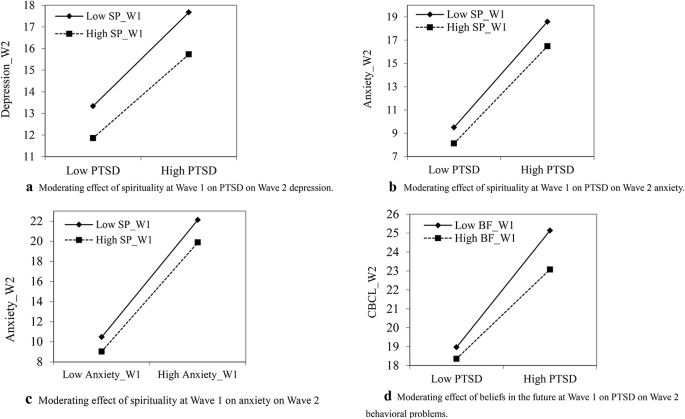
Moderating effect of spirituality and beliefs in the future at wave 1. Note. SP_W1 = spirituality scores at Wave 1, BF_W1 = beliefs in the future at Wave 1, Depression_W2 = depression scores at Wave 2, Anxiety_W1 = anxiety scores at Wave 1, Anxiety_W2 = anxiety scores at Wave 2, CBCL_W2 = child behavior checklist scores at Wave 2, PTSD = post-traumatic stress disorder at Wave 2
Meanwhile, Wave 1 anxiety and Wave 2 anxiety exhibited a stronger relationship for those with lower spirituality (β = 0.40, p <.001) compared to adolescents with higher spirituality (β = 0.37, p <.001) (Fig. 1c). For behavioral problems, the standardized slope (Fig. 1d) supported that the effect of COVID-related PTSD on behavioral problems during the pandemic was more substantial for adolescents with lower beliefs in the future (β = 0.23, p <.001) than for adolescents with higher beliefs in the future (β =.17, p <.001). However, no significant interactions were found for spirituality, beliefs in the future, and internet addiction.
Discussion
This study investigated the impact of the COVID-19 pandemic on beliefs in the future, spirituality, and their influence on mental health among Chinese adolescents based on a large-scale longitudinal design. Multi-informant data – specifically, matched parent-child dyads – collected before the pandemic and at the end of the first wave of COVID-19 allows for a clear assessment of the impacts of the pandemic while also accounting for adolescents’ baseline vulnerabilities and potential self-reporting biases. The results revealed a significant decrease in both beliefs in the future and spirituality following the outbreak. These two PYD attributes not only directly predicted fewer mental health problems but also moderated the relationship between COVID-related PTSD and following mental health problems. The findings highlight the important roles that beliefs in the future and spirituality play in shaping adolescents’ experiences and coping mechanisms in response to external adversities like pandemics.
This research found that spirituality declined among Chinese adolescents during the pandemic, a finding that contradicts prior research suggesting that spirituality often increases following disasters or traumatic experiences as a result of post-traumatic growth. For example, earlier studies have shown that individuals with PTSD were more likely to resort to their religion for comfort and meaning (Shaw et al., 2005), and many people found their spiritual or religious beliefs to become more essential and meaningful after experiencing loss (Calhoun & Tedeschi, 2001). However, our findings indicate a decrease in spirituality among Chinese adolescents during the pandemic compared to pre-pandemic levels.
One possible explanation is that post-traumatic growth is a process that unfolds over time, and the traumatic effects of the pandemic may have still been too immediate and unresolved at the time of data collection for growth to take place. Adolescents were likely still coping with heightened anxiety, uncertainty, and emotional distress, which may have hindered the development of deeper spiritual reflection or growth.
Moreover, cultural differences in the conceptualization of spirituality may also explain the divergent findings. In Western societies, where much of the previous studies have been conducted, spirituality is often closely associated with religious beliefs and practices. During times of crisis, individuals may seek support from religious beliefs and communities, which can enhance their spirituality (Shaw et al., 2005). In contrast, this study adopted a definition of spirituality grounded in the Chinese cultural context, which highlights existential concerns, such as the purpose of life and one’s reactions to the limits of life, including issues surrounding death and dying (Shek, 2012).
At the early stage of pandemic relief, Chinese adolescents were likely still preoccupied with anxiety, fear and concerns about the future, which may have prompted them to question the meaning of life and their own mortality—leading not to spiritual growth, but to a decline in spiritual well-being. This finding highlights the need for researchers to carefully consider the specific dimensions of spirituality being assessed. Given its multifaceted nature, encompassing both religious and existential components, spirituality may respond differently to various types of crises depending on cultural context and the stage of crisis exposure. Further research should explore these distinct dimensions to better understand how spirituality evolves in response to trauma and adversity.
The observed decline in beliefs in the future is partially consistent with previous research (Halevy, 2017). For example, Trumbo et al. (2014) found that optimism increased two years after people experienced hurricanes. In contrast, the post-pandemic data in our study were collected immediately after the first wave of COVID-19, during the initial resumption of in-person schooling – a period marked by ongoing stressors and societal ambivalence about the future development of the pandemic. Heightened fears and uncertainty may have instilled a sense of pessimism, undermining adolescents’ confidence in the future. In Trumbo et al.’s (2014) research, the two-year interval may have allowed for psychological recovery and adaptation, which enable individuals to gradually rebuild optimism and hope. This contrast highlights how the timing of a crisis can shape psychological trajectories: immediate proximity to threat may weaken beliefs about the future, whereas temporal distance from adversity may foster resilience and support the restoration of hope (Pica et al., 2024). Future research should explicitly examine how beliefs in the future evolve across different stages of crisis and recovery.
Another possible explanation for the decline in beliefs in the future involves cultural factors, particularly in the Chinese context, where parental beliefs and expectations, and communal well-being play a central role in shaping adolescents’ future outlooks (Leung & Shek, 2013; Kim & Hou, 2016). After the pandemic, many Chinese parents shifted their focus from exclusively emphasizing academic performance to concerns about health and economic security. As families faced disruptions such as job loss, reduced income, and health risks, parental conversations and behaviors may have reflected heightened pessimism about the future (Russell et al., 2021). Adolescents, who are highly attuned to parental expectations and emotional cues, may have internalized these anxieties, leading to increased uncertainty and reduced optimism about their own futures.
In addition, the pandemic disrupted societal stability, which is a key element of communal well-being. The breakdown of social routines—such as school closures, restricted access to public services, and the strain on healthcare systems—may have undermined adolescents’ trust in societal structures and their perceived reliability of communal support. In a cultural context where communal well-being is closely related to individual identity and hope, this erosion of societal reliability could further diminish adolescents’ confidence in a stable and positive future (Sun & Shek, 2012).
Another key finding from the present study is that spirituality and beliefs in the future serve as important predictors of fewer subsequent mental health problems. The protective effects of spirituality on mental health problems can be attributed to its emphasis on the purpose of life. The uncertainty brought by COVID-19 can lead to an existential vacuum (Yang, 2020), which is a precursor of mental health problems. When adolescents are confronted with the fragility of life during the pandemic, they may experience heightened levels of depression, anxiety and other forms of psychological distress. However, those with higher levels of spirituality may be more likely to focus on the goals and value systems that give their lives meaning and purpose, thereby promoting better mental health outcomes rather than losing sight of their future aspirations and sense of meaning (Emmons, 2005). These findings highlight the importance of fostering spirituality as a protective factor against mental health problems in adolescents, particularly during times of crisis. Future research should further investigate the mechanisms through which spirituality influences mental health and explore effective strategies for cultivating it in at-risk populations.
The protective effects of beliefs in the future on mental health are consistent with the theory of hope (Snyder, 2012) and optimism attribution theory (Seligman, 2018). Adolescents with higher levels of hope and optimism are more likely to view adversities as challenges rather than overwhelming obstacles (Hagen et al., 2005), and they tend to have greater confidence in their ability to overcome difficulties. Empirical evidence supports the direct protective effects of future-oriented beliefs, with high levels of optimism and hope significantly associated with reduced risks of depression (Karlsson et al., 2011) and anxiety (Weinberg et al., 2016; Richardson, 2023). During pandemics, adolescents who maintain strong beliefs in the future may perceive themselves as less vulnerable to the crisis and regard pandemic-related challenges as temporary and manageable.
In addition to being a direct predictor of fewer subsequent mental health problems, spirituality was also found to be a significant moderator that buffers the impact of COVID-related PTSD – a unique form of psychological challenges arising from fear of contagion and death of COVID-19 (Cao et al., 2022; Dou & Shek, 2021) – on adolescents’ mental health (depression and anxiety). This moderating effect can be explained by the role of spirituality in providing individuals with a sense of meaning, purpose, and connectedness, which are key coping resources in times of crisis (Pargament, 1997; Emmons, 2005).
Spirituality enables adolescents to interpret traumatic or stressful events within a broader existential framework, which potentially reduces the perceived threat and emotional intensity of such experiences (Park, 2005). Spiritual beliefs often foster hope, self-transcendence, and emotional regulation, helping adolescents manage stress caused by COVID-related PTSD more effectively and enhance psychological resilience (Smith et al., 2003; Koenig, 2009). Specifically, spirituality promotes acceptance of life’s limitations and the transience of existence, which may lessen adolescents’ excessive preoccupation with fear and anxiety related to COVID-19. Adolescents with higher levels of spirituality are more likely to anchor themselves in purposeful goals and enduring value systems. This anchoring may support their meaning-making during adversity (Emmons, 2005), allowing them to reframe pandemic-related challenges as manageable and meaningful rather than overwhelming.
This process aligns with Self-Determination Theory (SDT, Ryan & Deci, 2000), which posits that the pursuit of autonomous, intrinsically meaningful goals acts as a buffer against stress. When adolescents perceive stressors as consistent with their personal values and life purpose, they are more likely to experience a sense of competence, purpose, and psychological growth, rather than distress. The pathways through which spirituality moderates the effects of trauma on mental health should be further investigated in the future.
Similarly, beliefs in the future also serve as a protective buffer in the relationship between COVID-related PTSD and behavioral problems. Adolescents who hold strong, positive beliefs about their future are more likely to maintain a sense of direction and motivation despite experiencing trauma or uncertainty caused by the pandemic. These future-oriented beliefs may foster adaptive cognitive and behavioral mechanism that help adolescents manage stress more effectively and reduce their problem behaviors. Cognitively, hope and optimism encourage positive appraisal styles, which allow individuals to interpret adversities as temporary and controllable rather than permanent or overwhelming (Hagen et al., 2005). This outlook can reduce the perceived severity of traumatic stressors and decrease the likelihood of developing depressive or anxious symptoms.
Behaviorally, adolescents with strong beliefs in the future are more likely to engage in goal-directed coping strategies (Weitzer et al., 2022), such as problem-solving, planning, and seeking support, instead of resorting to avoidance or rumination. This proactive approach enhances their capacity to deal with the psychological challenges associated with COVID-related PTSD, such as fear of illness, loss, or future uncertainty. Furthermore, beliefs in the future contribute to a sense of agency and self-efficacy (Snyder et al., 2006; Chan et al., 2023), which are crucial for emotional regulation and psychological resilience. When adolescents believe they have the capacity to influence their future outcomes, they are better equipped to tolerate distress and maintain mental well-being under adverse conditions. These plausible explanations should be further examined by directly measuring cognitive and behavioral adaptive strategies in adolescents experiencing adversities in future studies.
Our findings also indicate that spirituality had a more pronounced impact on mental health outcomes than beliefs in the future. Specifically, spirituality negatively predicted depression, anxiety, internet addiction, and behavior problems, and moderated the relationships between COVID-related PTSD and depression/anxiety. In contrast, beliefs in the future only predicted depression and internet addiction and moderated the relationship between COVID-related PTSD and behavioral problems. Therefore, we argue that spirituality may play a more substantial role than beliefs in the future in protecting adolescents from the exacerbation of mental health problems during the COVID-19 pandemic. The uncertainty and instability brought by the pandemic may have weakened the adolescents’ connection with the external world, possibly limiting the effects of beliefs in the future on their mental health.
Spirituality emphasizes the connection with oneself (Pesut, 2003). In an unpredictable world, reinforcing the relationship between self and life can help adolescents maintain inner peace, self-control, and mental and emotional stability. This implies that future interventions targeting the early stages of adversity should prioritize enhancing the connection between adolescents and their lives. These results underscore the importance of spirituality as a critical protective factor in mental health interventions. Future research should explore the mechanisms through which spirituality influences mental health outcomes and identify effective strategies for enhancing it in at-risk populations. Additionally, interventions should consider the unique challenges posed by global crises like the COVID-19 pandemic and tailor their approaches to foster resilience and well-being.
Several limitations of the study should be acknowledged. First, data were collected during the early stage of the COVID-19 pandemic, after the first wave of the outbreak. This limited timeframe does not capture the evolving nature of the two PYD attributes and their long-term impacts on mental health status as the pandemic progresses. Subsequent studies should aim to track these attributes and their effects on mental health over a longer period, possibly incorporating different phases of the pandemic to provide a more comprehensive understanding. Second, this study relied solely on quantitative methods, which may limit the depth and contextual richness of the findings. Incorporating qualitative approaches such as interviews or focus groups on future research could provide deeper insights into adolescents’ lived experiences.
Third, the relatively small effect sizes observed suggest that other, potentially more influential factors may play a role in influencing youth mental health. Future research should explore these additional variables, such as environmental, socio-economic, or familial factors that were not examined in the present study. Finally, the sample was drawn from a single city in mainland China and was predominantly composed of urban participants, limiting the generalizability of the findings. To enhance external validity, future research should include more diverse samples, particularly from rural contexts, to examine whether the observed patterns hold across different settings.
Despite these limitations, this study offers important empirical evidence for understanding the development of the two PYD attributes – spirituality and beliefs in the future – and their protective roles in safeguarding adolescent mental health amid adversities. By focusing on these attributes, the findings highlight that targeted interventions may support adolescents in navigating crises like the COVID-19 pandemic, thereby reducing the risk of mental health problems.
Conclusion
This study provides valuable insights into the effects of the COVID-19 pandemic on beliefs in the future, spirituality, and their impacts on mental health among Chinese adolescents. The findings indicate a significant decrease in the two PYD attributes following the pandemic, with spirituality and beliefs in the future serving as important predictors of fewer subsequent mental health problems. Notably, spirituality emerged as a more robust protective factor than beliefs in the future, particularly in moderating the relationship between COVID-related PTSD and mental health issues. These results suggest fostering spirituality and beliefs in the future as part of comprehensive mental health interventions, especially during times of crisis. Future research should explore the mechanisms through which these attributes influence mental health outcomes and identify effective strategies for enhancing them in at-risk populations. By prioritizing these attributes, interventions can help adolescents navigate the complexities of adversity and ultimately promote better mental health and well-being.
