
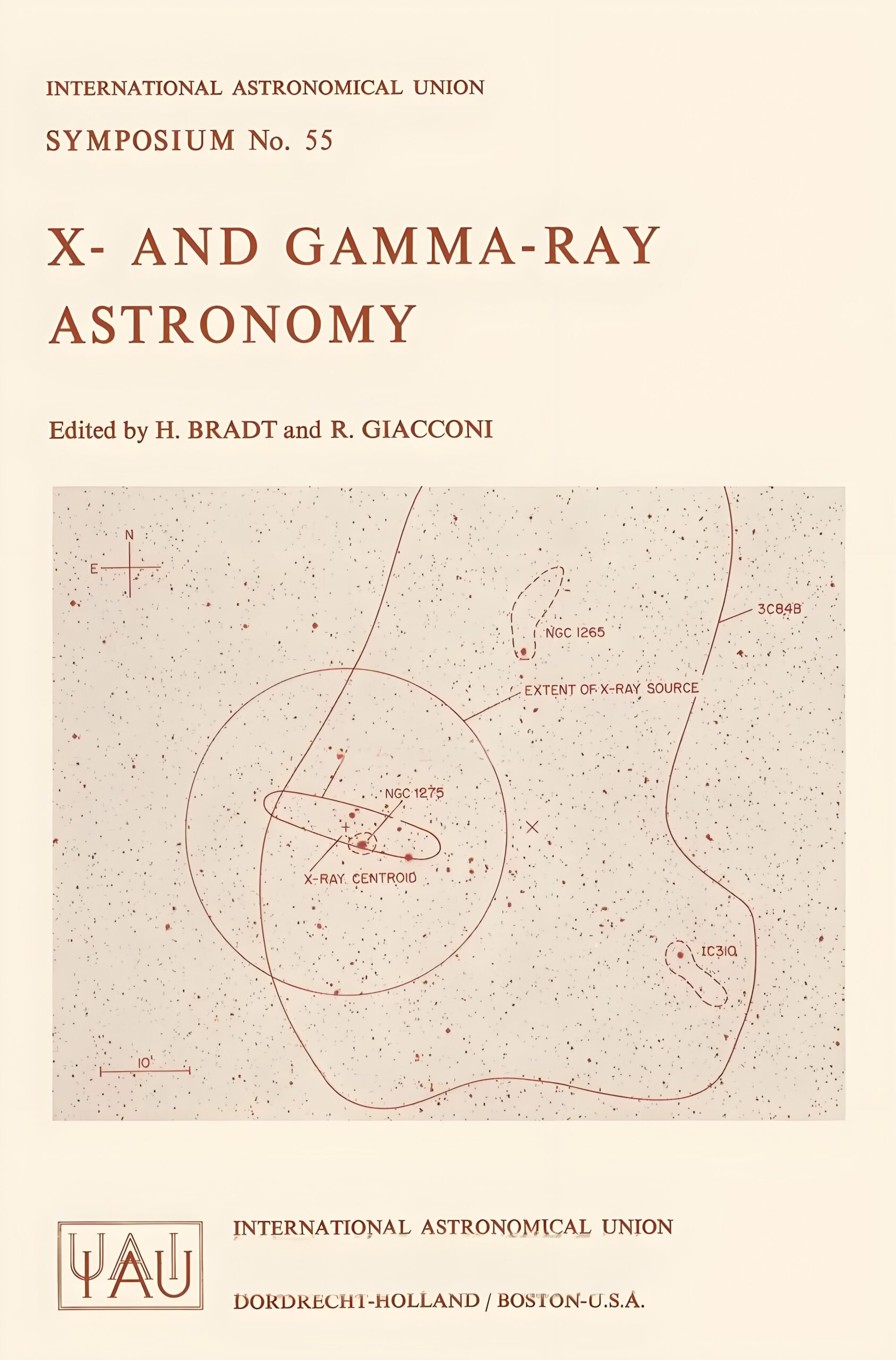
X- and Gamma-Ray Astronomy
Editors:H. Bradt, R. Giacconi
Paperback ISBN:978-90-277-0337-8
eBook ISBN:978-94-010-2585-0
The IAU Symposium No. 55 on ‘X-Ray and Gamma-Ray Astronomy’ has occurred, not entirely by coincidence, at an important moment in the development of these new branches of observational astronomy. In X-ray astronomy the data from the first X-ray observatory UHURU have contributed to a new view of the X-ray sky and a new conception of the nature and properties of galactic and extragalactic X-ray sources. In gamma-ray astronomy the exciting and often controversial nature of the results underlines the importance of the forthcoming launch of SAS-B, the first orbiting y-ray observatory. As Bruno Rossi reminds us (p. I), the Symposium occurred almost exactly ten years after the first detection of the X-ray star Sco X-I. During this time we have moved from the detection of a handful of the nearest and brightest sources to the detailed study of the nature of stellar sources in the farthest reaches of our own galaxy and in external galaxies of the local group. The detection of pulsating X-ray sources in bi nary systems permits the measurement of pulsation periods, and orbital parameters with precisions comparable to any yet achieved with traditional observational techniques. The strong indications that most X-ray sources are extremely compact objects give us confidence that X-ray astronomy will playa significant and possibly decisive role in the study of stars near the end point of stellar evolution.
astronomy
black hole
interstellar matter
spectroscopy
- Front Matter
- Introductory Remarks
- Galactic Sources
Front Matter - UHURU Results on Galactic X-ray Sources
- Observations of Cosmic X-ray Sources by the MIT Instrument on the OSO-7
- Binary Systems as X-ray Sources: A Review
- Hard Cosmic X-ray Sources
- Simultaneous X-ray, Optical and Radio Observations of Galactic X-ray Sources
- Radio Observations of X-ray Sources
- Radio Counterparts of X-ray Sources and X-ray Counterparts of Radio Stars
- X-Radiation from Supernova Remnants
- Galactic X-ray Polarimetry and High-Resolution X-ray Spectroscopy
- Theoretical Models for Compact Sources
Front Matter - Models for Compact X-ray Sources
- Models for Compact Pulsing X-ray Sources
- Black Holes in Binary Systems: Observational Appearances
- Pulsars and X-ray Sources
- Extragalactic Sources
Front Matter - UHURU Results on Extragalactic X-ray Sources
- The Properties of Extragalactic X-ray Sources from Visible Light Observations
- Extragalactic Sources
- Extragalactic X-ray Sources and Their Contribution to the Diffuse Background
- Interstellar Medium and Soft X-Ray Background
Front Matter - The Soft X-ray Background
- Absorption and Production of Soft X-rays in the Galaxy
- ‘Evolutionary’ Theories of the X-ray Background
- ‘Local’ Theories of the X-ray Background
- Panel Discussions
Front Matter - Diffuse Background of Energetic X-rays
- High-Energy Discrete Sources
Massachusetts Institute of Technology, Cambridge, USA
H. Bradt
American Science and Engineering, Cambridge, USA
R. Giacconi
Book Title
X- and Gamma-Ray Astronomy
Editors
H. Bradt, R. Giacconi
Series Title
International Astronomical Union Symposia
DOI
https://doi.org/10.1007/978-94-010-2585-0
Softcover ISBN
978-90-277-0337-8
Published: 31 March 1973
eBook ISBN
978-94-010-2585-0
Published: 06 December 2012
Series ISSN
1743-9213
Series E-ISSN
2352-2186
Edition Number
1
Number of Pages
333
Number of Illustrations
28 b/w illustrations
Topics
Astronomy, Observations and Techniques
Copyright © All rights reserved Designed and Developed by Digital Flavers
