
 info@apippress.com
 +86 18163351462 (WhatsApp)
 +86 182 8014 0209
Article Content
Introduction
Happiness is an important construct relevant to all areas of psychology and social sciences. Happiness has been described as the ultimate dependent variable within the psychological sciences (Lu & Gilmour, 2004). This broad, global, and universal perspective of happiness rests on the assumption that people around the world tend to value, pursue, or idealize happiness to the same, or at least similar, extent. This however may not be the case, as a growing body of empirical evidence indicates that sociocultural context relates to the experience of happiness (as typically measured by life-satisfaction indices), but also the extent to which people pursue or idealize happiness (Flanagan et al., 2023; Joshanloo et al., 2014; Krys et al., 2024; Uchida et al., 2004). Furthermore, it may be the case that pursuing high levels of happiness can paradoxically lead to less happiness (Gruber et al., 2011; Mauss et al., 2011; Zerwas & Ford, 2021). People who find happiness very important tend to experience more negative affect (Mauss et al., 2011), depression (Ford et al., 2014), and bipolar disorders (Ford et al., 2015) related symptoms and loneliness (Mauss et al., 2012) as compared to those who find happiness less important. Thus, it remains an important and open question: What societal and cultural factors may be most conducive to idealizing high levels of happiness?
Happiness Idealization as a Psychological Construct
What does it mean to idealize happiness? In our framework, we construe this construct as representing the extent to which a person prioritizes having a life with high levels of happiness. We operationally construe happiness as a broad and inclusive construct because different cultures tend to think about happiness and well-being in culturally specific ways, that include life satisfaction and independent happiness and may include the individual as the target or one’s close social group such as the family (Joshanloo, 2013; Krys et al., 2023; Uchida et al., 2004).
Extant research has used the valuing happiness scale to measure how much people think happiness is important (Gruber et al., 2011; Mauss et al., 2011) or happiness idealization. This scale, however, is limited in the type of happiness being measured. In our study, we used a different method based on prior work on self-discrepancy theory (Higgins, 1987) and cultural values of the idealization of life satisfaction (Diener et al., 2000). Some people think about happiness more in terms of their own life satisfaction, while others think about happiness more in terms of their close ingroups, such as their family (Delle Fave et al., 2016). Some people think about happiness using an interdependent perspective (Hitokoto & Uchida, 2015), while others think about happiness more as a construct solely related to one’s self (Gardiner et al., 2020). Thus, if the goal is to capture and assess societal and cultural variation in the idealization of happiness, several different styles of happiness should be considered.
We sought to use a framework that has utility across different people and different cultural contexts. It should be the case that when thinking about idealization, people in general are thinking about this construct similarly. Therefore, it is important to use relatively simple and direct terminology and to use a uniform structure in terms of the target, or reference point, for participants to think about. Following a consideration of each of the issues, we selected an approach initially developed by Diener et al. (2000) where participants were asked to think about an ideal person in their life and to report on that person’s level of happiness. This approach was developed and implemented specifically to measure culturally shared values in the extent to which a particular psychological construct is idealized. Next, we leveraged the existing psychometric evidence supporting the efficacy of scales used to measure four different styles of happiness (Hitokoto & Uchida, 2015; Krys et al., 2023). By using this approach, we were able to use a common target/reference point across all measures, and measure levels of idealization as related to four different styles of happiness: satisfaction with life (individual and family), and interdependent happiness (individual and family).
Societal and Cultural Indicators of Happiness Idealization
Very little is currently known regarding what societal and cultural factors are most related to idealizing happiness. The limited evidence to date highlights some factors related to different religious heritages (Joshanloo & Weijers, 2014) and country-level WEIRDness (Western, Educated, Industrialized, Rich, and Democratic) (Krys et al., 2024). Specifically, Joshanloo and Weijers (2014) explained that certain interpretations of Islamic and Christian doctrines discourage excessive worldly happiness, instead emphasizing humility, suffering, and devotion to God. Similarly, Buddhism regards the pursuit of happiness as an illusion that may ultimately lead to suffering. Krys et al. (2024) demonstrated a positive association between the WEIRDness score and the degree of happiness idealization, as measured by personal life satisfaction. Because of the dearth of prior research carried out on this topic, we opted to consider a wide and diverse array (18) of potential societal and cultural level indicators that could correspond to happiness idealization. We used an analysis approach, random forest analysis, to elucidate which of these 18 societal and cultural level indicators were most strongly associated with happiness idealization. By using this approach, we aimed to advance the understanding of happiness and well-being in a substantial way. Although many studies to date show that countries differ according to how much people experience happiness (Helliwell et al, 2021), very little is currently known regarding how countries differ in the extent to which people prioritize, pursue, or idealize happiness.
We selected a wide and diverse array of indicators inspired by two well-established theoretical frameworks, the existential security perspective (Inglehart, 2015) and the institutionalist perspective (Jepperson & Meyer, 2021) (Table 1). Inglehart (2015) theorized that as a consequence of post-World War II prosperity, a secure living environment fostered a value shift away from materialistic pursuits, economic stability, physical security, and survival, and towards self-expression, quality of life, and the experience of happiness. Therefore, it may be the case that societal and cultural level indicators reflective of existential security may relate to how much people idealize happiness.
We selected cultural religiosity as one indicator of existential security because it fosters a stable social structure and a unified moral code (Diener et al., 2011). Several other studies show that religiosity is associated with the experience of happiness, yet the direction of association differs according to the way religiosity and happiness are measured. At the individual level, there exists an unresolved debate regarding whether religiosity is associated with happiness or not (Diener et al., 2011; Lun & Bond, 2013). Some studies show that the strength of the association between religiosity and happiness experience is more positive in highly religious societies than in less religious societies (Diener et al., 2011; Stavrova et al., 2013). Other studies show that cultural religiosity is negatively associated with societal happiness across both US states and countries (Deaton & Stone, 2013). It is currently unknown however how societal-level religiosity may correspond with variation in happiness idealization.
For existential security, we also considered ecological threats (i.e., resource scarcity (Nadeem et al., 2018), natural disaster frequency (Hudson et al., 2019), pathogen threat (Koh, 2014), climate stress (Zapata, 2022), population density (Li & Kanazawa, 2016); social threats (i.e., ethnic fractionalization (Kwakwa & Peña-Vasquez, 2021), armed conflict threat (Shemyakina & Plagnol, 2013), unemployment rate (Helliwell & Huang, 2014); socio-economically, affluence level of the society (i.e., GDP) (Diener et al., 2013) and human development (Helliwell, 2003); politically, the capacity of the state (e.g., the state’s capacity in controlling over its territory and providing public goods) (O’Reilly & Murphy, 2022).
Next, we selected several societal and cultural level indicators reflective of an institutionalist perspective (e.g., Jepperson & Meyer, 2021). Institutionalist theory construes individuals as actors embedded within social institutions (e.g., schools); individuals are influenced by rules and scripts set up by the institutions (Jepperson & Meyer, 2021). Some argue that societies become more “institutionalist” as a consequence of individualization (Yan, 2010) and being more interconnected with international institutions (i.e., world society) (Meyer, 2010). This theory explains that individuation has occurred as a consequence of traditional institutions, such as autocratic governments and theocratic religions being replaced by modern institutions, such as democratic governments, legal systems, and the market (Yan, 2010). Specifically, institutions such as the market economy system may foster ‘utilitarian individualization’ by legitimating the maximization of self-interest (Cortois & Laermans, 2018). Political rights, civil rights, and commitment to decrease inequality may foster ‘moral individualization’ by construing an overall positive outlook of humans as being worthy of equal respect and dignity (Cortois & Laermans, 2018). The legitimization of self-interest and the institutionalization of various human rights may foster an overall positive life outlook as well as greater happiness idealization. To represent individuation, we selected several variables including indexes of market freedom (the Heritage Foundation, 2023), political rights (Freedom House, 2023), civil rights (Freedom House, 2023), and state commitment to decrease inequality (Oxfam, 2022). These indicators are positively associated with happiness experience (O’Connor, 2017).
Societies may also become more “institutionalist” as a consequence of being more interconnected with international institutions (i.e., world society) (Meyer, 2010). World society theory explains that many social consequences occur as a consequence of countries becoming more interconnected with international institutions (Meyer, 2010). This theory considers the entire world as an overarching context with its institutions, norms, and constituent members, which all have social consequences (Schofer & Fourcade-Gourinchas, 2001). As related to happiness, it may be the case that happiness, and happiness idealization, may have become a world society norm (Helliwell et al., 2021) and greater engagement with the world society may be conducive to greater happiness idealization. Therefore, we included several factors reflective of world society connection. We included a nation’s international NGO density (Schofer & Fourcade-Gourinchas, 2001; Schofer et al., 2022) and affiliation with illiberal intergovernmental organizations (Schofer et al., 2022).Footnote1
The Present Study
In this study, we sought to elucidate which societal and cultural indicators are most conducive to happiness idealization. To accomplish this goal, we sourced data from a total of 11,170 participants residing in 43 different countries representative of how much people tend to idealize four different styles of happiness. Next, we sourced country-level data from a wide range of publicly available databases representing a wide and diverse range of 18 different societal and cultural level indicators. A machine learning approach based on the random forests model was used to analyze the data (e.g., Joel et al., 2020; Lou et al., 2022). Broadly, our study and methodological approach were grounded by theory (existential security and institutionalist theory). However, we did not hold any specific hypotheses regarding which social indicators (out of the total of 18) would be most conducive to high levels of happiness idealization. The R codes used for data analyses are publicly available for download (https://osf.io/hn7fv/?view_only=6504a3bc23654ea7b7d74d897e3c4788).
Methods
Participants
We used data collected via a multiyear project spanning a wide range of psychological, cultural, and economic variables. Some parts of this data set have been reported in other studies (blinded for review). The primary data set consists of responses from participants residing in 50 different countries/territories collected in 2016—2017. For our analysis, data from Colombia, Hong Kong SAR, Iceland, Luxembourg, Saudi Arabia, and Taiwan were excluded due to missing data in at least one of our societal/cultural-level predictors, and data from Bulgaria was excluded due to low reliability. As a result, 11,170 participants from 43 countries were used for the analyses. The mean age of participants was 24.64 (SD = 9.00); 60% were females; 86% were students (detailed demographic information across countries was summarized in Table S1).
Measures
Happiness Idealization
Each participant reported how much they idealized four different styles of happiness: satisfaction with life (individual and family) and interdependent happiness (individual and family). Prior to each scale, each participant was explicitly prompted to think about an ideal person in their life. Then each participant was asked to complete each scale according to the way they thought this ideal person would respond. Prior evidence supports the utility of this item structure to measure shared or cultural values in the extent to which people prioritize or idealize different types of happiness (Diener et al., 2000; Krys, Haas, et al., 2023; Krys et al., 2023). To measure satisfaction with life we used two well-established the Satisfaction with Life Scale (Diener et al., 1985) (e.g., ‘In most ways your life is close to your ideal’). To measure interdependent happiness, we used the Interdependent Happiness Scale (Hitokoto & Uchida, 2015) (e.g., ‘You believe that you and those around you are happy’). Participants responded to these scales using the individual as the reference point, but also one’s family. Thus, as a consequence, we had data representing how much each participant idealized four different styles of happiness. Across the entire sample, reliability coefficients for each scale across all countries tended to be very good (> 0.88). Those coefficients for each scale for each country are reported in Table S2.
Societal and Cultural Indicators of Happiness Idealization
We selected a total of 18 different societal and cultural-level potential indicators of happiness idealization (Table 1). Further details regarding the specific datasets where each of these indicators were sourced from are provided in Supplemental Materials (Table S3).
Statistical Analyses
Variable Selection
We used a sophisticated statistical approach well suited for the complexity of our data set and optimal to test our specific question. Our primary goal was to identify which indicators, out of a total of 18, were most conducive to happiness idealization. However, traditional approaches, such as multiple regression suffer from issues like multicollinearity. One technique well suited to deal with such issues is machine learning based on random forests. Random forest is an ensemble learning method for classification or regression that works by constructing an array of decision trees throughout training time (Genuer & Poggi, 2020; Strobl et al., 2009). This approach directly outputs two separate sets of predictors (i.e., Prediction and Interpretation predictors) that serve different goals. ‘Prediction’ variables are the most parsimonious set of predictors that can properly predict the outcome; ‘Interpretation’ variables are all predictors that contribute to the prediction of the dependent variable, even though they may be inter-correlated (the detailed algorithms behind these two approaches were summarized elsewhere, see Genuer & Poggi, 2020; Lou et al., 2022).
To evaluate the robustness of results and rule out potential confounding effects from individual-level differences, the variable selection algorithm was run with and without individual-level demographics (age, gender, student status). All analyses were conducted using the package ‘VSURF’ in R (Genuer et al., 2015).
Random Forests Model Building
Following the rule of parsimony, we used the ‘prediction’ variables to build the random forests model and assessed its prediction performance. We also compared the performance of ‘prediction’ variables with ‘interpretation’ variables to test the validity of variable selection results. The random forests model uses the ‘bagging’ (Bootstrap aggregating) method for model training and testing (Strobl et al., 2009). The raw dataset was segmented into training and testing datasets. The model was trained using the training dataset. The variance of the outcome being explained by predictors (according to the trained model) is regarded as the model predictivity. The default parameter of the number of trees included in the random forest (ntree) was 500, the number of predictors evaluated in each node of a tree (mtry) was the square root of the predictor number, and the ratio of training/testing sample was 2:1. To account for the clustered nature of our data, we used stratified sampling for building the random forest according to our sample countries/territories.
Variable importance plots were used to compare the relative importance of each predictor. The importance of each predictor in the random forest model is quantified via a random permutation strategy (Strobl et al., 2009). A larger decrease in overall model prediction accuracy after randomly permutating the predictor indicates greater variable importance (Genuer & Poggi, 2020; Strobl et al., 2009).
Partial dependency plots were used to unpack the pattern of the association between each predictor and the outcome. This plot was calculated according to the trained random forests model. Specifically, this algorithm calculates the model prediction outcome across the level of the predictor by manipulating the predictor’s value while holding the value remainder of the predictors to their actual values for each participant in the test dataset (Molnar, 2020). All analyses were conducted using the package ‘randomForest’ in R (Liaw & Wiener, 2012). Listwise deletion was applied for handling individual-level missing data (< 5%) (Schafer, 1999). The R codes used for data analyses are publicly available for download (https://osf.io/hn7fv/?view_only=6504a3bc23654ea7b7d74d897e3c4788).
Results
Random Forest Analysis: Models without Demographic Covariates
Across the entire data set, with all 18 indicators as potential predictors, we found that cultural religiosity was the sole ‘Prediction’ variable of all four outcomes. The results of variable selection also demonstrated that religiosity was the sole ‘Interpretation’ variable of all four outcomes. Random forests models showed that religiosity explained 11.46% to 13.67% of the variance of all four outcomes (Table 2).
To validate the variable selection results, we built random forests models using all societal-level predictors.Footnote2 In the whole-predictor model, variable importance plots consistently showed that religiosity was the most important predictor across four outcomes (Fig. 1).
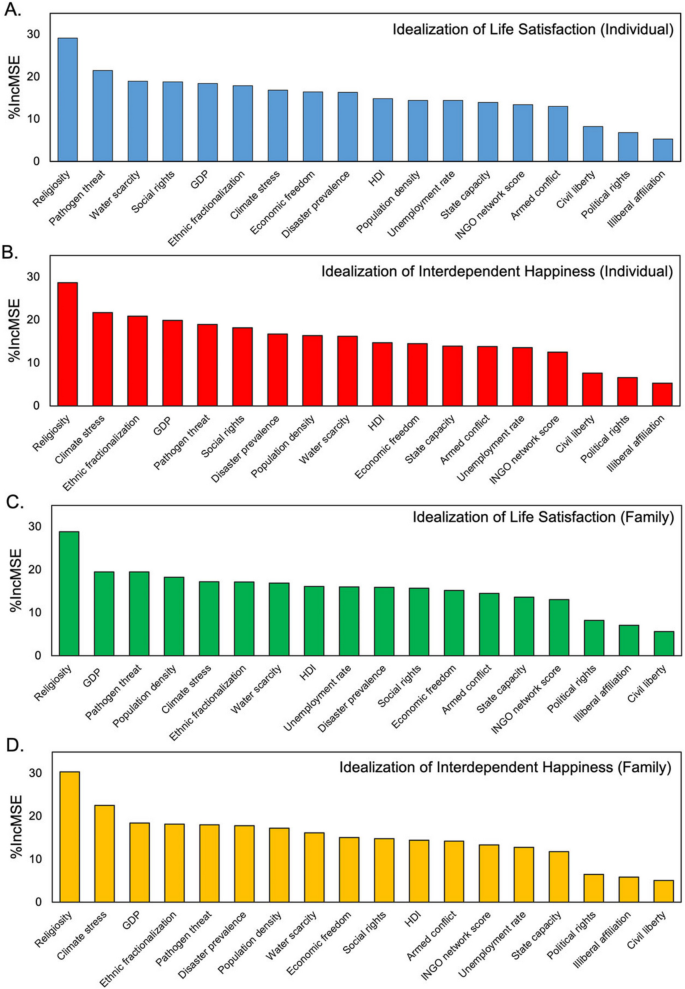
Variable importance plots for models without demographics. When constructing the random forests models using all 18 social indicators, religiosity shows the highest predictive power consistently across four happiness measures. GDP = Gross Domestic Production; HDI = Human Development Index; %IncMSE = Percent Increase in Mean Squared Error (indicates how much each variable contributes to the model’s predictive power, with a higher value signifying greater variable importance). A results regarding idealization of happiness (individual); B results regarding idealization of interdependent happiness (individual); C results regarding idealization of happiness (family); D results regarding idealization of interdependent happiness (family)
Partial dependency plots revealed that religiosity is inversely associated with four happiness outcomesFootnote3; all outcomes decline sharply after the religiosity score exceeds 60 and 90 (Fig. 2).
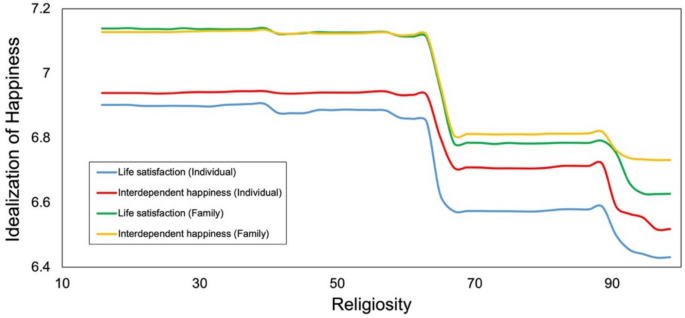
Partial dependency plots of religiosity and happiness idealization. An increase in cultural religiosity generally leads to decreases in four measurements of happiness idealization; two ruptures happen when religiosity scores are high (exceeds approximately 60 and 90). Blue line represents results regarding idealization of happiness (individual); red line represents results regarding idealization of interdependent happiness (individual); green line represents results regarding idealization of happiness (family); yellow line represents regarding idealization of interdependent happiness (family)
Random Forest Analysis: Models with Demographic Covariates.
Next, we examined the pattern of results when individual-level demographic variables were entered as covariates. The results of variable selection showed that religiosity was the sole ‘Prediction’ variable of all four outcomes. For ‘Prediction’ variable, random forests models showed that religiosity explained 11.36% to 13.62% of the variances of four outcomes (Table S4). In addition to religiosity, another 16, 15,16, and 13 predictors were respectively included in the ‘Interpretation’ variables for each four idealizations of happiness (Table S4). For the ‘interpretation’ variables, random forests models showed that the whole set of predictors explained 13.02% to 15.32% of the variance of the four outcomes (Table S4). These results further support the importance of religiosity in predicting idealized happiness.
Society-Level Correlational Analyses: Religiosity and Happiness Idealization
We carried out a series of bivariate correlation analyses to further examine the association between religiosity and happiness idealization (Fig. 3). We found that for each type of happiness, greater religiosity was negatively associated with happiness idealization, with medium-to-large effect sizes (−0.44 < Pearson’s r < −0.52).
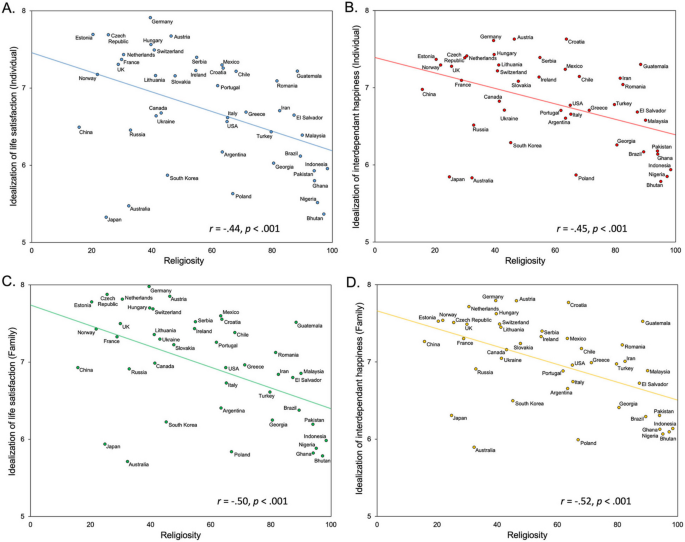
The society-level correlation between religiosity and idealized happiness. Society-level bivariate correlation analyses showed cultural religiosity was consistently and negatively associated with these four measurements of happiness, with medium to large effect sizes (rs ≤ −0.44). A = results regarding idealization of happiness (individual); B = results regarding idealization of interdependent happiness (individual); C = results regarding idealization of happiness (family); D = results regarding idealization of interdependent happiness (family)
Multilevel Regression Analyses: Religiosity, WEIRDness, and Happiness Idealization
A recent large-scale study has demonstrated that happiness idealization is strongly predicted by country-level WEIRDness (Krys et al., 2023). WEIRDness is a composite score representing a total of 8 different society-level variables; Individualism traditional (Hofstede, 2001), Individualism updated (Minkov et al., 2017), Expected years of schooling (UNDP, 2017), mean years of schooling (UNDP, 2017), Technological advancement (Welzel, 2013), GDP per capita (World Bank, 2017), and Democracy Index (Economist Intelligence Unit, 2020). To situate our findings with this previous work, we carried out a series of additional exploratory analyses designed to elucidate the relative explanatory strength of religiosity to WEIRDness (Table 3).
We found that country-level scores for religiosity or WEIRDness were highly correlated (r = −0.63); highly religious societies tend to be less WEIRD. When either religiosity or WEIRDness are tested as predictors of idealized happiness alone, each variable significantly predicts happiness idealization across all different types of happiness in this study. However, when religiosity and WEIRDness are added as predictors simultaneously, the majority of effects are no longer significant, likely due to the high correlation among predictors. A close inspection of the results indicates that religiosity seems to outperform WEIRDness when predicting interdependent happiness, but WEIRDness seems to outperform religiosity when predicting individual happiness (life satisfaction).
Discussion
We found that across 43 different societies, cultural religiosity is the strongest predictor of happiness idealization. Higher religiosity was associated with reduced idealization of four different styles of happiness (life satisfaction, interdependent happiness, life satisfaction-family, interdependent happiness-family). These findings contribute to recent work demonstrating that idealized happiness is a culturally variant phenomenon (Ballas & Danny, 2013; Krys et al., 2023). Krys et al. (2024) used the framework of WEIRDness to contextualize idealized happiness and found robust evidence showing that WEIRDness fosters greater happiness idealization as measured by individual-level life satisfaction. Our findings extend this finding about idealization to other forms of happiness and highlight the importance of another contextual factor along with WEIRDness, i.e., religiosity. These findings also echo previous research demonstrating that cultural religiosity is an essential cultural dimension related to many different psychological consequences, such as directly influencing personal religiosity or other aspects like morality (Gebauer & Sedikides, 2021; Stankov & Saucier, 2015).
Several reasons may account for why cultural religiosity is negatively associated with happiness idealization. It could be the case that highly religious societies provide a context for people to prioritize other aspects of their lives besides happiness, such as morality, spirituality, and purpose (Chan et al., 2019; Gebauer & Sedikides, 2021; Haybron, 2008; van Tilburg et al., 2019). Thus, people in highly religious societies may think relatively less about achieving high levels of happiness because they are preoccupied with thinking about other goals. For instance, several Christian doctrines, espouse the value of having a life in communion with Jesus and strictly following Jesus’precepts (Stone, 1909). Similarly, Joshanloo and Rastegar (2013) described that the Sufism (a branch of Islam) belief system construed the perfect man as one who ‘disowned himself and drowned in God’. The internalization of such religious doctrines may guide people to think about an ideal person in terms of his/her relation with the religious authority or religion-mandated priorities for living, instead of happiness per se. Interestingly, there is also evidence showing a high overlap between self and Jesus in highly religious Christians (Hodges et al., 2013), which may hint that a highly religious person may also think about God when imagining an ideal person. Finally, Buddhist doctrines specify craving and aversion as the source of suffering (Chen, 2006); accordingly, craving for happiness can potentially be taken as a source of suffering, which may deter happiness idealization. In sum, several religious psychological processes may deter people from overly focusing on happiness maximization.
It may also be the case that certain religious doctrines tend to be inconsistent, or even contrary, to the notion that one should prioritize their happiness during “this life” here on earth (Joshanloo & Weijers, 2014). For example, many Christian doctrines describe that perfect happiness can only be attained in the afterlife and transcendent happiness is construed as the face-to-face relationship with loving and knowing God in the afterlife (Stoker, 2023). In contrast, earthly life is construed as miserable and earthly happiness as imperfect (Ballas & Danny, 2013). Likewise, some Islamic doctrines construe earthly pleasure as inferior to religious faith, which asks for total submission of oneself to God’s will and breaking oneself free from the fetter of earthly pleasure (Joshanloo, 2013). Some Islamic branches, such as Sufism, place particular emphasis on asceticism and piety, and it is believed that sacrifice of earthly pleasure is necessary for attaining spirituality (Joshanloo & Rastegar, 2013). These doctrines, once internalized, may explain, in part, lower levels of happiness idealization.
The European Enlightenment may be a common precursor of decreased cultural religiosity and increased happiness idealization. Before the Enlightenment, Europe was in its ‘dark middle ages’. The dominant perspective of happiness at that time was highly religious, perhaps in part due to difficult daily life conditions. Thus, many people tended to idealize the afterlife and belittled earthly happiness (Veenhoven, 2010), with beliefs such as ‘people are born in sin and suffering was seen as a way to clean our souls from sin and thus to prepare for entrance to Heaven’ prevailing (Veenhoven, 2010). Fundamental shifts in perspectives regarding happiness occurred after the Enlightenment, characterized by both secularization and the idealization of earthly pleasure (Veenhoven, 2010). For instance, the replacement of reasoning with religious revelation tended to foster beliefs such as earthly happiness can be attained in this life via reasoning. The 17 th-century utilitarian philosophers like Jeremy Bentham and John Stuart Mill directly equated happiness with people’s subjective experiences and normalized the maximization of earthly pleasure and the minimalization of pain (Veenhoven, 2010), and they construed earthly happiness maximization instead of religious doctrines as the single moral yardstick to regulate the behavior of individuals and states. In this sense, our findings suggest that happiness idealization as an Enlightenment ideology grew in parallel with the fading of religious institutions and authority in 17 th-century Europe. This idea echoes recent works demonstrating that happiness maximization is a cultural phenomenon particularly associated with WEIRD societies (Krys et al., 2024). This implies the prolonged debates regarding the institutionalization of universal human rights across the world (Le, 2016) may also apply to the more recent institutionalization of happiness in the United Nations (Helliwell et al., 2021); and it is debatable whether imposing a single form of happiness as a global developmental goal is fair to nations vary greatly according to their endorsement of ideal happiness levels and specific happiness experiences. Further research may be considered to elucidate the extent to which happiness maximization reflects Western cultural imperialism or is a culturally universal phenomenon.
Several social indicators highly relevant to happiness were found not influential in happiness idealization when cultural religiosity was considered. For instance, GDP per capita has been repeatedly found to be associated with higher happiness, though its utility diminishes gradually with increasing wealth (e.g., Easterlin, 1995). GDP is the synonym for development in the post-WWII era (Costanza et al., 2014); thus it is intuitive to speculate that it will be associated with prospects for higher happiness. Our non-finding may indicate that social contexts that are conducive to experienced happiness and idealized happiness can be very different. Or perhaps it may implicate the dark sides of economic development (Marglin, 2003), which may counter-balance its utilities (e.g., abundance in goods and services). For instance, with economic development, the marketization process goes hand in hand with the loss of community and the commodification of social relationships (Marglin, 2003). For another instance, better educational and medical services in urban areas tend to come along with the loss of natural habitats and greater exposure to pollution (Kesebir & Kesebir, 2017).
We also found that three indexes of liberalism institutions (i.e., civil liberty, political rights, and illiberal affiliation) did not relate to any outcomes in our study. Some prior evidence does show that individual rights and freedom are positively associated with happiness (Veenhoven, 2000) when liberal states were in their euphoria of the Soviet Union breakdown. Again, our non-finding may indicate that social contexts that are conducive to experienced happiness and idealized happiness can be very different. Or perhaps it may implicate that those liberal institutions, though important in ensuring individual rights and preventing society from slippering into authoritarianism, may also have drawbacks. For instance, communitarian criticism of liberalism usually focuses on its imbalance in fostering individual rights over responsibility; the fact that liberalism institutions breed an atomized self, community collapse, and crime, which all perpetuate a malfunctioning society (Gutmann, 1985).
It may be the case that the occurrence of lower levels of happiness idealization in highly religious societies corresponds to positive psychological outcomes. Indeed, several other studies show that placing greater value or importance on achieving happiness can negatively affect several aspects of well-being (Gruber et al., 2011; Mauss et al., 2011; Zerwas & Ford, 2021). In addition, other research shows that the tendency to predict high levels of life satisfaction in the future compared to one’s current life is associated with increased psychological distress (Busseri & Merrick, 2016). Thus, it may be the case that people who hold more realistic expectations of happiness (i.e., low happiness idealization) also tend to experience greater well-being throughout their lives. This idea is consistent with other research showing the health and well-being benefits associated with religiosity (Green & Elliott, 2010).
There exist ongoing debates regarding whether religiosity influences individuals’ experience of happiness (Diener et al., 2011; Prati, 2024; Stavrova et al., 2013; Yonker et al., 2012). Some studies suggest that individual religiosity serves as a positive factor in happiness (e.g., Diener et al., 2011), while others argue that the effect is too small to hold practical significance (e.g., Prati, 2024; Yonker et al., 2012). Additionally, some research indicates that this effect may depend on cultural religiosity (Diener et al., 2011; Stavrova et al., 2013), with others suggesting specific religious heritage may have different impacts on this topic (Sánchez-Rodríguez et al., 2023). By examining the idealization of happiness and identifying a negative association between religiosity and such idealization, our findings suggest a new direction for future research. Rather than focusing on whether religiosity enhances happiness, it may be more insightful to first explore what kinds of experiences are valued by religious individuals or societies (Flanagan et al., 2023; Krys et al., 2024). If earthly happiness is not a central value in religious contexts, then debating whether religious individuals are actually happier may be a misguided endeavor.
This study has several limitations. We relied on convenience sampling and used social indicators to characterize these samples, which could induce biases. Future research focusing on cross-cultural comparisons should aim at collecting nationally representative samples when resources permit. Another representativeness issue is that only 43 societies were sampled, and some world regions (e.g., Caribbean areas) are completely missing. Also, poorer societies and failed or failing states are not included in our sample of societies. In addition, we measured happiness idealization by adapting the established Satisfaction with Life Scale (Diener et al., 1985) and Interdependent Happiness Scale (Hitokoto & Uchida, 2015): we asked participants to think about an idealized person first and then complete each scale. Though these measurement tools do show adequate reliability and measurement invariance in this study, their other psychometric features’ performances (e.g., criterion validity) are unclear. Future research may consider developing more direct happiness idealization measurement tools. Our evidence of measurement invariance is imperfect, particularly for the two based on the Interdependent Happiness Scale. This, however, aligns with prior evidence that detecting perfect non-invariance in large-scale, cross-national studies is extremely rare (Marsh et al., 2018; Robitzsch & Lüdtke, 2023; Rutkowski & Svetina, 2024; Welzel et al., 2021; Zercher et al., 2015). Our invariance results provide some limited support for the equivalence and fidelity of these measures across cultures (Rutkowski & Svetina, 2014; Welzel et al., 2021).
In addition, our measurement of happiness may align best with the way Euro-American and East Asia participants’ perspectives on happiness, with the measurement tools developed by North American scholars (Diener et al., 1985) and East Asia scholars (Hitokoto & Uchida, 2015). Imposing these ways of thinking about happiness in other cultures may lead to unfair comparisons. Future research may consider developing other sensitive and indigenous tools for measuring happiness across cultures. For instance, indigenous ideologies like Ubuntu in Africa and Buen Vivir in South America can be sources of inspiration (Van Norren, 2020).
Furthermore, this study did not differentiate religion types and reveal the psychological mechanisms bridging cultural religiosity and individual-level happiness idealization. Different religions have different doctrines that may dampen happiness idealization (Joshanloo & Weijers, 2014). Future research may consider investigating these psychological mechanisms across religions.
Lastly, while our analyses suggest that religiosity is the most significant predictor among the social indicators considered, this does not imply that other social indicators have no effect on the dependent variables. Rather, it indicates that, statistically, they are significantly less influential than religiosity. Our variable importance analyses indeed reveal that ecological factors such as pathogen threat, water scarcity, and climate stress all contribute substantially to predicting happiness maximization, albeit to a lesser extent than cultural religiosity. This finding aligns with recent perspectives in the field, which suggest that relatively benign ecological conditions in areas such as Northwestern Europe will free people from survival concern and are conducive to happiness maximization (Krys et al., 2024). Future research could further clarify if and how other social indicators influence happiness maximization.
In conclusion, this investigation highlights that happiness is not idealized to the same extent across cultures and societies. We found consistent evidence that cultural religiosity as an essential predictor is negatively associated with idealized happiness. Our research contributes to the contextualization of happiness idealization by linking it to a more secular cultural background and calls for further diversification of well-being conceptualization and measurement in religious groups. Our research also highlights a need for illuminating psychological mechanisms bridging the dampening effect of cultural religiosity on happiness idealization.
