
 info@apippress.com
 +86 18163351462 (WhatsApp)
 +86 182 8014 0209
Article Content
Abstract
This article examines why some states emerging through decolonization are more actively contributing to international organizations (IOs) than others, focusing on their voluntary financial contributions to the United Nations System (UN). I argue that the birth legacies of states, particularly modes of decolonization, significantly influence their subsequent financial contributions to the UN. A regression analysis of 95 former colonies, mandates, and dependencies suggests that states with a negative legacy – derelict decolonization – provide larger financial contributions to the UN. This finding highlights the impact of colonial history on state behavior within IOs and suggests that former colonies may seek active participation in global governance, valuing international resources highly.
Explore related subjects
Discover the latest articles and news from researchers in related subjects, suggested using machine learning.
- Development Aid
- Diplomatic and International History
- Economics of International Organizations
- Imperialism and Colonialism
- International Finance
- International Organization
1 Introduction
Why do some states contribute more financially to the United Nations System (UN) than others? This paper explores the conditions under which some states emerging from decolonization voluntarily contribute more to the United Nations System (UN) than other former colonies. I argue that a specific mode of entry into the international system – derelict decolonization – influences whether and how much individual former colonies make voluntary contributions to the UN (Lemke & Carter, 2016). Specifically, states born through derelict decolonization are more likely to rely on and value international resources, leading them to make a larger voluntary contribution to the UN and host various security and development projects, rather than implementing policies on their own. In other words, derelict decolonization increases the likelihood of former colonies contributing more to the UN as they value the returns from the international organizations (IOs) to improve and help address their domestic agendas from security to economic development.
I test this argument with panel regression analyses, drawing on states’ voluntary financial contributions of states to the UN between 1997 and 2015 (Parizek & Stephen, 2021). I find supportive evidence for the theory that states born with the legacy of derelict decolonization increase their voluntary financial contributions to the UN. In addition, I provide illustrative cases of Cambodia and Vietnam making voluntary contributions. Cambodia went through derelict decolonization, made large and consistent voluntary contributions, and hosted various projects that addressed fundamental domestic agendas. Vietnam, emerging with a relatively positive legacy – violent secession – seldom made voluntary contributions, in contrast.
This article contributes to our understanding of the financial dynamics within the UN by focusing on the patterns of voluntary contributions made by former colonies. In particular, this study extends previous studies on voluntary contributions (Hüfner, 2019; Laurenti, 2018; Bayram & Graham, 2017; Stoessinger, 1964; Eichenauer & Reinsberg, 2017). Although mandatory contributions are less controllable by donor states due to their obligatory nature and the inability to earmark funds, voluntary contributions, especially when restricted, offer donors the opportunity to direct funds towards specific programs or projects, thereby exerting greater influence over the UN’s agenda (Graham, 2015, 2017). Therefore, studying the voluntary contribution behaviors of states contributes to our understanding of how states strategically use financial devices in IOs.
Furthermore, this paper underscores the evolving role of the Global South in shaping global governance (Parizek & Stephen, 2021). It highlights how states in the Global South, particularly those with a negative birth legacy, are not just recipients of international aid and assistance but are active and strategic contributors to the UN’s financial mechanisms. This shift in focus from receiving to giving presents a nuanced view of the Global South’s agency in international relations and its increasing importance in global governance. From this perspective, this study addresses the politics of global governance, focusing on the actors that are relatively less examined in the literature.
Lastly, this article examines how the legacy of decolonization can have lasting impacts on financial and development strategies beyond national borders. Existing findings on birth legacy suggest that states with negative legacies tend to show a lower capacity to mobilize the population and resources, thus increasing the chances of defeats in war and state failures (Lemke & Carter, 2016; Carter & Lemke, 2022). The paper extends the literature on birth legacies and finds corresponding evidence that negative birth legacies would lead states to look for alternative methods of governance from the IOs, complementing the lack of independent state capacity and legitimacy.
The remainder of this paper begins by introducing the theoretical framework of why some states are more likely to make voluntary contributions to the UN. Then, it outlines the research design and data on voluntary contributions and birth legacies. The next section provides the empirical findings of the paper. Lastly, the paper concludes by discussing the implications of the study.
2 Explaining voluntary financial contributions to the UN
Why do states voluntarily contribute to the UN? Voluntary contributions have unique characteristics in terms of influencing international policymaking processes. Studies on financing mechanisms within the UN system argue that the choice of funding method – mandatory contributions, unrestricted voluntary contributions, and restricted voluntary contributions – serves as a strategic tool for donor states to exert influence within the organization (Bayram & Graham, 2017). It suggests that while formal voting structures provide a framework for decision-making, the informal governance mechanisms, notably through financial contributions, allow states to navigate and influence the UN’s agenda beyond their voting power. Therefore, voluntary contributions are often based on strategic considerations, where donor states seek not only to support the UN’s objectives, but also to align the organization’s activities with their national interests and policy preferences.
In addition, voluntary contributions play an important role in funding the UN system. Voluntary contributions account for 65.43% of the total UN system in 2017 with about 34.81 billion US dollars, which exceeds that of assessed contributions by large margins (Hüfner, 2019, p. 14). In particular, many of the Special Funds and Programmes of the United Nations are financed by voluntary contributions, which are likely to be of interest to the states of the Global South (Hüfner, 2019, p. 18). Furthermore, most voluntary contributions made recently are earmarked; 78% of voluntary contributions were earmarked by donors in the case of UNICEF, 79% for UNHCR, 83% for UNDP, and 93% for WFP (Laurenti, 2018, p. 272), showing the strategic nature of making such funding efforts.
There are multiple factors that influence the decisions of each state on making voluntary financial contributions. Bayram and Graham (2017) points out two factors that influence states’ choices on when to make voluntary contributions: affordability and policy substances. Affordability leads to the expectation that the amount of mandatory and voluntary contributions would naturally increase as the wealth of a member state increases. Policy substances, on the other hand, is a more uniquely applicable concept to explain states’ strategic decisions over making voluntary contributions attached to individual states’ policy goals (Bayram & Graham, 2017, p. 428).
Existing studies also commonly point to the willingness of states to participate in and influence global governance (Bayram & Graham, 2017). In particular, the literature on the contribution of peacekeeping forces commonly highlights the alignment of national interests with the objectives of missions (Kreps & Wallace, 2009; Bellamy & Williams, 2013; Perkins & Neumayer, 2008). Although most of the research points to the coincidence of national interests, existing research differs in how they conceptualize national interests that might or might not align with contributing to peacekeeping missions. In general, it ranges from dealing with security threats (Bove & Elia, 2011; Uzonyi, 2015), economic interests (Gaibulloev et al., 2009; Khanna et al., 1999) to normative interests, including concerns about global human rights and democratic norms (Lebovic, 2004; Banerjee, 2013).
2.1 Birth legacies and the Global South’s financial contributions to UN
Then how would the states emerging from decolonization engage in global governance, specifically by making a voluntary financial contribution to the UN? Scholars point out that IOs, especially the UN, are of particular importance for states emerging from decolonization (Coggins, 2011; Krasner, 2004; Jackson, 1991; Herbst, 1990). Jackson (1991) illustrates new states born in the era of decolonization were sovereignty-wise ‘quasi-states’ because they lacked traditional bottom-up state building while were able to maintain juridical statehood in international law. Kranser similarly observes the failures of conventional sovereignty among newly independent states and the instances where their sovereignty had to be ‘shared’ with international actors (Krasner, 2004).
The literature highlights the role of external actors, including IOs, in supporting and complementing the weak political capacity and legitimacy of newly independent states (Jackson, 1991). Consequently, it is not surprising that these states emphasized and valued the role of the UN in addressing political and governance challenges within their countries. For instance, Seretse Khama, the former President of Botswana, underscored the UN’s importance in his first speech to the General Assembly:
… My country is… a comparative newcomer to the United Nations. As a small and poor country we set a particularly high value on our membership of the United Nations and those of its specialised agencies which our budgetary restrictions have permitted us to join. I should like to emphasize the particular importance of the United Nations for states like Botswana which, because of development priorities, are obliged to restrict their conventional bilateral contacts and keep their overseas missions to a bare minimum. Here in New York we can make contacts which would otherwise be difficult to achieve. The United Nations enables us to keep in touch with international opinion, and to put our views before the world. Together with its specialised agencies, it is of course also a major source of development finance and technical assistance from which Botswana benefits greatly (emphasis added) (UN General Assembly, 1973).
Access to external resources and support through the UN has been invaluable for newly independent states seeking to build political capacity and legitimacy. Moreover, these states often faced constraints in establishing bilateral or multilateral diplomatic channels outside the UN due to limited administrative capabilities and political resources (Kay, 1969, p. 24, 26). In other words, the constraints of weak political institutions and governance capacity increase the importance of UN membership and operations for these new states.
Those new states have strategically used voluntary contributions to the UN to access resources and technical assistance that directly benefit their domestic governance and bolster their state-building efforts. For example, in the early years of the UN, developing countries such as Burma, Chile, Egypt, and Peru actively lobbied for the inclusion of technical assistance in the UN agenda (Graham, 2023, p. 90). The pattern was also observed in the early years of UNDP trust funds. Developing states, including Zambia, for instance, have established single-donor funds within the UN system to finance domestic projects directly; five out of sixty-five trust funds were created by the recipient states for this purpose (Graham, 2023, 142). These actions illustrate how states with deficits in political capacity and legitimacy were able to use voluntary contributions as strategic investments to secure international support for their own governance and development. By channeling resources through the UN, these states can enhance their administrative functions and improve service delivery.
Although states emerging from decolonization commonly expressed the value of IOs, the manner of decolonization was far from identical to that of all former colonies. Lemke and Carter (2016) points out that states are born differently, where “birth types vary in the political capacity and legitimacy of the proto-state, … some birth types require the emerging state to have its administrative act together on the course to statehood to a significantly greater degree than other birth types” (Lemke & Carter, 2016, p. 500). In particular, the case of derelict decolonization describes the abrupt withdrawal of a colonizing power from a territory, often leaving a vacuum of governance. In other words, emerging states in the case of derelict decolonization did not go through internal state-building to defeat a colonial power, the process of which could have nurtured its capacity to mobilize population and resources, nor did they have prior arrangements with colonial powers to provide enough time and legitimacy. Therefore, this birth type implies the weakest form of statehood, increasing the incentives for making voluntary contributions and hosting international assistance.
Considering the context of decolonization after the end of WWII, other types of state births in Lemke and Carter (2016) expect stronger state capacity and legitimacy, reducing the need to make voluntary contributions. Three relatively positive birth types are birth by agreement, non-violent secession, and violent secession.Footnote1 Birth-by-agreement captures the case of state births, which includes states such as Singapore and island countries in the Pacific, emerging ready for self-governance after decolonization processes “followed a careful, long-term policy of preparation” (Lemke & Carter, 2016, p. 498). Non-violent secession involves a peaceful transition to independence where demands for statehood are met without conflict. Violent secession marks the birth of states like Eritrea, which gained independence through forceful separation from a colonial power or parent state. Both cases of secession imply that the nascent indigenous political power was able to mobilize the population and resources and confront the colonial government, leading to stronger state capacity at the time of independence.
Importantly, these different birth legacies lead states with similar levels of economic development to pursue different strategies regarding voluntary contributions to the UN. States with positive birth legacies may rely on their stronger political capacity and legitimacy and have less need for fundamental international assistance in state-building, thus potentially contributing less or focusing on auxiliary projects. Conversely, states with negative birth legacies, despite often having limited political capacity and legitimacy, can prioritize voluntary contributions as a strategy to access essential international support for state-building purposes. For states born through derelict decolonization, the value of UN resources is exceptionally high due to their challenges in establishing effective governance and political legitimacy. Investing in voluntary contributions becomes a strategic move to invite international assistance that is crucial to building administrative structures and enhancing legitimacy.Footnote2
This perspective contrasts with common assumptions about the relationship between state capacity and willingness to financially contribute to IOs (Jackson, 1991; Bayram & Graham, 2017) and aligns well with the recent findings by Iwunna et al. (2023) that lower middle-income countries made more voluntary contributions than upper middle-income countries to World Health Organization. Although it is often assumed that states with weaker capacity may lack the ability to contribute meaningfully to IOs, I argue that states with negative birth legacies are more inclined to make more voluntary contributions because they see the role of IOs complementing their deficiencies in political capacity and legitimacy.
The case of the International Civil Aviation Organization (ICAO) is one such example illustrating how different birth legacies shape states’ incentives to make a voluntary contribution. Table 1 shows that, in 2015, 16 of the 36 states that made voluntary contributions were former colonies that achieved independence after the end of WWII. Only three of the 16 former colonies– the Republic of Korea, Singapore, and India – made voluntary contributions to the ICAO, with the intention of supporting projects outside of their territory (ICAO, 2015). South Korea and Singapore were born with a relatively positive birth legacy, birth by agreement, while India was among the cases of derelict decolonization. Other former colonies made voluntary contributions to receive various types of assistance for themselves from the ICAO.
States with negative legacies provided voluntary contributions to host projects aimed at establishing fundamental mechanisms for aviation regulation—critical investments in their statehood and governance. For example, Somalia contributed $5,629,000 in 2014 and $4,932,000 in 2015 (UN General Assembly, 2016). These funds enabled the ICAO to “build capacity in Somalia related to the regulation of civil aviation through the establishment of an effective legal framework for safety regulation and oversight of air navigation services” (ICAO, 2015, 31). Similarly, Djibouti funded projects “to assist the State in capacity building and to increase the efficiency of the Civil Aviation Administration” (ICAO, 2015, 10). These contributions reflect strategic investments to compensate for their weaker state capacity resulting from negative birth legacies.
In contrast, countries with positive legacies made contributions toward technical enhancements and non-essential projects, such as purchasing advanced equipment or supporting international initiatives (ICAO, 2015). For instance, the Bahamas (birth by agreement) contributed $11,941,000, and Bangladesh (violent secession) contributed $154,000 between 2014 and 2015, primarily to acquire advanced systems like radar equipment (ICAO, 2015, 3). South Korea and Singapore invested in programs that extended beyond their borders, indicating their stronger state capacity and different strategic priorities.
These examples demonstrate that birth legacies influence states’ decisions to make voluntary contributions, beyond what would be expected based on their economic development levels alone. States with negative birth legacies, despite limited resources, prioritize contributions that grant them access to essential international resources necessary for state-building. Those with positive legacies focus on auxiliary enhancements and aim to contribute beyond their domestic projects.
In sum, birth legacies shape the strategic evaluations of international resources and the decision to make voluntary contributions to the UN. States born with negative legacies are more likely to invest in voluntary contributions as a means to strengthen their fundamental state capacity through international assistance. This leads to the following prediction:
- Hypothesis 1: States born with negative legacies are more likely to make voluntary contributions to the UN.
3 Research design and data
3.1 Unit of observation
The sample for empirical analysis consists of former colonies, mandates, and dependencies that achieved independence after 1945 (the establishment year of the UN). I coded the date of independence following the timing of states’ entrances to the international system in the Correlates of War State System membership list (Correlates of War Project, 2017). I use panel datasets, which contain the yearly observations of all states that had colonization histories. Therefore, the dataset excludes colonies that failed to achieve independence and existing states that have never been colonized. It fits with the scope condition for testing the theory, since the data is restricted to the group of countries eligible for UN membership and, at the same time, to have colonial backgrounds. This identifies 103 states with prior colonial history, the complete data is available for 95 of them.
Voluntary contributions to the UN (per GNI per capita)
3.2 Outcome variable
The outcome variable is the voluntary contribution of each state to all international organizations in the United Nations system between 1997 and 2015, drawing on Parizek and Stephen (2021). Parizek and Stephen (2021) offers the sum of yearly voluntary contributions made by individual states to all UN organizations, collected from related UN budget reports. To test whether states with negative legacies have contributed more, I use the natural log of the contributions and the standardized measure with GNI per capita (current US dollars).
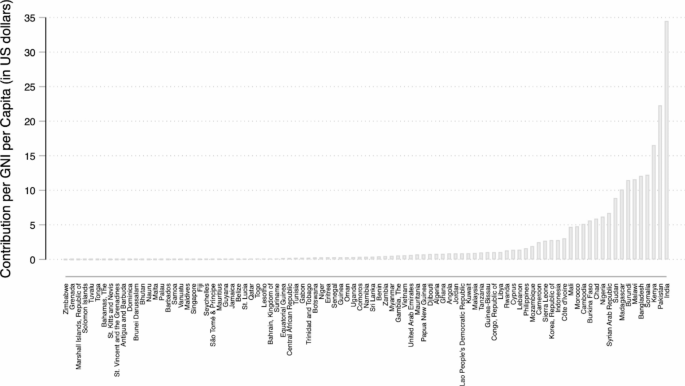
Figure 1 shows the average voluntary contributions to UN organizations by each state from 1997 to 2015. Countries with relatively greater economic powers, such as India, Pakistan, and South Korea, made large voluntary contributions, which is generally consistent with one of the findings in Parizek and Stephen (2021) that rich countries tend to make larger voluntary contributions. However, countries often reported as examples of state failure, such as Somalia, Sudan, and Chad, made large voluntary contributions relative to their wealth. Also, it is important to note that many states born by agreement, including Singapore and Brunei Darussalam, make fewer voluntary contributions compared to their substantial GNI per capita.
Voluntary contributions to the UN (per GNI per capita)
3.3 Explanatory variable
I use derelict decolonization as a measure of how the past colonial history unfolded to independence (Lemke & Carter, 2016). It is a binary measure where one indicates the cases of derelict decolonization, whereas zero indicates all other state births. Among 95 former colonies, mandates, and dependencies, 44 of them went through derelict decolonization, and 51 states had more positive birth legacies.
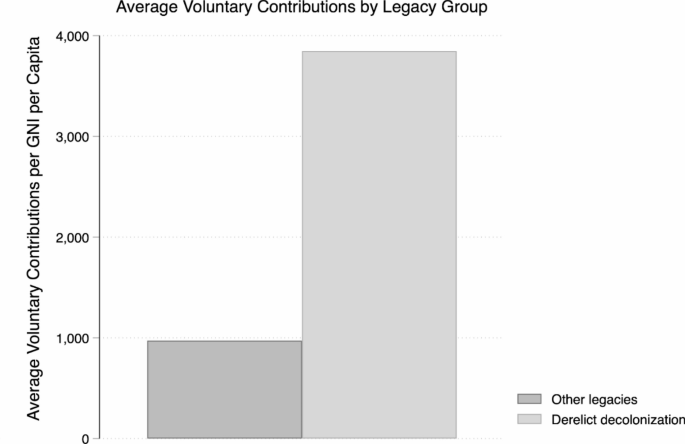
To illustrate, Fig. 2 shows the average voluntary contributions made by the states born through derelict decolonization and those with other legacies. It illustrates that, on average, between 1997 and 2015, countries with derelict decolonization make approximately four times more voluntary contributions to the UN than their counterparts that have similar GNI per capita and more positive legacies. The figure provides an initial observation regarding how derelict decolonization affects states making voluntary contributions.
3.4 Controlling for observables
In estimating the effect of states’ birth legacies on voluntary financial contributions to the UN, an ideal case would be that birth legacies are randomly assigned to former colonies. The assumption is not feasible in the context where various factors might influence how states would go through decolonization and their subsequent decisions to engage in global governance. The main empirical strategy in this paper is to control for the observable confounders as much as possible.
First, I control for the trade dependence on the colonizer during the colonial period or in the first year after independence. It captures the economic dependency that might predispose a state to follow the colonizer’s lead in international policy or financial contributions. I constructed a variable with the amount of export and import data available in the International Monetary Fund’s Direction of Trade Statistics (DOT) (International Monetary Fund, 2024). DOT data contains the amount of export and import data going back to the colonial period of the states. With the data, I generate the relative measure of trade reliance, export to (import from) colonizer/total export (import). The variable aggregates the yearly data on the export and import data during the colonial period, providing a single measure of trade dependence for each former colony. For countries where the DOT does not have data going back to the colonial period, the data of the year a state achieved independence were used to construct the measure.
Similarly, I control for which colonial powers had colonized a state to account for any colonizer-specific influences. Different colonial powers had different colonial policies and responses to decolonization, which could affect the subsequent politics of the former colonies. In addition, geography plays a crucial role in state formation and economic development (Herbst, 2000). Thus, a geography dummy is included to indicate whether a state’s location might have contributed to specific decolonization experiences that affected their later engagement in the UN. Both variables are incorporated from the Correlates of War dataset (Sarkees & Wayman, 2010).
I also control for whether each former colony experienced anti-colonial wars before independence, which is likely to influence decolonization legacies as well as a new state’s relationship with colonial powers, affecting subsequent contribution behaviors in the UN. The data is incorporated from the Correlates of War dataset (Sarkees & Wayman, 2010). In addition, I control for whether each state was previously a sovereign state or a state-like entity before colonization (Roeder, 2007). It addresses the concern that some precolonial history affects both the colonial legacies and subsequent contribution behaviors in the UN. Lastly, I control for the size of populations and the GNI, as larger populations and economies have more resources that affect their ability to make financial contributions (World Bank, 2024).
I use several model specifications to estimate the effects of derelict decolonization. First, I use random-effects (RE) models to incorporate variation across both states and time. The random-effects specification is particularly useful for capturing unobserved heterogeneity that varies across units but is constant over time while also allowing the inclusion of time-invariant covariates (Clark & Linzer, 2015). Second, I employ Feasible Generalized Least Squares (FGLS) models, which are particularly suited to address heteroskedasticity across panels and potential autocorrelation in the residuals. This approach allows efficient estimation when the error structure varies across units and over time (Beck & Katz, 1995).Footnote3 Lastly, I use panel-corrected standard errors (PCSE) models to explicitly address heteroskedasticity and contemporaneous correlations. Following the diagnostic tests that assess stationarity and autocorrelation, the models are estimated with a lagged outcome variable.Footnote4
4 Findings
In Table 2, I report the findings based on the panel dataset, using various model specifications. Models 1 and 4 report the random-effects (RE) regression estimates; Models 2 and 5 use Feasible Generalized Least Squares (FGLS) with adjustments for heteroskedasticity and autocorrelation; and Models 3 and 6 apply panel-corrected standard errors (PCSE) to address heteroskedasticity and contemporaneous correlation. Models 1, 2, and 3 use the natural log of voluntary contributions as the outcome variable, while Models 4, 5, and 6 use voluntary contributions standardized by GNI per capita. Across all models, the coefficients of derelict decolonization are positive and statistically significant, with significance levels reaching 95% or higher in most cases. These results provide consistent support for Hypothesis 1, indicating that states with derelict decolonization are more likely to make voluntary contributions to the United Nations.
The finding is even more pronounced, considering that material wealth, measured by GNI, certainly increases voluntary contributions to the UN, supporting existing findings and conventional wisdom (e.g., Jackson, 1991; Parizek & Stephen, 2021). However, derelict decolonization, often associated with negative political outcomes such as defeats in war (Lemke & Carter, 2016) and state failure (Carter & Lemke, 2022), still expects to increase states’ voluntary contributions to the UN. This contrasting pattern increases our confidence that states with derelict decolonization turn to the UN by making voluntary contributions as a strategic supplement to host external assistance and strengthen state capacity and legitimacy.
Although the earlier analyses offer the recent pattern of making voluntary contributions, one might wonder if it can explain past contribution behaviors as well. To address such concerns, I tested the effects of derelict decolonization with data on past voluntary contributions of the United Nations Development Program (UNDP) from 1980 to 1989.Footnote5 UNDP has been the most important recipient of voluntary contributions, which represented more than 70% of total voluntary contributions in the 1970s (Elmandjra, 1973, p. 247) and still more than 33% in 1990 (UN General Assembly, 1992, 21). The timeframe of the analysis captures the years in which most former colonies achieved independence and also before the end of the Cold War, where the pattern of state birth becomes widely different (Roeder, 2007).Footnote6
Table 3 reports the findings, drawing on the UNDP voluntary contributions data. The model specifications are identical to Model 2 in Table 2, except for GNI, due to the absence of data for many of the new states. In both models, the coefficients for derelict decolonization are positive and statistically significant at the 95% level. The finding provides additional evidence for past contributions; states born with negative legacies had made a voluntary contribution to host international resources in their countries.
In the Supplementary Information, I provide descriptive statistics and a series of sensitivity analyses using an alternative measure of birth legacy and a different set of control variables. First, I use an ordinal measure of the birth legacy measure (Lemke & Carter, 2016) instead of the dichotomous variable of derelict decolonization. The findings remain consistent; states with positive birth legacy are less likely to make a voluntary contribution to the UN. In addition, the finding remains robust with alternative choices of control variables, including some post-treatment variables. Lastly, I report some evidence that low political capacity and legitimacy explain states’ decisions over making voluntary contributions to the UN, drawing on Lemke and Carter (2016) and its empirical test on how types of state birth are correlated with initial state capacity when new states enter the international system. It shows that states with greater material capabilities, measured by the Composite Index of National Capability (CINC), are more likely to contribute voluntarily to the UN, aligning with the conventional wisdom that wealthier and more powerful countries make more voluntary contributions. In contrast, countries with lower political capacity and legitimacy, which best captures the theoretical mechanisms, are more inclined to make voluntary contributions. It supports the theoretical argument that such states make a voluntary contribution to the UN to supplement their state capacity and legitimacy.
In the next section, I provide some illustrative evidence of how different birth legacies shape former colonies’ strategies to use international resources and make voluntary contributions to the UN.
4.1 Illustrative cases: Cambodia and Vietnam
Selecting and comparing the cases of Cambodia and Vietnam has the advantage of controlling for many potentially confounding factors that could contribute to the observed correlations between the legacy of decolonization and subsequent voluntary contributions to the UN. First, Cambodia and Vietnam share the geography in Southeast Asia, leading to many common developmental needs such as containing floods, improving agricultural productivity, and preserving cultural heritage. Most importantly, both nations were colonized by the same colonial power, France, which reduces the likelihood that different colonial policies influence the legacy of decolonization and the subsequent valuation of international resources. Therefore, illustrating how the decolonization legacy affects recent voluntary contributions by the two countries is effective in illustrating the theoretical processes.
Cambodia went through the process of ‘derelict decolonization,’ while Vietnam emerged as a state via ‘violent secession’ (Lemke & Carter, 2016). Therefore, compared to Vietnam, Cambodia is likely to experience weak political capacity and legitimacy because the decolonization process deprived the nascent government of opportunities to develop the nation-state (Lemke & Carter, 2016, p. 500). In contrast, Vietnam took a path through violent secession, resisting attempts by the French to reestablish their rules after the end of World War II (WWII) (Tarling, 1998, p. 37). Although Cambodia experienced a smoother transition accepting or at least passively tolerating collaboration with France, in due course, the traditional monarchy remained largely intact without generating strong anti-colonial nationalist challenges (Tønnesson, 2003, p. 254, 262). For many observers comparing Cambodia and Vietnam, Cambodia was largely in contrast to Vietnam in terms of its ‘lack of nationalist sentiment’ and ‘elusive statehood’ (Clymer, 1997; Duncanson, 1980).
Cambodia was admitted to the UN on December 14, 1955. In Cambodia’s first appearance at the General Assembly, Nong Kimny, the UN Ambassador of Cambodia, expressed the nation’s willingness to contribute to the UN, emphasizing its unique feature of being one of ‘smaller nations’ promoting peace and prosperity across the world (UN General Assembly, 1956, 240). In particular, the Ambassador underscored the ability of the UN to assist socioeconomic development in the poorer part of the world and the need to reorient the UN’s financial resources to those areas:
… For the under-developed countries, the achievement of political independence is not an end in itself unless it is accompanied by parallel efforts to promote economic development and raise living standards.… Hence the countries which have newly achieved independence will try to find means of speeding up their economic development either by developing their resources more intensively or by obtaining foreign aid through bilateral or multilateral economic agreements.… We must, of course, face the fact that the United Nations lacks the funds for promoting adequate and balanced economic development in all parts of the world; but at least we can draw the appropriate lesson and pay heed to the warning given. For instance, the United Nations could promote and encourage national, bilateral or regional programmes for the economic development of those vast regions throughout the world “where” as the Secretary-General puts it, poverty continues to be the law of life for the great majority of mankind. (emphasis added) (UN General Assembly, 1956, 241).
It is noticeable that Cambodia highly values external resources to boost its socioeconomic development. Unlike Cambodia, Vietnam’s first address at the General Assembly, in 1978, was a more global security- and ideology-focused one. Nguyen Duy Trinhm, Deputy Prime Minister and Foreign Minister, largely focused on Vietnam’s antiimperialist foreign policy and solidarity with the communist block. Compared to his emphasis on security issues, he did not express financial expectations for other UN bodies.Footnote7 In general, Vietnam did not demonstrate a high valuation of international resources or a willingness to receive them.
Therefore, the theory expects that Cambodia should be making more voluntary contributions to the UN than Vietnam, considering its higher valuation of international resources and willingness to host them. Table 4 shows the voluntary contributions made to UN organizations by Cambodia and Vietnam between 2014 and 2023.Footnote8 In general, Cambodia has made more voluntary contributions than Vietnam over the years. This is even more impressive considering the relative sizes of their economies; Vietnam’s total GNI is approximately 15 times higher than that of Cambodia (World Bank, 2024).
Secondly, Cambodia’s voluntary contributions are mostly earmarked, indicating that their contributions had specific goals. In contrast, most of the Vietnamese contributions were unearmarked, meaning that although the contributions were voluntary, the allocation of funds was generally open-ended. This suggests that Vietnam’s voluntary contribution behaviors were less oriented toward domestic development.
Specifically, Cambodia’s voluntary contributions have led to tangible benefits for its own. For example, Cambodia’s substantial contributions to the World Health Organization (WHO) between 2020 and 2022 were earmarked and used for improving access to essential medicines, vaccines, diagnostics, and devices for primary health care within Cambodia (World Health Organization, 2022). Similarly, Cambodia’s contributions to UNICEF have been significant and specifically directed toward domestic projects. In 2020, Cambodia contributed $3,688,041 to UNICEF, earmarked for health and nutrition programs within the country (United Nations Children’s Fund, 2022). These funds were used to combat malnutrition, improve maternal and child health, and support knowledge management systems. Lastly, Cambodia’s voluntary contributions to the International Labour Organization (ILO), particularly the “Better Factories Cambodia” program, exemplify strategic investment in domestic economic development. Between 2019 and 2022, Cambodia contributed approximately $1,586,000 to this initiative (International Labour Organization, 2022). The program aims to improve working conditions and labor rights in Cambodia’s garment industry, a key sector of the national economy.
In sum, most Cambodian voluntary contributions were earmarked and expected to be reinvested in various domestic projects, mainly related to health and infrastructure. From this perspective, Cambodian voluntary contributions were more strategic, aiming to host international resources to address various domestic issues. By making substantial voluntary contributions, Cambodia supplemented its state capacity to address the critical issues at hand. In contrast, Vietnam made fewer voluntary contributions and most of them were unearmarked.
5 Discussion and conclusion
In this paper, I explore how the legacy of decolonization influences financial contributions to international organizations of newly independent states in the Global South. I argued that the nature of a state’s emergence from colonial rule profoundly influences its later international engagement and financial contributions to the UN. Specifically, states with negative legacies of decolonization tend to value international public goods more highly and are more likely to invest in international organizations as a strategy to aid state capacity and legitimacy. Regression analyses with various specifications provided support for the theory. In the comparative cases of Cambodia and Vietnam, I also showed that Cambodia, with its derelict decolonization legacy, contributed more significantly and strategically to the UN, compared to Vietnam, which had a relatively positive legacy of violent secession.
This paper contributes to our understanding of how colonial legacies shape contemporary state’s behaviors in global governance. Although much of the existing literature focuses on the domestic implications of colonial legacies, this study extends the insights to international behaviors, shedding light on how historical conditions at the time of independence can set states on different trajectories in their engagement with international organizations.
In addition, this study contributes to our existing knowledge of the relationship between state capacity and financial contributions to international organizations. Traditionally, it is assumed that stronger, richer states are the primary contributors to international organizations due to their abundant resources and interest in maintaining global order. While this notion is certainly supported in this study, it also reveals that states with derelict decolonization, associated with weak political capacity and legitimacy, are more inclined to make voluntary contributions to the UN. This suggests that contrary to our prior beliefs, these states are not merely passive recipients of international aid but are actively investing in international organizations to compensate for domestic deficiencies and to enhance their state-building efforts (Jackson, 1991; Krasner, 2004). It leads us to reevaluate our understanding of the role of the Global South states in global governance. In other words, the findings in this study suggest that even states with limited capacities can play proactive roles in international engagement, adding nuance to the notion that wealthy and powerful states dominantly fund international organizations (Iwunna et al., 2023).
Also, this study adds to our understanding of the transformative funding structure of the UN (Graham, 2023). The findings in this study highlight that states with negative decolonization legacies strategically use voluntary contributions to enhance their own state capacity and legitimacy, likely geared toward their domestic priorities. Therefore, the findings in this study engage with how the structure of funding in the UN has changed over time, from multilateralism and assessed contributions to bilateralism and voluntary contributions (Graham, 2023, p. 182). The patterns observed in this study strengthen the view that UN agencies, as a “channel,” transfer states’ resources to their own agendas, consequently blurring the line between voluntary contributions to international public goods and the pursuit of national interests (Graham, 2023, p. 187).
This study also raises new questions about what other aspects of states’ development trajectories, such as conflict history and democratization, might affect their financial strategies in international organizations. Furthermore, while this paper focused on voluntary contributions to the UN, it leaves open the possibility for further examination of how decolonization legacies affect other strategic behaviors of Global South states in engaging with different international organizations.
Lastly, this study focuses specifically on voluntary contributions as the dependent variable of interest, it is important to note that the distinction between earmarked and non-earmarked contributions has significant implications for UN financing. Recent research, such as Reinsberg et al. (2024), highlights the increasing trend of earmarked funding to international organizations and its impact on resource allocation and organizational performance. Future studies are needed to explore how birth legacies influence not only the decision to make voluntary contributions but also the choice between earmarked and non-earmarked funding.
Data availability
All data generated or analyzed in this study is publicly accessible. The data that support the findings of this study will be posted on a replication archive upon publication. The replication materials is accessible at https://dataverse.harvard.edu/dataset.xhtml?persistentId=doi:10.7910/DVN/3PPQ9G.
Notes
-
There are two more birth types, yet largely irrelevant to the decolonization context. State fragmentation results from the disintegration of an existing state due to internal failures, exemplified by the Soviet Union’s dissolution into 15 independent states. Indigenous generation describes states that evolve organically from a central region, gradually expanding and assimilating surrounding territories to form a cohesive national state. The latter is best captured by state-building processes in Western Europe (Lemke & Carter, 2016).
-
Relately, the recent article by Carter and Lemke (2022) shows that a negative legacy is associated with more state failures. Their findings support the theoretical assumptions of this article; negative legacy might increase states’ strategic needs to access international actors.
-
More specifically, I specify a panel-specific autoregressive correlation structure (PSAR1) and calculate the autocorrelation parameter using the Durbin-Watson method, which directly addresses serial correlation in the residuals.
-
The results of the diagnostic tests are reported in Tables A2 - 1 and A2 - 2 in the Supplementary Information.
-
I collected the data from a series of financial reports from the Governing Council of the UNDP. For instance, see Governing Council of the United Nations Development Programme (1984) and Governing Council of the United Nations Development Programme (1990).
-
In this analysis, GNI is not included in the analysis because the data is not available for many new states in this period. I use the number of population in the year of 1980.
-
The relevant part of the speech is as follows. “Viet Nam is willing to pursue bilateral and multilateral co-operation with other countries and to participate in or maintain relations with international co-operation organizations in order to develop its economy on the basis of respect for each other’s independence and sovereignty, equality and mutual benefit. Viet Nam is a member of the World Bank, IMF. the Asian Development Bank, the Mekong Committee and many other international organizations. It also maintains relations with the European Economic Community” (UN General Assembly, 1980, 396).
-
The data is collected from various UN organizations websites. For instance, see UNESCO (2024).
References
-
Banerjee, D. (2013). 10 India. In A. J. Bellamy, & P. D. Williams (Eds.), Providing peacekeepers: The politics, challenges, and future of united nations peacekeeping contributions (pp. 225–244). Oxford University Press.
-
Bayram, A. B., & Graham, E. R. (2017). Financing the united nations: Explaining variation in how donors provide funding to the UN. The Review of International Organizations, 12(3), 421–459.
-
Beck, N., & Katz, J. N. (1995). What to do (and not to do) with time-series cross-section data. American Political Science Review, 89(3), 634–647.
-
Bellamy, A. J., & Williams, P. D. (2013). 19 explaining the national politics of peacekeeping contributions. In A. J. Bellamy, & P. D. Williams (Eds.), Providing peacekeepers: The politics, challenges, and future of united nations peacekeeping contributions (pp. 416–436). Oxford University Press.
-
Bove, V., & Elia, L. (2011). Supplying peace: Participation in and troop contribution to peacekeeping missions. Journal of Peace Research, 48(6), 699–714.
-
Carter, J., & Lemke, D. (2022). Birth legacies and state failure. Journal of Conflict Resolution, 66(10), 1854–1880.
-
Clark, T. S., & Linzer, D. A. (2015). Should I use fixed or random effects? Political Science Research and Methods, 3(2), 399–408.
-
Clymer, K. J. (1997). Cambodia: The view from the United States, 1945–1954. The Journal of American-East Asian Relations, 6(2/3), 91–124.
-
Coggins, B. (2011). Friends in high places: International politics and the emergence of States from secessionism. International Organization, 65(3), 433–467.
-
Correlates of War Project (2017). State system membership list, v2016. Online: https://correlatesofwar.org
-
Duncanson, D. (1980). Cambodia – an elusive nationhood. Asian Affairs, 11(3), 254–263.
-
Eichenauer, V. Z., & Reinsberg, B. (2017). What determines earmarked funding to international development organizations? Evidence from the new multi-bi aid data. The Review of International Organizations,12(2), 171–197.
-
Elmandjra, M. (1973). The united nations system: An analysis. Faber.
-
Gaibulloev, K., Sandler, T., & Shimizu, H. (2009). Demands for UN and non-UN peacekeeping: Nonvoluntary versus voluntary contributions to a public good. The Journal of Conflict Resolution,53(6), 827–852.
-
Governing Council of the United Nations Development Programme (1984). Financial, budgetary and administrative matters: Annual reviews of the financial situation, 1983. Technical report DP/1984/53.
-
Governing Council of the United Nations Development Programme (1990). Financial, budgetary and administrative matters: Annual reviews of the financial situation, 1989. Technical report DP/1990/64.
-
Graham, E. R. (2015). Money and multilateralism: How funding rules constitute IO governance: International theory. International Theory, 7(1), 162–194.
-
Graham, E. R. (2017). The institutional design of funding rules at international organizations: Explaining the transformation in financing the United Nations. European Journal of International Relations, 23(2), 365–390.
-
Graham, E. R. (2023). Transforming international institutions: How money quietly sidelined multilateralism at the United Nations. Oxford University Press.
-
Herbst, J. (1990). War and the state in Africa. International Security, 14(4), 117–139.
-
Herbst, J. (2000). States and power in Africa: Comparative lessons in authority and control. Princeton University Press.
-
Hüfner, K. (2019). Financing the United Nations– An introduction. Frank & Timme.
-
ICAO (2015). Annual report of the council: Technical cooperation projects. Technical report appendix 2.
-
International Monetary Fund (2024). Direction of trade statistics. Online: https://data.imf.org/?sk=9d6028d4f14a464ca2f259b2cd424b85
-
International Labour Organization (2022). Better Factories Cambodia: Programme expenditure 2019–2022. Online: https://www.ilo.org/asia/WCMS_099345/lang–en/index.htm
-
Iwunna, O., Kennedy, J., & Harmer, A. (2023). Flexibly funding WHO? An analysis of its donors’ voluntary contributions. BMJ Global Health,8(4), e011232.
-
Jackson, R. H. (1991). Quasi-states: Sovereignty, international relations and the third world. Cambridge studies in international relations. Cambridge University Press.
-
Kay, D. A. (1969). The impact of African States on the United Nations. International Organization,23(1), 20–47.
-
Khanna, J., Sandler, T., & Shimizu, H. (1999). The demand for UN peacekeeping, 1975–1996. Staff General Research Papers Archive, Iowa State University, Department of Economics.
-
Krasner, S. D. (2004). Sharing sovereignty: New institutions for collapsed and failing States. International Security, 29(2), 85–120.
-
Kreps, S. E., & Wallace, G. L. (2009). Just how humanitarian are interventions? Peace-keeping and the prevention of civilian killings during and after civil wars. Social Science Research Network Scholarly Paper.
-
Laurenti, J. (2018). Financing. In T. G. Weiss, & S. Daws (Eds.), The Oxford handbook on the United Nations (pp. 250–280). Oxford University Press.
-
Lebovic, J. H. (2004). Uniting for peace? Democracies and United Nations peace operations after the cold war. The Journal of Conflict Resolution, 48(6), 910–936.
-
Lemke, D., & Carter, J. (2016). Birth legacies, state making, and war. The Journal of Politics, 78(2), 497–511.
-
Parizek, M., & Stephen, M. D. (2021). The increasing representativeness of international organizations’ secretariats: Evidence from the United Nations system, 1997–2015. International Studies Quarterly,65(1), 197–209.
-
Perkins, R., & Neumayer, E. (2008). Extra-territorial interventions in conflict spaces: Explaining the geographies of post-cold war peacekeeping. Political Geography,27(8), 895914.
-
Reinsberg, B., Heinzel, M., & Siauwijaya, C. (2024). Tracking earmarked funding to international organizations: Introducing the earmarked funding dataset. The Review of International Organizations, 1–27. https://doi.org/10.1007/s11558-024-09548-1
-
Roeder, P. G. (2007). Where Nation-States come from. Princeton University Press.
-
Sarkees, M. R., & Wayman, F. (2010). Resort to War: 1816-2007. Wasthington, DC: CQ Press.
-
Stoessinger, J. G. (1964). Financing the United Nations system. Brookings Institution.
-
Tarling, N. (1998). Nations and States in Southeast Asia. Cambridge University Press.
-
Tønnesson, S. (2003). National divisions in Indochina’s decolonization. In P. Duara (Ed.), Decolonization (pp. 271–295). Routledge.
-
UN General Assembly (1973). General Assembly, 24th session: 1764th plenary meeting, Wednesday, 24 September 1969, New York.
-
UN General Assembly (1980). General Assembly official records, 33rd session: 21st plenary meeting, Wednesday, 4 October 1978, New York.
-
UN General Assembly (1956). General Assembly, 11th session: 590th plenary meeting, Thursday, 22 November 1956, New York.
-
UN General Assembly (1992). Statistical report of the ACC on the budgetary and financial situation of the organizations of the United Nations system (1992). United Nations – CEB.
-
UN General Assembly. (2016). Budgetary and financial situation of the organizations of the United Nations system: note by the Secretary-General.
-
UNESCO (2024). Sources of funding. Online: https://core.unesco.org/en/sources-of-funding
-
United Nations Children’s Fund (2022). Compendium of Resource Partner Contributions 2020–2022. Online: https://www.unicef.org/reports/resource-partner-contributions-compendium-2022
-
Uzonyi, G. (2015). Refugee flows and state contributions to post-Cold war UN peacekeeping missions. Journal of Peace Research, 52(6), 743–757.
-
World Health Organization (2022). Programme Budget Portal: 2020–2021 Budget and Financing. Online: https://open.who.int/2020-21/budget-and-financing/flow
-
World Bank (2024). GNI per capita, Atlas method (current US$). Online: https://data.worldbank.org/indicator/NY.GNP.PCAP.CD
Funding
The author did not receive support from any organization for the submitted work.
Ethics declarations
Conflict of interest
The author has no competing or financial interests to declare that are relevant to the content of this article.
Additional information
Responsible editor: Axel Dreher
Rights and permissions
Open Access This article is licensed under a Creative Commons Attribution 4.0 International License, which permits use, sharing, adaptation, distribution and reproduction in any medium or format, as long as you give appropriate credit to the original author(s) and the source, provide a link to the Creative Commons licence, and indicate if changes were made. The images or other third party material in this article are included in the article’s Creative Commons licence, unless indicated otherwise in a credit line to the material. If material is not included in the article’s Creative Commons licence and your intended use is not permitted by statutory regulation or exceeds the permitted use, you will need to obtain permission directly from the copyright holder. To view a copy of this licence, visit http://creativecommons.org/licenses/by/4.0/.
Reprints and permissions
About this article
Cite this article
Yi, J. Decolonization legacies and financial contributions to international organizations. Rev Int Organ (2025). https://doi.org/10.1007/s11558-025-09592-5
- Accepted
- Published
- DOI https://doi.org/10.1007/s11558-025-09592-5
Keywords
- Decolonization
- International organizations
- Financial contributions
