
 info@apippress.com
 +86 18163351462 (WhatsApp)
 +86 182 8014 0209
Article Content
Abstract
Recent appeals to the aesthetic-affective realm, specifically to sublimity, tend to concentrate on how it can work to disrupt political power. But another, older, tradition of interpretation looks to sublimity not as a generator of dissensus, but rather as a feeling that can bind people together to enact democratic power. Its roots are in eighteenth-century figures as diverse as Kant, Robespierre, and John Adams. But there is a perennial problem with this tradition: The enthusiastic exaltation associated with being motivated by the sublimity of popular democratic movements is difficult to differentiate from a similar motivation evident in fascist ones. I engage this difficulty in two ways. First, I trace how it troubles William E. Connolly’s attempt to link the aesthetic-affective dimension in politics with the myth of a general strike as a way of motivating future collective democratic action. But my engagement with Connolly is not just critical. It also, secondly, draws positive value from his thinking about how mortality needs to be folded into our political sensorium. That insight is crucial if we are to conceive and cultivate a sense of sublimity that is associated not just with enthusiasm, but also with a certain kind of sobriety about our finitude, our human limits. The embrace of a two-fold sense of sublimity, encompassing both “enthusing” as well as “sobering” dimensions, can help constitute a democratic sensibility that deflates proto fascistic tendencies to see ourselves as embodying an unlimited will to power when we participate in collective insurgency.
Explore related subjects
Discover the latest articles and news from researchers in related subjects, suggested using machine learning.
- Analytical Aesthetics
- Conformity
- Extrinsic Motivation
- Literary Aesthetics
- Political Philosophy
- Political Psychology
The association of sublimity with politics is a venerable one. In recent years, many scholars have envisioned the feeling of sublimity primarily as a source of dissensus and disruption that can loosen the hold of frames of power. The connection of that feeling with the unsettling of normalized expectations allows it to play this role in relation to persistent injustice. We might think of this effect as a “centrifugal” force on political power, disrupting its grip on the consciousness of individuals.Footnote1 But there is another tradition of interpretation, an older one, that looks to ways in which our aesthetic-affective reactions can enhance, as opposed to disrupt, the concentration of power—more particularly for present purposes, the democratic concentration of power. In the eighteenth century, attention began to focus on the phenomenon of popular insurgency. This tradition attends to the motivating power of the sublimity of shared, democratic enthusiasm and awe to bind together those struggling against authoritarian orders. We can envision this way of understanding the influence of feelings of sublimity as involving a binding, “centripetal” force on the generation of power in collective action.
Neither of these approaches to sublimity can claim to be categorically preferable. The centripetal and the centrifugal perspectives each brings a valuable, but contestable, angle of insight into politics. And each is also entangled with a distinctive problem. For the centrifugal, a persisting question is whether it ends up authorizing only a negative attitude toward any coherent formation of political power, authoritarian or democratic, even though it imagines its role to be one of opening space for democracy. In short, power is engaged only for the purpose of disruption; it is not explicitly affirmed as something to be shared and enhanced. For the centripetal, the critical doubt is whether its solidifying affirmation of popular manifestations of power can also sufficiently differentiate between types of insurgencies. In short, it is not immediately clear how one can distinguish between enthusiasm for popular democratic phenomena of power and enthusiasm for fascist ones.
In what follows, I want to critically rethink the centripetal conception with the intention of mitigating the fascism problem. In today’s climate of emerging proto fascism in a variety of countries around the world, this sort of endeavor will hopefully be seen as having potential real-world implications, a characterization sometimes denied to explorations of topics associated with aesthetics.Footnote2 To give my discussion a specific referent for engaging this nexus of questions, I turn to the work of William E. Connolly. He has made important contributions to understanding how our aesthetic-affective sensibility relates to politics, as well as to how we should fold those insights together with democratic insurgency. Connolly has argued that effective resistance to the cascading problems of climate destruction, racism, extractive capitalism, inequality, and right-wing populism requires us to consider novel ways of motivating democratic action; in short, generating centripetal force. More particularly, he has promoted the value of a “turn to myth” for the political left, more particularly, the myth of “the general strike,” as crucial to an effective appeal to take up collective action. Although he does not explicitly use a concept of sublimity in this context, I will argue that he in fact operates with one, more particularly one that is centripetal.Footnote3 The problem with this implicit deployment is that it allows the fascism problem to persist, even though this is manifestly not Connolly’s intention (2017a, pp. 1, 121–149; 2022, pp. 140–141).\ My point is not to claim that Connolly ends up supporting fascism, but rather that he configures a sensibility supporting violence on the left that is difficult to clearly distinguish from that of fascism, with its appeals to myth and enthusiasm for vehement action. The goal of my analysis is simply to encourage those on the democratic left to think more carefully about how we should imagine a distinctly democratic approach to violence.
This engagement with Connolly should not be seen as a simple, one-dimensional critique. Rather, my aim is to show that he could avoid the fascism difficulty if he were to explicitly embrace a certain understanding of the centripetal sublime that I will propose. Moreover, adopting that understanding also opens up an overlooked congruence between Connolly’s account of democratic insurgency, on the one hand, and the fundamental commitments of his own ontology of identity\difference, on the other—commitments that I share, and that are in fact crucial to the character of the centripetal conception of democratic sublimity that I propose. Thus, my strategy is one of constructive critique aimed at a mutually acceptable theoretical stance.
Toward that goal, I pursue two lines of argument that provide grounds not for summarily rejecting his appeal to the myth of a general strike, but rather for reconceptualizing it in a more clearly democratic fashion. First, Connolly needs to recognize that his account of that myth implicitly appeals to a conception of the centripetal sublime. This emerges when he embraces the ideas of Georges Sorel who explicitly invokes the motivating power of sublimity, something that ended up making the latter’s ideas attractive to twentieth-century fascists. Thus, in turning to Sorel, Connolly unintentionally becomes entangled with this problem. Second, I argue that the way to address this difficulty is not by rejecting an embrace of the sublime altogether, but rather by adopting a modified conception of it. Taking this turn would also have an unexpected value for the coherence of Connolly’s work as a whole. This is because it helps better align his recent discussions of insurgency with his earlier reflections on identity\difference, especially in how the latter thematizes the role of human finitude or mortality.Footnote4 With my suggested reconfiguration, we achieve a perspective that highlights the admirable role a centripetal sublimity can play in sustaining specifically democratic upwellings of popular collective action.
Centripetal conceptions of a political sublime have typically focused on the awe and elevating enthusiasm associated with motivating popular manifestations. In the eighteenth century, this association became common and was deployed by a remarkable variety of figures, including, notably, Kant (2011, pp. 22–25, 95; 2000, pp. 153–154, 246–247; 1991, p. 182), Robespierre (Huet, 1994, p. 61), and John Adams (1773, 1964). But for Kant and Adams, this salutary elevation could become problematic if it morphed into feelings of sheer enthusiasm for violence divorced from all sense of restraint. In what follows I want to pick up on this concern and address it by means of the articulation of a more capacious comprehension of the role sublimity can play in political life, something that can help us see what is problematic about a reduction of sublimity into a feeling of unlimited enthusiasm. This will involve unpacking how our aesthetic-affective sensibility may be intertwined with a consciousness of human finitude. We might speak here of re-vivifying a “sobering” dimension of the sublime. A core contention of this article is that when we want to characterize the centripetal sublimity of democratic politics, this dimension must be brought more into the foreground, so that an experience of sublimity is imagined as encompassing both “enthusing” and “sobering” elements.Footnote5
With the foregoing goals in mind, let me begin by recounting how Connolly theorizes democratic resistance. He has done a stellar job of analyzing the visceral, aesthetic-affective dimension of politics, focusing on how we might cultivate a self that is more aware and militant “as fascist movements proliferate and the Anthropocene gallops at an accelerating pace” (2023, p. 26). Although Connolly has provided perceptive elucidation of how we can work on ourselves and each other to make our sensorium more resistant to disturbing trends in the regnant political culture, for a long time he had relatively less to say about the visceral dimension of vehement, collective democratic insurgency itself. In the last decade, however, he has moved further in this direction with his bold appeal to the vivid idea of “cross-regional general strikes,” something he hopes will appear as the culmination of merging strands of political resistance (2017, p. 12).
But this appeal remains somewhat perplexing. He indicates that such a strike has the character of a “myth” (2017, pp. 12, 120, 146–147). My sense is that Connolly sees the need for democratic insurgency to appear as a looming, powerful ideal about which we should feel awe and enthusiasm, but he is not very clear about its form and the character of its attractiveness. The appeal to a general strike seems to function primarily as a symbolic driver of a hoped for, highly disruptive force of resistance against normalized politics. One of the main theorists of the idea of a general strike—and the one from whom Connolly draws his inspiration is the late nineteenth and early twentieth-century French political thinker, Sorel (Connolly. 2017, pp. 129–131, 147). He believed that “terrifying” violent action, including bloodshed, was a crucial part of a general strike, something he hoped would “completely annihilate” the existing regime (Sorel, 1961, pp. 274–275). Without violence, he argued, revolutionary movements will fail to continually rejuvenate the awe and enthusiasm associated with a “sublime” (Sorel, 1961, pp. 139, 275), “epic state of mind” (Sorel, quoted in Jennings, 1985, p. 135).
After his initial embrace of Sorel, however, Connolly struggles to create some distance from him regarding the violent characteristics of a general strike. But this secondary gesture generates some perplexity as to why he attaches his views to that thinker’s images in the first place. My key question for Connolly can now be stated this way: How might he clarify this striking appeal to a mythic of enthusiastic democratic insurgency in a way that more persuasively coheres with both core democratic values and the deepest commitments of his work as a whole? In trying to answer these questions, I begin by considering in how the aesthetic-affective dimension of democratic insurgency has been taken up historically, especially how it has been associated with the topic of the sublime and entangled with the issue of political violence. This will help locate Connolly’s invocation of a general strike in a broader philosophical and historical context. In the next section, I explore how the issue of violence in democratic insurgency might be productively negotiated by means of a thematization of human finitude that is alien to fascism. My analysis starts in an unexpected place, namely, Edmund Burke’s reflections on how the feeling of sublimity is entangled with our mortality. This path might seem to be a complete non-starter, given Burke’s fulsome rejection of any sort of vehement democratic manifestation in Reflections on the Revolution in France (1987). But there may yet be something of value that can be redeemed in the way he associates finitude with the sublime. This unlikely interpretive path will hopefully be rendered less questionable when I suggest that a central theme in Connolly’s own thought runs parallel in its attention to finitude. Then in the subsequent section I try to flesh out how this way of thinking about the sublime encompasses a sensibility not only related to awe and enthusiasm, but also to a sobering sense of how our finitude should infuse our engagement with politics in general, but especially insurgent movements. In the final section, I show how my weaving together of these threads might help to provide a better context for Connolly’s appeal to the myth of a general strike as part of the motivational palate of democratic resistance. My specific claim here is intended to apply more generally to any attempt to bring the motivating force of sublimity into the imagination of emerging democratic power.
The aesthetic-affective dimension of democratic insurgency
I have suggested that there is a problem with how Connolly connects aesthetic-affective sensibility in general with the motivation of democratic insurgency. At the heart of this deficiency is his neglect of what is, historically, the most salient orientation to conceptualizing the aesthetic-affective dimension of collective action. Here, I refer to the tradition of comprehending the visceral appeal of popular movements through the notion of sublimity. As noted above, the distinctively modern version of this was highlighted in the eighteenth century with the emergence of democratic revolutions. The first prominent philosophical characterizations of what we might call, following Jason Frank (2021), the “democratic sublime,” were either cautiously measured in their judgment (Kant, 1991, pp. 182–184) or downright hostile (Burke, 1987, pp. 9–10, 15, 57, 134). Neither of these thinkers wanted to be seen as encouraging what Robespierre lauded as the “sublime enthusiasm” of violent revolutionary action—the ‘volcanic’ eruptions of democracy, as it were (quoted in Huet, 1994, p. 61).
The association of the sublime with natural phenomena like volcanos or vertiginous mountain peaks was a familiar one; but it must be remembered that the concept of the sublime in politics was always entangled with our moral character. In Burke, it is our character as mortal creatures of God who are embedded in social hierarchies; in Kant, it is our character as noumenal beings.Footnote6 Both believed that the significance of these moral frames can be heightened through cultivation. Of course, each of them thought that their way of perceiving these foundational values—noumenal in Kant and hierarchical, theistic in Burke—merely reflected something intrinsic to the metaphysical character of the world. Thus, each in his own way differentiated (even if not entirely explicitly) between something like a “real” or “authentic” (eigentlich) sublime and a “false” sublime, with only the former involving “true enthusiasm.”Footnote7 The question of how exactly we should draw that distinction and cultivate it was approached differently by these two philosophers, as they witnessed the violence of the French Revolution.
What I want to suggest is that Connolly needs to better engage the knot of questions that is highlighted by those who have grappled with the entanglement of democratic insurgency, foundational values, and the sublime. As I suggested above, this whole terrain of reflection becomes salient to Connolly when he appeals to the idea of a general strike as the culmination of the micro-politics of the self and the politics of “swarming” between diverse groups that he hopes will gather momentum toward a culminating volcanic eruption (2019, pp. 43; 2017, pp. 6, 123–129).
The general strike is an image, not a blueprint for action. Like Sorel, Connolly promotes the idea of a general strike as a novel addition to our political mythic. In short, it needs to be part of the aesthetic-affective imaginary that generates enthusiasm for vehement democratic movements. But Connolly, unlike Sorel, is quite clear that his idea of a general strike is to be one of restrained violence not involving substantial “bloodshed.” This limitation is stated in relatively categorical terms. But the only reason Connolly gives for his position is that recourse to bloodshed on the left is strategically bad in the sense that it is likely to give those on the right the excuse to raise the level of their own violence (2017, pp. 131–132). This is no doubt a serious consideration today; but I would question whether purely strategic reasoning here is adequate to comprehending the issue of bloodshed as it emerges at this point in the discussion of democratic insurgency.
One of my reasons for highlighting the importance of discussions of the sublime and politics becomes clearer in the light of this concern. That is because the issue of violence, as I noted above, has always been at the center of discussions of modern democratic insurgency. Concern about violence in the French Revolution led Kant to affirm the feeling of sublimity when experienced by one observing that novel emergence of popular politics, but he did not allow that to extend to any enthusiasm that might draw one toward participation in revolutionary violence. (Kant, 1991, pp. 182–184). Such caution became vivid condemnation in Burke who believed that the French Revolution was awash in a “false” sublime: One powered by awe and enthusiasm in the face of scenes of human willfulness un-leashed from all the hierarchical social and political bonds of the ancien régime, as well as from the humility embodied in Christian values. Unlimited willfulness—human infinitude—was displacing a proper appreciation of our character as finite creations of an infinite deity atop the Great Chain of Being. This, to Burke, was at the core of the felonious assault on western civilization ushered into history by popular insurgency; and when The Terror emerged, Burke could say he told us so.
Generations of scholars of both liberal and conservative persuasions have at least tacitly followed Burke in his suspicions about the role of aesthetic-affective empowerment of forceful democratic insurgency, even if they have not all wanted to endorse his nostalgia for a hierarchical world. Frank, in his The Democratic Sublime, has tried to show that this recurring suspicion amounts to a tendentious “democratic terror thesis” (Frank, 2021, pp. 68–69). As he argues, invocations of it simply tar every democratic manifestation in the streets with the brush of impending violence, terror, and authoritarianism. Although I agree with the bulk of Frank’s counterargument here, he nevertheless clears the field of obstacles to his categorical affirmation of a democratic sublime a bit too quickly. By this I mean that he succeeds in showing that there is no necessary slide to terror and authoritarianism in vehement popular manifestations, but he has not refuted the argument that such manifestations may slide that way, if we simply bathe our action-oriented attitudes in the accelerant of a supportive aesthetic-affective sensibility. In short, popular insurgencies whose motivation is enhanced by such a sensibility may track in a democratic direction, but they may also track in populist authoritarian ones as well.
This is hardly a minor academic issue today, as many democratic polities confront right-wing populist movements. More events such as the insurgency in Washington, DC, on January 6, 2021, are not a remote possibility. Clearly, that event was an authentic, vehement popular manifestation, fired by collective enthusiasm; in short, entangled with an elevating sense of the sublime. Many of the participants felt they were acting together to “stop the steal” and save democracy. Is their feeling of being part of a sublime and estimable event defensible? Or is it a stunted, indefensible manifestation of a democratic ethos?
The sublime and finitude
As noted earlier, Burke’s account of the sublime is deeply unfashionable today. But I want to suggest that there may yet be something partially valuable in his critique of political insurrection, once we detach it from his affinity for hierarchy, both theological and social-political. We might then begin to reconfigure his critique of modern, systemic political willfulness as calling valuable attention to a forgetting of our mortality, our finitude.Footnote8
But how exactly might the cultivation of a sense of finitude infuse a feeling of the sublime, after one has given up the more familiar, apparently necessary, contrasting figure of divine infinitude? Burke was struck by the way in which some experiences of pain or the closeness of death can bring not just fear or terror, but also a curious sense of pleasurable elevation.Footnote9 Of course, if one is immediately threatened with death, there is nothing positive about it; it is merely terrifying. But if one is somewhat removed from the danger, that space may allow for a subtle sense of elevation that, however, remains in tension with the “sobriety” evoked by the coerced vividness of our mortality experienced against the background of God’s immortality (Burke, 1990, p. 32). But if we relinquish that transcendental anchor, however, the compound sense of both pleasure and sobriety must be comprehended as emerging somewhat differently. It can arise, I would suggest, from experiencing our real but precarious, capacity to challenge and temporarily exceed limits in pursuing our ideals, in this case the collective ideal of a sustainable democratic world. (This sort of experience would especially stand out if we were experiencing our finitude against the ontological background of an infinite becoming of the world around us, an idea at the core of Connolly’s own ontology, as I will show in a moment.)Footnote10
The key issue here becomes how to conceptualize this in a way that does not inflate the exhilaration of challenging limits into a confidence in human limitlessness. The feeling of sublimity needs to be better associated with the evocation of an experience of finitude joined with an uplifting, exhilarating sense of the human spirit engaging its limits in a world of becoming. This means embracing what I called above the “sobering” dimension of the sublime. It contrasts with, but also should accompany, the more familiar sense of an “enthusing” sublime that Frank so admirably illustrates. Democratic life must cultivate a sensibility characterized by a tensional congruence of the two, if it is to adequately distinguish its own occasional resort to violence from that of fascism or of groups on the left for whom violence became simply an enthusiastically embraced strategy, like the Weather Underground or the Red Army Faction.
One might argue, however, that my suggestions about a distinctive democratic sensibility are not well grounded: Don’t all regimes, even fascist ones, attend in some way to our finitude? Those who die in the favored cause are exalted and remembered as martyrs. But here the enthusing valence of sublimity is consistently given effective priority; the other, sobering valence, plays a markedly subordinate, even disappearing, role. The fascist does not allow deaths to resonate with any real depth, but rather categorically locks them into a script in which they serve a grief-transcending purpose without limits: the further “hardening [of] oneself like steel” against the enemy (Junger, 2008, pp. 16–17). We have seen a similar, if milder, version of this strategy pursued by the Trump movement. Leaders radically reinterpret moments that might otherwise be interpreted as evoking a sense of finitude and humility. For example, the enthusiasm of an election contest juxtaposed to the sobering moment of acknowledging that your party has lost is a crucial, if often overlooked, moment in the experience of democratic life. But Trump and his circle consistently urged supporters to literally deny these moments in relation to the 2020 election; thus, a loss was not really a loss, but only the occurrence of fraud and conspiracy by opponents. Supporters are accordingly encouraged to harden their hostility toward the enemy and enthusiastically pursue their fight to retain power.
If one tries to think of a vivid example of how bivalent sensibility informs political protest in democratic polities, civil disobedience is likely to come quickly to mind given its notable highlighting of the sobering dimension. In his 1963, “Letter from a Birmingham Jail,” Martin Luther King, Jr., speaks of the “sublime courage” of the protestors as they faced the violence of police dogs and batons with a spirited sense of collective empowerment and sobriety (King 1963). Although this characterization of the protests is apt, it is nevertheless important not to misinterpret the exemplary character of what went on in places like Birmingham, Alabama in the 1960s. These episodes quickly came to be distorted into narrowly restrictive models of how oppositional protest should be conducted in liberal, constitutional orders. This sort of idealized interpretation allowed many white Americans to see any sort of more vehement, “uncivil” protests on the part of blacks in that era as patently illegitimate. The latter were seen as unacceptable in a “reasonably just” society, as John Rawls characterized the existing order. (Pineda, 2021, pp. 22–52). But for blacks in America at that time, the U.S. hardly fit that description. Thus, while instances like Birmingham should indeed be seen as embodying an admirable bivalent sensibility, that judgment should not be equated with the further claim that this status simultaneously denies legitimacy to more uncivil modes of protest of the kind that tended to become prevalent in later years, both in the civil rights movement and in the anti-Vietnam war protests. The choice of a mode of protest always involves weighing the degree of injustice present in a regime against the degree of violence being entertained as appropriate by opposition actors. These are typically rough and fallible decisions in fraught contexts; and they may only find fuller justification after some passage of time (as I will explain further in a moment).
It is thus crucial not to confuse my claims about the significance of a bivalent sensibility with a narrow liberal position that accords certain actions like civil disobedience an overly idealized status without regard to context. My argument aims rather to highlight that democratic decisions about vehement protest should involve a range of ethical and strategic concerns infused with a sense of sublimity. It thus differs from both a narrow liberal argument mandating a blanket prohibition on violence, on the one hand, and a fascist one where the deployment of violence is animated merely by strategic calculations and a sense of enthusiasm for the deed, on the other.
The background orientation provided by such a bivalent sublimity is needed to provide coherence to a position like Connolly’s, with its somewhat perplexing notion of a violent general strike that is nevertheless to be “bloodless” (Connolly, 2017, pp. 128–129). In short, for actors to plausibly pursue his scenario of a vehement, but restrained, opposition, they would need to embrace something like this sort of sensibility. But further argument is needed for this claim to be sufficiently convincing. Toward that end, two additional issues have to be engaged.
First, any claim highlighting a sense of finitude in democratic life is likely to meet with some wariness. Bonnie Honig has warned against the danger of what she calls a “mortalist humanism” that threatens to turn attention too sharply away from admirable, contestatory upwellings of democracy (Honig, 2013, pp. 15, 19, 26–27, 30, 146–147). Following this sentiment, Frank similarly contends that a focus on finitude and the associated stress on human vulnerability efface “democratic contention” and “the importance of inspiring new assemblages of collective, demotic power” (Frank, 2021, pp. 9; 2009, pp. 670–671). In short, focusing on finitude means agonistic enthusiasm is being traded away for humility and quiescence. This feels like a bad exchange; and it would presumably worry Connolly as well, given the centrality of the notion of agonism to his work as a whole. Accordingly, my attempt to affirm the value of a “sobering sublime,” attached to a highlighting of finitude, would seem to be a dead end. Then again, maybe not.
From time to time in Connolly’s recent work, the theme of finitude surfaces. In Facing the Planetary, for example, he affirms “Nietzschean explorations of mortality…in a world of becoming” (2017, pp. 190; 2019, 88). But such statements are relatively few and scattered. To grasp the full importance of this topic for him, we need to return to his earlier, pathbreaking Identity\Difference (1991). There our anxiety about mortality is at the core of an ontology that continues to animate Connolly’s thought today. Significantly, that book is also where his distinctive take on agonism is first developed. Given the suspicions just noted about the danger that a stress on finitude represents for agonism, it is useful to recall its insights.
Connolly claims there that our identity takes shape through its constitutive relation with what it is not; in short, I don’t exist as a purely self-constituting being which then goes out into the world to encounter what is different. This means that I am not the ontological sovereign of myself. I am constitutively entangled. That is the source of an underlying existential ressentiment. Why is that the case? It is because this underlying anxiety is cathected with awareness of my mortality. The closer I can feel to being sovereign, the freer I feel from the bondedness of my finitude. If so, then I will continually resent the fact that the would-be sovereignty of my identity is always already constrained by its entanglement with others. That resentment of my condition manifests itself in a persistent “temptation” to transfigure what is “different” into what is “other,” with the latter being the object of abiding hostility, underlain by a wish that this other’s impeding of my/our will could be erased from the world (1991, pp. ix-x, 1-3, 8-9).
The existential relation of identity\difference is thus a deep source of agonism in human affairs. And it is resilient because our anxiety about mortality is ineliminable. Although we may not be able to free ourselves from it, we can resist the persistent temptation to assuage that anxiety and resentment by indulging the desire to dominate the other, especially in political life, where that hostility can manifest itself in such horrendous ways. Connolly’s hope is that we can cultivate our sensibility in such a fashion as to temper this dynamic, so that we do not allow politics to slide from a “agonism of respect” to an imperial agonism of annihilation (1991, pp. x, 10, 33, 166–167, 170).
This would seem to indicate that an investment in agonism is not at all incompatible with a deep embrace of mortality. It should, of course, be emphasized here that this relationship is, for Connolly, not conceived in theistic terms, in relation to which our mortal condition stands out; rather it appears against the background of an ontological picture of non-theistic being as becoming.
This ontology is crucial to the second issue that must be engaged if my Connolly interpretation is to be convincing. A critic might suggest that I am inappropriately bringing aspects of his early work on human identity\difference to bear on issues related to his later work that focuses on non-human nature and a radical politics of democratic response to the climate crisis. The claims arising from the former, including the crucial place of finitude, are, it might be argued, simply not related to the latter. But there is in fact a close relationship between the two. To grasp its character, one must attend to how the ontological background structures Connolly’s thinking on the latter issue, as well as the former. Although Connolly originally developed the identity\difference conception primarily to think about self and human other, this relation should not be understood as only having a purely inter-human dimension. Its embeddedness in his encompassing ontology of becoming has significant implications for the relation of self and non-human otherness. And this connection allows one to see how his earlier reflections open into the concerns of his later work on the climate crisis, with its focus on how we need to reconceptualize our understanding of non-human nature in order to adequately comprehend and respond to that crisis.
Understanding the process of becoming as applying to non-human nature means seeing the latter as characterized by a powerful and increasing dynamism. Following recent scientific opinion, Connolly wants to expand our comprehension of both the scope and speed of change in nature to include how things like ocean currents are being rapidly transformed by human-caused climate warming. The processes of non-human, natural becoming are not as fixed or slow as humans have typically imagined them in the Anthropocene.
How does this more rapid non-human becoming relate to the identity\difference dynamic? The solidity of my identity is fundamentally threatened by such becoming in nature, especially the acceleration that results from human intervention. A stable and systematically pliable non-human natural world is a crucial part of the imaginary embedded in modern life. Such a world helps sustain the continued assumption that we can achieve an infinitely increasing mastery of nature with relatively little cost. But nature now appears as something more precarious or fragile in relation to our efforts to manipulate it and more subject to rapid becoming, especially a becoming that also demonstrates the fragility of our frameworks for human planning. This threatens a core component of the imagined sovereignty of modern selves, just as does the existence of human others who challenge our identity (Connolly, 2013). For example, the human-caused warming of the climate is linked to increasingly intense storms and rising sea levels that threaten settled patterns of living necessary to the stability of the background conditions in which modern identity is anchored.
Moreover, when we see this link between Connolly’s early account of identity and his later work on the climate crisis, it helps us to better understand why climate change deniers manifest such dogged resistance to accepting scientific facts. What would otherwise seem to be an obviously irrational stance gains its sense from a low-grade rage at the idea that natural otherness seems to be willfully assaulting the stability of our identity as sovereign, modern selves. Determined, increasingly vehement denial and hostility toward those “others” who worry about fragility seem to be the only ways to protect the integrity of that identity and keep our finitude at bay.
If the argument in the preceding paragraphs is valid, then there is no reason that the “later” Connolly should not be able to find value in a bivalent conception of the sublime that embodies the centrality of finitude. Such a conception would encompass the feelings of elevation, awe, and enthusiasm that can attend and help motivate vehement popular manifestations but do so in a way that “tempers” or sobers the feeling of agonism directed at our political opponents (Scudder and White, 2023, pp. 71–106.).
Picturing a two-fold sublime
Although I have suggested that some political phenomena, such as civil disobedience, can model a fully bivalent feeling of sublime, it needs to be acknowledged that vehement democratic manifestations at a given time may be characterized predominantly by enthusiastic turmoil, mixed with some sorts of violence, manifesting little apparent sense of sobriety. And that may not be inappropriate, depending on the intensity of the harms being contested and the goals being pursued. But, if so, doesn’t this mean that a feeling of the sublime in a fully bivalent sense will often not be readily apparent in tumultuous politics? Here, we need to recognize, as I noted above, that a sequence of decisions associated with collective insurgency may only be capable of adequate evaluation over extended periods of time, as democratic actions are reflected upon and moderated, thereby hopefully manifesting the increasing presence of a sobering component.
Taking temporality in this sense into account helps in clarifying the distinction between democratic insurgent actions and proto-fascist variants. The degree to which the former show characteristics of a sobering sublime will be crucial to this judgment. Over time, democratic movements should be able to modulate their self-image and behavior to better align their commitment to militancy with a capacious, bivalent sense of sublimity.
But if insurgent democratic actions are, on their own, often unlikely to immediately manifest a full sense of sublimity, where might we look for aid in vivifying and cultivating such a compound feeling that might then be brought to bear on our judgments of political action? There are, of course, vivid historical examples of full manifestations of a two-fold sublimity. It is important to keep these alive in public memory. Here, I have already mentioned civil disobedience in the 1950s and 1960s. Similarly, we can look to events like the Boston Tea Party, attending especially to how it represented great popular enthusiasm balanced with a remarkable attention to minimizing bloodshed.Footnote11 But we should also attend to how aesthetic representations can provide us with images that can evoke both senses of the sublime simultaneously. As an example, consider the public enactments of the contemporary South African performance artist, Sethembile Msezane. In one of her works (Fig 1), she inserted herself into a setting of enthusiastic collective democratic action that occurred at the University of Cape Town during the dismantling and removal of a large statue of Cecil Rhodes in 2015.
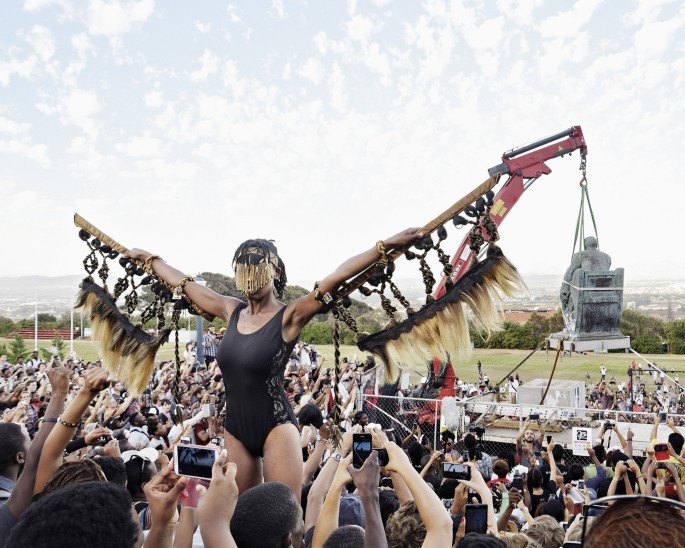
Sethembile Msezane, Chapungu: The Day Rhodes Fell (2015). See “Standing for art and truth: A chat with Sethembile Msezane,” TED Blog; https://blog.ted.com/standing-for-art-and-truth-a-chat-with-sethembile-msezane/
On one level, her appearance might appear to fit seamlessly with the crowd’s enthusiastic sense of sublimity at the toppling of this prominent figure in South Africa’s racist history. Clad as an eagle, she seems to soar triumphantly above the scene of Rhodes being toppled. And yet Msezane clearly wants to strike, as well, a note of sobriety. The bird she is mimicking is the Chapungu, a species that is threatened today in South Africa. And the easy enthusiasm of the crowd snapping photographs is juxtaposed to what Msezane clearly intended to be a long, grueling ordeal for herself. This and other performances she has staged portray a sense of the vulnerability, precarity, and pain of the human body, especially the black female body in the history of that country. The suffering is intended as part of the drama of these performances. As she said of her condition when she stepped off the plinth after hours in 90-degree-F weather: “By the time I came down, I was shaking and experiencing sunstroke. But I also felt a burst of life inside” (Msezane, 2020).Footnote12
A sobering sublime and connolly’s appeal to sorel’s general strike
If my reflections so far have lent the notion of a sobering aspect of sublimity some general plausibility, what exactly is its specific value for Connolly’s take on what is to be done to contest our current political threats? He points us to two general strategies: The “politics of swarming” and the “cross-regional general strike.”Footnote13 The former refers to multiple forms of local knowledge-building, sensibility tuning, and organizing to draw together diverse constituencies who have a stake in combatting present ills. This idea seems plausible and admirable. But how do we imagine such a multifaceted “rhizomatic complex” of activity binding itself into the form of a vehement collective insurgency (Connolly, 2017, pp. 12, 120)? We need some way of animating the motivation of “dispersed participants” so that they coalesce into the “perfect storm” of a general strike. Such motivation “dissolves the sense of being neutralized by the everyday practices of capitalism” and vivifies “the prospect of acting collectively” (Connolly, 2017, pp. 129, 148).
Crucial to generating the needed motivation for such an eruption is the looming image of the general strike presented in Sorel’s Reflections on Violence, published in 1908. As Connolly says, Sorel makes clear “how such a … myth…can sharpen needed energies and divisions” between “us” and “them” and motivate insurgent collective action (Connolly, 2017, p. 130). Sorel looked to this myth to weld the working class into a monolithic “terrifying” weapon of “war” (1961, pp. 274–275).
Connolly thus turns to the general strike for its force as a mythic image of a political upheaval. He lauds Sorel for his “projection of a vision” intended to “mobilize [people] to act” (2017, p. 147). Sorel emphasized that the sense and power of this vision could not be transmitted by reasoned explication (1961, pp. 122–124). It was to move an audience of workers by its visceral, aesthetic-affective appeal to their imagination to enthusiastically take up the violent task of the revolutionary overthrow of capitalism.Footnote14
But immediately after announcing his investment in Sorel’s central idea, Connolly begins a process of significant qualification. This is where the trajectory of his thinking gets problematic. The reason is that we are first incited to cathect with a powerful, visceral image of a volcanic, lethal, explosion whose appeal exceeds reason; but then we are provided with an opposing list of reason-based cautions. We are accordingly told to look to insights from other thinkers like Gandhi on nonviolence, cautioned that such a strike must be “bloodless,” and informed that the unified fist of Sorelian opposition must rather take the form of “pluralist assemblages” moving in “slow motion” (Connolly, 2017, pp. 128–129). In sum, participants in Connolly’s general strike are incited to be furiously enthusiastic in collectively toppling the pillars of the contemporary economic-political order, but then abruptly told to restrain themselves with cautious, rational qualifications.
My point in emphasizing the sharp contrast between the visceral appeal to a mythic versus the subsequent rational chastening of it is not meant to question Connolly’s cautions themselves. In fact, I agree with them. Rather what I want to highlight is the striking divergence between his declaration of a need to move beyond reason alone by looking to the aesthetic-affective power of the mythic, on the one hand, followed by his announcement that we must radically deflate that aesthetic-affective force with reason alone, on the other. Here, ironically, Connolly could be his own best critic, given his assertions about the unpersuasiveness of any thinking that fails to acknowledge the persistent force of aesthetic-affective dynamics in politics. I want to suggest that we embrace an alternative way of proceeding here that might allow a better negotiation of this problem—but do so in a way that nevertheless respects the deepest commitments of Connolly’s thought. This will, however, require an openness on his part to embracing the language of sublimity.
With that goal in mind, let me begin by noting that although Connolly appeals to the power of Sorel’s aesthetic-affective framing, he curiously does not pick up on the latter’s explicit binding of his myth of collective action with the feeling of the sublime. For example, Sorel refers to the “sublime work” of revolutionary action and urges us to see how the myth of the general strike is “capable of inspiring sublimity” (pp. 139, 214–215, 275). I assume that Connolly’s inattention to this usage in Sorel is not intentional, but rather simply an oversight. Perhaps, however, instead of either overlooking Sorel’s sublime or simply adopting it, one could here embrace a bivalent notion of sublimity. This might help avoid enhancing the danger of freely accelerating violence and bloodshed in popular insurgency through the depletion of some dimensions of its motivational power; in short, we would be looking for an influence on our visceral, aesthetic-affective register, rather than solely to prudential dictates.
This criticism of Connolly is not a categorical claim that one cannot bring aesthetic-affective sensibility into a relation with rational-moral cautions. As my discussion of Burke and Kant noted, there has typically been an entanglement of the two in discussions of sublimity. And Connolly similarly promotes combining appeals to our sensibility with “refined processes of reflection” (2017a, pp. xxi-xxii, 84). My objection is rather that in his invocation of a general strike the aesthetic-affective force he appeals to is diametrically opposed to his rational-moral reflections. All of the force on the visceral register is on the side of Sorel’s sublime mythic image. It is no secret that his demotion of reason in this formulation of what I have been calling an exclusively enthusing sublime is something that undemocratic characters, starting with Mussolini, have found attractive.Footnote15
Now Connolly, as noted above, is acutely aware that “there is never a vacuum on the visceral register of affective communication” (2017a, p. 17). But his formulations seem to leave just such a vacuum in the democratic sensorium that he wants so much to help cultivate. If one is to effectively fight fascism’s visceral strength, then one must draw some resources from that same register. Connolly clearly does not want to follow Sorel’s simple, enthusiastic embrace of violence, but his caution in this regard needs to be better supported by insights about the cultivation of an appropriate countervailing sensibility.
As Connolly says repeatedly, fascism is a threat we must “counter on the visceral register” (2017a, p. 19). But what then might provide the positive, aesthetic-affective source of such a counterforce? It is here that turning to the sobering dimension of sublimity can be helpful, especially when it is interpreted in terms of the ontological grounding that Connolly has so compellingly sketched in his earlier work. There the self is imagined as continually and consciously negotiating its finitude by resisting the temptation to transform difference into otherness, a tendency that is generated by our modern, perpetually renewed tendency to repress any abiding acknowledgement of our mortality. A resistant attitude here would reflect and help manifest an attachment to being as becoming, in the sense that our orientation to difference would now acknowledge that condition of the world by expressing a “presumptive generosity” and “agonistic respect” toward the continual becoming of difference (2005, p. 31;1991, p. x).
This ontological scene, and the proto narrative it supports, together provide a positive, existential framing for affirming and cultivating a sobering dimension of sublimity. And that cultivation would help us to feel motivated not just by sublime enthusiasm for collective action in the pursuit of democratic political goals, but also by an abiding resistance to the temptations to self-righteousness and certainty that feed a sense of unlimited, iron willfulness. As Connolly has noted, fascism revels in images of the “armored male” body imagining itself capable of annihilating any obstacle to its will (2017a, pp. 53–58, 84–86). He highlighted this deep association well before the January 6, 2021 insurrection in Washington, when we witnessed so many of Trump’s enthusiastic male co-conspirators proudly clad in full tactical military armor. Contrast that with the vulnerable, but courageous, body as it appears in Msezane’s performances.
Conclusion
The armored male of a fascist mythic has a clarifying, romantic, almost transcendental affinity for violence and bloodshed.Footnote16 How might folding in a sensitivity for the sobering sublime help a democratic political mythic—Connolly’s as well as others—to resist the pull of such a sensibility in the context of engaging in vehement collective action? Being receptive to a sobering sublimity does not bring us to any absolute prohibition on violence and possible bloodshed. They may in fact become necessary in pressing circumstances. But the cultivation of a sensibility animated by a bivalent sublime might help lessen our propensity to imagine violent action as a pure medium for exhilaration, self-cleansing, and an iron transcendence of the complexities of politics. More precisely, it should better dispose us to feel the difference between violence and bloodshed as attractive lures, on the one hand, and as occasionally grim necessities, on the other.
Data availability
Not applicable.
Notes
-
Perhaps the best representative of this dominant contemporary way of conceiving the political sublime is Shapiro, 2018, pp. 2–4, 39, 172. Jacques Rancière characterizes this general approach as aiming “to think politics and aesthetics under the concept of dissensus” (2011, p. 1).
-
When I refer to the fascism problem today in the U.S. and elsewhere, I am speaking of the congealing of several characteristics apparent on the right that constitute an emerging threat: Continual intensification of a sense of “us” vs. “them,” with the latter defined especially in racial and ethnic terms; a growing enthusiasm for violence directed at “them” that is encouraged by leaders; and all this is bathed in the imaginary of a “mythic past,” whose greatness we are promised can be regained. See Stanley (2020, pp. xiii, xxviii-xxxii, 5, 58, 183, 187).
-
My attention to the centripetal character of Connolly’s approach should not be taken as a claim that nothing he says is sympathetic to the centrifugal view. Clearly, he is interested in evoking dissensus in relation to existing political ideas and forms. My point is simply that what is most distinctive in his work is the way it engages the question of how to generate the positive, binding force of collective democratic commitment.
-
As Connolly says, he is presenting an interpretation of “life, identity, and death” (1991, p. 172). The role of finitude in Connolly is elaborated in White (2000, pp. 106–150).
-
The character of such a bivalent conception of the sublime is explained at greater length in White (2025).
-
Burke’s early treatment of the sublime tried to present itself as an empirical analysis of our “natural” aesthetic-affective reactions. But this is not empiricism in our contemporary sense. It presumes the naturalness of the Great Chain of Being. The normative core of his analysis of our “natural” sensorium becomes increasingly evident in his later reactions to the French Revolution (White, 1994, pp. 4–5, 25–27).
-
In a letter attributed to him, Burke explicitly refers to a “false sublime,” see Boulton, 1958, p. cxii. Even if it were to turn out that Burke did not explicitly use the term, it is clear that he continually employed the concept; see White, 1994, pp. 72–75. For Kant’s terminology, see 1991, pp. 182–183; Kant, 2000, pp. 129–30. This English edition translates das eigentliche Erhaben as the “properly sublime” (Kant, 1974, p. 166). I prefer rendering this as “real” or “authentic.” This accords more with the contrasting sense of a “false” sublime in Kant; see Clewis, 2009, pp. 180–181.
-
As I suggested earlier (n. 6), various commentators, from Kant to the editor of a modern edition of A Philosophical Enquiry mistakenly see Burke as providing “a merely empirical exposition” of the sublime, thus missing entirely the philosophical centrality of finitude (Kant, 2000, p. 158; Burke, 1990, p. xi). Jean François Lyotard is one of the few contemporary philosophers who correctly comprehends this centrality (1989, pp. 204–206). A good treatment of how the normativity of Burke’s early work on aesthetics is connected to his later political texts, is O’Neill (2012).
-
For Burke, “death is the king of terrors” that can evoke the sublime; and pain is the “emissary” of death (1990, pp. 33–34, 36).
-
A modified Nietzschean notion of being as becoming is crucial to Connolly’s underlying ontology. One must learn to “respect the diversity of life flowing over and through officially sanctioned identities…Life exceeds identity” (1991, p. 170).
-
In this regard, Benjamin Carp’s Defiance of the Patriots (2010) is exemplary.
-
For a more extended analysis of other, similar performances of Msezane, as well as ones with comparable evocations of bivalent sublimity by Kehinde Wiley, see White (2025); see also Msezane (2017).
-
Although the notion of a general strike is discussed at greatest length in chapter five of Connolly (2017), he continues, more recently, to affirm it in Connolly (2022, p. 141).
-
My concerns about violence in this context do not constitute an argument against the idea of a general strike itself, nor against the idea of affirming a mythic dimension in democratic theory. My focus is merely on the problems that emerge from Connolly’s appeal to Sorel’s specific account of the general strike. Regarding my views on the importance of a mythic dimension in democratic theory, see Scudder and White (2023, pp. 106–170.
-
Mussolini stressed his debt to Sorel, saying he was crucial in helping him to learn how to build “the energy and power of … fascist cohorts,” quoted in Edward Shils’s introduction to Sorel (1961, p. 24).
-
“Steel romanticism” was a term Goebbels particularly liked; quoted in Wackerfuss (2013, p. 298).
References
-
Adams, John. (1773) From John Adams to James Warren, 17 December 1773.” https://founders.archives.gov/documents/Adams/06-02-02-0001.
-
Adams, J. (1964) In L.H. Butterfield (ed.) Diary and autobiography of John Adams. Atheneum, pp. 1771–1781.
-
Boulton, J.T. (1958) Editor’s introduction. In E. Burke (ed.) A philosophical enquiry into the origin of our ideas of the sublime and the beautiful. Routledge and Kegan Paul.
-
Burke, E. (1987) In J.G.A. Pocock (ed.) Reflections on the revolution in France. Hackett.
-
Burke, E. (1990) In A. Phillips (ed.) A philosophical enquiry into the origin of our ideas of the sublime and beautiful. Oxford University Press.
-
Carp, B.L. (2010) Defiance of the patriots: The Boston tea party and the making of America. Yale University Press.
-
Clewis, R. (2009) The Kantian sublime and the revelation of freedom. Cambridge University Press.
-
Connolly, W.E. (1991) Identity\Difference: Democratic negotiation of political paradox. University of Minnesota Press.
-
Connolly, W.E. (2005) Pluralism. Duke University Press.
-
Connolly, W.E. (2013) The fragility of things: Self-Organizing processes, neoliberal fantasies, and democratic activism. Duke University Press.
-
Connolly, W.E. (2017a) Facing the planetary: Entangled humanism and the politics of swarming. Duke University Press.
-
Connolly, W.E. (2017b) Aspirational fascism: The struggle for multifaceted democracy under trumpism. University of Minnesota Press.
-
Connolly, W.E. (2019) Climate machines, fascist drives and truth. Duke University Press.
-
Connolly, W.E. (2022) Resounding events: Adventures of an academic from the working class. Duke University Press.
-
Frank, J. (2021) The democratic sublime: On aesthetics and popular assembly. Oxford University Press.
-
Honig, B. (2013) Antigone, interrupted. Cambridge University Press.
-
Huet, M.-H. (1994) The revolutionary sublime. Eighteenth Century Studies 28(1): 51–64.
-
Jennings, J. (1985) Georges Sorel: The character and development of his thought. Macmillan.
-
Junger, E. (2008) On Pain, trans. In C. David (ed.) Durst with a preface by Russell Berman. Telos.
-
Kant, I. (1974) In W. Weischedel (ed.) Kritik der Urteilskraft. Suhrkamp.
-
Kant, I. (1991) A renewed attempt to answer the question: Is the human race continually improving? In H. Reiss (ed.) Political writings. Cambridge University Press, pp. 177–190.
-
Kant, I. (2000) In P. Guyer (ed.) Critique of the power of judgment trans. Paul Guyer and Eric Matthews. Cambridge University Press.
-
Kant, I. (2011) In P. Frierson and P. Guyer (eds.) Observations on the feeling of the beautiful and sublime and other writings. Cambridge University Press.
-
King, Martin Luther Jr. 1963. https://www.africa.upenn.edu/Articles_Gen/Letter_Birmingham.html
-
Lyotard, J.-F. (1989) The Sublime and the Avant-Garde. In A. Benjamin (ed.) The lyotard reader. Blackwell.
-
Msezane, Sethembile. (2017) https://blog.ted.com/standing-for-art-and-truth-a-chat-with-sethembile-msezane/.
-
Msezane, Sethembile. (2020) https://ideas.ted.com/we-dont-need-statues-we-can-preserve-our-history-in-more-memorable-ways/.
-
O’Neill, D.I. (2012) The sublime, the beautiful, and the political in Burke’s work. In K. Vermeir and M.F. Deckard (eds.) The science of sensibility reading Burke’s philosophical inquiry. Springer, pp. 193–221.
-
Pineda, E. (2021) Seeing like an activist: Civil disobedience and the civil rights movement. Oxford University Press.
-
Rancière, J. (2011) The thinking of Dissensus: Politics and aesthetics. In P. Bowman and R. Stamp (eds.) Readingm Rancière. Continuum, pp. 1–17.
-
Scudder, M.F. and White, S.K. (2023) The two faces of democracy: Decentering agonism and deliberation. Oxford University Press.
-
Shapiro, M.J. (2018) The political sublime. Duke University Press.
-
Sorel, G. (1961) In E. Shils (ed.) Reflections on violence, trans T. E. Hulme and J. Roth. NY: Collier, pp. 5–6.
-
Stanley, J. (ed.) (2020) How fascism works: The politics of Us and them. Random House.
-
Wackerfuss, A. (2013) The myth of the unknown storm trooper: Selling SA stories in the third Reich. Central European History 46: 298–324.
-
White, S.K. (1994) Edmund Burke: Modernity, politics, and aesthetics. Sage.
-
White, S.K. (2000) Sustaining affirmation: The strengths of weak ontology in political theory. Princeton University Press.
-
White, S.K. (2025) The aesthetics of democratic power: sensibility, normativity and the sublime. Constellations.
Acknowledgements
The author would like to thank the participants in a conference at Johns Hopkins University in November 2023, honoring William E. Connolly’s work, for their insights and reactions to an early draft of this paper. Thanks are also due to, Kathy Ferguson, Ross Mittiga, Smita Rahman, and two anonymous reviewers for their insights, and to Sam Chambers for his astute editorial suggestions.
Additional information
Rights and permissions
Open Access This article is licensed under a Creative Commons Attribution 4.0 International License, which permits use, sharing, adaptation, distribution and reproduction in any medium or format, as long as you give appropriate credit to the original author(s) and the source, provide a link to the Creative Commons licence, and indicate if changes were made. The images or other third party material in this article are included in the article’s Creative Commons licence, unless indicated otherwise in a credit line to the material. If material is not included in the article’s Creative Commons licence and your intended use is not permitted by statutory regulation or exceeds the permitted use, you will need to obtain permission directly from the copyright holder. To view a copy of this licence, visit http://creativecommons.org/licenses/by/4.0/.
Reprints and permissions
About this article
Cite this article
White, S.K. Imagining democratic insurgency: enthusiasm, sublimity, and finitude. Contemp Polit Theory (2025). https://doi.org/10.1057/s41296-025-00768-7
- Accepted
- Published
- DOI https://doi.org/10.1057/s41296-025-00768-7
Keywords
- Myth
- Democracy
- Insurgency
- Sublimity
- Finitude
- William E. Connolly
