
 info@apippress.com
 +86 18163351462 (WhatsApp)
 +86 182 8014 0209
Article Content
Abstract
Our study is aimed to evaluate the views/perceptions of pre-service science teachers regarding the nature of science (NOS) through activities in the NOS and its Teaching course, which is a required course in the fourth grade, and to evaluate their opinions on the integration of the characteristics of the NOS into the contents of science subjects. Participants are fourth-year pre-service science teachers in two classes (N = 72). In line with the purpose of the study, a mixed research method was preferred, in which qualitative and quantitative approaches were used together. In the quantitative dimension of the study, a single-group pretest–posttest design was used, whereas a case study was used in the qualitative dimension of the study. As a result of the activities conducted, it was determined that there was a significant development in pre-service teachers’ views on the NOS. When the opinions of the pre-service teachers were evaluated, the following themes were obtained: contributions of the course to them, course content, and suggestions for improving the course. Recommendations were made based on the results and themes obtained.
Explore related subjects
Discover the latest articles and news from researchers in related subjects, suggested using machine learning.
- Educational Research
- Education Science
- Public Understanding of Science
- School Research
- Sociology of Science
- Science Education
1 Introduction
1.1 Background of the Study
Science education plays a critical role in increasing individuals’ scientific literacy levels to enable adaptation to the global context (Patrick & Mantzicopoulos, 2015). It is stated that to meet the requirements of the century, it is very important to educate scientifically literate individuals who are proficient in scientific knowledge, can effectively apply scientific processes, and have a positive approach to science (National Research Council-NRC (1996); NSTA (National Science Teachers Association) (1982)). As a result of a theoretical analysis of the concept of scientific literacy developed in the last 20 years, it can be seen that scientific literacy is defined as a transition from a vision of transmitting education to a vision of transformative education that has a stronger relationship with social participation and liberation (Valladares, 2021). In fact, the scope of scientific literacy includes the aspects of scientific knowledge, the investigative NOS, the science that leads to knowledge, and the interactions of science, technology, and society (Boujaoude, 2002). Scientific literacy and understanding of basic concepts are considered important for inquiry skills and appreciating the NOS.
Recent reviews of the literature on the NOS show that most students and teachers still hold naïve, overly simplistic and inadequate views about the NOS (Abd-El-Khalick & Lederman, 2023; Bugingo et al., 2024; Cofré et al., 2019). Research on the NOS at the international level seems primarily to determine students’ perspectives (Erdaş et al., 2016). In this context, the first step was to create tools to identify attitudes, views, and beliefs toward the NOS (Lederman et al., 2002). It is seen that the studies conducted in recent years continue to determine student views (Gülmez Güngörmez & Akgün, 2020; Karataş Öztürk et al., 2023; Ozan & Uluçınar Sağır, 2020; Stadermann & Goedhart, 2020; Yacoubian, 2021), and at the same time, it is seen that studies have been conducted to examine the studies on the NOS in depth with different analysis methods and to determine the trends in this subject (Adsiz & Yiğit Kutluca, 2023; Bosco Bugingo et al., 2024 et al,; Kurtuluş & Bilen, 2021; Pranckute, 2021; Yanuarti and Suprapto, 2021). On the other hand, it can be seen that science teachers express that they do not have sufficient understanding of the NOS (Abd-El-Khalick & Lederman, 2000). Lederman (2007) stated that the reason for teachers’ inadequate understanding of the NOS is their misconceptions, while Hanuscin et al. (2010) stated that teachers’ pedagogical content knowledge (PCK) on how to teach the NOS is not at a sufficient level. Bugingo et al. (2024) conducted a recent literature review of 172 studies on students and teachers’ views on NOS between 2000 and 2022 and found that these studies have focused on different aspects or dimensions of NOS. Despite efforts to develop concepts related to NOS in many contexts around the world, research has found that the views of many teachers are still not compatible with NOS-related policies (Bugingo et al., 2024). When the scope of the studies conducted on teachers was examined, it was observed that teachers had incomplete knowledge about the characteristics of science (Kesgin & Timur, 2020; Timur & Sayıt, 2020) and incorrect information on some subjects and developed misconceptions (Timur et al., 2020). Lederman (2007) stated that the reason for misconceptions is that teachers’ understanding of the NOS is inadequate. When the literature is reviewed, it is evident that there are also studies aimed at determining the relationship between teachers’ views on the NOS and their teaching practices (Mellado et al., 2007; Zacharia and Barton, 2004).
1.2 Purpose and Significance of the Study
To train well-educated, scientifically literate individuals, the education of pre-service teachers and therefore the determination of their views on the NOS are important in many respects. It is important to understand the views of current pre-service teachers regarding the NOS to create the necessary environments for more effective delivery of courses related to the NOS included in undergraduate programs, to determine the content of in-service training courses, to shape policies for training science teachers, and to provide a foundation for new science education research. Lederman (2007) argued that approaches teaching the NOS should be integrated into science curricula and imparted to teachers. Therefore, it is believed that revealing the views of pre-service teachers, who are the teachers of the future, on the NOS will shed light on recommendations for improvements in future studies.
What makes this study different from other studies is that it is conducted within the NOS and its Teaching course given by the first researcher at the undergraduate level, and the second researcher’s specialization is on the NOS and its Teaching. In this course, pre-service teachers first receive theoretical information on the subject, and then, in the light of the theoretical information they have learned, they are asked to be involved in activities aimed at teaching the NOS to evaluate their views on the NOS and their level of relating it to the content of science subjects. Another important factor is that Taşkın (2021) examined studies on the NOS and stated that although the studies conducted in our country investigated the effect of an activity or course on the change in understanding of the NOS, he did not come across any longitudinal studies that examined this change over a wider time period. Thus, this longitudinal study is important. On the other hand, considering the recommendations of recent studies (Mesci & Schwartz, 2017; Mesci et al., 2023) on the integration of the NOS with science content, this study is believed to provide guidance for future research.
Our study can provide a basic framework for understanding the development of pre-service science teachers’ ability to integrate knowledge about the NOS into science subjects, their perceptions, and the effects of these perceptions on educational processes. We also hope that other natures of science and teaching researchers will consider this as an action plan for situations that they can use in their work. In this context, the study is designed to answer the following questions.
1.3 Research Questions
- 1.What is the extent of change in pre-service science teachers’ views on the NOS as a result of classroom activities?
- 2.What are the views of pre-service science teachers?
- a.On the contributions of classroom activities related to the aspects of the NOS in the context of science subjects.
- b.On the NOS and its Teaching course.
2 Theoretical Framework
This section presents the framework for the objectives related to the NOS that pre-service science teachers will use when implementing classroom activities to evaluate their views on the NOS. The relationship between science subjects, the NOS, and its Teaching is then explained.
2.1 NOS in Turkish National Curriculum and Science Teacher Training Program
Inculcation of an understanding of the NOS is seen as one of the basic factors of scientific literacy (Lederman, 1999). Therefore, the NOS is considered an important educational goal in various educational reforms and in the curriculum of many countries in the global context (Lederman, 2007). Although there are different statements about the aspects of the NOS, the relevant literature mostly takes into account the aspects determined by the NSTA (National Science Teachers Association) (1982). In this context, the aspects of the NOS are as follows: (1) tentativeness of scientific knowledge, (2) no single scientific method, (3) the role of creativity and imagination in science, (4) empirical basis of science, (5) theoretical and inferential dimensions of scientific knowledge, (6) subjectivity in science, (7) social and cultural embeddedness of science, and (8) the relationship between theory and law. Lederman et al. (2002) defined “Aspects of the NOS” as follows: (1) Scientific knowledge is reliable but subject to change. (2) Scientific knowledge includes logical, mathematical, and experimental inferences. (3) Scientific knowledge is subjective. (4) Imagination and creativity play an important role in obtaining scientific knowledge. (5) Observation and inference are different things. (6) Social and cultural factors influence the evolution and implementation of scientific knowledge. (7) Scientific theories and laws are different types of knowledge. It is seen that various activities have been implemented in the literature to instil the aspects of the NOS in individuals (Cavallo, 2008; Choi, 2004; Köseoğlu, 2011; Lederman and Abd-El-Khalick, 1998; National Academy of Sciences (NAS), 1998).
One of the important goals of science education is to enable students to understand the NOS (American Association for the Advancement of Science (AAAS), 1993; National Research Council-NRC, 1996; NSTA (National Science Teachers Association), 1982; Next Generation Science Standards [NGSS] Lead States, 2013). For this reason, it has been stated that the NOS is constantly included in science education reform documents and curricula in the global context (American Association for the Advancement of Science (AAAS), 1993; NGSS Lead States, 2013; National Research Council-NRC, 1996) and that teaching the NOS is of critical importance in educating scientifically literate individuals (Widowati et al., 2017). In the national context, the Science Curriculum in Turkey (Ministry of National Education (MoNE), 2018) includes learning outcomes such as “emphasizing that scientific knowledge is not absolute and can change and develop, and giving general information about theory as a type of scientific knowledge.” In the updated Science Curriculum in Turkey (MoNE, 2024), it is aimed for students to become scientifically literate by understanding scientific concepts, applying them to their daily lives, and developing critical thinking skills. In the undergraduate program for pre-service science teachers (Council of Higher Education (CoHE) (2018)), the “NOS and Its Teaching” is one of the required courses. The course aims to cover the subjects including the NOS and teaching approaches (science, scientific knowledge and its characteristics, scientific literacy and the NOS, the place of the NOS in science curricula, teaching the NOS), classroom activities for teaching the NOS, and the relationship between the NOS and science, technology, society, and the environment. Since the understanding of the NOS has long been among the goals of science education reform documents and curricula in the global context (Voss et al., 2023), when the relevant literature is reviewed, it is seen that there are various approaches that aim to teach the NOS (Gören & Kaya, 2023).
2.2 Approaches to Teaching the NOS
The identification of the fundamental features of teaching the NOS is considered an important success in focusing in depth on the NOS in science education. These features fall into three basic categories: (1) explicit (i.e., purposeful) attention to NOS, (2) promoting students’ mental engagement with and reflection on NOS, and (3) the role of context in NOS instruction (McComas et al., 2020, p. 68). It is stated that Abd-El-Khalick and Akerson (2009) associate the concept of “explicit” inherently with the curriculum, while they associate the concept of “reflection” to instruction (McComas et al., 2020). According to the results of the literature review on classroom practices in effective teaching of the NOS, implicit NOS practices can affect the initial development of NOS, while explicit teaching efforts are required to develop more nuanced and sophisticated NOS ideas and to eliminate misunderstandings (McComas et al., 2020). The “explicit” teaching efforts, as explained by Abd-El-Khalick and Akerson (2004), refer to the deliberate planning and design of understandings about the NOS as cognitive teaching outcomes through abstract scientific concepts and theories (McComas et al., 2020).
In general, it is stated in the literature that three different approaches can be used to teach the NOS: implicit, historical, and explicit/reflective approaches (Khishfe & Abd-El-Khalick, 2002). The implicit approach suggests that the NOS can only be understood by engaging in or participating in scientific activities (Abd-El-Khalick & Lederman, 2000). The content of the historical approach includes integrating the historical process of science into science teaching to develop students’ understanding of the NOS (Lederman, 1999). In the context of the explicit/reflective approach, it is aimed at developing students’ awareness of the aspects of the NOS through deep reflection as a result of their participation in activities (Khishfe & Lederman, 2007). The implicit approach is generally evaluated to have a limited effect on acquiring an understanding of the NOS (Bell et al., 2011). In some studies that used the historical approach, the approach has been evaluated as an effective means of teaching (Fouad et al., 2015). Scientific studies based on an explicit/reflective approach are reported to mostly result in positive effects (Akerson et al., 2000). Some examples emphasize the need to consider students’ individual learning abilities when they are learning specific concepts. For example, it is stated that topics such as “the experimental nature of science and the role of creativity in science” can be more easily understood by students when taught by primary school teachers using clear and reflective approaches (Maeng et al., 2018, p. 2260). It is stated that an explicit and context-based approach, especially one based on inquiry, enables students to actively engage with both scientific content, the nature of science, and inquiry-based teaching methods (Seung et al., 2009). In fact, studies conducted on primary and middle school students have shown that explicit instruction leads to significant improvements in epistemic understanding and more informed views of the Nature of Science (NOS), whereas implicit instruction generally results in little to no change in NOS concepts, and in some cases, even in regression (Eymur, 2019; Hrisa & Psillos, 2022; Khishfe and Abd-El-Khalick, 2002; Murphy et al., 2007). Implicit instruction, which assumes that engagement in scientific inquiry or process skills will naturally enhance understanding of the Nature of Science (NOS), has generally been found to be ineffective. Students and teachers rarely develop contemporary or complex NOS concepts through implicit means alone.
Indeed, the findings of meta-synthesis and review studies have revealed that, within the context of instructional strategies, one of the key components of Nature of Science (NOS) competencies, teachers need to understand that the explicit and reflective instructional approach is more effective in teaching the nature of science compared to implicit teaching methods (Bugingo et al., 2024; Cofré et al., 2019; Nouri et al., 2021; Uyar et al., 2024; Khishfe, 2023). Furthermore, these studies indicate that there is a significant amount of research bringing the explicit-reflective approach to the fore in teaching the nature of science; in addition, they emphasize the necessity of explicitly and systematically addressing various pedagogical approaches, teaching tools, and learning opportunities such as inquiry-based learning, history of science, scientific argumentation, and socio-scientific issues in teacher education (Abd-El-Khalick & Lederman, 2000, 2023; Cofré et al., 2019; Khishfe, 2020; Nouri et al., 2021; Van Griethuijsen et al., 2015). Similarly, investigations and experimental studies conducted on pre-service and practicing teachers have found that explicit approaches are relatively more effective in developing NOS concepts compared to implicit methods that rely on participation in scientific activities without a direct focus on NOS (Abd-El-Khalick and Lederman, 2000; Murphy et al., 2007; Voss et al., 2023).
On the other hand, it is seen that different teaching methods are presented in the literature for teaching the NOS. For example, it is stated that students can learn the NOS by performing science applications or using inquiry-based approaches (NGSS Lead States, 2013). Schwab (1962) proposed the inquiry science approach, one of the methods for teaching biology that exposes students to scientific inquiry processes through reading and analysis. Tsybulsky (2018) concluded that teaching the NOS using scientific methods based on inquiry in high school biology classes is an effective approach to improve the understanding of the NOS. Given that the social and cultural context in which scientists live affects them in various ways, it is stated that in order to properly understand the NOS, it may be necessary to provide explicit education based on the wealth of primary and secondary historical sources (Kampourakis, 2013). It is seen that researchers, especially those interested in teaching the NOS, find the method of reading and analyzing historical narratives quite positive (Kampourakis & McComas, 2010; Kampourakis, 2013). In a study outlining a methodology for research, writing, use, and testing of scientific stories through the use of storytelling in scientific practices, it has been shown that the historical and narrative features of the story can be systematically analyzed (Klassen, 2009). When the literature is reviewed, it is seen that there are effective teaching methods, such as enabling students to explore the NOS by examining current scientific articles (Shibley, 2003) and contemporary cases (Lederman et al., 2014). However, researchers have emphasized that teacher training and professional development efforts can be more effective if they adopt a comprehensive approach that addresses all subcomponents of pedagogical content knowledge, rather than merely focusing on instructional strategies for teaching the NOS (e.g., explicit-reflective instruction), as is commonly done (Demirdöğen et al., 2016).
2.3 Skills and Teacher Preparation in Teaching the NOS
The primary special field competence that science teachers should possess, as determined by the Ministry of National Education (Ministry of National Education (MoNE), 2013), is the ability to foster an understanding of the NOS and the historical development of scientific knowledge. The 2018 science curriculum (Ministry of National Education (MoNE), 2018) emphasizes that the goal of science is “to develop theories by providing logical and systematic explanations for natural phenomena and to discover principles and concepts. By transferring scientific processes to learning environments, it is aimed for students to conduct research to understand the world and to directly participate in the scientific process to comprehend how scientific knowledge develops.” The specific goals of the curriculum include the following: “To help understand how scientists create scientific knowledge, the processes this knowledge goes through, and how it is used in new research.” The teacher’s role here is emphasized as being a guide who shares with students the value and importance of science, as well as the responsibility and excitement of acquiring scientific knowledge, while also directing the research process in the classroom (Ministry of National Education (MoNE), 2018). In this context, the “NOS and its Teaching” course was added as a required course to the 2018 Science Teaching Curriculum by the Higher Education Council of Türkiye to support the development of these skills at the undergraduate level of our teachers, who make valuable contributions to the education of our students. Our study is expected to provide significant contributions to instructors teaching courses by evaluating the effectiveness and efficiency of the information given within this undergraduate course so that course content can be enriched, and shortcomings can be identified.
To teach the NOS effectively, teachers need a variety of skills that encompass both content knowledge and pedagogical strategies. PCK was first defined by Shulman (1986) as the knowledge regularly taught about a specific subject, which should be expressed through the most effective representations, powerful analogies, visuals, examples, explanations, and demonstrations. This means mastering the ways of representing and formulating the subject to make it understandable for others. According to Shulman (1986), the unique aspect of the teaching process is that it requires teachers to “transform” their subject knowledge for instructional purposes (Cochran et al., 1993). A teacher’s ability to transform subject matter knowledge, in other words, the factors contributing to a teacher’s pedagogical content knowledge, has been presented in relation to two components (Cochran et al., 1993). The first component is the teacher’s knowledge of students, including their abilities and learning strategies, ages and developmental levels, attitudes, motivations, and prior knowledge of the concepts to be taught. The second component is teachers’ understanding of the social, political, cultural, and physical environments in which students are expected to learn. Since Shulman’s (1986) first definition, efforts have been made to establish frameworks for the nature, development, and subcomponents of PCK (Cochran et al., 1993; Magnusson et al., 1999), teachers’ PCK in different subjects (De Jong et al., 2005; Friedrichsen et al., 2009), and later a framework for PCK in teaching the NOS (Faikhamta, 2013; Hanuscin, 2013). A framework has been established for PCK competencies related to the NOS, and it consists of the following components: NOS, subject matter knowledge, pedagogical knowledge, science teaching orientation, instructional strategy knowledge, student knowledge, curriculum knowledge, assessment knowledge, and history of science (Faikhamta, 2013; Hanuscin, 2013). As a result of meta-synthesis studies conducted by Nouri et al. (2021), a framework of general competencies that teachers should demonstrate has been presented for science educators who train teachers capable of exhibiting NOS competencies and enhancing the quality and depth of their students’ learning. This framework is organized into two categories: NOS-specific PCK and more general PCK. These skills are essential to navigate the complexities of NOS education and foster deeper understanding among students. It is thought that the effective teaching of NOS depends on teachers’ competences, such as their general NOS knowledge, subject matter knowledge, learners’ NOS knowledge, NOS teaching strategies knowledge, NOS assessment knowledge, general pedagogical content knowledge, motivation, and beliefs regarding NOS teaching (Nouri et al., 2021). Although these skills are crucial for effective NOS teaching, challenges such as overcoming misconceptions and resistance to NOS concepts in students, transferring NOS-specific PCK into classroom practices, and the quality of educational resources continue to persist. Continuous efforts are required to effectively integrate NOS education into science education programs and standards. Addressing these barriers is crucial for developing a comprehensive understanding of the NOS in educational settings (Clough et al., 2020).
Therefore, in our study, considering the findings and gaps in the literature, an open-reflective approach is employed to effectively develop pre-service science teachers’ understanding of the NOS. In this context, it is aimed at ensuring that pre-service teachers have a sufficient understanding of the NOS, to eliminate any misconceptions, and to bring their NOS-specific PCK on how to teach the NOS to a sufficient level. Thus, the present study makes an important contribution to the literature.
3 Methodology
3.1 Design of the Study
In our study, the aim is to identify pre-service science teachers’ views on the NOS, develop their understanding of the NOS through classroom activities, and evaluate and enhance their ability to integrate NOS objectives into science subjects within the context of the “NOS and its Teaching” course taken by fourth-year undergraduate students in the science education program for one term. To this end, the study employed a mixed research design in which quantitative and qualitative approaches were used together. Among the mixed research designs, the convergent parallel mixed methods design was used. In this study, both quantitative and qualitative data were collected and analyzed separately, and then the results were compared to determine whether the findings confirmed each other (Creswell, 2014). A single-group pretest–posttest design was used in the quantitative dimension, and a case study was used in the qualitative dimension.
The single-group pretest–posttest experimental design is an approach that allows us to observe changes over time by evaluating the effect of an intervention applied to a specific group using pretest and posttest (Shadish et al., 2002) and is commonly used (Campbell & Stanley, 1963). The single-group pretest–posttest design is a quasi-experimental research type that has potential threats to internal validity. For example, natural changes over time or external factors may affect the results (Cook & Campbell, 1979), test effects arising from the pretest and changes in instrumentation can all distort the results (Creswell & Creswell, 2018). However, despite these disadvantages, the use of the single-group pretest–posttest design was considered the most suitable method for the current study. The reason for selecting this method as the most appropriate method for the current study can be explained as follows: The study aimed to effectively develop pre-service science teachers’ understanding of the NOS and raise their level of pedagogical knowledge regarding how to teach the NOS to an adequate level. In this context, since the aim was to identify and improve the current situation, including a control group to answer the research questions and make comparisons was not considered logical or necessary.
Internal validity threats were thoughtfully managed in the current study. Conducting the study on a face-to-face education platform and collecting data at the beginning of the fall semester minimized the history threat, as no uncontrollable events were expected. The duration of the study was planned in such a way as to minimize the impact of potential external variables and no large-scale social, economic or educational changes were observed during the time frame in which the study was conducted. The time gap between the pretest and posttest was determined in accordance with the optimal time interval used in similar studies in the literature and to prevent the threat of long-term maturation, the period between measurements was not kept too long (Tabachnick & Fidell, 2013). The duration of the study was limited in a way that would minimize changes resulting from the participants’ individual development. Instead of a long-term intervention, a short and controlled process was carried out to prevent participants from showing changes independent of their age or cognitive development. Due to the nature of the study, the study could be concluded even with high dropout rates, which helped reduce the threat of participant attrition. The test threat was minimized by implementing the pretest and posttest at the beginning and end of the course period, preventing participants from becoming familiar with the questions. The instrument threat was managed by using consistent, valid and reliable tools in both the pretest and posttest. On the other hand, both quantitative and qualitative approaches were adopted, and detailed feedback was collected from the participants (Shadish et al., 2002) to support the study. In order to isolate effects such as personal experiences or other variables within the group, the experimental process was decided to be conducted on a single group, which helped to maintain consistency within the group and enabled better monitoring of the effects of external factors (Kazdin, 2017). In the current study, a single-group experimental design was chosen to analyze and support the development of pre-service teachers’ PCK specific to NOS. This design (Creswell, 2012) aiming to evaluate the effectiveness of a new educational module comes to the fore as a method suitable for the purpose and nature of the study. Indeed, it is pointed out in the literature that the single-group pretest–posttest experimental design is commonly preferred in studies conducted on the nature of science (Demirdöğen et al., 2016; Garcia-Carmona, 2023; Kaya & Aydemir, 2025; Mesci, 2020; Mesci et al., 2023; Mueller & Reiners, 2023; Wahbeh et al., 2014; Zion et al., 2020).
The activities decided to be included in the applications (Table 1) are aimed to be presented within the framework of the “activity plan” prepared by seeking the opinions of two faculty members, experts in the field of NOS and teaching, who teach undergraduate and graduate courses. Experts expressed the opinion that the activity plan should include headings such as the NOS outcomes addressed by the activities implemented by the pre-service teachers, the science subjects that the activity may be related to and the guidelines for the science subjects that the activity may be related to (with particular emphasis on which aspect of science is intended to be developed at each stage). The pre-service teachers were asked to prepare activities within the framework of the “activity plan” and implement them in a way that would ensure the active participation of all the students in the class.
3.2 Study Group
The study was conducted in the 2023–2024 academic year at a state university located in a large city in central Türkiye. The study group is composed of 72 pre-service teachers. Of the participating pre-service teachers, 57 are female and 15 are male. All of the participants are fourth-year students in the Department of Science Teaching. While a total of 58 pre-service teachers participated in the pretest, 70 pre-service teachers participated in the posttest. All the pre-service teachers participated in the intervention plan. To have a larger sample size so that the overall differences could be evaluated better, the data of the 12 pre-service teachers who additionally participated in the posttest were not excluded and were added to the analysis process. The semi-structured interview form used to collect qualitative data was administered to a total of 43 pre-service teachers. This study group was preferred because they were the students of the first researcher in the “NOS and its Teaching” course, so the course content could be efficiently organized and pre-service teachers’ perceptions of the NOS could be investigated carefully. In this way, shortcomings can be identified, and development and improvement opportunities can be found.
3.3 Instructional Sequence of Groups
This study was conducted with the approval of the university ethics committee. In the first week, a presentation was given about the course content and weekly program details; activities, tasks to be given to the students, materials to be used, and necessary information for the active participation of the students in the process were shared. At the same time, certain scientific books and articles on some subjects of science and teaching were suggested, and students were informed about the resources they could refer to throughout the term. In this way, the students were given a detailed introduction to the entire course.
The “NOS and its Teaching” course was taught for 14 weeks. In the first week of the course, the VOSTS questionnaire was administered as the pretest, information about the course content was provided and a list of activities to be implemented within the intervention plan was given (Table 1). Over the next 6 weeks, theoretical knowledge was provided through reading articles given before the intervention plan and discussing them in class, with an emphasis on the NOS objectives. In the following 6 weeks, the pre-service teachers planned and presented NOS activities as part of the intervention plan, evaluated the activities in the context of science topics, engaged in in-class discussions and assessments and emphasized the nature of the scientific objectives to be achieved through the presented activities. In the final week, the process was completed with the administration of the posttest and a semi-structured interview form.
The theoretical topics covered in the next 6 weeks after the first week of the course and reading examples are also included in Table 1.
In the light of the theoretical topics covered in the specified 6 weeks, the pre-service teachers were enabled to understand the concepts related to the NOS and to develop their understanding of the pedagogy of the NOS. After the theoretical lessons, the applications for teaching the NOS were started. In the following 6 weeks, the pre-service teachers performed activities related to the NOS and its teaching, as outlined in the intervention plan. The activities (Table 2) identified through the literature review to emphasize/teach the NOS objectives were conducted in groups with the participation of all the pre-service teachers in the class. In this context, the pre-service teachers were divided into groups of 3–4 people, and the process was planned so that two groups would carry out the activities each week. Since the participants were the students from two classes and two groups were formed from each class each week, and a total of four groups completed their activities each week. The pre-service teachers who conducted the activities informed their classmates in advance about the provision of the necessary materials so that they attend classes prepared, and the participation of other students in the class was encouraged. The activity implementation time for each group was approximately one class hour (45 min). The pre-service teachers were asked to write the NOS objectives in the activity plan reports they prepared and to indicate within which science subjects the NOS objectives could be addressed in the activity they implemented.
During the implementation of the activities, the pre-service teachers were asked questions to start discussions to help them relate their experiences as students in nature science teaching classes to new pedagogical knowledge about teaching the NOS. Each group applied various methods and techniques in their activities such as discussion (debate), structured reflection, six thinking hats, cooperative learning and station. For example, the tangram activity aimed to convey the fact that scientific knowledge has a dynamic structure and that this structure can change with new data. In addition, with this activity, it was also aimed to help students understand the fact that scientists can make different inferences and interpretations using the same data, and that past experiences, religious beliefs, experiences, imagination, creativity, prejudices and cultures can have an impact on these interpretations. In line with these aims, while carrying out this activity, the class was divided into groups and each group was given the same number of colored pieces. After the groups completed their shapes, each group was given a new piece, the same piece, and they were asked to evaluate the shape they made and re-make it if necessary. Each group was asked to evaluate what the product they created (Fig. 1) was, how they gave it this shape, what the final piece represented, and a spokesperson was chosen from each group to share all this information with the class and discuss it together. The group coordinating the activity ended the activity by providing information about the aspects that needed to be taught regarding the NOS. At the end of each lesson, with the active participation of the whole class and the implementation of the activity, the objectives regarding the NOS addressed in the activity and the science subjects integrated into the activity were evaluated. In this way, after observing each activity implementation, the pre-service teachers participated in reflective discussions with their peers and the instructor of the course, and thus, they gained experience for the implementation of the activities. Finally, the intervention process was concluded by making a general evaluation of all the processes with the participation of all the students in the class and the course instructor. A questionnaire was administered before and after each activity. Finally, interviews were conducted with pre-service teachers, and the entire process was evaluated.
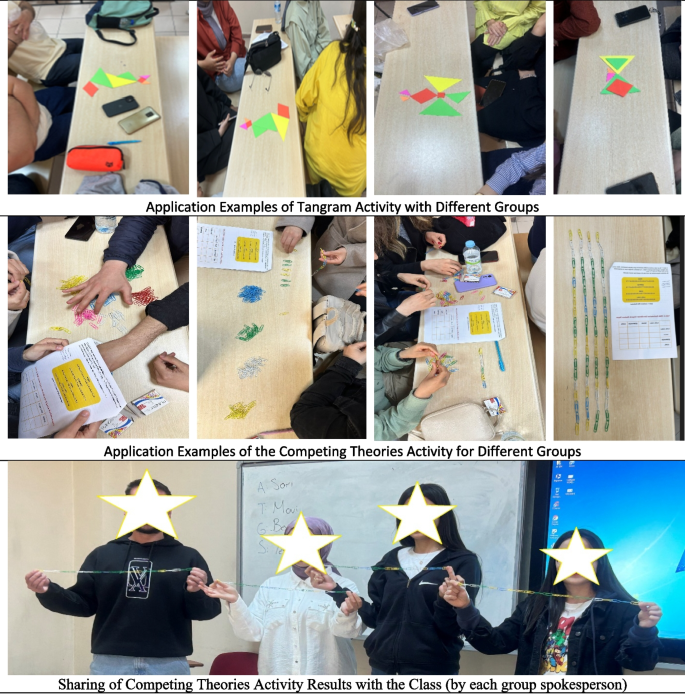
Examples of classroom applications of some activities prepared by pre-service teachers
The activities carried out in the implementation phase of the study, which lasted for 7 weeks, and the NOS objectives they contained are listed in Table 2.
Examples of classroom applications of some activities prepared by pre-service teachers are presented in Fig. 1.
3.4 Data Collection Tools
Data were collected using the Views on Science-Technology-Society Questionnaire and a semi-structured interview form. Detailed information about the data collection tools is provided below.
3.4.1 Views on Science-Technology-Society Questionnaire (VOSTS)
The questionnaire was developed by Aslan (2009), using the “Views on Science-Technology-Society Questionnaire” developed by Aikenhead et al. (1989). Aslan (2009) followed these steps while translating the VOSTS questionnaire into Turkish: 18 items were selected for the questionnaire and translated into Turkish. To justify the equivalence of the source and target languages and to prove their adequacy, the “back-translation technique” recommended by Brislin et al. (1973) was used in the translation process (as cited in Maneesriwongul & Dixon, 2004). The translation process was carried out with the collaboration of two science education experts, three foreign language experts, and two Turkish language experts. Permission to use the VOSTS items was obtained via email from one of the original developers of the questionnaire, Glen S. Aikenhead. In addition, his views and suggestions regarding the research process were also taken into account. Based on the validity and reliability results obtained from the pilot study by Aslan (2009), it was decided to use the questionnaire. The items in the questionnaire aim to evaluate aspects related to the NOS, such as the tentativeness of scientific knowledge, imagination and creativity, observation and inference, scientific models and the socio-cultural structure of science.
3.4.2 Semi-Structured Interview Form
In the qualitative dimension of the study, the opinions of pre-service teachers were elicited through a semi-structured interview form and then evaluated. The semi-structured interview questions asked the pre-service teachers were prepared by the researchers. The final form was given to students after receiving feedback from instructors specialized in their fields. In this way, the following interview questions were developed:
- − How does the NOS and its Teaching course contribute to the teaching of science subjects?
- − How do you explain the contribution of the NOS and its teaching course to daily life?
- − What are your contributions to the NOS and its teaching course?
- − In your opinion, what are the most important elements in the NOS and its teaching?
- − Which activity or NOS learning objectives did you like the most and which was the most challenging? Explain why.
- − What are your opinions and suggestions for improving the course?
3.5 Data Analysis
3.5.1 Analysis of Quantitative Data
The answers given by the pre-service science teachers to the items in the (VOSTS) questionnaire were classified, and percentages and frequencies were calculated for each item. In the VOSTS questionnaire, each item consists of options A, B, C, D, E, F, G, H, and I, and there are no correct or incorrect answers. In order to determine what the responses given by the pre-service teachers to the items of the scale meant, the options for each item were classified. In this classification, the pre-service teachers’ views were classified as realistic, plausible, and naïve, as previously done by Rubba et al. (1996) and Vazquez-Alonso and Manassero-Mas (1999). Here, assistance was received from a group of experts in the classification process of the options for each item. As a result of expert opinions, the key explaining which of the A to I views in the VOSTS test represents naïve, plausible, or realistic views is provided in Table 3. A sample question and classification criteria from the VOSTS questionnaire are presented in Table 4.
According to the classification made by the group of experts, the “realistic” view represents the most appropriate, contemporary view on the NOS; the “plausible” view represents unrealistic but reasonable views; and the “naive” view represents unrealistic or unreasonable views. The options “I don’t understand” and “I don’t know enough about this subject to make a choice” are the last two options for each item and were classified as naive views. The option “None of these options fit the basic viewpoint” was not included in any category (Vazquez-Alonso and Manassero-Mas, 1999). As a result, the total frequency values of the pretest and posttest of the pre-service teachers were analyzed using chi-square statistics and interpreted at a significance level of 0.05.
3.5.2 Analysis of the Qualitative Data
In the qualitative dimension of the study, data collected using the semi-structured interview form were performed. In qualitative data analysis, content analysis was used. The basic process of content analysis is to bring similar data together within the framework of certain concepts and themes and to interpret them by organizing them in a way that readers can understand (Yıldırım & Şimşek, 2011, p. 227). In the data coding stage, coding was performed according to the concepts derived from the data, as suggested by Strauss and Corbin (1990). After the coding stage, the analysis process is completed by identifying the themes, organizing the codes and themes, and defining and interpreting the findings (Yıldırım & Şimşek, 2011). Codes and themes were independently coded by the researchers on twenty randomly selected forms of pre-service teachers, and inter-rater reliability was assessed by calculating the percentage of agreement. In this initial coding process, an agreement of approximately 90% was achieved. However, there were disagreements among the coders in determining some of the themes. In the relevant literature, there are strategies for resolving such disagreements, including “open discussion and consensus” (Chinh et al., 2019; Schaekermann et al., 2019), “structured decision-making” (Schaekermann et al., 2019), “metric-based approaches” (Chinh et al., 2019; Schaekermann et al., 2019; Zade et al., 2018), and “compromise and concession” (Schaekermann et al., 2019). In the current study, disagreements between the coders regarding the assignment of each code to the appropriate theme or category were resolved through constructive discussions under the “open discussion and consensus” strategy. For example, one coder suggested dividing the themes into “contributions to pre-service teachers,” “contributions to the teaching of science subjects” and “contributions to daily life” while the other coder proposed two themes: “contributions to the teaching of science subjects” and “contributions to daily life”. To resolve such differences in opinion, a third expert was consulted, and a consensus was reached. Following the consensus, the coding of the forms continued independently, and as a result of coding a total of 48 forms, an inter-coder agreement rate of 96% was achieved. Subsequently, the remaining forms were coded by the first researcher based on the agreed-upon core principles. Finally, all findings were re-evaluated collectively. In order to calculate the percent agreement, randomly selected semi-structured interview forms were coded, and the agreement percentage between coders was calculated (Percent agreement = agreement/(agreement + disagreement) × 100) (Miles & Huberman, 1994).
The summary information regarding the themes, categories and codes reached during the analysis of the semi-structured interview forms is presented below in Table 5.
4 Findings
In this section, the findings are organized and presented according to the research questions. Statistical findings are explained using tables, graphs, and figures.
4.1 Evaluation of Changes in Pre-service Teachers’ Views of the NOS
When the responses of each pre-service teacher to the 18 items were categorized according to Aslan (2009), changes in their views were observed. In this connection, their views on the NOS at the beginning of the term (pretest) and at the end of the term after taking the NOS and its Teaching course (posttest) are given in Table 6.
When the results of the chi-square test statistical analysis presented in Table 6 were examined, a statistically significant change was identified in a total of five items regarding pre-service teachers’ views on the NOS after taking the NOS and Its Teaching course. These significant changes were observed in the items containing the concepts of scientific observations (I5; p < 0.05), hypothesis, data, law (I9; p < 0.05), scientific assumptions (I10; p < 0.05), scientific method (I12; p < 0.05) and interdisciplinary concepts paradigm (I18; p < 0.05). Statistically significant changes were observed in these items; however, while there was no category change in the pre-service teachers’ views on items 5, 9 and 12, a category change was detected in items 10 and 18. When the items that showed both a statistically significant change and a category shift were examined, it was found that in item 10, there was a shift from a Naïve (43.63%) perspective to a Plausible (53.9%) perspective, while in item 18, there was a shift from a Plausible (38.18%) perspective to a Realistic (40.90%) perspective.
In the other items in the VOSTS questionnaire, apart from these five items, there was no statistically significant change (p > 0.05). The analysis results also revealed items where, although no statistically significant change was found, a category shift was observed in the pre-service teachers’ views. For example, regarding scientific models (I6; p > 0.05), it was found that before taking the course, the pre-service teachers had a naïve view (51.78%), but after taking the course, they adopted a more realistic view (62.1%). In addition to that, for the following items, no change in the perspectives between the pretest and posttest was observed, but the views became clearer: the definition of science (I1; p > 0.05; Realistic: pretest 52.5%, posttest 66.1%), the impact of society on science (I2; p > 0.05; Plausible: pretest 58.6%, posttest 68.5%), the impact of science on society (I3; p > 0.05; Plausible: pretest 85.9%, posttest 88.5%), the characteristics of scientists (I4; p > 0.05; Realistic: pretest 76.6%, posttest 84.0%), the variability of scientific knowledge (I8; p > 0.05; Realistic: pretest 91.5%, posttest 92.7%), scientific theories (I11; p > 0.05; Realistic: pretest 66.6%, posttest 68.2%), and the scientific method (I13; p > 0.05; Realistic: pretest 76.7%, posttest 87.5%).
4.2 Pre-service Science Teachers’ Views on the Contributions of Activities Related to the NOS
As a result of the pre-service teachers’ views on the contributions of classroom activities conducted for a term (14 weeks) related to the aspects of the NOS in the context of science subjects, it was found that they expressed the contributions primarily under three main themes: “contributions to the NOS and teaching,” “contributions to science and scientific knowledge,” and “contributions to science-technology-society-culture awareness”. These themes were found to be focused on two categories: “contributions to the teaching of science subjects” and “contributions to daily life”. The codes and statistical information determined for the categories reached within the context of the themes are presented in Table 7.
It can be seen that the pre-service teachers mostly expressed the contributions of the NOS and teaching process to them by relating them to daily life. It was found that the contribution to daily life was most frequently expressed as the development of the ability to view situations from different perspectives. Both the contributions to the teaching of science subjects and to daily life were defined as meaningful learning and learning by doing and experiencing. Sample statements describing the views of pre-service teachers are given below:
It fostered the ability to more easily understand how events in daily life relate to science.
It allowed me to learn meaningfully, question, and explore different perspectives; my critical perspective has developed further.
The biggest contribution of this course to me is to think from different perspectives and improve myself in this regard. I think this will contribute to everything in daily life.
Doing different activities and work has improved us in terms of creativity.
Since there are many misconceptions about the NOS in daily life, what we learned in class has helped us to address these misconceptions.
The activities we did in the NOS, and its Teaching course helped us develop a different, more creative and enjoyable perspective on science subjects.
The NOS course has enabled us to analyse the observations made in daily life and fostered an objective approach to scientific and technological developments.
The structure and concepts of science were very useful when getting to the core of science subjects. The activities we conducted made a significant contribution to relating science subjects to science and learning how to do this.
When the findings regarding the contributions to science and scientific knowledge are examined, it is seen that pre-service teachers mostly expressed views on contributions to the teaching of science subjects. Although the contributions to the teaching of science subjects were defined from various perspectives, it was found that pre-service teachers mostly referred to the contributions to understanding the facts on which science is based. In statements regarding contributions to both the teaching of science subjects and to daily life, pre-service teachers emphasized that they learned that scientific knowledge is provisional in nature. Sample statements describing the views of pre-service teachers are given below:
I learned under what subjects’ scientific knowledge has survived to the present day and the facts and characteristics on which scientific knowledge is based.
I would like to emphasize that the teacher must have the mastery of basic concepts, that scientific knowledge is not absolutely true, that it can change, and that this must be learned by doing and experiencing in daily life.
I think that associating the activities with science lessons has contributed a lot to me in this profession because it is a lesson that both emphasizes the importance of science and associates it with experiments.
It made many contributions, such as understanding what influences scientists and that science consists of information that can change.
By understanding the characteristics of science more accurately, I realized that many situations in daily life fit the philosophy of the NOS.
I started to look at daily life from a scientific perspective. I started to look at how I can solve a problem scientifically.
I learned where science and its concepts come from and the basis and differences in the concepts of theory–law–hypothesis that we always encounter.
When the findings regarding the contributions to science-technology-society-culture awareness were examined, it was found that they mostly focused on the teaching of science subjects. Although there is a greater variety in the contributions to daily life, when the overall distribution is examined, it is seen that the contributions to teaching science subjects are emphasized more. They also expressed views that they could better understand science subjects or daily events through the historical processes behind them and that they learned how interdisciplinary interaction occurs. Sample statements describing the views of pre-service teachers are given below:
I understood the subjectivity in science, that science can change from society to society, from culture to culture.
If the development of scientific knowledge in the historical process is mentioned while teaching science subjects, the processes that the current knowledge has gone through until today, and the culture of the society that produces scientific knowledge are mentioned, the history, philosophy and NOS can be conveyed indirectly.
t helped me realize the unique beauty in nature and increase my awareness.
Science has social and cultural characteristics; we are talking about the relationship between science and social life.
It broadened my perspective on nature and the universe.
4.3 Pre-service Science Teachers’ Views on the NOS and Its Teaching Courses
As a result of the analysis of semi-structured interviews conducted with pre-service science teachers regarding their views on the NOS and its Teaching course, 3 main themes were identified. The findings for each specified theme are presented with the help of tables and figures containing descriptive statistical data, along with examples from pre-service teachers’ statements.
4.3.1 Important Elements of Teaching the NOS
In this theme, three categories were identified in line with the views of pre-service teachers on the most important elements for teaching the NOS. These categories (the elements necessary for teaching the NOS) are as follows: (1) from the perspective of the teacher, (2) from the classroom environment, and (3) from the perspective of the student. Codes related to categories are presented in Table 8.
As seen in Table 8, the highest number of pre-service teachers stated that being able to think from different perspectives and teaching the characteristics of science and scientific knowledge are important elements in the NOS when viewed from the teacher’s perspective, while from the student’s perspective, the most important element seems to be putting theoretical knowledge into practice. Sample statements regarding the views of pre-service teachers on this theme are as follows:
I think the most important thing is to be able to look from different perspectives, have a critical perspective, and be creative.
The teacher must have the mastery of terms and basic concepts.
In my opinion, the important elements are understanding the NOS and how to use it in teaching.
I think that elements such as science do not contain absolute truths and that scientists’ views may differ from each other are important.
Knowing different methods that can be used in the teaching of the subject and knowing which one to use and when.
Being able to fully explain what science is and the characteristics of scientific knowledge.
Knowing what scientific knowledge and its characteristics are, and its objectives must be well understood so that the NOS course can be taught.
Approaching scientific knowledge impartially and not accepting it as absolute truth.
Analysing the data collected during the observation stage and reporting the results.
It is important to integrate theoretical knowledge about science into other subjects. We learned how to do this in this course.
Teaching pre-service science teachers, the distinctions between the concepts of hypothesis, law and theory is an important element.
Teaching students the basic features of the NOS through concretization.
4.3.2 Evaluation of the Activities Implemented in the NOS and its Teaching Course
In this theme, it was determined that the categories derived from pre-service teachers’ evaluations of activities implemented in the NOS and its Teaching course were activities they liked the most and those they had the most difficulty with. The codes obtained for the categories were presented in Table 9.
According to Table 9, the activity that the pre-service teachers liked the most was new society, while the activity that they had the most difficulty with was competing theories. They stated that the reasons why they liked the activities were generally that they were entertaining, thought-provoking, and conducive to the development of different perspectives, allowing them to present their subjective ideas and supporting their imagination and creativity. On the other hand, it was determined that the main reason why they found some activities difficult is their not being able to understand them. Some sample explanations are given below:
The most difficult activity for me was determining the competing theories. My favorite periodic table was because I had difficulty understanding the competing theories. The periodic table was a fun activity for science students.
I really liked the new society activity. It was the most thought-provoking activity for me and the one where I could better understand the paths I took while conducting research.
The activities I liked the most were the Tangram and Competing Theories activities. They were the best activities to explain that science comprises changeable knowledge and that scientists are influenced by different ideas. I really enjoyed them. The activity I found the most challenging was the New Society activity. It was a difficult and complex activity, and I had to put in a lot of effort to make sense of it.
I liked the new society activity. It was good in terms of thinking and reasoning.
All the activities were good, but I had the most fun with the Periodic Table activity. This is because we challenged our brains by trying to solve problems and also engaged in a friendly competition with other groups.
4.3.3 Opinions and Suggestions for Improving the NOS and its Teaching Course
The pre-service teachers made some suggestions about activities and the course itself to make the NOS and its Teaching course more efficient. The codes derived from the opinions and suggestions are listed in Table 10.
The majority of pre-service teachers stated that the course was very efficient and pleasant. Some pre-service teachers stated that the theoretical part of the course should be shorter. It was determined that the suggestions for the activities were mostly about increasing the time allocated, followed by suggestions that interaction in the classroom should be increased, and different activities could be implemented. Some sample statements about the opinions and suggestions expressed are as follows:
“The lessons were very good and fun. I can’t think of anything that could have made the lesson more productive; lessons generally went the way I liked.
I think lessons were fun and productive because we actively participated in them.
The lesson was very enjoyable.
The activities and presentations in the class were very productive. Many thanks to our teacher.
The theoretical part can be kept shorter, and the number of activity weeks can be increased.
More concrete examples can be given while teaching concepts. Changes can be made to activities.
It could be better if more content focused on the history and philosophy of science was included.
I think that the comments made in class should be reduced a little, and the activities should be increased.
Participation in activities can be on a voluntary basis.
5 Discussion, Conclusion, and Recommendations
Our study, designed to focus on the NOS teaching based on classroom activities, is significant in terms of evaluating pre-service science teachers’ views on the NOS and its teaching process in a term-long course which included both theoretical information and practical activities related to the NOS and its teaching. An important distinguishing feature of this study is that it is activity-based. While planning and implementing these activities, pre-service teachers were supported in understanding the NOS by considering examples from the Ministry of National Education (MoNE) (2018) curriculum related to the NOS and science objectives. They were encouraged to think, plan, and experience how and why to teach the NOS by taking into account students’ interests, needs, and motivations, and by establishing connections between science content and the NOS. An important distinguishing feature of this study is that it is activity-based and while planning and implementing these activities, it supports pre-service teachers to think, plan and experience how and why they will teach the NOS by taking into account the objectives related to the NOS in the Ministry of National Education (MoNE) (2018) curriculum, the interests, needs and motivations of the students and establishing connections between science content and the NOS.
According to the results obtained, it was concluded that, in general, the activities implemented during the course throughout a term can change individuals’ views on the NOS and that they were able to experience a more meaningful and active learning process. Most importantly, the activities allowed pre-service teachers to be engaged in experiential learning (Kolb, 1984), which is a crucial source of learning and development, by helping them understand how the activities can be used to develop an accurate understanding of the NOS and what considerations should be taken into account while using them. In the first weeks of the course, through theoretical knowledge, activities contextualized with science subjects, various reading assignments, and in-class discussions, pre-service teachers were able to establish meaningful connections between their existing knowledge and new concepts, leading them to internalize an understanding of how scientific knowledge is constructed.
5.1 The Levels of Change in Pre-service Science Teachers’ Views on the NOS as a Result of Classroom Activities
Based on the initial findings of our study, it was determined that the activities carried out by pre-service teachers during the course to assess their views on the NOS significantly affected their views. It was determined that there was a statistically significant difference in the opinions of pre-service teachers, especially on the concepts of scientific observations, hypothesis-data-law, scientific assumptions, scientific methods, and paradigm of interdisciplinary concepts. From the results obtained, it can be concluded that there occurred a significant development in pre-service teachers’ views on these concepts related to the NOS.
On the other hand, it was found that there was a category change in pre-service teachers’ views on the items related to scientific models. When the changes in pre-service teachers’ views were examined, it was found that before the activities, pre-service teachers held naive views about scientific models, whereas after the activities conducted, they had more realistic views. While pre-service teachers initially thought of scientific models as replicas of reality, after the activities, they reached a consensus that scientific models are not replicas of reality, but rather serve as tools to help learn and explain things simply within their own limitations.
More than half of the pre-service teachers agreed on the realistic view that observations made by scientists are influenced by their beliefs and values, and therefore, scientists will think in different ways, which will lead to differences in their observations. Regarding the structure of hypotheses, theories, and laws, the vast majority of the pre-service teachers shared the realistic view that theories and laws are different types of scientific knowledge and that they cannot be transformed into one another. As a result of the findings obtained from the views of pre-service teachers, it is seen that pre-service teachers have the mastery of the related objectives included in the science curriculum (Ministry of National Education (MoNE), 2018). Therefore, it can be said that teachers having already acquired these objectives will make significant contributions to the process of educating future generations. The following can be given as examples of these objectives at the middle school level;
Discusses the views on the structure of the cell from past to present by relating them to technological developments. Emphasizes that scientific knowledge is not definitive and can change and develop.
Questions how ideas about the concept of atom have changed from past to present. a. Details about atomic theories are not given. b. It is emphasized that scientific knowledge can change over time. c. General information about theory, which is one of the types of scientific knowledge, is given.
Regarding the changeability of scientific knowledge, pre-service teachers initially equally embraced the view that new scientists disprove the theories or discoveries of old scientists (I8, option A) and the view that old knowledge will be reinterpreted in light of new discoveries (I8, option B). However, after the activities, it was determined that pre-service teachers agreed on the view that “old knowledge will be reinterpreted in light of new discoveries” (I8, option B). In contrast, regarding the uncertainty of scientific predictions, pre-service teachers who held the view that no one can predict the future with certainty, as well as those who believed that as new discoveries are made, correct information will change and thus predictions will change, maintained their positions after the activities. It was observed that they did not agree on any specific option and remained in a plausible view. Similarly, while a group of pre-service teachers believed that scientific laws already existed in nature and that scientists simply discovered them, another group of pre-service teachers thought that scientists invented scientific laws and interpreted the experimental facts they discovered. It was found that these views remained the same after the activities, and as a result, they held a naive view. In other studies, it has been found that pre-service teachers believe that science is a method used to discover the truth of nature (Wang et al., 2023), and this perspective is evaluated in the naive view category (Bell et al., 2011; Lederman et al., 2002; Mesci, 2020). Ultimately, it is observed that these results are parallel to the findings of our study.
Regarding scientific assumptions, it was observed that pre-service teachers transitioned from naive views to plausible views. In this context, while they initially thought that hypotheses form theories and theories form laws, they later reached a consensus that theories cannot become laws, and that both are different types of ideas. They also concluded that the truth of theories cannot be proven, while laws are based solely on facts. Erduran and Dagher (2014) classified scientific knowledge into three different types: theory, law, and models. They stated that these three types of knowledge work together holistically and play an important role in the development of the understanding of scientific knowledge.
Regarding the consistency and paradigm of interdisciplinary concepts, pre-service teachers initially believed that scientific thoughts containing plausible views are dependent on the perspectives or habits of scientists. However, after the activities, it was found that they agreed on the realistic view that scientists must make an effort to understand different perspectives that align with their own. Regarding the certainty, accuracy, and uncertainty of scientific knowledge, it was found that pre-service teachers maintained a plausible view, believing that predictions are not certain, and as new discoveries are made, correct information will change, and thus predictions will also change. Similarly, pre-service teachers who initially advocated for the certainty of scientific data were later found to express statements suggesting that scientific knowledge is not certain during subsequent interviews (Mesci, 2020). On the other hand, the number of pre-service teachers who share the views that reflect a realistic view that no one can make a definite prediction is high (38.8%). Akerson et al. (2000) suggested that different understandings of objectives may arise from differences in participants’ pre-instruction views on the NOS and the interaction between those views and the teaching of the NOS. Mesci and Schwartz (2017) argued that, in addition to instructional factors, motivational and sociocultural factors could also influence teachers’ views on the NOS. Zion et al. (2020) stated that perceptions of their own personal inquiry experiences may also play a significant role.
When the findings were evaluated, it was seen that the views of pre-service teachers on some items were more clearly consistent in the same categories after the application of activities. For example, they were mostly found to have a plausible view about the influence of society on science and that education has a certain influence, but so can the person (e.g., intelligence, talent and a natural interest in science). Scientific knowledge is in a constant state of change and evolution; it has an experimental nature. However, this does not mean that scientific progress is only possible through experiments. Science progresses not only by obtaining data from observations but also by making inferences from these observations. At the same time, scientific knowledge is built on a theoretical framework and is shaped by imagination and creativity. The NOS is also influenced by social and cultural values. In fact, Demirel et al. (2023) commented that most teachers focus on the social purposes of science. In this context, it is believed that the “new society” activity, conducted with the aim of understanding and instilling these aspects of scientific knowledge, contributed to changes in the views of pre-service teachers on this subject. Indeed, one of the findings is that the “new society” activity is the one most appreciated by pre-service teachers. Similarly, regarding the socio-cultural impact on science, it was found that while pre-service teachers mostly held a naïve view at the beginning of the study, believing that science is universal and unaffected by the socio-cultural conditions of the societies in which scientific knowledge is produced, at the end of the study, all the pre-service teachers were able to explain the socio-cultural impact on scientific studies using appropriate supporting examples (Mesci, 2020; Mesci et al., 2023). Indeed, Ayvacı and Çelebi (2024) found that when the type of activity changes, different levels of learning outcomes are achieved, and ultimately, participants’ views on the tentative NOS change depending on the context, type and form of the activity.
Another notable finding is that while pre-service teachers initially expressed some uncertainty about certain items related to the NOS before the activities, they reached a consensus after implementing these activities (Items 6 and 8). However, for other items (Items 14 and 15), pre-service teachers’ views continued to struggle to reach a consensus even after engaging in open-reflective activities and implementing the activities. Indeed, some studies have found that even when the NOS is taught using an open-reflective approach, expected progress in understanding concepts such as certainty, theory/law, subjectivity, and sociocultural embeddedness is not always achieved (Abd-El-Khalick & Akerson, 2004; Mesci & Schwartz, 2017). It was also determined that pre-service teachers expressed similar thoughts in the interview form. Interestingly, even though pre-service teachers have significantly improved their views on the NOS, as highlighted in previous studies (Cofré et al., 2019; Lederman & Lederman, 2014), the ongoing struggle in their views regarding the certainty and uncertainty of scientific knowledge and scientific laws suggests that they still face challenges in transferring their knowledge into teaching practice.
5.2 Pre-service Science Teachers’ Views on the Contributions of Classroom Activities Related to Aspects of the NOS in the Context of Science Subjects
Classroom activities were designed to highlight various aspects of the NOS and its teaching with the aim of integrating these aspects with science subjects. In this context, some of the selected activities were conducted directly on science subjects, while in others, pre-service teachers were expected to identify science subjects that would reflect the NOS objectives included in the activity content. For instance, in the “Competing Theories” activity, subjects such as DNA, genes, genetic codes and the periodic table were directly addressed through science-based activities. In contrast, the “New Society” activity aimed to help participants gain insights into the tentative NOS knowledge, factors contributing to change and the mutual influence between scientists’ social and ethical principles on society and society’s attitudes and values on science. It is seen that the contributions made to the NOS-specific PCK of pre-service teachers are gathered under the headings of contributions made in the context of teaching, daily life and science subjects.
It was seen that pre-service teachers mostly stated that the NOS and its teaching contributed to their ability to think from different perspectives and engage in critical/analytical thinking (f = 37). Then, it was observed that the contribution to meaningful learning (f = 30) is quite effective in all the three subcategories. Pre-service teachers stated that both in the teaching of science subjects and in situations that contributed to their development, they benefited from skills such as the development of scientific reasoning abilities, the capacity for inquiry-based, deep, and creative thinking, and learning based on observation. The skills mentioned by the pre-service teachers are seen to be expressed as life skills under the heading of field-specific skills in Ministry of National Education (MoNE) (2018). The relevant statement in MoNE (2018) is as follows:
b. Life skills: This area includes fundamental life skills such as analytical thinking, decision-making, creativity, entrepreneurship, communication and teamwork related to accessing and using scientific knowledge.
Through our study, it can be said that pre-service teachers were also supported in developing these skills, and as a result, they gained experience in imparting these skills to their students. Another finding of the study is that pre-service teachers tended to use activities that are more concrete and contextualized, with connections to daily life and science subjects, in the teaching of the theoretical foundations of the NOS. It can be said that it is important for pre-service teachers to accomplish the NOS objectives included in the MoNE Science Education Curriculum Ministry of National Education (MoNE) (2018) during their undergraduate education, and that this study facilitated the accomplishment of these objectives. On the other hand, it was observed that pre-service teachers presented their views on the elements necessary for teaching the NOS from the perspectives of the teacher, classroom environment, and student. Matthews (2012) states that the teaching of the NOS and the concept of scientific inquiry is shaped by individuals, the teacher, and the conditions of the course (classroom environment and design, student status, etc.), and is also a process related to epistemological beliefs. In this context, it can be said that the elements identified by pre-service teachers as necessary for teaching the NOS are parallel to the elements discussed by Matthews (2012).
When the contributions made regarding science and scientific knowledge were examined, it was found that pre-service teachers expressed their views on how they were able to understand the difference between theory and law, as well as the facts on which science is based, which contributed both to themselves and to their daily lives. According to Cofré et al. (2019), understanding certain concepts of the NOS, such as theory/law, is considered difficult. Therefore, it can be said that the development of pre-service teachers regarding these concepts is important. Similarly, the common contribution provided in all three subcategories was identified as the understanding that scientific knowledge is changeable and does not contain absolute truths. Another remarkable finding is that science and scientific knowledge are often seen to provide contributions to their daily lives.
On the other hand, when contributions made to Science-Technology-Society-Culture Awareness were examined, it was found that aspects that provided common contributions to both science subjects and their daily lives were most frequently emphasized. It was observed that they expressed understanding of the scientific facts behind science subjects and the events they encounter in daily life through a historical process, and that they gained a better understanding of the philosophical aspects of science. The common contribution provided to pre-service teachers across all three subcategories is the understanding that societal, social, and cultural interactions are involved in the production of scientific knowledge. Parallel to the findings of the study, it was found that after studying the history and philosophy of science course, pre-service teachers gained a sufficient understanding of the social and cultural embeddedness of scientific knowledge (Mudavanhu & Zezekwa, 2017), and students held an informed view on science, technology, and society (Shi, 2023).
An important issue observed among the results, but not clearly reflected in the findings, is that pre-service teachers struggled with the integration of the NOS and its teaching objectives into science subjects. The lesson plans created by pre-service teachers were examined, and it was found that under the heading “Science subject that the activity might be related to” they were able to write one or two subjects. However, the section titled “Application Guidelines for the Science subject(s) that the activity might be related to (When explaining the guidelines, it should be emphasized at which stage the specific aspect of science should be incorporated)” was left blank. Although the classroom activities enhanced pre-service teachers’ understanding of the NOS, the shortcomings in integrating it into science subjects suggest that we need to plan more detailed studies. On the other hand, the findings of Valente et al. (2024) regarding the implementation of classroom activities can also be evaluated, as they were limited and seemingly hindered due to the initial teacher training, the lack of teaching experience among participants, and various constraints related to the curriculum.
5.3 Pre-service Science Teachers’ Views on the NOS and Its Teaching Process
In our study, important evaluations were made to enhance the content of the NOS and Teaching course, which lasted one term, in order to ensure they can be well-equipped in terms of pedagogical content knowledge. Therefore, it can be said that in exploring the factors affecting the development of pre-service teachers’ understanding of the NOS, as supported by the findings of our study, it is strongly recommended that pre-service teachers be allowed to practice as much as possible and be given the opportunity to identify and correct their shortcomings in order to transfer their NOS-specific PCK into their teaching is important in guiding the work of science education researchers interested in the NOS. Indeed, the data obtained through the semi-structured interview form administered at the end of the term also showed that they reinforced their learning by having the opportunity to explain the aspects of the NOS.
It was concluded that, for the most part, pre-service teachers were satisfied with the course content, and they expressed the view that the theoretical aspect should be reduced, while the application of activities should be diversified, with an increase in the time allocated for practice and more classroom interaction should be encouraged during the activities. As supported by the findings of our study, it is strongly recommended that pre-service teachers be allowed to practice as much as possible and be given the opportunity to identify and correct their shortcomings in order to transfer their NOS-specific PCK into their teaching. It can be interpreted that the diversification of activities and the increase in classroom interaction, as mentioned in the findings, could be shaped within the framework of the innovative thinking skills of either pre-service teachers or the teacher managing the course because if the entire framework is determined by the instructor or teacher, it can be said that students’ abilities to create, develop different perspectives, and think innovatively will be limited. Therefore, it can be suggested that different approaches be used while conducting the theoretical part of the lesson, in order to enable pre-service teachers to be more active in applying activities and to think innovatively. In this context, approaches developed for understanding the NOS can be employed to support the development of pre-service teachers’ views on the teaching of the NOS. The current study is based on the “consensus view” framework, which is widely accepted in the literature, in order to evaluate the development of pre-service teachers’ NOS-specific PCK (Abd-El-Khalick, 2012; Lederman et al., 2002; McComas & Olson, 1998). This framework provides a functional structure for making the nature of scientific knowledge teachable and assessable. However, the findings of the study indicate that the pre-service teachers’ understanding of science is not limited to this approach alone, and can also be associated with different NOS approaches. The findings of the study have shown that the pre-service teachers’ understanding of scientific knowledge is multidimensional. The pre-service teachers’ statements regarding the social aspect, variability and contextuality of scientific knowledge align with Allchin’s (2011) “holistic science” approach. Similarly, there are significant parallels between the categories defined within Irzik and Nola’s (2014) “Family Resemblance Approach” (FRA), such as the goals and values of science, scientific methods (Kaya & Erduran, 2016b), and some trends that emerged in the current study. Moreover, within the framework of Matthews’ (2012) “characteristics of science” approach, it was observed that pre-service teachers grasped certain NOS components in a different way. These findings indicate that the study is not limited to a specific framework; rather, it provides a broad discussion ground that contributes to various NOS perspectives. In this context, other different approaches developed for understanding the NOS can be utilized to support the development of pre-service teachers’ views on teaching the NOS. For example, the approach proposed by Erduran and Dagher (2014) and expressed as the “Reconceptualised Family Resemblance Approach to NOS (RFN)” by Kaya and Erduran (2016a) (Buber & Unal Coban, 2023) can serve as a framework to integrate the NOS into science education through both vertical and horizontal alignment. The activities used in our study can be integrated into the framework of the RFN approach and applied to pre-service teachers. In this context, support can be provided on how to develop pre-service teachers’ views on teaching the NOS. Alternatively, a model related to the NOS-specific PCK sources of science teachers (Wahbeh et al., 2014) can be used to teach the NOS more effectively through rich, contextualized content.
Finally, while the practical implications of using a single-group pretest–posttest design in the context of teacher education are clearly stated in the current study, various factors may make its applicability in different educational contexts more challenging and hinder its transfer to other contexts. For example, given that each student’s learning style is different, teaching the NOS requires the design of activities that cater to different needs, such as visual, auditory and kinesthetic learning styles. Therefore, designing these activities in a way that includes all students in the process with an inclusive education approach may pose a significant challenge for teachers. From another perspective, there may be a need for more effective and creative assessment tools to measure how well students understand the NOS. The factors can also be evaluated for different grade levels. On the other hand, the generalizability of our research findings to different contexts may be influenced by various factors such as the sample in which the study was conducted, the implementation process and the assessment methods used. In this context, some contextual limitations that may restrict the generalizability of the current study can be addressed as follows: Pre-service teachers’ levels of pedagogical knowledge, lack of experience and approaches to learning processes may prevent the results from emerging in the same way in a different context (Dimitrov & Rumrill, 2003). Since our study was conducted solely with the participation of pre-service teachers, the generalizability of the findings to experienced teachers or other professional groups may be limited. Although the use of a single-group pretest–posttest design contributes to internal consistency in evaluating the effect of the intervention, the absence of a control group may limit external validity (Campbell & Stanley, 1963).
Different educational settings and more broadly variations in socio-cultural and institutional structures, socio-economic backgrounds, levels of pedagogical competence, access to technology, instructional materials, or teacher training opportunities may also create challenges in implementing science-focused instructional practices across diverse educational contexts. For example, it is clear that an urban school equipped with well-resourced laboratories and supportive materials does not operate under equal conditions for NOS instruction compared to a rural school with limited physical facilities and where students are transported as part of a centralized education system. Similarly, in schools located in socioeconomically disadvantaged areas, students’ preconceived notions about scientific thinking, motivation levels and the support environment at home may vary. The size of the class, a teaching approach focused on central exams or the teacher’s level of experience in classroom management may also limit the effective implementation of NOS-specific PCK instruction. Therefore, it is also important for teacher training programs to be designed not only with theoretical knowledge but also with strategies on how to adapt this knowledge to different contexts, along with practical applications (Cofré et al., 2019; NGSS Lead States, 2013). Through application examples, case discussions and context-based instructional designs, gaining awareness of the practical challenges pre-service teachers may encounter in various educational settings and developing solution-oriented approaches could be the focus of future research. Alongside all these components, it is strongly recommended that pre-service teachers be given as many opportunities as possible to practice in order to transfer their experiences to NOS-specific PCK instruction and see and overcome their deficiencies (Mesci et al., 2023). Related studies in the literature show that teachers focusing on teaching the nature of science often prefer to use the strategies they learned in theoretical courses rather than developing new strategies. Therefore, another recommendation can be that teacher training should be conducted in a correct and engaging manner, providing examples that allow participants to develop their own approaches to the nature of science (Nouri et al., 2021).
Data Availability
The data that has been used in this study is confidential and can be made available upon reasonable request.
References
-
Abd-El-Khalick, F. (2012). Examining the sources for our understandings about science: Enduring confations and critical issues in research on nature of science in science education. International Journal of Science Education, 34(3), 353–374.
-
Abd-El-Khalick, F., & Akerson, V. L. (2004). Learning as conceptual change: Factors mediating the development of preservice elementary teachers’ views of nature of science. Science Education, 88(5), 785–810.
-
Abd-El-Khalick, F., & Akerson, V. (2009). The influence of metacognitive training on preservice elementary teachers’ conceptions of nature of science. International Journal of Science Education, 31(16), 2161–2184.
-
Abd-El-Khalick, F., & Lederman, N. G. (2000). Improving science teachers’ conceptions of nature of science: A critical review of the literature. International Journal of Science Education, 22(7), 665–701. https://doi.org/10.1080/09500690050044044
-
Abd-El-Khalick, F., & Lederman, N. G. (2023). Research on teaching, learning, and assessment of nature of science. In N. G. Lederman, D. L. Zeidler, & J. S. Lederman (Eds.), Handbook of research on science education (Vol. III, pp. 850–898). Routledge.
-
Adsiz, E., & Yiğit Kutluca, A. (2023). Teachers’ views on the teaching of science process skills through integrated science and mathematics activities: Effect of the nature of science understandings. Educational Academic Research, 48(1), 27–41.
-
Aikenhead, G. S., Ryan A. G., & Fleming, R. (1989). Views on science–technology–society (from CDN.mc.5). University of Saskatchewan.
-
Akerson, V. L., Abd-El-Khalick, F., & Lederman, N. G. (2000). Influence of a reflective explicit activity-based approach on elementary teachers’ conceptions of nature of science. Journal of Research in Science Teaching, 37(4), 295–317.
-
Allchin, D. (2011). Evaluating knowledge of the nature of (whole) science. Science Education, 95(3), 518–542.
-
American Association for the Advancement of Science (AAAS). (1993). Benchmarks for science literacy: A project 2061 report. Oxford University Press.
-
Aslan, O. (2009). Fen ve teknoloji öğretmenlerinin bilimin doğası hakkındaki görüşleri ve bu görüşlerin sınıf uygulamalarına yansımaları [Science and technology teachers’ views on nature of science and the reflections of these views in classroom activities]. Unpublished doctoral thesis, Gazi Üniversitesi: Ankara, Turkey.
-
Ayvacı, H. Ş, & Çelebi, E. (2024). Application and evaluation of activities for teaching the nature of science: An example of a closed prison house within the scope of lifelong learning. The Educational Science and Research Journal (EBAD), 5(1), 29–75. https://doi.org/10.54637/ebad.1414896
-
Bell, R. L., Matkins, J. J., & Gansneder, B. M. (2011). Impacts of contextual and explicit instruction on preservice elementary teachers’ understandings of the nature of science. Journal of Research in Science Teaching, 48(4), 414–436. https://doi.org/10.1002/tea.20402
-
Bosco Bugingo, J., Lal Yadav, L., Sebasaza Mugisha, I., & Mashood, K. K. (2024). Improving teachers’ and students’ views on nature of science through active ınstructional approaches: A review of the literatüre. Science & Education, 33, 29–71. https://doi.org/10.1007/s11191-022-00382-8
-
Boujaoude, S. (2002). Balance of scientific literacy themes in science curricula: The case of Lebanon. International Journal of Science Education, 24(2), 139–156. https://doi.org/10.1080/09500690110066494
-
Brislin R. W., Lonner W. J. & Throndike R. M. (1973). Cross-cultural research methods. John Wiley & Sons.
-
Buber, A., & Unal Coban, G. (2023). The development of nature of science understandings questionnaire within associated approaches. Science & Education, 32, 1075–1137. https://doi.org/10.1007/s11191-022-00357-9
-
Bugingo, J. B., Yadav, L. L., Mugisha, I. S., & Mashood, K. K. (2024). Improving teachers’ and students’ views on nature of science through active instructional approaches: A review of the literature. Science & Education, 33, 29–71.
-
Campbell, D. T., & Stanley, J. C. (1963). Experimental and quasi-experimental designs for research. Rand McNally & Company.
-
Cavallo, A. (2008). Experiencing the nature of science: An interactive, beginning-of-semester activity. Journal of College in Science Teaching, 37(5), 12–15.
-
Chinh, B., Zade, H., Ganji, A., & Aragon, C. (2019). Ways of qualitative coding: A case study of four strategies for resolving disagreements. Extended abstracts of the 2019 CHI conference on human factors in computing systems. https://doi.org/10.1145/3290607.3312879.
-
Choi, J. (2004). The nature of science: An activity for the first day of class. Summer research program for science teachers.http://www.scienceteacher program.org/genscience/choi04.html.
-
Clough, M. P., Herman, B. C., & Olson, J. K. (2020). Preparing science teachers to overcome common obstacles and teach nature of science. In W. McComas (Ed.), Nature of science in science instruction: Rationales and strategies (pp. 239–251). Springer.
-
Cochran, K. F., DeRuiter, J., & King, R. (1993). Pedagogical content knowing: An integrative model for teacher preparation. Journal of Teacher Education, 44(4), 263–272.
-
Cofré, H., Nunez, P., Santibáñez, D., Pavez, J. M., Valencia, M., & Vergara, C. (2019). A critical review of students’ and teachers’ understandings of nature of science. Science & Education, 3–5, 205. https://doi.org/10.1007/s11191-019-00051-3
-
Cook, T. D., & Campbell, D. T. (1979). Quasi-experimentation: Design & analysis ıssues for field settings. Houghton Mifflin.
-
Council of Higher Education (CoHE) (2018). Fen bilgisi öğretmenliği lisans programı [Science teaching undergraduate program]. www.yok.gov.tr › Fen_Bilgisi_Ogretmenligi_Lisans_Programi
-
Creswell, J. W. (2014). Research design: Qualitative, quantitative and mixed methods approaches (4th ed.). Sage.
-
Creswell, J. W., & Creswell, J. D. (2018). Qualitative, quantitative, and mixed methods approaches (5th ed.). SAGE.
-
Creswell, J. W. (2012). Educational research: Planning, conducting, and evaluating quantitative and qualitative research (4th ed.). Pearson
-
De Jong, O. D., Van Driel, J. H., & Verloop, N. (2005). Preservice teachers’ pedagogical content knowledge of using particle models in teaching chemistry. Journal of Research in Science Teaching, 42(8), 947–964.
-
Demirdöğen, B., Hanuscin, D. L., Uzuntiryaki-Kondakci, E., & Köseoğlu, F. (2016). Development and nature of preservice chemistry teachers’ pedagogical content knowledge for nature of science. Research in Science Education, 46, 575–612. https://doi.org/10.1007/s11165-015-9472-z
-
Demirel, Z. M., Sungur, S., & Çakıroğlu, J. (2023). Science teachers’ views on the nature of science and its integration into instruction. Science & Education, 32, 1401–1433. https://doi.org/10.1007/s11191-022-00409-0
-
Dimitrov, D. M., & Rumrill, P. D. (2003). Pretest-posttest designs and measurement of change. Work, 20(2), 159–165.
-
Erdaş, E., Doğan, N., & İrez, S. (2016). Bilimin doğasıyla ilgili 1998–2012 yılları arasında Türkiye’de yapılan çalışmaların değerlendirmesi. Kastamonu Eğitim Dergisi, 24(1), 17–36.
-
Erduran, S., & Dagher, Z. (2014). Reconceptualizing the nature of science for science education: Scientific knowledge, practices and other family categories. Springer.
-
Eymur, G. (2019). The influence of the explicit nature of science instruction embedded in the argument-driven ınquiry method in chemistry laboratories on high school students’ conceptions about the nature of science. Chemistry Education Research and Practice, 20, 17–29. https://doi.org/10.1039/C8RP00135A
-
Faikhamta, C. (2013). The development of in-service science teachers’ understandings of and orientations to teaching the nature of science within a PCK-based NOS course. Research in Science Education, 43(2), 847–869.
-
Fouad, K. E., Masters, H., & Akerson, V. L. (2015). Using history of science to teach nature of science to elementary students. Science & Education, 24(9–10), 1103–1140.
-
Friedrichsen, P. J., Abell, S. K., Pareja, E. M., Brown, P. L., Lankford, D. M., & Volkmann, M. J. (2009). Does teaching experience matter? Examining biology teachers’ prior knowledge for teaching in an alternative certification program. Journal of Research in Science Teaching, 46(4), 357–383.
-
Garcia-Carmona, A. (2023). Improving preservice primary teachers’ understanding of the nature of methods of science through reflective reading of news articles. Science & Education, 32, 1847–1867. https://doi.org/10.1007/s11191-022-00338-y
-
Gören, D., & Kaya, E. (2023). Öğrencilerin bilimin doğası anlayışları ile üst bilişsel farkındalıkları [The relationship between students’ understanding of nature of science and their metacognitive awareness]. Boğaziçi Üniversitesi Eğitim Dergisi, 2(2), 315–336.
-
Gülmez Güngörmez, H., & Akgün, A. (2020). Student’s opınıons about nature of scıence actıvıtıes embedded ın process orıented guıded ınquıry learnıng method. Electronıc Journal of Educatıon Scıences, 9(18), 128–148.
-
Hanuscin, D. L. (2013). Critical incidents in the development of pedagogical content knowledge for teaching the nature of science: A prospective elementary teacher’s journey. Journal of Science Teacher Education, 24(6), 933–956.
-
Hanuscin, D., Lee, M. H., & Akerson, V. (2010). Elementary teachers’ pedagogical content knowledge for teaching the nature of science. Science Education, 95(1), 145–167. https://doi.org/10.1002/sce.20404
-
Hrisa, K., & Psillos, D. (2022). Investigating the effectiveness of explicit and implicit inquiry-oriented instruction on primary students’ views about the non-linear nature of inquiry. International Journal of Science Education, 44, 604–626. https://doi.org/10.1080/09500693.2022.2050486
-
Irzik, G., & Nola, R. (2014). New directions for nature of science research. In M. Matthews (Ed.), International handbook of research in history, philosophy and science teaching (pp. 999–1021). Springer.
-
Kampourakis, K. (2013). Mendel and the path to genetics: Portraying science as a social process. Science & Education, 22(2), 293–324. https://doi.org/10.1007/s11191-010-9323-2
-
Kampourakis, K., & McComas, W. F. (2010). Charles Darwin and evolution: Illustrating human aspects of science. Science & Education, 19(6–8), 637–654.
-
Karataş Öztürk, S., Işık, H., & Alpaslan, M. M. (2023). Examination of middle school students’ views on the nature of scientific knowledge in the context of learning activities. The Journal of Buca Faculty of Education, 57, 1555–1580.
-
Kaya, O. N., & Aydemir, S. (2025). A new learning environment for improving pre-service science teachers’ views of nature of science: Triple blended learning environment. Education and Information Technologies, 30, 7387–7455. https://doi.org/10.1007/s10639-024-13014-1
-
Kaya, E., & Erduran, S. (2016a). From FRA to RFN, or how the family resemblance approach can be transformed for science curriculum analysis on nature of science. Science & Education, 25(9–10), 1115–1133.
-
Kaya, E., & Erduran, S. (2016b). Reconceptualized “family resemblance approach”: A holistic perspective on nature of science in science education. Part b: Journal of Turkish Science Education, 13(2), 77–90.
-
Kazdin, A. E. (2017). Research design in clinical psychology. Cambridge University Press.
-
Kesgin, D., & Timur, B. (2020). Öğretmen adaylarının bilimin doğasına yönelik görüşleri. Journal of Resource Management (JRES), 7(1), 270–299.
-
Khishfe, R. (2020). Explicit instruction and student learning of argumentation and nature of science. Journal of Science Teacher Education, 32, 325–349. https://doi.org/10.1080/1046560X.2020.1822652
-
Khishfe, R. (2023). Improving students’ conceptions of nature of science: A review of the literatüre. Science & Education, 32, 1887–1931. https://doi.org/10.1007/s11191-022-00390-8
-
Khishfe, R., & Lederman, N. (2007). Relationship between instructional context and views of nature of science. International Journal of Science Education, 29(8), 939–961. https://doi.org/10.1080/09500690601110947
-
Khishfe, R., & Abd-El-Khalick, F. (2002). Influence of explicit and reflective versus implicit inquiry-oriented instruction on sixth graders’ views of nature of science. Journal of Research in Science Teaching, 39(7), 551–578. https://doi.org/10.1002/tea.10036
-
Klassen, S. (2009). The construction and analysis of a science story: A proposed methodology. Science & Education, 18(3–4), 401–423. https://doi.org/10.1007/s11191-008-9141-y
-
Kolb, D. A. (1984). Experiential learning: Experience as the source of learning and development. Prentice-Hall.
-
Köseoğlu, F. (2011). Bilimin doğası öğretimi: Bilim felsefesi ve bilim tarihine dayanarak bilimsel argüman oluşturma ve akıl yürütme öğretimine yönelik bir öğretmen mesleki gelişim paketinin hazırlanması. TÜBİTAK 1001 Araştırma Projesi, Proje No: 108K086.
-
Kurtuluş, M. A., & Bilen, K. (2021). A bıblıometrıc analysıs on nature of scıence: A revıew of the research between 1986–2019. Scientific Educational Studies, 5(1), 47–65. https://doi.org/10.31798/ses.941238
-
Lederman, N. (1999). Teachers’ understanding of the nature of science and classroom practice: Factors that facilitate or impede the relationship. Journal of Research in Science Teaching, 36(8), 916–929. https://doi.org/10.1002/(SICI)1098-2736(199910)36:8%3c916::AID-TEA2%3e3.0.CO;2-A
-
Lederman, N. G. (2007). Pedagogy and the practice of science. International Journal of Science Education, 29(7), 931–934.
-
Lederman, N. G., & Abd-El-Khalick, F. (1998). Avoiding de-natured science: Activities that promote understandings of the nature of science. In W. F. McComas (Ed.), The nature of science in science education: Rationales and strategies (pp. 83–126). Kluwer Academic Publishers.
-
Lederman, N. G., Abd-El-Khalick, F., Bell, R. L., & Schwartz, R. S. (2002). Views of nature of science questionnaire (VNOS): Toward valid and meaningful assessment of learners’ conceptions of nature of science. Journal of Research in Science Teaching, 39(6), 497–521.
-
Lederman, N. G., Antink, A., & Bartos, S. (2014). Nature of science, scientific inquiry, and socio-scientific issues arising from genetics: A pathway to developing a scientifically literate citizenry. Science & Education, 23(2), 285–302.
-
Lederman, N. G., & Lederman, J. S. (2014). Research on teaching and learning of nature of science. In Abell, S. K., & N. G. Lederman (Eds.), Handbook of research on science education (Vol. II pp. 600–620). Routledge.
-
Maeng, J. L., Bell, R. L., T., St. Clair, A. L., Gonczi, B. A., & Whitworth. (2018). Supporting elementary teachers’ enactment of nature of science instruction: A randomized controlled trial. International Journal of Science Education, 40(18), 2245–2264.
-
Magnusson, S., Krajcik, J., & Borko, H. (1999). Nature, sources, and development of pedagogical content knowledge for science teaching. In J. Gess-Newsome & N. Lederman (Eds.), Examining pedagogical content knowledge: The construct and its implications for science education (pp. 95–132). Kluwer Academic.
-
Maneesriwongul, W., & Dixon, J. K. (2004). Instrument translation process: A methods review. Journal of Advanced Nursing, 48(2), 175–186.
-
Matthews, M. (2012). Changing the focus: From nature of science (NOS) to features of science (FOS). In M. S. Khine (Ed.), Advances in nature of science research (pp. 3–26). Springer.
-
McComas, W., & Olson, J. (1998). The nature of science in international science education standards documents. In W. F. McComas (Ed.), The nature of science in science education. Science & technology education library (pp. 41–52). Springer
-
McComas, W.F., Clough, M. P., spsampsps . Nouri, N. (2020). Nature of science and classroom practice: A review of the literature with implications for effective NOS instruction (Chapter 4). İn McComas, W. (Ed.). Nature of science in science instruction: Rationales and strategies. Springer Nature.
-
Mellado, V., Bermejo, M. L., Blanco, L. J., & Ruiz, C. (2007). The classroom practice of a prospective secondary biology teacher and his conceptions of the nature of science and of teaching and learning science. International Journal of Science and Mathematics Education, 6, 37–62.
-
Mesci, G. (2020). The ınfluence of PCK-based NOS teaching on pre-service science teachers’ NOS views. Science & Education, 29, 743–769. https://doi.org/10.1007/s11191-020-00117-7
-
Mesci, G., & Schwartz, R. S. (2017). Changing pre-service science teachers’ views of nature of science: Why some conceptions may be more easily altered than others. Research in Science Education, 47(2), 329. https://doi.org/10.1007/s11165-015-9503-9
-
Mesci, G., Yeşildağ-Hasançebi, F., & Tuncay-Yüksel, B. (2023). Argumentation-based nature of science instruction: Influence on preservice science teachers’ NOS views and practicing. Teaching and Teacher Education, 132, 104231.
-
Miles, M. B. & Huberman, A.M. (1994). Qualitative data analysis: An expanded sourcebook. (2nd ed.). Sage.
-
Ministry of National Education (MoNE) (2013). Primary education institutions science course (3–8th grades) teaching program. Ankara: Ministry of National Education.
-
Ministry of National Education (MoNE) (2018). Science course (3–8th grades) curriculum. Ankara: Ministry of National Education
-
Ministry of National Education [MoNE]. (2024). Türkiye maarif model: Primary school science curriculum (Grades 3–8). Board of Education.
-
Mudavanhu, Y., & Zezekwa, N. (2017). The views of nature of science expressed by in-service teachers who were learning history and philosophy of science. Journal of Educational and Social Research, 7(3), 39.
-
Mueller, S., & Reiners, C. S. (2023). Pre-service chemistry teachers’ views about the tentative and durable nature of scientific knowledge. Science & Education, 32, 1813–1845. https://doi.org/10.1007/s11191-022-00374-8
-
Murphy, C., Kilfeather, P., & Murphy, C. (2007). An exploration of issues surrounding teaching the nature of science to pre-service primary school teachers. Irish Educational Studies, 26, 27–38. https://doi.org/10.1080/03323310601125120
-
National Academy of Sciences (NAS). (1998). Teacching about evolution and the natüre of science, investigating common descent: Formulating explanations and models. National Academy Press.
-
National Research Council-NRC. (1996). National science education standards. National Academy Press.
-
Next Generation Science Standards [NGSS Lead States]. (2013). The National Academies Press. https://books.google.com.tr/books?hl=tr&lr=&id=0vu9DwAAQBAJ&oi=fnd&pg=PR1&dq=Next+Generation+Science+Standards,+2013&ots=g1ZytwIBrl&sig=Fs2JgDcuNoWCauRolEQkecGAhM&redir_esc=y#v=onepage&q=Next%20Generation%20Science%20Standards%2C%202013&f=false
-
NGSS Lead States. (2013). The next generation science standards. National Academy Press.
-
Nouri, N., Saberi, M., McComas, W. F., & Mohammadi, M. (2021). Proposed teacher competencies to support effective nature of science instruction: A meta-synthesis of the literature. Journal of Science Teacher Education, 32(6), 601–624.
-
NSTA (National Science Teachers Association) (1982). Science-technology-society: Science education for the 1980s. Washington, DC: Author.
-
Ozan, F., & Uluçınar Sağır, Ş. (2020). Te effect of stem actıvıtıes to the secondary school students opinions on the nature of scıence. Journal of STEAM Education, 3(2), 32–43.
-
Patrick, H. & Mantzicopoulos, P. (2015). Young children’s motivation for learning science. Trundle, K. C. and Saçkes, M. (Ed.), Research in early childhood science education içinde (s. 7–34). New York: Springer.
-
Pranckute, R. (2021). Web of ˙ Science (WoS) and scopus: The titans of bibliographic ınformation in today’s academic world. Publications, 9, 12. https://doi.org/10.3390/publications9010012
-
Rubba, P. A., Bradford, C. S., & Harkness, W. L. (1996). A new scoring procedure for the views on science-technology-society instrument. International Journal of Science Education, 18, 387–400.
-
Schaekermann, M., Beaton, G., Habib, M., Lim, A., Larson, K., & Law, E. (2019). Understanding expert disagreement in medical data analysis through structured adjudication. Proceedings of the ACM on Human-Computer Interaction, 3, 1–23. https://doi.org/10.1145/3359178
-
Schwab, J. J. (1962). The teaching of science as enquiry. In J. J. Schwab & P. Brabdwein (Eds.), The teaching of science. Cambridge: Harvard University Press.
-
Seung, E., Bryan, L. A., & Butler, M. B. (2009). Improving preservice middle grades science teachers’ understanding of the nature of science using three instructional approaches. Journal of Science Teacher Education, 20(2), 157–177.
-
Shadish, W. R., Cook, T. D., & Campbell, D. T. (2002). Experimental and quasi-experimental designs for generalized causal ınference. Houghton Mifflin.
-
Shi, X. (2023). The value of the philosophy of science in senior high school science education from the perspective of the nature of science. Science & Education, 32, 1613–1636. https://doi.org/10.1007/s11191-023-00451-6
-
Shibley, I. A. (2003). Using newspapers to examine the nature of science. Science & Education, 12(7), 691–702.
-
Shulman, L. S. (1986). Those who understand: Knowledge growth in teaching. Educational Researcher, 15(2), 4–14.
-
Stadermann, H. K. E., & Goedhart, M. J. (2020). Secondary school students’ views of nature of science inquantum physics. Internatıonal Journal of Scıence Educatıon, 42(6), 997–1016. https://doi.org/10.1080/09500693.2020.1745926
-
Strauss, A., & Corbin, J. M. (1990). Basics of qualitative research: Grounded theory procedures and techniques. Sage Publications, Inc.
-
Tabachnick, B. G., & Fidell, L. S. (2013). Using multivariate statistics (6th ed.). Pearson.
-
Taşkın, T. (2021). Bilimin doğası konulu makalelerin çeşitli değişkenler açısından incelenmesi. Bolu Abant İzzet Baysal Üniversitesi Eğitim Fakültesi Dergisi, 21(1), 1–20. https://doi.org/10.17240/aibuefd.2021.21.60703-794024
-
Timur, B., & Sayıt, D. (2020). Investigation of teacher candidate’s views on the nature of science and STEM awereness. Ihlara Journal of Educational Research, 5(2), 195–219.
-
Timur, B., İmer Çetin, N., Timur, S., & Aslan, O. (2020). Investigation of science teachers’ knowlegde of nature of science concepts with the word association test. Gazi Üniversitesi Gazi Eğitim Fakültesi Dergisi, 40(1), 113–137.
-
Tsybulsky, D. (2018). Comparing the ımpact of two science-as-ınquiry methods on the NOS understanding of high-school biology students. Science & Education, 27, 661–683. https://doi.org/10.1007/s11191-018-0001-0
-
Uyar, F. K., Uludağ Kırçıl, R., & Uluçınar Sağır, Ş. (2024). Analysis of articles on the nature of science between 2015 and 2022. Participatory educational research (PER), 11(4), 215–234. https://doi.org/10.17275/per.24.57.11.4
-
Valente, M., Maurício, P., & Faria, C. (2024). The ınfluence of real-context scientific activities on preservice elementary teachers’ thinking and practice of nature of science and scientific ınquiry. Science & Education, 33, 5–27. https://doi.org/10.1007/s11191-022-00377-5
-
Valladares, L. (2021). Scientific literacy and social transformation. Science & Education, 30(3), 557–587. https://doi.org/10.1007/s11191-021-00205-2
-
Van Griethuijsen, R., van Eijck, M., Haste, H., den Brok, P., Skinner, N., Mansour, N., Gencer, A., & BouJaoude, S. (2015). Global patterns in students’ views of science and interest in science. Research in Science Education, 45, 581–603.
-
Vazquez-Alonso, A., & Manassero-Mas, M. A. (1999). Response and scoring models for the ‘views on science–technology–society’ instrument. International Journal of Science Education, 21(3), 231–247.
-
Voss, S., Kent-Schneider, I., Kruse, J., & Daemicke, R. (2023). ınvestigating the development of preservice science teachers’ nature of science ınstructional views across rings of the family resemblance approach. Wheel Science & Education, 32, 1363–1399. https://doi.org/10.1007/s11191-023-00418-7
-
Wahbeh, N., & Abd-El-Khalick, F. (2014). Revisiting the translation of nature of science understandings into instructional practice: Teachers’ nature of science pedagogical content knowledge. International Journal of Science Education, 36(3), 425–466. https://doi.org/10.1080/09500693.2013.786852
-
Wang, M., Gao, S., Gui, W., Ye, J., & Mi, S. (2023). Investigation of pre-service teachers’ conceptions of the nature of science based on the LDA model. Science & Education, 32, 589–615. https://doi.org/10.1007/s11191-022-00332-4
-
Widowati, A., Widodo, E., & Anjarsari, P. (2017, November). The development of scientific literacy through nature of science (NOS) within inquiry based learning approach. In Journal of Physics: Conference Series (Vol. 909, No. 1, p. 012067). IOP Publishing.
-
Yacoubian, H. A. (2021). Students’ views of nature of science. Science & Education, 30, 381–408. https://doi.org/10.1007/s11191-020-00179-7
-
Yanuarti, E. A., & Suprapto, N. (2021). Ten years of research on history of science (physics): A bibliometric analysis. Studies in Philosophy of Science and Education, 2(1), 8–17.
-
Yıldırım, A. & Şimşek, H. (2011). Sosyal bilimlerde nitel araştırma yöntemleri [Qualitative research methods in social sciences]. Ankara: Seçkin Yayıncılık.
-
Zacharia, Z., & Barton, A. C. (2004). Urban middle-school students’ attitudes toward a defined science. Science Education, 88(2), 197–222. https://doi.org/10.1002/sce.10110
-
Zade, H., Drouhard, M., Chinh, B., Gan, L., & Aragon, C. (2018). Conceptualizing disagreement in qualitative coding. Proceedings of the 2018 CHI conference on human factors in computing systems. https://doi.org/10.1145/3173574.3173733.
-
Zion, M., Schwartz, R. S., Rimerman-Shmueli, E., & Adler, I. (2020). Supporting teachers’ understanding of nature of science and inquiry through personal experience and perception of inquiry as a dynamic process. Research in Science Education, 50(4), 1281–1304. https://doi.org/10.1007/s11165-018-9732-9
Funding
Open access funding provided by the Scientific and Technological Research Council of Türkiye (TÜBİTAK).
Ethics declarations
Ethics Approval
This research was conducted by obtaining Ethics Committee Approval with decision number 2024/218 of the Ethics Committee of the Social and Human Sciences of Necmettin Erbakan University, dated 01–03–2024, and the number of meetings is 5. All procedures performed in studies involving human participants were in accordance with the ethical standards of the institutional and/or national research committee and with the 1964 Helsinki declaration and its later amendments or comparable ethical standards.
Conflict of interest
The authors declare that they have no conflict of interest.
Additional information
Rights and permissions
Open Access This article is licensed under a Creative Commons Attribution 4.0 International License, which permits use, sharing, adaptation, distribution and reproduction in any medium or format, as long as you give appropriate credit to the original author(s) and the source, provide a link to the Creative Commons licence, and indicate if changes were made. The images or other third party material in this article are included in the article’s Creative Commons licence, unless indicated otherwise in a credit line to the material. If material is not included in the article’s Creative Commons licence and your intended use is not permitted by statutory regulation or exceeds the permitted use, you will need to obtain permission directly from the copyright holder. To view a copy of this licence, visit http://creativecommons.org/licenses/by/4.0/.
Reprints and permissions
About this article
Cite this article
Kara, S., Aslan, O. Innovative Evaluation of Pre-Service Science Teachers’ Nature of Science-Based Activity Practices and Their Integration with Science Subjects. Sci & Educ (2025). https://doi.org/10.1007/s11191-025-00665-w
- Accepted
- Published
- DOI https://doi.org/10.1007/s11191-025-00665-w
Keywords
- Nature of science (NOS)
- Classroom activities
- Science subjects
- Pre-service teachers
- Evaluation of opinions
