
 info@apippress.com
 +86 18163351462 (WhatsApp)
 +86 182 8014 0209
Article Content
Abstract
This study introduces novel data crucial for evaluating representative analyses of null objects in Mandarin Chinese. It advocates for what this article terms the Topic-bound Variable (TBV) analysis. In the TBV analysis, null objects are treated as variables bound by the topic. This stands in contrast to alternative approaches such as the Argument Ellipsis (AE) analysis, which views null objects as elided arguments. In the AE analysis, the content of these objects is recovered directly from their linguistic context antecedents, not from a topic. This study investigates empirical predictions of the analyses regarding the (un)availability of the sloppy reading and the quantity reading. Through a close examination of aspects of the sloppy reading, this article demonstrates that adjuncts, reflexive possessors, and other elements within the antecedent of a null object can be excluded from the interpretation of the null object. These phenomena pose serious challenges to the AE analysis but are compatible with the TBV analysis, as the mediating topics can yield such interpretive possibilities. In addition, this article finds that the quantity reading can be “turned on and off” by managing the type of topics to be projected, independent of the type of antecedent the null object has. Specifically, I show that the type of the topic—i.e., whether it is a definite- or kind-denoting bare nominal or a licensed numeral phrase topic—is crucial to the interpretation of null objects. The topic’s mediating role in the interpretation of null objects favors the TBV analysis over the AE analysis. This suggests a dissociation between the interpretation of the null object and its antecedent, challenging the empirical foundation of the AE analysis in general.
Explore related subjects
Discover the latest articles and news from researchers in related subjects, suggested using machine learning.
- Applied Linguistics
- Dialectology
- Discourse Research
- Discourse Analysis
- Logical Analysis
- Theoretical Linguistics / Grammar
1 Introduction
This article evaluates key predictions of the Argument Ellipsis (AE) analysis for null objects, a widely explored analysis in various languages, especially in Asian languages (e.g., Takahashi 2008; Şener and Takahashi 2010; Landau 2018; Takahashi 2020; among many others). This analysis assumes that a null object is elided directly via a process that is akin to the one occurring in VP ellipsis, where an antecedent for an elided VP is identified in the linguistic context and the elided content can be recovered from the antecedent. A version of the AE analysis most pertinent to deriving a reading examined in this article, the quantity reading in particular, considers null objects as direct copies of their linguistic antecedents (either at PF or LF). For example, Cheng (2013:133, 206) argues for such an AE analysis to derive the quantity reading of null objects in Mandarin Chinese (MC), where the null object is marked with an “e”Footnote1:
- (1)The strong Argument Ellipsis (SAE) analysis of null objects[TP1 Subject1 Verb1 Object1], [TP2 Subject2 Verb2 {e=Object1}]
I refer to this AE analysis as the strong AE (SAE) analysis. I will discuss the implications of the current study for weaker versions of the AE analysis, which do not necessarily require copying the entire object antecedent but only a part of it, in Sect. 5.
By contrast, an important alternative analysis of null objects, which I will call the Topic-bound Variable (TBV) analysis, posits that null objects are variables bound by the null topics of the sentences, as illustrated in (2).Footnote2
- (2)The Topic-bound Variable (TBV) analysis of null objects[TP1 Subject1 Verb1 Object1], [CP (Topicj) [TP2 Subject2 Verb2 ej]
According to the TBV analysis, the null topic controls the interpretation of the null object. This analysis is put forward by Huang (1982, 1984), and similar proposals can be found in Abe and Park (2019) and Mizuno (2025).Footnote3
Using novel data from MC, this article reveals that the interpretation of the null object is not always identical to its linguistic antecedent, contrary to the identity condition that the SAE analysis assumes. I argue that the interpretation of the null object is mediated by the corresponding (overt or null) topic, assuming that there is such a topic binding the null object as in a TBV analysis. The mediating role of the topic also helps distinguish TBV from weaker versions of the AE analysis. Therefore, this study uses null objects in MC as an empirical lens to evaluate the predictions of the SAE analysis, other variants of the AE analysis, and the TBV analysis.Footnote4
Various studies on null objects have pointed out that the strongest arguments for the AE analysis against alternative analyses such as the TBV analysis are from the availability of the sloppy reading and the quantity/quantificational reading (in Chinese, Japanese, and Korean) (Oku 1998, Kim 1999, Saito 2007, Takahashi 2008, Şener and Takahashi 2010, Cheng 2013, Simpson et al. 2013, Takahashi 2014, Sakamoto 2020, Landau 2023; among others). The availability of the sloppy and quantity readings thus provides a critical window into an adequate assessment of the AE analysis in contrast to the TBV analysis. This article is organized accordingly to closely examine the conditions of the sloppy and quantity readings of null objects in MC. In Sect. 2, I will first focus on the sloppy reading, demonstrating that an ellipsis-based analysis cannot account for the sloppy reading under examination. The possible partial interpretation of the null object in the sloppy reading contexts, where elements within the linguistic antecedent are excluded from the interpretation of the null object, indicates that the AE analysis is insufficient and necessitates the TBV analysis. I will then address the quantity reading from Sect. 3 onward, arguing that in cases where the AE analysis might be applied, it overgenerates: various tests indicate that the quantity reading is not available when the AE analysis predicts it should be. That is, the AE analysis is not necessary for the analysis of null objects in MC. In fact, the presence or absence of the quantity reading highlights the important mediating role of the topic in the interpretation of the null object: the quantity reading for a null object is available only when a quantity reading of the corresponding topic is possible, independent of the type of antecedent the null object has. Only the TBV analysis predicts this mediating effect of the topic. Sect. 4 highlights a methodological pitfall in previous tests of the availability of the quantity reading that support the AE analysis’s assumption of an identical relation between the antecedent and the null object: identical predicates are used exclusively in all tests involving the antecedent and the target sentences. Importantly, once nonidentical predicates are introduced, the quantity reading is hardly accessible, suggesting that the apparent quantity reading is a byproduct of parallel interpretation between the two sentences. Sect. 5 discusses the implications of the data presented in this article on weak variants of the AE analysis, specifically the “mixed AE analysis” and the “bare AE analysis.” While the mixed AE analysis, being a less restrictive approach, is compatible with some of the data associated with the quantity reading, it overgenerates in cases where the quantity reading is not accessible and undergenerates in cases of partial interpretation of null objects in sloppy readings. Crucially, the mixed AE analysis also lacks a principled explanation for the topic’s mediating role in the interpretation of null objects. The TBV analysis is then compared to a similar analysis proposed by Li (2014) and an analysis following Hoji’s (1998) analysis of Japanese null objects, again highlighting the importance of the mediating role of the topic, yielding a further confirmation of the TBV analysis. Sect. 6 concludes.
2 The derivation of the sloppy reading: Why AE is insufficient
As mentioned, the availability of the sloppy reading was considered important evidence for the AE analysis. An example of the sloppy reading can be found below:Footnote5
- (3)
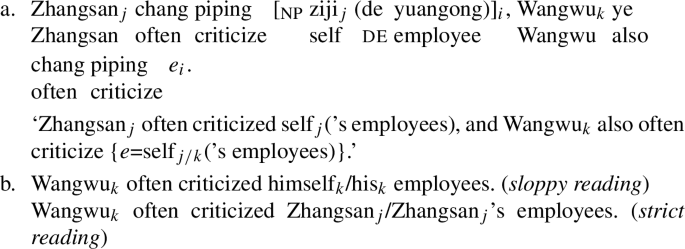
In (3), the null object with an antecedent as a reflexive or an NP possessed by a reflexive possessor can take on two interpretations: the sloppy reading and the strict reading. Under the SAE analysis, if the null object refers to Wangwu or Wangwu’s employees, it represents the sloppy reading, given the assumption that the null object containing a reflexive is bound by its local subject, Wangwu. Conversely, if the null object refers to Zhangsan or Zhangsan’s employees, the reflexive or reflexive possessor within the null object isn’t bound locally but corefers with the subject of the antecedent sentence, resulting in the strict reading.
It is important to note that the TBV analysis can also derive both the strict and sloppy readings. The strict reading can be derived by introducing a topic that has the same reference as the antecedent object (Object1 in 4), which requires the null object to be interpreted in the same way as its antecedent.Footnote6
- (4)Deriving the strict reading under the TBV analysis[TP1 Subject1 Verb1 [Object1 Reflexive (de NP)], [CP (Topic) [TP2 Subject2 Verb2 ej]
On the other hand, the sloppy reading is derived by imposing a topic containing a reflexive that is interpreted at the null object position, as illustrated in (5). The possibility of a reflexive in the topic being reinterpreted at a null object position has been previously observed (Li 2000) and has been considered for the derivation of the sloppy reading of null objects, yet it was rejected as a plausible account (Otani and Whitman 1991).Footnote7
- (5)Deriving the sloppy reading under the TBV analysis[TP1 Subject1 Verb1 [Object1 Reflexive(de NP)], [CP ([Topic Reflexive(de NP)]) [TP2 Subject2 Verb2 ek]
In the rest of this section, I will argue that a closer examination of the availability of the sloppy reading actually supports the TBV analysis over the AE analysis. Cases in which the sloppy reading is less accessible than the competing strict reading can be attributed to the absence of a reflexive in the projected topic. This absence may arise due to various semantic or pragmatic factors. I argue that only the TBV analysis can account for both the presence and absence of the sloppy reading.
As has been mentioned in (5), the sloppy reading can be derived by the TBV analysis through the reconstruction-like interpretation of a reflexive from the topic to the null object position, which may or may not involve movement. If this process involves movement, then the reconstruction of the topic to the null object position is straightforward. If not, the reconstruction effect could arise as a byproduct of interpreting Li’s (2014:62–65) true empty category at LF. More specifically, in syntax, a minimal empty category with a categorical feature serves as a placeholder in the null object position. Then, at LF, the true empty category is replaced by the content of the topic, following a mechanism similar to the LF late-insertion approach proposed in Oku (1998), resulting in the reconstruction-like effect. From this point forward, I will use the term “reconstruction” to denote either of these reconstruction-like effects for the sake of convenience, without a commitment to a movement or nonmovement approach (see also Footnotes 3 and 10). (6) illustrates the interpretation of the null object that is bound by an overt topic, which is equivalent to the interpretation with a corresponding null topic.Footnote8
- (6)
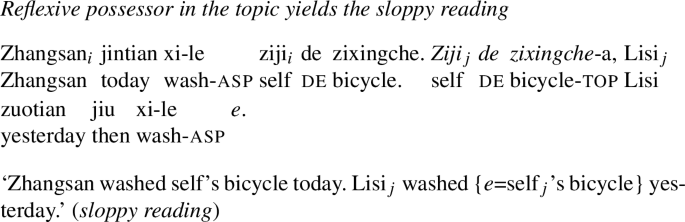
If there is an overarching topic shared by the sentences, also known as “topic chain” (Shi 1992), that is, the topic is what all the sentences are about, and if the overarching topic contains a reflexive, the sloppy reading is also easily available. This is illustrated by (7), which confirms that it is the reflexive possessor serving as a bound variable that is being interpreted in the null object positions, thus yielding the sloppy readings.
- (7)

In contrast, (8) illustrates a case where an NP distinct from the antecedent clause’s topic is imposed as the topic of the target clause, thereby blocking the overarching topic.
- (8)
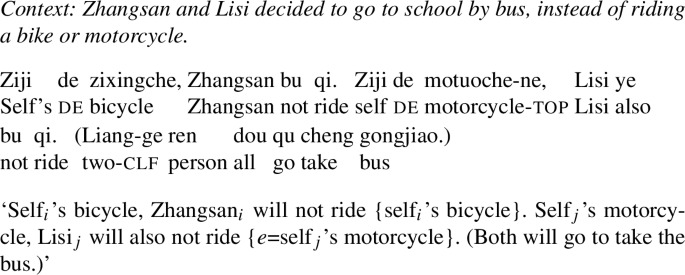
Consequently, the typical sloppy reading is blocked. In this case, the local topic of the target clause is reconstructed as the clause’s null object.
Overall, my observation is consistent with Simpson et al.’s (2013:122–127) conclusion that the availability of the sloppy reading is probably independent from AE (see also Merchant 2013) but is more likely correlated with the critical use of anaphors. However, I have made a different argument for this: it is the nominal topics (containing a reflexive) that mediate the sloppy reading.
2.1 Partial interpretation in the sloppy reading
In this subsection, I present a range of evidence supporting the derivation of the sloppy reading of null objects through the reconstruction of the reflexive in the topic. One crucial piece of evidence is that the interpretation of the null object can potentially exclude adjuncts and even possessors that are part of the antecedent object. Such optional partial interpretation cannot be derived by the SAE analysis or the AE analysis in general without additional stipulations.
2.1.1 Adjuncts in the antecedent can be excluded
If the AE analysis, especially the SAE analysis, is adopted, the interpretation of the null object is predicted to be directly constrained by its linguistic antecedent. This means that the interpretation of the null object and its antecedent should be identical or close to identical. However, I argue that this is not always the case, as there are instances where important parts of the antecedent can be excluded in the interpretation of the null object. For example, adjuncts that are sandwiched between a reflexive possessor and a noun in the antecedent object can be excluded in the interpretation of the null object, although not necessarily so. In contrast, a TBV analysis correctly allows for—but does not force—this type of exclusion.
When the intended interpretation is the sloppy reading, any number of adjective modifiers of the noun inside the antecedent object can be excluded from the interpretation of the null object, given an appropriate context. For example, in sentence (10), the null object can refer to just Lisi’s sedan, which can be small-sized (rather than big-sized and luxurious) or blue (rather than red), or an imported (rather than domestic) sedan. In this case, any of the modifiers ‘luxury’, ‘big-sized’, ‘red’, and ‘domestic’ can be excluded from the interpretation.
- (9)Context: Zhangsan and Lisi each own several cars and take good care of them.
- (10)
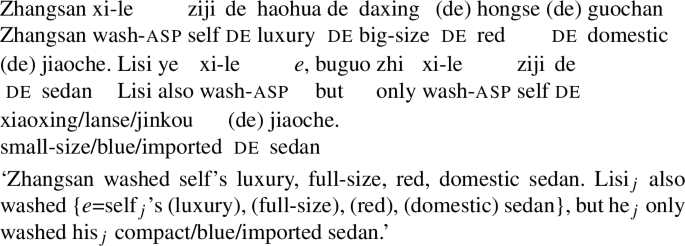
This flexibility in the interpretation is predicted by the TBV analysis, as the (null or overt) topic can be ‘self’s sedan,’ which is comaptible with different properties. In contrast, the AE analysis struggles to account for this flexibility without introducing additional stipulations (e.g., allowing discontinuous ellipsis or the optional exclusion of adjuncts). Since the modifiers are sandwiched between the reflexive possessor and the head noun, they are naturally part of the elided object and are expected to be interpreted together with the rest of the null object when the null object is reconstructed at LF. Therefore, the TBV analysis provides a more satisfactory explanation for the observed flexibility in the interpretation of the null object.
The potential exclusion of adjuncts in the interpretation of the null object can be further confirmed with proper context management. In the following context, Zhangsan and Lisi obviously have different bicycles, therefore, the interpretation of the null object must be different from that of its antecedent, excluding the adjective modifiers:
- (11)

In addition, relative clauses sandwiched between the possessor and the noun in the antecedent object can also be optionally excluded in the interpretation of the null object, as shown in (12).
- (12)
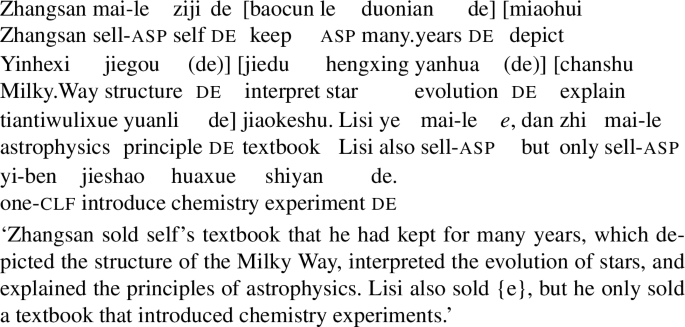
To summarize, the adjuncts that modify the head noun of the antecedents of null objects can be optionally ignored in the interpretation of null objects, which cannot be accounted for by the AE analysis. However, one might wonder whether the AE analysis can still be tenable if adjuncts in the antecedent are optionally accessible to the null object in the target sentence, for whatever reason. Notably, such an approach would need to allow all the adjuncts to be optionally available for the target sentence, which would further loosen the AE analysis. In Sect. 2.1.2, I will present a more compelling argument against even this version of the AE analysis, showing that the possessor in the antecedent object can also be optionally excluded from the interpretation of the null object.
2.1.2 The possessor in the antecedent object can be excluded
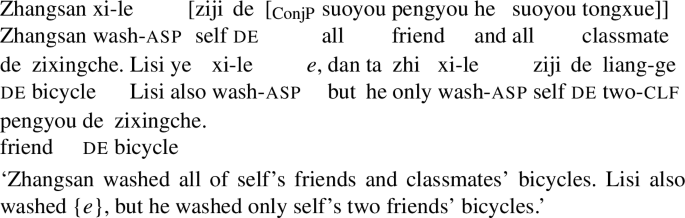
Not only adjuncts in the antecedent object can be excluded from the interpretation of the null object, possessors or parts of them can also be ignored given a proper context:
- (13)
- (14)
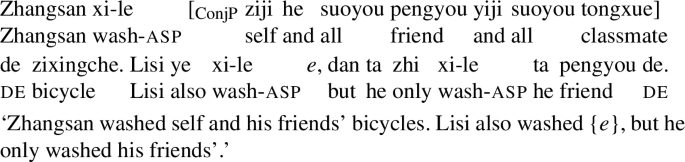
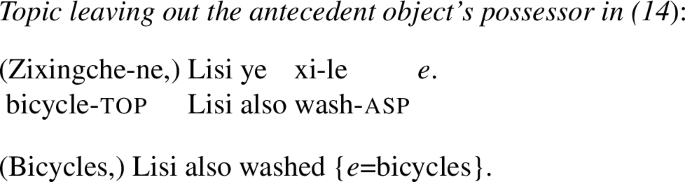
In (13), the antecedent object refers to all of Zhangsan’s friends and classmates’ bicycles, whereas the null object can be interpreted as some of his friends’ bicycles. In other words, part of the possessor in the antecedent is not included in the interpretation of the null object. This implies that the null object cannot be the entire antecedent object but is likely a bare noun ‘bicycle.’ Furthermore, as demonstrated in (14) with a complex conjunction phrase (ConjP) possessor in the antecedent object, only one of the conjuncts is included in the interpretation of the null object, while the other two are ignored. Therefore, the possessor or part of the possessor in the antecedent can be optionally excluded in the interpretation of the null object. It is noteworthy that this finding provides strong evidence against the AE analysis since it is unclear why part of the possessor in the antecedent can be optionally left out when the antecedent is copied to the null object position (either at LF or PF). In contrast, the TBV analysis does not encounter this problem, as an overt topic of the second sentence can be specified such that the possessor or part of the possessor is not included, as shown in (15).
- (15)
2.1.3 Part of the NP possessum can be excluded
In Xu (2003:169), a similar example is discussed (the following example is adopted with minor modifications, and the ziji ‘self’ version is added by me), which shows that part of the NP possessum in the antecedent object can also be ignored in the interpretation of the null object:
- (16)
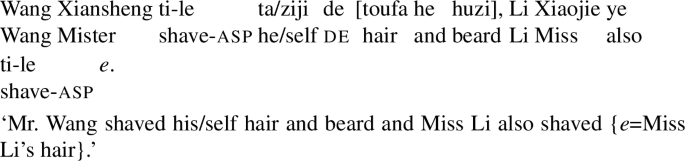
This example, which was previously puzzling, now receives an explanation. For the pronoun version, Xu’s consultants have explained that if Mr. Wang decided to become a monk and Miss Li a nun, (16) could be semantically true and grammatically correct on the interpretation that Miss Li shaved her hair but not her hair and her beard. The intuition here is that the reflexive version is judged in a similar way. Therefore, it is possible to leave out part of the NP possessum in the antecedent object in the interpretation of the null object, although this is highly constrained.Footnote9 Such partial interpretation is not expected under the AE analysis, which predicts that the whole NP conjunction phrase should be copied to the null object position (e.g., at LF). The data can be compatible with the TBV analysis as the null topic for the target sentence can be ta de toufa ‘her hair’ or ziji de toufa ‘self’s hair.’
2.2 Pragmatic influence
To demonstrate the potential for a mismatch between a null object and its antecedent when the sloppy reading is accessed, the sentences tested in Sects. 2.1.1 to 2.1.3 were deliberately constructed with multiple adjuncts or nouns within the antecedent objects, allowing for the exclusion of some of these elements in the interpretation of the null object. Conversely, simpler sentences with fewer adjuncts and nouns in the antecedent object generally exhibit a stronger preference for a matching relationship between the null object and its antecedent. I argue that this is a pragmatic effect.
Below, I show sentences where my consultants strongly prefer to interpret null objects as identical to their antecedents.
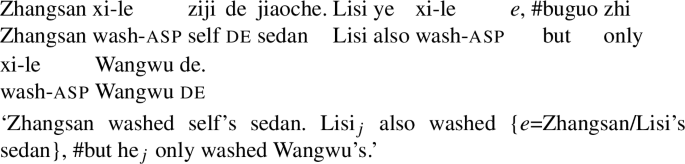
- (17)
- (18)
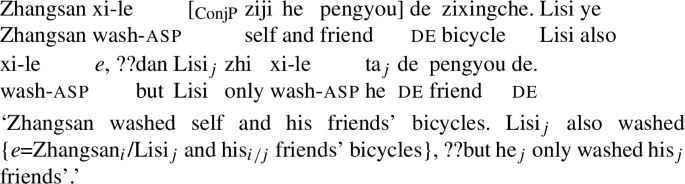
Take the sentence in (17) as an example. It was judged to be unnatural because my consultants imposed a reading to the null object that requires it to be exactly identical to its antecedent. That is, the null object must mean Lisi also washed his own sedan. (18) further shows that the speakers were reluctant to interpret the null object with ‘friend’ excluded from the possessor. In other words, (17) and (18) suggest a pattern that differs from the examples discussed in Sects. 2.1.1 to 2.1.3, such as (10), where an identity relation between the null objects and their antecedents is not observed.
Previous studies have commonly used sentences like (17) to test the sloppy reading, but have never employed sentences like (10). This is perhaps why the AE analysis was considered a straightforward account for the sloppy reading. However, it is (10) that requires an analysis different from the AE analysis.
One may wonder why there is a difference between the acceptability of (17) and (10). My speculation is that this difference is due to pragmatic effects. In order to understand this, I make another observation related to the lifted identity requirement between the null object and its antecedent: the competition between the availability of the sloppy reading and the strict reading. This reveals that the effects in question are indeed pragmatic, not syntactic. For instance, the strict reading is more prominent in (10) than in (17) if the third clause is not included in the examples. This is probably because there is a competition between the strict reading and the sloppy reading, and the sloppy reading becomes less likely as the probability that Lisi has the same type of sedan as Zhangsan’s decreases, given real world knowledge. This can be further managed, for example, by adding more modifiers to the description of Zhangsan’s sedan in (17). The additional details contribute to the uniqueness of Zhangsan’s sedan, which reduces the likelihood of Lisi owning an identical one. In (10), it has been observed that providing a detailed description of Zhangsan’s sedan alters the belief that Lisi owns an identical one, breaking the identity between the interpretation of the null object and its antecedent. Under the TBV analysis, this means that the topic binding the null object in the target sentence cannot be identical to the antecedent object.
What if even more modifiers are added to (10), exemplified by the sentence in (19)?
- (19)
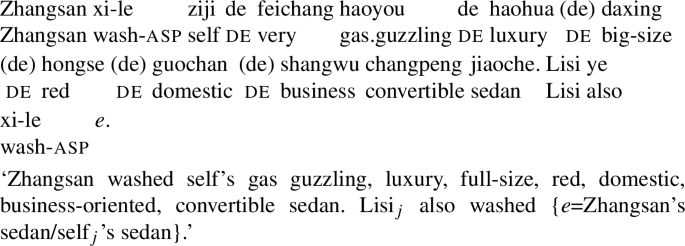
As predicted, the additional modifiers in the antecedent object increase the probability that Zhangsan’s sedan is unique, and it is unlikely that Lisi has the same sedan. Thus, to force a sloppy reading, the modifiers should be excluded from the interpretation of the null object. Another possibility is to exclude the reflexive possessor from the interpretation of the null object, which yields the strict reading. This is also why the sloppy reading of the null object in (20) below sounds odd: the probability of Zhangsan and his father owning an identical small, crowded, and shabby dark red mahogany bookshelf is perceived to be low in the real world.
- (20)
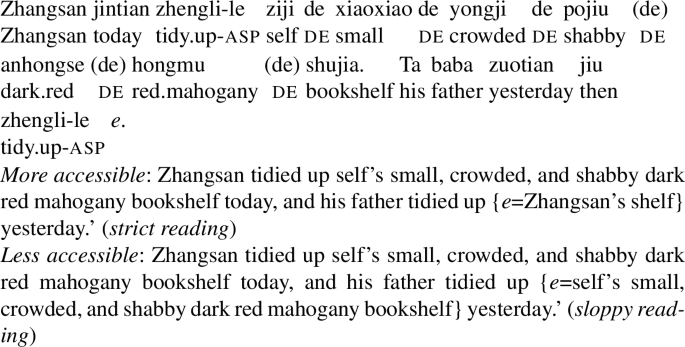
I have so far discussed cases in which the identity relation between a null object and its antecedent is not readily accessible, in contrast to those cases where the identity is required or preferred. It is argued that this is due to pragmatic reasons: when the identity relation is pragmatically unlikely to occur, the identity requirement will be loosened. This observation disfavors the AE analysis, which is primarily a syntactic mechanism. However, the pragmatic effect is compatible with the TBV analysis. The TBV analysis derives cases where an identity relation holds between a null object and its antecedent by default by imposing a (potentially null) topic coreferring with its antecedent. Whenever such a coreference relation is unlikely to be sustained, for example, due to a pragmatic constraint, a different topic can be projected, leading to the observed breakdown of the identity relation.
In sum, the investigation of the availability of the sloppy reading ends up supporting the TBV analysis as a viable analysis of null objects in MC. The sloppy reading is derived with the reconstruction of a reflexive possessor from the topic to the null object. Furthermore, evidence suggests that the TBV analysis is a more suitable explanation for null objects in MC than the AE analysis. Specifically, novel data demonstrate that adjuncts inserted between the reflexive possessor and the nominal possessum in the antecedent object can be excluded from the interpretation of the null object. Additionally, the possessor and part of the NP possessum of the antecedent object can also be omitted in the interpretation of the null object. These data cannot be easily explained if the AE analysis is adopted for null objects. The TBV analysis, however, does not run into the same problems as it allows flexibility of projecting a different topic from a default one that is identical to its linguistic antecedent. This occurs when the default one is unlikely to serve as the topic, e.g., due to pragmatic reasons. Taken together, the topic mediates the interpretation of null objects in cases relevant to the sloppy reading. This mediating effect provides important evidence for the TBV analysis, which will be elaborated on in more detail in Sect. 3.3.
3 The derivation of the quantity reading: Why AE overgenerates
In the previous section, I demonstrated that AE is insufficient to derive various aspects of the sloppy reading associated with null objects. This examination leads to the conclusion that TBV is necessary to derive the sloppy reading. Below, I will shift to the derivation of the quantity reading, a discussion that will suggest the AE analysis overgenerates, making incorrect empirical predictions for cases where the quantity reading should be available but is not.
I will start with an example of a null object with a numeral phrase antecedent in MC. Note the various interpretations associated with the null objects:
- (21)
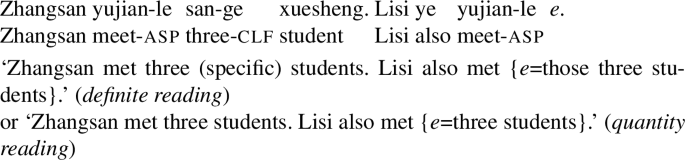
As indicated in the English translation of the sentence, the null object can give rise to two types of readings if its antecedent is a numeral phrase (NumP). When matching a NumP antecedent with a specific reading, it receives a definite or specific reading, two terms that I use interchangeably in this article. The null object thus means the particular three students that Zhangsan met in the antecedent sentence. Alternatively, when the NumP antecedent is interpreted as nonspecific and nonreferential (Li 1998), a nonreferential, quantity reading of the null object is obtained. According to this reading, the null object refers to three students that are usually not the ones that Zhangsan met. This quantity reading is also called quantificational reading in the literature on null objects (e.g., Cheng 2013; Sakamoto 2020). Below are some similar examples from the literature that suggest a quantity reading of null objects:
- (22)

- (23)
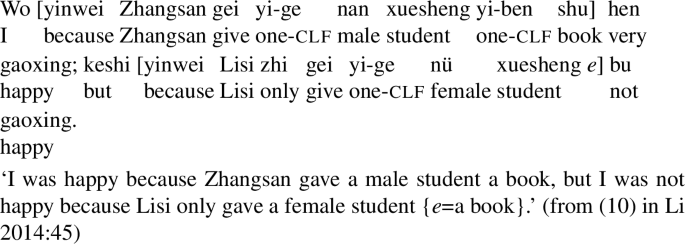
The definite/specific reading can be derived by both the SAE analysis (with the antecedent object interpreted as definite) and the TBV analysis (with a definite topic). The quantity reading can be derived by SAE because both the quantity phrase antecedent of the null object (‘three students’) and the null object itself obtain the same interpretation. By contrast, at first glance, this quantity reading is not anticipated by the TBV analysis due to the restriction that indefinite quantity phrases are not licensed topics (Cheng 2013, Li 2014). I will argue that the TBV analysis has been abandoned prematurely. This article presents novel data demonstrating that the quantity reading claimed in (21) to (23) is merely a byproduct of a generic interpretation of the null object. The perceived quantity reading is, therefore, only an apparent one. A genuine quantity reading is only attested when a quantity phrase is a licensed topic under particular contexts. In other words, the null object is interpreted as a variable bound by the (licensed) topic, rather than as a direct copy of the NumP antecedent. This is consistent with the TBV analysis as the interpretation of null objects is mediated by the topics which bind them as variables. By contrast, the mediating role of the topic in the interpretation of null objects cannot be easily explained by the SAE analysis.
The AE analysis argues against the TBV analysis in (2), primarily based on the observation that indefinite quantity phrases generally cannot occur in the topic (or subject) position (cf. Chao 2011, Li and Thompson 1981; see also Huang 1989, 1991; Cheng 2013; Li 2014; Takahashi 2008; Sakamoto 2020).Footnote10 The rationale behind the argument against the TBV analysis consists of several steps: (i) in order for the TBV analysis to work, it requires a topic to be projected (at the specifier of TopicP) to bind the variable associated with the null object; (ii) consequently, to access the quantity reading, an indefinite antecedent (e.g., ‘three students’ in (21)) must be projected as the topic of the second/target sentence; (iii) however, restrictions on the topic generally prohibit a nonreferential NumP, which blocks such an indefinite topic; (iv) thus, if the TBV analysis is adopted, the quantity reading cannot be derived, contrary to fact.
This article suggests that the above argument against the TBV analysis is not sustainable because of the following two reasons. (i) The quantity reading that was previously claimed to be accessible is, in fact, a byproduct reading of null objects bound by a bare nominal topic. To put it another way, the quantity reading is only an apparent reading made possible by an interpretation of the null object that does not specify a quantity. (2) The quantity reading is only attested in a construction where a nonreferential NumP is a licensed topic. Hence, the presence and absence of the quantity reading is controlled by the type of nominals that can occur in the topic position. This phenomenon is referred to as the “mediating effect of the topic” in this article, aligning with an essential prediction of the TBV analysis.
In this section, I will argue for the mediating effect of the topic in the following steps. Sect. 3.1 provides a brief survey of the restrictions associated with the topic position, setting the stage for the investigation of the types of NumP topics that allow or disallow the quantity reading. Sect. 3.2 applies various tests and points out that instances in which the quantity reading can be canceled align precisely with those in which nonreferential NumPs are disallowed in the topic position. Conversely, cases where the quantity reading is accessible are exactly those where nonreferential NumPs can be licensed as topics. This suggests that the topic controls the interpretation of the null object it binds (leading to the mediating effect of the topic), independent of the type of antecedent the null object has, a point argued in detail in Sect. 3.3.
3.1 Constraints associated with topichood
The goal of this subsection is to review the restrictions associated with the topic position, with a special focus on when a quantity expression is allowed or disallowed in the topic position, paving the way for the discussion of how different types of topics control the interpretation of null objects. I will demonstrate that the quantity reading is absent only when a NumP topic is not licensed and is available only when a NumP topic is licensed. Cases where a quantity phrase is licensed to be a topic have been previously noticed but have not been sufficiently appreciated in the analysis of null objects. Building on this review, I will argue in the rest of this section that a systematic evaluation of these cases calls for the TBV analysis, which offers an adequate explanation for some otherwise puzzling phenomena.
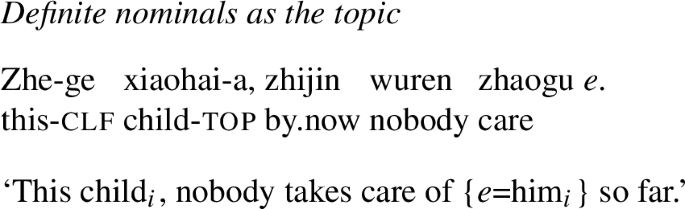
It is widely known that definite and bare nominals can be licensed as topics:
- (24)
- (25)
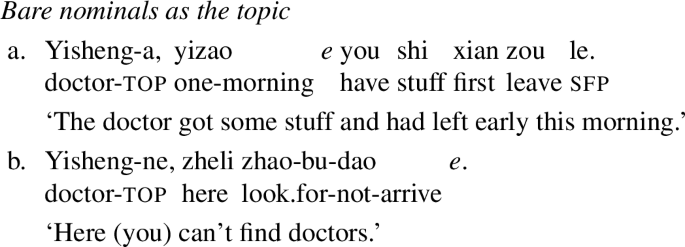
The examples in (25) demonstrate that when the topics are bare nominals, they can either refer to a particular entity salient in the context with a specific reading (25a) or be interpreted with a generic, kind-denoting reading (25b) (Cheng and Sybesma 1999).
More relevant to the current study, NumPs with a quantity reading (not a referential reading) can occur in the topic position if they are licensed by a modal or another paired NumP in the sentence, as illustrated by the examples in (26).Footnote11 The NumPs and their licensing modals and paired NumPs are emphasized in italics in the examples.
- (26)
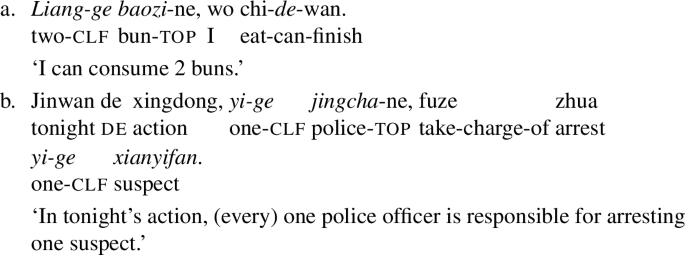
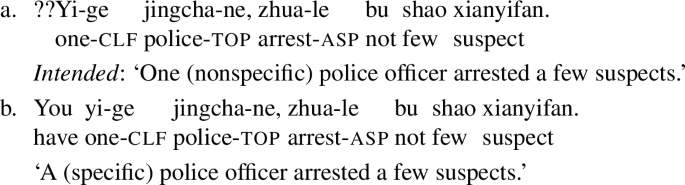
In cases where nonreferential NumPs are not licensed by a modal or another NumP, the NumPs with a quantity reading cannot occur in the topic position, as shown in (27a). Instead, the existential marker you ‘have’ must be used to license a NumP topic, as seen in (27b), which yields a referential, specific reading of the NumP. Otherwise the sentence is degraded.
- (27)
Additionally, a NumP can appear in the topic position if it receives a generic reading, and this is restricted to “one-clf NPs”:
- (28)

In sum, NumPs, indefinite expressions, and bare nominals are allowed in the topic position if they receive a generic/kind-denoting reading or if they receive a quantity reading when licensed by a modal or another NumP. Otherwise, topics must refer to a definite or specific salient object in the context.
In addition, as will be discussed in more detail throughout this article, a discernible pattern in the use of the topic in relation to linguistic discourse or its antecedent is that, by default, a bare nominal or null topic’s reading should match that of its linguistic antecedent whenever possible. This holds even when the topic and its antecedent differ structurally. Therefore, if the antecedent of the null object has a quantity reading that the topic does not license, a null bare nominal topic must be projected, leading to an interpretation that differs from that of the antecedent.
3.2 The absence of the predicted quantity reading
Now we are ready to examine cases where a nonspecific NumP is not permitted to occupy the topic position. The TBV analysis thus predicts that the quantity reading is not accessible in these cases, whereas the SAE analysis predicts that the absence or presence of the quantity reading for null objects is not constrained by the properties of the topic. In fact, SAE should predict that the quantity reading is always available, provided that the linguistic antecedent has the same interpretation and that the constructions or contexts expect or even require the quantity reading to make the sentences acceptable. The results of this scrutiny suggest that SAE overgenerates in these cases.
3.2.1 The tongshi ‘simultaneously’ test
Tongshi ‘simultaneously’ requires the concurrence of two or more events when used as an adverb. A comparison between the (a) and (b) sentences in (29) and (30) demonstrates situations where tongshi has or does not have multiple events induced by a NumP for it to modify. When the second clauses use an overt NumP object, rather than a null object or an overt bare nominal object, all the sentences in (29) and (30) are perfectly acceptable. The (b) sentences are cases where tongshi leads to the interpretation that multiple events associated with a NumP occur simultaneously.
- (29)
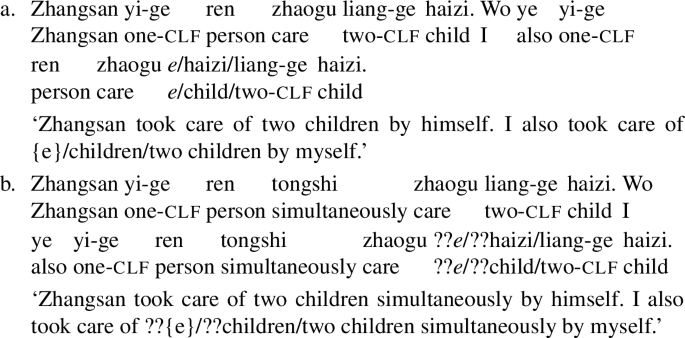
- (30)
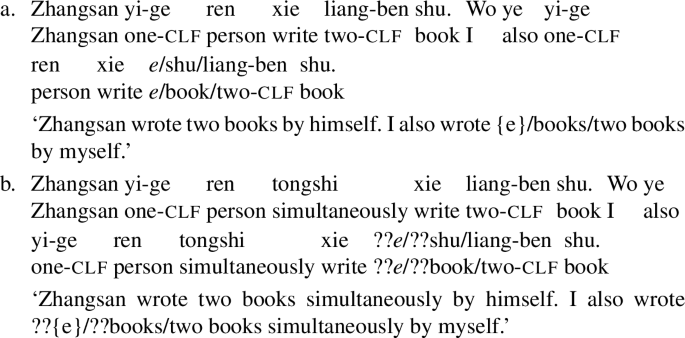
By contrast, when the objects of the second clauses in (29) and (30) are either left empty or filled with a bare nominal, the (b) sentences with tongshi, in contrast to the (a) sentences without tongshi, are degraded. The reason for this is that, in the second clauses of the (b) sentences, there are no multiple events available for tongshi to modify. Crucially, this contrast indicates that null objects in these cases behave like bare nominals, not like NumPs, consistent with the prediction of the TBV analysis, not that of the SAE analysis. This test confirms that the AE analysis overgenerates and makes incorrect predictions regarding the availability of the quantity reading, as the construction requires the quantity reading for sentences (29) and (30) to be acceptable. However, the fact remains that the quantity reading is still not accessible.Footnote12
3.2.2 When a NumP antecedent cannot be specific: Insufficiency in quantity
Shao ‘little/less/insufficient(ly)/lack’ can be an adjective, an adverb, or a verb. The adverb shao attaches to a verb that selects a NumP object, indicating insufficiency in the quantity denoted by the NumP object. For example, shao shuo-le yi-ju hua literally means “less speak-asp one-clf sentence,” and implies speaking one sentence less than what was expected or planned. Since shao modifies the quantity of the NumP object, the quantity reading of the NumP in the antecedent sentence is forced and the specific reading of the NumP is hardly accessible. We can thus utilize this property to test whether the interpretation of a null object in the target sentence includes a numeral expression and receives a quantity reading, like its NumP antecedent.
Take (31b) as an example:
- (31)
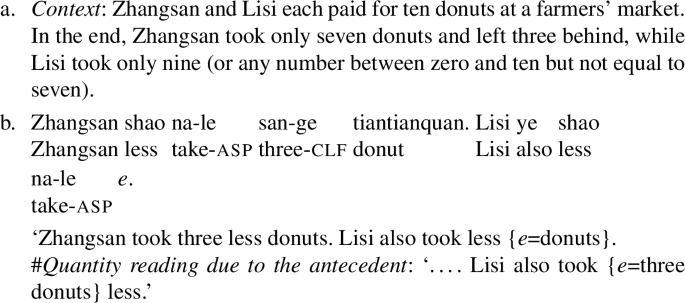
Note that, by default, the null object will be interpreted as identical to its linguistic antecedent if the sentence is stated out of the blue without context. However, as (31) shows, the example in (31b) is legitimate under the context (31a) where the quantity reading identical to the antecedent object is not compatible with the context: ‘Lisi also took {e=three donuts} less’ will be a false statement if evaluated against the context. This indicates that the antecedent object is not copied into the null object position, contrary to the prediction of the SAE analysis. A plausible alternative interpretation is ‘Lisi also took less {e=donuts}’; that is, an interpretation of the null object leaving out the numeral. Such a reading can be captured if a bare nominal topic, tiantianquan ‘donut,’ is projected as the topic for the target sentence in (31b), as predicted by the TBV analysis.Footnote13
Again, note that the quantity reading indeed appears to be an easily available reading if the context is not set up as in (31a). For instance, if Zhangsan and Lisi both happened to take three donuts less, then the sentence would end up with the same interpretation as if the quantity reading is actually accessed. However, this type of “quantity reading” occurs only as an incident. This should not come as a surprise because the quantity reading here is simply a byproduct of the generic interpretation of null objects.
3.2.3 When a NumP antecedent cannot be specific: Narrow scope nonreferential NumPs
Some speakers may allow for a specific reading in addition to a quantity reading of NumP antecedents, although it may not always be easily accessible. However, there is a cleaner case where only a nonspecific, quantity reading is possible: when a NumP antecedent is bound by a quantifier phrase. In MC, the scope relation between two NumPs/quantifier phrases reflects their surface c-command relations, which is known as the Isomorphic Principle (Huang 1982, Aoun and Li 1989). Hence, a specific reading of a NumP resulting from an inverse scope interpretation is generally unavailable when it falls within the scope of a universal quantifier phrase. In the following antecedent sentence (32a), san-ge laoshi ‘three teachers’ cannot be interpreted as three specific teachers in the speaker’s mind. Instead, its reference must covary with that of the universal quantifier phrase mei-ge nüsheng ‘every female student.’ This provides a clean case to test the availability of the nonspecific quantity reading of null objects, given its NumP antecedent cannot be interpreted as specific.
- (32)
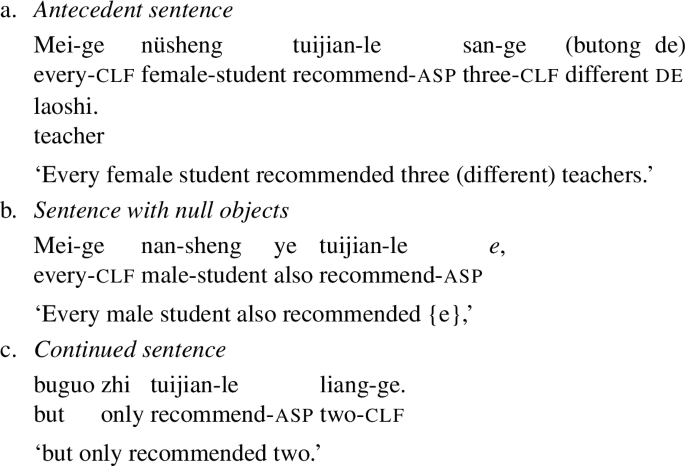
We therefore anticipate a clean case of a null object that is interpreted with a quantity reading if the SAE analysis is adopted. This is not borne out. The sentence continuation in (32c) is legitimate if every male student recommended two teachers (e.g., for best-teacher awards). This once again demonstrates that the null object in (32b) cannot be the same as the NumP antecedent in (32a). Instead, this data can be accounted for if a bare nominal topic laoshi ‘teacher’ is projected in the left periphery of the target sentence (32b), controlling the (kind-denoting) interpretation of the null object, just as the TBV analysis proposes.
3.2.4 When a NumP antecedent cannot be specific: The insignificance reading
Wh-phrases such as shenme ‘what’ can receive an insignificance reading in the context of negation, in addition to the canonical negative polarity item (NPI) reading. This has been studied in detail by researchers such as Huang (2013), Chen (2021), and others. According to Chen (2021), shenme has both an individual/kind-denoting reading and a degree reading. Negating over the kind-denoting reading leads to the polarity reading (33a), whereas negating over the degree reading can naturally derive the insignificance reading (33b).
- (33)
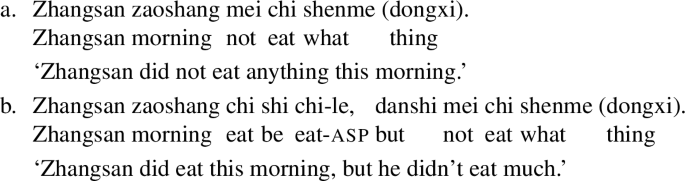
(33a) demonstrates the canonical interpretation of “shenme” under negation, in which it functions as an NPI and means “anything” (see, e.g., Li 1992, Cheng 1994, Lin 1996, etc.). However, (33b) reveals another possible interpretation of shenme, which Huang (2013) refers to as the “insignificance reading”: shenme behaves not as a regular NPI, but means “close to nothing (and therefore it’s not nothing).”
Let us return to the issue of the quantity reading, assuming that the insignificance reading of shenme is a special instance of this reading. Based on (34), we see that the insignificance reading is not readily available in the target sentence, which involves a null object. Instead, the dominant reading, similar to the NPI reading, has caused the example to be in conflict with the information given in the context.
- (34)
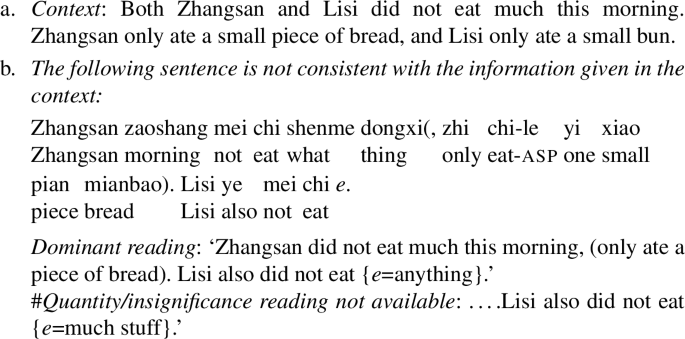
The dominant reading is correctly predicted under the TBV analysis, because shenme with a degree reading cannot be in the topic position, see (35).
- (35)

Therefore, a kind-denoting reading, which is equivalent to the bare nominal ‘thing’ under negation, is fit into the topic position, yielding the NPI-like ‘anything’ reading (36).
- (36)

Thus, the dominant reading of the example in (34b) with regard to the null object is exactly derived by the projection of a bare nominal topic that binds the null object, as has been illustrated in (36). By contrast, if the SAE analysis is adopted, we would incorrectly predict that the insignificance reading would still be available in (34b), since this analysis does not take into account the mediating role of the bare nominal topic in the interpretation of the null object.
3.2.5 Resultative constructions
Resultative verb compounds that carry the presupposition that a certain amount has been exhausted also require a quantity reading, and thus it is relevant for us to investigate what quantity reading is being produced with a null object. Is it the quantity reading that is predicted by the SAE analysis? Resultative verb compounds such as hua-wan ‘totally spend/use up’ (literally: spend-complete), zhao-man ‘fully recruit’ (literally: recruit-full), shouji-quan ‘collect all’ (literally: collect-completed), etc. indicate the completion of the whole planned process represented by the main verb part. Examples (37) and (38) substantiate the argument that the resultative parts of the resultative compounds force the interpretation of the null objects to be related to the completion of the goals set up in the contexts.Footnote14
- (37)
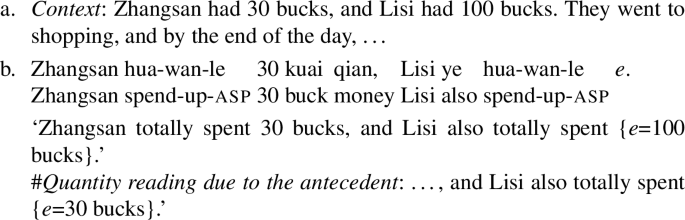
- (38)
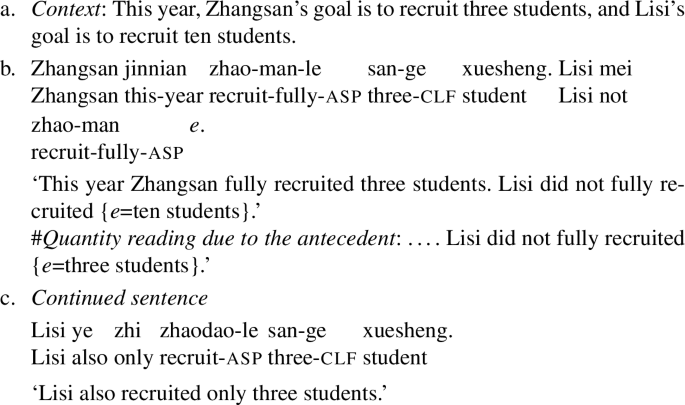
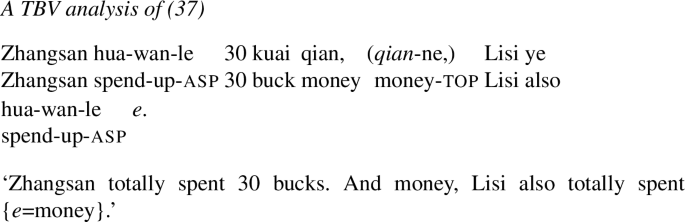
Critically, as (37) and (38) show, the null objects, although still obtaining an (apparent) quantity reading, are not interpreted as identical to their linguistic antecedents. Instead, they are associated with a contextually defined quantity. These examples indicate that when the quantity reading of a null object is present, it is not the quantity reading predicted by the SAE analysis. By contrast, these cases can be easily accommodated within the TBV analysis with a bare nominal topic, for example:
- (39)
3.2.6 Negative contexts
Another interesting phenomenon is the effect of a sentential negative operator on the interpretation of null objects, which generally renders the quantity reading inaccessible for most of the native speakers I consulted, although there may be some individual variation. The following sentences indicate that the null objects are not interpreted as a quantity, different from the overt NumP phrases (cf. Wei 2010:127 for a similar observation).
- (40)
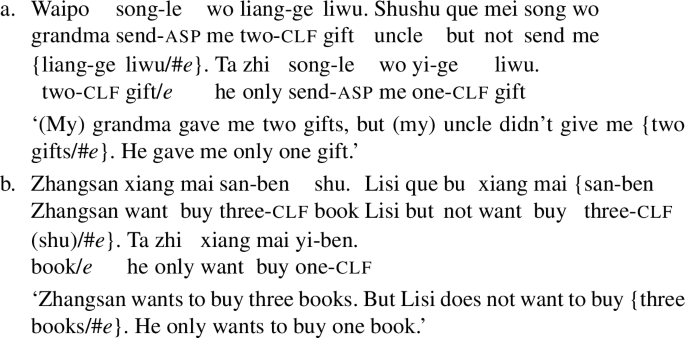
Note that the intended interpretation of the NumP in the antecedent sentences is the quantity reading, not a specific reading. If the NumP is interpreted as specific, the sentence would be acceptable. This issue is especially evident in contexts where the use of the predicate allows for this specific reading, such as ‘invite’ in (41). This is a potential source of individual variation. A context might be added to strengthen the quantity reading over the specific reading, although not always effective:
- (41)
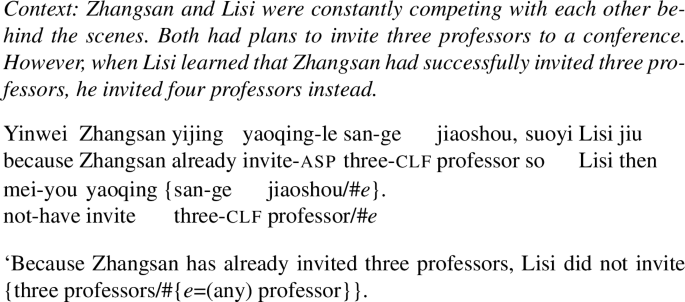
In this scenario, the prevailing interpretation of the sentence with the null object is that Lisi did not invite any professors. This means the sentence with the null object does not align with the context, since it does not convey that Lisi refrained from inviting three professors, even though the context supports such a quantity reading. If the NumP is copied from the antecedent to the null object position, as suggested by the SAE analysis, one would expect the sentence to be acceptable as long as Lisi did not invite three professors. However, this is not the case.
Consider (42) as another example. The null object in (42c) also cannot obtain a quantity reading (this remains the same even without the context; but the context will be helpful when we compare (42) to (43)).
- (42)
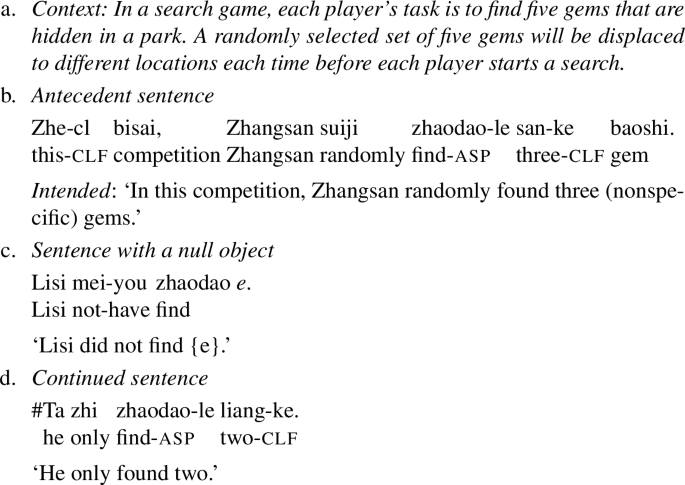
If the quantity reading of the null object were actually accessed just as that with san-ke baoshi ‘three gems’ in the antecedent sentence, the second sentence (42c) should mean ‘Lisi did not find three gems.’ Then, we should expect the continued sentence (42d) to be compatible with (42c), which is not true. Indeed, if the antecedent object san-ke baoshi ‘three gems’ is inserted into the null object position in (42c), then (42d) becomes a suitable continuation.
As a point of comparison, the absence of quantity reading is consistent with what the TBV analysis predicts. (42c) should have a bare nominal, i.e., baoshi ‘gem,’ rather than a NumP, i.e., san-ke baoshi ‘three gems,’ as its (null) topic, because nonreferential NumPs cannot be at the topic position given it is neither specific or generic nor licensed by a modal. (42c) thus means ‘Lisi did not find gems,’ in accordance with the fact that Lisi also could not find two gems if he did not find gems at all, causing (42d) to be an invalid continuation. Therefore, the quantity reading is disallowed by the actually accessed reading due to a bare nominal topic. This is different from the nonnegative contexts discussed above, where the quantity reading is one of the readings that is allowed by the actually accessed reading.Footnote15
Note that the following example (43), in direct contrast to (42), is not a counterexample to the TBV analysis. What makes (43) different is that the NumP ‘three gems’ becomes the overarching topic, a shared topic over the antecedent clause and the clause with the null object (Shi 1992).
- (43)
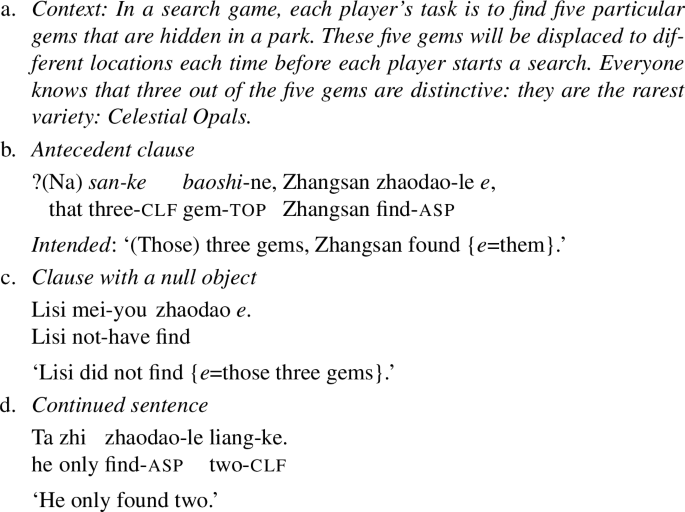
Due to familiar restrictions on topics, the NumP topic must have a specific reading and refer to the three specific gems in the context, instead of having a quantity reading. In this case, the null object in (43c) is bound by the overarching topic, and the sentence then means ‘Lisi did not find those three gems,’ making it compatible with the continued sentence (43d).
Also for comparison purposes, if the adjective xinyi yijiu-de ‘longtime favorite’ is inserted to strengthen the specific reading of san-ke baoshi ‘three gems’ in (42b) without the context, which is the dominant reading accessed in (44a), then the null object in the second sentence (44b) will be more likely interpreted as referring to those three gems that were Zhangsan’s longtime favorite, an effect similar to having an overt overarching topic as in (43).
- (44)
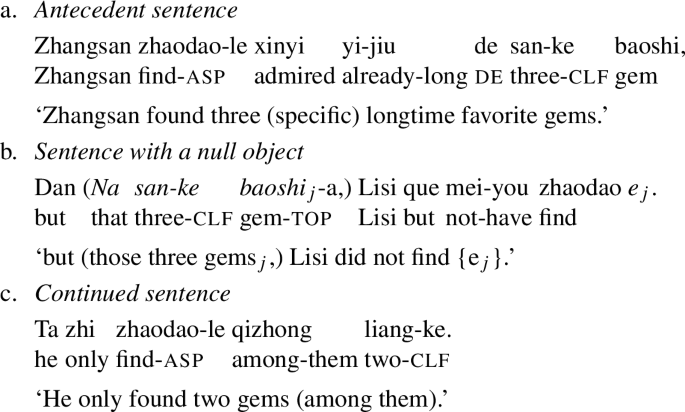
This is possible because the topic of the sentence in (44b) as a definite expression refers back to the three specific gems in the antecedent sentence, leading to the following interpretation: ‘those three gemsi, Lisi did not find ei.’ Moreover, the continued sentence in (44c) would still be invalid if liang-ke baoshi ‘two gems’ were not specific (which would be the default interpretation in the absence of context). As expected, this sentence is greatly improved if we highlight the specific reading of liang-ke baoshi with qizhong ‘among them,’ which explicitly referring back to the three gems that Zhangsan found. Given that it is not directly relevant to the main goal of this article, we will set aside the specific/definite interpretation of NumPs as exemplified in (44) for the remainder of the discussion.
It should be noted that there may be individual variation in the judgment of sentences like (42). In order to better understand the distribution of individual variation, we consulted five additional native speakers specifically for these sentences, in addition to the five native speakers we had already consulted for this article. Out of the ten native speakers, one considered the sentences completely acceptable, two considered them marginal, and the rest found them unacceptable. As a reminder, those who found the sentences unacceptable had excluded the quantity reading of the null object, whereas those who judged the sentences acceptable had allowed the quantity reading. How can the TBV analysis explain why sentences such as (42c) are considered acceptable by some, although a minority of, native speakers? Crucially, those native speakers who marginally allowed null objects to have the quantity reading were also the ones who found a NumP topic to be only marginal, not completely unacceptable. For instance, they judged (42c) with a topic ‘three gems’ as marginally acceptable rather than outright unacceptable. In fact, when the NumP topic was stressed, they even considered the sentence acceptable. As will be discussed below, for those speakers, these are cases where the quantity reading of a topic is licensed.
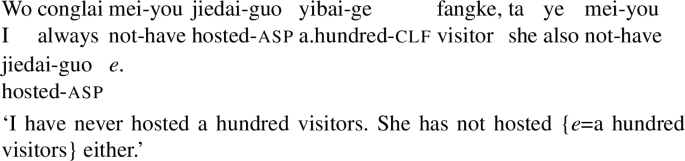
Interestingly, not all negative contexts prevent the quantity reading. Both (45) and (46) show that the quantity reading is readily accessible in certain special contexts to all speakers I consulted.
- (45)
- (46)

These examples can reasonably be taken as evidence for the AE analysis. However, these contexts are special in the sense that they involve stress: the NumP yibai-ge fangke ‘a hundred visitors’ in (45) and liang-ge shoudu ‘two capitals’ in (46) are stressed prosodically in their intended interpretations, representing exceptional instances. The stress may signal the presence of focus, as the sentences naturally occur in situations where the speaker has received a number of visitors less than one hundred (for 45), and the USA has only one capital instead of two (for 46). The focus may license the projection of a covert NumP topic/focus in the left periphery of the antecedent sentences, which then being inherited by the target sentence as the topic to bind the null object which is negated by the negative operator. This suggests another source of the observed individual variation: for some speakers, a focus can license a quantity NumP topic. Whether a further distinction between a topic and a focus is necessary is an interesting empirical question, and we will leave it for future research. (47) presents the version with an overt topic binding the null object in both the antecedent and the target sentence.
- (47)

The sentences in (48) below confirm that, within a negative context, focus might be able to license a nonreferential NumP topic. This represents an additional licensing strategy for indefinite topics that has not been formally discussed previously, even though Zhang (2009) and Ke (2023) have observed that (contrastive) focus improves some topic constructions that would otherwise be unacceptable. In the following examples, the nonreferential NumPs are licensed topics:
- (48)
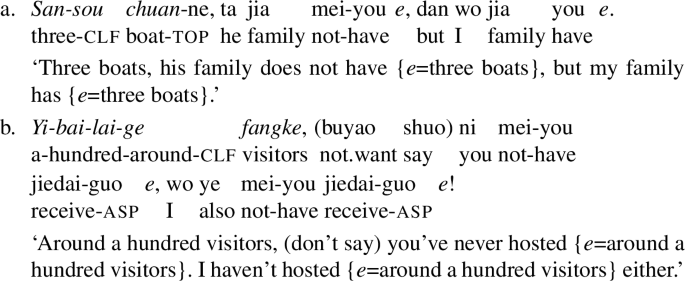
The fact that a quantity reading is accessible exactly when a NumP is licensed to be a topic, by focus in this current case, confirms the idea that the topic mediates the interpretation of the null object, consistent with the TBV analysis. I now turn to this mediating effect of the topic.
3.3 The mediating effect of the topic
The apparent availability of the quantity reading was considered important evidence in support of the AE analysis but against the TBV analysis. However, I have shown that the previously claimed quantity reading is in fact not available, even in constructions or contexts where the quantity reading is required to make the sentences acceptable. The TBV analysis offers a natural explanation of the absence of the quantity reading: this is due to the fact that generic bare nominals, as opposed to NumPs, are projected in the topic position and bind the null object variables. This is consistent with an important constraint of the topic: bare nominals, but not nonspecific NumP, can generally occupy the topic position. This effect is referred to below as “the mediating effect of the topic”:
- (49)The mediating effect of the topicThe interpretation of a null object e is determined by the type of the possible topic of the clause containing e.
Nevertheless, the TBV analysis must also explain the examples where the quantity reading is accessible. I will argue that the mediating topic is crucial in accounting for the presence of the quantity reading. In addition to generic bare nominals, a NumP licensed by a modal can also occur in the topic position, which derives the quantity reading of the corresponding null object. Therefore, the cases where the quantity reading is absent versus where it is present are derived by projecting different types of topics that bind the null objects, although the null objects have the same NumP antecedents. To put it another way, the switch from the absence of the quantity reading to the presence of the reading is controlled by the type of topic that is projected, which can be managed, to some extent, by the context. The turning on and off of the quantity reading is not related to what type of antecedent the null object has, thus precluding the SAE analysis as plausible. In the rest of this section, I will demonstrate how to manage the context or control the presence of licensors of NumP topics in order to regulate the types of topics that are projected.
I will start with cases where the apparent quantity reading arises. I argue that the seemingly available quantity reading is not actually a reading directly available, consistent with the predictions of the TBV analysis. This is because, again, NumPs are generally prohibited from occupying the topic position except when they are licensed. The example in (50) is a case that appears to be ambiguous between a specific reading and a quantity reading:
- (50)
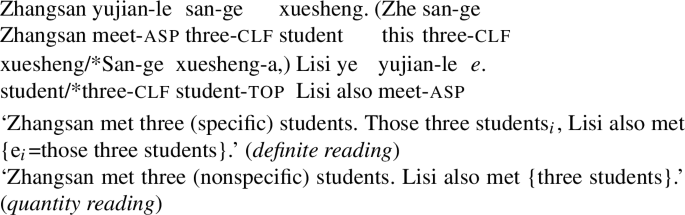
The phrase zhe san-ge xuesheng ‘these three students’ as a definite expression can occur in the topic position. However, in order to use the definite topic, its referent must be introduced in the context, i.e., in the first sentence. This is exactly what we observe in example (50): when the definite reading is obtained, the three students that Lisi met must be those three specific students mentioned in the first sentence. Crucially, the NumP san-ge xuesheng ‘three students’ cannot occupy the topic position of the second sentence. Since ‘three students’ in (50) is not licensed, e.g., by a modal, it cannot serve as a topic. Without a quantity phrase topic to bind the null object, the TBV approach predicts that the quantity reading is, in fact, not a reading that is directly available with the null object in (50).
However, intuitively, such a quantity reading does seem possible to native speakers, posing a challenge to the TBV approach. A potential solution is to argue that the quantity reading that is accessed intuitively is not a quantity reading. Instead, it could be a byproduct of another reading where a generic bare nominal is taken as a topic binding the null object. That is, when ‘three students’ in the first sentence in (50) receives a nonspecific reading, the topic for the second sentence must be a generic bare nominal (51a).
- (51)
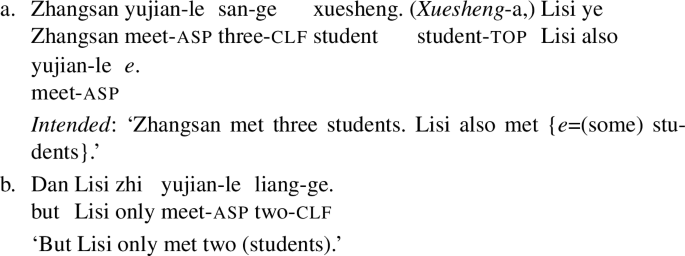
Such a TBV analysis then predicts that the second sentence would not specify the number of students Lisi met. This prediction is confirmed by the acceptable continuation in (51b), where a different quantity is specified. The perceived quantity reading ends up being simply a special case of the kind-denoting reading: it happens to be the case that Lisi also met three students. This reading is usually taken as the default reading only because it is reinforced by the parallel structure between the antecedent and the target sentence (see Sect. 4).
In the rest of this subsection, I will discuss the other side of the mediating effect: when a nonspecific NumP is licensed to be a topic, the quantity reading emerges, exactly as predicted by the TBV analysis.
In Sect. 3.1, we have mentioned two particular instances where a NumP is allowed in the topic position: if it is licensed by a modal or a NumP. We predict that whenever a NumP is licensed to be a topic, the quantity reading will be available for null objects, different from all the cases we have discussed in Sect. 3.2. This prediction seems to be on the right track. (52a) exhibits such exceptional cases where the quantity reading of the null object is licensed by a modal (highlighted in italics). (52b) confirms that it is exactly the quantity reading that is accessed with the null object, which directly contradicts the quantity specified in the continued sentence.
- (52)
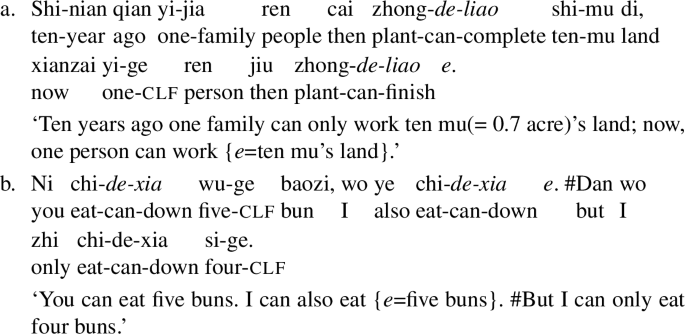
Furthermore, such quantity reading is natural in negative contexts as well, as exemplified by (53), licensing a continued sentence which contains a different quantity.
- (53)
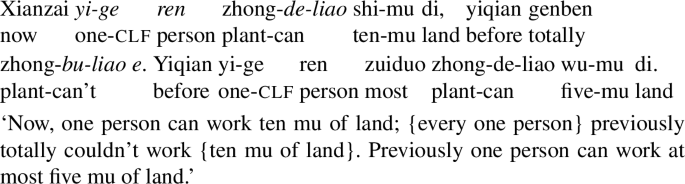
(54) presents a TBV analysis of the second clause in (52a), which provides an empirically adequate account to the availability of the quantity reading in (54).
- (54)

Let me pause and highlight examples such as (53), contrasting them with examples in negative contexts as discussed in Sect. 3.2.6, e.g., the sentences in (40). The contrast is strong and striking. For the SAE analysis and any other variant of the AE analysis, they must explain why the quantity reading is clearly accessible in (53) while it is not in (40). Explanations that resort to optionality will leave the contrast as an unresolved mystery.
What if a NumP topic is licensed by another NumP (without a modal)? In this case, because the licensing NumP must be present at the surface structure, together with the NumP topic, no null object will be allowed. The following sentence can be stated in a family gathering where accommodations are inadequate for the number of guests, and the speaker is humorously questioning whether there really are no more beds available in the house:
- (55)
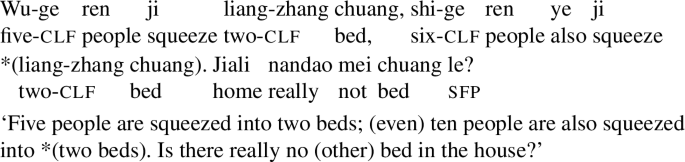
Note that this does not argue against the TBV analysis; in fact, it is exactly as predicted by the TBV analysis, as an overt NumP topic also cannot license a null NumP object when the null object is supposed to be bound by the topic:
- (56)

Another type of construction that may be considered similar to the above construction is where the NumP topic and another NumP inside the (comment of the) sentence form a whole–part or superset–subset relation. For instance, in (57), ‘ten-tenth’ and ‘two-tenth’ form a whole–part relation. However, different from the above case in (52), the null object in (57) does not yield a quantity reading.
- (57)
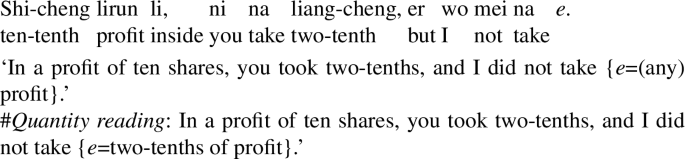
Interestingly, some of my consultants initially felt tempted to report a quantity reading of (57), especially before a context was presented. Once a context such as “In this business, the addressee took two-tenths, and the speaker took one-tenth, and a third person took the rest” is specified, it becomes clear that (57) is no longer acceptable in its quantity reading. Suppose that the SAE analysis is adopted, a quantity reading of the null object is possible provided its linguistic antecedent ‘two-tenths,’ which in fact does not occur. Therefore, the second clause has a topic different from the linguistic antecedent, e.g., a bare nominal topic such as ‘profit,’ as the binder of the variable represented by the null object. The example is then correctly predicted to mean ‘… and I did not take {e=(any) profit}.’ The apparently accessed quantity reading by some native speakers is thus a byproduct of this reading predicted by the TBV analysis, an account to which I will return in Sect. 4.2.
4 Parallelism in interpretation: Why is the quantity reading apparent
I have provided a TBV account for both cases where the quantity reading is absent and where the reading is present. The absence or presence of the quantity reading is determined by whether a NumP with a quantity reading can be the topic. However, previous studies consistently report the quantity reading even when it is, in fact, not available. I refer to this intuitively but illusorily accessed reading as an apparent quantity reading. To understand when and why this reading is accessed, I will investigate the effects of using different or identical predicates when testing the interpretations of null objects. These predicates either disrupt or reinforce the default parallel interpretation between null objects and their antecedents. I argue that the apparent quantity reading arises precisely in cases where this default parallel interpretation is supported by the use of identical predicates. Consequently, when different predicates are used, this parallel interpretation is weakened or even disappears, rendering the quantity reading inaccessible.
4.1 Effects of (non)identical predicates
There is another type of construction that generally disallows null objects to be copies of their linguistic antecedents: when the target sentence with the null object is headed by a predicate that is different from the predicate in the antecedent sentence. I single out this case because the discussion will reveal what have caused previous studies to believe that the quantity reading is generally available. (58) gives evidence for the unavailability of the quantity reading due to such a difference between the two predicates (zheng ‘steam’ vs chi ‘eat’).
- (58)

Crucially, the null object in the second clause can only refer to the buns that were steamed. It cannot be a copy of the quantifier/NumP antecedent. But what happens with the following example, where a quantity reading seems to be possible?
- (59)
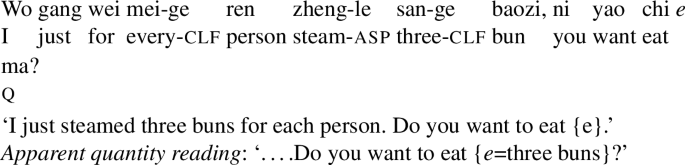
This example is interesting because it appears to allow the quantity reading as a default reading. However, this reading may result from pragmatic reasoning. Since three buns were prepared for each person, by default the speaker might have been asking whether the addressee wanted to eat three buns. Furthermore, because ‘three buns’ in the antecedent clause receives a quantity reading as it is inside the scope of a universal quantifier, the topic of the target clause cannot refer to it in the same way as in (58), leading to the observed difference (see also the relevant discussion of “bathroom sentences” below). Additionally, it should be noted that the example is well accepted if the speaker continues with ‘although there is only an extra one for you,’ thus canceling the quantity reading, confirming that the perceived quantity reading is only a byproduct of an interpretation where the quantity is not specified:
- (60)
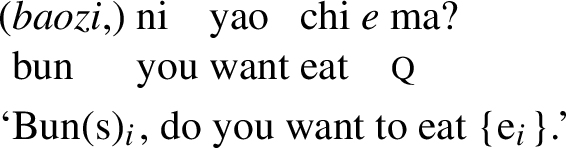
Below, I list more examples of the same pattern as observed in (58), where the specific reading is the dominant reading and the quantity/quantifier reading is generally not accessible, and this seems to be due to the fact that different predicates are used in the antecedent clause and in the target clause with the null object.
- (61)

Note that when a NumP with the number ‘one’ such as yi-ge haizi ‘one-clf child’ is within the scope of negation, it can yield an NPI-like reading, not a regular quantity reading, different from a NumP with a number bigger than one. The NumP in the following sentence, for example, leads to an NPI-like reading, not a regular quantity reading, thus mei zhaodao-guo yige… means ‘have never recruited any…’:
- (62)
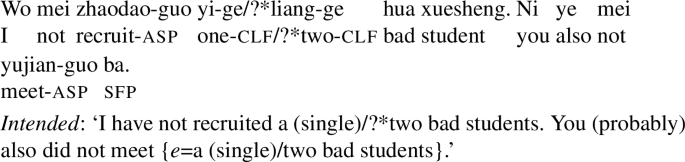
As my focus is the regular quantity reading, I leave aside such NPI-like reading in this article. This is also why in most examples, I use a number bigger than one to avoid this reading.
The following sentence, revised from Bi and Jenks’s (2019) MC version of the “bathroom sentences,” also involves different predicates and prohibits a quantity reading of the null object. However, this sentence is different from the above sentences in an important way: it does not allow for a referential interpretation of the null object because there is no relevant discourse antecedent. This explains why the null object cannot be replaced by an overt pronoun, as overt pronouns require such a discourse antecedent (Bi and Jenks 2019).
- (63)
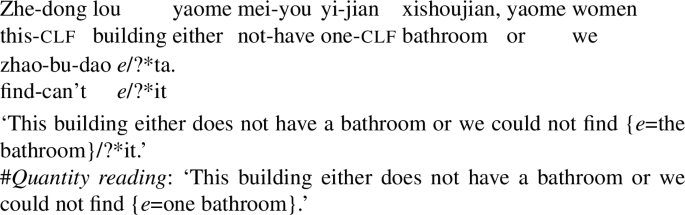
The null object in (63) seems to be best described as bound by a bare nominal topic. (64) shows a TBV analysis of the sentence.
- (64)

Crucially, (64) indicates that the pronoun is still prevented from occurring in the object position after the bare nominal topic is made explicit, as the bare nominal obtains a kind-denoting reading, not a definite or specific reading to which a pronoun refers.
Finally, another type of construction that involves different predicates is what I will call E-type null objects (see Tomioka 2014). The following example in (65) is revised from Tomioka’s (2014) example (20); I use the E-type null objects here to test the quantity reading:
- (65)
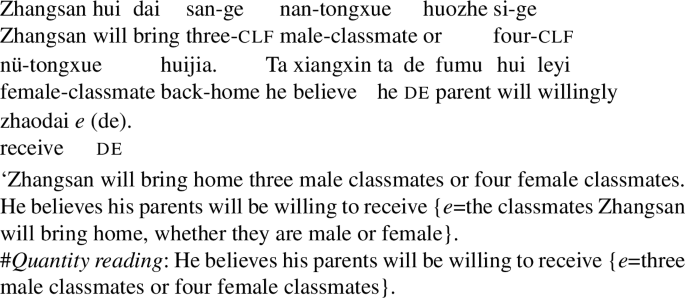
This is an interpretation related to E-type pronouns (see, for example, Evans 1980, Heim 1990, Elbourne 2005) because as the English translation indicates, there is no referential antecedent for the null object. E-type pronouns, like regular pronouns, can be topics. This is probably because of their definite, descriptive property (Neale 1990, Elbourne 2005; see Nouwen 2020 for a review). (66) provides a TBV analysis of the second sentence in (65), with an E-type pronoun as the topic:
- (66)

The upshot of the above discussion is that the quantity reading is barely available whenever the predicate that selects the null object and its antecedent are different, and it cannot even be derived from a generic reading. An immediate question is why the identity of predicates is crucial for the quantity reading to be seemingly available, as exemplified by sentences like (21) discussed in previous studies. It is worth noting that all previous studies claiming that the quantity reading is a reading available to null objects use identical predicates. This is likely not a coincidence. In the next subsection, I will discuss a possible reason that may have contributed to the elicitation of the observed quantity reading. The goal is to explore an account that reconciles the previous claims regarding the existence of the quantity reading and this article’s conclusion concerning the absence of the quantity reading. It turns out that such an account further excludes the possibility that the interpretation of null objects is directly determined by their linguistic antecedent.
4.2 Controlling factor: Parallel interpretation
The previous subsection highlighted a crucial difference between cases where the quantity reading is seemingly available and those where the quantity reading is clearly unavailable: whenever the predicates that select the null object and its antecedent are different, the quantity reading is generally not accessible. I have also argued that even when the same predicates are used, the availability of quantity reading is likely only apparent. This raises the question of why the quantity reading has been claimed to be possible in almost all previous studies on null objects (e.g., Cheng’s (2013) example in (44a) in Chap. 3, Li’s (2014) examples (9) and (10), Li and Wei’s (2023) examples in (32), as well as similar examples found in crosslinguistic studies on Asian languages). What factors have concealed the illusory nature of the quantity reading in cases such as (21)?
The most important controlling factor, I argue, is the default assumption that the antecedent sentence and the sentence containing the null object should be interpreted in a parallel way. When the matching predicates in these two sentences are identical, such an assumption is generally confirmed and reinforced.Footnote16 However, when the predicates are different, such an assumption becomes more risky to hold. (67) presents a direct comparison of these two cases: while the quantity reading is accessible in (67a), it is inaccessible in (67b).
- (67)
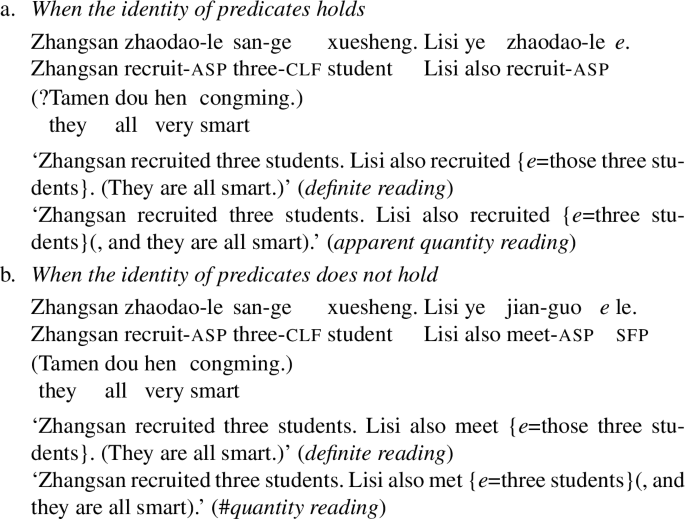
For the sake of convenience, I name this the identity of predicate effect: the identity of the predicates of the two sentences leads to a default preference for parallel interpretation.
More examples where the identity of predicates does not hold can be found below. The null objects receive a definite reading rather than a quantity reading in all these cases. Note that these examples are acceptable if we replace the null objects with the (nonreferential) NumP antecedent objects, which confirms that the unavailability of the quantity reading in these examples are not due to pragmatic reasons.
- (68)
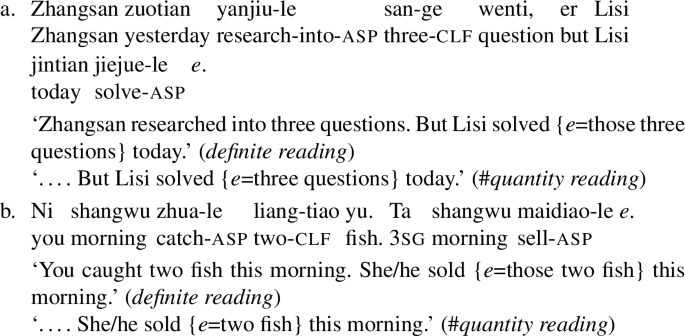
In the above sentences, there is no preference for a parallel interpretation, and consequently, accessing the quantity reading becomes very difficult, if not impossible. In fact, attempting to force a quantity reading without identical predicates renders the sentence semantically quite odd:
- (69)

The identity of predicate effect is not a hard constraint, as we have seen instances where such an effect can be canceled (Sect. 3.3; see also Otani and Whitman 1991). In the rest of this section, I will present evidence to further support the claim that the identity of predicate effect leads to a preferred interpretation, which can be canceled whenever the assumed parallelism is explicitly violated due to a particular setting up in the context. In other words, by manipulating the context, the default assumption of parallelism can be nullified, such that the apparent quantity reading can be “turned on and off” to some extent (as the default assumption of parallelism is generally strong).
Let us start with the following example which was originally employed to support the availability of the quantity reading (example (49) in Cheng 2013:130, with slight modifications):
- (70)
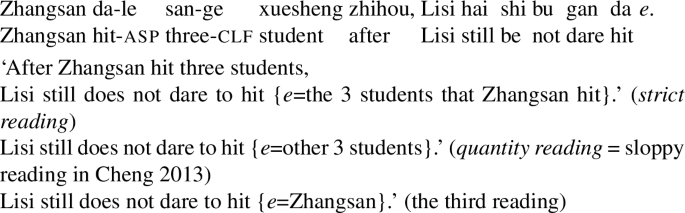
According to Cheng (2013), all the three readings listed in (70) are available. For the SAE analysis, both the strict and quantity readings can be derived easily, as the antecedent of the null object can be interpreted in either way. For the third reading, Cheng (2013) suggests that, as far as SAE analysis is concerned, Zhangsan could be base-generated in the sentence and later gets elided at the PF. Such a proposal does not explain why Zhangsan can be simply elided, whereas ellipsis analysis generally imposes an identity condition between a null object and its antecedent. Cheng (2013) also mentions that the TBV analysis can provide a plausible account for the third reading, as Zhangsan can be projected as the topic of the target clause.
What is crucial for the current purpose is the management of the quantity reading in (70). Again, the idea is that the quantity reading is in fact a byproduct of the assumption that the antecedent and target sentences should be interpreted in a parallel way, an assumption that is supported by the identical predicates in the two sentences. To put it another way, the quantity reading is not due to the copy of the NumP antecedent to the null object position. It is simply a possible and, in most cases, a prominent reading that is licensed by the sentence structures in parallel. An explicit setup of the context, e.g., (71), will bring to the surface a reading that is previously less prominent, overriding the apparent quantity reading, as demonstrated in (74).
- (71)Context: Zhangsan and Lisi together are fighting against 7 other students.
- (72)The sentence in (70) is stated.
- (73)

- (74)
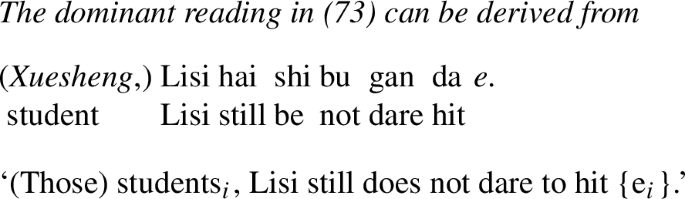
The parallelism between the first and second clause in (70) is disrupted by the context, given that Zhangsan and Lisi are fighting against 7 students together rather than each fighting against 3 students. Consequently, the illusory quantity reading is not able to be derived. However, the sentence is good with a different interpretation that is predictable under the TBV analysis: a bare nominal topic, xuesheng ‘student,’ is projected to bind the null object, which produces the expected definite/specific reading (74) (which further derives the meaning that Lisi does not dare to hit any of those students). This strongly argues against an SAE analysis but could be accommodated under the TBV analysis.Footnote17
Another type of construction that allows us to manage the occurrence of the perceived apparent quantity reading is resultative verb compounds, as have been discussed in Sect. 3.2.5. What makes those examples intriguing is that the dominant reading that is seemingly available is still a quantity reading. Yet such a quantity reading is not as expected by the SAE analysis. It is, again, a familiar byproduct of the interpretation of a null object bound by a generic bare nominal topic (see 39).
To summarize, I have shown that the seemingly available quantity reading observed in previous studies on null objects in MC is a byproduct of the identity of predicates effect that leads to a preferred interpretation of null objects in parallel to their antecedents. Once different predicates are used, this apparent quantity reading disappears. In addition, even when identical predicates are used, such default preference can be explicitly canceled by some special setup of the context. This is to manage the interpretation of null objects by controlling the type of topic to be projected. Therefore, neither the presence nor the absence of the quantity reading cause problems for the TBV analysis; on the contrary, both aspects enhance the idea that the topic plays a mediating role in the interpretation of null objects. This mediating effect of topics receives an adequate account under the TBV analysis: the interpretation of the null object is controlled by the interpretation of the topic that binds the null object.
5 Other competing analyses
In this section, I will briefly review some other competing analyses of null objects in MC and discuss their major advantages and disadvantages.
5.1 Other variants of the AE analyses
I have demonstrated that the SAE analysis is insufficient for deriving the sloppy readings examined in this article and that it overgeneralizes when deriving the quantity reading in cases where it is not accessible. Furthermore, evidence from both the presence and absence of the sloppy reading indicates that the SAE analysis misses the general picture concerning the interpretation of null objects, i.e., the mediating effect of the topic. Together, the evidence strongly supports the TBV analysis over the SAE analysis. One may wonder whether a different variant of the AE analysis might account for the data. Here, I consider two such variants: (i) ellipsis applies to either the whole linguistic antecedent or a part of the antecedent including the bare noun, and (ii) ellipsis applies solely to the bare noun.Footnote18 I refer to these two variants as the “mixed AE analysis” and the “bare AE analysis,” respectively.
The mixed AE analysis enjoys the advantage of flexibility: if either the whole linguistic antecedent or a part of the antecedent including the bare noun can be elided in the target clause with a NumP antecedent, this analysis can be compatible with both the cases where the quantity reading is not attested (via bare noun ellipsis) and those where the quantity reading is attested (via NumP ellipsis). As a result, the mixed AE analysis is generally compatible with the data on the quantity reading. This outcome is not necessarily unwelcome, as AE is arguably an operation that applies to other constructions and languages. However, it is important to note that this article demonstrates that the topic mediates the interpretation of the null object: when a NumP cannot serve as the topic, the quantity interpretation is unavailable or can be canceled; conversely, when a NumP is licensed to be a topic in a special context, the quantity reading is accessible and cannot be canceled. If the mixed AE analysis is adopted, then the mediating role of the topic demands an explanation. One can no longer explain the inaccessibility of the quantity reading where a NumP cannot be a licensed topic in the cases discussed in Sect. 3.2. Furthermore, an explanation is also owed for why the quantity reading is accessed when a NumP topic is licensed as in Sect. 3.3. An immediate account based on the mixed AE analysis would attribute the presence and absence of the quantity reading to arbitrary optionality, which may lead to overgeneralization as the quantity reading is predicted to be always available. As demonstrated in Sects. 3.2.1 through 3.2.6, the quantity reading is not available even when it is syntactically or pragmatically necessary for the sentences with null objects to be acceptable. In addition, the mixed AE analysis also overgenerates in another way: it predicts that the generic reading associated with a bare null object is always available. However, it has been shown that the generic reading is not available when a nonreferential NumP is licensed as the topic that binds the null object.
Regarding the phenomenon of sloppy reading, a perplexing observation for the mixed AE analysis is the instances where elements sandwiched between a possessor and the head noun—for example, an adjective modifier or a relative clause—might be ignored in the interpretation of the null object (Sects. 2.1.1 and 2.1.2). For the mixed AE analysis to accommodate this, it would have to assume that such adjective modifiers or relative clauses can be optionally disregarded. Moreover, when the NP possessor and the NP possessum take the form of a ConjP, the fact that some of the conjuncts might be excluded from the interpretation of the null object poses a significant challenge to the mixed AE analysis (Sects. 2.1.2 and 2.1.3). No known AE analysis would permit the ellipsis of the possessor along with a portion of the ConjP, while excluding another part of that ConjP. In addition, The pragmatic influence discussed in Sect. 2.2 will remain mysterious under the mixed AE analysis.
The bare AE analysis fits squarely with the data where the quantity reading is inaccessible and can likely derive the apparent quantity reading in the same manner as the TBV analysis advocated in this article. However, it struggles to address the presence of the quantity reading as discussed in Sect. 3.3. For instance, considering that it is the bare noun being elided in the target sentence in (52b), repeated below as (75), the continued sentence is predicted to be feasible. However, (75) suggests that this prediction is incorrect.Footnote19
- (75)
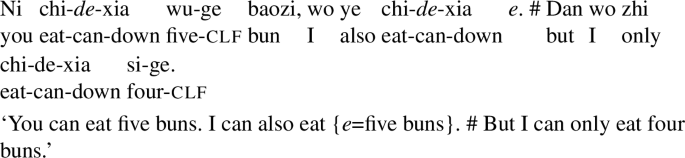
In order to derive the sloppy reading in addition to the strict reading, the bare AE analysis must assume ambiguity in the interpretation of bare nominals, akin to that in Hoji’s Bare Nominal Object analysis, which I will discuss in more detail in Sect. 5.3. Additionally, the bare AE analysis cannot account for cases where a part of the nominal ConjP is excluded from the interpretation of the null object, mirroring the challenges faced by the mixed AE analysis. This data imposes a challenge to the bare AE analysis because the entire nominal ConjP is expected to be elided according to the bare AE analysis and thus should be included in the interpretation of the null object. Much like the mixed AE analysis, the bare AE analysis provides no insight into why pragmatic influences arise.
5.2 The TEC analysis
It is important to note that Li (2014) (and earlier Aoun and Li 2008) proposes a third approach that shares fundamental characteristics of the AE analysis: the elided object is in fact a true empty category which bears only a categorial feature (DP), and this empty object is filled at LF (cf. Oku 1998) based on the content of its antecedent that is provided by the context in general. That is, the content of the antecedent may or may not be specified explicitly and linguistically. This approach is called the True Empty Category (TEC) analysis.Footnote20
The TBV analysis advocated in this article can be compatible with the core proposal of the TEC analysis, if the null object, as an empty category, copies the content of the topic that determines its interpretation. The TEC analysis generates very similar predictions regarding the interpretation of definite null objects as the TBV analysis because it assumes that null objects are filled at LF by what is available from the discourse context (Li 2014:64), along the same lines as how the reference of topics are identified.
However, the TEC analysis can make different predictions from those of the TBV analysis in important ways, depending on its treatment of the antecedent. On the one hand, if the antecedent must be explicitly defined in the antecedent sentence, and if an identity condition (either at PF or LF) must be held between the null object and its antecedent, as in a regular (VP) ellipsis analysis, the TEC analysis will make essentially the same predictions as the SAE analysis regarding the availability of the quantity reading. That is, the TEC analysis predicts that if a quantity reading is possible with the antecedent, it is also possible with the null object. On the other hand, if “the antecedent for the null object can be explicit or implicit in the discourse context” (Li 2014:64), the identity condition for ellipsis is basically rendered trivial as the content of the antecedent is not defined in a principled way. Such a TEC analysis thus predicts a less restricted theory than the SAE analysis: it allows different interpretations of the null object, including the quantity reading. Therefore, the general unavailability of the quantity reading, and more broadly, the mediating effects of the topic (49), remain unexplained in this version of the TEC analysis.
5.3 Hoji’s (1998) Bare Nominal Object analysis
In this subsection, I will compare the TBV analysis with another competing analysis, Hoji’s (1998) Bare Nominal Object (BNO) analysis (cf. Abe and Park 2019), and further underpin the TBV analysis based on an exploration of the mediating role that the topic plays in the interpretation of null objects. Although Hoji’s analysis is originally proposed for Japanese, not MC, the application of the analysis to MC is considered to be not far-fetched, as Hoji (1998:130) has pointed out himself (also see Simpson et al. 2013). The main proposal of the BNO analysis is that null objects are bare nominals that can be interpreted either as definite or indefinite expressions. Therefore, the BNO analysis resorts to the ambiguity of bare nominals to explain the various interpretations of null objects, and the interpretations are not mediated by a topic. For example, (76) is a Japanese example taken from (Hoji 1998:140).
- (76)

The null argument is proposed to be a bare nominal ‘car’ that can refer to either John’s car, yielding the strict reading, or Bill’s car, yielding the sloppy reading. The sloppy reading is therefore assumed to be not a consequence of variable binding, but instead a result of (coincidental) coreference.
The comparison between the TBV analysis and the BNO analysis is meaningful because these two approaches share important features but differ in critical aspects. The TBV analysis, as advocated in this article, highlights the possibility that kind-denoting bare nominals are available as topics, whereas NumPs are not unless they are licensed in special contexts. This overlaps with the BNO analysis, which proposes that the null object is a null version of bare nominals that can be interpreted either as definite or indefinite. In addition, as Simpson et al. (2013) point out, the presence of bare nominals as either definite or indefinite expressions in a language correlates with the availability of null objects (and null arguments in general) in that language. This applies to various languages that have been examined so far, including Japanese, Korean, Turkish, Chinese, Bangla, Hindi, Malayalam, Spanish, and Italian. Tomioka (2003:336) makes a similar generalization: all languages which allow discourse pro-drop also allow (robust) bare NP arguments (cf. Landau 2023 for a review). Given that the TBV analysis makes use of bare nominal topics and the various interpretations available to bare nominals, this analysis also enjoys the same advantages of being a compelling approach that bears the crosslinguistic explanatory power regarding the distribution of null objects.
A critical difference between these two analyses, however, is that the TBV analysis puts the topic in a weighty position in its empirical account, whereas the BNO analysis does not. Therefore, an efficient way to tease apart the predictions of these two approaches is to examine the role of topic in the interpretation of null objects.
While the BNO analysis can account for both definite and indefinite readings by positing the ambiguous nature of bare nominals, this also means that it allows for considerable flexibility in the interpretation of null objects. This flexibility allows the theory to explain cases like (70) and (76) where multiple interpretations are possible. However, the analysis also faces challenges with overgeneralization. It cannot give a satisfactory explanation for rigidity of interpretation in some other cases. For example, it struggles to explain the rigid interpretation of null objects associated with definite antecedents.
The BNO analysis fails to account for the restrictions on the interpretation of the null object in simple sentences such as (77). It cannot exclude the possibility of an indefinite interpretation, which is not available in this case.
- (77)
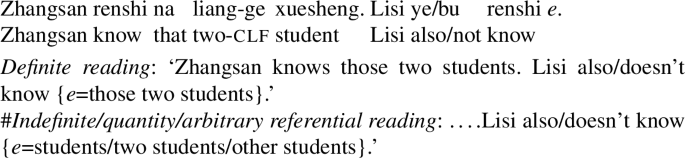
This is because, according to the BNO analysis, null objects come with two flavors, namely, individual type (e) or property type (<e,t>), and both of them are assumed to be freely available, just as Chierchia’s (1998) type-shifting operation can be freely applied to turn a predicate to an individual.Footnote21 Different from (70), (77) allows only the definite reading of the null object, not any other readings, which calls for an explanation.
In order to restrict the interpretation possibilities, one may argue that the definite reading is the most prominent reading given that the interpretation of null objects is highly context-dependent. However, even if we impose a context that favors an indefinite or quantity reading, like (78), still only the definite reading is possible.
- (78)Context in favor of an indefinite or quantity reading of the null object in (77)Zhangsan will interview four students. Zhangsan knew the first two students he interviewed = those two students in (77); but Lisi did not know the other two students.
This restriction on the interpretation of null objects receives a simple explanation under the TBV analysis. According to this analysis, the topic of the target sentence in (77) refers to the object in the antecedent sentence, which is a definite expression. Since the antecedent object is definite, the topic of the target sentence can only receive a definite interpretation: a topic cannot be indefinite or nonspecific while it refers back to a definite expression. Bare nominal topics are available only in cases where the reference of the topic has not been established in the context, and therefore a bare nominal topic can have either a specific or a kind-denoting reading.
The example in (79) further pinpoints another related key distinction between bare nominal objects and null objects: null objects can serve as anaphoric definites, whereas overt bare nominal objects may not, when referring to a definite NumP antecedent (cf. Schwarz 2009, Jenks 2018).
- (79)
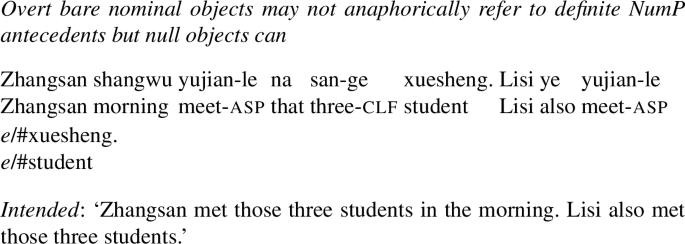
It is unclear what underpins this contrast. However, Simpson and Wu (2022) suggest that (postverbal) objects in MC tend to be interpreted by default as indefinite in reference, and this is not a hard constraint but a preference (see also Dayal and Jiang 2022). It follows, then, that the null object is likely not a covert version of the bare nominal object, contrary to the fundamental assumption of the BNO analysis.Footnote22 The null object must be represented in other ways.
Let us now step back a little and ask: can the TBV analysis restrict the interpretation possibilities in (77) and allow the topic to serve as an anaphoric definite? The answer seems to be in the positive. Note that there are two possible mechanisms for the TBV analysis to derive the definite interpretation of null objects: one is to have a definite expression as the topic, and the other is having a bare nominal with a definite reading in the topic position. Only the latter allows for flexibility of interpretation. The former will give rise to only a definite interpretation, as the variable represented by the null object is bound by a definite topic. The empirical evidence that will be presented below is more aligned with the former mechanism, that is, a definite topic is used to anaphorically refer to the “antecedent” of the null object, and therefore can restrict the interpretation possibilities when the antecedent of the null object is definite.
The main evidence underpinning the employment of anaphoric definite topics when referring to a definite antecedent comes from the observation that overt bare nominal objects are not ideally suited to function as such anaphoric definites. (80a) confirms that a demonstrative phrase topic in the second sentence can refer to a definite antecedent in the first sentence, whereas (80b and c) flag the inability of bare nominal and NumP topics functioning as anaphoric definites.
- (80)
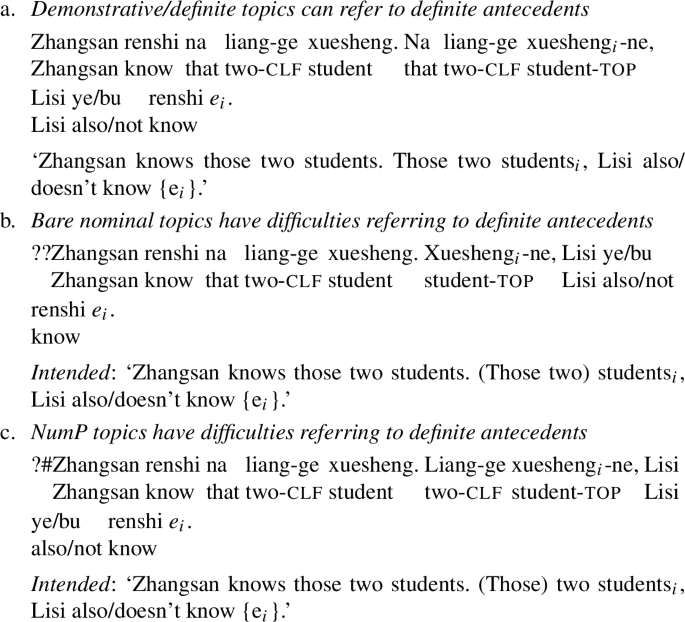
Therefore, I conclude that in cases where antecedents are demonstrative phrases, the topic that binds the variable represented by the null object is most naturally also a demonstrative phrase. When the “antecedent” cannot be a licensed topic, e.g., a nonspecific NumP, a bare nominal topic will be projected for the target sentence. In the case of the sloppy reading, when the pragmatic knowledge obstructs (to some extent) the identity relation between the antecedent and the topic, a similar observation is made: the semantic content of the topic may deviate from its linguistic antecedent. This flexibility is not available in the BNO analysis but is a core mechanism of the TBV analysis.Footnote23 As a point of comparison, in instances where the antecedent sentence contains a nonspecific expression, such as a NumP, a bare nominal topic is projected in the sentence with the null object, rather than a NumP:
- (81)
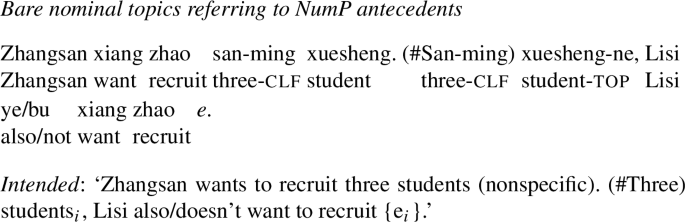
Again, the target/second clause does not specify a quantity, as the topic is a bare nominal. It is the assumption that the two sentences in (81) should be interpreted in parallel, an assumption that is arguably reinforced by the identity of predicate effect, that has led to the emergence of the preference for a perceived quantity reading.
Before concluding, I would like to address an observation related to the data presented throughout this article. It pertains to the relationship between the interpretation of a null object’s antecedent and the subsequent topic, whether overt or null, that governs the null object’s interpretation:
- (82)
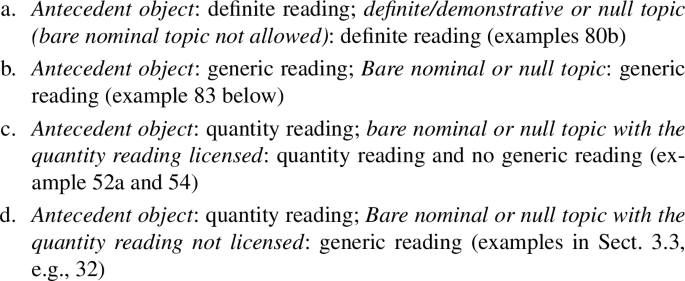
- (83)
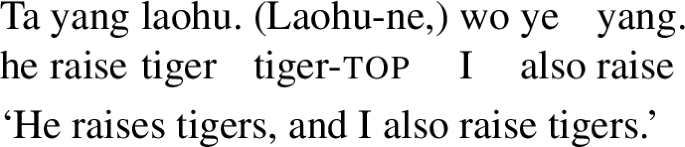
A clear pattern in (82) is that the interpretation of a bare nominal or null topic should, by default, align with that of its linguistic antecedent whenever possible, as illustrated in (82a–c). This holds even when the topic and its antecedent differ structurally. However, if the antecedent object has a quantity reading that the topic cannot support, a null bare nominal topic must be projected, resulting in an interpretation that diverges from the antecedent, as seen in (82d).Footnote24 According to the TBV analysis promoted in this article, such constraints on topic interpretation serve as an important source of restrictions on the interpretation of the null object.
6 Conclusions
This article examines an important prediction of the SAE analysis of null objects in MC: the existence of the sloppy and quantity readings. I argue that, with a closer scrutiny, the absence and presence of these readings do not confirm the predictions of the SAE analysis. I have shown that possible partial exclusion of the adjuncts, possessor, and possessum in the derivation of the sloppy reading suggests that the AE analysis is insufficient. I argue that sloppy reading of the null object can be derived from the TBV analysis with a reconstruction-like mechanism: the reflexive in the topic can be interpreted as a variable in the null object bound by its local subject.
In addition, evidence shows that previously claimed quantity reading is in fact a byproduct of the interpretation of null objects bound by bare nominal topics. A real quantity reading is accessible only when the null object is bound by a NumP that is licensed to be a topic, independent of the type of antecedent the null object has. Therefore, the topic serves a mediating role in the interpretation of the null object. I have illustrated that both the absence and presence of the quantity reading is well-predicted by the TBV analysis but not by the AE analysis (including both the SAE and the weak variants). The TBV analysis correctly predicts that the topic mediates the interpretation of the null object. Various tests have demonstrated that the previously reported quantity reading of a null object is derivable from the generic reading of bare nominal topics, which is then made a salient interpretation of the null object by the identity of predicate effect. This explains the source of this facade quantity reading. The identity of predicate effect highlights a pitfall in previous studies that always use identical predicates for the antecedent sentence and the sentence with the null object, strengthening a parallel interpretation of the null object and its NumP antecedent, leading to the apparent quantity reading.
In addition, the TBV analysis is distinct from a competing analysis where the null object is assumed to be a bare nominal without making a commitment to the projection of a topic binder. This article thus argues that the TBV analysis is worth a serious reconsideration as a potentially adequate and unified analysis of null objects in MC.
Through this study, I seek to establish a theoretical foundation and an empirical framework for future research, both in Mandarin Chinese and other languages where AE analysis is applied to the study of null objects. An indepth examination of null objects in these languages is an important next step of this research, potentially using the same methodologies laid out in this article.
Notes
-
Note that Cheng (2013) intends to use the quantity reading of null objects to demonstrate the necessity of the AE analysis, rather than its exclusivity, as he applies the Topic-bound Variable analysis to some other interpretations of null objects in MC.
-
I assume that null topics are generally available in regular CPs in MC, as Chinese is a topic prominent language, following Chao (2011), Li and Thompson (1976, 1981), Huang (1984), and many others.
-
Note that this article stays neutral regarding whether the topic is base-generated or raised from the null object (different from, e.g., Mizuno (2025), who argues for a movement approach). If the movement approach is adopted, the fact that null objects can occur within islands, as noted in Footnote 10, becomes a potential concern. However, since my consultants generally expressed reservations about sentences with null objects in islands, a more expansive survey or a formal acceptability judgment experiment might be essential to determine the degree of acceptability of null objects within these islands. Additionally, topicalization of objects inside islands received judgments akin to those of null objects in islands. This signals that whatever mechanism underpins topicalization might also underlie the null object, compatible with the overarching proposal of this article. On the other hand, if the base-generation approach is adopted, one might consider the proposal from Wei (2010) and Li (2014) that the variable associated with the null object is a semantic representation of a true empty category. What then distinguishes the current TBV analysis from Li’s (2014) True Empty Category analysis is the mediating role of the topic in the interpretation of the null object, which is extensively discussed in this article (see Sect. 5.2 for more discussion).
-
Due to space considerations, null subjects in MC are intentionally left out of the discussion in this article. Null subjects and null objects have been identified as observing a different set of restrictions and may introduce distinctive complications (see Huang 1984, Huang 1989, Cheng 2013, Li 2014, Abe and Park 2019, and others).
-
This article uses abbreviations following the Leipzig Glossing Rules with the following additions: asp – aspect, de – either a prenominal modification marker, a relative clause marker, or a sentence-final particle, sfp – sentence-final particle.
-
Another possible way to derive the strict reading under the TBV analysis is by considering Object1 (= Reflexive (de NP)) as the topic and applying Takahashi’s (2020) proposal of deriving the strict reading through vehicle change, as the reflexive in the topic can be replaced with a pronoun that corefers with Subject1. In this case, the analysis needs to have only the representation in (5) to derive both the strict and sloppy readings, with vehicle change applied as an additional mechanism to derive the strict reading.
-
Otani and Whitman (1991) raise a potential problem of the TBV analysis. The following example is a potential counterpart of their Japanese example in (7):
- (i)

Their argument is that the sloppy reading is not easily accessible for the sentence as in (1), in which the TBV analysis may assume a null topic, whereas an overt topic for the second clause includes a reflexive possessor such as “self’s garden’s carrot” can be projected to elicit the sloppy reading. However, it must be noted that the reflexive-possessed NP is the subject of the first sentence, not the object; this might have an effect on the availability of the sloppy reading. The example below, in which the antecedent and target sentence are more closely aligned structurally, demonstrates that an NP possessed by a reflexive possessor also results in only the strict reading. In this case, the AE analysis predicts that the sloppy reading should be possible, yet it is not. This suggests that a null topic with a subject antecedent tends to produce a strict reading, possibly for reasons independent from the current issue under discussion:
- (ii)

- (i)
-
In this and other examples in this article, the pause particles -a or -ne serve as topic markers (see, e.g., Chao 2011:90–91).
-
It seems that only when world knowledge makes it unlikely to include certain parts of the conjunct NP possessum in the antecedent can these parts be excluded in the interpretation of the null object (1). This contrasts with regular cases where an identical interpretation of the antecedent object and the null object is forced (2).
- (i)

- (ii)
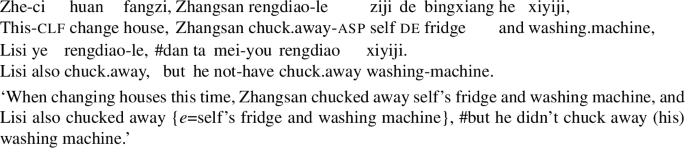
This contrast seems to suggest that an identity relation between the antecedent object and the null object is the default option. Only when such a default relation is not possible is a different interpretation licensed (potentially related to the projection of a different topic). Please see relevant discussion at the end of Sect. 5.3.
- (i)
-
Li (2014) mentions another observation that potentially distinguishes null objects from topic-bound variables, namely, null objects are insensitive to islands whereas topic-bound variables are sensitive. Below are two of the examples she uses to make a contrast between topic-bound variables, which are argued to be constrained by islands, and null objects, which do not observe such constraints (p. 44):
- (i)
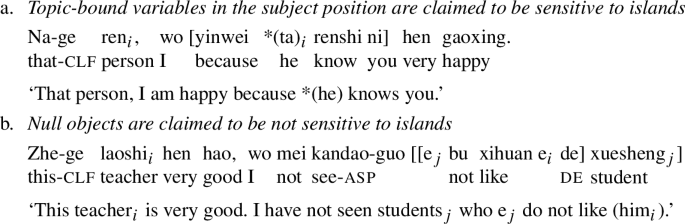
However, it is important to note that a potential confounding factor might have obscured the overall picture. In (1a) the topic is related to a null subject, whereas in (1b) it is a null object. This thus confounds with the so-called subject–object asymmetry effect: topics associated with a null subject inside an island is generally prohibited, whereas topics associated with a null object inside an island is much less restricted (see the debate between Huang (1984, 1987) and Xu and Langendoen (1985), Xu (1986)). In fact, Li (2014) has an insightful discussion of this asymmetry in her article (Sect. 3). Indeed, if we look at topic-bound variables in object positions and null subjects instead, an opposite pattern regarding their sensitivity to islands is revealed. Note that all these cases where island constraints are violated are not completely natural to native speakers. Therefore, what is more important here is the contrast between topic-bound null objects and topic-bound null subjects (e.g., (1a) vs. (2a)).
- (ii)
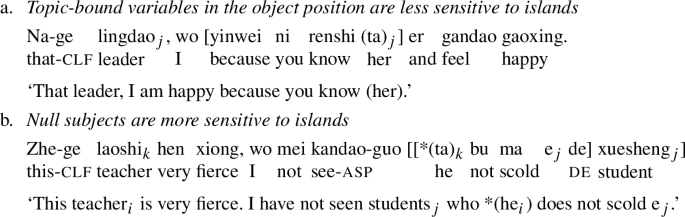
- (i)
-
See Tsai (1994, 2001, 2008), Li (1998), and Huang et al. (2009:328) for relevant discussions of restrictions associated with topics, subjects, and fronted objects in a focus position, which observe similar constraints as objects in the topic position.
-
It is important to use caution when applying the tongshi test. I included yi-ge ren (literally ‘singly’) to exclude a potential alternative reading where tongshi connects the events represented by two clauses, rather than modifying the NumP inside the second clause. For instance, without yi-ge ren, (29b) could be interpreted as Zhangsan and the speaker took care of multiple children simultaneously. (1) below shows another example of this usage of tongshi: here tongshi indicates that the husband’s working at home and taking care of the speaker’s father occur in parallel (the two events overlap).
- (i)

This is an interpretation that is irrelevant to the test, and thus it should be excluded for the test. In principle, the tongshi test should only be applied if the target clause is not acceptable with an overt bare nominal object, as otherwise tongshi is modifying irrelevant elements in the sentence.
- (i)
-
Of course, still another alternative approach is to simply assume that the null object is a bare nominal without being bound by a topic. We will turn back to the differences between this alternative approach and the TBV analysis in Sect. 5.3.
-
Not all resultative constructions lead to the (true/obligatory) quantity reading of null objects. For instance, the resultative construction dapo ‘hit.break’ in (1) does not require a quantity reading on the null object.
- (i)

Again, only resultative constructions that carry the presupposition that a certain amount has been exhausted are used for the test here.
- (i)
-
See Landau (2020) and Simpson (2023) for a relevant debate concerning using negative contexts as a diagnostic for the Verb-Stranding VP-Ellipsis analysis of null objects.
-
Words such as ye ‘also,’ que ‘but,’ you ‘again,’ etc. may also strengthen, although not necessarily require, such a preference for parallel interpretation (Soh 2007).
-
The disappearance of the quantity reading when the predicates differ could potentially support the Verb-Stranding VP-Ellipsis analysis of null objects (Goldberg 2005). However, this analysis struggles to account for the mediating role of topics in the interpretation of null objects. It also incorrectly predicts the availability of the quantity reading when the verbs are identical, as shown in Sect. 3.3. See Cheng (2013) and Li (2014) for additional arguments suggesting that the Verb-Stranding VP-Ellipsis analysis may not be applicable to MC.
-
Note that adding a pro-based analysis (cf. Huang 1984) to the toolbox would not make a significant difference in the theory’s explanatory power to these two variants of AE analysis.
-
Interestingly, Koulidobrova (2017) presents data from American Sign Language where the interpretation of null arguments excludes elements attached to the bare nominal antecedent (such as number or possessor; see p. 404). Koulidobrova (2017) proposes that this occurs because (nonbranching) bare nominals are the arguments intended for ellipsis, similar to the bare AE analysis.
-
The TEC analysis is proposed to account for a whole different set of distributions where null objects are prohibited. The TBV analysis is compatible with the critical data discussed in Li (2014) Sect. 6: In all those cases where null objects are not possible, the sentences are also not acceptable with a topic related to the null objects.
-
See Tomioka (2003) for a proposal that attributes the property type to the application of object NP-raising and existential-closure and individual type the application of iota. Consequently, the bare nominals are not themselves ambiguous. This proposal may be immune to the issue raised here.
-
Note that the sentence is more acceptable if the bare nominal object is interpreted with a generic reading. Then, the target sentence will mean ‘Lisi also/doesn’t meet students.’ This is an interpretation we do not investigate here.
-
This implies that demonstrative phrases are different from bare nominals that have a definite reading.
-
In some other instances, the topic can be a prominent entity in the discourse but unrelated to the linguistic antecedent. These cases are beyond the scope of this article (cf. Hankamer and Sag 1976 for discussion of deep anaphora which exhibits characteristics also observed for null topics in this article). It suffices to note that when such a topic is overt, it can even be entirely independent of both linguistic and discourse contexts. By contrast, as shown in (82), the interpretation of null topic is rather restricted.
References
-
Abe, J., and M. K. Park. 2019. An NP-substitute approach to null arguments in Chinese, Japanese, and Korean. Manuscript.
-
Aoun, J., and Y. H. A. Li. 1989. Scope and constituency. Linguistic Inquiry 20(2):141–172.
-
Aoun, J., and Y. H. A. Li. 2008. Ellipsis and missing objects. In Foundational issues in linguistic theory: Essays in honor of Jean-Roger Vergnaud, eds. J. R. Vergnaud, R. Freidin, C. P. Otero, and M. L. Zubizarreta. Vol. 45, 251–273. Cambridge: MIT Press.
-
Bi, R. A., and P. Jenks. 2019. Pronouns, null arguments, and ellipsis in Mandarin Chinese. In Proceedings of Sinn und Bedeutung, eds. T. Espinal, E. Castroviejo, M. Leonetti, L. McNally, and C. Real-Puigdollers. Vol. 23, 127–142.
-
Chao, Y. R. 1968/2011. A grammar of spoken Chinese. Beijing: University of California Press. Reprinted by the Commercial Press.
-
Chen, Z. 2021. The insignificance reading of shenme revisited. Journal of East Asian Linguistics 30(1):83–107. https://doi.org/10.1007/s10831-021-09220-4.
-
Cheng, L. L. S. 1994. Wh-words as polarity items. Chinese Languages and Linguistics 2:615–640.
-
Cheng, H. T. J. 2013. Argument ellipsis, classifier phrases, and the DP parameter, PhD diss., University of Connecticut, Storrs.
-
Cheng, L. L. S., and R. Sybesma. 1999. Bare and not-so-bare nouns and the structure of NP. Linguistic Inquiry 30(4):509–542. https://doi.org/10.1162/002438999554192.
-
Chierchia, G. 1998. Reference to kinds across language. Natural Language Semantics 6(4):339–405. https://doi.org/10.1023/A:1008324218506.
-
Dayal, V., and L. J. Jiang. 2022. The puzzle of anaphoric bare nouns in mandarin: A counterpoint to index! Linguistic Inquiry 54(1):147–167.
-
Elbourne, P. D. 2005. Situations and individuals, Vol. 90. Cambridge: MIT Press.
-
Evans, G. 1980. Pronouns. Linguistic Inquiry 11(2):337–362.
-
Goldberg, L. M. 2005. Verb-Stranding VP Ellipsis: A Cross-Linguistic Study, PhD diss., McGill University Montreal, Quebec, Canada.
-
Hankamer, J., and I. Sag. 1976. Deep and surface anaphora. Linguistic Inquiry 7(3):391–428.
-
Heim, I. 1990. E-type pronouns and donkey anaphora. Linguistics and Philosophy 13(2):137–177. https://doi.org/10.1007/BF00630732.
-
Hoji, H. 1998. Null object and sloppy identity in Japanese. Linguistic Inquiry 29(1):127–152. https://doi.org/10.1162/002438998553680.
-
Huang, J. C. T. 1982. Logical relations in Chinese and the theory of grammar, PhD diss., MIT.
-
Huang, C. T. J. 1984. On the distribution and reference of empty pronouns. Linguistic Inquiry 15(4):531–574.
-
Huang, J. C. T. 1987. Remarks on empty categories in Chinese. Linguistic Inquiry 18(2):321–337.
-
Huang, J. C. T. 1989. Pro-drop in Chinese: A generalized control theory. In The null subject parameter, eds. O. A. Jaeggli and K. J. Safir, 185–214. Dordrecht: Kluwer Academic. https://doi.org/10.1007/978-94-009-2540-3_6.
-
Huang, J. C. T. 1991. Remarks on the status of the null object. In Principles and parameters in comparative grammar, ed. R. Freidin, 56–76. Cambndge: MIT Press.
-
Huang, A. 2013. Insignificance is significant: Interpretation of the wh-pronoun shenme ‘what’ in Mandarin Chinese. Language and Linguistics 14(1):1–45.
-
Huang, Z., and Y. Jiang. 2009. The function of měi in měi-nps. In 21st North American Conference on Chinese Linguistics (NACCL-21), ed. Y. Xiao. Vol. 2, 304–322. Bryant University.
-
Huang, J. C. T., A. Y. H. Li, and Y. Li. 2009. The syntax of Chinese. Cambridge: Cambridge University Press.
-
Jenks, P. 2018. Articulated definiteness without articles. Linguistic Inquiry 49(3):501–536. https://doi.org/10.1162/ling_a_00280.
-
Ke, A. H. 2023. Syntax and semantics of NPs in Chinese possessive topic constructions. Journal of East Asian Linguistics 32:133–167. https://doi.org/10.1007/s10831-023-09254-w.
-
Kim, S. 1999. Sloppy/strict identity, empty objects, and NP ellipsis. Journal of East Asian Linguistics 8(4):255–284.
-
Koulidobrova, E. 2017. Elide me bare: Null arguments in American Sign language. Natural Language & Linguistic Theory 35:397–446.
-
Landau, I. 2018. Missing objects in Hebrew: Argument ellipsis, not VP ellipsis. Glossa: A Journal of General Linguistics 3(1):76. https://doi.org/10.5334/gjgl.560.
-
Landau, I. 2020. On the nonexistence of verb-stranding VP-ellipsis. Linguistic Inquiry 51(2):341–365.
-
Landau, I. 2023. Argument ellipsis as external merge after transfer. Natural Language & Linguistic Theory 41:793–845. https://doi.org/10.1007/s11049-022-09552-3.
-
Li, Y. H. A. 1992. Indefinite wh in Mandarin Chinese. Journal of East Asian Linguistics 1(2):125–155. https://doi.org/10.1007/BF00130234.
-
Li, Y. H. A. 1998. Argument determiner phrases and number phrases. Linguistic Inquiry 29(4):693–702. https://doi.org/10.1162/ling.1998.29.4.693.
-
Li, Y. H. A. 2000. Topic structures and minimal effort. ZAS Papers in Linguistics 20:1–20.
-
Li, Y. H. A. 2014. Born empty. Lingua 151:43–68. https://doi.org/10.1016/j.lingua.2013.10.013.
-
Li, C. N., and S. A. Thompson. 1976. Subject and topic: A new typology of language. In Subject and topic, ed. C. N. Li, 457–489. New York: Academic Press.
-
Li, C., and S. Thompson. 1981. Mandarin Chinese: A functional reference grammar. Berkley: University of California Press.
-
Li, A. Y. H., and T. C. Wei. 2023. Nominal ellipsis in Chinese, Oxford research encyclopedia of linguistics. London: Oxford University Press. https://doi.org/10.1093/acrefore/9780199384655.013.912.
-
Lin, J. W. 1996. Polarity licensing and wh-phrase quantification in Chinese, PhD diss., University of Massachusetts at Amherst.
-
Merchant, J. 2013. Diagnosing ellipsis. In Diagnosing syntax, eds. L. L. S. Cheng and N. Corver. Vol. 1, 537–542. Oxford: Oxford University Press.
-
Mizuno, T. 2025. Argument ellipsis as topic deletion. Natural Language & Linguistic Theory 1–56.
-
Neale, S. 1990. Descriptions. Cambridge: MIT Press.
-
Nouwen, R. 2020. E-type pronouns. In The Wiley Blackwell companion to semantics, 1–28. New York: Wiley. https://doi.org/10.1002/9781118788516.sem091.
-
Oku, S. 1998. A theory of selection and reconstruction in the minimalist perspective, PhD diss., University of Connecticut, Storrs.
-
Otani, K., and J. Whitman. 1991. V-raising and VP-ellipsis. Linguistic Inquiry 22(2):345–358.
-
Saito, M. 2007. Notes on East Asian argument ellipsis. Language Research 43:203–227.
-
Sakamoto, Y. 2020. Silently structured silent argument. Amsterdam: Benjamins.
-
Schwarz, F. 2009. Two types of definites in natural language, PhD diss., University of Massachusetts at Amherst.
-
Şener, S., and D. Takahashi. 2010. Ellipsis of arguments in Japanese and Turkish. Nanzan Linguistics 6:79–99.
-
Shi, D. 1992. The nature of topic comment constructions and topic chains, PhD diss., University of Southern California.
-
Simpson, A. 2023. In defense of verb-stranding VP ellipsis. Syntax 26(4):431–448.
-
Simpson, A., and Z. Wu. 2022. Constraints on the representation of anaphoric definiteness in Mandarin Chinese. In New explorations in Chinese theoretical syntax: Studies in honor of Yen-Hui Audrey Li, Vol. 272, 301. Amsterdam: Benjamins. https://doi.org/10.1075/la.272.11sim.
-
Simpson, A., A. Choudhury, and M. Menon. 2013. Argument ellipsis and the licensing of covert nominals in Bangla, Hindi and Malayalam. Lingua 134:103–128. https://doi.org/10.1016/j.lingua.2013.06.007.
-
Soh, H. L. 2007. Ellipsis, last resort, and the dummy auxiliary shi ‘be’ in Mandarin Chinese. Linguistic Inquiry 38(1):178–188.
-
Takahashi, D. 2008. Quantificational null objects and argument ellipsis. Linguistic Inquiry 39(2):307–326. https://doi.org/10.1162/ling.2008.39.2.307.
-
Takahashi, D. 2014. Argument ellipsis, anti-agreement, and scrambling. In Japanese syntax in comparative perspective, ed. M. Saito, 88–116. Oxford: Oxford University Press.
-
Takahashi, D. 2020. Derivational argument ellipsis. The Linguistic Review 37(1):47–74.
-
Tomioka, S. 2003. The semantics of Japanese null pronouns and its cross-linguistic implications. In The interfaces: Deriving and interpreting omitted structures, eds. K. Schwabe and S. Winkler. Vol. 61, 321–339. Amsterdam: Benjamins.
-
Tomioka, S. 2014. Micro-parameters in discourse pro-drop languages: Comments on “born empty” by Yen-Hui Audrey Li. Lingua 151:69–77. https://doi.org/10.1016/j.lingua.2014.07.015.
-
Tsai, W. T. D. 1994. On economizing the theory of A-bar dependencies, PhD diss., MIT.
-
Tsai, W. T. D. 2001. On subject specificity and theory of syntax-semantics interface. Journal of East Asian Linguistics 10(2):129–168. https://doi.org/10.1023/A:1008321327978.
-
Tsai, W. T. D. 2008. Object specificity in Chinese. The Linguistic Review 25:479–502. https://doi.org/10.1515/TLIR.2008.014.
-
Wei, T. C. 2010. A movement and resumption approach to VP-ellipsis in Mandarin Chinese. Tsing Hua Journal of Chinese Studies 40(1):113–158.
-
Xu, L. 1986. Free empty category. Linguistic Inquiry 17(1):75–93.
-
Xu, L. 2003. Remarks on VP-ellipsis in disguise. Linguistic Inquiry 34(1):163–171.
-
Xu, L., and D. T. Langendoen. 1985. Topic structures in Chinese. Language 61(1):1–27.
-
Zhang, M. 2009. Hanyu huati-hua jiegou xianzhi zhong de linjie tiaojian: Renzhi chuli jiaodu de lunzheng [A revisit of subjacency constraint in Chinese topicalization from the perspective of cognitive processing]. In Yuyanxue Luncong [Essays on Linguistics], ed. J. Lu. Vol. 39, 523–557. Beijing: Commercial Press.
Acknowledgements
The core data in this article primarily come from individual interviews with five native speakers of Mandarin Chinese. I also consulted other native speakers as needed for specific examples, as indicated in this article. I am deeply grateful to all of them for their invaluable contributions. Special thanks go to Dr. Yanmin Zhang and Dr. Quan Wan for their insightful feedback. Many thanks go to the audience in the 59th Annual Meeting of the Chicago Linguistic Society (CLS 59) for their helpful comments. I also appreciate the constructive comments and suggestions from the anonymous reviewers and Associate Editor Dr. Vera Gribanova, which have greatly strengthened this article’s argument and readability. Any remaining errors are my own.
Ethics declarations
Competing Interests
The author declares no competing interests.
Additional information
Publisher’s Note
Springer Nature remains neutral with regard to jurisdictional claims in published maps and institutional affiliations.
Rights and permissions
Open Access This article is licensed under a Creative Commons Attribution 4.0 International License, which permits use, sharing, adaptation, distribution and reproduction in any medium or format, as long as you give appropriate credit to the original author(s) and the source, provide a link to the Creative Commons licence, and indicate if changes were made. The images or other third party material in this article are included in the article’s Creative Commons licence, unless indicated otherwise in a credit line to the material. If material is not included in the article’s Creative Commons licence and your intended use is not permitted by statutory regulation or exceeds the permitted use, you will need to obtain permission directly from the copyright holder. To view a copy of this licence, visit http://creativecommons.org/licenses/by/4.0/.
Reprints and permissions
About this article
Cite this article
Ke, A.H. Mandarin null objects: Topic-binding over argument ellipsis. Nat Lang Linguist Theory (2025). https://doi.org/10.1007/s11049-025-09670-8
- Received
- Accepted
- Published
- DOI https://doi.org/10.1007/s11049-025-09670-8
Keywords
- Null object
- Topic
- Variable
- Quantity reading
- Sloppy reading
- Argument ellipsis
- Empty category
