
 info@apippress.com
 +86 18163351462 (WhatsApp)
 +86 182 8014 0209
Article Content
Abstract
This longitudinal study examined relations between mixed-sex peer interactions and adjustment in Chinese adolescents. Participants included 461 sixth grade students (223 boys; initial mean age = 12 years) in junior high schools in urban China. Data on mixed-sex peer interactions and social and school adjustment were obtained from multiple sources. The results showed that mixed-sex peer interactions significantly predicted higher social competence one year later. Mixed-sex interactions were associated with reduced loneliness for adolescents who were low on same-sex social preference and increased social competence for those who were high on same-sex social preference. Mixed-sex interactions were also associated with higher social competence and less learning problems for adolescents who were high on opposite-sex social preference. The results indicate the developmental significance of adolescents’ mixed-sex peer interactions in the contemporary Chinese context and help alleviate parents’ and teachers’ concerns about their adverse impact on social and academic development.
Research has consistently shown that young children prefer to play with same-sex peers, which represents a distinct characteristic of the social world of boys and girls (e.g., Fabes et al., 2003; Maccoby, 1998). The sex-segregated pattern of peer interactions has been observed in childhood across cultures (Liu & Chen, 2003; Wu, 1997). As puberty begins, youth display increased interest in opposite-sex peers and start to expand their social activities beyond cliques of same-sex peers (Brown, 1999). As a result, mixed-sex peer interactions become increasingly evident from early adolescence (e.g., Lam et al., 2014; Martin et al., 2018). According to Dunphy (1963), the developmental progression to mixed-sex interactions may occur through the process of same-sex groups of boys and girls joining together. Mixed-sex peer interactions based on the merging and integration of boys’ and girls’ interaction styles, such as activity- and emotion-oriented activities (Maccoby, 1998; Rose & Rudolph, 2006), constitute an important context in which adolescents understand diverse perspectives, learn social skills for interaction with opposite-sex peers, and develop competencies that are needed for functioning in future romantic relationships and mixed-sex work environments (Connolly & Johnson, 1996).
According to Sullivan (1953), social relationships serve to fulfil important social needs across developmental periods and have implications for psychological adjustment. From early adolescence, due to the heightened need for intimacy, youth are interested in interactions and relationships outside of their familiar same-sex peer spheres. Research indicates that adolescents often experience difficulties (e.g., rejection and misunderstanding by opposite-sex peers) in their initial attempt to get involved in mixed-sex groups (O’Neill, 2021; Thorne, 1993). However, the experiences in mixed-sex settings may bring about benefits for socioemotional wellbeing over time (Grygiel et al., 2022; Rose & Smith, 2018). From a different perspective, the intergroup contact theory (Pettigrew et al., 2011) asserts that contact with members of different groups promotes social diversity, which may lead to new alternative ways of thinking and behaving and positive attitudes toward others. As argued by Martin and colleagues (2018), the diversity of interactions with mixed-sex peers facilitates the generation of various problem-solving strategies and strengthen motivations to achieve in social and academic areas. Moreover, as youth strive to gain independence from their families, mixed-sex interactions may help them attain socioemotional support that is not available in same-sex interactions for coping with stress and distress and pursuing positive self-regard in a broader social environment (Martin et al., 2018).
Despite the arguments about the significance of adolescents’ mixed-sex interactions, little research has been conducted on their relations with adjustment outcomes, and the findings from the limited existing research are inconsistent. It was found, for example, that adolescents who had connections with more mixed-sex and opposite-sex peers reported higher levels of school belonging and happiness (Martin et al., 2022; Procsal et al., 2015) and performed better in social and academic areas (e.g., Connolly et al., 2004; Willoughby et al., 2009). Mixed-sex peer experiences were also associated with increased self-esteem and social satisfaction among high school students (e.g., Csikszentmihalyi & Larson, 1984). On the other hand, researchers reported that mixed-sex peer affiliation might bring about increased risks for alcohol use, smoking, violence, early sexual activities, and antisocial behaviors, particularly in adolescent girls (e.g., Allen et al., 2013; Lam et al., 2014; Molloy et al., 2014; O’Neill, 2021). It should be noted that a large number of studies have been conducted about adolescents’ interactions and relationships with opposite-sex peers or friends, particularly in dyadic settings (e.g., Procsal et al., 2015). Whereas the findings may help us understand some aspects of mixed-sex interactions because they involve opposite-sex peers, the two types of social interactions may be distinct in the nature and features of the context and experiences (e.g., levels of social complexity and associated stress, exposure to the diversity of perspectives). The present study focused on mixed-sex interactions, which is particularly important for early adolescents in Chinese society.
Mixed-Sex Peer Interactions in Chinese Context
Interactions with same-sex peers, especially those who are socially and academically competent, are generally supported in China (e.g., Chen et al., 2018). However, parents and teachers often have ambivalent or even negative attitudes toward interactions involving opposite-sex peers among Chinese adolescents (e.g., Ji et al., 2017; Li, 2006; Sun, 2011). A primary developmental task for school-age children and adolescents is to acquire academic achievement in school (Chen, 2023; Pomerantz et al., 2014). Adolescents are required to concentrate on learning and perform optimally on schoolwork, which is directly associated with future educational, occupational, and social status. At the same time, schools are responsible for creating an environment that helps students gain knowledge and improve their academic performance without distractions. This is particularly the case from junior high school when students face great pressure in competition to get into a high-quality or key senior high school, which provides better opportunities to succeed on the final nationwide college-entrance examinations. Parents and teachers are concerned that youth might develop increased sexual interest but lack adequate abilities to control their behaviors in interactions with opposite-sex peers, which may undermine their academic learning and school performance (Li, 2006; Li et al., 2019). As a consequence, adolescents are often discouraged or even forbidden to engage in opposite-sex peer interactions. For example, some high schools in China have policies and rules to prevent opposite-sex interactions, such as “Do not send text messages to each other” and “Do not sit together for lunch” between male and female students (Seven special rules, 2013). It was reported that a high school in Sichuan province stipulated that opposite-sex students were not allowed to talk or interact with each other within half a meter; violating the rule might result in criticisms of teachers and other disciplinary actions (Education Network, 2014).
Researchers and professionals in China have, however, argued that there may be benefits of mixed-sex peer interactions for the development of social skills and psychological wellbeing (Li, 2006; Sun, 2011). For example, young adults often report heightened stress and difficulties when they start to date, typically after they complete their education and have a secure job (e.g., Nu et al., 2015; Tian et al., 2020). Interactions with mixed-sex peers in adolescence may provide opportunities for youth to acquire skills, experiences, and confidence that are useful for dating in the future. Whereas parents and teachers may be highly concerned about adolescents’ interactions with opposite-sex peers in a one-to-one setting (Sun, 2011), interactions with multiple mixed-sex peers can be an alternative that is less directly related to sexual behaviors and their associated consequences. Adolescents may also prefer mixed-sex peer interactions because, relative to dyadic opposite-sex peer interactions, they are more similar to familiar same-sex peer interactions and thus less challenging and stressful (Brown, 1999; Tuval-Mashiach et al., 2008).
Over the past three decades, due to its massive economic reform, China has changed dramatically toward a competitive, market-oriented society, particularly in urban regions. During this period, Western ideologies and values, particularly those pertaining to individual freedom, pursuit of personal interest, and self-expression, have been increasingly accepted, especially by young people. The social change in past decades has affected school policies, family socialization patterns, and individual attitudes, which may have implications for adolescents’ social interactions, including mixed sex interactions. For example, although dating is still typically considered undesirable, many high schools in mainland China have changed the rules and practices to allow for interactions involving opposite-sex classmates (Zhu & Feng, 2016). Parents and teachers have begun to understand and accept adolescents’ mixed-sex peer interactions and believe that the prohibition of these interactions may not be an effective strategy to enhance adaptive adolescent development (Ji et al., 2017; Li, 2006).
The increasingly positive social attitudes may contribute to an environment that supports adolescents to engage in mixed-sex peer interactions, which may enhance their self-confidence and facilitate learning processes. The experiences may be complementary to those of same-sex interactions, allowing adolescents to develop a more complete and balanced set of competencies and qualities that are needed to achieve group harmony and individual wellbeing (Maccoby, 1998). Relative to dyadic peer interactions, interactions with multiple mixed-sex peers with diverse values may be particularly useful for youth to learn and practice relevant skills to perform in the larger school context and in the society. The feedback, assistance, and emotional support of peers from different perspectives in mixed-sex interactions may also help adolescents who display social and psychological problems to understand the problems and to improve their functioning.
Mixed-Sex Peer Interactions and Adjustment: The Present Study
A sample of junior high (middle) school students in an urban area of China participated in the study. We assessed adolescents’ mixed-sex peer interactions using self-reports. We also collected data on adolescents’ same-sex and opposite-sex social preference or likeability. In addition, we collected one-year longitudinal data on social and school adjustment from multiple sources including peer evaluations, teacher ratings, self-reports, and school records. The longitudinal data allowed us to examine unique contributions of mixed-sex peer interactions to later adjustment with initial adjustment status (stability) and social preference controlled.
The first objective of the study was to examine how mixed-sex peer interactions were associated with later adjustment in Chinese adolescents. Based on the literature on the constructive function of mixed-sex interactions in adolescents’ adaptive development (Connolly et al., 2004; Grygiel et al., 2022; Willoughby et al., 2009) and our previous discussion, we expected that mixed-sex peer interactions would be positively associated with later adjustment and negatively associated with later adjustment problems. More specifically, we expected that mixed-sex interactions would be positively associated with later social competence and leadership and negatively associated with later learning problems and loneliness.
The second objective of the study was to examine whether same-sex and opposite-sex social preference would affect the relations between mixed-sex interactions and adjustment. It seems reasonable to argue the relations between mixed-sex interactions and adjustment may vary for adolescents who have different relationships with same-sex and opposite-sex peers. We speculated that same-sex and opposite-sex relationships, as indicated by social preference, might moderate the relations between mixed-sex interactions and adjustment in different manners. Specifically, research has shown that social preference, as a major indication of social competence, are generally associated with various skills, such as active initiation and cooperation, in social interactions among children and adolescents (Chen et al., 2005; Liu et al., 2023; Rubin et al., 2015; Xiong et al., 2023). Adolescents who are liked by opposite-sex peers, as reflected in higher opposite-sex social preference, may receive support from opposite-sex peers in mixed-sex interactions and experience lower levels of stress and less obstacles in these settings, which may help them develop confidence in display their strengths and contribute to better adjustment outcomes. However, adolescents with low opposite-sex peer preference may not acquire evident benefits in mixed-sex interactions. Same-sex peer social preference may have different moderating effects on the relations between mixed-sex interactions and adjustment. For adolescents who have difficulties in same-sex peer relationships, mixed-sex interactions, as a different social context, may offer new opportunities to obtain support to cope with their difficulties (Grygiel et al., 2022). These adolescents may be more likely than others to appreciate the opportunities and attempt to use the resources to improve their social and psychological wellbeing. Thus, it seemed reasonable to expect that the contributions of mixed-sex interactions would be more evident for adolescents who were low on same-sex social preference than for adolescents who were high on same-sex social preference.
Method
Participants
The original sample consisted of 461 sixth grade students (223 boys, 48%) in two regular middle schools in Shanghai, P. R. China. Unlike a small number of “key” schools in the city in which students were often selected from different areas on the basis of their school performance, students in regular schools came from the residential areas in which the school is located. There were 13 classes in the study, with about 40 students in each class. The mean age of the participants was 11 years, 9 months (SD = 6 months). The core curriculum, structure, and organization of middle schools are similar in China. Students are encouraged to participate in a variety of extracurricular social and academic activities in school, which provides extensive opportunities for adolescents to interact with each other. One teacher is designated as the head teacher to be in charge of a class. This head teacher often teaches one major course and takes care of the social and daily activities of the class. Students are not allowed to switch classrooms. The schedule of courses and other activities are typically identical for students in the same class.
In the sample, 438 of the participants (95%) were from intact families; the remainder came from families with one parent due to parental divorce or death. Of the participants, 313 (68%) were only children in the family; the others had one or more siblings. The participants came from families with mostly low to middle socioeconomic status. Preliminary analyses indicated nonsignificant differences between the different types of families on the variables or relations of interest in the study.
From the original sample, 408 (195 boys, 48%) students in seventh grade participated in the follow up study one year later. There were nonsignificant differences on the Time 1 variables between students who participated in the follow up study and who did not.
Procedure
We group administered to the adolescents a peer assessment measure of social competence, a sociometric nomination measure of social preference, and a self-report measure of loneliness. Teachers were asked to complete a rating scale for each participant concerning his or her learning problems. Data concerning adolescents’ leadership in school were obtained from school records. The same data were collected from the sample 1 year later. In addition, the participants completed a self-report measure of mixed-sex peer interaction in the initial study. The data were collected near the end of the school year (May and June) at each time.
The members of our research team carefully examined the items in the measures, using a variety of strategies, such as repeated discussion in the research group and interviews with students and teachers. Extensive explanations of the procedure were provided during administration. No evidence was found that the participants had difficulties understanding the procedure or the items in the measures. The administration of the measures was carried out by a group of psychology faculty and graduate students in China. All students in the schools were invited to participate in the study with no criteria for exclusion. The study was approved by the Institutional Review Board. Active written consent was obtained from parents and active written assent was obtained from the participating students through the school. The participation rate (of all students who were invited, those who agreed to participate) was approximately 95% each time.
We performed power analysis for the model with the moderator effects of same-sex and opposite-sex peer preference, with seven predictors in predicting adolescents’ later adjustment. The analysis indicated that the minimum sample sizes of 65, 109, and 153 participants were needed to achieve power levels of 0.80, 0.90, and 0.95. Thus, the present study is well-powered to detect medium-sized effects.
Measures
Mixed-Sex Peer Interaction
Adolescents’ mixed-sex peer interaction experiences were assessed with a measure that we developed for the study. The measure was created through the iterative process of discussions among research groups and adolescents and psychometric evaluations (e.g., item analyses, internal consistency assessments, factor analyses to examine the dimensionality of the scale and factor loadings, replications). The 6 items in the measure assessed the frequencies of activities involving mixed-sex peer interactions: “How often do you play/ hang out after school/ study (e.g., doing homework or preparing for an exam) or work on a school project/ stay outside in the evening/ engage in leisure activities (e.g., watching movies, going to concerts, doing physical exercise)/ discuss topics related to school and other matters, with a group of both boys and girls?”. The participants were asked to rate the items on a 5-point scale: (1) Never, (2) Rarely (one or two times per year), (3) Occasionally (one or two times per month), (4) Sometimes (one or two times per week), and (5) Often (multiple times a week). The measure showed adequate psychometric properties. The goodness of fit for a one-factor model was acceptable, χ2(6) = 11.627, CFI = 0.994, TLI = 0.984, and RMSEA = 0.047, and SRMR = 0.016, with standardized factor loadings ranging from 0.441 to 0.759. The internal reliability (Cronbach’s alpha) for the measure was 0.83.
Social Preference
Students were asked to nominate up to three classmates with whom they most liked to be and three classmates with whom they least liked to be (positive and negative nominations). The nominations received from same-sex and opposite-sex peers were totaled and then standardized within gender to permit appropriate comparisons. The procedure was shown to be appropriate and valid in previous studies with Chinese adolescents (e.g., Liu et al., 2017). Test–retest reliabilities (interval of two weeks) in a different sample (N = 132) of Chinese students were 0.77 and 0.93 for positive and negative sociometric nominations, respectively. Following the Coie et al. (1982) procedure, indexes of same-sex and opposite-sex social preference, which indicate how well an individual is liked by same-sex and opposite peers, were formed by subtracting negative nomination scores from positive nomination scores.
Social Competence
We assessed adolescents’ social competence using a peer assessment measure adopted from the Revised Class Play (RCP, Masten et al., 1985). The RCP is widely used in the U.S. and other countries. This technique has been found particularly useful in assessing students’ social competence in different contexts because it taps into the insiders’ perspectives. Consistent with the procedure outlined by Masten et al. (1985), during administration, the research assistant read each of the behavioral descriptors, and students were asked to nominate up to three classmates who could best play the role if they were to direct a class play. Nominations received from all classmates were used to compute item scores for each student. The item scores were standardized within the class to adjust for differences in the number of nominators. The variable of social competence was formed based on the five items in the scale (e.g., “A person who everyone listens to,” “Someone who helps other people when they need it”). The goodness of the model fit for the model was acceptable, χ2(29) = 134.380, CFI = 0.962, TLI = 0.942, RMSEA = 0.089, and SRMR = 0.055, with standardized factor loadings ranging from 0.681 to 0.840 and from 0.628 to 0.892 at Time 1 and Time 2, respectively. The measure was shown to be reliable and valid in other studies with samples of Chinese students (e.g., Chen et al., 1995, 2005; Liu et al., 2023). The internal reliabilities of this measure were 0.85 and 0.85 at Times 1 and 2, respectively, in the present study.
Leadership
There are various formal student organizations, which are often hierarchical in nature, in Chinese schools. Leaders of these organizations, elected by peers and teachers, are usually believed to be good students in social and behavioral aspects. Leadership at a higher level such as school level is considered as indicating greater competence than that at a lower level such as the class or within class group level. Data on student leadership were collected from school records. Leadership was coded as follows: Students who were small group leaders within the class received a score of 1; students who held leadership positions at the class level (e.g., class committee member) and at the school level received scores of 2 and 3, respectively. Students who did not hold leadership positions were given a score of 0. Leadership scores were standardized within the class and then used in the analyses. This information has been shown to be a useful indicator of social competence in Chinese students (e.g., Chen et al., 2005; Liu et al., 2023).
Learning Problems
The head teacher in each class completed a measure of learning problems adapted from Hightower et al. (1986). The teacher was asked to rate, on a five-point-scale ranging from 1 (not at all) to 5 (very well), how well each of six items described the participant in assessing learning problems (e.g., “Having problems in learning academic subjects,” “Poorly motivated to achieve”). The total scores were standardized within the class to control for the teacher’s response style and to allow for appropriate comparisons. The measure was shown to be reliable and valid (e.g., concurrent and predictive validities with measures from other sources such as school grades and school attitudes) in other studies with Chinese students (e.g., Chen et al., 2019; Liu et al., 2023). The goodness of fit for the model was acceptable, χ2(47) = 142.151, CFI = 0.964, TLI = 0.949, RMSEA = 0.067, and SRMR = 0.043, with standardized factor loadings ranging from 0.437 to 0.796 at Time 1 and from 0.550 to 0.891 at Time 2. The internal reliabilities of the measure were 0.85 and 0.87 learning problems at Times 1 and 2, respectively, in this study.
Loneliness
Students’ loneliness was assessed by a self-report measure adapted from Asher et al. (1984). The participants were asked to respond to 12 self-statements (e.g., “I have nobody to talk to,” “I feel lonely”) using a five-point scale (1 = not at all true; 5 = always true). The goodness of fit of the model was acceptable, χ2(242) = 690.831, CFI = 0.914, TLI = 0.902, and RMSEA = 0.064, and SRMR = 0.046, with standardized factor loadings ranging from 0.419 to 0.867 and from 0.521 to 0.857 at Times 1 and 2, respectively. The measure was shown to be reliable and valid in other studies with Chinese students (e.g., Chen et al., 2014). The internal reliabilities were 0.89 and 0.93 at Times 1 and 2, respectively, in this study.
Results
Descriptive Data
The Little’s MCAR test (Little, 1988) for the missing data showed that they were missing completely at random, χ2(434) = 480.92, p = 0.059. As suggested by other researchers (e.g., Graham, 2009), the full information maximum likelihood (FIML) estimation method was used to handle missing data. We conducted a multivariate analysis of variance (MANOVA) to test the effects of adolescent sex on the variables. Significant effect of gender was found, Wilks’ Λ = 0.866, F(14, 201) = 2.504, p = 0.002, η2 = 0.134. Follow-up univariate analyses revealed that boys had higher scores on learning problems at Time 1, F(1,241) = 8.518, η2 = 0.034, p = 0.004. The means and standard deviations of the variables for boys and girls are presented in Table 1, and the correlations among the variables are presented in Table 2. The magnitudes of the correlations among adjustment variables were weak to moderate, indicating that the measures tapped different but overlapping aspects of social and school adjustment. Classroom-and school-level intraclass correlations were less than 0.05 for the variables, indicating no clustering effects of the classroom or school in the present study.
Measurement Invariance
As suggested by other researchers (e.g., Cheung, 2008), we conducted longitudinal measurement invariance tests for the latent constructs in this study. The metric invariance model, in which the factor loadings were constrained to be equal across times, was compared with the unconstrained configural invariance model, in which the factor loadings were allowed to vary across times. As suggested by Chen (2007), the changes in CFIs (ΔCFI ≥ 0.010), RMSEAs (ΔRMSEA ≥ 0.015), and SRMRs (ΔSRMR ≥ 0.030) were used to indicate longitudinal metric noninvariance. The results suggested full metric invariance across times for all latent constructs, which allows for analysis of longitudinal relations between latent variables. We also conducted a measurement equivalence for each of the latent constructs across gender. Compared with the unconstrained configural model with the metric invariance model in which the factor loadings were constrained across male and female students, measurement invariance was achieved on measures of mixed-sex interactions, social competence, learning problems, and loneliness, ΔCFI = 0.001 to 0.006, ΔRMSEA = 0.001 to 0.005, and ΔSRMR = 0.002 to 0.029.
Relations Between Mixed-Sex Interaction and Adjustment Variables
A series of hierarchical regression models was conducted to examine the relations between Time 1 predictors and Time 2 adjustment variables. In the analyses, sex and Time 1 adjustment variable were first entered as control variables. Then, same-sex and opposite-sex social preference variables were entered simultaneously, followed by mixed-sex peer interaction. After the main effects, the interactions among the variables were entered mainly to examine the moderating effects of same-sex social preference and opposite-sex social preference on the relations between mixed-sex peer interaction and Time 2 adjustment variables.
The results concerning the main effects and the moderating effects are presented in Table 3. As shown in the table, after controlling for sex, Time 1 adjustment, same-sex social preference and opposite-sex social preference, mixed-sex interaction positively and significantly predicted Time 2 social competence. Mixed-sex peer interaction did not have significant main effects on other adjustment variables. There were significant interactions between opposite-sex social preference and mixed-sex interaction in predicting later social competence and learning problems, and significant interactions between same-sex social preference and mixed-sex interaction in predicting later social competence and loneliness. Johnson-Neyman (J-N) plots, as showed in Fig. 1, indicated that when opposite-sex social preference was higher than 0.32 standard deviations below the mean, mixed-sex interaction positively predict Time 2 social competence, and that when opposite-sex social preference was higher than 0.03 standard deviations below the mean, mixed-sex interaction negatively predicted Time 2 learning problems. When same-sex social preference was higher than around 0.41 standard deviation below the mean, mixed-sex interaction was positively associated with Time 2 social competence. When same-sex social preference was lower than −0.25 standard deviations below the mean, mixed-sex interaction was negatively associated with Time 2 loneliness.
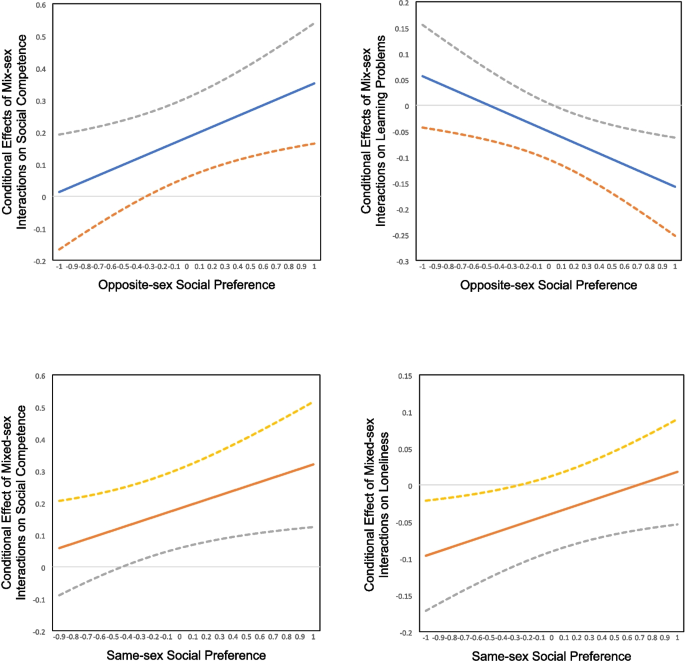
Johnson-Neyman (J-N) Plots of Interactions Between Social Preference and Mixed-sex Interaction
To further understand the nature of the interactions, we examined simple slopes of the regression of each of the Time 2 variables on mixed-sex interaction at a high value and a low value (1 standard deviation above and 1 standard deviation below the mean) of same-sex or opposite-sex social preference, as described by Aiken and West (1991). The regression lines are shown in Fig. 2. The results indicated that mixed-sex interaction was positively associated with later social competence and negatively associated with later learning problems for adolescents with high scores on opposite-sex social preference, but not for adolescents with low scores on opposite-sex social preference. Mixed-sex interaction was also positively associated with social competence for adolescents with high but not low same-sex social preference. In addition, mixed-sex interaction was negatively associated with later loneliness for adolescents with low same-sex social preference but not for adolescents with high same-sex social preference.
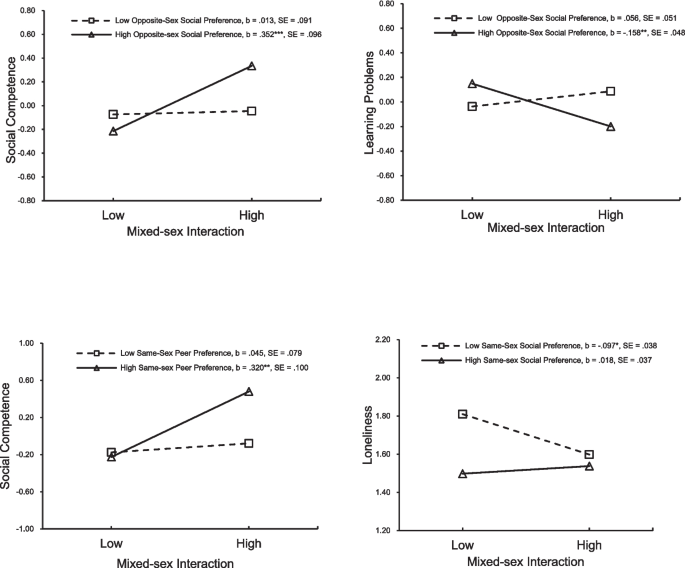
Simple Slopes of Interactions Between Social Preference and Mixed-sex Interaction
Discussion
As an important feature of development from childhood to adolescence, mixed-sex peer interactions become increasingly salient and play a significant role in individual socioemotional and school adjustment (Connolly et al., 2004; Molloy et al., 2014). However, little research has been conducted on this issue. The existing limited studies of adolescent mixed-sex interactions have focused on their relations with adjustment in limited domains, such as dating, self-perceptions, and involvement in delinquency, mostly using a cross-sectional design (e.g., Allen et al., 2013; Molloy et al., 2014; O’Neill, 2021). Moreover, these studies have been conducted in Western countries. The present longitudinal study with Chinese adolescents made significant contributions to the literature on mixed-sex interactions and their relations with later social-behavioral and school adjustment in a non-Western society.
Mixed-Sex Interactions and Social and School Adjustment
Our results first showed that mixed-sex peer interaction positively and significantly contributed to later social competence, with the effects of sex, stability, and social preference controlled, indicating that adolescents who engaged in more mixed-sex peer interactions became more socially competent with time. This indicates that mixed-sex peer interactions are a constructive experience that helps adolescents develop abilities, skills, and qualities that are required to function appropriately in social situations.
Whereas the main effects of mixed-sex interactions on social competence are interesting, the study revealed that their contributions were moderated by social preference. Moreover, the moderations of social preference of same-sex and opposite-sex peers appeared to occur similarly as well as differently across adjustment domains. Specifically, the results showed that mixed-sex interaction was associated positively with social competence and negatively with learning problems for adolescents high on opposite-sex social preference, but not for adolescents low on opposite-sex social preference. Research has demonstrated positive associations between social preference and behavioral styles such as sociability, cooperation, and prosociality in peer interactions among children and adolescents (e.g., Chen et al., 2005; Liu et al., 2023; Rubin et al., 2015). Adolescents with high opposite-sex social preference are perceived favorably by opposite-sex peers and thus are likely to have positive relationships with, and obtain support from, them. The experiences seem to be relevant to the acquisition of meaningful experiences in mixed-sex settings, which in turn help adolescents improve their social and school performance.
Same-sex social preference moderated the relations between mixed-sex interaction and later adjustment in a more complicated manner. Mixed-sex interaction positively predicted later social competence for adolescents high on same-sex social preference, but not for adolescents low on same-sex social preference, which was similar to the moderating effect of opposite-sex social preference. The results suggest that adolescents’ abilities to form positive relationships with peers in general may serve to enhance the benefits of mixed-sex interactions for the development of social competence. On the other hand, the moderation mechanism of same-sex social preference was different in predicting later loneliness. The results showed that mixed-sex interactions were associated with later lower levels of loneliness for adolescents who were low on same-sex social preference but not for adolescents who were high on same-sex social preference. The results suggest that for adolescents who are well accepted by same-sex peers, mixed-sex interactions may not be particularly important for their psychological adjustment. However, for adolescents who have difficulties in same-sex peer relationships, mixed-sex peer interactions are valuable in fulfilling their social needs and helping them reduce their feelings of loneliness, which appears to support the compensatory mechanism of different contexts in social networks (Grygiel et al., 2022).
Mixed-sex interactions were not significantly associated with later leadership in this study, suggesting that the experience might not be particularly important for adolescents’ acquisition of leadership status. In Chinese schools, students who are elected by students and then assigned by the head teacher in the class as leaders are often viewed as socially/morally and academically competent (Zhu, 2021). Social competence, positive peer relationships, and academic achievement are typically major predictors of leadership (Chen et al., 2005; Zhou et al., 2024). Mixed-sex interactions may not be a as salient factor as social and academic competence in contributing to leadership. Of course, this issue should be further investigated in future research.
The present study is the first about the effects of adolescents’ mixed-sex interactions taking into consideration of same- and opposite-sex peer preference. The results of the study indicate that same-sex and opposite-sex peer relationships play similar as well as different roles in shaping developmental outcomes of mixed-sex interactions. How adolescents gain from mixed-sex interactions for social and school adjustment depends, to some extent, on their experiences with same-sex and opposite-sex peers.
Implications, Limitations, and Future Directions
This study examined how mixed-sex peer interactions might contribute to adolescents’ social and school adjustment. In general, the study provided a positive perspective on mixed-sex peer interactions. As noted earlier, parents and teachers in China are concerned about the potential negative influence of social activities of adolescents including interactions involving opposite-sex peers, particularly on school performance. The results of this study may help alleviate the concern; involvement in mixed-sex interactions did not increase learning problems, but instead, served to reduce learning problems. In addition, the results suggested that for adolescents with low same-sex peer social preference, taking part in mixed-sex activities might help them reduce their feelings of loneliness and social dissatisfaction. In short, the results of the present study will be useful for educators and professionals to develop culturally relevant peer-oriented education and intervention programs to enhance the quality of adolescents’ life in the contemporary Chinese context (Leung & Fung, 2021). Teachers should promote mixed-sex interactions among students through explicit encouragement and praise of such interactions in the class. Schools may also design specific activities to provide opportunities for mixed-sex interactions, such as collaborative learning and extra-curricular academic work involving mixed-sex students, arranging mixed-sex “learning buddies” as a team, and making regular changes in seating for same-sex and opposite-sex deskmates, which help adolescents develop confidence and gain experiences and skills in mixed-sex settings (e.g., Hanish et al., 2021).
Several limitations and weaknesses of the study should be noted. First, the study was concerned with relations between mixed-sex peer interactions and adolescents’ social and school adjustment. Although we discussed possible processes involved in the relations, these processes were not directly examined in the study. Based on the literature (e.g., Connolly & Johnson, 1996; Dunphy, 1963; Molloy et al., 2014; Sun, 2011), for example, we argued that mixed-sex interactions may provide opportunities for adolescents to learn skills, receive emotional support, and gain social experiences that are complementary to those from same-sex interactions. However, we did not assess these factors in the study. Observing mixed-sex peer interactions and activities may be an effective strategy to obtain the information that helps us understand the processes in the relations.
Second, we used the Western literature (e.g., Dunphy, 1963; Molloy et al., 2014) mainly as a background for the discussion of the role of mixed-sex peer interactions. In general, the results meshed well with this literature. However, some of the specific results, such as those concerning the moderating effects of social preference on the relations between mixed-sex interactions and later adjustment, were not directly comparable with Western findings because there is virtually no existing research on the issues. Thus, this study needs to be replicated in other societies, including North America.
Third, the present study was conducted in a major city of China. As indicated earlier, as urban China has rapidly changed toward a competitive market-oriented society, individualistic values, such as independence and self-expression, have played an increasingly important role in shaping adolescent attitudes and behaviors. However, there are substantial regional differences in social and economic development in the country. Thus, generalization of the results to other regions should be made with caution.
Relatedly, like China, many developing countries in Africa, Asia, and Latin America (e.g., Brazil, India) are experiencing massive changes toward urbanization and modernization, which have implications for adolescents’ functioning in social situations. The results of this study may help us understand similar issues in some other non-Western countries. However, given the specific traditions and social and cultural conditions of each nation, one needs to be careful in generalizing our results to other societies.
Despite the limitations, the present study provided insights into the significance of mixed-sex peer interactions among Chinese adolescents for adjustment in various domains. It will be important to conduct further research on the issues, such as the developmental processes in the relations, in different social and cultural contexts from a broader perspective.
