
 info@apippress.com
 +86 18163351462 (WhatsApp)
 +86 182 8014 0209
Article Content
Abstract
The present study pursued a dual objective. First, to assess the impact of online scaffolding in writing on English as a foreign language (EFL) learners’ reflectivity in writing, and second, to explore the perceptions of participants in the experimental group regarding the use of Google Docs for scaffolding digital writing. The study involved 78 Iranian EFL university students majoring in English literature, and it employed a quantitative research design. Data were collected using two scales, namely, the Reflection on Writing Questionnaire (RWQ) and EFL students’ attitudes toward scaffolding digital writing through Google Docs. The essays produced by the learners were also evaluated to consolidate the findings of the survey. The results demonstrated a significant enhancement in EFL writing reflectivity among participants. Furthermore, the instructional intervention positively influenced the experimental group’s perceptions. This study sheds light on the potential benefits of integrating peer-scaffolding writing instruction within an online platform, specifically Google Docs, to promote reflectivity in a second language. The findings have implications for language educators when designing interactive writing tasks and incorporating online platforms for teaching writing.
Explore related subjects
Discover the latest articles and news from researchers in related subjects, suggested using machine learning.
- Digital Humanities
- Educational Research
- eLearning
- ESCRT
- Groupwork
- Lamination
Data Availability
Data will be made available on reasonable request.
References
-
Abdul Rabu, S. N., & Badlishah, N. S. (2020). Levels of students’ reflective thinking skills in a collaborative learning environment using Google Docs. TechTrends. https://doi.org/10.1007/s11528-020-00504-5
-
AbuSeileek, A. F., & Qatawneh, K. (2013). Effects of synchronous and asynchronous computer-mediated communication (CMC) oral conversations on English language learners’ discourse functions. Computers & Education, 62, 181–190.
-
Al-Chibani, W. (2016). Impact on student motivation of integrating Google Docs within remedial English writing class [Paper presentation]. Conference: ICICTE, Greece.
-
Alibakhshi, G., & Mohammadi, M. (2016). Synchronous and asynchronous multimedia and Iranian EFL learners’ learning of collocations. Applied Research on English Language, 5(2), 237–254.
-
Aljaafreh, A., & Lantolf, J. P. (1994). Negative feedback as regulation and second language learning in the zone of proximal development. Modern Language Journal, 78(4), 465–483. https://doi.org/10.2307/328585
-
Ash, S. L., & Clayton, P. H. (2009). Generating, deepening and documenting learning: The power of critical reflection in Applied Learning. Journal of Applied Learning in Higher Education, 1, 25–48.
-
Avarzamani, F., & Farahian, M. (2019). An investigation into EFL learners’ reflection in writing and the inhibitors to their reflection. Cogent Psychology, 6, 1690817.
-
Barnard, R. (2002). Peer tutoring in the primary classroom: A sociocultural interpretation of classroom interaction. New Zealand Journal of Educational Studies, 37(1), 57–72.
-
Barnard, R., & Campbell, L. (2005). Sociocultural theory and the teaching of process writing: The scaffolding of learning in a university context. The TESOLANZ Journal, 13, 76–88.
-
Behroozizad, S., Nambiar, R. M. K., & Amir, Z. (2014). Sociocultural Theory as an approach to aid EFL learners. The Reading Matrix, 14(2), 217–226.
-
Bernard, A., Gorgas, D., Greenberger, S., Jacques, A., & Khandelwal, S. (2012). The use of reflection in emergency medicine education. Academic emergency medicine. Official Journal of the Society for Academic Emergency Medicine., 19, 978–982.
-
Chiriac, E. H. (2014). Group work as an incentive for learning—students’ experiences of group work. Frontiers in Psychology, 5, 558. https://doi.org/10.3389/fpsyg.2014.00558
-
De Guerrero, M. C. M., & Villamil, S. O. (2000). Activating the ZPD: Mutual scaffolding in L2 peer revision. Modern Language Journal, 84(1), 51–68.
-
Dewey, J. (1933). How we think: A restatement of the relation of reflective thinking to the educative process. Houghton Mifflin.
-
Ebadi, S., & Rahimi, M. (2017). Exploring the impact of online peer-editing using Google Docs on EFL learners‟ academic writing skills: A mixed methods study. Computer Assisted Language Learning, 30(8), 787–815.
-
Ebadi, S., & Rahimi, M. (2018). An exploration into the impact of WebQuest-based classroom on EFL learners’ critical thinking and academic writing skills: A mixed-methods study. Computer Assisted Language Learning, 31(5–6), 1–35.
-
Ebadi, S., & Rahimi, M. (2019). Mediating EFL learners’ academic writing skills in online dynamic assessment using Google Docs. Computer Assisted Language Learning, 32(5–6), 1–29. https://doi.org/10.1080/09588221.2018.1527362
-
Farahian, M., Avarzamani, F., & Rajabi, Y. (2021). Reflective thinking in an EFL writing course: To what level do portfolios improve reflection in writing? Thinking Skills and Creativity, 39, 1–12.
-
Fathi, J., Arabani, A. S., & Mohamadi, P. (2021a). The effect of collaborative writing using Google Docs on EFL learners’ writing performance and writing self-regulation. Language Related Research, 12(5), 333–359.
-
Fathi, J., Arabani, A. S., & Mohamadi, P. (2021b). The Effect of collaborative writing using Google Docs on EFL learners’ writing performance and writing self-regulation. Language Related Research, 12(10), 333–359.
-
Fereidouni, P., & Farahian, M. (2024). Is ChatGPT a cure all? Demystifying the impact of using ChatGPT on EFL learners’ writing skill. Applied Linguistics Inquiry, 2(1), 89–103. https://doi.org/10.22077/ali.2024.8389.1051
-
Gholami Pasand, P., & Tahriri, A. (2017). Peer scaffolding in an EFL writing classroom: An investigation of writing accuracy and scaffolding behaviors. Relp, 5(2), 147–166.
-
Gibbons, P. (2002). Scaffolding language, scaffolding learning: Teaching second language learners in the mainstream classroom. Cambridge University Press.
-
Gillow-Wiles, H., & Niess, M. L. (2015). Engaging Google Docs to Support Collaboration and Reflection in Online Teacher Education: In M. L. Niess & H. Gillow-Wiles (Eds.), Handbook of Research on Teacher Education in the Digital Age: (pp. 635–662). IGI Global. https://doi.org/10.4018/978-1-4666-8403-4.ch024
-
Goda, Y., Yamada, M., Matsuda, T., Kato, H., Saito, Y. & Miyagawa, H. (2013). Effects of help seeking target types on completion rate and satisfaction in e-learning. Proceedings of INTED.
-
Hampton, M. (2020). Reflective writing: A basic introduction. University of Portsmouth, Department for Curriculum and Quality Enhancement. Retrieved from https://www.jcu.edu.au /__data/assets/pdf_file/0004/120478/jcu_128366.pdf
-
Helyer, R. (2015). Learning through reflection: The critical role of reflection in work-based learning (WBL). Journal of Work-Applied Management, 7(1), 15–27.
-
Hoang, D., & Hoang, T. (2022). Enhancing EFL students’ academic writing skills in online learning via Google Docs-based collaboration: a mixed-methods study. Computer Assisted Language Learning, 10, 1504.
-
Huang, J. (2015). Interactive technological media as means in language learning programs serving learners from birth through age 9. Technology in Education, 19(4), 18–19.
-
Hubbard, P., & Levy, M. (2006). The scope of CALL education. In P. Hubbard & M. Levy (Eds.), Teacher education in CALL (pp. 3–21). John Benjamins.
-
Hyland, K. (2019). Second language writing. Cambridge University Press.
-
Ishtaiwa, F. F., & Aburezeq, I. M. (2015). The impact of Google Docs on student collaboration: A UAE case study. Learning, Culture and Social Interaction, 7, 85–96.
-
Johnson, D., & Johnson, F. (2008). Joining together: Group theory and group skills. Pearson.
-
Kember, D., Leung, D. Y., Jones, A., Loke, A. Y., McKay, J., Sinclair, K., & Wong, M. (2000). Development of a questionnaire to measure the level of reflective thinking. Assessment & Evaluation in Higher Education, 25, 381–395.
-
Kim, S., & Cho, S. (2017). L1 translation as scaffolding in tutor talk: A case study of two Korean tutors. GEMA Online Journal of Language Studies, 17, 15–32.
-
Kolb, D. A. (1984). Experiential learning: Experience as the source of learning and development. Prentice-Hall.
-
Lane, K. L., Graham, S., Harris, K. R., & Weisenbach, J. L. (2006). Teaching writing strategies to young students struggling with writing and at-risk for behavioral disorders: Self-regulated strategy development. Teaching Exceptional Children, 39, 60–64.
-
Lantolf, J. P., & Thorne, S. L. (2007). Sociocultural theory and second language learning. In B. VanPatten & J. Williams (Eds.), Theories in second language acquisition: An Introduction (pp. 197–221). Lawrence Erlbaum.
-
Lee, S. N. & Tajino, A. (2008). Understanding students’ perceptions of difficulty with academic writing for teacher development: A case study of the university of Tokyo writing program. Kyoto University Research Information Repository. Retrieved from http://repository.kulib.kyoto-u.ac.jp/dspace/handle/2433/70833.
-
Malloy, I. A. S. (2007). How to enable students to become more independent essay writers? Encuentro, 17, 62–67.
-
Mezirow, J. (2009). Transformative learning theory. In J. Mezirow & E. W. Taylor (Eds.), Transformative learning in practice: Insights from community, work-place, and higher education (pp. 18–32). Jossey Bass.
-
Mohammadzadeh, A., Ahour, T., & Saeidi, M. (2022). Investigating Iranian EFL learners negotiation types in writing with different scaffolding patterns. Journal of Language Horizons, 6(1), 95–110.
-
Nassaji, H., & Swain, M. (2000). A Vygotskian perspective on corrective feedback in L2: The effect of random versus negotiated help on the learning of English articles. Language Awareness, 9(1), 34–51.
-
Ohta, A. S. (2000). Rethinking interaction in SLA: Developmentally appropriate assistance in the zone of proximal development and the acquisition of L2 grammar. In J. P. Lantolf (Ed.), Sociocultural theory and second language learning (pp. 51–78). Oxford University Press.
-
Pham, T., Trinh, V., & Bui, L. (2020). Electronic peer feedback, EFL academic writing and reflective thinking: Evidence from a Confucian context. SAGE Open, 10, 1–20.
-
Proctor, L. (2020). Fostering critically reflective thinking with first-year university students: Early thoughts on implementing a reflective assessment task. Reflective Practice International and Multidisciplinary Perspectives, 21(4), 444–457.
-
Rabu, S. N. A., & Badlishah, N. S. (2020). Levels of students’ reflective thinking skills in a collaborative learning environment using Google Docs. Tech Trends, 64, 533–541.
-
Ranjbar, N., & Ghonsooly, B. (2017). Peer scaffolding behaviors emerging in revising a written task: A microgenetic analysis. Iranian Journal of Language Teaching Research, 5(2), 75–90.
-
Resta, P., & Laferrière, T. (2007). Technology in support of collaborative learning. Educational Psychology Review, 19(1), 65–83.
-
Rezaee, M., Farahian, M., & Ahmadi, A. (2012). Critical thinking in higher education: Unfulfilled expectations. Brain Broad Research in Artificial Intelligence and Neuroscience, 3(4), 64–73.
-
Rudd, R. D. (2007). Defining critical thinking. Techniques, 82(7), 46–49.
-
Saadat, M., & Alavi, S. Z. (2020). Variability in Peer-peer Scaffolding during Writing Tasks in L2 English. Iranian Journal of Language Teaching Research, 8(3), 99–120.
-
Salmasi, M., Bonyadi, A., & Alavinia, P. (2015). CALL-assisted enhancement of grammatical accuracy: Iranian EFL learners studying in rural settings. Theory and Practice in Language Studies, 5(4), 765.
-
Setyowati, l., & Sukmawan, S. (2020). Write down your thoughts: Essay writing for EFL learners. Delta Pijar Khatulistiwa.
-
Shabani, K. (2016). Implications of Vygotsky’s sociocultural theory for second language (L2) assessment. Cogent Education, 3(1), 1242459. https://doi.org/10.1080/2331186X.2016.1242459
-
Shariff Hosseini, M., Bavali, M., & Rezavani, R. (2020). Wiki-based collaborative writing in EFL classrooms: Fluency and learners’ attitudes in focus. Cogent Art and Humanities, 7(1), 1826649.
-
Shariff Hosseini, M., Bavali, M., & Rezavani, R. (2021). Wiki-based collaborative writing in EFL classrooms: Writing accuracy in focus. Journal of Language and Translation, 11(1), 65–75.
-
Shintani, N., & Aubrey, S. (2016). The effectiveness of synchronous and asynchronous written corrective feedback on grammatical accuracy in a computer-mediated environment. The Modern Language Journal, 100, 296–319. https://doi.org/10.1111/modl.12317
-
Slavin, R. E. (1996). Research on cooperative learning and achievement: What we know, what we need to know. Contemporary Educational Psychology, 21, 43–69.
-
Soodmand Afshar, H., & Hamzavi, R. (2014). The relationship among reflective thinking, listening anxiety and listening comprehension of Iranian EFL learners: Does proficiency make a difference?. Issues in Language Teaching, 3(2), 261–237.
-
Storch, N. (2002). Patterns of interaction in ESL pair work. Language Learning, 52, 119–158.
-
Tan, B. H. (2011). Innovative writing centers and online writing labs outside North America. Asian EFL Journal, 13(2), 391–418.
-
Vygotsky, L. S. (1978). Mind in society. Harvard University Press.
-
Vygotsky, L. S. (1986). Thought and language. MIT Press.
-
Wang, M., Yuan, B., Kirschner, P.A., Kushniruk, A.W., & Peng, J. (2018). Reflective learning with complex problems in a visualization-based learning environment with expert support. Computers in Human Behavior, 87, 406–415. https://doi.org/10.1016/j.chb.2018.01.025
-
Wang, J., Bai, B., & Song, H. (2021). Primary school students’ acceptance of computer-mediated collaboration in English writing: The role of peer and teacher support. Computer Assisted Language Learning, 10, 1–24. https://doi.org/10.1080/09588221.2021.1881974
-
Willingham, D. T. (2007). Critical thinking: Why is it hard to teach? Arts Education Policy Review, 109(4), 21–29.
-
Wu, W., Marek, M., & Yen, L. (2012). Promotion of EFL student motivation, confidence, and satisfaction via a learning spiral, peer-scaffolding, and CMC. International Journal of Computer-Assisted Language Learning and Teaching, 2, 54–75.
-
Yaacob, A., Mohd Asraf, R., Hussain, R. M. R., & Ismail, S. N. (2021). Empowering learners’ reflective thinking through collaborative reflective learning. International Journal of Instruction, 14(1), 709–726.
-
Yaacob, A., Walters, L. M., Ali, RMd., Abdullah, S., & Walters, T. (2014). Reflecting on Malaysian teacher trainees’ journals. Malaysian Journal of Learning and Instruction, 11, 1–21.
-
Zorko, V. (2009). Factors affecting the way students collaborate in a wiki for English language learning. Australasian Journal of Educational Technology, 25(5), 645–665.
Acknowledgements
We would like to thank the editor and reviewers.
Funding
The authors received no funding for this research.
Ethics declarations
Conflict of interests
The authors declare that they have no competing interests.
Additional information
Appendices
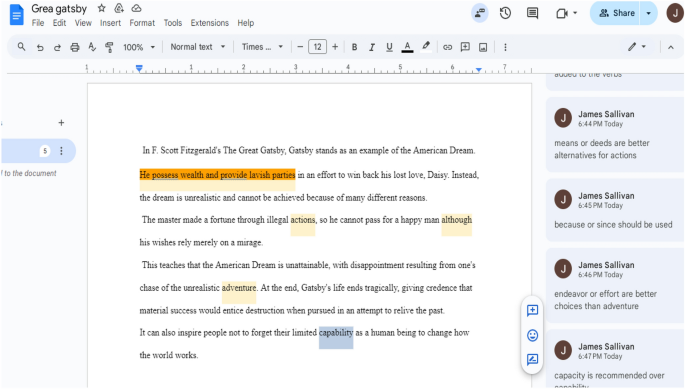
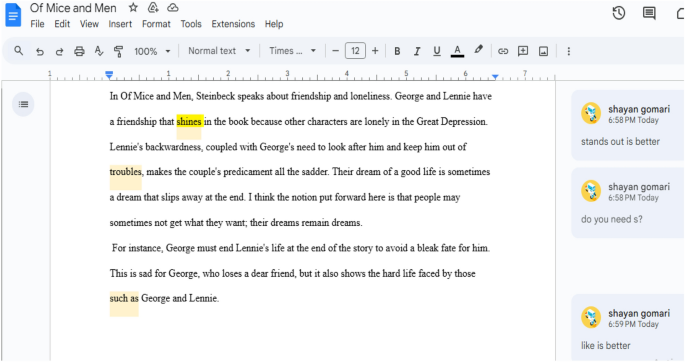
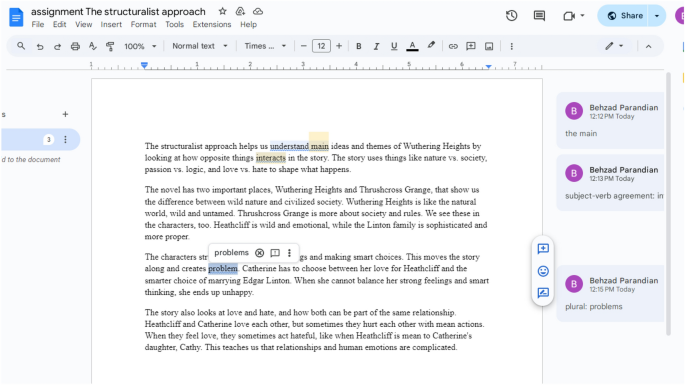
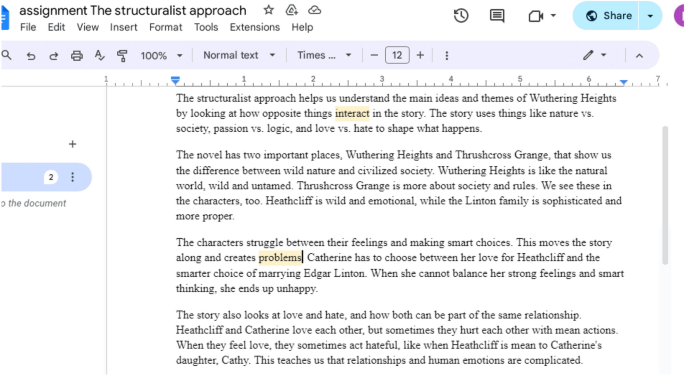
Appendix A
More Snapshots of Collaborative Writing Using Google Docs.
Appendix B
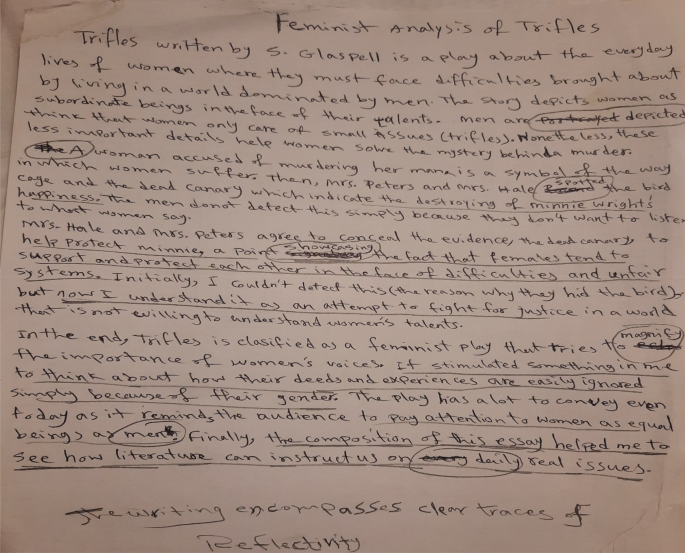
Samples of Experimental and Control Groups’ participants’ Literary Analyses.
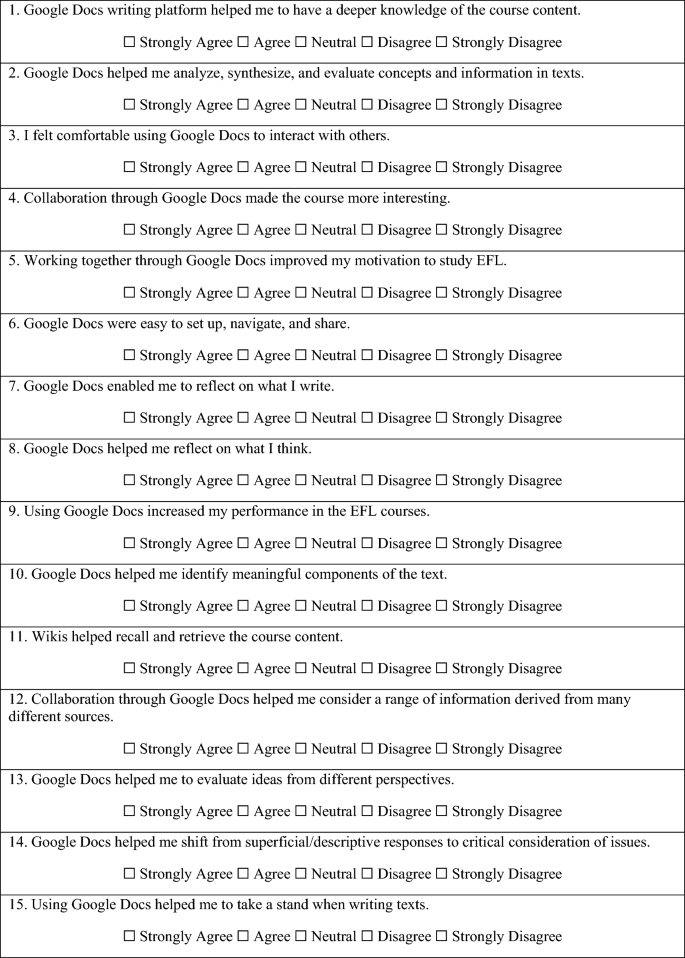
Appendix C
EFL Students’ Attitudes toward Learning Literature through Google Docs.
Appendix D
Reflection on Writing Questionnaire (RWQ).
| Category | Item | Not at all | To a small extent | To some extent | To a moderate extent | To a great extent |
|---|---|---|---|---|---|---|
| Habitual Action/
Descriptive |
1 When I write in English, I do it without thinking
2 When writing it is likely that I use a lot of fixed set of sentences borrowed from somebody or somewhere 3 I probably write an essay without getting deeply involved with the meaning 4 I often start writing without planning for it |
|||||
| Understanding | 1 My writing is often limited to state what / when/where something happened
2 I write my ideas without questioning them or considering them in depth 3 My writing is often limited to conveying meaning to readers 4 I know how to begin, how to write, and how to revise |
|||||
| Reflection | 1 While writing I often reflect on the steps I take
2 I can explain the meaning/significance/value of things 3 While writing, I may get help from others 4 I can relate the topic to my personal experiences 5 I sometimes think about revising the text I have written |
|||||
| Critical reflection | 1 As a result of the course, I can think about my strengths and weaknesses in writing
2 I can write for and against certain positions and ideas 3 I set a new goal at every stage of writing 4 I provide reasons and justifications for events 5 I often think about how I should improve my writing the next time I write 6 I state my preferences and provide a rationale for them |
About this article
Cite this article
Farahian, M., Rajabi, Y. & Gholami, H. Promoting EFL Students’ Reflectivity in Writing Through Peer-Scaffolding Digital Writing. Psychol Stud (2025). https://doi.org/10.1007/s12646-025-00835-4
- Received
- Accepted
- Published
- DOI https://doi.org/10.1007/s12646-025-00835-4
Keywords
- Peer scaffolding
- Digital writing
- Writing reflectivity
- Google docs
- EFL writing
