
 info@apippress.com
 +86 18163351462 (WhatsApp)
 +86 182 8014 0209
Article Content
1 Introduction
Old proponents of social system modeling (SSM) would include Marx and Pareto. Later proponents include Parsons (1956) and Luhmann (1995). They share a trans-disciplinary framework in which the economic system is one functional subsystem, next to other functional subsystems of households and social groups, politics, law, education, science, theocracy, etc. These subsystems act and interact in forming together the whole societal system. Agents inhabit each subsystem and pursue specific goals characteristic to each subsystem. In its pursuit of fulfilling its specific goal, each subsystem functions by itself, sets up its organization, and adapts itself to other subsystems and the changing environment. The interactions of subsystems over time often lead to the dominance of one subsystem over other subsystems.
SSM is an offshoot of general systems theory and analysis, a cross-disciplinary collection of scientific thought in physical sciences that offers an exciting potential for systemic description and integration of separated theories into a single framework. It is generally acknowledged that while the general system approach has sounding successes in the physical sciences, progress of SSM in the social sciences has been slow.Footnote1
Building on previous work,Footnote2 two purposes of the paper are to use the SSM approach in formulating a theory of social system dynamics and development, and to apply the theory in tracing major episodes in the economic history of the western world. Our SSM approach distinguishes between three main subsystems centered around, respectively, the household, the state and the firm. The agents in these three functional subsystems are driven by three distinct motivations, respectively, the social, the political and the economic motive. The paper uses this framework in tracing the changing and evolving dominance of rival subsystems in the economic history of the western world. The paper succeeds in giving a systematic, quantifiable, and verifiable holistic calibration of economic developments, and this contrasts with the narrower written accounts of economic history. We differ from the convention of looking at history as the occurrence of exogenous consequential events and offer instead a system dynamics analysis that makes historical events endogenous to the system in the sense that they are impacted and often caused by the powerplay within the system.
It is recognized right out that the distinguished contributions on the dynamic interaction of state and firms due to Schumpeter, Stigler and Galbraith, and on the historical rise of the state and markets in the works of Hicks, North and Williamson are cornerstones in the formulation of the SSM.
The paper is organized into three sections. Section 2 will lay out the modeling framework and illustrate its application. Section 3 will review the timeline of the changing dominance of rival subsystems in the economic history of the western world. Section 4 concludes and discusses applicability of the results in other contexts than the western world.
2 Conceptual Framework for a System Analysis
2.1 Behavioral Settings
Conventionally, a behavioral setting, call it b, is defined as a physical site populated by interacting persons who have become members of the setting by accident and/or choice. Behavioral settings relevant for economic analysis are those that generate for their participants added value from the economic transformation of production and/or exchange activity. Agents inhabiting a behavioral setting engage thus in a value-added transformation of goods and services. The actions of agents are subjected to physical-technological boundaries and guided by institutional rules and information schemes. Setting types of significance and interest for economic analysis are those of household, firm, and state settings, that is, government.Footnote3 These three types of settings will be denoted by h, f, and s. Agent behavior and transformation processes in the household, firm, and state settings are driven by intrinsically distinct goal functions and reinforced by regulating institutions. For example, affinity sharing is the underlying intrinsic motive in household settings. Agents in household settings are united by kinship, ethnic, locality or religious ties and adopt initially institutions of reciprocal exchanges and the collective sharing of benefits and costs. In contrast, profit maximization is the intrinsic motive in firm and market settings, while acquisition of a polity rent and political advantages attached to the political intermediation are the intrinsic motives in state settings; in short, rent politicization.
2.2 Functional Subsystems
A specific subsystem, called B, consists of a vast number of behavioral settings b of the same specific type. Proceeding from the level of settings to the level of subsystems involves objectifying and depersonalizing the settings, turning them into entities, and supplementing these entities by supportive institutions that safeguard the sustainability and expansion of the subsystem. Footnote4 Accordingly, each subsystem B has its own institutional rules and information schemes for guiding actions of the agents present in that subsystem. We shall denote the subsystems corresponding with household, firm, and state settings, by capital letters H, F and S, respectively. Of course, there are other subsystems that are indirectly engaged in economic transformations that may have significant bearings on the economy. The role of other subsystems will be reviewed where relevant.
The goal functions are distinct and intrinsic for the three types of settings/subsystems. The intrinsic goal in the household subsystem is described as affinity sharing, and coordination mechanisms have a sociologic character. The goal in the firm subsystem is profit maximization and coordination mechanisms are economic in character. The goal in the state subsystem is rent politicization, and coordination mechanisms are political in character. The distinct behavioral motives of the three subsystems can be expressed formally in equational forms.Footnote5
Expanding on the above, in the household-communal subsystem, the motto of the homo sociologicus is most applicable: from whom according to his/her ability and to whom according to his/her needs, resulting in social sharing and committed reciprocity. The firm subsystem functions along the homo economicus where choices in production and exchanges are made to assure that material benefits less costs are maximized. From whom according to his/her abilities and effort and to whom in accordance with his/her relative abilities and efforts is the rule of the game. In contrast, the state subsystem is represented by the homo politicos; this is a state authority who brokers a settlement among insecure and/or differing parties in ways that guarantee security and resolve conflict peacefully, with simultaneously strengthening institutions that bolster power and protective rent for the state authority. The rule of the game in the state subsystem is close to what can be described as from whom according to his/her maximum negotiable ability and to whom according to his/her minimum negotiable needs. The difference between the two volumes is the polity rent that the state agent acquires.
While each subsystem B is in some sense a sum of its own constituent behavioral settings b, there is more to that than being a simple sum. The subsystems are self-functional wholes by themselves. Any of the subsystems engages in (a) establishing and applying internal rules of conduct aiming at eliminating free riding among members and securing the sustainability of the subsystem, thus leading to a deepening of the goal function of the subsystem; (b) acting to improve and expand the scope of the transformations in the face of emerging challenges.
Pioneering leaders within the subsystem level play major roles in initiating the above actions. Followers sustain these actions. Pioneers in the F subsystem are innovative, entrepreneurial, and risk takers, while pioneers in the S subsystem are state reformers and are highly devoted to public service. Finally, changes in the external environment open external opportunities that encourage pioneering as well as freeriding to take place. Events in the external environment impact significantly the expansion and exhaustion of the comparative advantage of a subsystem in activities that the subsystem is most suited to transform.
2.3 Systemic Influences
Subsystems influence each other, with usually one overgrowing and the others declining or growing but lagging. It is important to have a precise formulation of what we mean by the influence of one subsystem on other subsystems. Focus is on two dimensions of influence; interactive influence and regulative influence.
Interactive influence relates to the intensity of participation and activity of the agents in one subsystem relative to other subsystems. To start with, in any country there are active agents in households, firms and state subsystems in large numbers. The same agents can be members of more than one subsystem simultaneously. Agents communicate with other agents within their own subsystem and with other subsystems. The exchange of information and communication on performances of subsystems activates the realignment of agents toward the more promising (overgrowing) subsystem. This leads over lengthy periods of time to relatively greater concentrations of agents in the overgrowing subsystem, say subsystem B gains on subsystems B’, opening the way for the spread and dominance of the institutions of B over B’, and of the behavioral traits that coincide with those of subsystem B, over those of B.’ Once a threshold is reached regarding accepting a specific behavioral type, say that of B, this can be expected to gain momentum in view of network externalities, and spread further to all other B’s.
There is a vast literature on the adoption and spread of a particular behavioral type among many agents. Some six mechanisms of agent interactions, that may include overlapping, can be singled out as determining the formation of the common behavioral pattern, its spread and dominance. (1) Sharing of the same external environment and history fosters convergence toward a common behavioral type. (2) Agents observe the transformation outcomes in alternative settings and move to the advantaged setting or copy its behavior thus resulting in the prospect that the typical behavior of the advantaged subsystem becoming prevalent. (3) Intensive and extensive interactions and communications of agents taking part in several subsystems are prone to extend the prevalence of the advantaged behavioral type that associates with the most growing and dominant subsystem. (4) Network externalities enforce convergence toward the advantaged behavioral type. (5) The deep-rooted social-psychological inclination of individuals toward consistency in their relationships and cognition ends up in adopting a positive attitude toward the preferential behavior of the dominant counterpart. (6) Other related mechanisms include imitation, convention, focal points, information cascades, reciprocal behavior, group learning, Markov chain inversions, melting pot, and power of dominant shares, among others.Footnote6
Of course, next to all the interactive mechanisms, external events and environments play major roles in strengthening or weakening the relative dominance of the competing subsystems, and thereby contribute significantly to speeding up or obstructing the convergence tendencies toward one integral system that associates with the dominant subsystem.
Summing up, the better performing subsystem attracts more agents from the less performing subsystems, gains interactive influence, and takes the lead in interactive dominance. Supported by the above interactive mechanisms, the lead is strengthened; and the behavioral motive of the dominant subsystem is likely to become the norm for the whole system in the long run. Thus, one subsystem is very likely to evolve into dominance, and the whole system tends to become identifiable with the dominant subsystem.
To drive the point in an approximative manner, it can be reasoned for example that in the USA, the high concentration of agent interactions in firms has allowed over time the goal of profit maximization (which is intrinsic to the firm subsystem) to overshadow the intrinsic goals typical of the household and state subsystems. Similarly, it can be reasoned that comparable assimilation processes tended to oblige agents in household and firm settings in Soviet Russia to follow a politicized behavioral motive typical of the state subsystem. As a result, all three subsystems in USA behave in ways typical of firm settings, while in Soviet Russia, they manifested behavior typical of state settings. Footnote7The above implies that agent behavior, institutional conduct and outcome performance of the whole system will tend to be relatively homogeneous and reasonably predictable. It is logical to expect high degrees of consistency and correlation between the sociological, economic and political aspects of a specific social system.
The interactive influence of subsystem B on other subsystems B’ can be quantified using a Dominance Index (DI), denoted by DI B. The index has two arguments: the relative share of agents of B in the whole system and the relative share of transacted transformations of B in the whole system. See Eq. 4.
In this equation, there are two share parameters that affect prevalence. AB is the share of agents in subsystem B, with respect to all agents in all settings. CB is the share of commodities demanded that are most suitably transformed in subsystem B, with respect to all demanded commodities. Personal commodities are most suitably transformed in firm settings. Collective needs are most suitably transformed in state settings. Equation 4 proposes that the greater the shares of those agents and commodities associated with a particular setting, the greater is the probability that the behavioral type underlying this setting prevails over other behavioral types. In this equation, ω1 and ω2 are weights applying to these two shares, whereby .Footnote8
The dominance index, DIB, is indicative of the interactive power of subsystem B over all the other subsystems B’. Quantification of this index can be done at lower levels (for specific firms within an industry, for specific industries within the whole economy, for specific agencies within the state subsystem). It can be applied also at higher levels, i.e., for individual countries within a world region or the world economy as an indicator of the relative influence of individual countries, see Cohen (2015).
Moving to regulative influence, this arises in a situation in which a behavioral setting b happens to stand higher in relation to b’ in the hierarchy of settings; allowing b to set behavioral rules typical of b that other settings b’ should abide with. In this way, the behavioral type of b overrides b’, allowing the further spread of behavioral norms of b at the cost of those of b’. The example is extendable to the level of subsystems. The origin of the regulative influence lies in the ability of the higher subsystem to impose binding rules of conduct on the lower subsystems. One example: the imposition of the regulated workday by firms on households had significant regulatory effects of the firm subsystem on the household subsystem. The other example: in regulatory terms, the state subsystem stands above the firm subsystem; though this is legally correct, state regulations of industrial activity can hide an indirect regulatory influence of firms on the sate in case of capture. Apart from quoting examples, it is not feasible to give meaningful quantifications of the degree of regulative influence as in the case of interactive influence. Quantification is obstructed by difficulties in standardizing diversified measures of state regulation across countries. Besides, the state regulations are robbed of their meaning in cases they are captured by firms.
While the dominant power of the firm subsystem in western countries has been the result of the past growth of interactive influence and is less the result of a regulative influence of the firm subsystem on other subsystems, it is generally believed that the accumulated power of state authorities consists mainly of regulatory influence. Economists have studied in depth the nature of the regulatory influence of the state subsystem on the firm subsystem, and vice versa, with surprising findings that are generally acknowledged. Stigler (1971), Joskow and Rose (1989), and Winston (1993) found that a very large part of the state regulations on producing firms is interpretable in terms of models of ‘producer capture’ and not of ‘public interest.’ Although the extents of the firm’s manipulation of the state’s regulations differ by sector and duration, the following hypothesis can be stated to be generally valid. In the country context, where the F subsystem is all dominant and the S subsystem is subordinate, such as in USA and less so in EU, the regulative influence of the S subsystem is for the greater part fake and capture. In contrast, in the past Soviet Union, where the state was all dominant, the regulative influence of the state on firms was absolute and real.
There are subtle differences between the interactive mechanisms and the regulative mechanisms. The interactive influence represents the results of horizontal integration. Regulative influence is a vertical relationship. It can be speculated also that the contribution of horizontal channels toward unified behavioral formation across subsystems is likely to be more influential and more permanent than that of vertical channels. Being generated via experiencing, learning and adoption horizontal interactions are likely to have more endurable effects. In the case of vertically accommodated behavioral attitudes, the regulative influence can terminate abruptly if the regulative mechanisms become too demanding due to technological loopholes, or the rationale for the binding restrictions disappears, or the balance of power between b and b’ reverses. Furthermore, it is likely that there is a positive association between the two notions, in the sense that a subsystem powerful in interactive influence is also powerful in regulative influence.Footnote9
2.4 System Prototypes
In summary, agent mobility and communications between subsystems in the direction of the better performing subsystem, together with regulatory influence in the same direction end up in one dominant behavioral type typical of subsystem B over other B’. As such, the result is a homogeneous social system that can be approximately described in terms of the dominant subsystem, that is, H, S or T. The three figures below show the configurations of the system when the system is dominated by the H, S and F, subsystems, respectively. The dominant subsystem is in bold print, and its interactions with and impact on other subsystems carry more weight, hence their lines of communication are also drawn in bold.
Analysis of past records of world events should be able to answer such questions as to how the western society, has changed from a distant past where H dominated, as in Fig. 1a, to its current form which is most aligned with the F-dominant system, as in Fig. 1c. Internal and external events have brought about differential effects that favor one competing subsystem over other competing subsystems, and thus resulting in one dominant subsystem that shapes western society. As the next section will demonstrate, the external environments are continuously changing as world development moves on, causing intermittingly weakening effects and strengthening effects for both the F and S subsystems. It is sufficient to mention here a few examples to make the point clear. The ages of geographical discovery and colonial conquest in the fourteenth–seventeenth centuries strengthened both subsystems in Europe, though more so for S than F. The industrial revolution in the eighteenth–nineteenth centuries brought technological advances, which enhanced major diversifications in demanded private goods, a huge jump in personal needs of the newly settling migrating populations and a significant push for the firm subsystem. This period also saw the subjection of state governance to constitutional law, which in terms of dominance, was equivalent to a downgrade of the state subsystem and an upgrade of the firm subsystem. The next section treats these epochs in some detail.
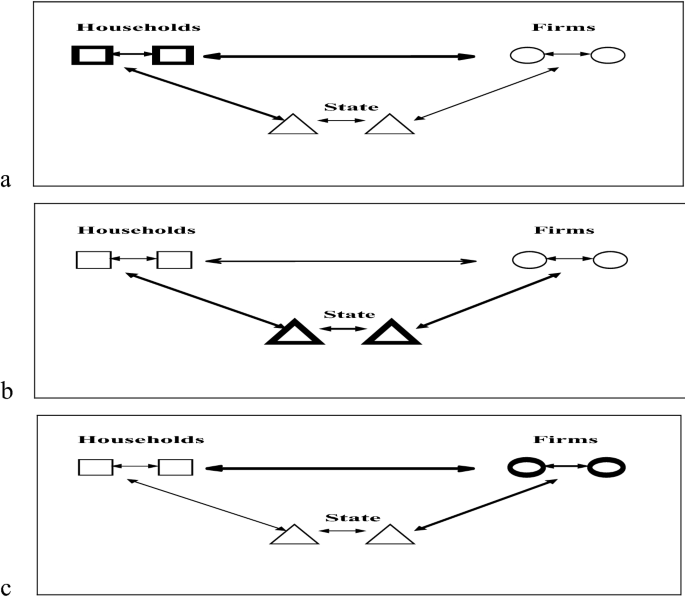
a, b, c Configurations of three social systems: H-dominated, S-dominated and F-dominated
3 Historical Developments
3.1 A Timeline with Systemic Relevance
There is a vast literature on the economic history of western countries. Our concern is with the evolving spread of the firm subsystem at the cost of other subsystems: how historical events/changes strengthened the firm subsystem vis-à-vis other major subsystems and allowed the firm subsystem to eventually dominate the entire system.
The drive toward dominance of one subsystem over other subsystems is comparable to a long marathon race that goes through mountains and valleys. The chasing subsystems change positions as frontrunners, with some of the front running subsystems at one time losing strength or dropping out altogether centuries later. In Europe, the marathon began in a period of fragmentation and vacuum, around 900 or 1000 A.D. Once the race was started, the leading subsystem at the time (that of traditional household settings) experienced a continuous loss of agents and transformation to the benefit of rising subsystems. A spectacular gainer in the eleventh–fourteenth centuries was the theocratic subsystem (church and related settings), but this dwindled in later centuries. The feudal-lordship-manorial subsystem (an overlapping combination of feudal, lordship, and manorial settings) was another spectacular gainer in the tenth–fourteenth centuries but was destined to disappear completely five centuries later. The subsystems of manor law, urban communes and the central monarch started also in the same period, and it took them another five centuries of reformist and constitutional revolutions to evolve and fuse into the democratically elected state subsystem that is characteristic of western countries today. Small but rising in terms of agents and transformations were merchants and craftsmen. Although the trading, crafting, and cottage industry settings expanded with expanding markets for goods, labor and finance, it was only six centuries later, with the industrial revolution, that these settings developed into firm settings; and it took the firm subsystem two more centuries to evolve to their present dominant position in western countries. In the subsequent subsections, we fill out the details of this introductory paragraph.
Historical analysis commonly pinpoints specific years or periods as a starting point for analysis, though conditions in any year or period are the result of conditions in earlier years and periods. This makes it difficult to select a starting point. However, if one would replace the microscopic approach with a macroscopic perspective, and interpret history in terms of phases, the task is simplified. Historical evidence on Europe would indicate and justify the ninth–tenth century A.D. as a starting period for the marathon race. At that time the subsystem of traditional households and kinship related settings (i.e., villages and tribal groups) was still dominating the whole socio-economic and political system; in short, it was a household intensive system, HIS. Berman (1983) gives an elegant description of the dominance of the H subsystem in Europe, at and before that time.Footnote10
The period of the sixth–tenth century experienced major upheavals. A series of territorial wars between the various tribal groups, peoples and territories in Europe was further exasperated by the external invasions from Islamic armies and failure to stop the defeat. The uncertainties and fragmentations of the time led to two important responses: one is the strengthening of religious settings (Christian church) and their regulatory influence on household behavior, and the other is the emergence of feudal settings (overlapping with lordships and manors) that embodied/subdued households. These two developments signaled the beginning of the end of the dominance of the household subsystem.
We draw in Fig. 2 a timeline for the evolution of the economic system of the western world that starts accordingly from 1000 A.D. to the present day. The timeline depicts events and effects, categorized in various epochs, which are relevant for our subject matter. The timeline shows subsequent ages of world development, some were inspired by thoughts (shown above the timeline), while others were driven by events (shown below the timeline). These world developments created and strengthened the firm and state subsystems, F and S, and added other subsystems, at the cost of the H subsystem. As will be shown, the accumulated gains for F were greater than for S. The timeline depicts four long periods, with earlier periods longer than latter periods. The first period is the genesis of the contemporary socio-economic and political system, it covers 400 years (1000–1400), the second covers 300 years (1400–1700), the third covers 200 years 1700–1900, and the fourth is years 2000–2014.
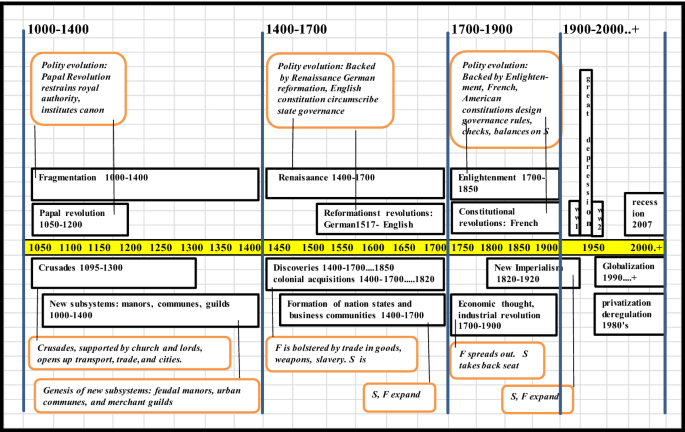
Timeline of the firm intensive system in western countries 1000–2000 +
3.2 The Period of 1000 to 14,000
As was just said, uncertainty, fragmentation, and defeat in the sixth–tenth century were at maximum levels, the dominant traditional household subsystem already started to crack down, and newly emerging subsystems started showing their muscles. The eleventh–fourteenth centuries historically provided the right times for newly emerging settings to consolidate themselves into emerging subsystems and establish institutions that assure their sustainability. Foremost among the newly emerging subsystems was the theocratic subsystem. Christian churches more than multiplied in the eleventh and twelfth centuries.Footnote11 The Christian Church was able to organize itself internally as a consolidated theocratic subsystem, subdue the power of the monarch in several respects, and dictate the course of the crusading wars; in what has been named the Papal Revolution. Another important subsystem that gained strength was the feudal-lordship-manorial subsystem. The joint occurrence of the crusading wars, economic growth and demographic expansion strengthened the rise of another subsystem, that of urban towns, merchants and craftsmen. Emboldened by the institutional successes of the papal and manorial subsystems, the urban communes and trade guilds started developing and organizing themselves as important subsystems, as well. Commune and guilds were intricately linked. Sometimes the establishment of merchants’ guilds preceded a commune, and sometimes otherwise. We shall briefly review the rise and growth of these subsystems.
The theocratic subsystem. One can speak generally of Christian churches in their plural form, but in its singular form, the Christian Church encompasses and subjugates all churches, and develops unified codes of conduct for its subsidiaries and for participating household agents in what is known as the canon law. It was only in the eleventh century with the commencement of the Papal Revolution that the Christian Church organized itself as a coherent and unified theocratic subsystem and was able to exercise substantial influential powers on other subsystems. The Papal revolution consolidated the hundreds of churches, bishops, services and millions of worshippers in a holistic subsystem with adhered institutions, established canon law, wrote down property rights of monasteries in charters, instituted the papal curia, and delineated the independent authority of the Church from that of the monarch. Dictatus papae, initiated by Pope Gregory VII circa 1050–80, has been named as the Papal Manifesto by legal historians. It is based on the principles of papal primacy, and the conviction that the Church was founded by God and entrusted with the task of embracing all mankind in a single society in which divine will is the only law; and that the pope, in his role as head of the Church, is the vice-regent of God on earth, so that disobedience to him implies disobedience to God: or, in the extreme, a defection from Christianity. The manifesto acknowledged the existence of the monarch as a dispensation of Providence, described the coexistence of church and monarch as a divine ordinance, and gave them the joint right to share the investiture of bishops. The manifesto demanded also the centralization of ecclesiastical government in Rome (all important matters of dispute referred to Rome, and appeals were to be addressed to the pope) and this meant the curtailment of the powers of bishops. The Papal revolution significantly impacted the evolution of European society. It revived compulsory celibacy among the clergy and gratis simony (payment to receive sacrament), promoted the significance of the written word in law and court proceedings, strengthened constitutional authority, made authority negotiable between power holders, and strengthened belief in the rule of law in guiding conduct and resolving conflicts. However, the narrow interpretation of the supremacy of the Papacy carried it with it weakening effects: it led to the estrangement of the Eastern Church, and would spark one century later the Protestant Reformation with significant weakening effects to the theocratic subsystem.
