
 info@apippress.com
 +86 18163351462 (WhatsApp)
 +86 182 8014 0209
Article Content
1 Introduction
Society has become increasingly aware of the negative environmental impact of economic activity, pressuring companies to find solutions through the adoption of more sustainable actions (Dyck and Silvestre 2018). Simultaneously, companies are facing the dilemma of how to be competitive while protecting the environment. Companies are increasingly focusing on improving their innovation performance (IP) as a prerequisite for survival or development, highlighting the importance of sustainability innovation (SI) (Klewitz and Hansen 2014).
According to Dodgson et al. (2014), innovation is the successful application of new ideas resulting from organizational processes that combine different resources, leading to improved or new products, services, or processes. The economic dimension of innovation has traditionally received significant attention (Ausloos et al. 2018). However, the impact of innovation on organizational performance fails to account for other performance aspects such as reduction of environmental pollution or resource efficiency, although these sustainability aspects are becoming more and more important due to the increasing demands for sustainable products (Ogbeibu et al. 2020).
Researchers commonly use terms such as “green,” “eco,” “environmental,” or “sustainability” to describe innovations that lessen a firm’s negative impact on the environment and society (Diaz-Garcia et al. 2015). While traditional innovation primarily focuses on improving products, services, or processes to enhance efficiency, profitability, and competitiveness, usually on a short or medium term approach, SI Focuses on creating solutions that address environmental and social challenges as well while achieving long-term economic success. It emphasizes minimizing negative impacts on the planet, society, and future generations. Researchers call for a more holistic approach, recognizing that sustainability encompasses more than just environmental improvements (Klewitz and Hansen 2014). In general, the terms are, to a large degree, used synonymously in the literature (Ben Arfi et al. 2018). Recent literature has noted that the distinctions between “sustainable innovation,” “environmental,” “green,” and “eco-innovation” are minimal and frequently used interchangeably (Tariq et al. 2017).
Boons et al. (2013) define SI as innovation that improves sustainability performance, where performance includes all three dimensions of sustainability—environmental, economic, and social. Hermundsdottir and Aspelund (2021) define SI as a process that integrates sustainability considerations (environmental, social, and financial) into organizational systems, starting from idea creation and continuing through to R&D and commercialization.
The topic of innovation in industrial organizations is important given that the manufacturing sector is a critical pillar of any nation’s economy. However, any increase in manufacturing output will also create issues related to society and the environment. Therefore, it becomes vital to incorporate sustainable practices in manufacturing at the product or process level (Pulicherla et al. 2022). In this vein SI focuses on the creation of new products, processes, or organizational procedures that positively influence the three dimensions of sustainable development: social, environmental, and economic (Kneipp et al. 2019). Concerns over sustainability issues from both customers and governments are driving industrial companies to develop sustainable products and processes based on SI. At present, many manufacturing SMEs prioritize sustainability by enhancing their internal systems and collaborating with external consumers. This collaboration has motivated SMEs to integrate sustainability into their manufacturing processes and operations. Additionally, SI significantly improves the competitiveness of industrial enterprises (De Oliveira et al. 2019). Consequently, the implementation of SI assists SMEs in accomplishing their objectives and in expanding their market share by incorporating consumers who are inclined to purchase sustainable, environmentally friendly products (Panda et al. 2020). SI in manufacturing is associated with the implementation of economically viable processes or decisions that conserve natural resources and mitigate negative environmental impacts (Aboelmaged and Hashem 2019).
Knowledge is considered an important factor in business success and a source of innovation. After all, innovation involves the creation, acquisition, sharing, and application of knowledge to create new products and services (Gloet and Terziovski 2004). Although knowledge does not solely focus on innovation, it fosters a supportive environment by promoting collaboration and sharing. Researchers hypothesize a positive relationship between knowledge and IP (Gloet and Terziovski 2004). In this vein, Knowledge Management (KM) has become a prevalent research trend for academia and the business sector. Lee (2001) defines KM as the process of capturing, storing, sharing, and using knowledge, with a focus on the acquisition, creation, codification, and use of knowledge within organizations (Shujahat et al. 2017). KM is critical for companies as it sustains the organizational learning, growth, success, and innovation (Lee et al. 2016). KM plays an invaluable role in innovation through diverse means like facilitating collaboration, assisting in tacit knowledge conversion into explicit knowledge, identifying knowledge gaps, and ensuring that knowledge is available and accessible.
Prior research confirms that knowledge fosters innovation through the development of new capabilities (Chen and Huang 2009); the creation of new products (Brockman and Morgan 2003); and may increase the pace of innovation. Products, services, and processes ultimately result from various transformations of knowledge. Recent studies highlight the ability of knowledge to trigger environmental innovation (Yusr et al. 2017; Abbas and Sagsan 2019).
According to the literature, different researchers have considered different KM processes. Dalmarco et al. (2017) argue that early conceptualizations of KM processes focused on knowledge creation and transfer with an emphasis on tacit and explicit knowledge. Alegre et al. (2013) consider dissemination and storage as the main KM processes, while Xie et al. (2018a, b) argue that knowledge acquisition, assimilation, transformation, and exploitation represent KM processes. Soto-Acosta et al. (2017) pointed out that KM processes include knowledge acquisition/creation, knowledge sharing/dissemination, and knowledge utilization. Al-Emran et al. (2018) identified knowledge creation, transfer, and application as the key KM processes, while Costa and Monteiro (2016) considered knowledge acquisition, storage, codification, sharing, application, and creation as the critical KM processes.
Regarding the relationship between knowledge and IP, Darroch and McNaughton (2002) demonstrated that KM processes are influencing IP. More recent studies highlight that managing knowledge effectively improves a firm’s innovation capacity (Donate and Pablo 2015). The same study demonstrated that KM processes have the capacity to improve performance in terms of product innovation. Inkinen et al. (2015) found that whilst KM can support IP, not all the KM processes are directly associated with IP. While some findings show that knowledge protection has no direct influence on innovation (Inkinen et al. 2015), others demonstrate that all KM processes improve firms’ IP (Wang et al. 2018). Xie et al. (2018a, b) found that knowledge acquisition has a substantial and positive impact on radical innovation, while Darroch and McNaughton (2002) found that KM processes are related to incremental innovation. Ode and Ayavoo (2020) study examined the influence of KM on IP and found that KM processes such as knowledge generation, knowledge storage, and knowledge application positively and substantially contribute to product, service, and business model innovations. Furthermore, knowledge application acts as a central mechanism mediating the impact of other KM activities on the improvement of a firm’s innovation. Chaithanapat et al. (2022) investigated the association between customer KM, innovation quality, and firm performance. The results showed that KM effectively mediates the relationship between knowledge-oriented leadership and innovation quality. Borodako et al. (2023) demonstrated that KM plays a crucial role as a mediator connecting various dimensions of innovation orientation with the improvement of organizational and innovative performance. Ritala et al. (2015) find support that KS has a positive effect on IP. Mardani et al. (2018) demonstrate that KM processes directly impact IP directly and indirectly through an increase in innovation capability. Shujahat et al. (2017) argue that knowledge creation has an indirect effect on innovation. These studies demonstrate that the relationship between KM processes and innovation is mixed. SMEs may achieve better IP by improving their organizational ability to share or use knowledge and by identifying and transforming existing and new knowledge into innovation. SMEs have realized the importance of knowledge and start strengthening their capabilities related to KM processes to effectively use them to innovate (Sandhawalia and Dalcher 2011).
Because innovation revolves around having and implementing ideas, it heavily depends on KM processes such as knowledge sharing (KS) and knowledge application (KA) (Gloet and Terziovski 2004). KS and KA may improve the innovation process through faster access to new knowledge, making a firm more likely to be innovative. Among KM processes we focused on KS because these are the most frequently studied KM processes by empirical papers, considering the relationship with innovation (Costa and Monteiro 2016). Xu et al.’s (2010) review paper emphasised the mediating role of KA the relationship between KS and innovation.
Romania is a relevant example of the radical transformation of manufacturing industries and their role in the national economy (Popescu 2021). The country passed through structural changes and regional relocation of industries that strengthened the concentration and specialization externalities (Popescu 2021). The same study found that Romania’s above-average manufacturing sector size positively influences the EU convergence process. Despite a significant decrease in employment, industrial enterprises experienced a 15.3% increase from 2002 to 2019, attributable to domestic entrepreneurship and foreign direct investments. The distribution of industrial companies by size indicates a predominance of SMEs, comprising 97.4% in 2002 and 98.6% in 2019. A substantial part are micro-enterprises, indicating the prevalence of very small organizations, generally linked to low innovation and substantial vulnerability to contextual and structural shifts.
Romania has a favourable framework for SI (Davidescu et al 2015). In this context, a study presented Romania as a country with significant potential in the field of SI. Meghişan-Toma et al. (2022) found that in Romanian companies green performance has a direct impact on the level of green production and environment commitment. The authors also demonstrated the influence of Industry 4.0 on environmental performance. Ceptureanu et al. (2020) examined the relationship between eco-innovation capability and sustainability driven innovation practices. Their study show that eco-innovation capability development positively influences adoption of sustainability driven innovation practices in Romanian SMEs. Shah and Ivascu (2024) analysed the impact of the board on the performance of firms in Romanian industrial companies and the moderating impact of environmental disclosure, environmental performance, green innovation, and innovation output.
Regarding KM processes in Romanian SMEs, Popescu et al. (2019) investigated the relationships between absorptive capacity, IP and information technology on a sample of 357 SMEs. They found that there are positive relationships between dimensions of knowledge absorptive capacity and SMEs IP. The study showed that organizational knowledge integration and knowledge exploitation mediate the connections between knowledge acquisition and IP, as well as between knowledge assimilation and IP. Ceptureanu et al. (2018) examined the impact of competitive capabilities on sustainable manufacturing practices in Romanian SMEs from the textile industry. Their study show that the organisational determinants and environmental pressures on sustainable manufacturing practices but no significant effect of technology determinants, while the influence of environmental factors was partially confirmed.
The structure of the paper is as follows: the first section outlines the study’s rationale, the second section reviews the literature and develops hypotheses, the third section describes the materials and methods, the fourth section outlines the study’s results, and the final section includes a discussion and conclusions.
2 Literature review and hypothesis development
2.1 Sustainability innovation and innovation performance
There is not a single established definition for SI (Kneipp et al. 2019); notably, various authors go beyond eco-innovation by including social dimensions and refer to the holistic and long-term process of sustainable development (Boons et al. 2013). SI is the creation of new products or services that improves performance in the three dimensions of sustainable development: social, environmental, and economic. These improvements encompass not only technological advancements but also modifications in processes, operational practices, business models, thinking, and business systems. Hence, the major challenge for companies is to innovate from the perspective of sustainable development by adding value to products and processes and contributing to minimizing the socio-environmental impacts that result from industrial activity.
Prior research has found numerous factors influencing SI. Diaz-Garcia et al. (2015) categorize these factors as external pressures from governments and stakeholders, as well as internal motivations to enhance competitiveness. Regulations and the pursuit of competitiveness occasionally converge to drive companies into adopting SI (Horbach et al. 2012).
Two contrasting perspectives exist on the relationship between SI and competitiveness (Cai and Li 2018). The first, traditional perspective regards SI as a cost driver; proponents of this perspective argue that SI is less beneficial for companies because of the substantial costs and complex solutions required to adopt it. The increased costs, risks associated with SI, inadequate governmental support, and inadequate regulations may adversely impact competitiveness (Garcia-Sanchez et al. 2019). Consequently, this perspective views SI as a zero-sum trade-off between environmental and economic interests. The second, revisionist perspective, rejects the idea of a zero-sum game, positing that SI can generate mutually beneficial outcomes that enhance value for both the environment and society while simultaneously improving organizational competitiveness. Boons et al. (2013) argue that companies should perceive the sustainability transition as a business opportunity rather than merely a cost burden, arguing that firms that invest in SI early may secure a competitive edge, at least in the medium term. Still, the long-term prospects are challenging due to rapidly evolving technologies and regulatory changes.
The organizational focus of SI involves implementing changes or new organizational routines and procedures, developing new business models, and introducing management or marketing innovations, all with a distinct focus on the environment (Li et al. 2018). Despite the fact that a variety of studies have posited that large corporations are more likely to produce sustainable products and services, successful SMEs are able to reconcile sustainability with innovation and thereby achieve a competitive advantage. Redefining products, technologies, processes, and business models achieves this, while simultaneously reducing costs by utilizing fewer inputs. Additionally, new processes and products generate additional revenues. SMEs are more likely to possess a higher level of environmental awareness and a stronger conviction in the significance of sustainability. This is why Klewitz and Hansen (2014) argue that SMEs are more suitable for the implementation of SI.
In order to achieve economic, environmental, and social performance, SI determines improvements extending beyond green technologies and includes changes in business models, systems, products, and processes (Adams et al. 2016). As such, it directly contributes to new products, processes, and organizational settings and procedures and supports manufacturing SMEs to minimize the environmental impact of their activities (Fernando et al. 2019). Various studies support the assumption that SI may affect performance (Lopez-Valeiras et al. 2015).
SI fosters the creation of new products by encouraging the use of organic (Fernandez-Vine et al. 2010), recycled (Chen 2008), or renewable raw materials (Zhang et al. 2019). These products enable SMEs to compete with larger companies in terms of costs, capitalize on new opportunities, and attract customers who are interested in protecting the environment by purchasing green or sustainable products; consequently, sustainable products enable SMEs to enhance their competitive positions in existing markets or expand into new ones (Danneels and Kleinschmidt 2001). In the manufacturing industries, SI can enhance manufacturing processes by minimizing the use of raw materials, energy, and resources (Gürlek and Tuna 2018). Secondly, SI can improve product quality and reduce costs by minimizing material consumption, utilizing fewer hazardous substances and reduced packaging, and increasing the incorporation of recyclable materials (Dey et al. 2019). Thirdly, they can enhance managerial processes by employing assessment methods like environmental management systems, which facilitate the identification and realization of cost reductions and increases in productivity (Hojnik and Ruzzier 2017). Finally, use of SI can better capitalize on the increasing number of consumers who are environmentally and socially conscious. Consequently, it may lead to product distinctiveness, an expanding client base, and better market and brand positioning (Garcia-Sanchez et al. 2019).
SI focuses on methods for SMEs to enhance the overall eco-efficiency of their operations. This can be achieved by enhancing production processes (Albort-Morant et al. 2016), reducing resource consumption, or incorporating more renewable materials into products. Other actions include recycling measures and ecological disposal of materials (De Palma and Dobes 2010), implementing energy-saving measures (Bos-Brouwers 2010), or replacing inefficient equipment (Lee and Klassen 2008). Overall, these actions enhance the innovative capabilities of SMEs (Klewitz and Hansen 2014), thereby improving their IP. Therefore, we hypothesize that:
H1: In manufacturing SMEs, SI is positively related to IP.
2.2 Knowledge sharing as a mediator
KS is defined as the process of enabling knowledge transmission to individuals or groups (Abbas and Sagsan 2019). Lee et al. 2021 view it as a social interaction where employees share their experiences, skills, and knowledge within the firm, thereby providing employees with relevant knowledge (Grant 2016). It is a crucial mechanism through which employees commit to knowledge acquisition and innovation (Marouf and Khalil 2015). KS is a sustained process of transferring experiences and organizational knowledge to business processes through communication channels among individuals, groups, and organizations (Sedighi et al. 2016).
KS plays a key role in innovation by directly influencing product innovation (Wong 2013), radical innovation (Maes and Sels 2014), and innovation capabilities (Saenz et al. 2012). Various authors consider different mechanisms that allow the KS to influence innovation, like information and communication technology, personal interaction, and management processes (Saenz et al. 2012).
By sharing the details of their manufacturing processes, SMEs gain customer trust (Lucas 2010). KS permits SMEs to share, disseminate, and replicate information regarding SI. It also plays a vital role in ensuring that the knowledge required in the innovation process is available and accessible for employees, reducing innovation-associated risk and costs. There is a growing need to understand how KS impacts the environmental, social, and/or economic dimensions of innovation, given the increasing demand to incorporate sustainability in all business activities.
KS increases the degree of innovativeness in SMEs by distributing existing knowledge within the company (Mueller 2014) and continuously collecting and integrating new knowledge. SMEs use shared knowledge to enhance their existing products, processes, or services or to develop new technologies (Abbas and Sagsan 2019). SMEs use employee competencies to foster innovation, improving their economic, environmental, and social performance (Stanovcic et al. 2015). KS contributes to the development of skills for employees that may be relevant to the innovation process and contributes to establishing an innovation-friendly culture. Various studies point out that KS increases innovation capabilities and organizational performance (Habib et al. 2019). Therefore, we hypothesize that:
H2: In manufacturing SMEs, KS mediates the relationship between SI and IP.
2.3 Knowledge application as a mediator
KA represents the use of knowledge in the design or delivery of products and services (Mothe et al. 2017). For Choi et al. (2010) the focal point of KM is KA because it makes knowledge more active and relevant for the creation of firm value. KA may contribute to improving innovation by creating new core competencies or uncovering new processes (Abbas and Sagsan 2019). Previous studies suggest that KA is important for new products creation and a key facilitator of innovation and performance (Mardani et al. 2018). Boateng and Agyemang (2015) define KA as a knowledge process that enables organizations to utilize and leverage knowledge in a manner that enhances their operations, generates new knowledge assets, and develops new products. By providing knowledge integration to address organizational issues, KA enables SMEs to identify the source of their competitive advantage (Shin et al. 2001). This is a fundamental component of KM because the primary objective of KM is to ensure that the knowledge that is available is utilized to the advantage of an organization. The primary objective of KA is to facilitate the integration of knowledge from both internal and external sources in order to achieve organizational objectives (Shin et al. 2001).
The way an organization uses its existing knowledge determines its utility in innovation (Brockman and Morgan 2003). By embracing SI, those SMEs following environment-friendly approaches integrate existing knowledge and generate new knowledge to develop new products, processes, and organizational procedures (Albort Morant et al. 2018). This enables them to consume fewer resources, which will not only make SMEs more effective but also more environmentally friendly (Mardani et al. 2018). KA is the process of retrieving and using knowledge to initiate actions, solve problems, and, overall, productively use knowledge. This is especially crucial because knowledge, regardless of its creation and dissemination, holds no significance until it finds its application. Without KA, the gathered knowledge yields no concrete innovation benefits. In the context of sustainability, KA creates and utilizes knowledge in a sustainable manner (Lim et al. 2017). Other researchers discovered a positive link between KA and innovation (Lynn et al. 2000). According to their findings, promoting the application of knowledge is one of the fundamental steps for achieving advantages based on innovation. Therefore, KA integrates and uses the existing knowledge in organizational procedures, making them more effective for SMEs (Zack et al. 2009). SMEs can decrease the probability of errors, increase efficiency, reduce redundancy, and translate their organizational expertise into embodied products by appropriately applying relevant knowledge.
SMEs develop new products and by utilizing KA. KA applies knowledge that has been generated and disseminated within the company, in conjunction with different categories of knowledge that are available (Chen and Huang 2009). Shujahat et al. (2017) emphasize that KA is more significant than other KM processes due to the fact that knowledge is of no value until it is applied. Choi et al. (2010) contend that KA has a direct correlation with IP, whereas Ode and Ayavoo (2020) discovered that KA can mediate the relationship between other KM processes and innovation (Fig. 1). Therefore, we hypothesize that:
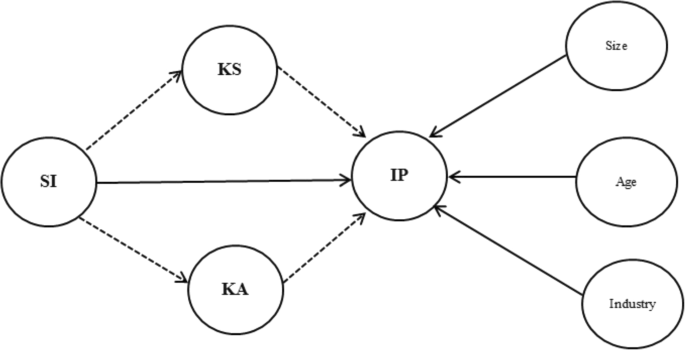
The proposed conceptual model
H3: In manufacturing SMEs, KA mediates the relationship between SI and IP.
3 Materials and methods
3.1 Sampling and data collection
For data collection we designed an questionnaire which was evaluated by 2 experts and 2 researchers in terms of suitability and relevance before the pilot study, then had a one-month pilot study with 25 respondents. We retained a minimum of three items for each construct to maintain reliability, based on Hair et al. (2010) recommendations. After the pilot several changes to the questionnaire were made, especially in terms of phrasing and we added some additional explanations for the terms used. The revised questionnaire was delivered via email in the first round and in hard copy in the second round, 2 months apart, and collected it over a 6 month period (April–September 2023). We used a preliminary sample of 312 Romanian manufacturing SMEs from other studies we authored. After receiving suggestions from some respondents, we expanded the initial preliminary sample to include 437 SMEs. The respondents were entrepreneurs or senior executives of manufacturing SMEs since we assumed only they have the best knowledge regarding the innovation and KM processes within investigated firms. After 2 rounds of data collection we received 192 questionnaires, a response rate of 43.93%. Due to various errors and inconsistencies, we rejected 7 questionnaires; ultimately, we used 185 questionnaires for data analysis, representing an actual response rate of 42.33%. Table 1 provides the characteristics of the sample of 185 investigated SMEs.
3.2 Method
We used PLS-SEM and SmartPLS 3 (v. 26) software for data analysis. PLS-SEM was suitable for given the our research model complexity, model specification, and interpretation. PLS-SEM is also known to simultaneously address multiple dependency associations with higher statistical efficiency (Ringle et al. 2018). In order to address the issue of common method bias (CMB), we adhered to the suggestions by Podsakoff et al. (2003). Initially, we used many information sources to construct our study: self-reported data on SI, KS, and KA, as well as objective data on IP. We took measures to guarantee the anonymity and confidentiality of the participants. We considered the non-response bias by examining the averages of the variables and subsequently compared the demographic characteristics of the initial 25% of the sample with the final 25%. The analysis revealed no significant differences between the two subsamples. In line with MacKinnon et al. (2012), while collecting data for studies focused on mediation, it is advisable to introduce a time gap between the measurement of predictor variables and the dependent variable. By doing this, it is possible to mitigate the potential impacts of common method bias (CMB). Consequently, we administered the questionnaires in 2 rounds, the first for SI, the second 2 weeks apart for KS and KA. The variance inflation factor (VIF) of 1.552 (see Table 2) shows that the highest VIF value is well below the 3.3 threshold, which is what Kock (2015) says should be done to check for collinearity. Therefore, this study suggests that CMB is not a significant concern.
3.3 Measurements
Independent variable. SI construct (9 items) was adapted from Fernandez-Vine et al. (2010), Klewitz and Hansen (2014), Ketata et al. (2015), and Alshanty and Emeagwali (2019) studies. We asked respondents to rate each item on a 7-point Likert scale, with a high score signifying SMEs’ commitment to implementing SI. We further considered the average of the scores on the nine items to assess SI focus in each investigated firm.
3.4 Mediating variables
(1) KS construct was adapted from Garcia-Fernandez (2015), Obeidat et al. (2016), and Alshanty and Emeagwali (2019) studies and comprised the following factors: 6 items related to encouragement of sharing knowledge necessary for the tasks achievement, knowledge exchanges between employees to achieve business goals and supporting information systems developed to share knowledge, rewarding KS and top management support, enabling processes facilitating KS;
(2) KA construct was adapted from Garcia-Fernandez (2015), Obeidat et al. (2016), and Alshanty and Emeagwali (2019) studies and comprised the following factors: 6 items related to the use of incentives for suggestions in utilizing existing knowledge, effective management of various sources of knowledge, application of all available knowledge to improve business performance or use of available knowledge in improving products and processes, teamwork encouragement, and employee reward for commitment to KA.
We measured all items on a 7-point Likert scale, similar to the independent variable. The scores were used to measure the intensity of KS and KA within the firm. We also took into account the average scores obtained from the three items for KS and the four items for KA.
Dependent variable. The dependent variable IP was measured by 3 items, adapted from Zhang and Li (2010), Chen et al. (2011), and Wu et al. (2016): The three items measured were the ratio of new products to all products in the last three years, the ratio of improved products to all products in the last three years, and the ratio of sales generated by the new and improved products to total sales in the last three years. We measured each item on a 7-point Likert scale. We further considered the average of the items’ scores.
3.5 Control variables
(1) Firm’s size (SIZE) was measured by the natural log of the number of employees.
(2) Firm’s age (AGE): was measured by the number of years since the firm was established.
(3) Industry (IND): represented by the NACE for the main activity; NACE codes from 10 to 31; for NACE 10, a corresponding dummy variable 1 was considered, while for the last NACE code, 31, a dummy variable 17 was considered.
4 Empirical results
4.1 Measurement model
The measuring model comprises item reliability, internal consistency, convergent validity, and discriminant validity. When evaluating the reliability of individual items, it is necessary to analyze the extent to which the measures align with their respective constructs. A minimum threshold of 0.70 is recommended for this analysis (Hair et al. 2010). All factor loadings were above the set threshold; hence, all of them were retained in the model (see Table 2).
The descriptive statistics indicate that there is no significant variation among the constructs evaluated in this study, as seen by the standard deviation (SD) results. Similarly, the results of skewness and kurtosis indicate a normal distribution (Hair et al. 2010). All measurement items were loaded with values higher than the specified minimum threshold of 0.7 (Ringle et al. 2018). Hence, it may be inferred that all relevant assessment items contribute significantly to the constructs they are assessing (Ringle et al. 2018). The constructs’ consistency and internal reliability are indicated by Rho_A and CR values, whereas convergent validity is confirmed by AVE values (Hair et al. 2016).
An investigation of construct reliability (CR) and convergent validity was used to evaluate internal consistency. To understand CR, Hair et al. (2010) propose a minimum threshold of 0.7 for interpretation. All of the constructions have been demonstrated to be dependable, with all measures of construct reliability exceeding 0.8. Convergent validity was evaluated by assessing the composite reliability. All constructions exhibited high reliability, surpassing the minimum threshold of 0.7.
In order to assess convergent validity, we employed the average variance extracted (AVE). As stated by Hair et al. (2010), the minimal threshold is 0.5. All constructs satisfy this criteria. Refer to Table 2 for CR and AVE results. We calculated the average variance extracted (AVE) and verified that all outcomes were above the suggested threshold of 0.5, demonstrating convergent validity.
Discriminant validity pertains to the degree of differentiation between one construct and others. We evaluated the discriminant validity using the square root of AVE. The average variance extracted (AVE) for a particular construct should exceed its correlation coefficient with any other construct. In other words, the squared correlation between two constructs should be lower than the AVE. This criterion is satisfied for all the variables (see Table 3). The correlation coefficients of constructs are less than the square root of AVE, indicating that each of them exhibits strong discriminant validity. The results show that the average variance extracted (AVE) for all components supports their ability to tell different things apart, since the AVE values are higher than the squared correlations between the different constructs (Hair et al. 2010). Table 3 presents the results.
We used the variance inflation factor (VIF) to check multicollinearity. The results (Table 2) were all below the common threshold value of 5 (Hair et al. 2016), proving minimal collinearity.
We further analyzed the discriminant validity for pairs of constructs by using the HTMT ratio and confidence interval (low-up). The achieved HTMT ratios and the corresponding confidence intervals up for each pair are < 0, which, according to Henseler et al. (2015), prove that the model possesses discriminant validity (Table 4).
4.2 Structural model
Reliability and validity were assessed through examining internal consistency and items loadings. In terms of confirmatory factor analysis to assess the convergent validity of all constructs, the results showed a good convergent validity (χ2 = 253.497, p = 0.000; χ2/df = 2.188, incremental fit index = 0.961, Bentler non-normed fit index = 0.951, comparative fit index = 0.957, RMSEA = 0.081).
4.3 Testing the mediating effects
To examine how KS and KA act as mediators in the relationships between SI and IP, SEM was used. SEM and Smart PLS are widely used in the literature for causal modeling methods (Cepeda-Carrion et al. 2019). We initially tested the baseline model, which does not have direct paths from SI to IP. All of the fit indices indicated a good fit (χ2 = 452.82, p < 0.001; Bentler non-normed fit index = 0.922; comparative fit index = 0.931; incremental fit index = 0.931; RMSEA = 0.076).
We further tested several models against the baseline model to see which one best fits the data:
Model 1 is Model 0, with the path of Hypothesis 2 constrained to zero. The path between SI, KS, and IP is removed from Model 0. A significant change in the chi-square difference was found (χ2 = 498.13; Δχ2 = 45.31**, p < 0.001; Δdf = 2), while the fit indices indicate a good fit (incremental fit index = 0.921; Bentler non-normed fit index = 0.909; comparative fit index = 0.921; RMSEA = 0.083). The result shows that the constrained path is important, proving the superiority of Model 0.
Model 2 is Model 0, with the path of Hypothesis 3 constrained to zero. In Model 2, the path between SI, KA, and IP was removed from Model 0 this time. Again, a significant chi-square difference is found (χ2 = 498.37; Δχ2 = 43.67**, p < 0.001; Δdf = 2), while the fit indices (incremental fit index = 0.925; Bentler non-normed fit index = 0.913; comparative fit index = 0.925; RMSEA = 0.082) are good. Again, the result shows that the constrained path is important, proving the superiority of Model 0.
Model 3 is Model 0, plus the direct path from SI to IP. The results show the chi-square difference between it and Model 0 is significant (χ2 = 440.74; Δχ2 = 11.78**; p < 0.001; Δdf = 1; incremental fit index = 0.940; Bentler non-normed fit index = 0.929; comparative fit index = 0.940; RMSEA = 0.078). Therefore, we concluded that adding the direct path between SI and IP significantly improved the model fit, and Model 3 proved superior to Model 0.
With Model 3 displaying a better fit to the data than Model 0, the next two models were compared with it.
Model 4 is Model 3, with the paths from SI to KS and KA constrained to zero. In this model, we assumed that there is no causal relationship between SI, on the one hand, and KS and KA, on the other hand. The chi-square difference test shows that Model 3 is superior to Model 4 (χ2 = 482.88; Δχ2 = 41.63**, p < 0.001; Δdf = 2; incremental fit index = 0.925; Bentler non-normed fit index = 0.912; comparative fit index = 0.925; RMSEA = 0.080).
Model 5 is Model 3, with the paths from KS and KA to IP constrained to zero. In Model 5, we assumed that KS and KA were marginal for IP. The chi square difference test shows that Model 3 is superior to Model 5 (χ2 = 495.67; Δχ2 = 51.68**, Δdf = 2; incremental fit index = 0.923; Bentler non-normed fit index = 0.911; comparative fit index = 0.923; RMSEA = 0.083).
In conclusion, after testing six models, Model 3 best fits the data and was chosen for hypothesis testing.
4.4 Hypothesis testing
Hypothesis 1 assumes that, in manufacturing SMEs, SI is positively and significantly related to IP. The path from SI to IP proved significant (t-value = 1.853, b = 0.231, p < 0.001), therefore we conclude that H1 is confirmed.
Therefore, our findings suggest that successful SMEs manage to reconcile sustainability with innovation by redefining products, technologies, and processes to improve IP. Adopting SI helps SMEs both improve and change products or processes (Adams et al. 2016). As such, it directly contributes to new products, processes, and organizational settings and procedures and supports manufacturing SMEs to minimize the environmental impact of their activities (Fernando et al. 2019). The results corroborate the findings of other studies, which suggest that SI could impact performance (Lopez-Valeiras et al. 2015). Promoting production focused on organic, recycled, or renewable raw materials or reducing energy consumption allows SMEs to compete with larger companies in terms of costs, capitalization of new opportunities, and capturing those customers interested in protecting the environment by purchasing green or sustainable products; hence, sustainable products allow SMEs to improve their competitive positions on existing markets or to penetrate new ones (Danneels and Kleinschmidt 2001). Overall, the effects improve the innovative capabilities of SMEs (Klewitz and Hansen 2014), leading to an improvement in their IP. SI path determines changes or new organizational routines and procedures, new business models, and management or marketing innovations, with a distinct focus on the environment in manufacturing SMEs (Li et al. 2018) (Fig. 2).
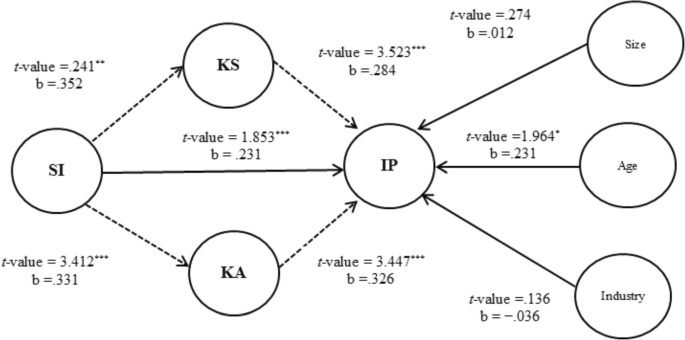
Final model and hypothesis testing results. Note: *p < 0.05; **p < 0.01; ***p < 0.001
To determine the extent and impact of constructs, the path coefficients are analyzed (Table 5).
Hypothesis 2 assumes that KS mediates the relationship between SI and IP. The path from SI to KS is significant (b = 0.352, t-value = 2.241, p < 0.01), and the path from KS to IP is significant (b = 0.284, t-value = 3.523, p < 0.001). Therefore, we conclude that H2 is confirmed.
Hypothesis 3 assumes that KA mediates the relationship between SI and IP. Both paths, the one from SI to KA (b = 0.331, t-value = 3.412, p < 0.001) and from KA to IP (b = 0.326, t-value = 3.447, p < 0.001), are significant; therefore, H3 is confirmed. Considering the model that best fits the data (Model 3), we conclude that KS and KA partially mediate the relationship between SI and IP.
KS and KA underlie the performance of organizational processes. Most times, the knowledge required to innovate is already available in SMEs, but the process for its mobilization is inefficient. Both KS and KA may prove critical when relating to SI, since research and development activity is critical for the development of SI, even more than for non-environmental innovations. Under this context, firms need an adequate internal knowledge base to address environmental concerns affecting their activities (De Marchi and Grandinetti 2013). Moreover, innovation is not just about creating new products or processes. SMEs need a new innovative format since the traditional model of innovation favors a preferential use of existing internal resources and knowledge (Jones and Linderman 2014). However, in addition to internal knowledge, external knowledge also plays a crucial role (Kim et al. 2015), increasing the importance of KS in improving IP (Wang et al. 2015a, b). Therefore, internal investments towards the introduction of SI by knowledge originating in SMEs partners (De Marchi and Grandinetti 2013) may leverage innovation outcomes. SMEs favoring SI cooperate with a larger value network than other organizations (Lopes et al. 2017).
5 Discussion and conclusions
5.1 Main findings
This study examined the multidimensional relationship between SI and IP and the mediation effects of both KS and KA.
The study provides empirical evidence to support the first hypothesis, which asserts a positive relationship between SI and IP. It suggests that SMEs can improve their IP by implementing SI. These findings support previous studies emphasizing the role of sustainability in innovation (Forsman 2013) or in providing mechanisms to improve organizational performance without affecting the environment (Schrettle et al. 2014). Nowadays, manufacturing SMEs have to cope with the challenge of translating sustainability goals into products, processes, and organizational settings, bringing value to both customers (Keskin et al. 2013) and society. Moreover, the findings support the literature suggesting that SMEs engagement in environmental-based innovation, in our study SI, may not contribute but rather drive innovation (Maletič et al. 2016).
Regarding the next two hypotheses, the results indicate that the impact of SI on IP in manufacturing SMEs is partially mediated by KS and KA, demonstrating the ability of knowledge to mediate this impact. This finding is in line with Yusr et al.’s (2017) study proving that knowledge significantly improves the innovation capabilities of companies. The findings also corroborate the Albort-Morant et al. (2018) study, which demonstrated that knowledge facilitates the organization’s adoption of environmental sustainability. Further, the findings confirm Abbas and Sagsan’s (2019) study proving the role of KA in enhancing organizational capabilities toward a more pronounced environmental focus.
KS facilitates or creates the conditions for sharing knowledge between employees. Of course, the employees must be willing to share their knowledge, but SMEs may create appropriate conditions for sharing. To address this issue, we incorporated a question about the utilization of IT systems for information and KS, despite the significantly limited resources available to SMEs for their implementation. We proved that there is a connection between KS and SI, supporting Habib et al.’s (2019) finding that KS increases innovation capabilities. Therefore, we concluded that SMEs have to encourage KS to improve IP. In a similar vein, KA enables the transformation of knowledge into new products, processes, or organizational innovations, both management and marketing. The study’s findings align with previous research (Kopnina 2015), which highlights the significance of KA in fostering environmentally sustainable organizations. Moreover, it enables SMEs to increase the pace of new product development and facilitates process and organizational innovation adoption. SMEs should implement incentive policies for their employees, encouraging them to utilize existing knowledge or effectively manage various sources of knowledge. The goal is to use all available knowledge to improve the products offered to customers, thereby fostering IP.
5.2 Theoretical contributions and practical implications
This study highlights the importance of SI in improving the IP of SMEs. Furthermore, we provide evidence of the relationship between KM processes and innovation by scrutinizing the mediating effects of both KS and KA. The study suggests that to improve IP, SMEs should encourage KS and KA.
We also extend both the innovation and KM-related literature (Trantopoulos et al. 2017) by unveiling how KS and KA contribute to IP in SMEs. Most existing studies have largely been conceptual; usually, they have primarily analyzed the role of different knowledge sources on product (Caloghirou et al. 2004) or process innovation (Trantopoulos et al. 2017). We support their general findings that knowledge is beneficial to innovation.
SMEs, given their size and economic contribution, have the potential to significantly contribute to environmental innovation, particularly SI. However, the literature on this topic primarily focuses on large companies. Due to their limited resources, SMEs often struggle to identify the specific KM processes they should prioritize. Our findings align with previous studies that demonstrate the critical role of knowledge in ensuring the long-term survival of SMEs (Bagnoli and Vedovato 2014).
The relationships between SI, IP, KS, and KA are also of practical importance. Industrial SMEs may improve IP in terms of sustainability and innovation operationalization by considering KS and KA (Ayuso et al. 2011). To achieve SI, such SMEs exploit existing knowledge capabilities to share or use relevant knowledge; at this aim, they increase their employees competence or comply with sustainability-related standards and regulations. SI contributes to the development of existing innovation capabilities in SMEs (Ayuso et al. 2011), and it may increase firm-level sustainability. Its implementation may be facilitated through the adoption of new knowledge sources, including, for instance, a specific focus on corporate social responsibility (Hart and Sharma 2004). SMEs have to pay attention to these signals by investing in absorptive capacity (Aschehoug et al. 2012) or by recognizing the importance of external knowledge, such as bringing customers’ input into the business (Milliman et al. 2012). This is virtually impossible without effective KM.
KS and KA mediation effects should include those KM processes that increase SMEs’ sensitivity to changes in environmental-related innovation opportunities. In order to develop these capabilities, SMEs are advised to implement processes that emphasize KA regarding the latest product, process, or organizational-related developments. Developing these KM processes will enable SMEs to identify new innovation opportunities.
5.3 Limitations and recommendations for future research
The findings have to be understood as context-specific since a sample of manufacturing SMEs was investigated. SMEs from other industries may act differently, both in terms of using SI or other forms of innovation and in the mediating effects of KS and KA.
Secondly, SI may have further implications for IP in the long term; this study is not longitudinal, thereby the long-term effects are not assessed. In the same vein, with only two KM processes considered—KS and KA—the mediating effects may dilute or not if other KM processes, such as knowledge creation, are considered.
Regarding future developments of the study, extending the range of the investigated SMEs by including companies in services and large companies may provide deeper insights on the relationships between SI, KM processes, and IP. Secondly, including more KM processes, such as knowledge creation, will be beneficial for the effects assessments by providing a more comprehensive framework for SMEs to decide which KM processes they have to consider to improve IP.
