
 info@apippress.com
 +86 18163351462 (WhatsApp)
 +86 182 8014 0209
Article Content
Abstract
The growing complexity and vulnerability of global supply chains underscore the need for robust frameworks to enhance resilience and sustainability. This quantitative study investigates the enablers of supply chain resilience and examines its dual role as both a direct contributor to sustainability performance and a mediator in the relationship between blockchain technology and sustainability outcomes. A cross-sectional approach was used to collect 387 valid responses from medium- and large-scale logistics firms operating in four major logistics hub cities in China. The data were analyzed using a structural equation modeling approach by applying partial least squares structural equation modeling. The results show that the proposed model explains 37.4% of the variance in SCR (R² = 0.374), 25.2% in economic performance (R² = 0.252), and 30.3% in environmental performance (R² = 0.303). Among the blockchain capabilities, transparency (β = 0.264, p = 0.001) and transaction cost efficiency (β = 0.212, p = 0.000) had the strongest direct effects on SCR, while value co-creation (β = 0.371, p = 0.000) significantly mediated the path between SCR and sustainability outcomes. Furthermore, multi-group analysis revealed significant differences based on firm size and operational tenure, such as a stronger effect of value chain integration on SCR among firms operating for eight years or less (β = 0.421, p = 0.022). Theoretically, this study integrates the multidimensional dynamic capabilities perspective with transaction cost economics, providing a nuanced understanding of blockchain’s role in enhancing supply chain resilience and sustainability, and enriching dynamic capability theory. Practically, it offers actionable insights for practitioners and policymakers by identifying enablers and barriers to blockchain adoption and emphasizing the need for standardized frameworks and supportive policies. This study advances the understanding of blockchain’s transformative potential for building resilient, adaptive, and sustainable supply chains amid global volatility.
Explore related subjects
Discover the latest articles and news from researchers in related subjects, suggested using machine learning.
- Business Strategy and Leadership
- Logistics
- Expertise
- Resource and Environmental Economics
- Supply Chain Management
- Sustainability
1 Introduction
The concept of supply chain resilience (SCR) has gained paramount importance in the contemporary landscape of global supply chains, characterized by rapid globalization, technological advancements, and increasing environmental consciousness. The vulnerabilities exposed by recent global disruptions, such as the COVID-19 pandemic and geopolitical tensions, have necessitated a re-evaluation of traditional supply chain frameworks. These events have underscored the critical need for organizations to enhance their SCR capabilities while simultaneously addressing the growing demand for transparency, traceability, and sustainability from consumers and regulatory bodies (Saberi et al. 2018; Zhu & Wu 2022).
Blockchain technology has emerged as a promising solution to these challenges, offering unique features that can significantly bolster SCR. By providing a decentralized and immutable ledger, blockchain facilitates real-time data sharing and enhances operational transparency across supply chains (Li and Chen 2022). This technology not only improves traceability of products but also fosters trust among stakeholders, which is essential for collaborative efforts in managing supply chain disruptions (Ko et al. 2022; Turgay and Erdoğan 2023). The integration of blockchain can enhance visibility and accountability, thereby addressing the complexities of modern supply chains and aligning with sustainability goals (Ibrahim 2024; Revathi, 2024).
Moreover, the application of blockchain extends beyond mere transparency; it encompasses the potential for ethical sourcing or corporate social responsibility (Kang et al. 2025) and sustainable practices. For instance, studies have shown that blockchain can effectively enhance ethical production processes by ensuring that all stakeholders have access to verified information regarding the origin and handling of products (Ibrahim 2024). This capability is particularly relevant in sectors such as agriculture, where ethical sourcing is increasingly demanded by consumers. Furthermore, the ability of blockchain to streamline operations can reduce waste and improve resource management, contributing to the overall sustainability of supply chains (Ejairu 2024; Wang et al. 2019a, b). Despite the acknowledged benefits of blockchain, its role as a comprehensive enabler of SCR and its sustainability remains underexplored. Further research is required to fully understand how blockchains can be leveraged to address the dynamic challenges faced by supply chains today (Yin 2024).
The integration of blockchain technology into supply chain management (SCM) has garnered significant attention due to its potential to enhance SCR and sustainability. However, the existing literature often emphasizes isolated benefits, such as transparency and cost reduction, neglecting the multidimensional impacts of blockchain on SCR and its broader implications for performance outcomes. This narrow focus limits the understanding of how various blockchain attributes—such as cybersecurity, real-time data sharing, and stakeholder collaboration—can synergistically enhance SCR (Saberi et al. 2018). A comprehensive examination of blockchain capabilities reveals that its attributes collectively contribute to improved supply chain performance. For instance, blockchains facilitate enhanced visibility and traceability, which are critical for navigating disruptions and ensuring accountability among stakeholders (Wang et al. 2019a, b). Moreover, the integration of smart contracts within blockchain frameworks can streamline processes, reduce transaction cost and foster trust among supply chain partners, thereby enhancing overall operational efficiency (Turgay and Erdoğan 2023). However, the literature lacks a holistic framework that integrates these capabilities, which is essential for advancing both theoretical insights and practical applications of SCM (Brau 2023; Markus and Buijs 2022).
Furthermore, the relationship between blockchain-enabled SCR and broader performance outcomes including economic, environmental, and collaborative value creation remains underexplored. Although operational efficiency is frequently highlighted, the interplay between resilience and these broader dimensions has not been sufficiently examined (Wang et al. 2019a, b). Understanding these connections could provide a more comprehensive view of blockchain’s contributions to sustainable supply chain performance, particularly in the context of global challenges, such as climate change and geopolitical uncertainties (Revathi, 2024). Another critical gap in the literature is the mediating role of value co-creation (VCC) in blockchain-enabled SCR. Blockchain-facilitated collaboration among supply chain stakeholders has the potential to enhance stakeholder engagement and improve sustainability outcomes (Chittipaka et al. 2022; Wang 2023). However, the mechanisms by which VCC link blockchain adoption to performance outcomes remain inadequately studied, highlighting the need for further exploration of this critical mediator (Ma 2024).
From a policy perspective, the regulatory and institutional frameworks necessary to support blockchain adoption in SCM have not been sufficiently addressed in the literature. Issues such as standardization, interoperability, and ethical considerations, including data privacy and stakeholder equity, remain unresolved (Ejairu 2024; Oriekhoe 2024). These gaps hinder the widespread adoption of blockchain and limit its impact in addressing dynamic supply chain challenges. Therefore, it is imperative to investigate the regulatory landscape and develop frameworks that facilitate the integration of blockchain technology in supply chains (Quayson 2024).
To address the identified research gaps, this study investigates the enablers of SCR, its dual role as both a direct contributor and a mediator of sustainability performance, and the mediating influence of VCC within this dynamic relationship. Therefore, this study significantly advances the theoretical and practical understanding of blockchain technology’s role in SCR and sustainability. Amid global disruptions, such as pandemics, geopolitical tensions, and climate-induced crises, building adaptive supply chains has become critical. By presenting a comprehensive framework, this study highlights blockchain’s multidimensional capabilities—transparency, cybersecurity, real-time connectivity, and transaction cost—and their collective impact on SCR. It also explores how VCC mediates the link between blockchain-enabled resilience and broader performance outcomes such as economic, environmental, and collaborative benefits, offering insights for achieving long-term sustainability and stakeholder engagement. Practically, the findings can guide practitioners and policymakers in leveraging blockchain to address dynamic supply chain challenges while aligning with global sustainability goals. This study emphasizes the need for supportive policies including standardization, interoperability, and ethical considerations to accelerate blockchain adoption. Furthermore, sector-specific and contextual insights provide a roadmap for integrating blockchain across industries and regions. By addressing the intersection of blockchain, resilience, and sustainability, this study contributes to developing adaptive future-ready supply chains in a volatile global environment. Accordingly, this study seeks to answer the following research question: What is the role of blockchain in strengthening supply chain resilience and sustainability, and how do value co-creation and policy frameworks influence this relationship? This paper is organized as follows: Sect. 2 reviews relevant literature and presents the theoretical framework and hypotheses. Section 3 describes the research design, including sample and data collection. Section 4 outlines the findings, starting with demographic information. Section 5 discusses theoretical implications, and Sect. 6 concludes the study.
2 Literature review
2.1 Theoretical underpinning
The dynamic capabilities theory (DCT), proposed by Teece et al. (1997), provides a compelling framework for understanding how organizations adapt, integrate, and reconfigure resources to navigate rapidly changing environments. In SCM, dynamic capabilities foster resilience, manage uncertainties, and achieve multidimensional performance outcomes. This study leverages DCT to examine how blockchain-enabled supply chain capabilities enhance resilience and deliver competitive, sustainable, and collaborative advantages. Blockchain technology, with its core features of traceability, transparency, real-time connectivity, cybersecurity, value chain integration, and cost efficiency, serves as a transformative resource enabling organizations to sense, seize, and reconfigure resources effectively (Zhao et al. 2023). For instance, traceability and real-time data connectivity improve situational awareness, helping organizations monitor operations, detect risks, and identify growth opportunities (Pu 2024; Zhou et al. 2022). Transparency and cybersecurity build trust among stakeholders and enable agile responses to disruptions (Singh et al. 2020). Value chain integration and cost efficiency enhance flexibility and adaptability, critical for maintaining supply chain stability during disruptions (Altay et al. 2018).
In this framework, SCR—the capability to prepare for, absorb, and recover from disruptions—is a manifestation of dynamic capabilities in SCM (Aslam et al. 2020; Vanany et al. 2024). Blockchain facilitates SCR by enabling secure, decentralized information flows, thereby enhancing decision-making speed and flexibility. It supports operational continuity through reliable traceability and strengthens supplier relationships through enhanced visibility (Chittipaka et al. 2022). These blockchain-induced dynamic capabilities ultimately influence multidimensional performance, including operational efficiency (e.g., inventory optimization), environmental outcomes (e.g., carbon tracking), and collaboration (e.g., smart contracts for fair sourcing) (Mishra et al., 2024; Quang 2024).
The integration of DCT with blockchain provides a forward-looking and adaptive framework, aligning technology attributes with organizational capabilities (Wu 2025). It allows for a comprehensive assessment of how blockchain supports resilience, not in isolation, but as part of an integrated performance-driven strategy. The model addresses the growing need for digital agility and sustainability alignment in global supply chains (Wang 2023; Ma 2024). However, the model assumes technological readiness and interoperability across supply chain partners, which may not hold true in all industries, especially in developing regions (Oriekhoe 2024). Additionally, over-reliance on technology without corresponding organizational change may limit the realization of dynamic capabilities. The model may also underemphasize the institutional and regulatory barriers that can hinder blockchain diffusion, which warrants further investigation (Ejairu 2024; Quayson 2024).
2.2 Hypothesis development
2.2.1 Blockchain-enabled SCM and SCR
The multifaceted nature of SCR—such as real-time connectivity, traceability, transparency, cybersecurity, value chain integration, and transaction cost efficiency—plays a crucial role in enhancing SCR, enabling firms to navigate the complexities and uncertainties of the modern supply chain landscape effectively. real-time connectivity is pivotal for enhancing SCR, particularly for logistics firms operating in the dynamic Chinese market. By facilitating seamless communication and information sharing among stakeholders, real-time connectivity significantly enhances visibility and decision-making capabilities. Research indicates that firms equipped with advanced connectivity tools can monitor inventory levels, track shipments, and communicate with partners instantaneously, which is crucial for operational agility and continuity (Hastig and Sodhi 2020; Saberi et al. 2018). This capability allows firms to respond proactively to disruptions, thereby minimizing their impact and fostering an environment conducive to resilience (Wang 2023; Zhu & Wu 2022). Furthermore, the integration of digital technologies, such as blockchain, has been shown to improve responsiveness and adaptability in supply chains, reinforcing the importance of real-time connectivity in mitigating risks and enhancing overall SCR (Ning et al. 2022).
H1
Real-time connectivity positively influences SCR of logistic firms in China.
Traceability, defined as the ability to track products and materials throughout a supply chain, is essential for enhancing transparency and reliability in logistics operations. In China, where regulatory compliance and customer trust are paramount, effective traceability systems enable firms to identify bottlenecks, monitor shipment conditions, and verify the authenticity of goods (Fang and Ge 2023; Zhang and Li 2023). The implementation of advanced tracking systems, including blockchain technology, has resulted in significant improvements in traceability efficiency, thereby reducing the time required to trace products from weeks to a few seconds (Wu et al. 2023; Zhang and Li 2023). This capability not only mitigates the risks associated with supply chain disruptions but also builds stakeholder confidence, thereby reinforcing logistics firms’ resilience (Wang 2023; Wu and Zhang 2022). Consequently, traceability has emerged as a critical enabler of SCR, allowing firms to respond swiftly to challenges and maintain operational integrity.
H2
Traceability positively influences SCR of logistics firms in China.
Transparency within a supply chain is characterized by the unrestricted flow of accurate real-time information among all stakeholders. In the face of challenges, such as demand volatility and regulatory changes, transparency is vital for effective risk management (Hussain et al. 2022; Trivellas et al. 2020). By fostering an environment of trust and collaboration among partners and customers, transparent operations enable firms to identify inefficiencies and risks early, thereby facilitating rapid responses to changing circumstances (Pettit et al. 2019; Zhu & Wu 2022). Enhanced visibility and accountability derived from transparency not only strengthen the resilience of logistics firms but also contribute to improved service continuity during disruptions (Pu et al. 2023; Wang 2023). Thus, transparency is a fundamental component of SCR, enabling firms to navigate complexities and uncertainties more effectively.
H3
Transparency positively influences SCR in logistics firms in China.
In an increasingly digitalized logistics environment, cybersecurity has emerged as a critical factor in maintaining the integrity and reliability of supply chain operations. The rise of cyber threats poses significant risks to operational continuity and stakeholder trust, making robust cybersecurity measures essential (Aslam et al. 2020; Prastiti 2023). By protecting sensitive data and ensuring system reliability, cybersecurity mitigates vulnerabilities that could disrupt supply chain operations (Alvarenga et al. 2023; Zhu & Wu 2022). Furthermore, a secure digital infrastructure enhances the trustworthiness of data-driven decision-making processes, enabling firms to respond effectively to disruptions (Ning et al. 2022; Wang 2023). Therefore, cybersecurity plays a vital role in enhancing SCR by safeguarding the stability and functionality of logistics systems.
H4
Cybersecurity positively influences SCR in logistics firms in China.
Value chain integration involves the seamless coordination of activities and processes across the supply chain, optimizing performance and reducing inefficiencies. For logistics firms in China, effective integration of value chain components—such as procurement, production, and distribution—can significantly enhance resilience (Wang 2023; Zhu & Wu 2022). Integrated value chains facilitate the dynamic reconfiguration of processes and resources, ensuring operational continuity during disruptions (Cui et al. 2022; Hussain et al. 2022). Moreover, value chain integration promotes collaboration and improves resource utilization, enabling firms to anticipate and mitigate risks proactively (Ning et al. 2022; Pu et al. 2023). As such, value chain integration is a critical determinant of SCR, allowing firms to navigate the complexities of the supply chain landscape more effectively.
H5
Value chain integration positively influences SCR in logistics firms in China.
Transaction costs efficiency refers to the minimization of costs associated with coordinating and executing supply chain activities. For Chinese logistics firms, reducing transaction cost enables more streamlined operations, allowing them to allocate resources to resilience building initiatives (Wang 2023; Zhu & Wu 2022). By lowering costs, firms can invest in technologies and processes that enhance their ability to detect and adapt to disruptions (Alvarenga et al. 2023; Aslam et al. 2020). Additionally, efficient transaction management fosters stronger relationships with supply chain partners, promoting collaboration and trust (Hussain et al. 2022; Pettit et al. 2019). Consequently, transaction cost directly contributes to the resilience of logistics firms by enabling operational flexibility and sustainability in the face of uncertainties.
H6
Transaction costs positively influence SCR in logistics firms in China.
2.2.2 SCR, VCC, and firm performance
The positive influence of SCR on VCC, economic performance (ECP), and environmental performance (ENP) in logistics firms in China is well-supported by empirical evidence. The ability to adapt, innovate, and collaborate effectively in the face of disruptions not only enhances operational performance but also contributes to sustainable practices and value creation among stakeholders.
SCR enhances collaboration and trust among supply chain partners, which is crucial for an effective VCC. As noted by Gu et al., firms that build resilience capabilities with their supply chain partners can ensure stable material supply and continuous service delivery, thereby satisfying end customer needs and improving overall supply chain performance (Gu et al. 2021). The ability to adapt and innovate in response to disruptions fosters an environment conducive to VCC, as resilient firms are more likely to engage proactively with stakeholders to address collective challenges (Baah et al. 2023). Furthermore, SCR promotes transparency and agility, allowing firms to respond swiftly to changing market conditions, which is essential for creating shared value among customers, suppliers, and partners (Cao 2024). This aligns with the findings of Zhou et al., who emphasize that internal and external resilience significantly impacts firm performance, thereby facilitating better collaboration and value generation (Zhou et al. 2022).
H7
SCR positively influences on VCC of logistic firms in China.
SCR is increasingly viewed as a key driver of ECP, particularly in the complex and dynamic environment of logistics in China. Resilient supply chains enable firms to mitigate risks and minimize losses while capitalizing on emerging opportunities (Pettit et al. 2019). For instance, logistics firms that maintain operational continuity during disruptions can reduce downtime and avoid penalties, directly enhancing their economic outcomes. This is corroborated by Liu et al. (2018), who found that SCR significantly contributes to firm performance in the liner shipping industry, highlighting the economic benefits of resilience. Moreover, the proactive risk management strategies inherent in SCR lead to better resource utilization and cost savings, which are critical for improving profitability in a competitive landscape (Issa 2024). The integration of advanced technologies, as discussed by Belhadi et al., further enhances SCR and, consequently, economic performance (Belhadi et al. 2021).
H8
SCR positively influences on economic performance of Logistic Firms in China.
Incorporating resilience into supply chain operations not only ensures continuity but also enhances ENP, a crucial aspect in the context of sustainability. SCR facilitates the adoption of environmentally friendly practices by enabling logistics firms to optimize processes and leverage advanced technologies, thereby minimizing waste and reducing emissions (Essuman et al. 2023). As highlighted by Agyabeng-Mensah et al., green logistics management practices significantly drive sustainability performance, which is closely linked to SCR (Agyabeng-Mensah et al. 2020). Additionally, SCR supports compliance with environmental regulations, reducing the risk of penalties and fostering a positive corporate image (Papachristos 2023). The ability to respond effectively to disruptions, such as natural disasters, ensures that environmental commitments are upheld even in challenging conditions, reinforcing the importance of SCR in achieving sustainability goals (Dai 2024). This is further supported by the findings of Essuman et al., which indicate that firms with strong resilience capabilities are better positioned to manage environmental challenges and enhance their sustainability performance (Dovbischuk 2022).
H9
SCR positively influences environmental performance of logistic firms in China.
2.2.3 VCC and firm performance
VCC involves collaborative efforts between firms and their stakeholders—such as customers, suppliers, and technology partners—to innovate and optimize service offerings. This collaborative approach allows logistics firms to leverage shared knowledge and resources, which can lead to significant operational efficiencies and improved service delivery (Liu and Wang 2022). For instance, Agyabeng-Mensah et al. (2020) highlight that green logistics management practices positively impact both environmental and operational performance, suggesting that such practices can also enhance economic performance by reducing costs and improving service quality. Similarly, Liu and Wang assert that green logistics innovations can lead to reduced energy consumption and improved economic outcomes, thereby reinforcing the notion that VCC can drive economic performance through sustainable practices (Liu and Wang 2022). Mutie et al. (2020) discusses how logistics performance can indirectly contribute to economic growth, emphasizing the importance of effective logistics strategies in enhancing overall firm performance.
In addition to economic performance, VCC also plays a crucial role in enhancing the environmental performance of logistics firms in China. As regulatory pressures and stakeholder expectations for sustainability grow, logistics firms are increasingly adopting collaborative approaches to develop eco-friendly solutions. This includes co-developing green logistics strategies and energy-efficient systems, which not only reduce the ecological footprint but also maintain operational efficiency (Jayarathna et al. 2022). The collaborative nature of VCC allows logistics firms to engage in joint initiatives that promote sustainability, such as adopting sustainable packaging and optimizing delivery routes to minimize carbon emissions (Elliot et al. 2023; Ye et al. 2022). This alignment of environmental objectives with co-creation efforts not only enhances environmental performance but also strengthens stakeholder relationships, contributing to long-term competitiveness in a rapidly evolving market (Li 2024; Tapaninaho and Heikkinen 2022).
H10 − 11
VCC positively influences economic and environmental performance of logistic firms in China.
2.2.4 Mediating effect of SCR
Research indicates that resilient supply chains can leverage real-time connectivity to quickly identify and address risks, thereby optimizing processes and enhancing competitiveness (Cao 2024). The ability to transform real-time information into actionable insights is crucial for decision-making, and SCR acts as a catalyst in this process, ensuring that the advantages of real-time connectivity extend beyond mere connectivity (Kokkinou 2023). Similarly, traceability enhances visibility and accountability within supply chains, fostering transparency and trust among stakeholders. While traceability inherently supports VCC, its full potential is realized when paired with SCR. Resilient supply chains utilize traceability to anticipate and respond to disruptions, such as quality issues or supplier delays, ensuring that operational objectives are met (Saberi et al. 2018; Wu and Zhang 2022). SCR mediates this relationship by converting traceability into actionable intelligence that enhances responsiveness and collaboration, thus bolstering VCC in complex environments (Nikookar and Yanadori 2021).
Although Transparency is another critical factor for building trust and collaboration within supply chains, transparency alone does not guarantee VCC; it must be complemented by SCR. Sharing transparent information about market demand or potential risks allows firms to proactively adjust operations, minimizing disruptions and enhancing competitiveness (Mollashahi 2024; Wieland et al. 2023). SCR transforms transparency from a static attribute into a dynamic capability that drives competitive advantage. Likewise, while cybersecurity contributes to operational stability, its strategic value in enhancing VCC becomes evident when mediated by SCR. Resilient supply chains employ robust cybersecurity measures to mitigate vulnerabilities and ensure continuity during cyber incidents, thus maintaining trust and operational efficiency (Gafni and Levy 2023; Ibiyemi 2024). SCR amplifies the effects of cybersecurity by integrating protective measures into a broader framework of adaptability and recovery, creating a secure and competitive value chain (Odimarha 2024).
The contribution of value chain integration to VCC is significantly enhanced when mediated by SCR. Resilient supply chains capitalize on integration to develop flexible networks capable of withstanding disruptions and adapting to market changes (Zhou et al. 2023). For example, firms with integrated and resilient supply chains can quickly reconfigure operations in response to supplier failures or demand fluctuations, ensuring sustained competitiveness (Li et al. 2022). Lastly, transactional cost efficiency reduces operational expenses, enhancing a firm’s cost competitiveness. However, achieving and sustaining VCC requires resilience. SCR mediates the relationship between transaction cost and VCC by ensuring that cost-efficient operations are robust and adaptive. Resilient supply chains can maintain efficiency during disruptions, ensuring that cost advantages translate into sustained competitiveness (Hirsch 2024). Therefore, the following hypotheses are proposed:
HM1 − 6
SCR mediates the effect of real-time connectivity, traceability, transparency, cybersecurity, value chain integration and transactional cost on VCC among the logistic firms in China.
Real-time connectivity facilitates timely decision-making and operational synchronization, which, when mediated by SCR, significantly enhances a firm’s ability to respond to unforeseen challenges (Fu 2024; Queiroz et al. 2022). Moreover, traceability enhances visibility and accountability across supply chains, while SCR amplifies these benefits by ensuring resource optimization and operational continuity, ultimately driving improved economic outcomes (Aigbogun et al. 2022). Transparency fosters stakeholder trust and collaboration, which, when mediated by SCR, allows firms to reduce inefficiencies and achieve superior financial performance (Trivellas et al. 2020).
By ensuring data integrity and secure operations, a cybersecurity protects firms from costly disruptions. When SCR acts as a mediator, its ability to prevent and recover from cyberthreats contributes to economic stability (Pettit et al. 2019; Siagian et al. 2021). Value chain integration enhances operational cohesion, and its impact on ECP is magnified by the capacity of SCR to reconfigure resources and sustain competitive advantages during market uncertainties (Sadia 2024). Transactional cost efficiency minimizes waste and reduces operating costs; with SCR as a mediator, these cost-saving initiatives translate into improved profitability and long-term economic performance (Krimi 2024; Saddique 2023). Additionally, VCC mediates the relationship between SCR and ECP, enabling firms to leverage resilience capabilities to enhance operational efficiency, stakeholder satisfaction, and market responsiveness (Hussain et al. 2022). SCR and VCC act as critical mediators, ensuring that blockchain-enabled capabilities translate into sustained economic performance in dynamic and volatile environments. Empirical evidence suggests that enhancing SCR not only fortifies firms against disruptions but also serves as a strategic asset that drives economic performance (Basuki 2024). Therefore, the following hypotheses are postulated:
HM7 − 13
SCR mediates the effect of real-time connectivity, traceability, transparency, cybersecurity, value chain integration, transactional cost, and VCC on the economic performance of logistic firms in China.
Research indicates that SCR significantly mediates the relationship between real-time connectivity and ENP by ensuring that firms can leverage real-time data to make informed decisions during disruptions (Zhu & Wu 2022). This adaptability is crucial for maintaining operational continuity and achieving sustainability goals. Furthermore, traceability enhances visibility across the supply chain, allowing firms to monitor compliance with environmental standards. When mediated by SCR, traceability strengthens the ability of firms to implement sustainable practices efficiently, as it enables quick identification and rectification of non-compliance issues (Saberi et al. 2018). Similarly, SCR amplifies the impact of transparency on ENP by fostering collaborative efforts among supply chain partners to meet environmental objectives. This collaborative approach is essential for achieving long-term sustainability, as it encourages shared responsibility and accountability (Zhu & Wu 2022). In addition, cybersecurity is increasingly recognized as vital for safeguarding data integrity and ensuring the security of operations within supply chains. The integration of cybersecurity with SCR not only reduces environmental vulnerabilities but also fosters robust ENP by protecting sensitive information related to sustainability practices (Layode 2024).
Value chain integration facilitates streamlined processes essential for implementing environmentally friendly practices (Zhu & Wu 2022). Transaction costs efficiency leads to the sustainable practices by reducing waste and optimizing resource utilization. SCR mediates the relationship between transaction cost and ENP by facilitating sustainable supply chain practices, ultimately leading to improved environmental outcomes (Zhu & Wu 2022). Moreover, the VCC acts as a secondary mediator linking SCR to ENP. By enabling firms to achieve sustainable performance through superior operational efficiency and stakeholder collaboration, VCC enhances the overall effectiveness of SCR in promoting environmental sustainability (Zhu & Wu 2022). SCR and VCC are instrumental in enhancing the relationship between blockchain-enabled capabilities and ENP, thus equipping firms with the ability to achieve long-term sustainability and environmental excellence. Thus the following hypothesis are recommended:
HM14 − 20
SCR mediates the effect of real-time connectivity, traceability, transparency, cybersecurity, value chain integration, transactional cost, and VCC on the environmental performance logistic firms in China.
All direct associations hypothesized above are presented in Fig. 1 below.
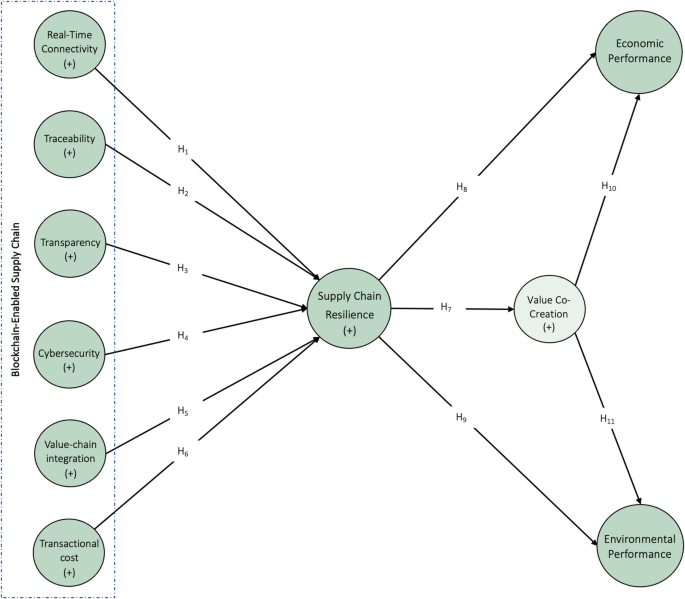
Research framework
3 Research methodology
3.1 Sample selection and data collection
This empirical study employed quantitative analysis and utilized a self-administered questionnaire with a cross-sectional design to explore the predictors of SCR and sustainability performance. This study focuses on medium- and large-sized logistics firms operating in four major logistics hub cities in China: Chongqing, Shenzhen, Qingdao, and Xi’an. These cities were selected for their pivotal roles as key logistical hubs and their contributions to China’s supply chain ecosystem. According to Qichacha (Link: www.qcc.com), a comprehensive business database, China has 828,787 logistics firms, including 6,379 medium- and large-sized firms. To develop a robust and relevant sampling frame, specific screening criteria were applied, such as (a) actively registered logistics firms (excluding those with abnormal statuses) and (b) firms classified as business enterprises (thereby excluding other organizational types). Additionally, firms had to have been established for more than three years to ensure operational stability and employ more than 200 insured employees, meeting the classification of medium or large firms. The industry focus was narrowed to logistics-related subcategories within transportation, warehousing, and postal services, and only firms located in Chongqing, Shenzhen, Qingdao, and Xi’an were considered. Following these stringent criteria, 561 medium-sized and large logistics firms were included. Detailed information on the cities, the number of logistics firms in each city, and the selected firms is presented in Supplementary Material 1, Table S1.
To determine the necessary sample size, G*Power 3.1 (V. 4) software was used, considering eight predictors, an effect size of 0.15, and a statistical power of 0.8, which indicated a minimum of 109 responses. However, Hair et al. (2022) recommend a minimum sample size of 200 for robust analysis using partial least squares structural equation modeling (PLS-SEM). To ensure the representativeness and reliability of the collected data, the data collection team contacted 561 companies between July and October 2024 using valid corporate contact information from the Qiachai Database. During the telephone interview phase, the data collection team explained the study’s topic, objectives, and significance to all interviewed companies, ensuring their interest in participating and addressing any concerns. Of the 401 companies that agreed to participate, the team sent links to an online questionnaire via text message and email. Ultimately, 387 completed questionnaires were obtained from medium- and large-sized logistics firms, meeting the minimum sample size required for data analysis.
Participants voluntarily provided informed consent after being fully briefed on the study’s objectives, the intended use of their data, and their right to withdraw at any time. Measures were implemented to ensure confidentiality and anonymity, including anonymizing personal identifiable information. The collected data were securely stored, accessible only to authorized researchers, and used exclusively for this study. Ethical approval was obtained from the appropriate institutional review board, ensuring adherence to stringent ethical standards throughout the research process.
3.2 Research instrument
This study employed a structured questionnaire as the primary research instrument, divided into two sections. Part A focused on gathering demographic information, while Part B aimed to identify the factors influencing SCR and sustainable performance. Part A included a mix of open- and closed-ended questions, whereas Part B exclusively utilized closed-ended questions. All items were adapted from existing literature, with modifications to ensure relevance and alignment with the objectives of this study. The operational definitions of all variables and respective sources are detailed in Supplementary Material 1, Table S2. Responses were captured using a 5-point Likert scale, ranging from 1 (“Strongly Disagree”) to 5 (“Strongly Agree”). To ensure the questionnaire’s face validity, the questionnaire was reviewed by three university lecturers and one doctoral student to ensure clarity, relevance, and appropriateness of the items. The instrument was translated and back-translated by lecturers from the language department of a Chinese university to maintain accuracy in meaning across languages. A pilot study was conducted with 40 logistics firms to test the instrument’s reliability. The Cronbach’s alpha values for all constructs exceeded 0.65, confirming the reliability of the scales used. The complete questionnaire is presented in Supplementary Material 1, Table S3.
3.3 Common method bias (CMB)
This study employed multiple methodologies to assess and mitigate the risks of CMB to ensure the reliability and validity of the results. First, Harman’s single-factor test was conducted to evaluate the extent of CMB. The analysis revealed that the largest component accounted for 32.176% of the total variance, which was well below the recommended maximum threshold of 50% suggested by Podsakoff et al. (2012). This finding indicates that significant CMB is unlikely to affect the results of the study. Additionally, a full collinearity test was employed, as recommended by Kock (2021), to ensure robustness against CMB. The Variance Inflation Factor (VIF) values for all constructs were calculated and are shown in Table 1. The VIF values ranged between 1.456 and 2.198, which were below the suggested threshold of 3.30 (Kock 2015). This indicated that multicollinearity and method bias were not present in the dataset.
3.4 Multivariate normality
Before determining the appropriate data analysis method, it is crucial to conduct a multivariate normality test. In this study, multivariate normality was assessed using the online tool Web Power (https://webpower.psychstat.org/models/kurtosis/). The results yielded a p-value of less than 0.05, indicating that the dataset does not follow a normal distribution. Consequently, PLS-SEM was adopted for data analysis. PLS-SEM is recognized as an effective method for estimating complex models, particularly those involving mediation and moderation effects (Preacher and Hayes 2004). Moreover, it is well-suited for analyzing intricate relationships within conceptual frameworks, including moderation interactions (Hair et al. 2022).
3.5 Data analysis methods
This study utilized SmartPLS software to validate and analyze the proposed model and hypotheses. The partial least squares structural equation modeling (PLS-SEM) approach was selected for its suitability in analyzing small samples, offering valuable insights into the endogenous structure and variance within predictive models. Unlike other methods, PLS-SEM imposes fewer restrictions on the assumption of multivariate normality. The analysis process involved two primary stages: evaluating the measurement model’s reliability and validity, followed by assessing the structural model. To examine linear relationships between constructs, the study applied the Fornell-Larcker criterion and VIF analysis. Reliability was assessed using Cronbach’s alpha, while internal consistency reliability was measured through Dijkstra–Henseler’s rho, composite reliability, and average variance extracted (AVE). Discriminant validity was confirmed through the Fornell-Larcker criterion, heterotrait-monotrait (HTMT) ratio of correlations, and cross-loading analyses. The structural model quality was determined using the path determination coefficient (R²) and effect size (f²). The significance of path coefficients was assessed using the bootstrapping technique, as recommended by Hair et al. (2017). Additionally, the study examined the moderating variables and their effects by incorporating dedicated model paths and assessing their significance.
4 Findings
4.1 Demographic details
The demographic profile (presented in Supplementary Material 1, Table S4) of the sample (N = 387) provides a detailed overview of the participants across various dimensions, including gender, age, education, marital status, work experience, and industry affiliation. This diversity enhances the robustness of the study by representing a broad spectrum of perspectives relevant to the transportation, storage, and postal service industries. Such heterogeneity contributes to a comprehensive understanding of the context and implications of a study. The sample demonstrated a nearly equal gender distribution, with males (51.2%) slightly outnumbering women (48.8%). This balance ensures the equitable representation of viewpoints, potentially minimizing gender bias in the findings. The age distribution revealed that the majority of participants fell within the 31to 40-year age group (35.9%), followed by those aged 18–30 years (29.7%). This younger demographic suggesting a workforce that is likely to be dynamic, adaptable, and open to adopting new technologies and innovative practices, which are critical in industries undergoing digital transformation. Education levels among the respondents were high, with 50.4% holding a bachelor’s degree and 27.6% possessing an advanced degree (master’s degree or PhD). This well-educated workforce reflecting the technical and managerial competencies required in these industries.
Furthermore, a substantial proportion of participants (64.6%) occupied managerial or senior staff roles, signifying that the insights derived from the study are likely reflective of individuals in influential and decision-making positions. Work experience data highlighted a workforce with substantial expertise, with 39.3% of the participants having six to ten years of experience and 19.6% having two to five years. However, only 5.2% of respondents had remained in their current firms for over 10 years, suggesting moderate retention rates and dynamic career trajectories. This trend may raise questions about organizational culture, employee retention policies, and firms’ ability to foster long-term strategic alignment. Industry-wise, the transportation sector dominated the sample (48.6%), followed by storage (28.7%), and postal services (18.3%) also significantly represented. Most firms have been operating for nine to ten years (51.9%), reflecting an established but not overly mature operational base. Most of these firms (46.8%) employed 351–400 employees. The distribution of operating net revenues reveals that a significant proportion of firms operate within the RMB 10–40 million (30%) and RMB 40–120 million (76.65%) brackets, indicating financial stability across many sampled firms.
4.2 Predictive accuracy
The PLS prediction software allows for the evaluation of predictive validity, as outlined by Shmueli et al. (2019). As shown in Supplementary Material 1, Table S5, the root mean square error (RMSE) values for the PLS-SEM predictions are consistently lower than those of the indicator average (IA) model across all constructs, confirming the superior predictive accuracy of the PLS-SEM model. Notably, the PLS loss for constructs such as ENP (0.943) and SCR (0.843) is significantly lower than the IA loss (1.187 and 1.057, respectively), with the average loss differences being statistically significant (p < 0.001). Similarly, t-tests comparing PLS and IA models across all constructs indicate robust predictive performance (t = 10.343 for ENP and t = 5.882 for SCR). When comparing the PLS-SEM with the linear model, the RMSE and loss differences are less pronounced. However, for SCR, the PLS-SEM model still demonstrates statistically significant superiority (p < 0.001), highlighting its ability to predict dynamic supply chain scenarios effectively. Overall, the PLS-SEM model exhibits strong predictive accuracy, particularly in assessing constructs related to resilience and environmental performance, further affirming its suitability for predictive applications in supply chain research.
4.3 Correlation analysis
To strengthen the validity of the findings, a correlation analysis was conducted as presented in Table 2. The analysis revealed that all primary constructs are positively and significantly correlated at the 0.01 level. In particular, blockchain-related capabilities—including RC, TR, and TS—exhibited strong associations with SCR and VCC, highlighting their critical role in enhancing resilience. Additionally, SCR showed meaningful positive correlations with both ECP and ENP, reinforcing its importance in achieving broader sustainability goals. These correlations offer initial empirical backing for the hypothesized links and support the subsequent PLS-SEM structural model analysis.
4.4 Measurement model
To ensure the robustness of the measurement model, convergent validity, internal consistency, and discriminant validity were assessed (Hair et al. 2022). The evaluation of convergent validity revealed that the AVE values ranged from 0.592 to 0.698 (Table 3), exceeding the minimum threshold of 0.5. Discriminant validity was assessed using the Fornell-Larcker criterion and the HTMT (Heterotrait-Monotrait) ratio of correlations (Supplementary Material 1 Table S6). The Fornell-Larcker criterion results indicate that the square root of the AVE for each latent variable was greater than the correlations with other latent variables and items, thereby satisfying the criterion (Hair et al., 2019). Additionally, none of the HTMT correlation ratios exceeded the recommended threshold of 0.85, further confirming satisfactory discriminant validity (Avkiran and Ringle 2018). Overall, the study demonstrated strong reliability and validity of the measurement model (Dijkstra and Henseler 2015). Furthermore, Supplementary Material 1 Table S7 and FIGure S1, demonstrate that the loading values for all items surpassed both the cross-loading levels and the threshold of 0.7, confirming the presence of convergent validity (Avkiran and Ringle 2018). Additionally, internal consistency was confirmed, as Cronbach’s alpha, composite reliability, and Dijkstra–Henseler’s rho values all exceeded the benchmark of 0.7, ensuring reliability across all items. Finally, the VIF values presented in Supplementary Material 1, Table S8, are all below the threshold of 3.3, indicating no concerns with multicollinearity among the variables. This confirms that the predictors in the model are not highly correlated and can be reliably used in the analysis.
4.5 Structural model
According to Cohen (1988), an R² value of 0.26 or higher is considered significant, while values of 0.13 and 0.02 are categorized as moderate and weak, respectively. The R² values presented in Table 4 highlight the explanatory power of the independent variables in predicting the dependent constructs. For instance, an R² value of 0.374 for SCR indicates that its predictors (real-time connectivity, traceability, transparency, cybersecurity, value chain integration, and transaction cost) collectively explain 37.4% of the variance, which reflects substantial explanatory power. Similarly, VCC has an R² value of 0.138, indicating moderate explanatory power, whereas ECP and ENP exhibit R² values of 0.252 and 0.303, respectively, signifying significant explanatory power. Overall, the R² values confirm the model’s robustness.
4.5.1 Hypothesis testing (direct effects)
This study highlights (Fig. 2) the nuanced role of supply chain enablers in fostering SCR within the challenging and dynamic Chinese logistics market. Hypothesis (H1), which posited a positive relationship between real-time connectivity and SCR, revealed a weak association (β = 0.114, p = 0.088, f² = 0.010), suggesting a limited direct impact. Although real-time connectivity is recognized for enabling agility and communication (Saberi et al. 2018; Zhu & Wu 2022), its effectiveness when considered in isolation is questioned. This aligns with findings emphasizing real-time connectivity’s role as a foundational rather than transformative enabler, requiring integration with advanced systems and practices to substantially impact resilience. Traceability (H2) demonstrated a significant positive effect (β = 0.126, p = 0.039, f² = 0.016), affirming traceability’s role in enhancing SCR. Traceability systems, particularly blockchain technologies, support compliance and swift disruption management (Wu et al. 2023; Zhang and Li 2023). These findings reinforce the growing need for robust traceability mechanisms to enhance operational reliability and stakeholder trust, especially in globalized and fragmented supply chains.
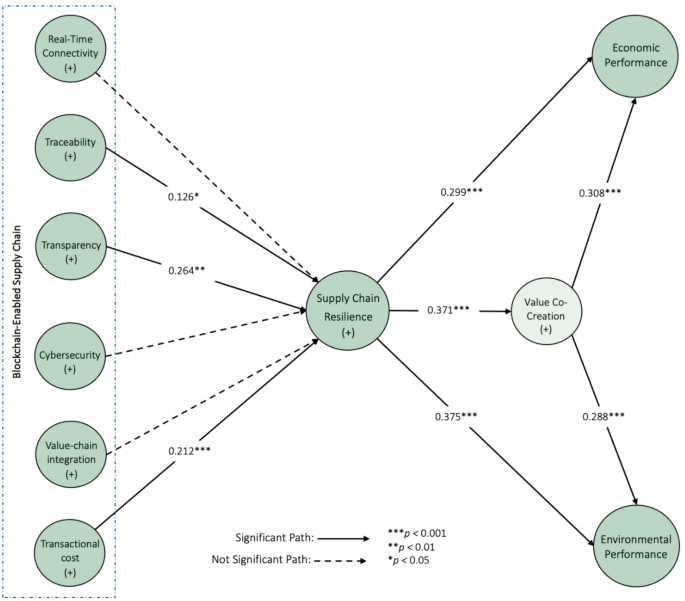
Final model with findings
Transparency’s (H3) demonstrated strong validation (β = 0.264, p = 0.001, f² = 0.068), highlighting transparency as a pivotal enabler of SCR. Transparent practices facilitate real-time collaboration and risk mitigation (Trivellas et al. 2020). The moderate effect size underscores the dual role of transparency in operational efficiency and stakeholder alignment, enabling firms to proactively counteract supply chain vulnerabilities. Cybersecurity (H4), which showed an insignificant result (β = 0.099, p = 0.150, f² = 0.004), highlights the contextual and complementary nature of cybersecurity in resilience building. While critical for safeguarding systems (Aslam et al. 2020; Ning et al. 2022), its contribution to SCR in isolation remains limited. This underscores the need for an integrated approach where cybersecurity synergizes with enablers like transparency and traceability. Similarly, value chain integration (H5) (β = 0.081, p = 0.188, f² = 0.003) revealed an insignificant relationship, suggesting that while value chain integration enhances coordination (Pu et al. 2023), its standalone impact is insufficient. This finding aligns with calls for holistic strategies that pair value chain integration with innovative technologies and agile practices to build resilience. Transactional Cost Efficiency (H6), with moderate significance (β = 0.212, p = 0.000, f² = 0.053), underscores cost efficiency’s critical role in resilience. Firms reallocating resources to resilience-enhancing initiatives achieve greater operational stability (Aslam et al. 2020; Wang 2023). This validates the cost-resilience link, emphasizing efficient resource management as a cornerstone of SCR.
The validation of Value Co-Creation’s (H7) (β = 0.371, p = 0.000, f² = 0.160) emphasizes SCR’s role in fostering collaborative innovation and trust among partners (Gu et al. 2021; Zhou et al. 2022). These findings suggest that resilient supply chains drive VCC by enabling adaptive capabilities and shared problem-solving. Economic performance (H8), with support (β = 0.299, p = 0.000, f² = 0.103), confirms that SCR minimizes disruptions and enhances profitability. This aligns with studies indicating that resilient supply chains leverage agility and reliability to optimize resources (Liu et al. 2018; Pettit et al. 2019). The significant effect size reinforces SCR’s importance in financial stability for China compared to the French empirical outcomes (β = 0.060) (El Baz et al. 2023). Environmental performance (H9), demonstrating a robust positive effect (β = 0.375, p = 0.000, f² = 0.174), highlights SCR’s contribution to sustainability goals (Agyabeng-Mensah et al. 2020; Essuman et al. 2023). Resilient supply chains enable proactive measures like emissions reduction and waste control, directly supporting environmental objectives. The intermediary role of VCC (H10 & H11), linking VCC to ECP (β = 0.308, p = 0.000, f² = 0.109) and ENP (β = 0.288, p = 0.000, f² = 0.103), affirms VCC’s intermediary role. Collaborative innovation fosters economic efficiency and sustainability, underscoring the need for integrated VCC strategies to maximize resilience outcomes.
4.5.2 Mediating effects of supply chain resilience
Real-time connectivity enhances situational awareness and operational efficiency, particularly when mediated by SCR. The analysis (HM1) reveals an insignificant indirect effect of real-time connectivity on VCC through SCR (β = 0.042, p > 0.05). These results are inconsistent with previous research by Cao (2024), which emphasize the integration of real-time connectivity into resilient supply chains. Similarly, traceability enhances VCC by improving supply chain visibility and accountability. The mediation analysis (HM2) confirms the insignificant role of SCR in amplifying traceability’s impact on VCC (β = 0.047, p > 0.05). SCR might not converts traceability into actionable intelligence, ensuring operational objectives are achieved even in volatile environments. These findings contradict with Saberi et al. (2018) and Nikookar and Yanadori (2021), who highlight the dynamic interplay between traceability and resilience in modern supply chains.
Transparency, a critical factor in fostering trust and collaboration, also demonstrates enhanced effectiveness when mediated by SCR (HM3). The results indicate a robust indirect relationship between transparency and VCC (β = 0.098, p < 0.01), as SCR enables firms to leverage transparency for proactive decision-making and resource optimization. The dynamic nature of transparency when coupled with resilience is supported by studies such as Trivellas et al. (2020) and Wieland et al. (2023). The strategic value of cybersecurity for VCC is insignificantly amplified by SCR (HM4), with results showing no indirect effect (β = 0.022, p > 0.05). SCR mitigates cyber risks, ensuring operational continuity and enhancing competitiveness. These findings against with research by Gafni and Levy (2023) and Siagian et al. (2021), which emphasize the critical role of resilience in safeguarding digital supply chain systems. Value chain integration is vital for developing flexible and adaptive supply chains. The mediation analysis (HM5) confirms that SCR is not significantly enhances value chain integration’s impact on VCC (β = 0.021, p > 0.05), enabling firms to maintain competitive advantages in rapidly changing markets. These findings are not resonated with Zhou et al. (2023), who underline the synergy between integration and resilience. Transactional cost efficiency is another important driver of VCC, whose benefits are fully realized when mediated by SCR (HM6). The results (β = 0.079, p < 0.01) show that SCR ensures cost-efficient operations remain robust during disruptions, contributing to sustained competitiveness. These findings are consistent with Saddique (2023) and Hirsch (2024), who discuss resilience as a stabilizing factor in cost efficiency.
Moving to economic performance, the study demonstrates that SCR mediates the relationship between real-time connectivity and ECP (HM7), with an insignificant indirect effect (β = 0.034, p > 0.05). With the current results, SCR ensures that real-time connectivity does not contributes to superior financial outcomes, in contrary with the study conducted by Fu (2024) and Queiroz et al. (2022). Additionally, the role of SCR in amplifying traceability’s impact on ECP (HM8) is evident, with a significant mediation effect (β = 0.38, p < 0.01), supporting resource optimization and accountability, in line with Aigbogun et al. (2022). Transparency fosters collaboration and stakeholder trust, and its relationship with ECP is significantly mediated by SCR (HM9). The results (β = 0.079, p < 0.001) indicate that SCR transforms transparency into a dynamic capability, enhancing economic outcomes. This supports the findings of Trivellas et al. (2020) on the financial implications of transparency-driven resilience. Cybersecurity’s strategic importance for economic stability is also not mediated by SCR (HM10), as evidenced by an insignificant indirect relationship (β = 0.018, p > 0.05). SCR do not protect firms from disruptions, ensuring data integrity and operational continuity, inconsistent with Pettit et al. (2019) and Siagian et al. (2021). Value chain integration and its impact on ECP (HM11) are not significantly enhanced by SCR (β = 0.017, p > 0.05). This finding, opposite to Sadia (2024), highlights SCR’s role in fostering adaptable networks that sustain financial performance. Finally, the indirect relationship between transaction cost and ECP through SCR (HM12) is significant (β = 0.063, p < 0.01), showing that SCR ensures cost-efficient strategies remain effective during market uncertainties. This aligns with Saddique (2023) and Krimi (2024), emphasizing resilience as a facilitator of long-term economic gains. Moreover, the critical role of VCC in linking SCR to ECP (HM13) is evident (β = 0.114, p < 0.001). Competitive, resilient value chains play a pivotal role in achieving sustainability, as supported by Zhu and Wu (2022).
Environmental performance is not significantly influenced by SCR-mediated relationships outlined in the study. For instance, SCR do not mediate the effect of real-time connectivity on ENP (HM14) with a positive indirect effect (β = 0.043, p > 0.05), as resilience do not enable real-time responses to environmental challenges (Zhu & Wu 2022). Similarly, traceability’s impact on ENP is mediated by SCR (HM15), supporting compliance with sustainability standards (β = 0.047, p < 0.05). Transparency and ENP exhibit a strong mediated relationship through SCR (HM16), with results (β = 0.099, p < 0.01) underscoring SCR’s role in facilitating collaborative sustainability efforts. These findings are consistent with Zhu and Wu (2022). Moreover, the strategic value of cybersecurity for sustainability is not amplified by SCR (HM17), as evidenced by an insignificant mediation effect (β = 0.022, p > 0.05), in against with Layode (2024). Integration within the value chain and its environmental implications (HM18) are not mediated by SCR (β = 0.021, p > 0.05), ensuring resources are misaligned with sustainability objectives. Similarly, transaction cost influence on ENP (HM19) is enhanced by SCR (β = 0.079, p < 0.01), enabling cost-efficient yet sustainable operations. This outcome in Chinese context indicates a greater effect size than the Egypt empirical evidence and suggesting the validity and importance of SCR as a mediator. Lastly, the critical role of VCC in linking SCR to ENP (HM20) is evident (β = 0.107, p < 0.001). Competitive, resilient value chains play a pivotal role in achieving sustainability, as supported by Zhu and Wu (2022).
4.6 Multi-group analysis (MGA)
Measurement invariance was confirmed by permutation p values exceeding 0.05 (Supplementary Material 1. Table S9), thus validating the reliability of the MGA results (Table 5). Significant variations were observed based on years of operation, number of full-time employees, and operating income. As presented in Table 5, the effect of value chain integration on SCR (β = 0.421, p = 0.022), and SCR on VCC (β = 0.230, p = 0.035) is significantly higher among the relatively newly established logistics firms (operating eight years or fewer). In contrast, the effect of transparency on SCR is significantly higher (β = -0.564, p = 0.027) among the older firms (operating nine years or more). The effect of real-time connectivity and SCR (β = -0.361, p = 0.014) is significantly higher among firms with fewer than 350 employees, whereas the effect of SCR on VCC (β = 0.284, p = 0.004) is significantly higher among logistics firms with 351 or more employees. Furthermore, the effect of SCR and ENP (β = 0.232, p = 0.032) is significantly higher among logistics firms with operating income between RMB10 to 40 million, compared to firms with operating income between RMB40 to 150 million). These findings underscore the critical influence of firm characteristics, such as years of operation, size, and financial capacity, on the adoption of blockchain-enabled capabilities for resilience and sustainability.
5 Implication
5.1 Theoretical implications
This study makes several significant contributions to the literature by bridging blockchain technology with SCR, value co-creation, and performance outcomes. First, while previous research has extensively explored blockchain’s role in improving supply chain transparency and traceability, this study emphasized resilience, the framework extends beyond traditional metrics like operational efficiency or visibility. This novel perspective addresses a crucial theoretical gap: how blockchain capabilities collectively enhance SCR to navigate disruptions and uncertainties in global supply chains. This approach provides a nuanced understanding of how technological capabilities translate into strategic advantages.
Second, a major contribution of this research is its holistic integration of multiple blockchain dimensions, including traceability, transparency, and transactional cost efficiency. Unlike prior studies that address these capabilities in isolation, this framework underscores the interconnectedness and cumulative impact of blockchain technology on SCR. By treating blockchain as a multidimensional construct, the study enriches the theoretical discourse by challenging the siloed approach often adopted in existing literature and offers a more comprehensive view of blockchain’s potential in SCM. Third, introducing VCC as a mediator between SCR and performance outcomes (economic and environmental) adds an innovative layer to the theoretical framework. By highlighting the collaborative and stakeholder-centric benefits of blockchain-enabled resilience, the study expands on traditional performance metrics. This contribution addresses a significant theoretical gap by linking VCC to SCR within the context of blockchain technology, an area that has been underexplored in theories such as Stakeholder Theory and the Dynamic Capabilities Perspective.
Fourth, this study uniquely ties transaction cost reduction—a key feature of blockchain—to SCR and sustainability outcomes, thereby integrating transaction cost economics into the discourse on blockchain’s role in sustainable SCM. This theoretical integration fills a notable gap, as prior studies have seldom explored transaction cost economics’ relevance to blockchain’s dual impact on resilience and sustainability. By doing so, this study advances both SCM and sustainability literature, highlighting how cost efficiency contributes to economic and environmental performance. Fifth, the framework extends the theoretical conversation by linking SCR to three distinct performance outcomes: economic, environmental, and VCC. This interdisciplinary approach bridges SCM theories, sustainability frameworks such as the Triple Bottom Line, and collaborative value theories, such as Stakeholder Theory. By emphasizing the interplay between these performance outcomes, this study challenges traditional single-outcome models, providing a richer understanding of how blockchain-enabled SCR contributes to holistic performance improvement. Sixth, framing blockchain as a dynamic capability provides a novel theoretical angle, positioning it as a tool that enables firms to sense, seize, and adapt to disruptions, thereby fostering resilience and superior performance. This application of the DCT fills a gap in the literature, where blockchain is often discussed as a technological innovation but rarely as a dynamic capability. This study enriches the theoretical understanding of blockchain’s strategic role in building adaptive and competitive supply chains.
5.2 Practical and policy implications
This study provides actionable insights for supply chain practitioners and policymakers on leveraging blockchain technology to enhance SCR. Organizations can utilize blockchain-enabled attributes to build resilient supply chains capable of navigating disruptions. In practice, this involves investing in blockchain platforms that facilitate transparency and secure data sharing among supply chain partners. Stakeholders, including suppliers, manufacturers, and logistics providers, are encouraged to collaborate within blockchain ecosystems to strengthen trust and mitigate risks in global supply chains. For policymakers, supporting blockchain adoption through subsidies, tax incentives, or technology grants can accelerate its integration into critical sectors, contributing to a more stable and responsive supply chain infrastructure.
Supply chain leaders should adopt a multidimensional approach to implementing blockchain technology. By leveraging the combined benefits of transparency, traceability, and cost reduction, firms can enhance both operational efficiency but also resilience. Training programs and workshops should be developed to strengthen the technical capacity of supply chain professionals, enabling them to harness blockchain’s full potential. Policymakers can play a pivotal role by standardizing blockchain protocols across industries, facilitating interoperability and seamless integration among various supply chain actors. These efforts will optimize blockchain’s impact on SCR and support long-term sustainability goals.
The findings highlight the critical role of VCC as a key mediator between SCR and performance outcomes. Firms should implement collaborative strategies that involve all stakeholders—suppliers, customers, and policymakers—in blockchain-enabled supply chain networks. By fostering a co-creative environment, firms can strengthen stakeholder engagement, leading to improved economic and environmental performance. Policymakers should encourage public-private partnerships that leverage blockchain to achieve shared goals, such as waste reduction, energy efficiency, and circular economy initiatives. These collaborations can ensure equitable distribution of benefits and drive collective progress in supply chain sustainability.
This study underscores blockchain’s ability to reduce transaction cost while achieving sustainability objectives. Organizations should prioritize blockchain implementations that streamline operations, lower administrative expenses, and minimize resource waste. Sustainability-focused blockchain applications, such as carbon footprint tracking and waste management systems, should be integrated into supply chain processes. From a policy perspective, governments can incentivize companies to adopt blockchain by introducing regulations that recognize blockchain-enabled sustainability practices as part of Environmental, Social, and Governance reporting standards. These measures will align corporate strategies with global sustainability targets while promoting accountability.
Policymakers should develop regulatory frameworks that facilitate the integration of blockchain technologies into SCM. These policies should emphasize resilience as a key objective and incorporate guidelines for cybersecurity, data governance, and interoperability. Regional and international regulatory bodies can collaborate to create harmonized standards and ensure global compatibility of blockchain technologies. Moreover, establishing sandbox environments for blockchain testing and piloting can help organizations assess their feasibility and scalability in supply chain contexts. By fostering an enabling environment, policymakers can promote widespread blockchain adoption and enhance global SCR.
Dynamic challenges such as global pandemics, geopolitical uncertainties, and climate change demand supply chains must be agile and adaptive. This study highlights blockchain as a dynamic capability that enables firms to sense, capture, and respond effectively to disruptions. Policymakers should incorporate blockchain technology into national strategies for disaster preparedness and risk management in supply chains. Additionally, funding research and development initiatives that focus on blockchain applications can enhance their utility in addressing future challenges. These actions ensure that blockchain becomes an integral tool for building adaptive future-ready supply chains.
6 Conclusions
This study advances the understanding of blockchain technology’s transformative role in enhancing SCR and achieving sustainable performance outcomes. By presenting a comprehensive framework that integrates multidimensional blockchain capabilities—traceability, transparency, and cost reduction—this study highlights blockchain’s holistic impact on SCR. These findings underscore the importance of empowering stakeholders, fostering VCC, and emphasizing cost efficiency in achieving robust and adaptive supply chains. This study also establishes blockchain as a dynamic capability that allows firms to sense, seize, and respond to disruptions, contributing to economic, environmental, and collaborative performance outcomes. These insights are crucial for practitioners, policymakers, and academics aiming to leverage blockchain as a tool for building future-ready, resilient, and sustainable supply chains.
While this study provides valuable theoretical and practical insights, several limitations must be acknowledged. First, the proposed framework is conceptual and requires empirical validation across diverse industries and geographic contexts to ensure its generalizability. Second, the study focuses primarily on the technological dimensions of blockchain, potentially underexploring organizational and cultural factors that may influence its adoption and effectiveness. Third, this study assumes a linear relationship between blockchain-enabled capabilities and resilience outcomes, which might overlook the potential for complex, nonlinear dynamics. Finally, while the study incorporates multiple performance outcomes, it does not address potential trade-offs between these outcomes, such as balancing cost efficiency with environmental goals.
Future research can address these limitations by empirically testing the proposed framework in real-world supply chain settings using quantitative methods, case studies, or longitudinal analyses. Comparative studies across industries, such as manufacturing, healthcare, and agriculture, can reveal sector-specific insights into blockchain’s impact on SCR. Additionally, exploring the interplay between technological, organizational, and cultural factors can provide a more nuanced understanding of the challenges and enablers of blockchain adoption. Future research should also investigate the nonlinear relationships between blockchain capabilities and performance outcomes, leveraging advanced modeling techniques such as system dynamics or agent-based modeling. Lastly, integrating the social and ethical dimensions of blockchain adoption, including privacy concerns and stakeholder equity, can enrich the discussion on blockchain’s role in fostering sustainable and inclusive supply chains. These avenues of exploration will help solidify blockchain’s position as a cornerstone of resilient and sustainable SCM in the years to come.
Data availability
The original will be available on request, further inquiries can be directed to the corresponding author.
References
-
Agyabeng-Mensah Y, Afum E, Acquah I, Dacosta E, Baah C, Ahenkorah E (2020) The role of green logistics management practices, supply chain traceability and logistics ecocentricity in sustainability performance. Int J Logistics Manage 32(2):538–566. https://doi.org/10.1108/ijlm-05-2020-0187
-
Aigbogun O, Meng X, Fawehinmi O, Ibeabuchi C, Ehido A, Raza A, Abdullahi M (2022) A supply chain resilience model for business continuity: the way forward for highly regulated industries. Uncertain Supply Chain Manage 10(1):1–12. https://doi.org/10.5267/j.uscm.2021.11.001
-
Altay N, Gunasekaran A, Dubey R, Childe S (2018) Agility and resilience as antecedents of supply chain performance under moderating effects of organizational culture within the humanitarian setting: a dynamic capability view. Prod Plann Control 29(14):1158–1174. https://doi.org/10.1080/09537287.2018.1542174
-
Alvarenga M, Oliveira M, Oliveira T (2023) The impact of using digital technologies on supply chain resilience and robustness: the role of memory under the covid-19 outbreak. Supply Chain Manage Int J 28(5):825–842. https://doi.org/10.1108/scm-06-2022-0217
-
Aslam H, Khan A, Rashid K, Rehman S (2020) Achieving supply chain resilience: the role of supply chain ambidexterity and supply chain agility. J Manuf Technol Manage 31(6):1185–1204. https://doi.org/10.1108/jmtm-07-2019-0263
-
Aslam J, Saleem A, Kim YB (2023) Blockchain-enabled supply chain management: integrated impact on firm performance and robustness capabilities. Bus Process Manage J 29(6):1680–1705. https://doi.org/10.1108/BPMJ-03-2023-0165
-
Avkiran NK, Ringle CM (2018) Partial least squares structural equation modelling: recent advances in banking and finance. Springer. https://doi.org/10.1007/978-3-319-71691-6
-
Baah C, Agyabeng-Mensah Y, Afum E, Acquah I, Dacosta E (2023) Government influence on logistics and supply chain innovations: assessing implications for firm performance and societal impact in an emerging economy. Int J Emerg Markets 19(11):3646–3666. https://doi.org/10.1108/ijoem-09-2021-1348
-
Basuki A (2024) Investigating the effects of sustainability initiatives on supply chain resilience and performance in Indonesia. Int J Supply Chain Manage 9(1):27–38. https://doi.org/10.47604/ijscm.2321
-
Belhadi A, Mani V, Kamble S, Khan S, Verma S (2021) Artificial intelligence-driven innovation for enhancing supply chain resilience and performance under the effect of supply chain dynamism: an empirical investigation. Ann Oper Res 333(2–3):627–652. https://doi.org/10.1007/s10479-021-03956-x
-
Brau J (2023) Blockchain in supply chain management: a feature-function framework for future research. Supply Chain Manage Int J 29(1):27–49. https://doi.org/10.1108/scm-08-2022-0315
-
Cao R (2024) Ambidextrous supply chain strategy: roles and consequences with agile manufacturing and resilience. Int J Logistics Manage 35(6):1981–2011. https://doi.org/10.1108/ijlm-10-2023-0429
-
Central Government of the People’s Republic of China (2019), September 12 The Ministry of Transport of the National Development and Reform Commission jointly issued the list of national logistics hub construction in 2019. https://www.gov.cn/xinwen/2019-09/12/content_5429421.htm
-
Chittipaka V, Kumar S, Sivarajah U, Bowden J, Baral M (2022) Blockchain technology for supply chains operating in emerging markets: an empirical examination of technology-organization-environment (toe) framework. Ann Oper Res 327(1):465–492. https://doi.org/10.1007/s10479-022-04801-5
-
Cohen J (1988) Statistical power analysis for the behavioral sciences, 2nd edn. Erlbaum, Hillsdale, NJ
-
Cui L, Wu H, Wu L, Kumar A, Tan K (2022) Investigating the relationship between digital technologies, supply chain integration and firm resilience in the context of covid-19. Ann Oper Res 327(2):825–853. https://doi.org/10.1007/s10479-022-04735-y
-
Dai J (2024) Unveiling the impact of the congruence between artificial intelligence and explorative learning on supply chain resilience. Int J Oper Prod Manage 45(2):570–593. https://doi.org/10.1108/ijopm-12-2023-0990
-
Dijkstra TK, Henseler J (2015) Consistent partial least squares path modeling. MIS Q 39(2):297–316. https://doi.org/10.25300/misq/2015/39.2.02
-
Dovbischuk I (2022) Innovation-oriented dynamic capabilities of logistics service providers, dynamic resilience and firm performance during the covid-19 pandemic. Int J Logistics Manage 33(2):499–519. https://doi.org/10.1108/ijlm-01-2021-0059
-
Ejairu E (2024) Blockchain in global supply chains: a comparative review of Usa and African practices. Int J Sci Res Archive 11(1):2093–2100. https://doi.org/10.30574/ijsra.2024.11.1.0278
-
El Baz J, Ruel S, Ardekani ZF (2023) Predicting the effects of supply chain resilience and robustness on COVID-19 impacts and performance: empirical investigation through resources orchestration perspective. J Bus Res 164:114025. https://doi.org/10.1016/j.jbusres.2023.114025
-
Elliot E, Adams R, Tsetse E (2023) Customer value co-creation: environmental sustainability as a tourist experience. Sustainability 15(13):10486. https://doi.org/10.3390/su151310486
-
Essuman D, Ataburo H, Boso N, Anin E, Appiah L (2023) In search of operational resilience: how and when improvisation matters. J Bus Logistics 44(3):300–322. https://doi.org/10.1111/jbl.12343
-
Fang L, Ge H (2023) Research on traceability of agricultural product supply chain information. Acad J Sci Technol 5(1):126–127. https://doi.org/10.54097/ajst.v5i1.5470
-
Fu Z (2024) Hydro-economic risk and resilience to supply chain water scarcity in Chinese cities. Environ Sci Technol 58(49):21578–21588. https://doi.org/10.1021/acs.est.4c08472
-
Gafni R, Levy Y (2023) Experts’ feedback on the cybersecurity footprint elements: in pursuit of a quantifiable measure of smbs’ cybersecurity posture. Inform Comput Secur 31(5):601–623. https://doi.org/10.1108/ics-05-2023-0083
-
Gu M, Lu Y, Huo B (2021) The impact of information technology usage on supply chain resilience and performance: an ambidextrous view. Int J Prod Econ 232:107956. https://doi.org/10.1016/j.ijpe.2020.107956
-
Hair JF, Howard MC, Nitzl C (2019) Assessing measurement model quality in PLS-SEM using confirmatory composite analysis. J Bus Res 109:101–110. https://doi.org/10.1016/j.jbusres.2019.11.069
-
Hair JF Jr, Hult GTM, Ringle CM, Sarstedt M (2022) A primer on partial least squares structural equation modeling (PLS-SEM). SAGE
-
Hair Jr JF, Matthews LM, Matthews RL, Sarstedt M (2017) PLS-SEM or CB-SEM: updated guidelines on which method to use. Int J Multivar Data Anal 1(2):107–123. https://doi.org/10.1504/ijmda.2017.10008574
-
Hastig G, Sodhi M (2020) Blockchain for supply chain traceability: business requirements and critical success factors. Prod Oper Manage 29(4):935–954. https://doi.org/10.1111/poms.13147
-
Hirsch K (2024) Artificial intelligence and information systems capabilities for supply chain resilience: a study in the South African fast-moving consumer goods industry. J Transp Supply Chain Manage 18. https://doi.org/10.4102/jtscm.v18i0.1025
-
Hussain G, Nazir M, Rashid M, Sattar M (2022) From supply chain resilience to supply chain disruption orientation: the moderating role of supply chain complexity. J Enterp Inform Manage 36(1):70–90. https://doi.org/10.1108/jeim-12-2020-0558
-
Ibiyemi M (2024) Cybersecurity in supply chains: addressing emerging threats with strategic measures. Int J Manage Entrepreneurship Res 6(6):2024–2047. https://doi.org/10.51594/ijmer.v6i6.1241
-
Ibrahim M (2024) The effect of blockchain technology in enhancing ethical sourcing and supply chain transparency: evidence from the cocoa and agricultural sectors in Ghana. Afr J Empir Res 5(2):55–64. https://doi.org/10.51867/ajernet.5.2.6
-
Issa A (2024) The path from green innovation to supply chain resilience: do structural and dynamic supply chain complexity matter? Sustainability 16(9):3762. https://doi.org/10.3390/su16093762
-
Jayarathna C, Agdas D, Dawes L (2022) Exploring sustainable logistics practices toward a circular economy: a value creation perspective. Bus Strategy Environ 32(1):704–720. https://doi.org/10.1002/bse.3170
-
Kang K, Tan BQ, Chan FT, Kong XT (2025) Effect of blockchain on corporate social responsibility in supply chain management. Int J Prod Res 1–27. https://doi.org/10.1080/00207543.2025.2476007
-
Ko T, Lee J, Park D, Ryu D (2022) Supply chain transparency as a signal of ethical production. Manag Decis Econ 44(3):1565–1573. https://doi.org/10.1002/mde.3765
-
Kock N (2015) Common method Bias in PLS-SEM: A full collinearity assessment approach. Int J E-Collaboration 11(4):1–10. https://doi.org/10.4018/ijec.2015100101
-
Kock F, Berbekova A, Assaf AG (2021) Understanding and managing the threat of common method bias: Detection, prevention and control. Tour Manag 86:104330. https://doi.org/10.1016/j.tourman.2021.104330
-
Kokkinou A (2023) Developing resilient and robust supply chains through data analytic capability. Continuity Resil Rev 5(3):320–342. https://doi.org/10.1108/crr-07-2023-0013
-
Krimi I (2024) Resilient and sustainable b2b chemical supply chain capacity expansions: a systematic literature review. J Bus Industrial Mark 39(13):175–199. https://doi.org/10.1108/jbim-01-2024-0017
-
Layode O (2024) Addressing cybersecurity challenges in sustainable supply chain management: a review of current practices and future directions. Int J Manage Entrepreneurship Res 6(6):1954–1981. https://doi.org/10.51594/ijmer.v6i6.1208
-
Li N (2024) Analysis of the coupling degree between regional logistics efficiency and economic development coordination. PLoS ONE 19(1):e0293175. https://doi.org/10.1371/journal.pone.0293175
-
Li Y, Chen T (2022) Blockchain empowers supply chains: challenges, opportunities and prospects. Nankai Bus Rev Int 14(2):230–248. https://doi.org/10.1108/nbri-06-2022-0066
-
Li Y, Wang X, Gong T, Wang H (2022) Breaking out of the pandemic: how can firms match internal competence with external resources to shape operational resilience? J Oper Manag 69(3):384–403. https://doi.org/10.1002/joom.1176
-
Liu Z, Wang M (2022) Improving circular supply chain performance through green innovations: the moderating role of economic policy uncertainty. Sustainability 14(24):16888. https://doi.org/10.3390/su142416888
-
Liu C, Shang K, Lirn T, Lai K, Lun Y (2018) Supply chain resilience, firm performance, and management policies in the liner shipping industry. Transp Res Part Policy Pract 110:202–219. https://doi.org/10.1016/j.tra.2017.02.004
-
Ma Z (2024) Blockchain-based zero-trust supply chain security integrated with deep reinforcement learning for inventory optimization. Future Internet 16(5):163. https://doi.org/10.3390/fi16050163
-
Markus S, Buijs P (2022) Beyond the hype: how blockchain affects supply chain performance. Supply Chain Manage Int J 27(7):177–193. https://doi.org/10.1108/scm-03-2022-0109
-
Mishra R, Ramesh D, Mohammad N, Mondal B (2024) Blockchain enabled secure pharmaceutical supply chain framework with traceability: an efficient searchable pharmachain approach. Cluster Comput 27(10):13621–13641. https://doi.org/10.1007/s10586-024-04626-w
-
Mollashahi H (2024) The competition among supply chains regarding environmental, social, and resilience aspects in a supply chain network design problem. J Modelling Manage 20(1):182–210. https://doi.org/10.1108/jm2-01-2024-0005
-
Mutie M, Odock S, Litondo K (2020) Green logistics practices and firm performance: the mediating effect of economic performance among logistics firms in Kenya. Eur Sci J ESJ 16(25). https://doi.org/10.19044/esj.2020.v16n25p142
-
Nikookar E, Yanadori Y (2021) Preparing supply chain for the next disruption beyond covid-19: managerial antecedents of supply chain resilience. Int J Oper Prod Manage 42(1):59–90. https://doi.org/10.1108/ijopm-04-2021-0272
-
Ning Y, Li L, Xu S, Yang S (2022) How do digital technologies improve supply chain resilience in the covid-19 pandemic? Evidence from Chinese manufacturing firms. Front Eng Manage 10(1):39–50. https://doi.org/10.1007/s42524-022-0230-4
-
Odimarha A (2024) Securing the digital supply chain: cybersecurity best practices for logistics and shipping companies. World J Adv Sci Technol 5(1):026–030. https://doi.org/10.53346/wjast.2024.5.1.0030
-
Oriekhoe O (2024) Blockchain in supply chain management: a systematic review: evaluating the implementation, challenges, and future prospects of blockchain technology in supply chains. Eng Sci Technol J 5(1):128–151. https://doi.org/10.51594/estj.v5i1.732
-
Papachristos V (2023) The potential of Ict adoption in promoting sustainable and resilient supply chains: evidence from Greek logistics firms. Sustainability 15(22):15854. https://doi.org/10.3390/su152215854
-
Pettit T, Croxton K, Fiksel J (2019) The evolution of resilience in supply chain management: a retrospective on ensuring supply chain resilience. J Bus Logistics 40(1):56–65. https://doi.org/10.1111/jbl.12202
-
Podsakoff PM, MacKenzie SB, Podsakoff NP (2012) Sources of method bias in social science research and recommendations on how to control it. Ann Rev Psychol 63:539–569. https://doi.org/10.1146/annurev-psych-120710-100452
-
Prastiti N (2023) Halal product traceability system modeling using interpretive structural modeling (ISM) in Bangkalan halal industrial area. In Proceeding of Annual Conference on Islamic Economy and Law. 2(1):21–31. https://doi.org/10.21107/aciel.v2i1.129
-
Preacher KJ, Hayes AF (2004) SPSS and SAS procedures for estimating indirect effects in simple mediation models. Behavior research methods, instruments, & computers 36:717–731. https://doi.org/10.3758/BF03206553
-
Pu G (2024) Management antecedents of supply chain resilience: an integrating perspective. J Contingencies Crisis Manag 32(1). https://doi.org/10.1111/1468-5973.12551
-
Pu G, Qiao W, Feng Z (2023) Antecedents and outcomes of supply chain resilience: integrating dynamic capabilities and relational perspective. J Contingencies Crisis Manag 31(4):706–726. https://doi.org/10.1111/1468-5973.12473
-
Quang L (2024) Enterprise risk management and firm performance: exploring the roles of knowledge, technology, and supply chain. Probl Perspect Manage 22(2):150–164. https://doi.org/10.21511/ppm.22(2).2024.13
-
Quayson M (2024) Modeling the enablers of blockchain technology implementation for information management in healthcare supply chains. Mod Supply Chain Res Appl 6(2):101–121. https://doi.org/10.1108/mscra-06-2023-0028
-
Queiroz M, Wamba S, Jabbour C, Machado M (2022) Supply chain resilience in the Uk during the coronavirus pandemic: a resource orchestration perspective. Int J Prod Econ 245:108405. https://doi.org/10.1016/j.ijpe.2021.108405
-
Revathi MKL, Lakshmi TV, Goud KSK (2024) Impact of blockchain technology in supply chain system. Int Res J Adv Eng Manage (IRJAEM) 2(05):1670–1672. https://doi.org/10.47392/irjaem.2024.0238
-
Saberi S, Kouhizadeh M, Sarkis J, Shen L (2018) Blockchain technology and its relationships to sustainable supply chain management. Int J Prod Res 57(7):2117–2135. https://doi.org/10.1080/00207543.2018.1533261
-
Saddique F (2023) Impact of supply chain transformation on supply chain performance: the empirical study that bases on mediating role of supply chain resilience on construction organization on Pakistan. Asian J Eng Social Health 2(9):1072–1086. https://doi.org/10.46799/ajesh.v2i9.118
-
Sadia U (2024) Toward sustainable development: the triple nexus for enhanced supply chain performance through information technology, resilience, and sustainability integration. Bus Strategy Dev 7(3). https://doi.org/10.1002/bsd2.70019
-
Shmueli G, Sarstedt M, Hair JF, Cheah JH, Ting H, Vaithilingam S, Ringle CM (2019) Predictive model assessment in PLS-SEM: guidelines for using PLS predict. Eur J Mark 53(11):2322–2347. https://doi.org/10.1108/ejm-02-2019-0189
-
Siagian H, Tarigan Z, Jie F (2021) Supply chain integration enables resilience, flexibility, and innovation to improve business performance in covid-19 era. Sustainability 13(9):4669. https://doi.org/10.3390/su13094669
-
Singh S, Kumar R, Panchal R, Tiwari M (2020) Impact of covid-19 on logistics systems and disruptions in food supply chain. Int J Prod Res 59(7):1993–2008. https://doi.org/10.1080/00207543.2020.1792000
-
Tapaninaho R, Heikkinen A (2022) Value creation in circular economy business for sustainability: a stakeholder relationship perspective. Bus Strategy Environ 31(6):2728–2740. https://doi.org/10.1002/bse.3002
-
Teece DJ, Pisano G, Shuen A (1997) Dynamic capabilities and strategic management. Strateg Manag J 18(7):509–533. https://doi.org/10.1002/(SICI)1097-0266(199708)18:7
-
Trivellas P, Μαλινδρέτος Γ, Reklitis P (2020) Implications of green logistics management on sustainable business and supply chain performance: evidence from a survey in the Greek agri-food sector. Sustainability 12(24):10515. https://doi.org/10.3390/su122410515
-
Turgay S, Erdoğan S (2023) Enhancing trust in supply chain management with a blockchain approach. J Artif Intell Pract 6(6):56–64. https://doi.org/10.23977/jaip.2023.060609
-
Vanany I, Ali M, Tan K, Kumar A, Siswanto N (2024) A supply chain resilience capability framework and process for mitigating the covid-19 pandemic disruption. IEEE Trans Eng Manage 71:10358–10372. https://doi.org/10.1109/tem.2021.3116068
-
Wang M (2023) Effect of blockchain technology–supply chain risk fit on new product development performance: the moderating role of supply chain upgrading. J Gen Manage 50(1):26–36. https://doi.org/10.1177/03063070231216679
-
Wang Y, Han J, Beynon-Davies P (2019a) Understanding blockchain technology for future supply chains: a systematic literature review and research agenda. Supply Chain Manage Int J 24(1):62–84. https://doi.org/10.1108/scm-03-2018-0148
-
Wang Y, Singgih M, Wang J, Rit M (2019b) Making sense of blockchain technology: how will it transform supply chains? Int J Prod Econ 211:221–236. https://doi.org/10.1016/j.ijpe.2019.02.002
-
Wieland A, Stevenson M, Melnyk S, Davoudi S, Schultz L (2023) Thinking differently about supply chain resilience: what we can learn from social-ecological systems thinking. Int J Oper Prod Manage 43(1):1–21. https://doi.org/10.1108/ijopm-10-2022-0645
-
Wu Y (2025) Blockchain-enabled sustainable supply chain management: a study on the impact of collaboration optimization. Manag Decis ahead–of–print (No ahead–of–print). https://doi.org/10.1108/MD-08-2024-1769
-
Wu X, Zhang X (2022) The impacts of government subsidies and consumer preferences on food supply chain traceability under different power structures. Sustainability 15(1):470. https://doi.org/10.3390/su15010470
-
Wu H, Jiang S, Cao J (2023) High-efficiency blockchain-based supply chain traceability. IEEE Trans Intell Transp Syst 24(4):3748–3758. https://doi.org/10.1109/tits.2022.3205445
-
Ye C, Huang Z, Wei J, Wang X (2022) Spatial-Temporal evolutionary characteristics and its driving mechanisms of china’s logistics industry efficiency under low carbon constraints. Pol J Environ Stud 31(6):5405–5417. https://doi.org/10.15244/pjoes/151602
-
Yin W (2024) Exploring the drivers of supply chain sustainability: an internal and external configuration perspective. Bus Strategy Environ 33(6):5873–5885. https://doi.org/10.1002/bse.3785
-
Zhang X, Li L (2023) A review of blockchain solutions in supply chain traceability. Tsinghua Sci Technol 28(3):500–510. https://doi.org/10.26599/tst.2022.9010030
-
Zhao N, Hong J, Lau K (2023) Impact of supply chain digitalization on supply chain resilience and performance: a multi-mediation model. Int J Prod Econ 259:108817. https://doi.org/10.1016/j.ijpe.2023.108817
-
Zhou J, Hu L, Yu Y, Zhang Z, Zheng L (2022) Impacts of IT capability and supply chain collaboration on supply chain resilience: empirical evidence from China in COVID-19 pandemic. J Enterp Inform Manage 37(2):777–803. https://doi.org/10.1108/jeim-03-2022-0091
-
Zhou H, Wang Q, Li L, Teo T, Yang S (2023) Supply chain digitalization and performance improvement: a moderated mediation model. Supply Chain Manage Int J 28(6):993–1008. https://doi.org/10.1108/scm-11-2022-0434
-
Zhu X, Wu Y (2022) How does supply chain resilience affect supply chain performance? The mediating effect of sustainability. Sustainability 14(21):14626. https://doi.org/10.3390/su142114626
Funding
Open access funding provided by The Ministry of Higher Education Malaysia and Universiti Kebangsaan Malaysia. This research received no specific grant from any funding agency in the public, commercial, or not-for-profit sectors.
Ethics declarations
Ethical approval
The Applied Technology College of Soochow University’s academic ethics committee approved this study (ID: 2024DD0001) on June 4, 2024, under the condition that it be conducted with integrity, respect for life, and adherence to human rights. This study has been performed in accordance with the Declaration of Helsinki.
Informed consent
Written informed consent was obtained from all participants during the survey period, which spanned from June 8, 2024, to November 15, 2024, using an online survey form. Participation was entirely voluntary, without any risks, and occurred without any form of compensation. Participants grant their consent to publish, present and/or share the anonymous data.
Competing interests
The authors declare that the research was conducted in the absence of any commercial or financial relationships that could be construed as a potential conflict of interest.
Additional information
Electronic supplementary material
Below is the link to the electronic supplementary material.
Rights and permissions
Open Access This article is licensed under a Creative Commons Attribution-NonCommercial-NoDerivatives 4.0 International License, which permits any non-commercial use, sharing, distribution and reproduction in any medium or format, as long as you give appropriate credit to the original author(s) and the source, provide a link to the Creative Commons licence, and indicate if you modified the licensed material. You do not have permission under this licence to share adapted material derived from this article or parts of it. The images or other third party material in this article are included in the article’s Creative Commons licence, unless indicated otherwise in a credit line to the material. If material is not included in the article’s Creative Commons licence and your intended use is not permitted by statutory regulation or exceeds the permitted use, you will need to obtain permission directly from the copyright holder. To view a copy of this licence, visit http://creativecommons.org/licenses/by-nc-nd/4.0/.
Reprints and permissions
About this article
Cite this article
Wang, T., Al Mamun, A., Masukujjaman, M. et al. Synergy of blockchain-enabled supply chains, resilience, and sustainability performance in Chinese logistic firms. Oper Manag Res (2025). https://doi.org/10.1007/s12063-025-00557-w
- Received
- Revised
- Accepted
- Published
- DOI https://doi.org/10.1007/s12063-025-00557-w
Keywords
- Blockchain-enabled supply chain
- Supply chain resilience
- Sustainability performance
- Logistic firms
- China
