
 info@apippress.com
 +86 18163351462 (WhatsApp)
 +86 182 8014 0209
Article Content
Introduction
In all dimensions of human life, digital technologies have entered and made their presence felt. Especially those technologies that came to be known as ‘social media’ seem to be commonplace in many people’s lives. In 2024, it is projected that 62.2% of the global population will be involved with social media in one way or another, with major differences between the global north and the global south (We are Social, DataReportal and Meltwater 2024). Looking closer to the authors’ home, it is projected that in Germany almost 79.9% of the population will use social media at least once per month in 2024 (Dixon 2022).
Social media can be characterized as those information and communication technologies that are used to establish digital social interaction. These technologies cover social networking sites (e.g., Facebook, LinkedIn), blogs (e.g., Tumblr), microblogs (e.g., X (formerly Twitter)), and text-, calling-, photo-, or video message platforms (e.g., Instagram, Whatsapp, Snapchat, TikTok). Social media create media networks that form the basis of digital relations, transforming social media users into active information producers by nudging them into sharing information (Fang et al. 2014). These networks facilitate synchronic interaction, in which the interaction between the different parties occurs in real-time (e.g., calling, video-calling), and asynchronic interaction, in which the moments of interaction between the different parties are spread over time (e.g., messaging, postings).
Because social media are so deeply integrated into people’s lives, it should not be surprising that healthcare and supporting services are exploring their potentialities to provide certain services. Especially in social care practices, the relevance of these technologies cannot be discounted (Chan 2016; Rosenberg et al. 2021; Westwood 2019). Here, we rely on a broad conception of social care inspired by care ethics and especially Bernice Fisher’s and Joan Tronto’s characterization of care as “[…] a species activity that includes everything that we do to maintain, continue and repair our ‘world’ so that we can live in it as well as possible. That world includes our bodies, our selves, and our environment, all of which we seek to interweave in a complex, life-sustaining web” (Fisher and Tronto 1990, p. 40; Tronto 2013, p. 19). As such, we characterize social care as those care practices that support and strengthen people’s living situation, both individual and social, mainly by relying on social interaction and communication. Hence, social care as we conceive it includes, among others, psychology, social work, and different forms of counseling.
Existing research towards effects of social media in social care settings have, among others, focused on how social media and their contents impact people’s mental health (Sharma et al. 2020), for example how social media impact people’s bodily self-perception (Holland and Tiggemann 2016); how new forms of problematic behavior develop on social media platforms (e.g., cyberbullying, online abuse) (Willoughby 2019); and how social media can be implemented in the education of students of different social care disciplines (Franklin et al. 2016).
Moreover, research on how social media can be used in social care practices themselves has gained some traction (Chan 2016; Rosenberg et al. 2021; Cosgrove et al. 2017; Diamond and Whalen 2019). Social media enable interaction among clients seeking a peer network (Diamond and Whalen 2019; Naslund et al. 2020; Rosenberg et al. 2021) and between clients and professionals (Buzzi and Allen 2020; Megele and Buzzi 2020; Naslund et al. 2020; Rosenberg et al. 2021). Social media is also used by professionals as a way to search for and reach those in need of services (Chan 2016; Rosenberg et al. 2021) and to monitor or trace clients or ex-clients (Chan 2016; Cooner et al. 2020; Rosenberg et al. 2021). As Cooner et al. (2020, p. 148), based on their ethnographic study involving social workers that provide family and child services, indicate, the “[…] use of Facebook as part of their repertoire of everyday tools for working with families” is in the process of normalization. Additionally, the use of social media can be a means to guarantee a certain continuity of social care practices during emergency and crisis situations. For example, Rosenberg et al. (2021), based on their interview study with Israeli youth counselors and coordinators, social workers, a clinical psychologist, and senior and management personnel, indicate that therapeutic relationships “[…] that are formed online are especially relevant to […] complicated times of social distancing due to the COVID- 19 […]” pandemic. Research into the actual use of social media in social care is, however, minimal as Chan (2016), and more recently Cooner et al. (2020), indicate. Or as Chan (2016, p. 270) states the use of social media in social care is a case of “[…] rich application but weak empirical evidence […]”.
Notwithstanding, providing services via social media technologies is an ethically sensitive endeavor which entails both benefits (e.g., greater accessibility to services, cost-efficiency) and risks (e.g., loss of privacy). Moreover, it seems that existing codes of ethics do not always provide guidance for how to deal with possible ethical issues (Pascoe 2021). Clear ethical conditions, however, can strengthen the potentialities of social media use in social care. As such, there is a need to get better insight into the ethics of this use. With this systematic review, we investigate the current ethical debate on the use of social media technologies in social care practices so to better understand the ethical arguments and grounding concepts described in the ethics literature.
Methods
The aim of this systematic review of argument-based ethics literature is to reach an exhaustive and in-depth overview of existing ethical argumentation related to social media use in social care, so as to get grounded insight into the overall debate. To meet this aim, we used a four step methodology: (1) developing ethical-conceptual questions; (2) addressing these questions by carrying out a systematic literature search for peer-reviewed academic articles via the use of a self-constructed search string; (3) assessment and inclusion of relevant articles (4) extracting and synthesizing relevant reported data (McCullough et al. 2007; McDougall 2014; Mertz et al. 2016; Sofaer and Strech 2012; Vandemeulebroucke et al. 2018). The Preferred Reporting Items for Systematic Reviews and Meta-Analyses (PRISMA) inspired the search and the selection process (Liberatti et al. 2009). This review was carried out by the authors who have expertise in the development of systematic reviews of ethics literature, care ethics, and bioethics (TV) and philosophy of technology (LB and TV).
Conceptual-ethical research questions
To gain insight into the ethical debate on social media use in social care settings, it is important to study the arguments made and their grounding concepts (Vandemeulebroucke et al. 2018). As Vandemeulebroucke et al. (2018, p. 17) indicate, these concepts “[…] can be derived from traditional and/or current practices, existing ethical theories and/or what is considered to be virtuous” As ethical concepts (e.g., autonomy, privacy) frequently have different meanings depending on the context in which they are used, they can ground different, sometimes opposing, arguments. Consequently, we formulated two conceptual-ethical questions to guide the development of this review, each with its own aim:
- What are the arguments made in the ethical debate on the use of social media in social care practices?
- What are the ethical concepts grounding these arguments?
While the aim of the first question was to give an exhaustive overview of the arguments made in the ethical debate on social media use in social care, the aim of the second was to gain a deeper understanding of these arguments’ used concepts (Vandemeulebroucke et al. 2018).
Search strategy
Based on the conceptual-ethical questions, a search string was constructed which covered three word groups. A first group referred to social media, the technology under consideration. A second group focused on the context in which social media is used, this being social care. A third group referred to the ethics dimension of the literature. The first author (TV) developed the different search strings and discussed and finalized them with the co-author (LB). Four electronic databases were queried: CINAHL, Philosopher’s Index, Web of Science, and ProQuest Database Psychology. A first search string was made to be applicable in CINAHL (Tables 1 and 2). Afterwards, it was modified to be applied to the three other databases, for example, by adjusting the qualifiers, such as the field codes, to the respective databases.
The search was carried out on January 31, 2022 (Table 1). As the original review process took around two years, an additional search was done on February 4, 2024 (Table 2), to ensure that newly published relevant articles were not missed. Although social networking sites have existed from the 1990’s onwards, social media as a concept as well as its use only gradually became widespread among the public with the rise of online platforms such as Facebook (2004), YouTube (2005), Twitter (now X) (2006) (Van Dyck 2013), and more recently TikTok (2016) (Montag et al. 2021). Hence, reasoning that it would take some time for these social media to be implemented in social care practice, the search was limited to publications from 2010 onwards. Hence, the first search was limited to the period 2010–2022, the second to the period 2022–2024.
Inclusion and exclusion criteria
Search results were compiled in a reference manager (Endnote™ version 20.2.1.15749. Clarivate Analytics, Philadelphia, PA, USA). Before applying the specific inclusion and exclusion criteria, results were screened for their publication type. Results that were not indicated as being peer-reviewed articles were removed. After, duplicates were removed.
Inclusion and exclusion criteria, related to the results’ “Publication Type”, “Topic”, “Research Method” and “Language” were then systematically and sequentially applied to titles, abstracts, and full texts independently by the two authors (Liberatti et al. 2009). As indicated, to be considered eligible, publications had to be peer-reviewed articles (Publication Type). Additionally, articles had to focus on the ethics of the use of social media in social care (Topic) and had to consist of ethical argumentation in relation to the use of social media in social care (Research Method). Finally, articles had to be written in English, Dutch, German, or French (Table 3).
During each sequence of title, abstract, and full text screening, the results of the two authors were compared. Those publications of which eligibility was uncertain were discussed until consensus was reached. Finally, by checking the reference lists of those articles that were deemed eligible to be included in this review, so-called snowballing, the authors identified those articles that were not identified by the conducted search. Figure 1 presents the search and screening processes.
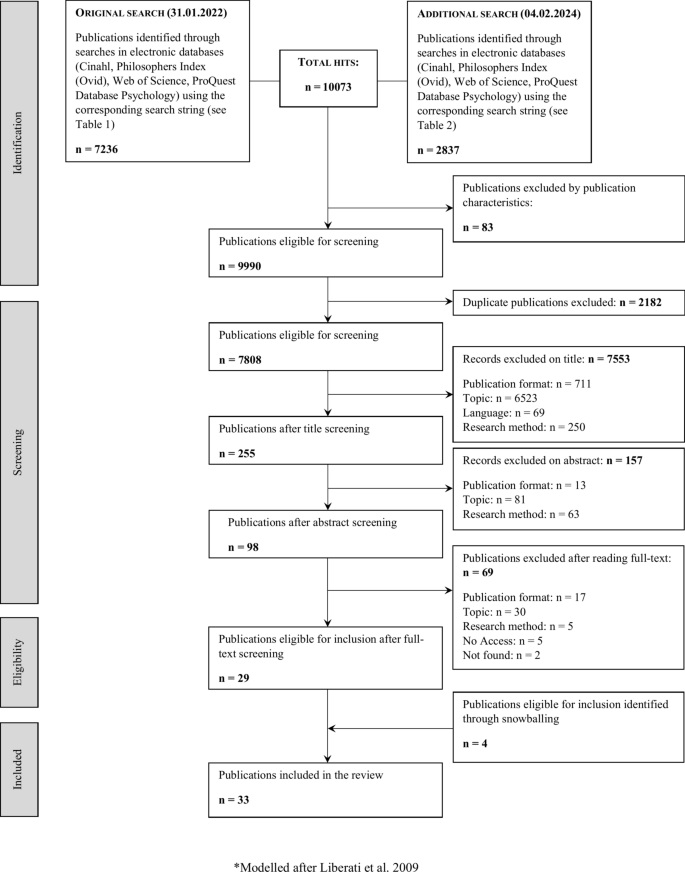
Flowchart overview screening process (Modelled after Liberati et al. 2009)
Data extraction and synthesis
Extraction of relevant data was executed by use of a custom-made extraction tool which was inspired by the tool developed by Vandemeulebroucke et al. (2022c) but further amended after several readings of the included literature (Additional file 1).
Data extraction tool
The tool consists of part focusing on publication characteristics and part focusing on the publication content. The part focusing on publication characteristics covered: (1) Language in which the article is written; (2) The country of the first author’s affiliation; (3) The first author’s profession or research discipline; (4) Research field which the article places itself in; (5) Research focus of the publishing journal; (6) Year of publication.
The part of the tool focusing on the content was directed at the articles’ ethical arguments and concepts. After an iterative process of multiple readings of the included articles, 11 themes to guide the analysis of the reported ethical arguments and used ethical concepts were distilled: (1) Benefits of social media; (2) Risks of social media; (3) Relations, limits and boundaries; (4) Privacy, confidentiality, and trust; (5) Documentation and records; (6) Competency; (7) Problematic behavior and client suitability; (8) Consultation and referral; (9) Informed consent; (10) Identity and image; (11) Others. These 11 themes were joined with two guiding questions on how social media as a technology was perceived and which ethical approach or theory grounded the articles. The final version of the data extraction tool was used to analyze the included literature.
Extraction and synthesis of data
The analysis and synthesis of data was inspired by the five preparatory steps of the coding process of the Qualitative Analysis Guide of Leuven (QUAGOL) (Dierckx de Casterlé et al. 2012). First, both authors thoroughly familiarized themselves with the content of the included articles by several readings of the full text. This familiarization enabled the authors to further develop the data extraction tool by including the 11 themes of focus which in a second step was used to obtain all relevant data reported in the included articles. Of each of these articles, a conceptual scheme was made (Additional file 2). Third, by comparing the conceptual schemes, common publication characteristics and content characteristics were identified on a per-characteristic basis. Fourth, tables were drafted by the first author (TV) summarizing the similarities and differences between the conceptual schemes. These tables were discussed with the co-author (LB) and finetuned. Fifth, these tables guided the reporting of the results in this article (Additional file 3).
