
 info@apippress.com
 +86 18163351462 (WhatsApp)
 +86 182 8014 0209
Article Content
Abstract
There can be a temptation to dismiss moral pushback against novel science and technology, particularly commonplace labels for nanotechnology and synthetic biology like “playing God” or “messing with nature”. One of the reasons for this is an implicit association between tragic themes and a lack of constructive benefit. Therefore, this paper uses concepts from art and cinema to offer a new perspective on public “fears”: ecstatic reframing. By treating negative narratives not as roadblocks to progress, but portals into latent dreams, this novel method reframes such views as housing a positive vision. However, while this offers a new approach regarding public talk of emerging science and technology, lay ethics is ultimately insufficient to deal with the underlying problems that stimulate their tragic tone. This paper uses a classic concept from anthropology–rites of passage–to argue that public unease is fundamentally cultural: modernity’s lack of a collectively agreed upon worldview and primordial ritual structure for stewarding change. This “cultural deficit” may lie at the core of tragic narratives regarding emerging science and technology.
Explore related subjects
Discover the latest articles and news from researchers in related subjects, suggested using machine learning.
- Cultural Theory
- Public Engagement with Science
- Public Understanding of Science
- Rhetoric of Science and Technology
- Science Ethics
- Science, Technology and Society
Although emerging technologies can be emblems of exciting change, they also trigger the intuition that something isn’t quite right. Public talk about emerging technologies has been described as reflecting a “tragic mood” [1]. Despite the promissory tone of interdisciplinary projects such as synthetic biology [2, 3], nanoscience [4] and geoengineering [5], analysts of public discussions often highlight negativity that includes abstract themes like the folly of our attempts to dominate nature and the hubris of technofixes. Some researchers have described these themes as archetypal [1, 6,7,8]: symbolic stories to which we continually return (see [9]). This perspective paper will consider this unease and why it is so difficult to integrate into modern institutions.
Powerful Forces
The multidisciplinary DEEPEN project used public focus group discussions and theatrical presentations to gauge public sentiment towards key emerging technologies [1, 10]. Five “archetypal narratives” were developed from the resulting qualitative data, and they captured a proscriptive tone from their participants: (1) ‘Be careful what you wish for’; (2) ‘Messing with nature’; (3) ‘Pandora’s box’; (4) ‘Kept in the dark’; and (5) ‘The rich get richer’. The researchers described these narratives as counter to one of the modern world’s grand narratives —that we are on a post-Enlightenment march of scientific progress [1, 11]. Contrary to this story of advancement, their 5 counter-narratives paint a metaphysical portrait about powerful forces we cannot control. The repetition of similar themes across public discussions may relate to the role of emotion in assessing unfamiliar science. For instance, cognitive research in Australia suggests that people are more likely to be guided by emotion during initial considerations of synthetic biology [12]. This guiding effect may also be the case with respect to trust, which has been shown to have a stronger effect than more entrenched social attitudes on support for unfamiliar gene drive techniques [13]. Therefore, it is likely that archetypal narratives and intrinsic concerns will continue to be part of public responses, because the unfamiliarity of fields like nanoscience and synthetic biology act as triggers for emotion and intuition (though the relationship between familiarity with a technology, cognitive processing, and ‘gut reaction’ are complex and could at times suggest a diminished role for emotion early on in assessment, [cf. 14]). However, while they can stimulate imaginative debate, the question persists as to how these responses could be used? Particularly with respect to bioengineering, there remains an “engagement gap” between studies on these views and their inclusion in planning and policy [15].
Breathing Apollo’s Dust
Among the Kuranko of Sierra Leonne, a story was generated that the Apollo moon landings lead to a local conjunctivitis epidemic, caused by cosmic dust that had been disturbed from the moon’s surface [16]. This is not empirically credible. However, just as certain intrinsic concerns (e.g., ‘playing God’) might translate into more tangible risks (e.g., the unintended transfer of genetically engineered material across species, see [17]), the reverse could apply: some specific interpretations of the world, which do not translate to credible cause-effect relationships, might be portals to something deeper. Jackson understands the Kuranko’s belief as their experience of modern change. The Kuranko had a growing sense of disempowerment under globalization, which alongside the boons brought powerful external influences and technologies they did not control or understand. They recognized powerful forces were driving transformations in their local world, while their own influence rapidly diminished. A similar reactionary discourse has been observed in Vanuatu, regarding concerns about “introduced” substances, foods and technologies that were seen as part of a modern incursion into a customary way of life [18]. For the Kuranko of Sierra Leone, they faced this in much the same way people make sense of catastrophe: a shock to the natural order is an emergency in need of response. This meant revisiting how to manage the movement of foreign commodities and people across their borders, and to engage in exchange that was more consensual and reciprocal. Apollo certainly did not cause the conjunctivitis epidemic, but it did animate this existential dilemma. Similarly, in Vanuatu, the belief that imported tinned fish had become the primary cause of skin conditions lacked reliable causal evidence. However, modern diets, with their financial and health costs, had indeed developed from new ways of life introduced through powerful external forces. This larger transition had deteriorated the relationships needed to ensure traditional subsistence practices continued providing fresh fish and gardened produce. Likewise, Jackson draws a valuable lesson from the Kuranko myth of Apollo: responses to novel biotechnologies are also about how people relate to larger influences behind them. In other words, this is not merely about emerging technology; it’s about the degree of control people feel in emerging relationships. This dovetails with the five narratives discussed earlier [1], which expressed variations on the same theme: the dangers of mysterious forces beyond our control. However, this leaves open the matter of how we should seek reconciliation with these forces?
Latent Dreams
The question of why publics might use tragic framing has been discussed, particularly around nanotechnology [1, 19]. However, it is rarely if ever asked: what should we expect in the way of ‘positive’ archetypal framing in the first place? This constitutes a curious gap for two reasons: the power of metaphor and symbols to frame technoscientific appraisal [7, 8], and the long-held concern that public counter-narratives are using these tools to hobble progress.
In the field of foresight practice for emerging technologies, “archetypal scenarios” are developed to test organization readiness, and they can include both positive and negative elements [20]. Futurists who advocate for this method have pointed out that archetypes themselves are not strictly positive or negative. They can be interpreted variously depending on framing and context. Therefore, Fergnani & Song [21] focus on their potential to stimulate our imagination for responding to crisis. For example, the image of hubristic societal collapse, a common trope in science fiction, can be used to encourage organisations to prepare. This is a constructive approach to this dreadful image, and the authors point out that research on the use of archetypes lacks such applied focus of artistic expression. This paper adopts a different focus with respect to the positive potential of archetypal narratives: the hope that is already contained within them.
To illustrate, the image of societal collapse can be seen as underpinned by an inherent desire for society to be healthy and stable. Without this, the very image of collapse has no stakes and would be meaningless. In other words, the “public fear” of societal collapse is not merely fear; it conceals a wish. This wish occupies the original narrative or image. It simply requires that the interpreter sees this through the negativity. Furthermore, once the interpreter has settled on a latent wish or hope, they can flesh out the picture by analysing the details of public talk. Publics might give more context about how a healthy and stable society should look. They might discuss health and stability in any number of local, contextual ways: e.g., through specific anecdotes and experiences, cultural practices or analogies, governance ideas and the reasoning behind them. From this, a new image could be generated. This would constitute a form of public engagement-based reframing, an activity that should be considered with respect to so-called “public fear”. However, no such re-framing approach seems to exist in the literature on public sensemaking, trust in science or narratives of emerging technologies. Therefore, this is an opportunity to introduce it with a novel exercise: take the five archetypal counter-narratives described earlier [1] and reframe them as positively as possible. This is not intended to advocate for a communication’s method. Rather, it grants the framer permission to stand toe-to-toe with the archetypal—only this time to be beatifically positive instead of tragic. This might help us consider public counter-narratives from a fresh angle. To achieve this, the paper suggests using two concepts, not from academia or policy frameworks, but art and cinema.
Negative Space
Negative space is a seemingly-paradoxical tool used in the visual arts. On canvas or screen, the primary subject of a composition is typically defined overtly in positive space. Negative space defies artistic convention because it defines an image through its absence. This is achieved through the amorphous space between or around the subject. Negative space is captivating. The relationship between presence and absence, formlessness and form, chaos and order, compels the viewer to complete the composition in their own mind, and the positive subject ‘pops out’ (Fig. 1).
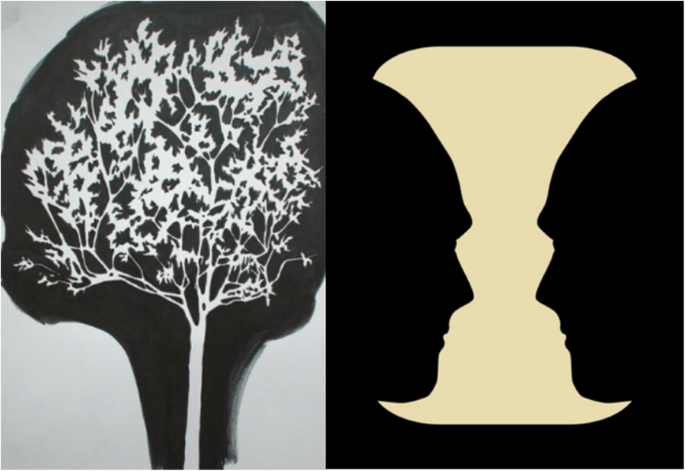
Left: Rather than drawing a tree, the artist uses negative space to reveal the subject (the tree) within (Reproduced with attribution. Part of the piece “Negative Space – Trees” by “iam-holly”. Posted Jan 6, 2012. Retrieved from https://www.deviantart.com/iam-holly/art/Negative-Space-Trees-277870053). Right: A well-known example from psychology, Rubin’s Vase (Retrieved from https://en.wikipedia.org/wiki/Rubin_vase). The vase is the negative space that reveals the faces (and vice versa in this case)
Just as negative space provides an unspoken narrative that shapes the composition, this paper suggests making conceptual use of negative space in lay ethics sensemaking. Public counter-narratives and intrinsic concerns are widely understood as cautious, tragic, suspicious of the grand story of progress—as negative visions—but here it is suggested that latent dreams lie buried within: implying a positive subject.
To give a couple of examples as to how this could be initially applied: First, consider once again the common objections “playing God” and “messing with nature”, which are widely deployed regarding synthetic biology and nanotechnology (e.g., [6, 17, 22,23,24]). Negative space considers how these concerns might form the contours of another subject. Another way of putting this is that intrinsic concerns reveal intrinsic values. “Playing God” and “messing with nature” can suggest reverence and appreciation for a natural order. Though we are able to measure and instrumentalise nature in many respects, it must be appreciated impressionistically. This is less a thoughtless fear or technophobia as a deep wish to make peace with complexity, uncertainty and limitlessness by respecting, perhaps in certain instances, that we should let things take their course. Indeed, virtue ethics [25] offers a critique of synthetic biology as a biotechnology that manifests the drive to refashion nature to our desires,Footnote1par excellence. This drive’s refusal to acknowledge the “giftedness of life” [26], Coyne argues, needs to be constrained. Regardless of whether one fully agrees with this argument, the point is that public intrinsic concerns are so valuable that they function both as a means of simplifying highly complex risks and mirroring rich, intrinsic values that are debated among ethicists. With negative space, this seemingly frustrating trope— “messing with nature”—looks to some like a black smudge across a canvas; but it reveals an appreciation of the world as a precious gift.
Beyond the positive archetype of, say, the wish for a wise steward, finer details such as “extrinsic requests” that crop up in dialogue would help enable it, and these could be added depending on the content of public discussions. This addition could also give it the benefit of being local (e.g., desire for certain institutional mechanisms that are particular to a given place). Taken as a whole, this is the positive subject revealing itself like the tree above. To truly work, this requires three ingredients: (i) the analyst tries to ascertain the existence of the positive subject in the first place, as per the viewer’s visual processing of positive space in art (e.g., from “messing with nature”, develop the latent wishes and desires within them, in this case, perhaps to “protect and appreciate nature”); (ii) creativity, particularly through tools like frames and metaphor for building emotion and meaning into the narrative; and (iii) the translational approach of connecting abstract, intrinsic concerns to tangible external matters (except here, once again negative space means no longer fixating on fears or proscriptions, but developing the latent wishes and desires within them. Therefore, just as the public fear “messing with nature” translates into specific risks that policymakers are more apt to consider like the loss of control in genetic engineering (see [17]), its positive space counterpart “protect and appreciate nature” might translate to specific actions like redefining what it means to have a protected area, revitalising cultural practices, sharing experiences of nature, citizen science activities, etc.).
Ecstatic Truth
This needs something more to lift things to the same emotional tone as archetypal narratives: “ecstatic truth”. The term was coined by filmmaker Werner Herzog. He explained his approach to filmmaking with a criticism of Cinema Verité. Herzog described fly on the wall documentary making as “the accountant’s truth” and advocated for a more creative method “reached only through fabrication and imagination and stylization,” [27]. Rather than a mere visual account of facts and events, like Cinema Verité or surveillance footage, ecstatic truth entails exploring “the inner landscape of the soul” [28]. Since archetypal narratives and intrinsic concerns refer to intuitive, emotionally-potent motifs, reframing them would need to be highly evocative rather than a list of instrumental guidelines. The term ecstasy itself derives from Greek “standing apart from” and in this sense it relates very closely to the concept of negative space. This paper uses the concept of ecstatic truth to elevate positive space to a beatific plane, that it may stand apart from something merely positive, and become ecstatic. For instance, the latent desire for a healthy and stable society would not remain framed as something safe and functional, but a dreamlike triumph. This is useful because it is worth going beyond questions like “how can we achieve public acceptance?”, “how can we increase trust in science?”, or “how should we weigh our emphasis on intended vs. unintended consequences in engagement?”. These all remain important questions, but we should embark on a more creatively stimulating pursuit: what could positive archetypal narratives of emerging technologies really look like? How does it sit with us when we consider them? Would they help? If so, how? If not, why?
Finally, it is hoped that this exercise will help drive home two points: (1) when it comes to transformative science and technology, people are more like Werner Herzog and less like the proponents of Cinema Verité—captivated by transcendent meaning and imagined worlds beyond facts, and (2) this captivation nonetheless sinks into negativity due to special conditions of modernity.
Ecstatic Reframe
With this in mind, the five counter-narratives developed from public responses to synthetic biology, nanoscience and geoengineering [1] will be reiterated and given a (pseudo) ecstatic reframe.
| Original Counter-Narrative | Ecstatic Re-frame |
|---|---|
| Be careful what you wish for | Manifest Blissful Dreamworlds |
| Messing with nature | Harmonizing a Cosmic Symphony |
| Pandora’s box | Giftbox of Blessings |
| Kept in the dark | Awakened by Glorious Illumination |
| The rich get richer | The Shared Breath |
One thing that will seem immediate is that these reframes take hubris to cult-like proportions. It is not the suggestion of this paper that this constitutes an appropriate communications technique. Indeed, as Boldt [29] argues, we should consider framing synthetic biology not as something that frees us from the limits of nature by reinventing the molecular basis of life, but as one tool among many that can help to overcome certain societal challenges. The (pseudo) ecstatic re-frames above clearly go beyond this to a religious zeal. However, as previously laid out, this was the point. Public responses to nascent technologies are an expression beyond the distal features of technology to a dreamlike vision of the world it might create. In many cases, these have been haunted by the “tragic mood” [1]. This exercise simply sought to show what exorcising those ghosts might look like.
Further, unlike archetypal narratives or intrinsic concerns, these ecstatic reframes were not produced organically. Lay ethics sensemaking involves a fundamentally inductive process based on dialogue, and it is from the data of live discussions that analysts interprete and develop narratives. In contrast, this activity was an attempt to use the same kind of tone that these narratives have used, and consider how their opposite (positive archetypal narratives) might appear. Instead, re-framing tools could be tailored to participants’ specific cultural worldviews. In New Zealand, researchers tested the effectiveness of different frames around CRISPR-based gene drive. They found no significant effect of worldview-based framing on negative affective response, arguing this is likely due to (at least initial) unfamiliarity with the novel technology [14]. That study used quantitative, attitudinal measures to classify people according to one of four, broad worldviews and test the role that pre-set frames might play in their support for gene drive. The reframing method described in this paper is quite different, both from prior quantitative studies and the pseudo reframing exercise above. Ecstatic reframing is exploratory and creative. It involves developing new narratives from fresh qualitative data, derived from open discussions, and uses the three elements: interpreting a positive subject or “wish” within public concerns (negative space); lifting it further with emotionally potent metaphor (ecstatic truth), and incorporating tangible “requests” and suggestions into its details (translation). The above exercise simply intended to answer the rarely asked question of what a radically positive version of public archetypal narratives of emerging technologies might look like. It is now worth considering why we do not see them in the wild.
Cultural Deficit
Narrative may be foundational to aspects of human cognition such as cause and effect reasoning [30, 31]. As such, it helps us to make sense of our lives [8], even if some aspects don’t always hold up to empirical scrutiny. Public counter-narratives do not quantify acceptance of science and technology; they reveal feelings about the state of the world. It is here where the tragedy really lies. The modern world has lifted living standards, but alongside its many improvements are a series of losses and disconnections: the atomization of individuals, breakdowns in generational continuity, local community living, shared cultural heritage and history, and most notably what Dupuy [32] calls “desacralization”. This refers to the removal of the sacred from everyday affairs. Desacrilization builds from Weber’s “disenchantment”—the gradual replacement of tradition, magic and religion with empirical, scientific understanding. The loss of the sacred, which accompanied secularization and the explosion of the economic sphere, has brought about a loss of meaning. One core aspect of this is the lack of ritual efficacy [32].
Ritual is one of the most profound innovations in the history of human culture, most notably rites of passage. Rites of passage are a primordial ritual which function to transition one state (e.g., a child) to another (an adult member of the social group). They contextualize and stabilize change by bringing it under the fold of culture, reducing its harmful effects. Van Gennep codified the broad structure of rites of passage across human societies: separation from society, a liminal phase, and reincorporation [33]. The liminal phase is the crucial stage between one’s prior identity and re-entry into society under the new identity. Turner [34, 35] called this the “betwixt and between” phase: a threshold stage of uncertainty and ambiguity, often involving tests and ordeals that transform the initiate. Importantly, ritual activities and lessons in the liminal phase are often purposefully esoteric; the fact that people don’t universally understand the processes of change taking place is not a problem. As he described, such rites of passage reached their maximal expression in small-scale societies, where change traditionally occurred through marked transitions in cycles such as seasons or the human lifecycle, not rapid technological innovation.
Although rites of passage can occur for individuals, groups or entire communities, the pattern is consistent: the natural order is temporarily suspended, a new identity is formed, and the initiate is reintegrated into society (rites of separation, transition and incorporation). Throughout this process, and especially the liminal phase, ritual elders are often (but not always) fundamental. These figures act as crossers of symbolic boundaries, managing transitions. They simultaneously connect the everyday banality of life to a shared story with deeper significance, and reclaim control over the capricious, external forces that transform us. Indeed, it may be partly for this reason that the Promethean critique is so prominent in counter-narratives of synthetic biology and nanoscience. Prometheanism refers to the ideal that we can overcome our problems through limitless transformations. Pushback against Prometheanism involves the notion that certain projects are “messing with nature” and the “natural cycle of things” [19]. In contrast, traditional rites of passage were seen not to interfere with cycles, but to mark transitions and steward them appropriately. They did not seek to create constant change; they helped turn uncontrollable forces that act upon us into a stable, social process. They didn’t convince people to trust a faceless institution or accept a novel tool; they converted overpowering forces (e.g., the life cycle) from an existential specter into a meaningful covenant (a time to mourn and a time to dance). This is not messing with nature; this is containing it within a reverential culture. This means a larger, symbolic order (beliefs and practices) encompassing nature’s mutability. This is what people are asking for.
Eliade [36] discussed the importance of integrating the sacred into everyday activities, particularly through ritual symbolism. For example, he describes how, across various cultures, the everyday act of constructing a physical building often involves the laying of a foundation stone. This stone may be consecrated by religious specialists, symbolically marking the activity as more than a practical solution to housing, instead folding it into a larger story of mythological significance to the community. This act opens up a connection to an “absolute reality”—the sacred—before the building project, with all of its practical concerns and tools, continues. Eliade calls such acts “heirophanies”: “the manifestation of something of a wholly different order, a reality that does not belong to our world, in objects that are an integral part of our natural “profane world”,” ([36], p. 11). In the absence of such a ritual, the house remains taboo [33].
DNA modification, especially human DNA modification, shares key similarities with Eliade’s heirophanies and van Gennep’s liminal space. It involves the temporary suspension of the natural order to initiate a new identity (traits) and reintegrates the individual (organism or biological parts) back into the existing order (outside the lab). This is the very same structure described in classic rites of passage (suspend the natural order, form a new identity, reintegrate it into the world). However, this is no longer done to maintain stability with an absolute reality. Rather, it (at least seemingly) introduces something fundamentally new and disruptive. The fact that people don’t understand what is occurring in the liminal phase is not the problem; it is the suspension and reintegration phases. The way to think about the rites-based significance of any given emerging technology is to reverse engineer its significance by asking: (1) Does it (appear to) alter the status quo at a fundamental level, as though it might be an act of cosmic significance (as per Eliade’s heirophanies appearing in the everyday world)? (2) Does its creation seem to mirror the three-part process of suspension, transformation, and reintegration (as per van Gennep’s ritual structure)? If the answers to these questions are yes, we have triggered something deeply significant. This domain begs the question: what concerns could a passage taken without proper rites provoke? This is a passage as yet unproven, and it raises the issue not of trust in science; but trust in ritual.
Modern-day boundary crossers like genetic engineers are not ritual specialists and nor do they claim to be. They don’t perform religious functions like lifting spiritual taboos as they stabilise the world. Rather, they are a professional class performing profane–that is to say, worldly–tasks. Indeed, it is common for scientists in fields such as synthetic biology to respond to public or media concern by arguing that what they do is a continuation of everyday practices. This denial that anything out of the ordinary is being performed has been critiqued with respect to nanotechnology and synthetic biology [9]. With nanotechnology, the broader sociotechnical system has been described as in denial, projecting a belief that “nothing special is being undertaken” and which considers “its dreams of control and improvement to require little external endorsement or explanation,” ([19], p. 33). In synthetic biology, a similar denial occurs in two forms: that it is the successor to modern genetics and its lab processes are linked to age-old genetic selection in domestication. Consequently, it shouldn’t be worthy of special ethical attention. With respect to the first, it isn’t clear simply because something has intellectual antecedents that it should not raise special ethical concerns. For the second, Marris [2] critiques the example of synthetic vanillin. The company producing it responded to public controversy by publishing an educational video explaining that their core process, genetically modifying yeast, was something that humans had been doing in some form for millennia. However, I do not dispute that scientists are engaged in everyday activities, nor that synthetic biology puts a new spin on something old. Rather, the point is that, like heirophanies, these are everyday activities and something that reveals “sacred matters”, at the same time (see [36]).
Public counter-narratives may be older not only than the sciences, but more ancient even than the theological language they sometimes employ. Disquiet around crossing metaphysical boundaries is less an expression of scientific ignorance or even theological allegiances as it is an intuition about a passage without the proper rites. A caste of functionaries with incredible power (a science-industrial complex) are not universally recognised, on some fundamental level, to be legitimate stewards of these boundaries. Modern science and governance conduct affairs within a desacralized, or secularized, society, whose functions are not unified beneath a religio-cultural framework. There is no foundation stone upon which a new edifice, with all of its beatific promises, is being built. Synthetic biology transforms the symbolic order (our relationship to nature) without consecrating it (linking it to a stable story). However, this is not a call for these activities to be banned. It may be an expression of a desire for culture to contain change. By contain, I mean not only holding it back, but in the same manner as Dupuy [32]: as something housed by culture. Here, rites of passage contain transformation because it exists within (and beneath) a universal story.Footnote2
The tragedy here is that in the face of ever-increasing disconnection, and with it the loss of the sacred and rites that safely and meaningfully consecrate change, our ability to engage in rapid change is accelerating. This leaves us squinting at some distant lighthouse for the passage. Yet without a coherent cosmological worldview, without a unified and tightly-knit culture, and without agreed upon ritual leaders or processes to reproduce such a system, the tragedy cannot resolve. This lack of cultural connection and sanctioned boundary crossers could be called a cultural deficit, a problem far more intractable than the knowledge-deficit-model whereby publics merely lack the scientific information to help them accept change. A cultural deficit, on the other hand, is a felt sense that our mundane activities are actually engaging with a transcendent truth, yet we no longer have the tools to acknowledge and articulate it, let alone guide it. We are sailing through fog, picking up speed. We appear to be experiencing a kind of cultural dementia. Lighthouses offer moments of revery (as per truncated archetypal narratives and intuitive, intrinsic concerns like “you’re messing with nature”), but never lucidity. Eventually, we may not merely lose our way; we may no longer remember that our species was above all cultural and religious. We may forget the forgetting. Then we drift, catatonically numb to a flat world where change itself has no meaning (as per the final stages of advanced dementia). This is the chasm beneath the “tragic mood”.
To this deficit, we should remain mindful of our ‘cultural abundance’ of arts, religion and humanities [37]. In Greek tragedy, its structure involves a chorus who expound on the fatal flaws of the protagonist, causing reflection and subsequent catharsis in the audience. This is later followed by “anagnorisis”– when the protagonist recognizes the flaw in themselves. Modernity is an unfinished tragedy because it is stuck in a narrative loop without this resolution: from ambiguous conflicts to pseudo-conclusions, to the continuation of conflicts. Public responses to emerging technologies are situated within this broader existential problem, just as the Kuranko of Sierra Leone’s myth of Apollo and ni-Vanuatu skin condition theory are situated within their diminishing sense of control under globalization. This is an expression of what we might call the “unfinishing tragedy of modernity”. Far from a hindrance, unhelpful or irrational, this negativity is a telling symptom to be investigated, and at its best, an invaluable, human talent. It tells us that we are missing not only critical ethical reflection, but meaningful social structure.
Conclusion
There is no clear solution to the problem this paper has arrived at. What began as an exploratory exercise to reframe the negativity of public archetypal narratives of emerging technology, employing two concepts from the creative arts, concluded that they have roots in a deeper, cultural problem. The sense that something isn’t quite right does not merely spring from ignorance, nor a distrust of science and scientists (see [13]). There is a genuine concern for how to midwife change. Therefore, while scientists and governments are indeed responsible for maintaining trust, they are not strictly at fault for counter-narratives. Rather, there is at least some contribution coming from the sense that something is missing from transformative science and technology – continuity with a story that transcends it and thus encapsulates our lives. Anthropologically, this has its roots in a social innovation that simultaneously recreates the group’s unified cosmological worldview while stewarding transformation, one that is older than religion: rites of passage.
If this is to change, it likely requires something closer to what Simons [24] describes: that moving a person’s symbolic arguments looks less like convincing and more like converting them into a certain point of view. He likens this to aesthetics, in which experiencing a work of art rather than rational argument converts a person to the view that something is beautiful. However, here I have introduced the neglected role of ritual. If there is truth to the power of archetypal narratives and intrinsic concerns, they should be engaged with as a method for forwarding discourse around nascent technologies. But without the meaning that rites bring to acts of transformation, the stories we produce in response to change may remain dystopic nightmares on the one hand, utopian fantasies on the other, or perhaps worst of all: ironically detached. If a society is to truly embrace modern transformations brought about by such fields as nanoscience and synthetic biology, it needs to be culturally alive: encapsulated within a transcendent dream (ecstatic truth) that is continually retold through the structure of primordial process (rites of passage).
Data Availability
Not applicable.
Change history
12 March 2025
The original online version of this article was revised: the authors would like to add a funding information in Funding section.
20 March 2025
A Correction to this paper has been published: https://doi.org/10.1007/s11569-025-00470-3
Notes
-
Coyne [25] argues that this drive to mastery is irrespective of the attitudes of specific scientists, who may or may not consciously seek to refashion nature to their desires.
-
Dupuy [31] describes containment in this sense as not only encompassing something at a lower level, but giving it meaning by being its opposite (cf. [38]).
References
-
Macnaghten P, Davies SR, Kearnes M (2019) Understanding public responses to emerging technologies: A narrative approach. J Environ Planning Policy Manage 21(5):504–518. https://doi.org/10.1080/1523908X.2015.1053110
-
Marris C (2015) The construction of the public as a threat to synthetic biology. Science as Culture 24(1):83–98. https://doi.org/10.1080/09505431.2014.986320
-
Schyfer P, Calvert J (2015) Intentions, expectations and institutions: Engineering the future of synthetic biology in the USA and the UK. Science as Culture 24(4):359–383. https://doi.org/10.1080/09505431.2015.1037827
-
Dupuy JP (2007) Some pitfalls in the philosophical foundations of nanoethics. J Med Philos 32(3):237–261. https://doi.org/10.1080/03605310701396992
-
McLaren D, Corry O (2023) “Our way of life is not up for negotiation!”: Climate interventions in the shadow of ‘societal security’. Global Studies Quarterly 3(3):1–14. https://doi.org/10.1093/isagsq/ksad037
-
Betten AW, Broerse JEW, Kupper F (2018) Dynamics of problem setting and framing in citizen discussions on synthetic biology. Public Underst Sci 27(3):294–309. https://doi.org/10.1177/0963662517712207
-
Fritzsche AF (1995) The role of the unconscious in the perception of risks. RISK 6(3):215–240
-
Kelsey D (2021) Psycho-discursive constructions of narrative in archetypal storytelling: A discourse-mythological approach. Crit Discourse Stud 18(3):332–348. https://doi.org/10.1080/17405904.2020.1802766
-
Dupuy J-P (2010) The narratology of lay ethics. NanoEthics 4(2):153–170. https://doi.org/10.1007/s11569-010-0097-4
-
Macnaghten P (2010) Narrative and public engagement: Some findings from the DEEPEN project. In: Von Schomberg R, Davies S (eds) Understanding public debate on nanotechnologies: Options for Framing Public Policy, European Commission, Debate on Nanotechnologies, pp 11–29
-
Davis S, Macnaghten P (2010) Narratives of mastery and resistance: Lay ethics of nanotechnology. NanoEthics 4:141–151. https://doi.org/10.1007/s11569-010-0096-5
-
Mankad A, Hobman EV, Carter L (2021) Effects of knowledge and emotion on support for novel synthetic biology applications. Conserv Biol 35(2):623–633. https://doi.org/10.1111/cobi.13637
-
Dixson HGW, Komugabe-Dixson AF, Medvecky F, Balanovic J, Thygesen H, MacDonald EA (2022) Trust in science and scientists: Effects of social attitudes and motivations on views regarding climate change, vaccines and gene drive technology. J Trust Res 12(2):179–203. https://doi.org/10.1080/21515581.2022.2155658
-
MacDonald EA, Edwards ED, Balanovic J, Medvecky F (2021) Scientifically framed gene drive communication perceived as credible but riskier. People and Nature 3(2):457–468. https://doi.org/10.1002/pan3.10186
-
Carter L, Mankad A, Hobman EV (2023) Is public engagement in bioengineering and synthetic biology improving research outcomes? OMICS J Integr Biol. 27(2):47–50. https://doi.org/10.1089/omi.2022.0181
-
Jackson M (2002) Biotechnology and the critique of globalisation. Ethnos 67, 2:141–154. https://doi.org/10.1080/00141840220136792
-
Carter L, Mankad A, Hobman EV, Porter NB (2021) Playing God and tampering with nature: Popular labels for real concerns in synthetic biology. Transgenic Res 30(2):155–167. https://doi.org/10.1007/s11248-021-00233-2
-
Dixson HGW (2016) Generosity, third party punishment and theory of mind among ni-vanuatu children. Dissertation. The Australian National University
-
Macnaghten P (2010) Researching technoscientific concerns in the making: Narrative structures, public responses, and emerging nanotechnologies. Environment and Planning A: Economy and Space 42(1):23–37. https://doi.org/10.1068/a41349
-
Dator J (2019) Alternative futures at the Manoa school. In: Dator J (ed) A Noticer in Time: Selected Works, 1967–2018: 5. Springer, pp 37–54
-
Fergnani A, Song Z (2020) The six scenario archetypes framework: A systematic investigation of science fiction films set in the future. Futures 124:102645. https://doi.org/10.1016/j.futures.2020.102645
-
Dabrok P (2009) Playing God? synthetic biology as a theological and ethical challenge. Syst Synth Biol 3(1–4):47–54. https://doi.org/10.1007/s11693-009-9028-5
-
Dixson HGW, Balanovic J, Medvecky F, Edwards ED, MacDonald EA (2023) Beware the unknown: Views on genetic technology in conservation. Narrative Inquiry in Bioethics 12(3):241–263. https://doi.org/10.1353/nib.2022.0060
-
Simons M (2022) Playing God: Symbolic arguments against technology. NanoEthics 16:151–165. https://doi.org/10.1007/s11569-022-00422-1
-
Coyne L (2020) The ethics and ontology of synthetic biology: A neo-aristotelian perspective. NanoEthics 14:43–55. https://doi.org/10.1007/s11569-019-00347-2
-
Sandel MJ (2007) The case against perfection: Ethics in the age of genetic engineering. Harvard University Press, Cambridge
-
Werner H, Weigel M (2010) On the absolute, the sublime, and ecstatic truth. Arion J Human Classics 17(3):1–12. https://doi.org/10.1353/arn.2010.0054
-
E-flux.com (2023) Werner Herzog: The ecstatic truth. https://www.e-flux.com/announcements/537593/werner-herzog-the-ecstatic-truth. Accessed 20 May 2023
-
Boldt J (2016) Swiss watches, genetic machines, and ethics. In: Boldt J (ed) Synthetic Biology: Metaphors. Springer, Worldviews, Ethics and Law, pp 1–9
-
Fletcher A, Benveniste M (2022) A new method for training creativity: Narrative as an alternative to divergent thinking. Ann N Y Acad Sci 1512(1):29–45. https://doi.org/10.1111/nyas.14763
-
Fletcher A (2023) Storythinking: The new science of narrative intelligence. Columbia University Press, New York
-
Dupuy JP (2013) The mark of the sacred. Stanford University Press, Stanford
-
Van Gennep A (2019) The rites of passage, 2nd edn. University of Chicago Press, Chicago
-
Turner V (1970) Betwixt and between: The liminal perios in rites de dassage. In: Turner V (ed) The Forest of symbols: Aspects of Ndembu ritual. Cornell University Press, Ithaca, pp 93–111
-
Turner V (1966) The ritual process: Structure and anti-structure. Cornell University Press, Ithaca
-
Eliade M (1957) The sacred and profane: The nature of religion. Harcourt Inc, New York
-
Mitcham C (2014) The true grand challenge for engineering: Self-knowledge. Issues Sci Technol 31(1). https://issues.org/perspectives-the-true-grand-challenge-for-engineering-self-knowledge/
-
Dumont L (1986) Essays on individualism: Modern ideology in anthropological perspective. University of Chicago Press, Chicago
Funding
Open Access funding enabled and organized by CAUL and its Member Institutions This paper received no specific grant from any funding agency in the public, commercial, or not-for-profit sectors. This research was funded by the Australian Research Council Centre of Excellence in Synthetic Biology (CE200100029). The views expressed herein are those of the author and are not necessarily those of the Australian Government or the Australian Research Council.
Ethics declarations
Ethics Approval and Consent to Participate
Not applicable.
Competing Interests
No potential competing interests are reported by the author.
Additional information
Rights and permissions
Open Access This article is licensed under a Creative Commons Attribution 4.0 International License, which permits use, sharing, adaptation, distribution and reproduction in any medium or format, as long as you give appropriate credit to the original author(s) and the source, provide a link to the Creative Commons licence, and indicate if changes were made. The images or other third party material in this article are included in the article’s Creative Commons licence, unless indicated otherwise in a credit line to the material. If material is not included in the article’s Creative Commons licence and your intended use is not permitted by statutory regulation or exceeds the permitted use, you will need to obtain permission directly from the copyright holder. To view a copy of this licence, visit http://creativecommons.org/licenses/by/4.0/.
Reprints and permissions
About this article
Cite this article
Dixson, H.G.W. The Wisdom of Negativity: Embracing Public Concerns About Emerging Technologies. Nanoethics 19, 1 (2025). https://doi.org/10.1007/s11569-024-00465-6
- Received
- Accepted
- Published
- DOI https://doi.org/10.1007/s11569-024-00465-6
Keywords
- Public engagement
- Narratives
- Framing
- Emerging technologies
- Ecstatic reframing
- Thematic analysis
