
 info@apippress.com
 +86 18163351462 (WhatsApp)
 +86 182 8014 0209
Article Content
Abstract
Many students possess a stereotypical conception of scientists (only) doing experiments in a laboratory. There is consensus in science education literature that this conception is incomplete and inadequate. Adequate conceptions of scientists and their work are important in students’ learning and career choices. However, what can be defined as an adequate conception in this regard remains unclear. This study aims to provide insight into biologists’ self-reported activities and their work locations to generate a basis for further research. 94 biologists with various positions and from a range of biological research areas answered an online questionnaire. The biologists were asked to describe three of their main scientific activities and the corresponding work locations in detail. A category system was established, which includes eight activities (‘Investigative and Artistic’, ‘Teaching’, ‘Realistic’, ‘Publishing and Reviewing’, ‘Enterprising’, ‘Conventional’, ‘Networking’, ‘Learning’) and 14 locations, which were subsumed under three main locations (‘In the Research Institute’, ‘In the Field’, ‘Remote Workspaces’). The variety of activities and locations reported by the biologists is much broader than the stereotypical image of scientific work that students typically have.
Explore related subjects
Discover the latest articles and news from researchers in related subjects, suggested using machine learning.
- Biogeography
- Biosciences and Society
- Biological Microscopy
- Philosophy of Biology
- Societal Outreach of Biology
- Sociology of Science
1 Introduction
Adequate conceptions about science, including conceptions about scientists and their work, are an important aspect of an informed nature of science (NOS) understanding and, thus of scientific literacy (McComas & Olson, 2002; Roberts, 2007). In addition, conceptions about science and scientific work play a role in students’ career choice motives (e.g., Meyer et al., 2019; Toma et al., 2022). However, students’ ideas often differ from adequate conceptions as they have stereotypical and thus frequently incomplete conceptions (e.g., Reinisch et al., 2017; Finson, 2002).
It is noticeable that students are often not asked about their conceptions of science and scientific work in a subject-specific way (Finson, 2002; Miller et al., 2018), such as conceptions about working in biology. Since the natural sciences differ from each other in their characteristics (biology, for example, is characterized by dealing with living objects; Mayr, 2005) and since the characteristics also have consequences for scientific work, a subject-specific consideration should not be disregarded. Furthermore, it should be considered that everyday practice is subject to change, for example, because women now make up a larger proportion of scientists, which is also reflected in students’ conceptions (Dickson & McMinn, 2022), or due to technical or scientific progress (e.g., Perkel, 2021). Thus, a subject-specific and up-to-date view of the job description therefore becomes relevant.
To promote adequate conceptions of science, it is important to have a sound baseline in the sense that the scientific field of interest can be described in a contemporary and subject-specific way. Surveying scientists makes it possible to gain such insights into everyday scientific work (Hodson & Wong, 2014).
This study aims to gain insight into everyday working life by surveying biologists with different positions (e.g., professors). The results of the survey can then be used in future studies as a basis for measuring and promoting students’ conceptions of biologists and their work.
2 Theoretical Background
2.1 Students’ Conceptions of Scientists and Their Work and Why They are Relevant
Research has shown that students enter science classes with conceptions that often differ from adequate scientific views, including conceptions of scientists and their work (Finson, 2002). The latter is seen as part of a NOS understanding (McComas & Olson, 2002), which is one element of students’ scientific literacy (Roberts, 2007).
Usually, students are asked about their conceptions of scientists employing drawing assessments, such as the Draw A Science-Test (DAST; see Miller et al., 2018). The described images in corresponding studies typically refer to conceptions about scientists’ appearance, the locations scientists work at, and the activities they pursue in their daily work (e.g., Farland, 2006; Finson, 2002). It was found that students, and also pre-service-teachers, possess what is called the “stereotypical image” of science and scientists including an image of a male scientist, wearing a lab coat and safety glasses, while performing (dangerous) experiments on his own (Reinisch et al., 2017; Finson, 2002; Henri et al., 2023; Subramaniam et al., 2013). Recent studies with students show the persistency of this conception with a slight shift regarding the gender of the drawn scientists (i.e., scientists are nowadays more often assigned to the female gender than in previous decades; Dickson & McMinn, 2022; Emvalotis & Koutsianou, 2018; Miller et al., 2018). However, despite some progress in gender representation, Sinclair et al. (2023) found that the overwhelming depiction of scientists in traditional, indoor laboratory settings in K-8 science textbooks continues to reinforce narrow and outdated conceptions. These portrayals fail to reflect the diversity of real-world scientific activities and settings, which is crucial for shaping a more accurate and inclusive understanding of the scientific profession. Henri et al. (2023) demonstrated how students’ assumptions about scientists’ gender, ethnicity, and background often align with such stereotypes but can be positively influenced by diversifying how scientists are represented in educational contexts, such as by including photos and names alongside scientific citations (see also Jarreau et al., 2019).
It seems significant for several reasons that students have an adequate conception of scientists and their work:
- (i)In many studies it is suggested that a ‘positive image’ of scientists and their profession is a motivation for students to enter a scientific profession (e.g., Meyer et al., 2019; Toma et al., 2022). Although the assumed connection is comprehensible, there is only few empirical evidence to support it. This might be reasoned by the lack of instruments to validly assess images of scientists and their work (see Reinisch et al., 2017; Toma et al., 2022). There are hints from interview studies, in which it was found that some students did not want to pursue a science career as they, for example, do not connect it to creative activities, which they considered important for their later profession (Young et al., 1997). Contrary, the creative character of science and scientific activities has been widely acknowledged in the literature (e.g., Lederman & Lederman, 2014) and confirmed by studies with scientists (Stamer et al., 2020; Wentorf et al., 2015; Wong & Hodson, 2009).
- (ii)Students who decide to pursue a career in science and begin their studies at university often enter with preconceived notions of what their future career will entail. This is comparable to the notion of ‘unrealistic optimism’ identified in health psychology (Weinstein, 1982), where students might adopt an overly optimistic conception of their chosen discipline, underestimating the challenges and overestimating their control over future outcomes. Stamer et al. (2020) emphasize the negative impact of such incorrect conceptions, noting that they ‘not only hinder students from choosing the right career path but they result in students dropping out of university’ (p. 170). An optimistic bias could manifest in students extrapolating from their past academic successes or interests in science, leading them to anticipate a career path that is smooth and without significant challenges. To address this tendency, it is essential to not just portray a positive image of scientific careers but, more importantly, to provide a realistic representation. This involves a realistic depiction of the activities scientists undertake. Meyer et al. (2019) and Toma et al. (2022) stress the importance of presenting a truthful picture that includes the challenges required in scientific careers. By providing a balanced and accurate portrayal of the scientific field, reflecting the real-life activities scientists face, students can develop a more realistic set of expectations, better equipping them for the realities of their chosen career path.
- (iii)Weisberg et al. (2021) showed with their study of 1,500 participants in the USA that a greater understanding of NOS and how scientists reach scientific consensus were positively related to the acceptance of the scientific consensus in socio-scientific issues (e.g., acceptance of climate change). They conclude from their study that an increased emphasis on developing people’s knowledge of how science works could help reduce resistance to scientific claims. On a broader level, people with an adequate understanding of scientists and their work, within the framework of NOS, are also more likely to comprehend scientific theories (e.g., evolution) or products (e.g., vaccines) and to place trust in them. While this trust is important, it should not be uncritical. Scientific work is embedded in societal and political contexts (Lima & Nascimento, 2022). Therefore, a nuanced NOS understanding not only fosters acceptance of scientific knowledge but also enables a reflective engagement with the role of science in society (Höttecke & Allchin, 2020).
However, while there is consensus that the so-called stereotypical conception of scientists (Finson, 2002; Miller et al., 2018) is rather inadequate, it remains unclear what can be considered an adequate conception.
2.2 Conceptions of Scientists and Their Work
In many studies, it is demanded to communicate a positive (e.g., Meyer et al., 2019; Toma et al., 2022) or authentic/realistic (Reinisch et al., 2017; Reinisch & Krell, 2023; Cakmakci et al., 2011) image of scientists and their work to students. Whereas the former aims directly or indirectly to ensure that students have an optimistic image of scientific professions, the latter is primarily concerned with ensuring that the reality of scientific professions is portrayed. Such an image can include positive aspects of the profession, but also negative or critical ones. Most of the studies, however, do not shed light on what can be counted as an adequate image but rather provide evidence from students’ answers about the stereotypical image. Thus, it can be seen as critical to define what can be counted as an adequate conception of scientists and their work.
One way to gain insight in this regard is to ask scientists about their work. Hodson and Wong (2014) suggest that scientists can provide vivid and authentic insights into everyday science. Such insights, in turn, can inform curriculum development (Hodson & Wong, 2014; Schwartz, 2012) and provide a baseline for analysing students’ conceptions. While some studies have shed light on the activities scientists engage in during their daily work (see below; e.g., Stamer et al., 2020; Wentorf et al., 2015), there is a lack of integration of these findings into discussions concerning students’ conceptions (e.g., Bozzato et al., 2021).
For example, Wentorf et al. (2015) interviewed 22 scientists (professors, doctoral students, postdocs) from physics, chemistry, materials sciences, food technology, and marine sciences. They asked the scientists what a typical working day looks like and what activities they pursue during it. Thus, the focus of their study was on scientific activities. They assigned the scientists’ statements to one of the six categories presented in Table 1, which were derived from the RIASEC (‘Realistic’, ‘Investigative’, ‘Artistic’, ‘Social’, ‘Enterprising’, ‘Conventional’) model by Holland (1997). Through the interviews and further investigations, the authors of the study found a seventh category, which they named Networking (Table 1). Thus, they renamed the model RIASEC + N.
In a further study, it was found that scientists perform different activities from the RIASEC + N model, depending on their position. Junior scientists (doctoral students and post docs), for example, mainly handle laboratory and administrative tasks, while professors focus on all kinds of activities related to the scientific job profile. Compared to junior scientists they are much more likely to plan the budget of research projects and communicate research results (Stamer et al., 2020).
In summary, a review of the current state of research highlights the importance of promoting adequate conceptions about scientists’ work. Asking scientists is a promising method for deciding which ideas or conceptions can be considered adequate (Wong & Hodson, 2009). However, it is important to keep in mind that this approach reveals the subjective recollections and interpretations of the participants, which may be influenced by memory biases or selective emphasis. This means that the findings of such studies represent scientists’ conceptions rather than a direct observational documentation of their work. At the same time, it is worth noting that any form of documentation (e.g., interviews, observations) relies on perspectives that are shaped by context and interpretation. While direct observation might capture different aspects of scientific work, it does not necessarily provide a more objective account. Rather, each approach offers a particular lens on the nature of scientific work, and scientists’ reflections represent an authentic perspective on how they experience and make sense of their professional activities.
When looking at existing studies, it becomes clear that subject-specific findings for biology are rare. While there is a rich body of literature in science and technology studies (STS), including ethnographic accounts of biological research (e.g., Keller, 1984), these studies often pursue different aims and employ distinct theoretical frameworks. Our approach focuses on systematically capturing biologists’ everyday activities and work locations across a broader sample. Thus, it complements, but does not replicate, the in-depth perspectives provided by STS literature.
3 Research Aim and Questions
This study aims to assess biologists’ views of their work regarding their daily activities and the locations where these activities are happening.
The research questions of this study are:
- (1)What scientific activities and work locations from their professional experience do biologists report?
- (2)How is the position of biologists (junior scientists, professors) related to their reported activities?
Regarding RQ 2, based on Stamer et al. (2020), we expect that junior scientists will report conducting more realistic and conventional activities, while professors will report conducting more social, artistic, networking, and enterprising activities.
4 Research Design and Methodology
4.1 Survey Instrument and Sample
Based on typical categories used in studies in which students’ conceptions about scientists’ work are assessed (e.g., Farland, 2006), we developed questions that ask biologists to report on their work locations and their activities. The first author developed the first draft of the questionnaire, which was revised by all authors until a consensus was reached. The final questionnaire was implemented in the online survey tool SoSci Survey (Leiner, 2019).
To identify potential participants, we listed all universities across the 16 federal states in Germany and identified biology-related working groups via each university’s homepage. The e-mail addresses of the secretary’s offices and heads of the working groups were recorded for each group. In addition, we identified further non-university research institutes in Germany through an online search (e.g., institutes of the Fraunhofer Gesellschaft), as these institutions play a significant role in applied and fundamental biological research. To capture additional perspectives, we also visited the homepages of various biological associations (e.g., German Life Sciences Association) and collected relevant contact details.
The decision to focus primarily on universities, research institutes, and associations was driven by their central role in biological research and scientific advancement. These institutions encompass a wide range of scientific activities, from experimental and field-based studies to theoretical research, teaching, and science communication. Additionally, their structured organization and public accessibility allowed for a systematic and efficient recruitment process. While we recognize that biologists also work in other professional fields, such as pharmaceutical and medical industries, nature conservation organizations, and museums, we aimed to prioritize research-oriented workplaces that align closely with our study’s focus on biologists’ scientific activities and work locations.
Altogether, the questionnaire link was distributed via e-mail to 640 research groups in Germany specializing in biology, requesting that the heads or secretaries forward our e-mail to their teams. A total of 94 biologists (nmale = 45; nfemale = 49; agemean = 44 years) from various universities and research areas with different degrees and positions participated, including 43 junior scientists (doctoral students: 20; postdocs: 23) and 41 professors (Table 2).
The study was reviewed and approved post hoc by the ethics committee of the IPN – Leibniz Institute for Science and Mathmatics Education LEIBNIZ INSTITUTE FOR SCIENCE AND MATHEMATICS EDUCATION (reference: 2024_52_KR), as the university where the authors were employed at the time of data collection did not have a corresponding ethics committee. Written informed consent was not obtained because the survey was conducted anonymously and participation was voluntary. All participants were informed about the study’s purpose in advance and could stop answering the questionnaire at any time. However, once submitted, the responses could not be withdrawn, as the data collection was anonymous, and the researchers could not link individual responses to specific participants.
We have grouped the indicated research areas into 12 research areas. The corresponding codes do not claim to be a systematic and valid classification but are only intended to give an overview of the diversity of the participants and their research (Table 3).
After requesting demographic data (e.g., academic degree, research area) on the first page of the online questionnaire, the actual questions were presented on the subsequent pages (Fig. 1). As this study was performed in the middle of the pandemic (summer until the end of 2021) and it was most uncertain which long-term effect the situation of the pandemic has on the work environment within science (especially in terms of locations), we decided to refer to the time before the pandemic started.
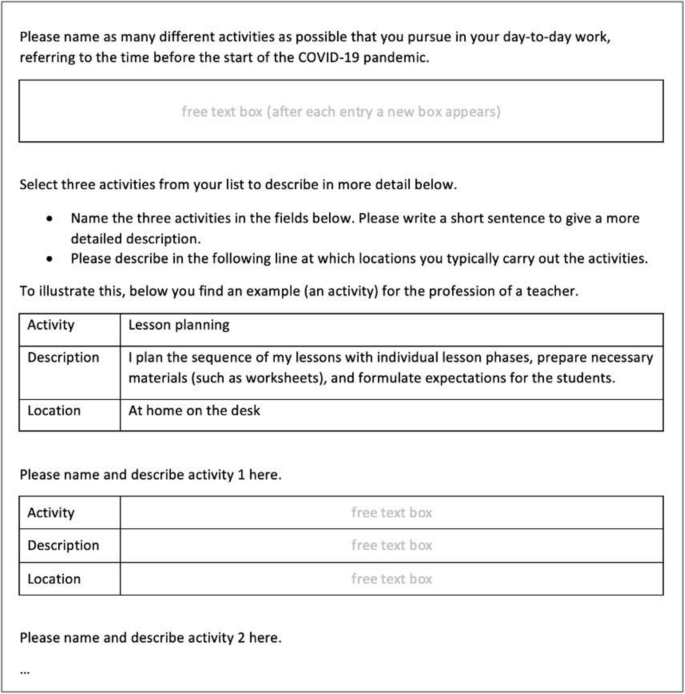
Questionnaire given to the participants
Almost all participants completed the questionnaire (Fig. 1) in full. In a few cases, one or more descriptions of the activities or the locations were missing. In particular, of the 94 participants, all named three activities each (in a total of 282), whereby the description was missing for 10 of these mentions. In addition, the location was missing for three of the activities mentioned. Overall, the participants stated an average of 103 words in their answers (SD = 57; wordsmin = 25; wordsmax = 253).
4.2 Data Analysis and Development of the Category System
The methodological framework chosen for the analysis of the responses of the biologists was the structuring qualitative content analysis according to Mayring (2015), which was carried out using the MAXQDA software (VERBI Software, 2019). In particular, for RQ 1 we deduced a category system from the existing literature, as described below.
For scientific activities, the initial categories were taken from the RIASEC + N model (Wentorf et al., 2015) which included ‘Realistic’, ‘Investigative’, ‘Artistic’, ‘Social’, ‘Enterprising’, ‘Conventional’, and ‘Networking’ activities (Table 1). If a coding unit could not be assigned to any of the existing categories because there was no suitable category, a new category was created. This resulted in the ‘Learning’ category. We also adapted the original categories from the RIASEC + N model (Wentorf et al., 2015) to better align with the specific activities reported by biologists in our study. While some categories were retained in their original form, others were renamed or modified for greater precision and to avoid conceptual overlap:
The categories ‘Investigative’ and ‘Artistic’ were merged into ‘Investigative and Artistic’, as analytical and creative aspects of scientific activities are often inseparable in practice. It was often not possible to categorise the data clearly into either one of both categories, as analytical and creative aspects of scientific activities are often closely linked, for example, when developing new experiments or research approaches: ‘I read scientific papers to gather information on our research topic and think about experiments we can carry out to answer our scientific question’ [B16].
The category ‘Social’ was renamed to ‘Teaching’ to emphasize the teaching-related activities of biologists, such as lecturing, supervising students, and preparing educational materials. This change ensures that teaching activities are distinct from ‘Networking’, which encompasses collaborative and communicative interactions with colleagues.
Finally, the “Enterprising” category was refined by separating “Publishing and Reviewing” into a distinct category. While publishing and reviewing are integral to scientific work, they differ substantially from the managerial and funding-related tasks typically described under “Enterprising”. This is strengthened by the fact that the t-test showed a significant difference between junior scientists and professors regarding the category “Enterprising” but not “Publishing and Reviewing” (see Section 5.2).
To provide a clearer overview of these adaptations, Table 4 illustrates the transition from the original categories (Wentorf et al., 2015) to the adapted categories used in this study, along with brief justifications for each change.
We took the initial location categories from DAST studies and included categories such as laboratory and office (e.g., Reinisch et al., 2017). As DAST studies mainly present stereotypical conceptions about scientists’ work locations, we inductively added most of the categories.
Analysis units were defined for the coding procedure: A unit of analysis corresponds to at least a single word and corresponds at most to the complete answer if the entire text can be assigned to the same category. An example of coding can be seen in Fig. 2.
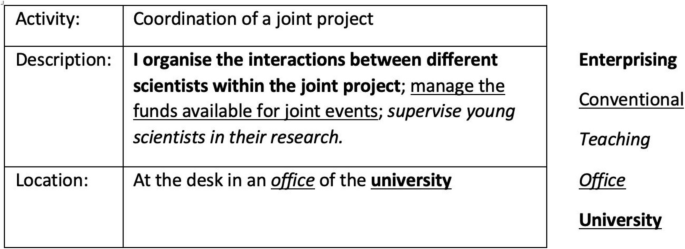
Part of the answer of a professor (evolutionary biologist, [B13]) to illustrate the coding process
Two authors performed four independent rounds of coding, each time coding answers from 10 respondents. Each round of coding was followed by the calculation of Cohen’s Kappa (ĸ) as a measure of intercoder agreement, discussions of disagreements in the coding among at least three authors, and refinement of the categories when necessary (Table 4). After the fourth coding round, ĸ indicated a ‘substantial’ to ‘almost perfect’ interrater agreement for the activities-categories (ĸ = 0.73) and the locations-categories (ĸ = 0.98) (Landis & Koch, 1977).
To address RQ1, we counted the number of biologists who included each activity or location in their responses. This approach helps identify prominent activities or locations and pinpoint those that occur infrequently.
For RQ2, we combined the data for doctoral students and postdocs into a new group termed ‘junior scientists’, similar to the approach taken by Stamer et al. (2020). Given the violation of the homogeneity of variances assumption, Welch’s F-ratios were used to examine differences between junior scientists and professors concerning the activity categories. This was followed by calculations of effect size using Cohen’s d (Field, 2018). For interpreting these effect sizes, we applied Cohen’s (1988) guidelines, which categorize effects as small (≥ 0.2), medium (≥ 0.5), and large (≥ 0.8; see Fritz et al., 2012).
5 Results
5.1 Description of Categories: Biologists’ Activities and Locations of Work (RQ 1)
The biologists’ responses were assigned to eight categories of scientific activities, which were represented by a varying number of biologists (Table 5): ‘Investigative and Artistic’ (n = 77), ‘Teaching’ (n = 70), ‘Publishing and Reviewing’ (n = 46), ‘Realistic’ (n = 39), ‘Enterprising’ (n = 36), ‘Conventional’ (n = 26), ‘Networking’ (n = 19), and ‘Learning’ (n = 1).
In the following, each activity will be described in more detail to show the diversity of activities within each category. It should be noted that the following descriptions of categories do not present clear sub-categories, as it would often not be possible to clearly categorize the statements into such subcategories.
The ‘Investigative and Artistic’ category includes both theoretical and analytical aspects of scientific work, which are often linked to practical activities (see Realistic-category below). Several facets can be described:
- The planning and preparation of experiments is essential. This includes the definition of research questions and hypotheses, the adaptation of experimental set-ups taking into account statistical aspects as well as cost and time planning. One biologist describes: “I plan the exact sequence of experiments, which are then carried out by my technical assistants or by students (final theses)” ([B29], Post doc in genetics). This also includes selecting and adapting the necessary materials and equipment: “I design plasmids on the computer and build these plasmids in the lab using molecular techniques” ([B35], Doctoral student in neurobiology).
- Experiments are carried out in the laboratory and the field. Techniques such as PCR, cloning and immunohistochemistry are used in the laboratory. Fieldwork involves taking samples and carrying out experiments in the field, e.g. to study biodiversity. Behavioural studies on animals are also important: “I carry out behavioural experiments with mice in which the mice go through certain paradigms and analyse the behaviour in the various experiments” ([B35], Doctoral student in neurobiology).
- The experiments are followed by careful preparation and analysis of the data, as claimed by participants. The biologists collect, process and store measurement data, and create graphs and tables for visualization: “I analyze data and create new hypotheses based on them, which are tested experimentally in my team” ([B60], Professor in cell biology). The application of statistical methods is central: “After analysing the experiment, we have to decide which type of statistics is best to use” ([B48], Doctoral student in ecology).
- Another key component emerging from participants’ responses is continuous research and the development of new ideas. This includes regular literature research to be aware of the current state of research: “I read papers and inform myself about the current state of research in my field of research. I plan my experiments with this in mind” ([B18], Doctoral student in microbiology). On this basis, biologists develop new questions: “I work out a new scientific question from our results and those of other researchers” ([B06], Professor in biochemistry and cell biology).
Overall, it can be seen that creative thinking plays a central role in all phases of biologists’ investigative work. From planning and implementation to data analysis and the development of new research projects, innovative approaches and creative problem-solving are essential.
Biologists also reported being involved in a variety of ‘Teaching’ activities that include lectures, practicals, and seminars. These activities can be summarised as follows:
- Biologists stated they prepare lectures, practical courses, and seminars by developing concepts, researching literature, and preparing materials. They give lectures, carry out practical exercises, and moderate discussions. One biologist describes: “I give lectures in which knowledge is classically conveyed in frontal teaching” ([B46], Post doc in ecology). Internships enable students to apply theoretical knowledge in practice: “I plan the entire course of the internship, explain theoretical knowledge, and teach various methods” ([B14], Doctoral student in animal physiology). Seminars offer space for in-depth discussions and methodological advice: “Lectures, seminars with students or adults/practitioners from the agricultural sector” ([B02], Head of institute in Ecology).
- Preparing and conducting examinations is also an important aspect of teaching activities. This includes preparing written examinations, taking written and oral examinations, and assessing students’ performance: “I prepare examinations, analyze them, and record the results” ([B47], Post doc in ecology).
- Supervision of students or doctoral candidates includes guiding and supporting them in planning, carrying out, and analyzing their research work. “I supervise students at different levels of education (Bachelor’s, Master’s, PhD) in the conception, implementation and writing up of their work” ([B24], Professor in cell biology). Students are helped to analyze their data and write scientific reports: “I teach them how to plan and carry out experiments and write scientific reports” ([B05], Professor in molecular biology).
Biologists reported being extensively involved in ‘Publishing and Reviewing’ activities, which can be summarized as follows:
- Biologists dedicate a significant portion of their time to writing and preparing research articles to disseminate their findings. This process includes compiling data, creating figures, and crafting well-structured manuscripts. “I summarize the results of my research and write a paper for a scientific journal” ([B25], Visiting scientist in zoology). They ensure the manuscripts meet journal standards through multiple revisions based on feedback from reviewers and co-authors. “I write a first draft of the manuscript, which I then revise based on discussions with my co-authors” ([B87], Post doc in evolutionary biology).
- Reviewing the work of peers is a critical responsibility, as reported by the participants. Biologists evaluate research proposals, manuscripts, and funding applications, providing constructive feedback to improve the quality of scientific work. “I read and evaluate applications and manuscripts” ([B07], Professor in virology).
- Biologists also present their research findings at conferences, through posters or oral presentations, to engage with the scientific community and receive feedback. “I present my current research results at conferences in the form of posters or talks, which allows for contact and exchange with colleagues worldwide” ([B95], Post doc in behavioural biology).
- In addition to academic publications, biologists claimed they contribute to public knowledge through media articles, public demonstrations, and advisory roles. “The lab is used for demonstrations to the public during tours” ([B08], Professor in zoology), and “I write media contributions and advise on scientific matters” ([B75], Professor in ecology).
Biologists reported engaging in a wide range of manual tasks (‘Realistic’ category) essential for their research and experimental work. These activities can be summarized as follows:
- Biologists meticulously prepare and conduct various experiments. This involves calculating and measuring chemicals for solutions, preparing samples for analysis, and setting up equipment. One biologist stated: “I calculate the needed amounts of chemicals, weigh them, dissolve them in the solvent, and autoclave the solution if necessary” ([B01], Doctoral student in molecular biology). Another mention, “I prepare samples collected in botanical gardens or the field, chemically fix them, and prepare them for electron microscopy” ([B38], Post doc in botany).
- Fieldwork is a crucial part of biological research, involving the collection and analysis of samples from natural environments. “I collect water samples or benthic organisms in flowing waters” ([B11], Senior lecturer in ecology), and “I conduct field experiments to study tick activity” ([B94], Post doc in parasitology). These tasks often require regular trips to specific locations and meticulous documentation of findings.
- In the lab, biologists perform a variety of technical tasks, such as running PCR assays, preparing and maintaining cultures, and analyzing samples under microscopes. “I run PCR assays, visualize results on a UV table, and document them photographically” ([B01], Doctoral student in molecular biology). Another biologist notes, “I conduct immunohistochemical experiments and analyze them under a microscope” ([B49], Professor in zoology).
- Caring for experimental plants and animals is a significant part of the manual work, as claimed by many participants. This includes regular maintenance such as watering, feeding, and monitoring health conditions. One biologist explains, “I take care of my plants in growth chambers and greenhouses, check their condition, and perform cross-breeding and sample collection” ([B30], Doctoral student in molecular biology). Another adds, “I manage and care for experimental animal colonies, ensuring they are fed and housed properly” ([B48], Doctoral student in ecology).
- Accurate documentation is critical for reproducibility and data integrity. Biologists maintain detailed records of their experiments and observations. “All steps I perform in the lab are meticulously recorded in a lab notebook to ensure reproducibility” ([B14], Doctoral student in animal physiology). This documentation includes photographing experimental setups and results, recording measurements, and updating animal or plant care logs.
Biologists reported engaging in a variety of ‘Enterprising’ activities that encompass project management, securing funding, and organizational leadership. These activities can be summarized as follows:
- A significant part of enterprising activities involves writing funding applications. Biologists identify suitable funding sources, follow guidelines, and compile comprehensive proposals. “I write […] funding applications” ([B05], Professor in molecular biology), and, “I think about which funding body is suitable for the project and write a detailed application following their guidelines” ([B06], Professor in biochemistry and cell biology).
- Biologists conduct market observation and plan investments for establishing biotechnological production facilities, considering factors such as trained personnel and long-term projections. One biologist describes this process: “Market observation and resulting investment planning for setting up biotechnological production facilities with trained personnel (approximately 8 years ahead)” ([B03], Senior vice president of a biotech company).
- Managing research projects and coordinating team activities are crucial tasks. This includes organizing interactions between scientists, planning and executing research projects, and overseeing laboratory operations. “I organize the interactions between various scientists within the collaborative project” ([B13], Professor in evolutionary biology), and “I lead a laboratory for electron microscopy, histology, immunohistochemistry, and light microscopy” ([B08], professor in zoology).
- Biologists are involved in administrative and organizational tasks such as project coordination, conducting meetings, and managing budgets. “I organize staff seminars, meetings on manuscripts and project work” ([B26], Professor in botany), and “Over a quarter of my time is spent on organizational tasks” ([B72], Professor in microbiology). These activities ensure the smooth operation of research projects and the effective use of resources.
- Strategic planning and decision-making are essential components, including cost planning, resource allocation, and personnel management. “I lead a department with over 150 employees through discussions, instructions, and supervision” ([B97], Professor in botany). This also involves making strategic decisions to enhance research capabilities and secure long-term project success.
Biologists reported engaging in various ‘Conventional’ activities, which include administrative tasks and academic self-administration:
- Biologists are sometimes involved in personnel management, which includes reviewing applications, selecting candidates, conducting interviews, and organizing the onboarding process. They are also responsible for personnel evaluation and development. “Screening applications, selecting candidates, conducting interviews, and hiring” ([B03], Senior vice president of a biotech company).
- Biologists also manage resources and budgets, including selecting laboratory materials for experiments, placing orders, and handling financial operations such as cost estimation and budgeting: “Selecting laboratory materials for experiments, ordering, and settling accounts with institutional administrative procedures” ([B04], …), and “I estimate the costs and personnel needs” ([B06], Professor in biochemistry and cell biology).
- Biologists reported taking part in academic administration, which involves participating in committees, organizing faculty meetings, and overseeing strategic planning, curriculum development, and financial matters. “Committee work in examination boards” ([B24], Professor in cell biology), and “All essential processes important for a faculty: budgetary matters, strategic planning, planning for study programs, doctoral programs, faculty appointments” ([B26], Professor in botany).
- Biologists also play a role in ensuring regulatory and safety compliance, which includes adhering to legal and safety regulations, preparing for inspections, conducting safety training, and managing compliance with institutional and governmental rules. “Creating documentation according to legal guidelines, preparing for inspections by regulatory authorities, conducting safety training for employees and students” ([B23], Post doc in biochemistry).
- Biologists are responsible for documentation and reporting tasks, such as maintaining collections and ensuring accurate records: “Maintaining the collection, organizing the collection data (entering into the database)” and “Handling the international loan traffic of collection objects for research and exhibitions” ([B08], professor in zoology).
- Many biologists take on organizational leadership responsibilities, which include overseeing laboratories and managing personnel, resources, and academic programs. “I lead a laboratory for electron microscopy, histology, immunohistochemistry, and light microscopy” ([B08], professor in zoology), and “Managing the chair and institute: financial management, hiring and supervising staff” ([B68], Professor in Microbiology).
‘Networking’ is a crucial part of a biologist’s professional life, facilitating collaboration, feedback, and the exchange of ideas. These activities can be summarized as follows:
- Biologists engage in regular discussions with colleagues to share the status of their work, seek feedback, and plan future steps. “I talk to my colleagues about the status of the work, ask for feedback, exchange current literature, share interesting results, and discuss future steps” ([B30], Doctoral student in microbiology). They also communicate with scientists within their research group as well as those from other groups, both locally and internationally. “I communicate with many scientists from my own group and others, discussing the implementation of research projects and the interpretation of research results” ([B31], Professor in evolutionary biology).
- Participation in various meetings is a key networking activity. Biologists attend laboratory meetings to report on their progress and plan upcoming work. “Attend laboratory meetings to report on the status of my work for the previous week and plan for the new week” ([B17], Post doc in parasitology). They also take part in larger group meetings to discuss research and organizational matters. “Meetings in larger and smaller groups to discuss the research and organization of the research group” ([B39], Professor in evolutionary biology).
- Attending conferences and workshops allows biologists to present their research, gain insights into the work of others, and establish new collaborations. “At conferences, you have access to future colleagues and get insights into the work of other researchers, which can lead to new collaborations or friendships” ([B71], Doctoral student in ecology). These events are opportunities for biologists to network with peers globally, exchange ideas, and form professional connections. “I present my current research results at conferences in the form of posters or talks and come into contact and exchange with colleagues worldwide” ([B95], Post doc in behavioral biology).
- Biologists also participate in bi- or multilateral research projects, which require extensive communication and collaboration with colleagues. “Planning and conducting bi- or multilateral research projects” ([B28], Senior scientist in genetics). These collaborations often involve detailed discussions and coordination to ensure the success of joint efforts.
- In light of recent challenges, such as the pandemic, online platforms have become valuable for networking. “Due to the pandemic, it was not possible to meet colleagues in person at conferences, but online it is sometimes easier to make first contacts because everyone is directly accessible in Zoom meetings” ([B71], Doctoral student in ecology).
The biologists named a high diversity of work locations, which were subsumed under three main categories: ‘In the Research Institute’, ‘In the Field’, and ‘Remote Workspaces’ (Table 6). Although we did not perform a systematic sampling strategy in this study, it seems that some of the sub-categories are connected to the research area of the biologists. For example, all four molecular biologists work in a lab with the two doctoral students spending time in the greenhouse. Further, the location “Open field” was only named by biologists working in the fields of Botany, Ecology, Parasitology, and Zoology.
In addition to the locations named in Table 6, there were other work locations only mentioned by only one biologist: animal/experimental rooms, biological station, botanical garden, break room, cellar with growth chamber, canteen, company, couch, deanery, different event locations, field station, graphics room, hallway, insectarium, in the boat/on the ship, museum/exhibition, repository, school, staff room, university hospital.
5.2 Relationship Between the Positions of Biologists and Their Typical Activities (RQ2)
We analysed the relationship between the positions of biologists and their typical activities (Fig. 3). Artistic and Investigative activities emerge as predominant activities across all positions, with 91% of junior scientists, and 68% of professors engaging in it. While junior scientists additionally pursue often realistic activities (67%), professors much more conduct teaching (95%), enterprising (68%), and conventional (54%) activities.
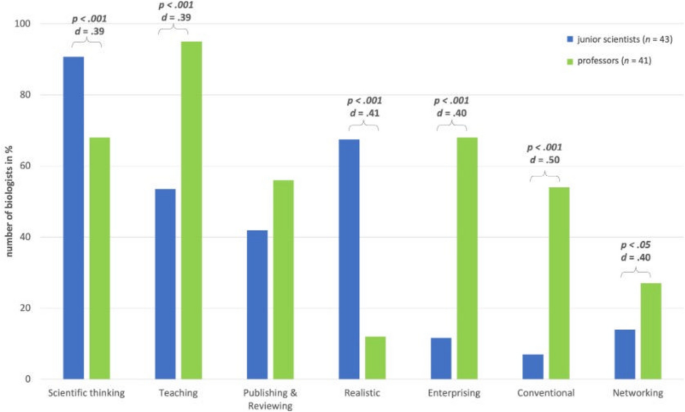
Percentage of Biologists mentioning the activity at least once; t-test for calculating differences between junior scientists and professors; Cohens d for effect size: small (≥ 0.2), medium (≥ 0.5; Cohen, 1988)
Welch’s F-ratio and effect size calculations reveal significant group differences between junior scientists and professors, with effects ranging from small to medium for all categories except ‘Publishing and Reviewing’ (Fig. 3). We also detected significant small effects between doctoral students (n = 20) and postdocs (n = 23) in the categories ‘Teaching’ (p = 0.024, d = 0,479) and ‘Enterprising’ (p = 0.022, d = 0,309).
6 Discussion
In the following, the study’s findings are discussed, including biologists’ self-reported typical activities and work locations, as well as the relationships between their professional positions and tasks.
6.1 What are Typical Activities and Locations of the Work of Biologists? (RQ 1)
The subjective experiences and conceptual frameworks of scientists help contextualize their activities and contribute to a deeper understanding of how science operates as a human endeavor. As Schwartz (2012) as well as Schwartz and Lederman (2008) emphasize, such reflections enrich the narrative of scientific work by integrating personal interpretations shaped by disciplinary contexts. While retrospective data are subject to memory biases (see Section 6.3), they nonetheless provide valuable insights into how scientists perceive and prioritize their work, offering a unique lens to examine the nature of scientific work and the environments in which it occurs.
Contrary to students’ stereotypical conception of scientists carrying out experiments (e.g., Finson, 2002), which can be regarded as a realistic activity, the most frequently described activities by the biologists referred to ‘Investigative and Artistic’ and ‘Teaching’ (Table 4). Beyond showing the most prominent named activities, the described categories present the diversity of scientific activities biologists perform in their daily work, which should be communicated in classes (Schwartz, 2012); Schwartz & Lederman, 2008. It should be noted that we explicitly asked the biologists to describe three activities in more detail whereas in DAST studies students are typically asked to draw only one picture of a scientist (Finson, 2002). It can therefore be assumed that students may also depict multiple activities when explicitly asked for. A comparison of three activities presented by students with the biologists’ activities would be necessary.
This becomes even more important for the locations students present, for example, in drawing assessments. The most frequently drawn location by students is the laboratory (Finson, 2002), which corresponds to the frequent indication by the biologists in our study (Table 6). Hence, it should be seen as critical to evaluate students as having a stereotypical conception when they were only requested to draw one picture.
In general, the biologists referred to a variety of places they work at, which we divided into three categories. The first category, ‘In the Research Institute’, is consistent with ideas that often show up in students’ drawings. Especially the lab is regularly found in DAST studies (Reinisch et al., 2017; Finson, 2002). However, Miller et al. (2018) point out that children are less likely to draw indoor scenes or labs in more recent studies. Thus, the conception of where scientists work seems to be shifting among students. Against the background of our study, such a shift in perspective is appropriate and necessary. The next category, ‘In the Field’ refers to working scenes, which are way less frequently drawn by students. As biology is the science of living beings it seems reasonable that biologists also do their research in corresponding habitats. However, with only 18 biologists mentioning this location the frequency is rather low. Contrary, more than half of the biologists named at least one remote working space. The study took place during the COVID-19 pandemic. As it was not clear at that time what working would be like after the pandemic, we asked the participants to refer to the time previous to the beginning of the pandemic, which was much more likely characterized by home office. We assume that remote working became more of a common practice during the pandemic and that some participants might still have referred to their present working day at the time of assessment. It would be interesting to see how working is shaped nowadays but it is reasonable to assume a higher amount of remote working after the pandemic.
Ultimately, working from home (as one example of a remote workspace) has been associated with health and job satisfaction (Niebuhr et al., 2022) and is increasingly common across scientific professions. Our data show that remote work is one of several relevant work locations in biology, alongside laboratories and field sites, which remain primary settings for empirical research. Highlighting this diversity can help students develop a more authentic and differentiated conception of the profession, which may contribute to its perceived attractiveness. However, it is not the availability of remote work alone that should inspire students to pursue biological sciences, but rather the nature of the work itself. Future research could therefore explore how scientists themselves experience different work environments, including laboratory spaces, not only functionally, but also personally, creatively, or even playfully.
6.2 Is There a Relationship Between Biologists’ Position and Their Activities? (RQ 2)
For the second research question, we assumed that the current position of the biologists surveyed influences their typical activities (Stamer et al., 2020).
One of the most striking findings is the prominence of ‘Investigative and Artistic’ across all positions. More than 90% of the junior scientists and almost 70% of the professors engage in this activity. The decline in this activity among professors, compared to junior scientists, may indicate a shift in focus as biologists progress in their careers. Such progress seems to go along with a wider remit: First, the data reveals a clear trend where teaching responsibilities increase with seniority (95% of the professors). This underscores the pedagogical role that professors play in academic settings.
Another finding is the significant involvement of professors in enterprising activities (68%). This contrasts with doctoral students, none of whom reported such activities. This is in line with the results of Stamer et al. (2020) and thus, suggests that as scientists ascend in their careers, they take on more leadership roles such as project management and grant applications.
Contrary to the study of Stamer et al. (2020), professors in our study also showed a significant inclination towards conventional activities (54%), which was not as prevalent among junior scientists. This is indicative of the administrative and organizational responsibilities that come with a professorial role. The difference to the study of Stamer et al. (2020) might be traced back to a different understanding of conventional activities. While the authors define the category by ‘meticulous and administrative activities’ the example they give, ‘writing down measurement data’, would be assigned to the category ‘Realistic’ in our study (Table 5). Thus, Stamer et al. might adhere more strongly to Holland’s (1963) original definition, describing conventional activities as clearly structured, predominantly verbal or numerical, in a subordinate role, avoiding complex situations and interpersonal interactions, and effective at well pre-structured tasks. Contrary, we refer to the more specific interpretation by Wentorf et al. (2015) for specific tasks of scientists around administration.
As with enterprising and conventional activities, our data also hint at the increasing importance of networking as biologists progress in their careers. While 14% of junior scientists reported networking activities, this number increases for professors (27%). This emphasizes the growing need for collaboration and external engagement as biologists advance in the field.
‘Publishing and Reviewing’ is the only category in which there is no significant difference between junior scientists and professors. Considering that publishing the own research results is usually considered an indicator of the scientists’ work quality—regardless of career stage—and that the publication of studies is sometimes even considered a condition for successful qualification such as a doctorate, this result is not surprising. If we now consider the results of studies with students, the difference between their typical conceptions and the reality of biologists becomes highly relevant. Students should be made aware that, regardless of their professional age, writing and reading research articles is part of the job.
In summary, the differences between the status groups seem intuitive and mostly correspond to the current state of research (Stamer et al., 2020). Professors report significantly more administrative and entrepreneurial activities. While such roles are a formal part of scientific leadership, their prominence has been linked to structural shifts in the organization of science such as competitive funding systems, increasing accountability, and commercialization pressures (Kaya et al., 2018). These developments may contribute to hierarchical work structures and, in some cases, create challenging environments for early-career researchers. A deeper understanding of how such roles are perceived and enacted could help inform institutional practices and science education alike: by making the structural conditions and role expectations within scientific careers more transparent, learners, especially in later school stages or early university phases, can develop more realistic and differentiated expectations of scientific professions. This may help counteract narrow or idealized conceptions and support reflective career orientation (Cakmakci et al., 2011).
It seems worthwhile to ask students about their conceptions of different positions. Even if students often do not yet have access to authentic scientific activities, previous studies show that they nonetheless develop (stereotypical) conceptions of scientists and their work early on (e.g., Finson, 2002). These images may also implicitly include assumptions about status, roles, or responsibilities (e.g., “professors only teach”, “scientists always work alone”). Understanding such differentiated conceptions could help tailor educational materials more effectively and address misconceptions that go beyond surface-level depictions.
6.3 Limitations
Our study aimed to gather insights from a diverse group of biologists, spanning a variety of research disciplines and professional standings. This was crucial to ensure that the findings were representative of the broader biology community. The inclusion of junior scientists (including doctoral students and postdocs) and professors allowed for a multifaceted view of scientific activities and work locations. While our sample was diverse, we acknowledge the possibility of selection biases. The method of recruitment, whether through direct invitation by our mail (mainly professors) or distribution by the head or secretary of the research groups, might have influenced the type of participants who chose to respond.
The total number of participants and the breakdown between junior scientists and professors provided a sizable dataset for analysis. However, we recognize that the absolute number of participants might not capture the entire breadth of experiences in the biology community. Future studies might consider a larger sample size or targeted recruitment strategies (leading to an approximately equal number of participants per research area) to ensure even more diverse representation. For example, we mainly reached out to biologists working in a university or similar research institutes. However, many biologists do not work at such locations but, for example, in a museum, in the medical/pharmaceutical industry, nature conservation association, zoos and other areas. Additionally, while our sample included researchers, aligning with our initial objective, it is important to recognize the potential value of including technicians and other related groups in future studies. Taking these occupational groups into account would not only provide a more comprehensive understanding but would also bring another occupational group into focus, which, at least in the country in which the study was conducted, can be accessed without a university degree but with training. Particularly concerning students’ motivation to choose a career, it would be worthwhile to show the wide range of approaches to the profession.
In addition to the retrospective nature of the responses (see Section 2.2), further limitations arise from the design of the questionnaire and the analytical framework applied. Although participants were asked to name three typical activities and three typical work locations freely, the structure of the prompt may have influenced their responses. Specifically, the requirement to describe three examples might have encouraged participants to prioritize particularly visible, formalized, or socially accepted aspects of their work, while more informal or context-dependent practices may have been underreported.
Moreover, while the categorization of responses was developed in an iterative process, starting from the RIASEC + N model and refined based on the data, the act of classification itself entails abstraction and interpretative framing. In this sense, the categories should be understood as heuristic tools rather than exhaustive representations. Future research may benefit from combining such survey-based approaches with qualitative methods that allow for a more nuanced exploration of scientists’ experiences and conceptions.
By counting the mentions of each activity or location, we aimed to identify and highlight the most prevalent trends within our sample. When interpreting the results, it should be kept in mind that all participants were only asked to describe three activities. This means that activities that respondents do less frequently are likely to be relevant in their everyday working lives but less prominent. Figure 3 must therefore be interpreted under these conditions.
One potential limitation we faced was conducting the study during the pandemic. While we chose to reference the pre-pandemic period, the ongoing situation might have influenced participants’ responses, especially regarding work locations (e.g., ‘Remote Workspaces’; Table 4). Also, memory recall may introduce biases, as participants might emphasize significant or recurring activities over less frequent tasks. It is still open whether the pandemic might have a long-lasting impact on the way and locations scientists work. Future research could benefit from real-time data collection (e.g., work diaries) to validate and extend these findings, and the potential influence of such contextual factors should be considered when interpreting results.
7 Conclusions and Future Prospects
In exploring biologists’ self-reported conceptions of their professional activities and work environments, we have uncovered subject-specific insights that not only offer a genuine perspective on the profession but also have implications for science education research and the teaching of biology. Especially the assessment of conceptions, as well as the promotion of adequate conceptions, benefit from the subject-related and current image of biology as a science. The diverse settings, which biologists report on, from traditional laboratories to remote workplaces and fieldwork sites, challenge traditional classroom conceptions of where biology happens. In addition, the myriad of tasks that biologists describe in our study, from experimentation to administration and networking, underline the richness of the profession. The varied work environments and roles of biologists should be woven into classroom teachings, helping to dispel stereotypes and provide students with a more comprehensive conception of the profession. The curriculum can be enriched by incorporating these diverse roles, offering students a broader understanding of potential career paths in biology. Furthermore, Henri et al. (2023) argue that the way scientists are represented in educational contexts plays a key role in shaping students’ conceptions of scientific careers. By presenting diverse scientists in positions of leadership, students might better understand the breadth of responsibilities, such as enterprising and networking activities, that scientists take on as they progress in their careers. This not only challenges the stereotypical image of a scientist but also provides a more nuanced and adequate understanding of the profession, especially regarding career development. Building on this, future educational approaches might explore how authentic insights into scientists’ work (e.g., through outreach activities, interviews, or digital storytelling) can help students connect more realistically with scientific careers. While such interventions go beyond the scope of our current study, they offer promising directions for bridging students’ conceptions with the lived realities of scientific work.
The insights from this study can guide future research in science education, particularly in exploring how these self-conceptions align with educational outcomes and students’ career aspirations. Educators can also design teaching methods that mirror biological practices, fostering a deeper connection between students and the subject matter (Hodson & Wong, 2014; Schwartz, 2008, 2012).
In conclusion, understanding how biologists see their work is central to a genuine appreciation of the profession and the design of effective and relevant science education. As we move forward, educational strategies and research in science education must reflect these insights to ensure a more holistic approach to teaching and understanding biology.
Data Availability
The data can be obtained on request from the corresponding author.
References
-
Bozzato, P., Fabris, M. A., & Longobardi, C. (2021). Gender, stereotypes and grade level in the draw-a-scientist test in Italian schoolchildren. International Journal of Science Education, 43, 2640–2662. https://doi.org/10.1080/09500693.2021.1982062
-
Cakmakci, G., Tosun, O., Turgut, S., Orenler, S., Sengul, K., & Top, G. (2011). Promoting an inclusive image of scientists among students: Towards research evidence-based practice. International Journal of Science and Mathematics Education, 9, 627–655. https://doi.org/10.1007/s10763-010-9217-4
-
Cohen, J. (1988). Statistical power analysis for the behavioral sciences. Erlbaum.
-
Dickson, M., & McMinn, M. (2022). Children’s perceptions of scientists and their work: The ‘Draw a Scientist’test in the United Arab Emirates. Public Understanding of Science, 31, 1079–1094. https://doi.org/10.1177/09636625221096795
-
Emvalotis, A., & Koutsianou, A. (2018). Greek primary school students’ images of scientists and their work: Has anything changed? Research in Science & Technological Education, 36, 69–85. https://doi.org/10.1080/02635143.2017.1366899
-
Farland, D. (2006). The effect of historical, nonfiction trade books on elementary students’ perceptions of scientists. Journal of Elementary Science Education, 18, 31–47. https://doi.org/10.1007/BF03174686
-
Field, A. (2018). Discovering statistics using IBM SPSS statistics. Sage.
-
Finson, K. D. (2002). Drawing a scientist. School Science and Mathematics, 102, 335–345. https://doi.org/10.1111/J.1949-8594.2002.TB18217.X
-
Fritz, C. O., Morris, P. E., & Richler, J. J. (2012). Effect size estimates: current use, calculations, and interpretation. Journal of experimental psychology: General, 141(1), 2.
-
Henri, D. C., Coates, K., & Hubbard, K. (2023). I am a scientist: Overcoming biased assumptions around diversity in science through explicit representation of scientists in lectures. Plos one, 18(7), https://doi.org/10.1371/journal.pone.0271010
-
Hodson, D., & Wong, S. L. (2014). From the horse’s mouth. International Journal of Science Education, 36, 2639–2665. https://doi.org/10.1080/09500693.2014.927936
-
Holland, J. L. (1963). Explorations of a theory of vocational choice and achievement: II. A Four-Year Prediction Study. Psychological Reports, 12, 547–594. https://doi.org/10.2466/pr0.1963.12.2.547
-
Holland. (1997). Making vocational choices: A theory of vocational personalities and work environments. Psychological Assessment Resources.
-
Höttecke, D., & Allchin, D. (2020). Reconceptualizing nature-of-science education in the age of social media. Science Education, 104(4), 641–666.
-
Jarreau, P. B., Cancellare, I. A., Carmichael, B. J., Porter, L., Toker, D., & Yammine, S. Z. (2019). Using selfies to challenge public stereotypes of scientists. PloS one, 14(5), https://doi.org/10.1371/journal.pone.0216625
-
Kaya, E., Erduran, S., Aksoz, B., & Ates, S. (2018). Looking at the social aspects of nature of science in science education through a new lens: The SAMI framework. Science & Education, 27(5–6), 445–469. https://doi.org/10.1007/s11191-018-9982-1
-
Keller, E. F. (1984). A feeling for the organism, 10th (anniversary). Macmillan.
-
Landis, J. R., & Koch, G. K. (1977). The measurement of observer agreement for categorical data. Biometrics, 33, 159–174. https://doi.org/10.2307/2529310
-
Lederman, N. G., & Lederman, J. S. (2014). Research on Teaching and Learning of Nature of Science. In N. G. Lederman & S. K. Abell (Eds.), Handbook of Research on Science Education (Vol. II, pp. 600–620). Routledge.
-
Leiner, D. J. (2019). SoSci Survey (Version 3.1.06) [Computer software]. Available at https://www.soscisurvey.de
-
Lima, N. W., & Nascimento, M. M. (2022). Not only why but also how to trust science: Reshaping science education based on science studies for a better post-pandemic world. Science & Education, 1–20.
-
Mayr, E. (2005). Konzepte der Biologie [Concepts of Biology]. Hirzel.
-
Mayring, P. (2015). Qualitative Inhaltsanalyse. Grundlagen und Techniken [Qualitative Content Analysis. Basics and Techniques]. Beltz.
-
McComas, W. F., & Olson, J. K. (2002). The nature of science in international science education standards documents. In W. F. McComas (Ed.), The nature of science in science education: Rationales and strategies (pp. 41–52). Kluwer Academic.
-
Meyer, C., Guenther, L., & Joubert, M. (2019). The draw-a-scientist test in an African context: Comparing students’ (stereotypical) images of scientists across university faculties. Research in Science & Technological Education, 37, 1–14. https://doi.org/10.1080/02635143.2018.1447455
-
Miller, D. I., Nolla, K. M., Eagly, A. H., & Uttal, D. H. (2018). The development of children’s gender-science stereotypes: A meta-analysis of 5 decades of US Draw-a-Scientist studies. Child Development, 89, 1943–1955. https://doi.org/10.1111/cdev.13039
-
Niebuhr, F., Borle, P., Börner-Zobel, F., & Voelter-Mahlknecht, S. (2022). Healthy and happy working from home? Effects of working from home on employee health and job satisfaction. International Journal of Environmental Research and Public Health, 19, 1122. https://doi.org/10.3390/ijerph19031122
-
Perkel, J. F. (2021). Ten computer codes that transformed science. Nature, 589, 344–348. https://doi.org/10.1038/d41586-021-00075-2
-
Reinisch, B., & Krell, M. (2023). Assessing pre-service teachers’ views of scientists, their activities, and locations: The VoSAL Instrument. Research in Science Education, 53(1), 139–153.
-
Reinisch, B., Krell, M., Hergert, S., Gogolin, S., & Krüger, D. (2017). Methodical challenges concerning the Draw-A-Scientist Test: a critical view about the assessment and evaluation of learners’ conceptions of scientists. International Journal of Science Education, 39(14), 1952–1975.
-
Roberts, D. A. (2007). Scientific literacy/science literacy. In N. G. Lederman & S. K. Abell (Eds.), Handbook of Research on Science Education (pp. 729–778). Erlbaum.
-
Schwartz, R. (2012). The nature of scientists’ nature of science views. In M. Khine (Ed.), Advances in Nature of Science Research (pp. 153–188). Springer.
-
Schwartz, R., & Lederman, N. (2008). What scientists say: Scientists’ views of nature of science and relation to science context. International Journal of Science Education, 30(6), 727–771. https://doi.org/10.1080/09500690701225801
-
Sinclair, B. B., Long, C. S., Szabo, S., & Naizer, G. (2023). Investigating Equitable Representation in K-8 Science Textbook Portrayal of Scientists. Science & Education, 1–14.
-
Stamer, I., Pönicke, H., Tirre, F., Laherto, A., Höffler, T., Schwarzer, S., & Parchmann, I. (2020). Development & validation of scientific video vignettes to promote perception of authentic science in student laboratories. Research in Science & Technological Education, 38, 168–184. https://doi.org/10.1080/02635143.2019.1600491
-
Subramaniam, K., Esprívalo Harrell, P., & Wojnowski, D. (2013). Analyzing prospective teachers’ images of scientists using positive, negative and stereotypical images of scientists. Research in Science & Technological Education, 31(1), 66–89. https://doi.org/10.1080/02635143.2012.742883
-
Toma, R. B., Orozco-Gómez, M. L., Molano Niño, A. C., Obando-Correal, N. L., & Suárez Román, R. S. (2022). Testing assumptions of the Draw-a-Scientist-Test (DAST): Do stereotyped views affect career aspirations? International Journal of Science Education, 44, 2423–2441. https://doi.org/10.1080/09500693.2022.2126738
-
VERBI Software. (2019). MAXQDA 2018 [computer software]. VERBI Software. Received from maxqda.com.
-
Weinstein, N. D. (1982). Unrealistic optimism about susceptibility to health problems. Journal of Behavioral Medicine, 5, 441–460. https://doi.org/10.1007/bf00845372
-
Weisberg, D. S., Landrum, A. R., Hamilton, J., & Weisberg, M. (2021). Knowledge about the nature of science increases public acceptance of science regardless of identity factors. Public Understanding of Science, 30(2), 120–138. https://doi.org/10.1177/0963662520977700
-
Wentorf, W., Höffler, T. N., & Parchmann, I. (2015). Schülerkonzepte über das Tätigkeitsspektrum von Naturwissenschaftlerinnen und Naturwissenschaftlern [Students’ concepts about scientists’ activities: Views, correspondent interests and self-efficacy]. Zeitschrift Für Didaktik der Naturwissenschaften, 21, 207–222. https://doi.org/10.1007/s40573-015-0035-7
-
Wong, S. L., & Hodson, D. (2009). From the horse’s mouth: What scientists say about scientific investigation and scientific knowledge. Science Education, 93(1), 109–130. https://doi.org/10.1002/sce.20290
-
Young, D. J., Fraser, B. J., & Woolnough, B. E. (1997). Factors Affecting Student Career Choice in Science: An Australian Study of Rural and Urban Schools. REsearch in Science Education, 27, 195–214. https://doi.org/10.1007/BF02461316
Acknowledgements
We thank Jasmin Opitz, who contributed to the data analysis.
Funding
Open Access funding enabled and organized by Projekt DEAL. No funding was received to conduct this study.
Ethics declarations
Research Involving Human Participants
The study was reviewed and approved post hoc by the ethics committee of the IPN—Leibniz Institute for Science and Mathematics Education (Kiel, Germany) (reference number: 2024_52_KR), as the university where the authors were employed at the time of data collection, did not have a corresponding ethics committee. The survey was conducted anonymously and participation was voluntary. All participants were informed about the study’s purpose in advance and could stop answering the questionnaire at any time during the process. However, once submitted, the responses could not be withdrawn, as the data collection was anonymous, and the researchers could not link individual responses to specific participants.
Competing interests
The authors report there are no competing interests to declare.
Financial Disclosure
The authors have no relevant financial or non-financial interests to disclose.
Additional information
Rights and permissions
Open Access This article is licensed under a Creative Commons Attribution 4.0 International License, which permits use, sharing, adaptation, distribution and reproduction in any medium or format, as long as you give appropriate credit to the original author(s) and the source, provide a link to the Creative Commons licence, and indicate if changes were made. The images or other third party material in this article are included in the article’s Creative Commons licence, unless indicated otherwise in a credit line to the material. If material is not included in the article’s Creative Commons licence and your intended use is not permitted by statutory regulation or exceeds the permitted use, you will need to obtain permission directly from the copyright holder. To view a copy of this licence, visit http://creativecommons.org/licenses/by/4.0/.
Reprints and permissions
About this article
Cite this article
Reinisch, B., Bielik, T., Krell, M. et al. What Biologists Do: Gaining Insights into Biologists’ Work Locations and Scientific Activities. Sci & Educ (2025). https://doi.org/10.1007/s11191-025-00662-z
- Received
- Revised
- Accepted
- Published
- DOI https://doi.org/10.1007/s11191-025-00662-z
Keywords
- Biologists
- Conceptions
- Nature of science
- Questionnaire
- Scientific work
