
Journal Stats
- Research Direction: Earth Science and Astronomy
- Sci Category: SCIE
- Total downloads: 6900 times
 info@apippress.com
 +86 18163351462 (WhatsApp)
 +86 182 8014 0209
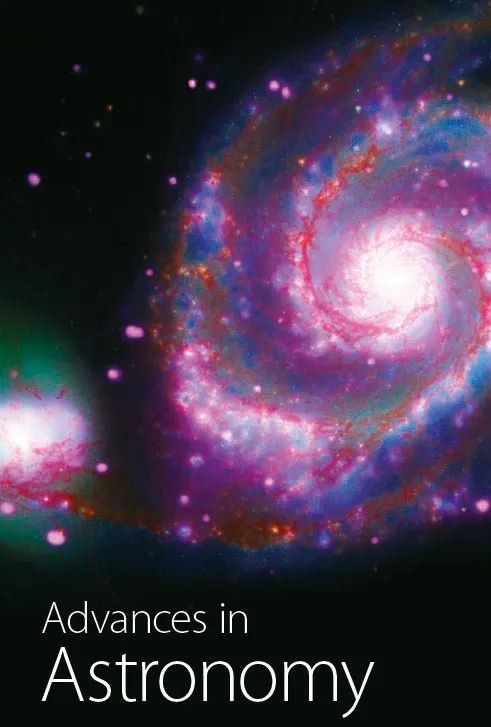
Advances in Astronomy
Journal ISSN: 1687-7969
Impact Factor: 2.542


Articles
Astronomy and Climate-Earth System: Can Magma Motion under Sun-Moon Gravitation Contribute to Paleoclimatic Variations and Earth’s Heat?
Zhiren Joseph Wang, Xiaopei Lin
First published: 19 May 2024 https://doi.org/10.1155/2015/536829
Dynamics of Cylindrical Collapse in Palatini Gravity
Sana Saleem, Rubab Manzoor, S. A. Mardan, Sundas Shahzadi
First published: 25 September 2024 https://doi.org/10.1155/2024/8855609
Academic Editor: Muhammad Farasat Shamir
Study of Anisotropic Compact Star Model in Modified Gravity Using Finch–Skea Geometry
M. R. Shahzad, M. Amjad, Y. M. Abo Essa, K. El-Rashidy, Faisal Rasheed, Khalil Hadi Hakami, Homan Emadifar
First published: 29 November 2024 https://doi.org/10.1155/2024/6749260Citations: 1
Academic Editor: Adnan Malik
Systematic Dynamical Analysis in Palatini f(R) Gravity
Fizza Saeed, Sehrish Iftikhar, Rubab Manzoor
First published: 30 December 2024 https://doi.org/10.1155/aa/4837522
Academic Editor: Zeeshan Yousaf
Weather Radar Detection and Analysis of Bolides in the Day or Night
Marc Fries, Jeffrey Fries
First published: 13 February 2025 https://doi.org/10.1155/aa/3041760
Academic Editor: Elizabeth A. Silber
Ionospheric TEC Forecast Using Bi-LSTM With the Adam Optimizer During X-Class Solar Flares Occurred in the Year 2024 and Validation With IRI-2020
Sarat C. Dass, T. Muthu, R. Mukesh, B. Raghavi, S. Muthamil, S. Nivetha, S. Kiruthiga
First published: 18 February 2025 https://doi.org/10.1155/aa/7000070
Academic Editor: Yu Liu
Forecasting the Timing of Peak Solar Flare Index in Solar Cycle 25 for Improved Space Weather Prediction
Mu He, Hongbing Zhu
First published: 28 February 2025 https://doi.org/10.1155/aa/7366830
Academic Editor: Yihua Yan
A Satellite Drift Scan Approach for Establishing the Pointing Model of Radio Telescopes
Ye Yuan, Zhi-Yong Liu, Na Wang, Hao Yan
First published: 01 July 2025 https://doi.org/10.1155/aa/8503450
Academic Editor: Arpan Hazra
Preimpact Detection of Chelyabinsk-Type Objects in the Thermal Infrared: Possibilities and Limitations
Thomas Müller, Luca Conversi, Javier Licandro, Marco Delbo, Alan Fitzsimmons, Karri Muinonen, Marcel Popescu, Paolo Tanga, Richard Moissl
First published: 09 July 2025 https://doi.org/10.1155/aa/3207732
Academic Editor: Michael Kueppers
Introduction
Advances in Astronomy publishes articles in all areas of astronomy, astrophysics, and cosmology. The journal accepts both observational and theoretical investigations into celestial objects and the wider universe, as well as the reports of new methods and instrumentation for their study. Submission of original research, and focused review articles, is welcomed from researchers from across the entire astronomy community.
Editorial Board
Editor-in-Chief
-
John Doe — University of Cambridge, UK
Associate Editors
-
Maria Smith — Harvard University, USA
-
Takashi Yamamoto — University of Tokyo, Japan
-
Elena Petrova — Moscow State University, Russia
Editorial Board Members
-
David Johnson — California Institute of Technology, USA
-
Anna Müller — Max Planck Institute for Astronomy, Germany
-
Carlos Ramirez — National Autonomous University of Mexico, Mexico
-
Sophie Dubois — Paris Observatory, France
-
Wei Zhang — Peking University, China
-
Fatima Al-Hassan — King Abdulaziz University, Saudi Arabia
Aims & Scope
- Observational Research: Includes the analysis of observational data on celestial objects such as stars, galaxies, black holes, quasars, and supernovae.
- Theoretical Research: Covers theoretical explorations in areas such as cosmological models, theories of gravity, and the formation of cosmic structures.
- Computational Simulations: Involves numerical simulations related to cosmic evolution, galaxy formation and evolution, and the large-scale structure of the universe.
- Instruments and Methods: Introduces new instruments, technologies, and data processing methods for astronomical observations.


Copyright © All rights reserved Designed and Developed by Digital Flavers
