
Journal Stats
- Research Direction: Sociology
- Sci Category: SSCI
 info@apippress.com
 +86 18163351462 (WhatsApp)
 +86 182 8014 0209
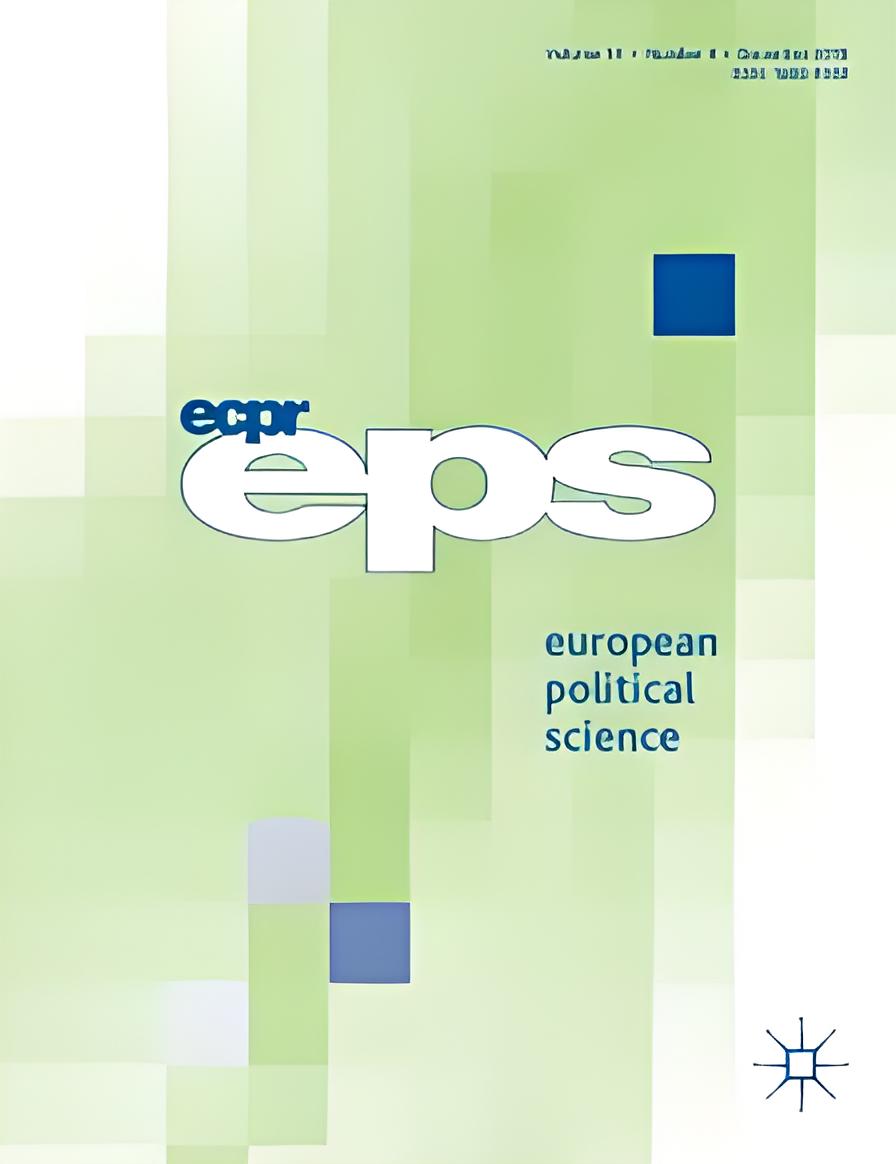
European Political Science
Journal ISSN: 1680-4333 ,1682-0983
JCR: Q2
Impact Factor: 1.4


Articles
The landscape of political science journals in Romania
Luciana Alexandra Ghica & Claudiu D. Tufis
Published: 26 June 2025
DOI:https://doi.org/10.1057/s41304-025-00547-3
Keywords:Political science as a discipline,Disciplinary history,Academic journals,Romania,Central and Eastern Europe
Building and legitimizing an illiberal transnational field: illiberal think tanks’ struggle for cultural hegemony in Poland and Hungary
Ramona Coman, Emilien Paulis, Leonardo Puleo & Noemi Trino
Published: 26 June 2025
DOI:https://doi.org/10.1057/s41304-025-00544-6
Keywords:Think tanks,Intellectuals,Dissensus,Illiberal,Poland,Hungary,Cultural hegemony,Twitter data
Dissensus in Europe: climate protesters before court
Christina Eckes
Published: 26 June 2025
DOI:https://doi.org/10.1057/s41304-025-00540-w
Keywords:Dissensus,Climate litigation,Civil disobedience,Climate protests,Role of judges,Separation of powers
Legitimacy and political dissensus in the implementation of the Recovery and Resilience Facility: the case of Italy
Andrea Capati & Thomas Christiansen
Published: 26 June 2025
DOI:https://doi.org/10.1057/s41304-025-00538-4
Keywords:Dissensus,Europeanisation,Legitimacy,Politicisation,Recovery and Resilience Facility (RRF)
Farewell to the liberal consensus: the intellectualisation of political projects in Poland and Hungary
Zsolt Enyedi & Benjamin Stanley
Published: 26 June 2025
DOI:https://doi.org/10.1057/s41304-025-00542-8
Keywords:Illiberalism,Postliberalism,Paleoconservatism,Poland,Hungary,Viktor Orbán,Jarosław Kaczyński,Intellectuals
Peoplehood, dissensus, and partisanship. The European Union as a case study
Martin Deleixhe
Published: 26 June 2025
DOI:https://doi.org/10.1057/s41304-025-00543-7
Keywords:Dissensus,Peoplehood,Transnational partisanship,Political integration,Rancière,Demos
Building an international relations journal from scratch and from the margins: the case of Journal of Regional Security
Marko Kovačević, Filip Ejdus, Nemanja Džuverović & Rok Zupančič
Published: 26 June 2025
DOI:https://doi.org/10.1057/s41304-025-00532-w
Keywords:Journal of Regional Security,Serbia,The Balkans,Journal,Knowledge production
Dissensus over liberal democracy in Europe: how does it shape policies and polity?
Nathalie Brack & Ramona Coman
Published: 26 June 2025
DOI:https://doi.org/10.1057/s41304-025-00546-4
Keywords:Liberal democracy,Populism,European Union,Crisis,Polarization
Ever distant union: the EU (In)action during COVID-19 as a source of disruptive dissensus
Sergiu Gherghina, Bettina Mitru & Sergiu Mişcoiu
Published: 26 June 2025
DOI:https://doi.org/10.1057/s41304-025-00545-5
Keywords:Disruptive dissensus,Pandemic,Dissatisfaction,Trust,EU
Introduction
This international journal publishes contributions written by and for the political science community, encompassing comparative politics, political economy, international relations, public administration, political theory, European studies and related disciplines.First published in 2001, European Political Science (EPS) presents articles that explore research matters. This includes debates within the discipline, research projects, information sources and funding opportunities; professional matters such as career structures and prospects, external evaluation, higher education reforms and accreditation issues; doctoral training and teaching topics; and relations between academics and politicians, policy-makers, journalists and ordinary citizens.Reaching beyond its core focus on European affairs and the development of the discipline, the journal also publishes work that compares politics in Europe with other continents and countries, as well as research focused on other regions that would be of interest to its readership of political scientists in Europe and around the world.As the professional journal of the European Consortium for Political Research, European Political Science is a prime outlet for original research on substantial topics covering comparative politics and the political profession. This includes research pieces about the political science profession itself, including teaching and learning contributions, as well as book reviews. EPS also publishes Special issue and academic debate collections.
Editorial Board
Editors
Linda Basile, University of Siena, Italy
Stella Ladi, Queen Mary University, UK and Panteion University, Greece
Reviews Editor
Luis Ramiro, UNED – Faculty of Political Science and Sociology, Spain
Editorial Coordinator
Rebecca Delve, eps@ecpr.eu
ECPR Copy-Editor
Ildi Clarke
Editorial Board Members
Alasdair Blair, De Montfort University, UK
Fiona Buckley, University College Cork, Ireland
Kerstin Hamann, University of Central Florida, USA
Mona Lena Krook, Rutgers University, USA
Heidrun Maurer, Danube University Krems, Austria
Alison McCartney, Towson University, USA
Ekaterina R. Rashkova, Utrecht University School of Governance, The Netherlands
Susan Scarrow, University of Houston, USA
Daniel Stockemer, University of Ottawa, Canada
Alessandro Nai, University of Amsterdam, The Netherlands
Andrej Zaslove, Radboud University, The Netherlands
Carmen Ortega Villodres, Universidad de Granada, Spain
Vasiliki Georgiadou, Panteion University, Greece and EKKE, Greece
Akosua K. Darkwah, University of Ghana, Ghana
Anthony Costello, Liverpool Hope University, UK
Stephen Quinlan, GESIS-Leibniz Institute for the Social Sciences, Germany
Aims & Scope
European Political Science (EPS) is an international journal dedicated to publishing contributions by and for the political science community. Its interpretation of ‘political science’ is broad, encompassing comparative politics, political economy, international relations, public administration, political theory, European studies, and related disciplines. While traditionally focused on European affairs and the development of the discipline, EPS also welcomes work that compares politics in Europe with other continents and countries, as well as research on other regions that would be of interest to European political scientists.




Copyright © All rights reserved Designed and Developed by Digital Flavers
