
Journal Stats
- Research Direction: literature
- Sci Category: AHCI
 info@apippress.com
 +86 18163351462 (WhatsApp)
 +86 182 8014 0209
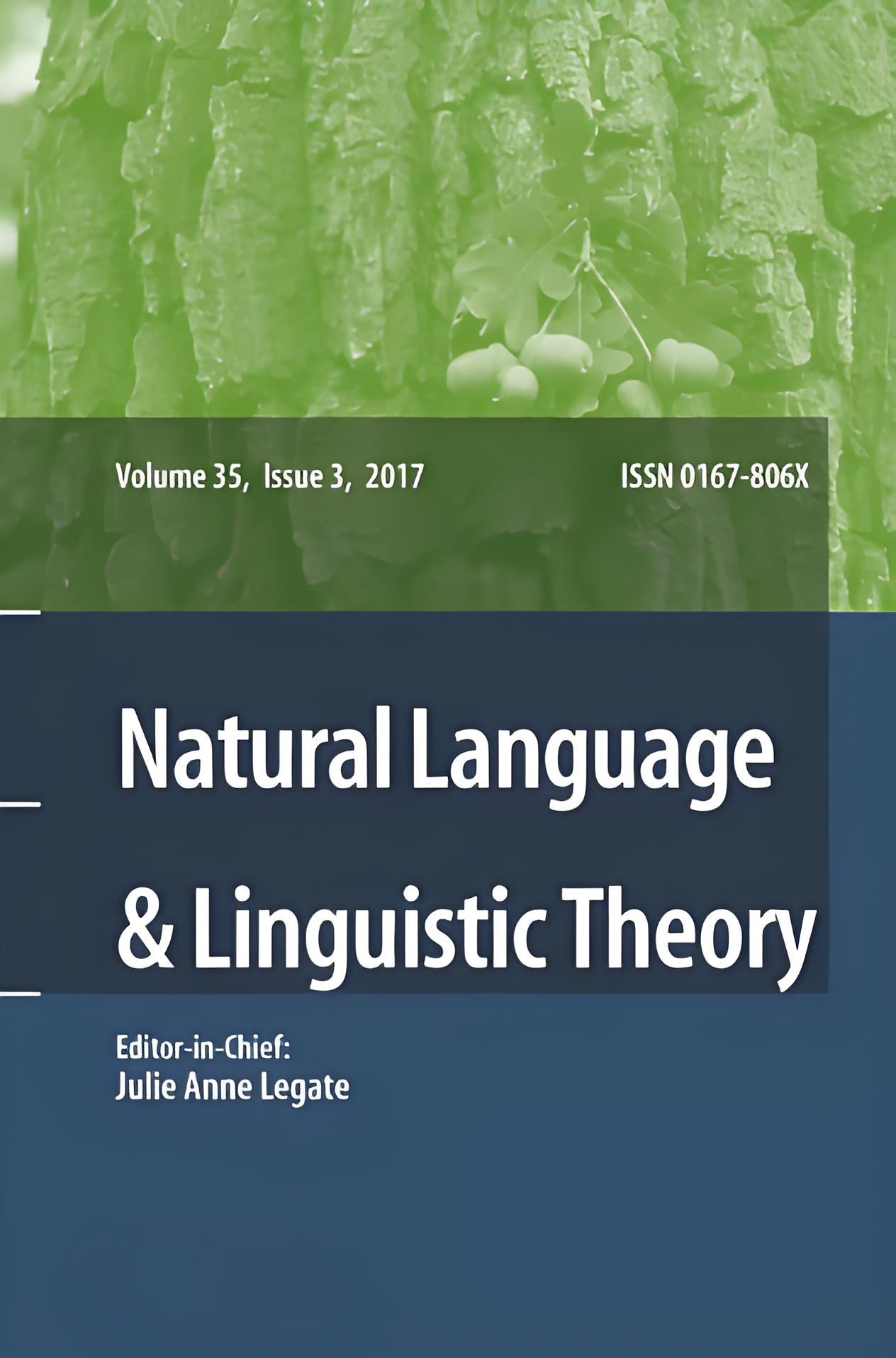
Natural Language & Linguistic Theory
Journal ISSN: 1573-0859 ,0167-806X
JCR: Q3
Impact Factor: 1.6


Articles
On the strong–weak status of the Akan definiteness marker
Augustina P. Owusu
Published: 22 April 2025
DOI:https://doi.org/10.1007/s11049-025-09665-5
Keywords:Akan,(in)definite determiners,Weak/strong determiners,Bare definites,Semantic uniqueness,Antiuniqueness,Demonstratives
On corrective questions and the position of focus
Vieri Samek-Lodovici
Published: 21 May 2025
DOI:https://doi.org/10.1007/s11049-025-09656-6
Keywords:Corrective focus,Left periphery,Focalization in-situ,Corrective questions,Canonical questions,Contrast,Focus fronting
Dominant domains in vowel harmony: A structural approach to a linear asymmetry
Paula Fenger, Maria Kouneli & Jonathan David Bobaljik
Published: 29 May 2025
DOI:https://doi.org/10.1007/s11049-025-09668-2
Keywords:Dominant-recessive vowel harmony,Phases,Domains,Syntax-phonology interface,Cyclic spell-out
Double downstep in Northern Toussian: Implications on tonal representation
Anthony Struthers-Young
Published: 03 June 2025
DOI:https://doi.org/10.1007/s11049-025-09666-4
Keywords:Double downstep,Downstep,Tone,Register Tier Theory,Northern Toussian
Passivization and composite A/Ā-movement in the Mandarin bei-construction
Fulang Chen
Published: 11 June 2025
DOI:https://doi.org/10.1007/s11049-025-09669-1
Keywords:Bei-construction,Composite A/Ā-movement,Passive,Mandarin,Syntax,Use our pre-submission checklist,Avoid common mistakes on your manuscript.
Matching domains: The syntax, morphology, and phonology of the verb in Sinhala
Paula FengerPhilipp Weisser
Published: 17 June 2025
DOI:https://doi.org/10.1007/s11049-025-09667-3
Keywords:Locality domains,Verbs,Syntax-morphophonology interface,Umlaut,Negation,Sinhala
Mandarin null objects: Topic-binding over argument ellipsis
Alan Hezao Ke
Published: 23 June 2025
DOI:https://doi.org/10.1007/s11049-025-09670-8
Keywords:Null object,Topic,Variable,Quantity reading,Sloppy reading,Argument ellipsis,Empty category
Variation in the lexical semantics of property concept roots: Evidence from Wá⋅šiw
Emily A. HaninkAndrew Koontz-Garboden
Published: 08 July 2025
DOI:https://doi.org/10.1007/s11049-025-09671-7
Keywords:Lexical semantics,Roots,Property concepts,Categorization,Possessive predication
A unified semantics for distributive and non-distributive universal quantifiers across languages
Nina Haslinger, Alain Noindonmon Hien, Emil Eva Rosina, Viola Schmitt & Valerie Wurm
Published: 09 July 2025
DOI:https://doi.org/10.1007/s11049-025-09673-5
Keywords:Universal quantification,Distributivity,Non-distributivity,Number,Morphosemantics
Demonstratives locate referents in common space and ground: A comparative syntactic approach
Valentina ColasantiMartina Wiltschko
Published: 15 July 2025
DOI:https://doi.org/10.1007/s11049-025-09675-3
Keywords:Common ground,Language variation,Demonstratives,Nominal Interactional Structure
Introduction
Natural Language & Linguistic Theory is a forum for world-leading theoretical research into detail-rich grammatical data. The journal seeks to bridge the gap between theory and description through work that translates complex theory into concrete evidence and makes complex data accessible and relevant to theoretical debate. It is heterodox, facilitating communication between researchers working in different incarnations of the generative program.The journal welcomes studies in morphology, phonology, semantics, syntax, and other aspects of natural language grammar, as well as interdisciplinary contributions written with theoretical linguists in mind. Submissions may be full-length articles or shorter papers (squibs) that make a focused empirical and theoretical contribution.
Editorial Board
- Edith Aldridge, Ph.D., Academia Sinica, Taipei, Taiwan
- Artemis Alexiadou, Ph.D., Humboldt University-Berlin, Germany and Leibniz-Zentrum Allgemeine Sprachwissenschaft (ZAS), Berlin, Germany
- Mark Baker, Ph.D., Rutgers University, Newark, USA
- Outi Bat-El, Ph.D., Tel-Aviv University, Israel
- Ellen Broselow, Ph.D., Stony Brook University, New York, USA
- Benjamin Bruening, Ph.D., University of Delaware, Newark, USA
- Carlo Cecchetto, Ph.D., University of Milan-Bicocca, Italy
- Marcel den Dikken, Ph.D., Research Institute for Linguistics, Hungarian Academy of Sciences and Department of English Linguistics, Eötvös Loránd University, Budapest, Hungary
- Michael Yoshitaka Erlewine, Ph.D., National University of Singapore, Singapore
- Berit Gehrke, Ph.D., CNRS-LLF, Paris, France
- Maria Gouskova, Ph.D., New York University, USA
- Scott Grimm, Ph.D., University of Rochester, UK
- Gunnar Hansson, Ph.D., University of British Columbia, Vancouver, Canada
- Brent Henderson, Ph.D., University of Florida, Gainesville, USA
- Caroline Heycock, Ph.D., The University of Edinburgh, UK
- Kyle Johnson, Ph.D., University of Massachusetts, Amherst, USA
- Laura Kalin, Ph.D., Princeton University, USA
- Shigeto Kawahara, Ph.D., Keio University, Tokyo, Japan
- Stefan Keine, Ph.D., University of Southern California, Los Angeles, USA
- Jaklin Kornfilt, Ph.D., Syracuse University, USA
- Ruth Kramer, Ph.D., Georgetown University, USA
- Anikó Lipták, Ph.D., University of Leiden, The Netherlands
- Laura McPherson, Ph.D., Dartmouth College, USA
- Joan Maling, Ph.D., Brandeis University, Waltham, USA
- Ad Neeleman, Ph.D., University College London, UK
- Sharon Rose, Ph.D., University of California, San Diego, USA
- Florian Schäfer, Ph.D., Humboldt-Universität zu Berlin, Germany and University of Stuttgart, Germany
- Jon Sprouse, Ph.D., New York University Abu Dhabi, UAE
- Shoichi Takahashi, Ph.D., Aoyama Gakuin University, Tokyo, Japan
- Jochen Trommer, Ph.D., University of Leipzig, Germany
- Coppe van Urk, Ph.D., Queen Mary University of London, UK
- Rachel Walker, Ph.D., University of California, Santa Cruz, USA
- Colin Wilson, Ph.D., Johns Hopkins University, Baltimore, USA
- Martina Wiltschko, Ph.D., University of British Columbia, Vancouver, USA
- Yimei Xiang, Ph.D., Rutgers University, New Brunswick, USA
Aims & Scope
-
Syntax
-
Semantics
-
Phonology
-
Morphology
-
Language Acquisition (as it relates to linguistic theory)
-
Typology (theoretically informed)
-
Interfaces between syntax, semantics, phonology, and morphology
-
Theoretical approaches to linguistic variation and universals




Copyright © All rights reserved Designed and Developed by Digital Flavers
